Feeds:
Posts
Comments

Archive for the ‘The Walrus’ Category

 SOUNDTRACK: FIONA APPLE—Live at SXSW (sampler), April 11, 2012 (2012).

Fiona Apple hasn’t been in the public eye much lately.  Her new album comes out any day.  And she gave a preview of her tour at SXSW this Spring.  NPR has access to four songs from that show (streaming).  I wish there was video—she’s an intriguing performer—but if audio is all what we get, so be it.

“Fast As You Can” starts this sampler, and she sounds great.  It’s not a challenging song vocally, but she sounds strong and like she hasn’t been away for very long.  Musically, the song isn’t as dense as on the record—I’m sure that’s the nature of her touring band.  “A Mistake” has a strangely long “jam” session, which strikes me as odd for her.  I wonder what she did during that time (or is she playing piano?).  “Extraordinary Machine” sounds good, but again, it seems so spare (the album was so full of music).  She hits the high notes quite well, though.  The final song of is “Every Single Night,” the new song from her new album.  It sounds great live.  And it was a good introduction to the song.

It’s hard to critique the music live because who knows what could have happened that did not transfer well.  But he voice sounds excellent.

I’m looking forward to her new album, with the preposterously long title.

[READ: May 17, 2012] “Atlas”

This story opened up in a very confusing way.  It begins with a day listed in all caps (The Day the Fat Man Almost Fell) and then proceeds to talk about Danny (who is not the fat man).  It is set in the fairly insular world of a hospital and those first few paragraphs have lots of jargon.  So much so that when I finally figured out that Danny was an employee not a patient, I had to reread it to get my bearings.

The first section ends with the Day mentioned above as the story then switches to flashback and context.

Danny has been at the hospital for three years.  He had a lot of medical problems, so his doctor inquired about his getting in on the ALP—Assisted Living Program.  The doctor explains it’s not disability or Goodwill, it a holistic treatment model.  There was a long list of applicants but since the doctor knew Danny, he could offer him this opportunity.  Danny would work for the hospital, live in subsidized housing provided by the hospital and get all kinds of in-house benefits (discounts on meds and the cafeteria.  He could even join study teams).  Eventually they even hoped to have tunnels that connected the housing to the hospital.  (I wonder what the hospital would get in return?  Underpaid workers?  It never says if he makes very much).

We jump back to the earlier scene and how Danny helps with the Fat Man (he helped to support him before he fell off the operating table).  The scene is darkly comic (“are we going to operate on his ass?”).   And it results in Danny earning some respect (one of the nurses winks at him and calls him “Atlas”). (more…)

Read Full Post »

SOUNDTRACK: PRIMUS Green Naugahyde (2011).

Primus is back with their first full length album since 1999.

As  they have done before, this album opens with a brief instrumental “Prelude to a Crawl” which sort of sets the tone for “Hennepin Crawler.”  As soon as “Hennepin” opens you know that this is classic Primus–bass loaded and crazy rhythms.  But it’s also apparent that Les is bringing some of the weird effects he’s been playing with in his various other bands to Primus–the bass is wonderfully distorted with crazy effects.  I love that he’s also playing harmonics on the bass.  It’s really hard to tell what is the guitar and what is the bass on this song.

The only problem I have with this song, and a few others, is that Les is singing in a low(er) register.  And since the bass is so prominent, it makes it really hard to hear the vocals.  Either that or they are mixed especially low.  Primus lyrics are usually just as weird as the music, and it’s always fun to hear what’s on Les’ mind.  So it’s a shame that they are buried.  It also means that the music has to stand on its own.  It often does this, but they do put extra effort into instrumental sections, so a section that feels like an instrumental because  the lyrics are so quiet means it’s not quite as interesting as it could be,

Having said that, there’s some great musical ideas here.  I love the riff of “Last Salmon Man” (again, the lyrics are hard to decipher) and the way it changes from verse to bridge.  Although at 6 minutes it’s a bit too long.  “Eternal Consumption Engine” is a great title.  It’s the first song where Les’ old vocals come back, and it’s nice to hear him.  Although I admit the “everything’s made in China” refrain does go on a bit long.

“Tragedy’s A’ Comin'” is classic Primus, a funky rubber bass line, and group vocals (although again, that bass lead vocal is hard to hear).  I think what I really like about it is the openness of the music–so that you can really hear the fun things that original drummer Jay Lane  is doing.  (I was bummed that Herb wasn’t here, but Lane is really great).

“Eyes of the Squirrel” is probably my least favorite song which is a real shame because the opening bass riffs are INSANELY wonderful!  I don’t know how anyone can play that fast.  I really like the way the song opens.  But it just seems to drag.  “Jilly’s on Smack” is one of those weird Primus songs that worms its way into you–the song is mostly quiet little noises and whispered vocals.  But there’s a cool instrumental break (and on this song, too, the drums sound great).

It’s the second half of the album that totally kicks ass.  “Lee Van Cleef” is a great stomper about missing Lee.  “Moron TV” is infectiously catchy (especially the dang a dang a dang a dang dang part) and the lyrics are wonderful.  The spoken word/jam section is also really fun.

“Hoinfodaman” is awesome and listening to Les pitch for fake products is hilarious.  It also features what may be a first for Primus: guitars in the lead melody line.  I especially love the crazy (and I think rather funny) guitar line that works as the bridge.

“Extinction Burst” ends the album on a major high note.  The harmonics from the bass jump into the really heavy main riff.  And Ler’s bizarrely fiddly guitar section is great–easily comparable to any of Les’ fiddly nonsense.  I don’t know how these guys make their instruments sound like this.  And the drums are a great complement once again.  The truly amazing part comes at the end.  The outro of the song is very Rush-like, except that Ler’s guitar chords go high when you expect low, which is awesome, and his solo is insane–all the while Les is being Les.

The disc ends with the 58 second reprise called “Salmon Men” which reintroduces the fishy theme.

It’s great to have Primus back.  It’s also great to hear them exploring different styles like funk! (within their own weird style).  Even the songs I don’t like that much are still enjoyable.  This makes for one of Primus’ best releases overall.

[READ: March 21, 2012] “The Life of a Zombie,” “The Forest,” “Snoopy,” “Life with Billy Joel”

I haven’t read Crosbie before, so I don’t know if she typically writes these really short (yup, I’m going to say it) flash fictions.  I’ve mentioned many times that I sort of love and hate flash fiction.  It seems like as the genre develops it revels even more in what is not stated.  Sometimes this works really well, and other times it just seems to ask too much of the reader–especially if you don’t have time to get invested in a character.

“The Life of a Zombie” is strangely titled because it’s actually about the life of a woman dating a zombie.  The story (half a page in total) goes into Lynn’s previous bad dates as well as the men she met through a dating service (including a criminal and a man on hid death bed).  The zombie has more life than either of them.  She just has to keep him from eating her brains, but otherwise they have a nice time and have just moved in together.

It’s hard to critique a story because it doesn’t do what you want it to, but I will anyway.  I had hoped this story would have been more deadpan–not so much that should couldn’t get anyone else but how it really is to be in love with a zombie.  It could have been funny through playing it straight.  And, yes, longer would have been better here as it was it kind of felt like a one note joke. (more…)

Read Full Post »

SOUNDTRACK: NICK CAVE AND WARREN ELLIS-The Road: Original Film Score (2009).

I haven’t seen The Road, and I probably never will.  Nor have I read it.  The only reason I was listening to the soundtrack was because I like Nick Cave.  So this is a contextless review.  Of course, I know what the book is about and I rather assume that the film is equally harrowing.  I expected the soundtrack to be full of desolation and horror.

So I was quite surprised that most of the main themes are played on a piano with gentle strings or simply violins.  True there is a sense of emptiness and loss in these songs (they’re not jaunty piano pieces or anything) but they are still unexpectedly pretty.

Of course,a song like “The Cannibals” is bound to be more disconcerting, which it is.  It starts with creepy scratchy violins and then tribal drums take over–all set over a buzzing background.  This is more of what I expected the whole score to be like.   Similarly, “The House” must be a very frightening scene, as the music is threatening, loud, intense and quite scary with, again, more creepy percussion.  Unsurprisingly, a track called “The Cellar” is also spooky; it is only a minute long.

But then songs like “The Church” are so delicate and beautiful and not even all that sad–it actually makes me wonder what the scene in the film is showing.  The end of the score feels like the end of a movie, which I know it is, but it feels like a conventional movie, with closure, something I’m led to believe the book doesn’t have a lot of.

Taken away from the movie, this soundtrack is quite nice.  Aside from the three scarier tracks, this would make for some nice listening on a sad, rainy Sunday.

[READ: February 28, 2012] “The Longest Destroyed Poem”

I enjoyed Kuitenbrouwer’s “Corpse” so much that I decided to see what else she had written.  It comes to three books and four uncollected short stories.  There’s “Corpse” from The Walrus, this one here, another one called “Laikas” (which has a different title on the site where it lives) and a fourth with a broken link.  Boo.

But that’s okay because I’ll certainly investigate her books too.

Like “Corpse,” this story explores women’s sexuality, but it explores it in a very different way.  In fact, I loved the way it was introduced–especially because of the wonderfully convoluted way the sentence reveals it (and how it’s not even the main point of the sentence):

She looked fabulous. Better than back then, when she’d thought she wanted to be an artist, and Victor had made a point — she realized this as she realized many many things, that is she realized it in retrospect — of dropping into the conversation — the one she hadn’t actually been having with him, because she was instead focused almost solely on the fact his much younger roommate had a hand under the blanket her crotch also happened to be under — that he was off to bed early so he could work on a poem he’d been having trouble with.

I had to read it twice because I thought it was funny the first time, and when I fully parsed it, it was even funnier.

So yes, sex.  But as the story opens, years after the above event, Rosa sees Victor and decides to crash into him with her car.  It’s shocking and it’s shockingly well told.

I love the way Kuitenbrouwer uses language.  I could probably quote from this story six or seven times, but I love this sentence that forecasts the trouble ahead:  “Victor noticed her in that split second, too, and he knew what Rosa was up to, for his face changed, channel surfing from neutral smug — well, this was his everyday face — to impending doom.”

As she’s about to ram him (with a Prius, no less), we flash back to their spirited relationship. (more…)

Read Full Post »

SOUNDTRACK: MUMFORD & SONS-Sigh No More (2011).

I had assumed that this album was massive until an email sent around to some of my friends revealed that many of them had never even heard of the band.  So I guess it’s massive in my own little world.  Well that’s fine, I’ve always liked rougher folk music.  And there are two or three songs on this album that absolutely deserve to be massive.

If you’re like my friends and you don’t know Mumford & Sons, this album is a kind of rocking folk album (lots of banjos and harmonies).  But it’s less Fleet Foxes and more Waterboys–earnest folk with updates to the traditional sound.  The disc opens kind of slowly with “Sigh No More.” It take about two minutes to get going (and for the banjo to kick in).  In addition to the banjo (seriously, who knew a banjo could be so catchy?–well, bluegrass musicians, for one), the main selling point is main Mumford’s voice–it’s powerful, bellowing and quite emotive.

“The Cave” is the first indication that this album is going to be impressive.  It starts out deceptively simple. Once you get to the second round of the bridge, “and I….” the song soars to the heavens in catchiness, (the singer’s enunciated vowels are weird and fun too).  “Winter Winds” has a bit more Irish feel to it (Irish via The Pogues), but it also has the same kind of soaring qualities as “The Cave.”

“Roll Away the Stone” features the banjo heavily and is all the better for it.  And “White Blank Page” really features the rough-hewn vocals that are the signature of Mumford & Sons.  Never has the word “raaaaage” been so singable!

Some of the slower moments of the album kind of bog the disc down.  Of course you couldn’t play everything at breakneck speed and still have your dynamic parts sound dynamic.  So a song like “I Gave You All” opens slowly but it builds in power.  The break is welcome (although quite a lot of songs start out slow and then get faster).  But the chorus is outstanding.

The pinnacle of the album comes with “Little Lion Man” an amazingly catchy chorus (with a very bad word in it) and more raucous banjo playing.  It’s almost impossible not to stomp your feet along.  “Thistle & Weeds” is another slow builder–you can really hear the angst in his voice by the end.  The end of the album is kind of a denouement.  On my first few listens I didn’t care for the end of the disc so much but by now the album has so won me over that I can just enjoy this folkier ending.

In many ways there’s no major surprises on this disc–it’s rocking folk after all–except for just how damn catchy the band is.

[READ: February 22, 2012] “Corpse”

I wasn’t too keen on reading this story (one of the Walrus‘ longer stories) because of the title (and the accompanying picture of two boys with a deer in their sites).  I didn’t think I would enjoy a hunting story.  And yet, it started out so peaceful and zen that it sucked me right in.

It opens in a very female space.  Maura and Angie are relaxing in Maura’s house.  Well, Maura is doing yoga while Angie is relaxing.  Maura is talking about the yoni, the great universal twat. Angie visualizes a massive latex vulva that she and her boyfriend Gordon enter.  After a few moments, Angie and Maura look at each other and start cracking up.

The female space is penetrated by Malcom, Maura’s 13-year-old son, carrying the beginnings of a bow and arrow.  He wants to know what’s so funny.  They pass of a few lame jokes which he doesn’t fall for until Angie comes up with a really funny one.  One that is especially funny in the printed delivery, in which you’re not entirely sure that  joke is being told (a nice trick!).  So I won’t spoil it here.

Malcolm informs them that he is just going to shoot his arrows at cans with his friend Andrew.  But in fact they have bigger plans.  A deer has been spotted in the local dog park (they live in the city so the deer are a rarity).  After laughing at the joke, he runs off with Andrew to go hunting. (more…)

Read Full Post »

SOUNDTRACK: QUEENSRŸCHE-Rage for Order (1985).

Thinks looked to be very different for Queensrÿche on Rage for Order.  I mean, look at them.  On the back of The Warning they were leather-clad hellions.  On Rage, they are quite the dandys (man, I wanted Geoff Tate’s coat!).   This would be the first of many times that they confounded their fans with a style change.

Yet despite the look of them, the album opens with a scorcher, “Walk in the Shadows.”  It’s not as heavy as their earlier songs, but it has perfected many of the elements of those earlier records: the chanted vocals, the great riffs and the screaming solos.  “I Dream in Infrared” shows their they’ve always been interest in technology.  It’s ballady, but it’s got some really sharp guitars and some more soaring vocals.

The keyboards at the end of the song segue into “The Whisper,” the first indication that things would be different on this record–orchestra keyboards hits (which I have always loved) are used to punctuate verses, and there are cool, whispered words (which would be used prominently on Operation: Mindcrime

Then comes the big shock, “Gonna Get Close to You” a weird synth/metal hybrid with a strikingly catchy and poppy chorus (that seems ever-so-80s to me)–see below for a fun surprise about this song.

Then “The Killing Words” opens with a keyboard riff that sounds not unlike 80s-era Marillion–Tate even whispers words not unlike Fish does on early Marillion albums.  Of course, when the chorus comes in it is pure Queensrÿche .  There’s more orchestral hits and cool effects on “Surgical Strike.”

I love everything about the opening of “Neue Regel,” from the unusual guitar to the “steam” sounds used as percussion to Tate’s processed, minimized voice–it makes for a wonderfully claustrophobic song.  It’s made even more so by the overlapping, intertwining vocals later on. 

“Chemical Youth (We Are Rebellion)” is a cool sparse song (the opening in particular). But it also shows their interest in, if not politics, then at least contemporary society (again, more foreshadowing of Mindcrime).  “London” just builds and builds in intensity, while “Screaming in Digital” takes the technological aspect one step further with all kind of sinister synthesized sounds and the crazy way it ends.

The album ends with “I Will Remember,” an acoustic song complete with mournful whistling from Tate.   But even as a ballad, it’s not your typical lyrical content: “And we wonder how machines can steal each other’s dreams.”  I don’t love it as an album ender, although it does wind things down pretty nicely.

This is my favorite Queensrÿche album, hands down.  I know most people like Mindcrime better, but for me, this one is more progressive and showcases a lot of the risks the band was willing to take.

Incidentally, there’s a wonderful review of Rage here, in which I learn that “Gonna Get Close to You” is actually a cover of a song by the Canadian singer Dalbello (who is really crazy and fun, and whom I’ve never heard of until I just looked her up).  How did I not know it was a cover?  (Or more like, I knew it, but forgot it over the last twenty some years)?  I might actually like the original better.

[READ: October 25, 2011] “This Cake is for the Party”

This was a very short story that crammed a lot of emotion into two pages.

As the story opens, Bonnie is finishing a cake for a party.  The party is to celebrate the engagement of Janey and Milt.  Janey is one of Bonnie’s older friends and she’s happy for Janey.  She likes her fiancée, Milt (even if he did just get a black eye).  The black eye came from a misunderstanding.  Milt was in a pub “lasciviously” twirling the mustache that his high school class dared him to grow.  Someone in the pub thought he was making advances on his woman and punched Milt in the face. 

But Bonnie’s boyfriend, David doesn’t like Milt.  He won’t say why, he just doesn’t.  It could very well have to do with the fact that he and Janey used to date, and it’s possible that Janey dumped David for Milt (that’s a little unclear in the story). (more…)

Read Full Post »

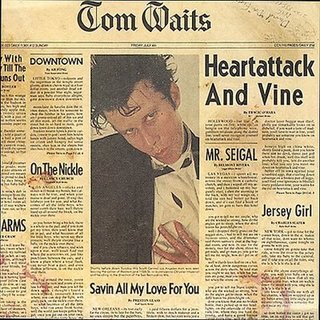
SOUNDTRACK: TOM WAITS-Heartattack and Vine (1980).

This is the final album Waits made before switching labels and starting over as a new, far more artsy artist.  The album cover is crazy, it looks like a newspaper (with all the lyrics to printed like articles on the cover).  And there’s a picture of Waits in a tux, hair askew, looking like the most stricken man alive.  It’s not a pretty cover, but it sure conveys a lot.

“Heartattack and Vine” is agreat noisy bluesy song.  It’s very simple and focuses on Wait’s lyrics and delivery: “I bet she’s still a virgin, but its only 20 after nine”).  Oddly, after that great vocal delivery song, we get the instrumental “In Shades.”  This has a lot of organ (which is a fairly new instrument in his repertoire) that he shows off his skills on, but it’s nothing that spectacular (and it’s recorded live apparently).

“Saving All My Love for You” is a sloppy kind of ballad (not as nice as most of his ballads), but then judging by the cover image, this is not going to be a sweet album.  See also “Downtown,” another rough track like the title song.

Of course, all of the talk of gruff nastiness is rendered false by the beauty of “Jersey Girl.”  Most people know the Springsteen version of this song, but (aside from the strings, which may be a bit much) I think this version exudes more real emotion.   “Jersey Girl” is a really wonderful song (especially if you’re married to a Jersey girl).  But what’s really great about it is that despite all of the sappy emotion (“My little girl gives me everything, I know that some day she’ll wear my ring,” there’s some great reality as well: “I see you on the street and you look so tired, I know that job you got leaves you so uninspired, When I come by to take you out to eat, You’re lyin’ all dressed up on the bed baby fast asleep, Go in the bathroom and put your makeup on, We’re gonna take that little brat of yours and drop her off at your mom’s.”

Sonically the shift from the guitar based blues noise of “‘Til the Money Runs Out” to the string laden ballad “On the Nickel” is pretty jarring. “On the Nickel” is one of Waits’ lullabies that’s not quite a lullaby.  But it’s got that mournful permanence that is hard to beat from Waits (he even performed it in the 2009 concert from NPR).  “Mr Siegel” is a barsy blues song (although it doesn’t sound like his earlier albums at all) and the album ends with the mournful ballad “Ruby’s Arms,”  which Waits sings in his best downtrodden voice. 

This album really showcases the breadth of his talents at this stage of his career.

[READ: September 24, 2o11] “The Ring Bin”

Who could even imagine what the title of this story means?  It’s weird, and it has so many possibilities.  By the time the answer is revealed, the story has gone in so many directions, you almost forget that you cared what the title meant in the first place.

First off, the tone of the story is bizarrely cool.  After a brief, confusing introduction (we’re at a celebrity gala of some sort), the story gives us this: “That’s when our heroine’s cellphone rings.”  It’s a kind of jarring intrusion by the narrator.  But before we can muse on this, the crowd is appalled at her break in etiquette.  And the story continues, “If these people knew the whole truth, they’d be more than annoyed.”  What is going on here?

And then the narrator gives up any pretense of disinterestedness: “I should step back a moment and describe for you the big picture.”  By now, as a reader you are reeling from all oft he broken rules.  

And then we find that this wonderful setting, this gala, is attended only by white people (which makes them all a little uncomfortable) but that the people onstage are a veritable United Nations and that the topic of the gala is tolerance.  Well, who knows what to think. (more…)

Read Full Post »

SOUNDTRACK: GOGOL BORDELLO-Trans-Continental Hustle (2010).

When I first heard Gogol Bordello, they were touring for this album (thanks NPR).  Consequently, I knew this album pretty well when I bought it.  At first I felt that it didn’t have the vibrancy of the live show (how could it?).  But after putting it aside for a few weeks, when I re-listened, I found the album (produced by Rick Rubin) to be everything I expect from Gogol Bordello: loud, frenetic fun, a bit of mayhem, and some great tunes that sound like traditional gypsy songs, but which I assume are not.

While I was listening to the album, I kept thinking of The Pogues.  They don’t really sound anything alike but they have that same feel of punk mixed with traditional music.  For The Pogues, it’s Irish trad, and for GB it’s a gypsy sound–I’m not sure if it is attributable to any specific locale.  But they have a common ground in a kind of Spanish-based trad style.  From the Pogues, you get a song like “Fiesta” which is overtly Spanish.  From GB, you get songs like “My Companjera” or “Uma Menina Uma Cigana.”  Singer/ringleader Eugene Hutz has been living in Brazil, and he has really embraced the culture (and the accent).  He also sings in a kind of drunken tenor (his accent is probably more understandable than MacGowan’s drunken warble, but not always).

I’m led to understand that previous albums were a bit more high-throttle from start to finish.  This disc has a couple of ballads.  At first they seem to not work as well, but in truth they help to pace the album somewhat.

It’s obvious this band will not suit everyone’s tastes, but if you’re looking for some high energy punk with some ethnic flare, GB is your band (and if you like skinny guys with no shirts and big mustaches, GB is definitely your band.  It is entirely conceivable that Hutz does not know how to work a button).

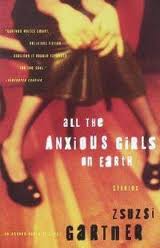
[READ: June 20, 2011] All the Anxious Girls on Earth

I’ve really enjoyed Zsuzsi’s stories in recent issues of The Walrus.  So much so that I wanted to get a copy of her new book.  It wasn’t available anywhere in the States yet, so I went back and got her first collection of short stories.

This collection felt to me like a younger, less sophisticated version of Zsuzsi’s later works that I liked so much.  This is not to say that I didn’t like them.  I just wasn’t as blown as w.

“How to Survive in the Bush”
I had to read the opening to this story twice for some reason.  The second read made much more sense and I was able to follow what was going on (I think there were a few terms that I didn’t know–a 1941 Tiger Moth, East Kootenays–that were given context after a few pages.  It transpires that this is a story o a woman who has given up her life to move to the boonies with/for her husband.  The whole story is written in second person which while typically inviting, I found alienating.  It made the story harder to read for me, but once I got into the groove of it I found it very rewarding. (more…)

Read Full Post »

SOUNDTRACK: GUSTER-Easy Wonderful (2010).

This Guster album is confusing.  It’s rather short (compared to their other discs).  Combined with the (kind of flimsy) cardboard packaging, it feels almost like an EP.  It also seems to be kind of religious (although I don’t think it is)–like a themed EP.  And yet it isn’t off-putting or anything (a few mentions of Jesus is all, although that’s a lot more than usual).

But, like most of Guster’s releases, it’s super catchy kind of alternative jangly pop.  After one or two listens the songs are instantly recognizable.  There isn’t a bad song in the bunch.  However, they’re also mildly underwhelming compared to their previous releases.  The songs feel a bit more subtle, but really it seems like they might be just a little too smooth.  The dynamics aren’t quite as exciting as they have been.

Having said all that, the disc is still pretty great and I find myself humming a lot of these songs all day long.

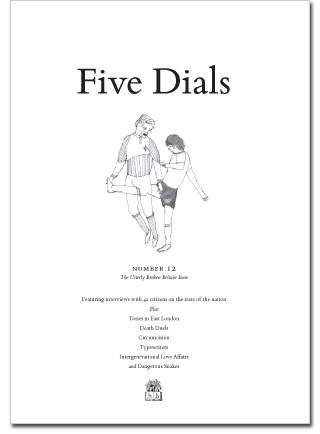
[READ: June 18, 2011] Five Dials Number 12

Five Dials Number 12 has a theme explicitly stated on the cover.  The premise of the theme is that the Conservative Party of Britain had been claiming (in their TV ads and billboards) that Britain was broken.  This idea was relentlessly pushed across Britain.  And Five Dials wondered if people thought that that was true in general.  So they asked 42 citizens (no idea what kind of random sample it may have been, realistically) and they recorded the results.

The rest of the issue has some of the standard Five Dials material we’ve come to expect: essays and fiction, advice and lists.  The theme gives an interesting tone to the proceedings.

CRAIG TAYLOR-A Letter from the Editor: On Broken Britain and Nick Dewar
Taylor addresses much of what is said above.  David Cameron (I still can’t get used to him being Prime Minister, it’s still Gordon Brown in my head–I guess Cameron hasn’t done much yet) is the man who keeps trying to “mend our broken society.”  Even though (and statistics are similar in the U.S.):

They found that violent crime had almost halved since 1995, while crime generally fell by an extraordinary 45%. The figures for teenage pregnancies – a favourite of those talking about social decay – remain constant since Labour came to power in 1997; so too do those for teenage abortions.

The rest of the letter is devoted to the passing of Nick Dewar.  Dewar drew the illustrations for Five Dials Number One.  I really liked Dewar’s style, and his absurdist sensibilities.  Taylor says that Dewar’s color work was even better.  And I think he’s right. (more…)

Read Full Post »

SOUNDTRACK: TINDERSTICKS-35 Rhums (2008).

This is a charming and very French sounding soundtrack. A delightful melody runs throughout the disc (which totals just over 25 minutes).

When Sarah first heard it, she said, “What’s this French music you’re listening to?”  And indeed, it is very French-sounding. There are very simple instruments: melodica, acoustic guitars, piano.  And that melodica is a prominent sound–giving it a sense of intrigue as well as a sense of solitude (the melodica can sound so yearning).  But it’s not all melodica and intrigue; for instance, there’s some delicate xylophone on “Night Time Apartments.”

There are also several snippets from the movie online.  Here’s one clip (with Tindersticks score underneath):

Of the new soundtracks releases this one is my favorite.  And it’s one that I could see listening to for fun.

[READ: June 16, 2011] “The Rules of Engagement”

This is the final story in The Walrus‘ Summer Reading issue.  As I mentioned, the intro states: “We asked five celebrated writers to devise five guidelines for composing a short story or poem. They all traded lists–and played by the rules.”  Alexi Zenther was given rules by Sarah Selecky (which I posted below).

I really enjoyed this story, despite the immoral behavior.  Susan and her friends from high school (it’s ten years after high school now) are enjoying a foreign vacation for a week.  The first thing we see is a man seducing Susan.  They call him “Fork” because after a few hours of flirting, he asked, “And now we fork?”  Amusingly, for someone who made a living seducing women, he was bad in bed.

The other women also meet and bed these professional gigilos.  After sex, one of them simply walked over to the woman’s wallet and took money when he was ready to leave.  She notes that he took “probably less than I would have given him if he had asked.”

The women are in various stages of relationships, one woman is divorced, another is serially monogamous and a third is married (that’s the immoral part).

There’s a wonderful diversion in the story that flashes back to Susan’s grandfather Bert.  Bert had a U-pick apple stand and the girls worked there for many summers.  There’s an especially tender moment in which Susan and Bert are wandering the island and they see a wild horse.  And the scene fills Susan (and the reader) with a sense of wonder at her grandfather. (more…)

Read Full Post »

SOUNDTRACK: TINDERSTICKS-Claire Denis Film Scores 1996-2009: L’Intrus [CST077] (2004).

This score comes from Claire Denis’ 2004 film L’Intrus.  The soundtrack was done by Stuart Staples.  In the booklet he talks about how conventional scoring just didn’t seem appropriate for the film, so he chose this rather noise-filled style.

It is a noisy, menacing work (L’Intrus means The Intruder, so that makes sense).  The sounds are clanky and squeaking, creating an ominous atmosphere.

But what’s most interesting about the score is that despite this limited collection of sounds, he creates a musical work out of it that is interesting to listen to on its own.  The track “Horse Dreams” is full of discordant notes and screeches.  While “The Black Mountain” features a solo horn over the noises.  It’s not easy listening, but it is certainly evocative.

This score is also very short about 25 minutes or so).  The movie is 130 minutes.  I wonder what other sounds are in the film?

[READ: June 15 2011] “Madame Poirer’s Dog”

This is the second story in The Walrus’ Summer Reading issue.  As I mentioned, the intro states: “We asked five celebrated writers to devise five guidelines for composing a short story or poem. They all traded lists–and played by the rules.”  Kathleen Winter was given rules by Alexi Zenther (which I posted below).

I didn’t enjoy this story all that much.  More specifically, I enjoyed the story within the story, but the full, proper story was a little too indistinct to me: It felt kind of all over the place.  In some ways this is appropriate as the story is set in an old folks’ home.  The titular dog comes into play throughout the story and the hard and fast facts of the dog’s tale give some grounding to the story.

The dog’s story is told in a just-the-facts, not-the-details style.  And the dog’s story is a funny story.  It involves a chastity belt (for the dog), and another dog’s skill at the belt’s removal.  But  the funniest part came at the end when the narrator criticized her son’s wife because she would be the kind of person who would ask for details “that no one cares to remember: what exactly does it look like, a chastity belt for digs, and of what material is such a thing made?”

The bookend parts that surrounded the story just kind of fade from my memory.

The five rules from Alexi Zenther: (more…)

Read Full Post »

« Newer Posts - Older Posts »