Feeds:
Posts
Comments

Archive for the ‘Magazines’ Category

SOUNDTRACK: beabadoobee-Loveworm (Bedroom Sessions) (2019).

beabadoobee is Beatrice Kristi Laus, a 19 year-old singer-songwriter who was born in the Phillipines and lives in London.  She has released some six EPs since 2018 and has been played on the radio on WXPN.  I see she’s also headlining a small tour over here in the Spring.

This EP is an acoustic version of her Loveworm EP.  I actually don’t know the other EP (that’s for tomorrow), but I wanted to start with this bedroom version because it promised to be stark.

It is just her on acoustic guitar and vocals.  Her voice is soft and delicate and quite pretty, with the “innocence” of early Juliana Hatfield.  That innocence makes her sharp lyrics all the more effective.

Even though this is a bedroom recording, it is in no way lo-fi.  The recording quality is excellent.  You can hear her hands move up and down the strings and there’s no hiss or fuzz.  You can hear her voice very clearly too.

“Disappear” has a simple melody.  I assume the guitar is looped at some point.  “1999” is not a Prince cover.  It continues in this quiet vein with some pretty guitar and vocals.  It seems kind of daring to name a song the same as one of the most popular songs in pop history.  But her understated take on 1999 is a quite different from Prince’s

You said I fucked up and ruined your life
But little did you know you ruined
Mine

“Apple Cider” is a bit more uptempo. with a cool delivery of this opening verse

We both like apple cider
But your hair be smelling like fruit punch
And I don’t even like you that much
Wait
I do
Fuck

“Ceilings” has a very pretty picked melody” while “Angel” is a darker song that sounds like it could be a Nirvana cover (it isn’t).  “You Lie All the Time” is a straightforward song and “Soren” features some interesting chords high on the neck of the guitar.  This final song is a sweet love letter

The green in your eyes
Are like the leaves in the summer
And it changes with the weather
The pink in your cheeks
When you slightly lose your temper
Makes me love you even more

There’s a lot of sameness on this EP, but that’s not surprising since it is an EP of acoustic versions of the he original album.  As an introduction to her music and her songwriting, though, it’s a great place to see just what she’s got vocally and musically.  I’m curious how she will flesh these songs out on the actual EP.

[READ: January 12, 2020] “Found Wanting”

This is a story of Scottish young adult trying to find his sexuality in a land that demonizes homosexuality: “living on a Glaswegian housing scheme and being gay was a death sentence.”  The narrator was more or less alone.  He lived in a rented bedsit.  His mother was recently dead and his brother, who had been looking after him, could no longer afford to.

The advent of a lonely hearts section in the paper allowed for people with similar interests to contact each other.  For the narrator, the day he mailed in his ad (which cost him much of his salary that week), opened up new avenues–avenues that were not always savory. (more…)

Read Full Post »

SOUNDTRACK: BROWNOUT-Tiny Desk Concert #931 (January 10, 2020).

I’d heard of Brownout when they released Brown Sabbath, a funk covers album of Black Sabbath songs.  They have also released an album of Public Enemy covers.

I didn’t realize that they were a long-established band (fifteen years).  They originally started as a Latin funk band (and backed up Prince).  Their singer, Alex Marrero, has only been with them for four years or so–it was originally a side project that turned into much more.

One of the things you need to know about this band is that they can change traditions or genres almost on a dime. The core members dip into soul, Latin funk, a form of Peruvian cumbia called chicha, and funk covers of both Black Sabbath and Public Enemy.

The first song they play “Somewhere To Go,”

is punctuated by an old-school R&B horn section (Mark “Speedy” Gonzales on trombone and Gilbert Elorreaga on trumpet) that’s deceptively simple and emblematic of the power of their concept and spirit.

The song has a slow groove and starts with a cool bassline from Greg Gonzalez.  There’s rocking, distorted guitars and lots of horns.  He sings a few lines and then starts singing into a megaphone “paddle your way out of this.”

The next song “Nain” is also new, “with lyrics in Spanish about being different and not fitting in and seeing that as a positive.”

The intricate interplay of the baritone sax (Joshua Levy), guitar (Beto Martinez), bongos (Matthew “Sweet Lou” Holmes) and electronic and acoustic drums (John Speice) launch the second cut, “Nain,” into another down-tempo burner,

I love the way the horns play a simple melody after the first section that sounds a bit like a commercial break in a TV show–waiting for whats to come next.  Again the guitar is interesting, playing a few complex patterns while the echoing keyboard solo from Peter Stopschinski adds a trippy aspect to it.

The final song is “You Don’t Have To Fall,” which includes

old-school Tower of Power horns that made quite a few heads dip and hips shake in our corner of the NPR building,

The song has a ripping guitar solo from Beto Martinez’s during  which Alex plays a shaker gourd.  It’s really catchy.

They seem to be able to do it all.

[READ: January 10, 2020] “The Whale Mother”

Leila’s marriage has fallen apart.  She still lives with her husband and kids, but they have both hired lawyers.  Her lawyer had told her things were over and she should “Go forth and date.”

So she decided to book a retreat

While on the SeaTac-Whidbey Island Shuttle, the older man in front of her started talking to her. He says he’s lived on the island for more than ten years.  When the ferry arrived, he led her upstairs–not waiting for her but assuming she’d be following him.  He was married–he wasn’t trying to pick her up–he just seem to enjoy talking to her.  Their time on the ferry was a little disappointing to her because she wanted to stay inside in he “sophisticated interior” but he went right through to the deck.  Nevertheless, she enjoyed the company and developed a bit of a crush on him.

He asked what her heritage was.  This “was the question she would have asked him if such a question weren’t now a minefield.  Leila welcomed the question when it came from another brown person but would not have assumed other brown people felt the same way.” (more…)

Read Full Post »

SOUNDTRACK: BRIDGET KIBBEY-Tiny Desk Concert #930 (January 8, 2020).

I love the harp.  Ever since I took a very brief class in grad school (like 4 weeks), where I learned exactly how to play one, I’ve wanted to buy one (that’s an expensive hobby).

Harps are usually thought of as celestial instruments, think “the stereotype of the genteel harp, plucked by angels.”

But the range on the harp is unreal–47 strings!  Such highs and lows.  And the things usually weigh a ton (not literally, or maybe literally).  When I saw Joanna Newsom, I was delighted to see her play a harp from relatively up close.

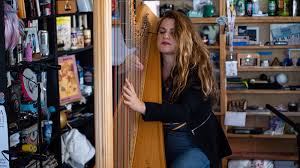
Now here is Bridget Kibbey.

Kibbey is crazy for the harp. She first heard one at a country church amid the Northwest Ohio cornfields where she grew up. Now she’s the go-to harpist for contemporary composers, some of whom who are writing pieces especially for her.

To be able to watch Kibbey play these pieces up close is breathtaking.  She starts with Bach (arr. Kibbey): “Toccata and Fugue in D minor, BWV 565.”  Yes, that one, the one we all know on the organ.  Well, hearing it on the harp is a whole new experience and watching her steamroll through as her fingers fly all over the place is wonderful.  You can marvel as she “offers tightly interwoven voices, like gears in a clock, with melodies and rhythms that sparkle.”

She says she transcribed the piece for the harp on a bet.  It gives her a chance to explore Baroque counterpoint and the drama of this piece.  And does she ever.

The second piece is by the “great living jazz artists Paquito D’Rivera” from Cuba.  He plays clarinet and saxophone and wrote “Bandoneon” (arr. Kibbey) for piano, which she transcribed for harp.   It is an Argentine tango and is really terrific.  I love how she keeps that bass line steady while the high notes fly around the harp.

Kibbey is really fun and boisterous and she’s very excited about her instrument.  It’s fun to hear her talk about what she’s going to be playing next.

The final piece is a “little ditty” she grew up singing in the cornfields of Ohio.  It’s Bach (arr. Kibbey): “O Sacred Head, Now Wounded” from St. Matthew Passion.

I see that she has played Princeton a few times in the past.  I sure hope she comes back!

[READ: January 9, 2020] “The Country in the Woman”

This story was published this month in a collection of previously unpublished work.

I don’t believe I’ve read much by Hurston and I was a a little put off that this story is written in partial dialect.

Looka heah Cal’line, you oughta stop dis heah foolishness you got.

But I quickly got over that as I saw what she was doing with the story.

Caroline and her man, Mitchell, are from Florida but they have moved to New York City.  The New Yorkers all want Caroline to be more like a New Yorker but they know you can’t get rid of “the country in the woman.” (more…)

Read Full Post »

SOUNDTRACK: DANIEL NORGREN-Tiny Desk Concert #929 (January 3, 2020).

download (19)I feel like I’ve heard of Daniel Norgren, but I really don’t know anything about him.  In fact, when I first started playing this Tiny Desk Concert I was surprised at the kind of music this Swedish musician played because it was steeped in American roots music.

Daniel Norgren has been self-releasing his analog recordings for nearly a dozen years. At the Tiny Desk, he and his band sampled music from three different records.

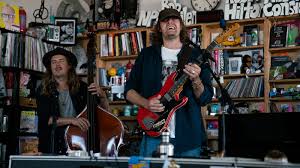
For the first song, “Putting My Tomorrows Behind,” Norgren plays piano.  There’s a slow, simple drum beat from Erik Berntsson.  And when the chorus comes along, all four sing with gorgeous harmonies.  There’s a pretty bluesy guitar solo from Andreas Filipsson.

Throughout the five minutes of this slow song, it feels like a piece of working-class Americana:

I hear myself saying, I’m doing fine
My life is a walk through the pines
But I’m sick and I’m tired, spending my time
Putting my tomorrows behind

The sky is big and white and I’m locked inside
Working all day with a frown
I guess I’m just a coward who would need to get fired
And banished from this town

For “Everything You Know Melts Away Like Snow” Norgren switches from piano to guitar.  This simple song runs 6 minutes with minimal lyrics.  But it has some lovely backing vocals and an interesting lead vocal melody that seems to go nicely with the guitar lines that are picked out.  As he played,

the bluesy Swedish musician kept his eyes tightly shut, as he seemed to tap into old souls to help conjure his tunes.  His body sway[ed] and writhe[d] as he and his band create[d] a dream state calming enough to slow the day’s hectic pace to a crawl.

Norgen takes the guitar solo on this song (mostly on the lower strings–a very bluesy kind of solo).  You’d swear this song came from an American band from the sixties.

You can’t really hear his Swedish accent (you can hear a fraction of it when he sings) until he introduces the band.  I also like that Anders Grahn plays the upright bass as Norgren is talking, giving everything they do a musical feel.

“Moonshine Got Me” is the oldest song he plays–it dates back to his 2011 EP Black Vultures.  The title sounds like Americana but the song also is not about “moonshine,” the liquor, it is about the actual moon shining. It’s over ten minutes long and opens with beautiful intertwining guitars–both he and Filipsson play different lines that feel like leads but which keep the melody perfectly.  His voice is the most aching on this song.

There’s a lengthy slow jamming middle section, in which both Andreas and Daniel take solos.  As the song slows, Daniel moves back to the piano and picks out a quiet melody to bring the song to a close.

[READ: January 6, 2020] “Linda Boström Knausgård’s Post-“Struggle” IKEA Trip

I don’t usually write about short pieces like this.  But this is about an author who I’ve recently read and whose new book I am quite interested in.  Plus, Linda Boström Knausgård is the ex-wife of Karl Ove Knausgård and she was written about so much in those books that I feel like I know her (fairly or unfairly).

This piece is, indeed, about Linda Boström Knausgård in an IKEA.  She is in New York for a book tour for her new novel Welcome to America.

It’s odd to feel you know things about a person when you have never met them and your only exposure to them is from someone else’s point of view.  There’s not a lot that Linda Boström Knausgård can do to get away from what we “know” about her.   But this little story does show her to be a bit more upbeat than the way she was left off in the novels.

It also made me laugh that the author of the piece felt the need to explain IKEA as “a notional store from Sweden.” (more…)

Read Full Post »

SOUNDTRACK: Bob Boilen’s Favorite Tiny Desk Concerts of 2019.

For 2020, I intend to put more albums in my Soundtrack section.  But it’s amazing how time consuming that can be.

Nevertheless, I’ll always be posting about Tiny Desk Concerts because I watch all of them.  So I’ll start 2020 with Bob Boilen’s favorite Tiny Desk Concerts of 2019.

It amuses me that Bob Boilen and I often share very similar tastes in music, but our favorite things are usually quite different.

When we first started filming musicians playing behind the Tiny Desk in April 2008, the beauty was in the intimacy and simplicity of these concerts. Now into our 11th year, after more than 900 Tiny Desks, the other treasure I find in these concerts is the variety. I remember having the cast of Sesame Street here in May, with NPR parents and their children seated on the floor watching the Muppets. The following Monday we had the blood red-faced raging of Idles, climbing all over the desk and singing “I’m Scum.” The scope of music is invigorating, especially considering a world of listening where we can not only get comfortable with what we love, but where the quantity of music from any particular genre could keep us happy all year. Tiny Desk concerts are here to shake up your tastes a little and help you stretch your ears and discover something you never knew existed or convert you to something you never thought you’d like. Here are 10 great examples of that magic from 2019.

I don’t have a list of favoirtes, but I will make some observations about Bob’s.

Bob seems to really like bands who put their names in all caps.  Also bands who have a number (specifically 47) attached to their letters.

Quinn was the Tiny Desk Contest winner.  Sesame Street is pretty iconic.  Taylor Swift is something of a surprise, but was clearly the biggest name they’ve ever had.  And yet, Lizzo’s Tiny Desk has twice as many views as Taylor Swift’s (5 million to 2.5 million!).

Looking forward to their 1,000th show later this year.  I wonder who it will be.

[READ: January 6, 2020] “Playing Metal Gear Solid V: The Phantom Pain”

This was a great short story about playing a video game.

For decades, the video game industry has been releasing video games in which a protagonist kills people from other countries.  Since I don’t play these games, I never really thought about what it would be like to be from that country and to play those games.

Surely people from all around the world like to play video games, and they probably want to play the popular ones as well.

In this story an an Afghani-American kid, Zoya, who works at Taco Bell has saved up all of his money (the money that he doesn’t give to his out of work father) to buy the final game in the Metal Gear series.  He has been playing this series which has becomes “so fundamentally a part of your childhood that often, when you hear the Irish Gaelic chorus from “The Best is Yet to Come” you cannot help weeping softly into your keyboard.” (more…)

Read Full Post »

30SOUNDTRACK: TANYA TAGAQ-Toothsayer EP (2019).

toothEarlier this year, Tanya Tagaq released a five-song EP to accompany the British National Maritime Museum’s “Polar Worlds” exhibit.
Tagaq’s music doesn’t radially change from release to release but she does vary things quite a bit within the style she creates.

This album feel more electronic than organic.  It’s full of drones and pulsing sounds.

“Icebreaker” opens with a low rumbling drone joined by a pulsing drum beat.  Then her heavy breathing/growling enters and she moved between guttural throat singing and high squeals.  A vocal melody appears around 2 and a half minutes but it is quickly swallowed by the main pulsing rhythm.

Tagaq uses katajjaq which Pitchfork explains is the vocal game traditionally played among Inuit women while men are away hunting. It involves two women standing face to face, exchanging repetitive vocal motifs until one fails to keep the pattern going. In older recordings of katajjaq, it’s easy to sense just how entertaining they were: Many games end with laughter.

When Tagaq does katajjaq she is solo (and not laughing).

 “Snowblind” is next.  with slow pulsing synths (from the Iranian-British electronic musician Ash Koosha) and a delicate piano as she sings a gentle wordless melody. The piano starts to pick up half way through and the low note grow more ominous as her voice grows more urgent.

“Toothsayer” features guttural breathing underneath while her voice soars above.  Midway through, it resolves into some gentle voices and an harsh stabbing guitar solo.

The most exciting track to me is “Submerged,” her katajjaq is delivered over what sounds like Inuit drumming, but Inuit drumming underwater–echoing and slightly underwater sounding.  Deep, slow clicking and heavy gasping breaths make up most of the song until about three minuets when a chord comes crashing in and her voice soars like a scream.  The pulsing continues and her voice sounds more ragged.  As it reaches its climax so does her voice shrieking louder and higher louder and higher until it abruptly ends.

The disc ends with the prettiest song, “Hypothermia.”  It is a quieter song, awash with keyboards.  Her voice soars like a siren.  Like the feeling of hypothermia, you are lulled by beauty when really your body is shutting down.

In “Hypothermia,” her katajjaq takes on the desperate cadence of someone panting, while the crystalline harmonies of “Snowblind” are both a vivid evocation of landscape and a bittersweet expression of pain—the pain of knowing that this could all be gone.

[READ: December 30, 2019] “I Can Speak!™”

The end of the year issue is called the Cartoon Takeover: A Semi-Archival Issue.  So there’s a lot of cartoons, but there’s also some old stories. Like this one.

This was originally published in the January 14, 1999 issue of the New Yorker.  I’ve now read it a few times, but it has been a while and I enjoyed it more this time than any other time.

The story is actually a letter to a customer unsatisfied with her I Can Speak!.  The customer service rep from KidLuv says he is on his lunch break–that’s how much he cares about her satisfaction. (more…)

Read Full Post »

30SOUNDTRACK: RAHSAAN ROLAND KIRK-“Volunteered Slavery” (live March 1972).

kirkI had never heard of Rahsaan Roland Kirk before reading this story.  This surprises me since i rather like avant garde jazz. I looked him up and was blown away by this live recording from Paris.

The song starts with a catchy saxophone riff.  The band (Ron Burton on piano, Henry Pearson on bass, Richie Goldberg on drums and Joe Texidor on percussion) interacts throughout the song–chatting, laughing.  Then they sing the simple, catchy lyrics:

Volunteered slavery has got me on the run
Volunteered slavery is something we all know

Then at two minute the magic begins.  He starts playing three horns at the same time.  I can’t quite tell what they are from this video, but he puts all three in his mouth and is able to play melody and harmony on separate instruments.  It’s amazing, if all too brief.

Then he starts playing a proper saxophone solo.  It runs for the next seven or so minute with the main melody being fun and bouncy, a perfect representation of 60s/70s jazz.

The band is very into it–“you got it!” and lot of encouragement all around. The song ends with a cacophony of percussion and whistles. What a fun set.  Wish I could have seen him live.

[READ: December 30, 2019] “Super Goat Man”

The end of the year issue is called the Cartoon Takeover: A Semi-Archival Issue.  So there’s a lot of cartoons, but there’s also some old stories. Like this one.

This was originally published in the March 29, 2004 issue of the New Yorker.  I don’t recall reading it then, so it was new to me.

When the narrator, Everett, was ten years old, Super Goat Man moved into the commune down the street from his house in Brooklyn.  Super Goat Man had fallen out of the world of superhero comics because he spoke out against the war and now he was living in a commune. (more…)

Read Full Post »

SOUNDTRACK: THE COMET IS COMING-Tiny Desk Concert #924 (December 13, 2019).

I had recently heard good things about The Comet is Coming.  But when I listened to some of their CD I wasn’t all that interested in them.

As a result I wasn’t really expecting much from this Tiny Desk Concert.

But HOLY CRAP!

This was amazing.  So amazing that I immediately looked to see if they were playing anywhere near me, because I must see them live!

Turns out they played the Foundry in Philly back in March.  I sure wish I had seen that, but am just happy they didn’t play there last week or something, because it means they might be back in a few months!

The musicians are King Shabaka on saxophone; Danalogue on synthesizer and Betamax on drums, and they are each amazing to behold.

I actually thought this might have been one long 20 minute jam, but in fact it is three separate songs from their second album Trust in the Lifeforce of the Deep Mystery.

The set began with a deep drone from keyboardist Dan Leavers, aka Danalogue. It kicked into full gear when he leaped into the air and, on descent, drummer Max Hallett, aka Betamax, whacked the snare drum, setting off a transformative 19-minute concert.

The Comet is Coming is a force of nature. The British trio’s approach to the Tiny Desk was ferocious. Shabaka Hutchings, aka King Shabaka, blew his sax hard while his effects pedal added reverb, expanding not only his sound but altering the office and making it a little eerier.

As soon as Danalogue hit the ground, the drums and sax absolutely take off–fast notes and drum hits as the song intros with sirens and electric bleeps and bloops.  Its hard to even know if the song itself has started or if its just a warm up.  But things mellow out as Danalogue and Betamax slow down.  But just as quickly, that rest is over and the drums and synth are off playing what I assume is now “Super Zodiac.”  King Shabaka plays a wild sax riff and off the song goes.  It’s about five minutes of fast heavy riffage and freeform sax.  There’s even a call and response with the keys and the sax at one point.

Then at around 4 minutes, the beat changes up and things sort of slow down a bit. The song pretty much ends at around 5 minutes, but the synth and drums continue as they begin a slow pounding introduction to the next song.

King Skabaka soon comes in with his sax as the pace picks up.  At around 7 minutes “Summon The Fire” begin with a great saxophone riff.  Moments later, the middle is wild and chaotic fun as King Shabaka gets sweatier and sweatier.  Danalogue must also be super sweaty in his full track suit.  Only Betamax seems calm back there as his arms are flying all over the place.

At 11 minutes, the whole thing comes almost comes to a halt until King Shabaka starts paying the opening riff of “Blood Of The Past.”  The song is more of that great riff making on synth and sax–fast and furious until about half way in when things slow down and there’s a lengthy trippy keyboard solo while the King takes a much-needed breather.

At 16 minutes the set seems like it’s over with rumbling drums and synths but they still have a little energy left– a squealing sax solo followed by Danalogue making all kinds of computer chip and glitch sounds as the set comes to a close.

I had to watch this three times in a row and I am certainly going to give their record another listen on the way home.

[READ: December 23, 2019] “Only Orange”

This was an excellent story to end the year with.  It was so good I saved it for S. to read because there were so many lines I wanted to share with her, I figured she should just read it herself.

The story begins with the narrator, Jeanne, saying to her brother’s girlfriend that she must like beige a lot since she wears it all the time…or maybe oatmeal?

Audrey, the girlfriend is taken aback and says that her pants are green.  And just like that Audrey found out she was color-blind.  She spent the rest of their family vacation asking the color of things.

Her parents thought this was so interesting and really loved talking to her about it but Jeanne thought she was faking–Audrey was twenty-six after all.  Audrey and Lino lived in the U.S. but Jeanne lived in Paris so this family vacation was their first time meeting.  When she asked where Audrey went to school and the answer was “Lewis & Clark,” Jeanne thought she was making it up, thinking fondly of the TV show Lois & Clark.

Jeanne’s brother, Lino, is annoyed at the way she starts acting toward Audrey, but then, he was never nice about Jeanne’s boyfriend Matt.  He only ever said Matt’s name to discuss the qualities of “an average human being” as in “people like Matt don’t care about contemporary theater.”

Jeanne was also jealous of Audrey because she Audrey was adopted:

to be able to look at the people who love you the most and not have to worry that you’ll turn out exactly like them must be amazing, I thought. An endlessly renewable source of relief.

Jeanne is also annoyed about how gullible her mother is being abut Audrey–how could she have read so many novels and still take anything anyone ever said at face value. (more…)

Read Full Post »

SOUNDTRACK: WEYES BLOOD–Tiny Desk Concert #923 (December 11, 2019).

The new Weyes Blood album has been on many people’s best of the of year lists. I hadn’t heard any of it but I’d read that it was lovely.

When I first listened to this Tiny Desk Concert, I really didn’t think much of it–couldn’t imagine what made this simple folk music so special.

But on a second (and third and fourth) listen, I heard a lot of the components that made it quite a beautiful set.

Nataile Mering sings and plays acoustic guitar.  Her voice reminds me a lot of Aimee Mann.

The blurb says that this set is

simple and restrained — a strummed guitar, two-part harmonies, a brushed beat — but still managed to re-create the majesty and wonder of the band’s latest release, Titanic Rising, one of 2019’s loftiest and most layered albums.

The music here is simple and straightforward–“rooted in ’70s folk-pop traditions, with mystical themes of rambling on to find meaning and purpose.”

“Andromeda,” an astral ode to love, set the tone with the acoustic guitar.  After a minute and a half there is a really cool otherworldly-sounding guitar solo from Stephen Heath.  It is just a slide on an electric guitar but it sounds very cool amid the folky quiet.  There is a very traditional organ sound from Walt McClements  filling in the spaces, but I think what really makes the song transcend folk are the fantastic backing vocals from bassist Eliana Athayde.  Whether it’s oohs and ahhs or harmonies, her contributions are monumental.

“Wild Time” is next and Athayde’s oohs are there supporting Mering’s gentle leads.  Like the previous song the acoustic guitar sets the pace with the keys filling in the gas and Andres Renteria’s drums keeping pace.  This time the standout sound from Heath’s guitar is a buzzing e-bow–an otherworldly insect buzzing around the song.  Near the end, Heath turns that buzz into a proper guitar solo and there’s a brief moment where I think Althayde and Mering are singing different lines at the same time.  The end of the song rings of early Pink Floyd with the piano sound and Heaths now noisy scratchy e-bow filed soloing.

The final song, “Picture Me Better,” is “a heartbreaking remembrance of a friend who died by suicide while Mering was working on the album.”  It’s the quietest song of the bunch.  Renteria leaves and it’s just acoustic guitar and keys with gentle electric guitar notes and Mering’s voice.  This time Athayde’s backing vocals add an otherworldly quality as we get lost in this song of loss and yearning.

It’s quite a lovely set, and if this is stripped down, I do wonder what a full-on, layered album must sound like.

[READ: December 16, 2019] “Sevastopol”

This was a story about writing stories.

The narrator, Nadia, receives a postcard from Klaus.  The postcard is of Sevastopol, although Klaus has never been there–he probably got it from a site like easterneuropeanjunk.com.

Klaus had rented a theater space in São Paulo (the story was written in Portuguese and translated by Zoë Perry) and called Nadia to insist that she come and help him fix it up.

They had met at the museum where she works.  He led a drama workshop and since staff could take classes for free she decided to check it out.  Klaus had directed a play which ran in a local theater.  Nadia hadn’t seen it, but her friend said it was awful.  Nevertheless, Nadia liked Klaus. (more…)

Read Full Post »

SOUNDTRACK: MOONCHILD-Tiny Desk Concert #925 (December 16, 2019).

Here’s another band that I’ve never heard of.  I rather assumed with a name like Moonchild, that the band would be kind of trippy.  But that couldn’t be further from the truth.  What they are, though, are amazing musicians.  It’s almost comical when the camera cuts back to each one who always seem to be playing a different instrument.

Amber Navran, Max Bryk and Andris Mattson joined forces in 2012 at the University of Southern California and their debut album, Be Free soon followed. This year, they released their fourth album, Little Ghost, intricately meshing jazz, R&B and hip-hop sounds under Amber’s subtle vocal feats.

I love so many parts of these songs, that it’s a shame I don’t really like the songs themselves.

“Money” has some quietly funky music with cool bass sounds from Andris Mattson’s keyboard.  There’s also some interesting echoing sounds from Max Bryk’s keys.

But Amber Navran’s voice is just too 70s soft rock for me.  Even Efa Etoroma Jr. on the drums seems kind of wasted with the simple beat he is providing.  I really didn’t like the song once she started singing.  But then Bryk played a flute melody and Navran played a second flute melody at the same time (and I’m very much into flutes at the moment), so that was great.  There was also a very cool keyboard/bass line later in the song from Mattson.

The backing vocals from Erin Bentlage, Michael Mayo and Micah Robinson are very pretty.  But I really wasn’t digging it.

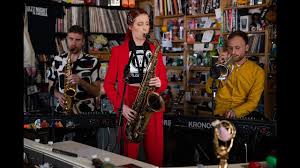
And then Bryk stops playing the keys and plays a saxophone melody.  Then they cut to Mattson and he is playing the fluegelhorn and the keybaord bass at the same time.  Then they cut back to Amber who is also playing a saxophone.  Wow.

I was blown away by them. I just didn’t like the song.

For “The Other Side” Mattson switches to acoustic guitar (is there anything he can’t do?) and Erin Bentlage picks up a ukulele.  They pay a lovely acoustic melody with nice piano sounds from Bryk.   It’s a shame this song went in the direction it did (the repeated lyric “the grass is always greener on the other side” isn’t terribly inspired either).  It’s so soft and gossamer that it could just float away.

After the is song, Amber

took advantage of the moment and amplified a cause near and dear to her heart. She asked us to “spend our privilege” and do more in the fight for people of color in the United States. They closed with a jam from 2017’s Voyager.

She spoke for a minute or so about finding a good cause that is helping people of color (even though she is not a person of color) and saying that if you earned something because of privilege it isn’t yours anyway, so it’s time to give it back.  I love the quote that “it’s not charity, its solidarity.”

The final song, “The List” is a jazzy number.  And once again I wish I liked it more, mostly because Amber is so nice.  As the blurb notes:

From the moment Amber walked into the building and throughout the performance, she wore a smile on her face and expressed sincere gratitude for the Tiny Desk platform.

I enjoyed the end of the song with the whistling.  There’s also an amusing moment when she says “give em some bass”  (there is no bassist) but Mattson plays a really funky bass line to take the song out.

[READ: December 5, 2019] “Old Hope”

I had been putting all of the New Yorker stories on the day the issue came out.  However, with the Short Story Advent Calendar taking up all of the Mondays in December, I figured I’d throw these pieces at the end of the year.

This is the kind of story that I really enjoy.  I’m not sure what about it speaks to me, but I enjoyed everything about it.

I like the vaguely specific opening of “When I was about halfway between twenty and thirty.”  The story is also chock full of details that I need to quote.  Like “I lived in a large, run-down house that other people thought was romantic.”  Her roommates are boys (not men, not really) who were often shirtless and smoked bongs that they didn’t clean.

One afternoon the narrator wrote an email to her high-school English teacher “because I remembered him as handsome in a remote way.”  She believed he went to a prep school, although “in college I learned that going to these schools entailed a lot of lacrosse and furtive blow jobs.” (more…)

Read Full Post »

« Newer Posts - Older Posts »