Feeds:
Posts
Comments

Archive for the ‘Magazines’ Category

SOUNDTRACK: TAIMANE-Tiny Desk Concert #956 (March 6, 2020).

This Concert opens with super fast percussive guitar. No!  Not a guitar, a six-string ukulele!

Taimane wears a crown of flowers.  There are flowers in front of the desk and in other places.  Taimane is from Oahu Hawaii so this love of colorful flowers makes a lot of sense.

So much magic unfolded in such short order. Within the first moments of Taimane’s stunning set, we hear her play fiery flamenco, a famous phrase from the opera Carmen, a touch of Bach and more than a nod to her Hawaiian homeland, all on her ukulele.

As she plays, this medley of “Carmen,” “E Ala Ē,” and “Jupiter” Ramiro Marziani adds some guitar and then Jonathan Heraux adds in percussion on the cajon.

After a brief introduction the Marziani stars playing the bass line to Carmen and she starts playing the lead on her uke.  She also plays an amazingly fast flamenco “solo” on the uke.

The playing and percussive style are not unlike Rodrigo y Gabriela.

As Taimane starts singing, violinist Melissa Baethoven adds harmony vocals and then Li’o comes out to do a Polynesian dance.

In what is a first at the Tiny Desk, a dancer named Li’o performed in a hau skirt made from dried lauhala leaves, with a lei of white conch wrapped around his neck. His Polynesian dance, along with the stick percussion, added to the beauty and the intensity.

After a brief cajon solo, Li’o returns without the skirt to show off his impressive legwork as he dances to a super fast ukulele melody.

Taimane is a an amazing ukulele player.  She began playing ukulele at age five; these days, it’s seemingly become an extension of her body.

Taimane has five albums out.  She

chose to represent the elements of the earth on her latest album, Elemental, and she brought the most feisty of those elements to the Tiny Desk: “Fire.” This music draws inspiration from Cuban traditions, with moments that are sensual as well as ecstatic.

This song is fast and fiery, including some impressively fast strumming from Taimane.  Then Ramiro takes a solo as everyone claps along.  Then after another impressive solo from Taimane, things slow down: “this is the sexy part,” she says.

The final song came as surprise because she does not play anything, she sings.  This is a lovely slow song called “Maluhia” which means peace.  It’s like a delicate cool down after the fire of the previous song.

I never knew a ukulele could sound like that.  I realize that this is a six-string and is considerably larger than a tiny four-string, but it’s still amazing to hear (and see).

[READ: March 29, 2020] “The Interpretation of Dreams”

This is a fascinating story set in 1924.  A thirty-three year old man, Gūnter Zeitz tracks down Sigmund Freud to talk to him.

Freud has a lisp and seems cranky to be interrupted by Zeitz.  But Zeitz starts flattering Freud’s ego and starts talking about dreams.  And by the end of the conversation, Gūnter says what he has wanted to: “I want to be a psychoanalyst, and I am hoping you will train me.”

Freud agrees and says the training will consist of Gūnter’s own analysis and Freud will be his analyst. (more…)

Read Full Post »

SOUNDTRACK: TERRI LYNE CARRINGTON + SOCIAL SCIENCE-Tiny Desk Concert #955 (March 4, 2020).

There is something that sets this apart from many other rap-centric performances.

Perhaps it’s because the music is complicated and fascinating–elements of jazz and prog and not just a 4/4 beat.

Perhaps it’s because on the first song “Trapped In The American Dream,” Kassa Overall on vocals doesn’t dominate the music, he is part of it.

Maybe it’s because singer Debo Ray has an utterly amazing voice, whether she is singing lead on “Waiting Game” (which sounds like it could be from a musical) or the amazing operatic backing vocals she contributes to the opening song “Trapped In The American Dream.”

It’s definitely because bandleader and drummer Terri Lyne Carrington is phenomenal:

In the jazz world, Carrington is a celebrity — a 40-year professional musician who’s won Grammy awards and performed with a seemingly infinite list of jazz dignitaries such as Wayne Shorter, Herbie Hancock and Geri Allen. An outspoken activist, teacher and mentor, she is also the founder and artistic director of the Berklee Institute of Jazz and Gender Justice, a multidisciplinary program whose motto is “Jazz Without Patriarchy.”

Her skills are really impressive and it’s fun to watch her really get into it.  There’s a moment where she is going super fast on the hi-hat and snare and it’s super cool.

“Trapped” has some interesting guitar melodies that run through the song.  When Ray sings along with them it’s quite magical.  The bass from Morgan Guerin sounds great and it’s quite a surprise when he busts out a saxophone solo.

“A Waiting Game” starts with just a piano and Ray’s voice.  There’s washes of guitar and Carrington hits her drums with her hands–flat open sounds.

The song is very pretty and ends with someone (I can’t tell who) playing bells.  As the bells ring out there’s rather a surprise as Malcolm Jamal Warner (yes) comes out to recite poetry “Bells (Ring Loudly),” in between verses from Ray.

The third tune, “Bells (Ring Loudly),” written by Parks and Carrington, features actor Malcolm Jamal Warner who also wrote the spoken word. Carrington had just seen the Philando Castile shooting and her powerful lyrics imagined what she would say to the offending police officer.

Throughout the set, pianist Aaron Parks plays some fantastic melodies and solos and guitarist Matthew Stevens seems to be perpetually filling the soundscape with little solos and accents.

Social Science [is] a collaboration with pianist Aaron Parks and guitarist Matthew Stevens (both performing here). In the works for some time, their project culminated in 2016 when the cultural divisiveness brought on by the presidential election inspired the trio to take action. “I think there’s an awakening happening in society in general,” Carrington writes on her website, “I feel a calling in my life to merge my artistry with any form of activism that I’m able to engage in.”

This performance features music from the band’s new album, Waiting Game. It’s story-filled, groove-music performed by a group of accomplished musicians who improvise, rap and sing over complex but highly crafted and accessible instrumental motifs. A perfect synthesis of jazz, indie rock and hip-hop influences, the four songs they played address important, culturally relevant protest narratives: mass incarceration, collective liberation, police brutality and Native American genocide.

The final song “Purple Mountains” features Kokayi rapping as Debo Ray sings beautifully with him.  The music in this song is outstanding–complicated and interesting (reminds me a bit of Frank Zappa, which I did not expect).

It opens with some really heavy chords from guitar and bass together while guitar play a cool atonal melody and Aaron Parks played an electric keyboard instead of piano.

The end of the song when Kokayi is rapping faster with yea yea yeas in the middle is really intense and cool.

“I hope that you can enjoy this music because it can be heavy,” drummer and bandleader Terri Lyne Carrington told the NPR crowd gathered for this Tiny Desk. “We’ve tried to figure out a way to make it feel good and still give these messages.”

“There is so much we can be angry about but you can’t really stay there,” Carrington told NPR. “Instead, you can reach somebody on a human level.”

I was totally won over by Social Science.

[READ: March 30, 2020] “Carlitos in Charge”

This story was really great and also an interesting (presumably true) look into what (might) happen at the United Nations.

This story was written in a fluid and ease to read style.  I especially enjoyed the lengthy passages of lists that he threw into the story.

Carlitos was nicknamed “Charles in Charge.”  Why? because he didn’t like standing out in an American middle school with such an ethnic name.  So he asked to be called Alex P. Keaton. But his father pronounced it like Alice, which didn’t help.  So he settled on “Charles in Charge.”

Carlitos has worked in the United Nations building for a little over a year assembling data for the Health Department.  And in that short time he has had sex with

the South Korean ambassador, the spokesman for the Swedish Mission, and Irish delegate, a Russian interpreter, an Iraqi translator, the assistant to the deputy ambassador from El Salvador, an American envoy, the chief of staff for the Ukrainian prime minister, the vice presidents of Suriname and the Gambia, a cultural attache from Poland, the special assistant to the Saudi ambassador, the nephew of the ruling party’s general secretary of Laso, a distant cousin of Castro, a film director from Mauritania, countless low-level staffers, a few guides, a half-dozen tourists and Brad.

He says that they had to leave their phones in a lock box on the second floor so cruising happened the old fashioned way.

He got the job through a college friend William Mycroft Quimby–Quim–an authentically Irish fellow living in Brooklyn. He says it was weird working for the world and not his country.  But really his jobs was “Convincing the U.S. to do no harm.”

The United States was immune to easily interpretable, commonsense data on everything–pollution, tuberculosis, birth control, breastfeeding, war, rape, white phosphorous, blue phosphorous, red phosphorous, lithium, P.T.S.D., G.M.O.s, slavery, winged migration, lions, tigers, polar bears, grizzly bears, panda bears, capital punishment, corporal punishment, spanking, poverty, drug decriminalization, incarceration, labor unions, cooperative business structures, racist mascots, climate change, Puerto Rico, Yemen, Syria, Flint, Michigan, women, children, wheelchairs, factory farms, bees, whales, sharks, daylight savings time, roman numerals, centimeters, condoms, coal, cockfighting, horse betting, dog racing, doping, wealth redistribution, mass transit, the I.M.F, CIA, I.D.F., MI5, MI6, TNT, snap bracelets, Pez dispensers, Banksy.  It didn’t matter what its was if the Human Rights Council (or Cuba) advocated one way, the U,S, Went the other.

He soon learned that people used their liaisons to influence decisions.

Do you mean blackmail?
Not blackmail, but, yes, blackmail.

Many of those dalliances resulted in changed results on important bills.

As for Brad, he met Brad at a bar.  Brad also worked at the U.N. but in a different department.  They started dating and got pretty serious. Their one rule was no talking about business.  That worked very well until something was bringing Brad down.  They tried not to talk about it but it soon became too much.

It turned out that Brad was working on a bill calling for a truth and reconciliation commission to investigate war crimes in El Salvador.  (Charles in Charge’s family is from El Salvador).

The problem was that China signaled support for it and the U.S. can’t go on record agreeing with China about a human-rights issue.  That would be a bad precedent.  Carlitos said he had been working at the U.N. long enough that this made sense.

China was supporting the resolution because El Salvador cut diplomatic ties with Taiwan. If El Salvador and Taiwan agreed with each other, that might change China’s decision.

Brad wonders of Charles in Charge cam have an impact on this momentous vote.

The way the story and the vote play out are both pretty surprising.

I enjoyed this a lot.

Read Full Post »

SOUNDTRACK: MELLOTRON VARIATIONS-Tiny Desk Concert #954 (March 3, 2020).

Most Tiny Desk Concerts list the musicians and what instrument they play.  So I got a kick out of this lineup:

John Medeski: Mellotron; Jonathan Kirkscey: Mellotron; Robby Grant: Mellotron; Pat Sansone: Mellotron.  [that’s the lineup left to right].

Indeed, Mellotron Variations are four guys standing behind Mellotrons making a universe of sounds.

The Mellotron was a magical 1960s invention that predates sampling. It’s a keyboard instrument, with each piano key triggering a tape loop — the sound could be a string ensemble, a flamenco guitar, a saxophone and so much more. Think about the flute sounds on The Beatles’ song “Strawberry Fields Forever” and you get the idea.

We’ve never had an original Mellotron at the Tiny Desk until now. Much like a Hammond organ, it’s big, heavy and fragile. When they fired it up, with all its mechanical gears turning tape loops and moving play heads, the 15-year-old geek in me blissed out.

Pat Sansone introduces the band and gives a fascinating history of the Mellotron and how it works.  Each of the 35 keys plays a magnetic tape like on a reel to reel player (I remotely understand that and it is cool to see the mechanism at work).  The modern ones, still made by Mellotron are all digital.

When Mellotron Variations keyboardist Robby Grant and I began discussing an all-Mellotron Tiny Desk, we quickly realized that having four of these beasts wouldn’t fit behind my desk. So Robby Grant, Pat Sansone (Wilco) and Jonathan Kirkscey performed on the portable — and still incredible-sounding — 21st-century version of the instrument. At the same time, John Medeski (Medeski, Martin & Wood) tackled the original beast.

The band plays three songs.  The first, “Agent Cha Cha” sounds like a trippy spy movie.  It’s really fun watching Medeski play the original machine and seeing him kind of forcibly make the sounds do what he wants–I guess he is literally slowing down the tape that’s playing?

Robby Grant seems to handle all of the drums and percussion.  It’s then fun to watch as Sansone holds down one key to get a 60’s cartoon melody mid song.

Jonathan Kirkscey and Robby Grant play some real spacey, synthy sounds as they segue into the next song.

“Dulcimer Bill” opens with some dulcimer sounds.  It is trippy and spacey sounding for a bit and then Sansone plays what S. immediately recognized as the opening to The Beatles’ “Bungalow Bill.”  I assume Sansone has simply sampled the guitar as he plays it with one key.  The end of the song sounds so incredibly 70s (Pink Floyd all over the place)

The sonic landscape they produce as Mellotron Variations is ingenious and impressive. It’s a score with the audience as collective filmmaker, each one of us capable of creating imagery in our heads to this music of mystery and sometimes comedy. In the words of my teenaged self, “it was a trip.”

The trip concluded with “Pulsar.”  The song opens with industrial space sounds from Kirkscey while Medeski plays flute loops. Grant adds the drums while Sansone plays a kind of harpsichord in space.

[READ: March 30, 2020] “Futures”

This is a story about tennis.

It reminded me a lot of David Foster Wallace’s essay about Roger Federer.  Not because it was like it in any way, but because the one character felt about Federer the way Wallace did.

But that aspect is somewhat minimal in terms of the plot.

The story Toby lives with his father.  Toby was supposed to become an professional tennis player, but he was never quite good enough.  But Toby’s father insisted upon hosting a young Asian tennis player every year–in part to bet upon his success (Toby’s father was a gambler) but also to have a tennis pro around to help Toby get better. (more…)

Read Full Post »

SOUNDTRACK: JOY DIVISION-“Isolation” (1980).

This is the second song on Joy Division’s second and final album Closer.

It opens with a sharp drumbeat and Peter Hook’s recognizable bass sound.  Hook’s bass was often a lead instrument an the riffs in this song are propulsive.

A very synthetic synthesizer melody runs counter to the bass.  A descending synth line is the only thing that marks the chorus of the song.

Then Ian Curtis’ voice echoes from out of a well.

This song is about internal isolation and so it doesn’t really fit in with the quarantine theme, although this line does kind of fit

Surrendered to self preservation,
From others who care for themselves.

Midway through the drums turn to real drums–suddenly coming to life as the synths go a little wild with distortion.

With about ten seconds left the song kind of fades out with echoing sounds.  Apparently this cool ending came as the result of Martin Hannett’s efforts to rescue the original master tape from a botched edit by a junior sound engineer.

For a song that lasts less that 3 minutes, it conveys an awful lot about solitude.

[READ: March 29, 2020] Self-Isolating

I love Chris Ware.  I love his style and I love his tone.  Sure, sometimes he is too dark for me, but there’s always a sly humor that makes me smile no matter how dark the content.

Most of his pieces are long, so it was fun to see a one-page comic that I could post below (copyright The New Yorker and/or Chris Ware, but come on, this kind of fun should be shared with everyone).

So what’s the deal??  Well, a cartoonist who spends all of his time in a tiny room drawing pictures sure knows about self-isolating.  One might actually say this is his moment to shine.

Sometimes hardships bring out the best art.

(more…)

Read Full Post »

SOUNDTRACK: BOB WEIR AND WOLF BROS.-Tiny Desk Concert #953 (March 2, 2020).

Bob Weir is, obviously, a founding member of Grateful Dead.

This set goes on much longer than a typical one (and they’re not rappers or R&B singers).  I got a kick out of this comment in the blurb:

When I produce a Tiny Desk Concert, one of my most important jobs is to make sure they run on time and that the performance sticks to our set time limit (roughly 15-minutes). So when Bob Weir and Wolf Bros achieved lift-off during a pre-show sound-check, it was my unthinkable responsibility to tell the guy who practically invented the jam band to… stop jamming.

It also fell to me to keep looking at my watch during the performance, even as I realized that my favorite “Dark Star” jams alone lasted well beyond our fifteen-minute performance window.

I’ve never been a big fan of the Dead (despite how much I enjoy jam bands).  Their music is a bit too slow for my tastes.  But in the right mood (like a rainy Sunday), they can be right on.

These songs are slow and expansive and allow for a lot of jamming.  There’s not a lot of opportunity for jamming here as this is just a trio, but Weir is very comfortable stretching things out.

The trio make an interesting look with drummer Jay Lane in a tie-dyed shirt and upright bassist Don Was in all black.  Weir stand between them in a gray T-shirt and his gray hair.

The first song

“Only a River,” from Weir’s 2016 solo album Blue Mountain, feels like a memorial to Jerry Garcia, with a reference to the Shenandoah River, a body of water Garcia famously made reference to on the song, “A Shenandoah Lullaby.” Weir turns the chorus into a mantra and seems to evoke the spirit of his fallen bandmate.

This song references the melody of “Shenandoah” pretty directly n the middle, but the “hey hey hey” let’s you know that this is a very different song.

Before the second song, he says they just got clearance to play it.  I didn’t realize that “When I Paint My Masterpiece” was a Bob Dylan song, but I guess maybe I should have.

And what would a Grateful Dead-related performance be without a Bob Dylan song? The intimacy of the Tiny Desk turns Weir into a sage Master Storyteller during a version of “When I Paint My Masterpiece” with its reference to Botticelli and a lonely Roman hotel room.

The set really comes to life when special guest, Mikaela Davis comes out to play harp.

The harp is always a magical-sounding instrument and amid the quietness of this trio, it really shines.  Davis basically takes the lead on “Bird Song” including bending strings (I’ve never seen a harpist do that before).

Midway through the song, Weir waves his hand and allows Davis to take a solo while Weir puts down his acoustic guitar.

When Weir switches to electric guitar midway during “Bird Song,” I looked at my watch because I knew we were in for some time travel. And the band didn’t disappoint as the rhythmic interplay between Weir and Davis showed off his singular rhythm guitar style, honed from more than thirty years of playing alongside one the most idiosyncratic lead guitarists in modern music.

Davis does some more note bending in her solo, which is so interesting.  When Weir joins in, their music melds really beautifully.

They jam the song out for 8 minutes and as the music fades Bob says, I’m pretty sure we’re over our time limit.

He says they were slated for 20 minutes and they’re at forty now (sadly we only get to see 26 minutes).  Someone shouts “keep going” and they do one more.

They play “Ripple” Grateful Dead’s fifty-year-old sing-along from their album American Beauty.  It demonstrates

the song’s celebration of hope and optimism, found in the spirit of all of the band’s music. Bob Weir continues to evoke that spirit every time he picks up a guitar; and as we all sang along at the end, we evoked that spirit too: “Let there be songs, to fill the air.”

I suppose it’s never too late to start enjoying a band, right?

[READ: March 25, 2020] “In the Cards”

This is exactly the kind of story I don’t like.  It seemed to go nowhere and in an oblique fashion. Plus the narrator was really hard to relate to.

The point of the story seems to be the last line: “You’re crazy when you’re a good writer.”

It starts with a discussion of playing cards and moves on to tarot cards.  Her friend Michel gave her a deck and she felt ill at ease just reading the directions.  But what most disturbed her was the image of The Fool.

The narrator says she is unfamiliar with playing cards and yet later she says when she was a child they played Mistigri which is a card game.  So go figure.  (more…)

Read Full Post »

  SOUNDTRACK: CIMAFUNK-Tiny Desk Concert #952 (February 28, 2020).

Tiny Desk Concerts have shown me how much I enjoy Afro-Cuban music, a genre I really didn’t know much about previously.

The fact that Cimafunk incorporates elements of funk makes his even more fun.

The band plays three songs.

From the moment Cimafunk and his band start their feathery intro to “Alabao,” it’s clear that something different is about to go down. Lead vocalist Cimafunk (Erik Rodríguez) has mastered the mash-up of Cuban soneos (vocal improvisations) and deep, soul-singing over music that I swear could have been played by any of the funk bands I saw back in the ’70s.

Cimafunk has a terrific voice–deep and resonant, able to rap and scat and make interesting vocal asides.  But he also shares the lead on “Alabao” with Ilarivis Garcia “Hilaria Cacao” Despaigne  who takes a verse and then plays trombone!

The middle of the song has a great stomping section with heavy bass from Ibanez Hermida “Caramelo” Marrero  and congas from Mario Gabriel Mesa “Machete” Meriño.

You can hear the funky guitar chords from Diego “Bejuko” Barrera Hernandez as the song draws to a close.

The next song “Cocinarte” opens with that fun Afro-Cuban chord progression on the keys from Juan Marcos “Firulais” Rodríguez Faedo (which I guess is called guajira).

the very traditional guajira piano riff on “Cocinarte” transitions to a James Brown-styled funk groove so easily, it sounds like they were made from the same root.

Backing singer Miguel “Miguelo” Piquero Villavicencio plays a percussive sliding instrument and Cimafunk adds in a fast rapping section.  Everyone sings along on the fun chorus especially “Hilaria Cacao” and “Miguelo” (who makes the kissing sound later in the song).

The band breaks things down into the funkiest of bolero-swing only to have it explode into another funk romp, powered by lead singer Cimafunk’s reimagining of 1960s soul singer Otis Redding and Cuban icon Benny Moré.

The final song “Me Voy” opens with great guitar work from “Bejuko” before it turns into a party from start to finish with everyone singing, a funky bass and great drums from Raul “Dr. Zapa” Zapata Surí.

Cimafunk proves that he’s a great front man as the song nears the end and he sings really fast, ending in a big “whooo!”

It’s really fun watching “Caramelo” slide his hands up and down the neck to make grooving bass sounds and when “Miguelo” brings out the whistle, you know it’s a party.

their tune “Me Voy” raises the roof and wakes the dead, with a deep Afro-Cuban, funk-party groove. This time, they turned the Tiny Desk into the hippest Cuban dance spot on the East Coast.

I don’t know what these songs are about, but I don’t care, because they are super fun.

[READ: March 22, 2020] “Out There”

This story is about dating.

But in addition to the normal pitfalls of modern dating, Folk has incorporated blots into the mix.

The narrator says that after a bleak Thanksgiving back home in Illinois, she returned to San Francisco and downloaded Tinder, Bumble and a few other similar apps.  She says she never liked the idea of ordering up a date the way you’d order an Uber, but now the blots had really complicated things.

I thought that perhaps I was too out of touch with this story and that blots were some thing I hadn’t heard of.  But no, blots are (as far as I know) specific to this story. They are biomorphic humanoids.

Early blots were easy to identify–too handsome, tall and lean, they were like models with no sense of humor.

She met one at a party.  Her fiend had invited her to the party to beta-test the blots without her knowing about them.  Roger was “solicitous, asking about my family, my work as a teacher and my resentment toward the tech industry.  He seemed eager to charm.”  But she felt spotlighted by this attentiveness and was not charmed by him. (more…)

Read Full Post »

2020_03_16 (1)SOUNDTRACK: MOUNT EERIE-Tiny Desk Concert #945 (February 12, 2020).

maxresdefaultI’ve heard of Mount Eerie, but I didn’t really know that much about them. And when I say them, I really mean him, Phil Elverum.

Phil Elverum’s songs come full circle, swooping down like vultures and floating up like ashes from flames. Throughout his work in Mount Eerie and The Microphones, idealism comes up against realism, existence entangles with impermanence and love discovers new forms. So when he sings, “Let’s get out the romance,” in close harmony with Julie Doiron at the Tiny Desk, there’s a history going back nearly two decades to an isolated cabin in Norway where he first wrote the phrase.

I have never really enjoyed quiet, sad music.  It’s just not my thing.  So this Tiny Desk is definitely not my favorite.  Although I can appreciate the intensity of his lyrics and the beautiful way his and Julie’s voices combine.

They recorded an album, Lost Wisdom Pt. 2, last year.

the sparsely decorated, deeply felt album meditates on a heart still breaking and mutating, but also gently reckons with a younger version of himself. That refrain on “Belief” is performed here with only an electric guitar and a nylon-string acoustic bought in Stockholm during that Scandinavian trip many years ago.

“Belief” opens with quiet acoustic guitar and then the two of them singing together.  And it’s pretty intense:

Elverum remembers himself as a young man who begged “the sky for some calamity to challenge my foundation.” We then become the Greek chorus, witness to the unfolding tragedy: first, the death of his wife and mother to their child, the musician and illustrator Geneviève Castrée, in 2016; then the marriage to actor Michelle Williams in 2018 and their divorce less than a year later. “‘The world always goes on,'” Doiron sings in answer, quoting a Joanne Kyger poem, “‘Breaking us with its changes / Until our form, exhausted, runs true.'”

Doiron’s guitar contributions are so minimal, she doesn’t play for most of the song.   The song runs almost seven minutes and does seem to end mid-sentence.

When “Belief” suddenly ends, seemingly in the middle of a thought, Elverum’s eyes search the room. The audience responds with applause, but a version of this dynamic plays out everywhere he’s performed for the last three years — long silences broken up by tentative claps, nervous laughs struck by grief and absurdity.

The second song, “Enduring The Waves” is only three minutes long.  He begins it by speak/singing “Reading about Buddhism” and I wasn’t sure if it was a lyric or an introduction.  It’s a lyric.  This song features Julie and Phil singing seemingly disparate lines over each other until their final lines match up perfectly  The construction of this song is really wonderful even if it is still a pretty slow sad song,

“Love Without Possession” Julie sings the first verse and after her verse, Phil starts strumming his guitar in what can only be described as a really catchy sort of way.  They harmonize together and Doiron includes minimal electric guitar notes.  This is my favorite song of the bunch.

[READ: March 13, 2020] “My High-School Commute”

Colin Jost is one of the presenters on Saturday Night Live‘s Weekend Update.  I think he’s very funny and has a great sarcastic tone.  Although, I have to agree with the title of his new memoir: A Very Punchable Face.

This is an amusing essay about his daily commute to high school, in which he took “a journey by land, sea and underground rocket toilet.”

His grandfather always told him about the value of an education–protect your brain! was his constant refrain.

It was his brain that got him out of Staten Island.  It got him into a Catholic high school called Regis* *Regis Philbin was named after my high school but went to Cardinal Hayes High School which was full of kids who beat the shit out of kids who went to Regis.

Regis is one of the best schools in the country and it is free–tens of thousands of kids apply for 120 spots. (more…)

Read Full Post »

SOUNDTRACK: LAURA STEVENSON-Tiny Desk Concert #946 (February 14, 2020).

maxresdefault (1)I don’t know Laura Stevenson, but she has a very pretty voice.

She is a singer-songwriter who I gather plays fairly stripped down songs.  But Bob Boilen wanted to spruce things up–I’ve never heard of him directly interfering in a Tiny Desk before–I wonder how often he does,

It was supposed to be so simple. Laura Stevenson, a singer-songwriter whose new material radiates warm intensity, would come in and knock us out with an intimate acoustic solo set … So I came to Bob with the idea … but Bob is nothing if not a pesky dreamer — a man who lives his life in pursuit of beauty and the creation of hard work for other people — so he suggested a wrinkle. What if we commissioned string arrangements for three songs from Stevenson’s newest album, The Big Freeze?

And there they are.

So arranger Amy Domingues, who doubles as a marvelous D.C.-area cellist, dreamed up some charts and gathered a small ensemble (herself and violinists Shelley Matthews and Winston Yu) for accompaniment so gorgeous, Stevenson couldn’t stop remarking on it between songs.

After the first song, “Lay Back, Arms Out” she says “.”  Then she talks about being six months pregnant and how she wasn’t pregnant when she booked this show.  She says she has to move her guitar a bit but it looks cool.

“Living Room, NY” is really lovely–Stevenson’s voice is clear and pure and makes the lyrics even more poignant.

The final song is called “Dermatillomania” (which she doesn’t even define, but which is chronic skin-picking).  She says it’s the saddest one but it is the happiest-sounding.

And that’s true, at least the happy-sounding part–it’s super catchy.

But apparently the most exciting part happened after the set was over

we also got to witness what’s almost definitely the first-ever Tiny Desk marriage proposal. Shortly after Stevenson’s set had ended, Jonathan Zember got down on one knee as unobtrusively as possible and proposed to his girlfriend, Dena Rapoport; the two were attending the show as guests of an NPR staffer, and he figured it’d be a memorable spot for their big moment.

Dena said yes.  No word if Laura will write a song about it.

[READ: March 13, 2020] “The Liver”

I enjoyed Klam’s novel Who is Rich, which I found funny and fun.  So I was looking forward to this story which has a title I wasn’t sure how to emphasize.

Boy, was I surprised to read that this is a story about a premature baby.

In fact, the majority of the story is about the narrator’s stresses about this premature baby.

The story begins with Kathy in the hospital after having given birth–two month before her due date. (more…)

Read Full Post »

SOUNDTRACK: KOKOKO!-Tiny Desk Concert #911 (November 15, 2019).

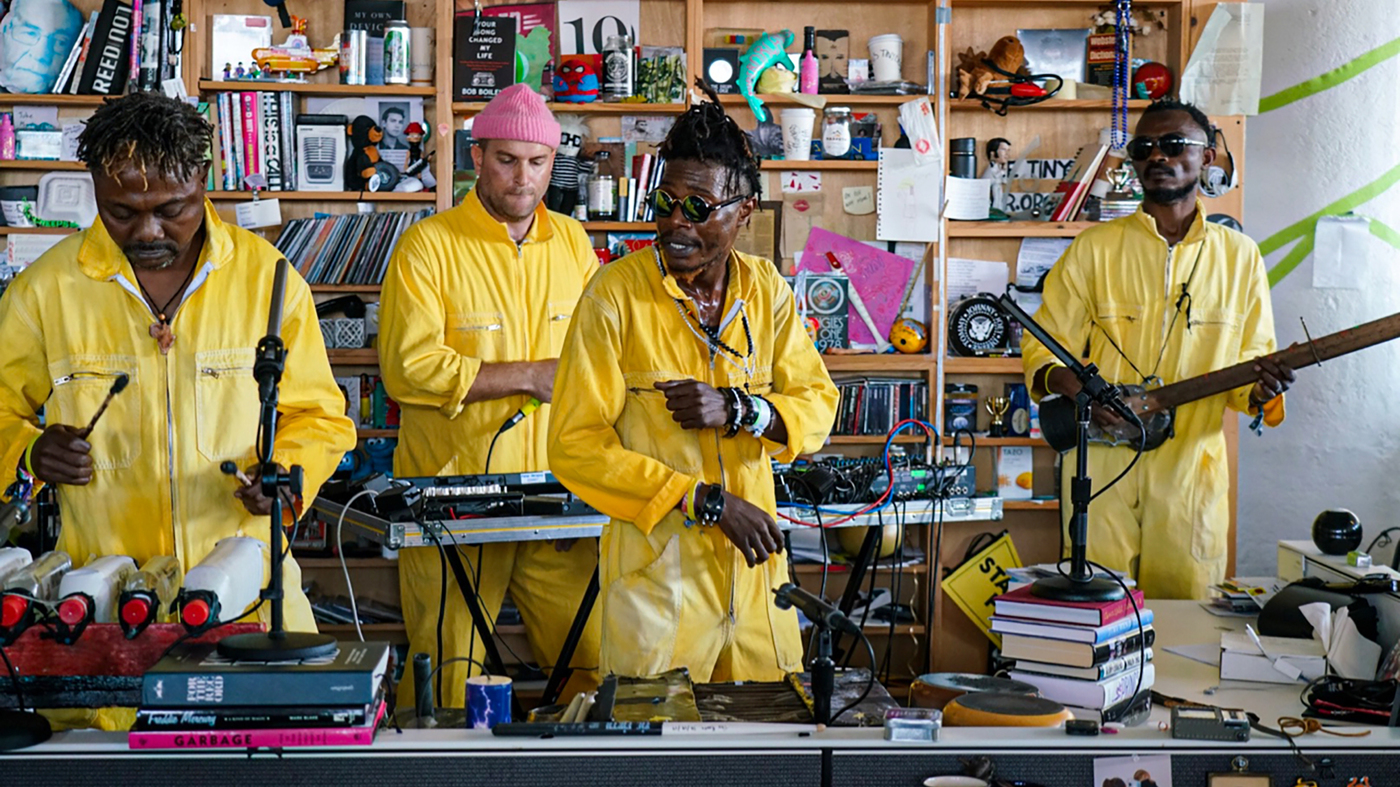
KOKOKO! are a visually arresting band.  The band dresses entirely in yellow jumpsuits and they play…garbage.

KOKOKO! are sonic warriors. They seized control of the Tiny Desk, shouting their arrival through a megaphone, while electronic sirens begin to blare. There’s a sense of danger in their sonic presence that left no doubt that something momentous was about to happen. And it did!

Makara Bianko was the guy shouting through the megaphone, walking all around the room.  Then after the siren, he sat at the drums (which are held together with duct tape and electrical tape) and started singing lead vocals on “Likolo”

Dido Oweke on the “guitar” starts the simple riff.  It’s possible that it has one string and the bottom of the guitar is definitely an old can.

Backed by a bank of electronics, including a drum machine, this band from the Democratic Republic of the Congo redefines the norm of what music is and how music is made. Wearing yellow jumpsuits that are both utilitarian and resemble Congolese worker attire, this band from Kinshasa feel as though they’re venting frustrations through rhythm. And all the while they’re making dance music, all from their debut LP, Fongola, that feels unifying — more party than politics.

“Tongos’a” starts with an electronic drum pattern from Débruit on the synth (he’s making a lot of the noise and twisting knobs and chanting along) and a simple bass line from Boms Bomolo.  Everybody chants along to the chorus.

Starting “Malembe” Débruit sings an echoing opening call as he starts electronic drums and Love Lokombe plays some analog drums.

Each song is arresting and catchy as the next (although “Malembe” feels a little long.

The only bad thing about this Tiny Desk is that you can’t really get a good look at the instruments.  I mean, it’s clear that Love Lokombe is playing a rack of glass bottles.  But he’s also hitting some kind of metal scraps.  And at the end of “Malembe” Makara Bianko picks up a board with a can attached to it  There’s a guitar string, I guess, which he strums rapidly.  I guess he can change the pitch by moving the ca,  He gets a pretty cool melody sound out of it.  It’s such a cool instrument and I want to see more!

There’s a nice story about the band in this NPR piece at Goats and Soda.

[READ: March 1, 2020] “Waiting for the End of the World”

In the great tradition of authors I like writing long form non-fiction for Harper’s, Lauren Groff heads to a Prepper’s Camp to learn how to deal with TEOTWAWKI.

The camp was started in 2014 by Rick and “Prepper Jane” Austin.

Groff acknowledges that she is not he usual prepper.

I am a vegetarian agnostic feminist in a creative field who sits to the left of most American socialists: I want immediate and radial action to halt climate change, free Medicare and free public higher education for all, abortion pills offered for pennies in pharmacies and gas stations, the eradication of billionaires; the destruction capitalism; and the rocketing of all the planet’s firearms into the sun.

Amen. (more…)

Read Full Post »

SOUNDTRACK: BURNA BOY-Tiny Desk Concert #912 (November 18, 2019).

I’ve heard of Burna Boy but I don’t know anything about him.  So:

The Nigerian singer and songwriter is one of the biggest African artists in the world. He’s also a pioneer of Afro-fusion which incorporates sonics and influences from a myriad of genres, laid on an Afrobeat foundation. The sound has been inescapable this year. The man born Damini Ogulu has been touring the world for the majority of 2019 and has at least 10 songs in the current nightclub rotation.

I was concerned when he started “Gbona” that I couldn’t understand him at all.  But it turns out the song is in Yoruba.  He even mutters something and I really like the rhythm of it, although I don’t know if its words or just sounds.

It’s weird that between the songs, there’s clapping and then silence.  No one in the band says anything.  And there’s some really long pauses.

The silence between songs must be atypical though:

his Tiny Desk performance offers something relatively different from what we’re used to seeing at his rowdy stage shows. He’s more reflective here and restrained, allowing his songwriting to shine.

“Wetin Man Go Do” opens up with some pretty, clean guitars from Gaetan Judd and some big fat bass sounds from Otis “Bdoc” Mensah.  The main melody of the song comes from Michael “Maestro” Masade Jr. or Jola Ade on the keys (they are not introduced, so I don’t know who is who).

The opening of the Tiny Desk Concert had a warning about explicit lyrics and I wondered how that would be if he didn’t sing in English. But in “Dangote” he gets this verse in

Choko, make you hustle, ma lo go
I no be olodo, I no be bolo
Wo Omo to ba lo fuck up

All of the songs feature some lovely backing vocals from Christina Matovu, although the last song, “Ye” features a sampled vocal (I thought it was Matovu’s voice filtered but it’s not).  Because she actually has a few call and response vocals and it’s nice to hear her voice alone a few times.

There’s some nice drum punctuation in the verses of “Ye” from Emmanuel “Manny” Abiola-Jacobs. Since there was some English in his songs, I thought he was saying Chewbacca (which seemed really unlikely).  So I had to look it up and this is a serious song and he’s actually saying “G-wagon”

My nigga what’s it gon’ be?
G-Wagon or de Bentley?
The gyaldem riding with me
I no fit, die for nothing

I really like the guitar sounds on this song, but overall this concert felt a little cold.

[READ: March 1, 2020] “The Fifth Step”

I started reading this story and was thinking how Stephen King’s stories used to be all about horror .  And now his stories are about people who have everyday issues and concerns.

Harold Jamieson was chief engineer of New York City’s sanitation department.  He was retired now at 68 and, despite his wife’s passing five years ago, he was pretty happy.  He enjoyed going to Central Park and reading the newspaper (if the weather was nice).

He was sitting, reading his paper, when a stranger sat on the bench with him.  He was about to get up when the man asked him for a favor.

Jamieson was definitely going to leave but the man pleaded with him and held out $20.  He said Jamieson could help save his life. Jamieson gave him five minutes.

The man, who said his name was Jack, said he was in AA and his new sponsor encouraged him to find a stranger and talk to him.  It was Step Five: Admit to God, to yourself and to another human being the exact nature of your wrongs. (more…)

Read Full Post »

« Newer Posts - Older Posts »