Feeds:
Posts
Comments

Archive for the ‘New Yorker’ Category

june8SOUNDTRACK: KAWABATA MAKOTO [河端一]-That Awaking: Good​-​bye Me (2020).

a0192176181_16Recently, Kawabata Makoto [河端一], mastermind behind Acid Mothers Temple, revealed a new bandcamp site for some newer releases.

This album is his most recent release (and I believe the impetus for this new site).

This album has two sons, each over a half an hour.

On “Summoning Souls To Meet” (35:47), a quiet, pretty acoustic guitar melody plays throughout the background while on top comes a series of electric guitar noises an explorations.  It’s a pretty improvisational song that never goes too crazy in the experimentation (although there are a few times when he plays some wild solos).  That acoustic melody keeps it grounded.

“That Awaking : Good-bye Me” (31.29) opens with a piercing sound which slowly morphs into another beautiful acoustic melody.  He then overdubs a pretty electric wah wah guitar solo.  It’s a lovely piece of music, although I wish that piercing ringing note was not there (it wouldn’t be Kawabata if there weren’t some high frequency sound floating around).  Eventually, you lose that high note amid the wonderful soloing he’s doing.  It’s soaring and psychedelic, sometimes fast sometimes echoing.  The last ten minutes or so seem to have some backwards looping going on.

Kawabata Makoto recorded this in May 2020 using electric guitar, acoustic guitar, and driftbox.

[READ: June 13, 2020] “White Noise”

This story is about Harvey Weinstein, except that it technically isn’t.

It’s about a movie mogul named Harvey who is on trial for abusing women.  It basically covers a short time before his verdict.

I wondered why Cline would feel compelled to write this fictionalized account of such a dreadful man.  I don’t often read the accompanying interviews with writers (I guess I should). The important takeaway is that “Curiosity about a consciousness doesn’t translate into endorsement.” (more…)

Read Full Post »

june8SOUNDTRACK: KAWABATA MAKOTO [河端一]-Mizu Naranu Ao Ni Sae [水ならぬ青にさへ] (1998).

a1335809529_16Recently, Kawabata Makoto [河端一], mastermind behind Acid Mothers Temple, revealed a new bandcamp site for some newer solo recordings.

 This album is more along the lines of what you might expect from Kawabata Makoto: electric guitar solos from 1998.

Dazzling music for the temporal world, overflowing with a sense of pellucidity totally different from his work with Musica Transonic.

The album has two songs.

The first is “Mai Sagarisi Negai [舞い下がりし願ひ] (16:38). .   It is loops of guitar noises and feedback.  It’s not a lot of guitar “playing” but more like guitar experimenting.

“Amou No Shibuki [天生の水沫] (17:59) is different.  It features ringing, chiming guitars and sounds like he has something metallic resting on the strings to keep everything vibrating.  This one is more spacey.

[READ: June 13, 2020] “Pursuit as Happiness”

I haven’t read a ton of Ernest Hemingway.  Honestly, his stories of hunting and boxing and whatever other masculine things he was up to while somehow also being a sissy writer never appealed to me.

This is the story of the pursuit, capture and slaughter of marlins.  Now frankly, I think a marlin is about the coolest thing in the ocean.  And while it may be very manly to wrestle one in with just a fishing line, it sure seems like a waste of a beautiful fish.

So Ernest (for the narrator’s name is Ernest Hemingway) and the captain of the boat he was on fished off of Cuba for a month.  They caught twenty-five but that wasn’t enough, so they went back for more. (more…)

Read Full Post »

june8SOUNDTRACK: KAWABATA MAKOTO [河端一]–Gesseki No Sho [月跡の焦] (1998).

a2609153540_16Recently, Kawabata Makoto [河端一], mastermind behind Acid Mothers Temple, revealed a new bandcamp site for some newer solo recordings.

This is Kawabata Makoto’s 1st Sarangi solo album.  The sarangi is  a bowed Indian instrument.

Esoteric acoustic works that conceal a sense of magic and chaos akin to that of Toho Sara.

1.Kimi Ga Chi O Mote 君が血を持て (21:06)  is a lengthy improv piece of high bowed notes– a lot of scratchy sounds or as my daughter put it, is that someone screaming?

2.Kusa Shinobu 草しのぶ (18:21) is more percussive, with him apparently banging on the sarangi to produce chords.  It’s a cool effect.  After about 3 minutes, he starts plucking the strings and then the bowing begins.  There’s moments of scratching and scraping as he explores all aspects of this instrument.

[READ: June 9, 2020] “Brooklyn”

This issue of the New Yorker has four one-page essays called “Close Encounters.”  Since I like all of the authors, I was looking forward to reading them all.

I have really enjoyed Moshfegh’s stories.  But there is very little that is less interesting than reading about somebody drinking a lot.

In 2006, evidently Moshfegh was a chronic alcoholic.  She went out with friends and drank.  She found their company lacking (as I am sure they felt about her as well) so she went out and drank some more. (more…)

Read Full Post »

june8SOUNDTRACK: KAWABATA MAKOTO [河端一]–Lost Milky Way in The Metaphysical Space (2013).

a0544282959_16

Recently, Kawabata Makoto [河端一], mastermind behind Acid Mothers Temple, revealed a new bandcamp site for some newer solo recordings.

This album features his voice and his glissando guitar.  It has two songs.

“Old Letters From Andromeda” (21:04)  sounds like metallic outer space filled with slowly moving metallic whale sounds.  At 6 minutes a lovely acoustic guitar melody comes in and there’s gently crooned ahhhs as well.  Around 12 minutes a lead solo lays over the top.  It’s all quite lovely.

“Lost Milky Way” (18:36) features squeaking, squealing feedback behind a lovely acoustic guitar melody.  Pretty much the entire song is made up of this delicate acoustic guitar pattern. The backing soaring sounds change and modify throughout.  Sometimes, it is tinny.  Sometimes trippy.  Sometimes menacing.  –

This release is quite fetching.

[READ: June 9, 2020] “You Miss It When It’s Gone”

This issue of the New Yorker has four one page essays called “Close Encounters.”  Since I like all of the authors, I was looking forward to reading them all.

This essay is about the current Coronavirus crisis and how it has impacted socializing.  Not by thinking about the now but by remembering the then.

Washington mentions various ways that customers at gay bars get close to each other.  Often it is simply very crowded, with everyone being “a blob of gas and air.”  But there are also details. (more…)

Read Full Post »

june8SOUNDTRACK: KAWABATA MAKOTO [河端一]–Sunday Morning (1978-83).

a2955928138_16

Recently, Kawabata Makoto [河端一], mastermind behind Acid Mothers Temple, revealed a new bandcamp site for some newer solo recordings.
This is Kawabata’s first musique concrète works. He played 2 cassette decks, a half-broken radio cassette-corder, tapes of field recordings and something else and a synthesizer.

This album has been reissued on CD-R as a part of “Kawabata Makoto’s Early Works 1978-1983 : Learning From The Past – R.E.P. Reissue Series vol.1” (11CD-Rs + 1 CD) box set in 2012.

There are two parts.  Part 1 is 24 min.  It sounds like short wave radio with lots of static. It’s a very mechanical, earthy sound which by the middle feels like a vacuum cleaner.  This one was particularly headache inducing.

Part 2 is 21 minutes long and feels a bit more musical with tape sounds and synthesizers but all under a gauze of hiss and static. There are musical notes –ringing harp-like notes buried beneath the fuzz–and echoing vocals.  At around 18 minutes the piece slows down with thumping “drums” that slow the pace.

These first two releases are very abstract.

[READ: June 9, 2020] “Breaking Stride”

This issue of the New Yorker has four one page essays called “Close Encounters.”  Since I like all of the authors, I was looking forward to reading them all.

This piece is fascinating to me because of two things.  The first is that Matthew Klam and his oldest friend managed to stay reasonably good friends for all of their lives.   And second because both of them went on to be creative.

In 1978 Matthew and David were in eighth grade.  They are not particularly popular but they both love Steve martin’s Let’s Get Small (this is right out of Freaks and Geeks). (more…)

Read Full Post »

june8SOUNDTRACK: KAWABATA MAKOTO [河端一]–Undead Underdrive Electrique (2019).

a3667527135_16Recently, Kawabata Makoto [河端一], mastermind behind Acid Mothers Temple, revealed a new bandcamp site for some newer solo recordings.

These are mostly abstract and meandering.  On this release he uses synthesizer and  electric guitar (and I hear a theremin).

Both of these tracks are similar although there is a clear distinction of style.

Part 1 is 22:52.  It is primarily the theremin sounds and sounds a lot like the middle siren-sounding section of Pink Floyd’s “Echoes,” but for twenty minutes.

Part 2 is 23 minutes.  It stars with a throbbing helicopter sounding pulse.  There’s lots of static and squelchy sounds.  Around 8 minutes in, it sounds vaguely outer-space like.  At 14 minutes it turns mechanical and like its breaking up and then the high siren returns.

[READ: June 9, 2020] “Praying”

This issue of the New Yorker has four one page essays called “Close Encounters.”  Since I like all of the authors, I was looking forward to reading them all.

Miranda July writes unusual pieces.  They don’t always make sense to me, but they’;re usually fun to read.  I often feel like Miranda is on a whole different wavelength than I am.

So, as this essay starts she talks bout going to the library and using her own method for finding a book.

She overhears a conversation and picks out a prominent word.  She searched for that word in the catalog and then pick the first author who shared a first or last name with someone she knew.  She would either take out that book or open it and pick out a word at random and resume the search until something grabbed her.  (more…)

Read Full Post »

SOUNDTRACK: D SMOKE-Tiny Desk (Home) Concert #28 (May 29, 2020).

The lineup of musicians for the Tiny Desk Home Concerts has been a fascinating mix of known and unknown folks.

I have never heard of D Smoke.  Apparently it’s not surprising that I don’t know who D Smoke is because

last year, the rapper and pianist, born Daniel Farris, rose to national acclaim when he won Netflix’s MC battle show Rhythm + Flow.

Winning allowed him to quit teaching and produce music full-time.  He plays four songs.

D Smoke’s songs here — taken from his latest album Black Habits, out earlier this year — acknowledge the disparities impacting the black experience that are simultaneously personal and universal. The opening selection, “No Commas,” is a heart-wrenching lament on injustice and inequality. The gentle touch of D’s fingers moving across the keys complement the song’s poignant lyrics, which he raps in English and Spanish.

I am really quite amazed at what rap sounds like without a beat, with no percussion of any kind.  These songs are performed with just the piano.  Stark and powerful.

I enjoyed the lyrics to “No Commas”

I told ’em I’m the one for the job, no commas
And I’m serious, period, no commas
Wanna enjoy my family and my friends with no drama

The song segues into “Closer to God” which has a more jazzy/lounge vibe.  He sings the chorus and has a lovely voice.

This is his first time playing and rapping “Seasons Pass.”  Although he is rapping, his is very musical about it, kind of singing more than straight ahead rapping.  But when he gets rapping, his flow is fast and impressive.

He also performed “Black Habits II,” the affecting finale to Black Habits, for the first time in a live setting.

The album is about his upbringing growing up, for the first nine years, with a single mother and then his pops coming home [from being incarcerated] and being a good role model.

He cautions us that it’s his first time playing it live so, “If I stumble a bit we gonna pick it back up.”  He does stumble a bit but it sounds great.

[READ: May 25, 2020] “Demolition”

It’s always interesting to read a story set in a different country.  I guess one always imagines a story is set somewhere familiar unless you are told otherwise.  It wasn’t until about half way through the story before I realized it was not set in the States.  And I think it was very close to the end that I realized it was set in Australia.

But the setting doesn’t matter so much because the story is about the house across the street which is being torn down today.

Eva lives across the street and is sad that the Biga house is being torn down.  Her husband, Gerald, is happy to see the eyesore go.  As they looked through the blinds, they watched people come and take souvenirs from the place.

Then came the media. (more…)

Read Full Post »

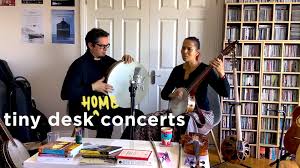
SOUNDTRACK: RHIANNON GIDDENS AND FRANCESCO TURRISI-Tiny Desk (Home) Concert #27 (May 28, 2020).

Rhiannon Giddens has a really amazing voice.  It is powerful and full and easily commands your attention.  She’s a practitioner of traditional music and loves to share the history and the culture.  She also writes her own songs.  However, introducing the second song Rhiannon Giddens explains “We’re not doing my original songs, ’cause with these kinds of emotions, the old songs say it best.”

They start with “Black as Crow” a lovely traditional song starting with Giddens’ mournful violin and then Turris’ plaintive banjo.  It’s amazing how rich and deep her violin sounds  Which makes me think it is a viola.

Rhiannon talks a bunch about how the pandemic has effected them.

They canceled their tour of Japan and returned home to Ireland; Rhiannon lives in Limerick while Francesco lives a few hours away in Dublin where they recorded this Tiny Desk (home) concert.

She says it’s hard for them as musicians because to do anything they have to be videographers and engineers and everything.  There’s a reason why people do that as the thing that they do and we appreciate them even more.

For the “Spiritual” mentioned above, Rhiannon plays the banjo and Francesco plays a bodhrán.  It starts with Rhiannon singing a capella, then she starts playing with great banjo picking (even some groovy slide work).

Food and art are the basis of what we are as human beings. And those are hit hard.  She started a website ArtLivesOn.com.

They end the set with two songs, “Carolina Gals” segues into “Last Chance.”  Rhiannon plays a violin (fiddle) while Francesco gets an amazing variety of sounds from the tiny hand drum he plays.  It’s like a tambourine with a skin on and there’s wonderful diversity of sounds.  The lyrics of “Carolina Gals” are familiar but different: “Carolina girl’s won’t you come out tonight.”  But my favorite part of the set comes at the end when Rhiannon just takes off on the fiddle playing the super fast instrumental “Last Chance.”

[READ: May 25, 2020] “Everyday Parenting Tips”

I love Simon Rich, he makes me laugh out loud pretty regularly.  Although this piece fell flat to me.  The premise is okay but there’s not enough to do with it, so it kind of runs out of steam pretty quickly.

This comic essay is all about how to help your children who are afraid of monsters.

It starts off easily enough with the calming assurance that it is normal for children to be afraid of monster.  It shows a sign of a healthy imagination.  By five they should be convinced that monsters aren’t real.

The problem however is that some monsters are real.  Ever since the Great Monster Uprising, when the monsters arrived from the Dark Place, monsters are an unavoidable part of out lives. (more…)

Read Full Post »

SOUNDTRACK: ALEX ISLEY-Tiny Desk (Home) Concert #21 (May 15, 2020).

Alex Isley’s father is one half of the Isley Brothers, purveyors of some of the baddest-ass riffs in rock and soul.

So how strange is it that Alex’s song have literally no low end.  Her voice is very high, her keys are soft and gentle chords and her rhythm is finger snaps.  These songs are gossamer and will easily blow away.

From her Los Angeles home, Isley takes us on a tour of her discography, starting with “About Him” from 2013’s Dreams in Analog.

The blurb describes “About Him,” as opening with an “angelic riff,” but I found it more demonic than angelic.  The song is like five minutes long and nothing happens.  The melody just swirls around and she repeats a few lines a lot–yes, this song is about you.

“Into Orbit” is much the same although this song is about her grandfather I think–it’s really hard to focus on what she;s saying because it’s all so ethereal.

Before the third song she gives a shout out to 9th Wonder, apparently a storied hip-hop producer who produced her brand new song, “Rain Clouds,”  This song actually has a drum beat on it and it’s short. There’s also a nice backing vocal track.  This feels like an actual song.

She closed with her latest single, “Gone.”  Even with a slightly interesting synth bass line, the rest of the song is so in the ether that it just seems to drift away.

And the whole show was forgotten just like that.

[READ: May 18, 2020] “The Afterlife”

There was a lot going on in this story but I really have no idea what it was.  The fact that it was divided into short numbered passages really didn’t help in any way.

R. is on a shuttle bus to the afterlife.  The building is unfeasibly large with side rooms.  The place was crowded and he wondered if he’d see anyone he knew.

Then he hears people, his, people muttering nonsensical sentences.  Until finally he sees someone writing something down.  He hopes the man is a poet.  But when R. talks to the man and asks if anything here adds up, the man says

“It doesn’t add up to anything at all. Not unless you saw the sequel.”
“The sequel?”
Avengers: Endgame.”

What?  Are you kidding me? (more…)

Read Full Post »

SOUNDTRACK: THE TEA PARTY-“Isolation” (2020).

It seems like a number of bands have been covering Joy Divison’s “Isolation” lately. It is appropriate after all.

The Tea Party are a Canadian band known for its sound, which blends classic rock and influences from many countries around the world.  I like that they are referred to as “Moroccan Roll.”

Musically this songs sounds quite a lot like the original. I don’t think of The Tea Party has being especially synthy, but they get the synth sound pretty spot on.  Usually The Tea Party has all kinds of middle eastern instrumentation, but there’s nothing like that here.

Jeff Martin has a deep resonant voice that often sounds like Jim Morrison.  Here he gets the same tone as Ian Curtis, but his voice is much better, much more full than Curtis’.  In fact, the whole song sounds bigger–a sound that befits a band that is often compared to Led Zeppelin rather than an indie British club band.

The original certainly conveys “isolation” better (I mean, it is Ian Curtis after all), but this version sound great too and it really rocks.

[READ: May 11, 2020] “The Resident Poet”

I was surprised to realize that I had never read anything by Katherine Dunn.  Her novel Geek Love is one of those books that I feel is always mentioned as being notable.  I always assumed it was about nerds.  I just found out it is about carnies–circus geeks.  My mind is blown.

If I was wrong about the entire premise of her most famous book, I clearly have no idea what the rest of her output is like.

I didn’t realize she was the author of this story (I saw the author’s name but didn’t connect her to anything).  I doubt that knowing she wrote it would have made me think any differently about the story.  Mostly because I don’t know what to think about the story.

Essentially this story follows a college-aged woman as she deliberately degrades herself for a poet who comes to teach at their school.  But she seems empowered by her degradation, so I’m not sure how to read it. (more…)

Read Full Post »

« Newer Posts - Older Posts »