 SOUNDTRACK: BECK-Morning Phase (2014).
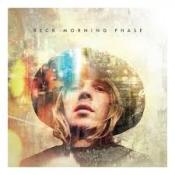 The release of Beck’s latest album is what got me investigating Beck’s back catalog–just to see how Beck arrived at this mellow chillout place.
I read a lot about this album when it came out and, even hearing Beck discuss it, I feared it would be a little too slow and mopey for my tastes. It is slow, but it’s not really mopey. It’s quite pretty, in fact. And as I’ve come to learn by going through Beck’s back catalog, he likes to experiment in all sorts of ways, but at his core, he is just a really good songwriter.
So it opens with 40 seconds of strings that act as nice introduction to the tone of the album, but don’t prepare you for the pretty acoustic song “Morning.” Lyrically it’s pretty dark, although with his falsetto, it’s kind of hard to realize that. The melody and vocal line are really lovely (especially the weird echo they put on his voice). And it has a surprisingly big sounding chorus–redemption even in sadness. “Heart is a Drum” has piano and an acoustic guitar with swelling strings–once again, the chorus is big and (relatively) fun. “Say Goodbye” is a sad song, and yet it is still catchy (which is nice), with a simple acoustic guitar. “Blue Moon” has a wonderfully catchy verse structure and it picks up the tempo somewhat with beautiful swells of music. And the chorus is dynamite too–it is a worthy single.
“Unforgiven” slows things down even more, making one of the moodiest Beck songs. And then comes “Wave,” perhaps Beck’s darkest and moodiest song–just waves of strings with no drums and Beck’s longing voice over the top. “Don’t Let It Go” has some very nice singing from Beck. His voice has always been good, but he sounds like his voice is maturing somewhat here.
“Blackbird Chain” is the prettiest melody on the record, and it feels especially light after the downcast last few songs. It has a great chorus and really strong verse melodies. My only gripe is the very brief string accompaniment in the middle of the song which feels like overkill–the piano solo is nice, bit the strings are too much. But they’re very brief and don’t ruin the song. “Phase” is a 1 minute instrumental that leads into “Turn Away.” “Turn” has Beck’s layered vocals and a wonderful easy guitar sound. The whole song has a sixties acoustic vibe, an again, the melody is great. “Country Down” has a, yes, country feel (including harmonica solo ala Neil Young), and Beck’s lower, more powerful voice. It’s a strange turn on this album, but it keeps with the mellow vibe. The disc ends with “Waking Light” a slow, building song with more great vocals and a wonderful chorus, that makes good use of loud and soft. It’s a very strong ending to an album.
Unlike other Beck albums this one is definitely a “have to be in the mood” for it. There’s no pop singles, no dancey hits. It’s all very mellow. But it’s very pretty.
[READ: April 2, 2014] The People of Paper
An excerpt from this book was published in McSweeney’s #12. Here’s what I thought of the excerpt:
This is an excerpt from Plascencia’s novel of the same name, a novel that I own but have not read yet. And wow is this crazy. There is, indeed a person made of paper and there are people made of meat, and there are different narrators. Federico de la Fe is a grown man who wets the bed–as the story begins he and his wife (who tolerates the wet spot) are going to the water’s edge to fill it with new straw. His wife has gotten used to it (ew), but once their young daughter is potty trained and her husband isn’t, she gets quite cross. It is only after his wife has died that he learns of a cure–sticking his hand in the fire. See, crazy–and we haven’t even gotten to the lady of paper yet. I’m assuming that actually reading the full novel will bring some clarity to this story.
I included this as an introduction because this story is very very unusual, even after reading the whole thing.
In addition to the story being unusual (and, as it turns out, completely metafictional), even the physical product is unusual.
The story is broken into several styles, which are distinguished at the front of each chapter by either three lines, three dots or one dot. In the three lines chapters, each page is broken into 3 columns–each column is about a character. In the three dots section, the chapter is formatted normally, but different characters are written about. And in the one dot section, the small chapter is about one person (you can read more about this in the interviews below). (more…)

 I Just Read About That...