Feeds:
Posts
Comments

Archive for the ‘Harper’s’ Category

harp jan SOUNDTRACK: RHEOSTATICS-CBC Studios (1999, 2000 or 2001).

cbcrheoThis is a hard event to document.  According to the Rheostatics Live website, this show was broadcast on Sonic 102.9 in 2000, but it appears to be a rebroadcast of a live show that the band recorded at CBC2 Studios in 1999 or, possibly, even in 2001 (according to the link to the video below which states Rheostatics CBC In Session October 26 2001 Just Concerts. Vancouver BC Studio 2, although that may just be a cut up version of the audio–so confusing!).

Whatever the case, the sound of this in-studio live show is tremendous.  It is one of the few instances where you can totally hear Dave’s acoustic guitar in the mix.

Kevin Hearn is there too, so they play a number of songs that they might not be able to without him.  And Michael Philip Wojewoda is on drums. (This complicates my understanding of the recording too, since Don left in 2001, but MPW often played with them anyway).

The audio version contains eight songs and two interview segments.  The interviews are funny (of course) and informative (although Tim sounds totally high), but it’s the music which is the highlight.

They play “Wieners and Beans,” “Martin’s Waltz (Blue Hysteria)” and “Kevin’s Waltz” form Music Inspired by the Group of 7.  They play “Easy to Be with You” “Monkeybird” and “Song of the Garden” from Harmelodia and then “Stolen Car” and “P.I.N.” as “new” songs.

The video below (which is the best video version of these recordings I’ve seen) has “Song Of The Garden” “Easy To Be With You” “Martin’s Waltz (Blue Hysteria)” “Stolen Car” and “Wieners and Beans.”  No word where the other three songs went.  But I love watching the video to see the way Martin makes the crazy sounds out of that little Steinberger guitar.

This is the last Rheostatics show I have for 2000.   I’ll be resuming with some shows from 2001, including Don Kerr’s final shows in a few months.

[READ: March 9, 2015]: “Two Parts”

I have only read two things by Dixon–the two McSweeney’s-released books I and End of I.

This story is a reflective look at regrets and decisions. It is told, as you might guess, in two parts.  He asks if he should start with his father or with Lotte.  He decides to start with his father.  He says he was thinking about something and he decided to talk at Abby about it. This framing device is used throughout the story.

The story about his father is from back when he was about ten and his father was about 51.  His father had always been in good health, but he had a temper.  Especially when it came to the narrator.  And while the father never hit the narrator with his hand, he did whack him with a rolled up newspaper. (more…)

Read Full Post »

harp febSOUNDTRACK: RHEOSTATICS-Scherzo Pub, Kingston, ON (October 15, 2000).
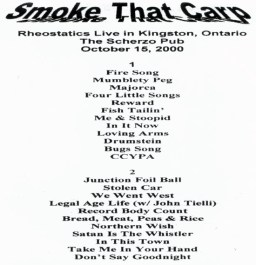
rheoscerzoThis show has some fun art work to go with it.  The notes say:

“Rare original drawing by local artist “tully” drawn during the october 15 2000 rheos gig at the now defunct scherzo pub, kingston, ontario. the story goes that “tully” goes to shows, does a drawing of the band, and just leaves it on a random table for someone (like me!) to find it. i actually found it on the floor!”

The other joke on the set list over here is the Smoke that carp joke which is from Martin talking about something before the set even starts.

They play a lot of songs from the then unreleased NotSS.  The version of “Four Little Songs” is crazy fun–lots of wildness, and a superfast ending.

In addition to playing “Majorca” they play two songs from Introducing Happiness and then talk about Martin’s guitar with the maple leaf on it.  They challenged Gordie Johnson from the band Big Sugar to put a leaf on his guitar. Dave says that not only did he put the leaf on his guitar (on the back) but he plays O Canada at every show now.

In the middle of “Junction Foil Ball” Dave talks about how much he struggled to get the riff (earlier Martin said Dave was very proud of the riff).  It’s a very lengthy talk with demonstration about the riff–quite amusing.

The end of the show has what sounds like an acoustic unplugged set.  Not quite acapella, but Don is only playing the tambourine.  It sounds like perhaps they are in the crowd or near the crowd or something.

Srheoscerzo2o for “Record Body Count,” the crowd sings along beautifully and “Bead, Meat, Peas and Rice” is also done in this format.  For “Northern Wish” Martin say he’s going to start it acoustic while the rest of the band goes back to their instruments.  It’s a great version of the song. In fact all three are wonderful, and it’s cool to hear them sounding so different.
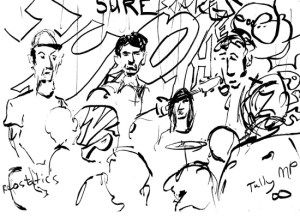
There’s another long chat from Martin about Burton Cummings and how they saw him playing a casino.  It’s very funny.  Then he insists on a “golden drag” on his cigarette before starting the next song.

The disc ends oddly with “Take Me in Your Hand” also done in that acoustic format as the earlier songs–which makes me think it should have been earlier and was placed at the end by mistake.  It sounds great either way.

This is definitely a great show and one for any Rheos fan to enjoy.

[READ: March 5, 2015] “Family Life”

I had recently read something about Zambra that made me want to read him, and then, here he was in Harper’s.  I like serendipity.

This story was translated by Megan McDowell, and I gather is part of a collection of stories called My Documents which will be out soon from McSweeney’s.

This story is a simple one, although it has an unusual beginning.

Martín is headed to a house for a job.  He is to house-sit for a family while they are away for four months.  I enjoyed the way the family members were laid out for us to meet: in alphabetical order: Bruno, the husband, Consuelo the wife (well, actually not the wife, because they never married although they act like a married couple) and Sofía their daughter.

We learn that Bruno sand Martín ‘s fathers were cousins.  Martin’s father has just died.  They barely know each other, although they did know each other when they were kids.  But Bruno tries to strengthen this familial connection, because it builds trust.  Otherwise they have a stranger in their house for four months.

When Martín arrives Sofi runs past him (“These days kids don’t say hi”) chasing the cat Mississippi.  Consuelo is friendly and gives him instructions, which largely entail looking after the cat (who has a swinging door which is open all the time).  When Martín looks at a large hour glass, Sofi runs up and says it last 12 minutes.

To pass the time Martín plays Sofi in chess.  And when they get bored, he changes the rules so that the object is to get beaten, which Sofi enjoys more.

While Sofi is going to bed, Martín and Bruno talk.  Bruno suggest that he “use the time to have ago with one of the neighbors.”  Martín thinks (but thankfully doesn’t say out loud) that he’s like to have a go with Bruno’s wife.

After they leave, Martín discovers a photo of Consuelo and puts it up on the wall.

Martin plans to try a different route every day (different stores, different roads) so as not to make an impression on anyone in the town. But one day Mississippi doesn’t return from his nightly stalking.  Two days go by and Martín grows concerned. So he puts posters up around town.  But when he emails Bruno he doesn’t say anything.

A few days later he sees that someone has posted lost dog posters up over each one of his lost cat posters.  He calls the number (while drunk) and talks to Paz, the woman who put up the posters. He complains about what she has done. The next day she does around moving her posters off of his.  He gets some courage and goes to talk to her about their lost animals.

A week later he sees a dog that looks like hers and he calls her.  They go looking for the dog but don’t find it.  Then, after a month, Mississippi returns. He is beaten up , bloody and gross.  Martín takes him to the vet and gets medicine that he must apply to Mississippi every night.  When Paz calls him, he tells her about the cat and she comes over.

Paz scrutinizes his house–the photo of Consuelo–and he creates and elaborate fiction about his former life with Consuela and their daughter.  How they are broken up and he is reluctant to date.  Later, they have sex and start seeing each other every day.

Things are going quite well, although of course, it is all based on a lie. And the time of Martín’s departure (and Bruno’s family’s return) is coming up.  But the sex is great and he really like her.  She even invites him to go to a wedding with her.

What will happen when it’s time for Bruno and Consuela to return?

This is an unusual story (I guess) to start with because I’m not sure if Zambra’s other fiction is anything like this.  This story was erotic and a bit salacious and was predicated on a lie.  I enjoyed the idea of the main character being someone else and then realizing that he could be that person forever.  (Even if that’s not an original concept).  But Zambra’s handling of the story was really good and I’m interested to read more from him.

Read Full Post »

harp febSOUNDTRACK: RHEOSTATICS-Commodore Ballroom, Vancouver, BC (August 18, 2000).

commThe band went back to the West Coast again (man, they’re everywhere).  They must have played a few shows out there, but this is the only one we’ve got. It’s over two hours and the sound is amazing (thanks so much for soundboard recordings).

Michael Phillip Wojewoda is with them on this leg, playing keyboards.  Which allows them to open with “Monkeys Will Come.”   This is the only other place I know of them playing it after Canada Day.  The recording quality is much better than the Harbourfront show so you can really get a good sense of the song.

Tim Vesely gets two songs in a row with “Remain Calm” and “We Went West” (which they have been extending to nearly 7 minutes).

When they play Satan is the Whistler, Dave says they’re not welcome back in Whistler anymore.  The crowd is rowdy and fun, but at one point someone shouts out for a moment of silence for the Russian Sub (I had to look this up, it was the Kursk disaster).  Dave says, everyone prays in their own way.

“Horses” continues to throw in the “Still Waiting” section from the Talking Heads during the middle improv.  And “Dope Fiends and Boozehounds” has a drum solo and an interesting synth part, along with a very brief coda of “Alomar!”

The set has a weird dancey bit at the end, which seems like maybe the songs are out of order.  It’s hard to be sure, but the set is great nevertheless.

One programming note is that the set list states “RDA” but it’s not.  It’s actually “Song of the Garden.”

[READ: March 5, 2015] “The Moronic Inferno”

As I had done with the New Yorker, I had also done with Harper’s.  Namely, I had put off reading several months worth of issues.  So I’m doing a run through of the last eight months or so.  The good news is that Harper’s is a monthly, so there’s a lot fewer issues to worry about.  Although I do find that I typically write about three or four pieces per issue.  The February 2015 issue had two worthy pieces.

This is an excerpt from Revulsion: Thomas Bernhard in San Salvador, translated by Lee Klein.  It is described as fiction, although Moya appears to be a character.

I have no sense of what the full book is like, but this expert (which is barely a whole page) is one long paragraph with the character of Vega ranting at Moya.  The rant is all about how horrible San Salvador has grown.   (more…)

Read Full Post »

harp marchSOUNDTRACK: RHEOSTATICS-Call the Office London, On (August 11, 2000).

calltheofficeCall the Office sounds like a great live venue.  It sounds small and intimate and, for this recording anyway, the sound quality is great.

The band is in great form with a ten minute version of “Fat.”   Then there’s a bunch of new songs: “In It Now” (the first time I’m aware of them playing it), “CCYPA” and a great version of “The Fire.”

Then they jump back to an old song and play “Torque Torque” with a very funny introduction about how they wrote this back in the early 60s and that it out-dorks the Doors (the Doors had no bass player).  Dave also says they’ll never play Full Moon Over Russia because it’s too hard.

There’s a lengthy introduction to “Satan is the Whistler” in which Martin tells about writing it–how it was originally going to be about Bigfoot (he used to read Bigfoot books as a kid) and the scariest thing about the Bigfoot stories was when people heard whistling.  The intro devolves into some funny talk about Whistler, the city, and extreme sports.  Someone eventually winds up describing the song as Ian Anderson skiing.

There’s a sadly aborted “Junction Foil Ball.”  Not sure if they just never played it or if there’s a problem with the recording.

There’s also an “off color” joke about Michael Jackson and Bubbles and Dave teases the jokester (Don Kerr?) saying that a guy with neck beard shouldn’t make off color jokes.

“Feed Yourself” a song they don’t play often enough sounds great here with some awesome soloing chords and effects in the middle.  And “Legal Age Life” also has some funny silly parts in the solos.

“Horses” (which the fans have been cheering for all night) sounds fantastic–a great version of it.  The middle section has Dave talking and ranting (all with his voice echoed).  It’s quite intense.  As is the final “Moon” high note at the end of “Dope Fiends and Booze Hounds” which they cap off with another fast run through “Satan.”

As I said this is a great sounding bootleg (and the notes on the site agree: “This is one of the best sounding Rheos boots I have heard. Listen to Don’s drumming. It is awesome. I loved seeing him play.”

[READ: March 2, 2015] “No Slant to the Sun”

I have read so many stories by Boyle, and they are all so very different that I never really know what to expect–or even where they will go.

This story begins with the title–“there as no slant to the sun–it was just there, overhead.”  It is about a man, Sten, and his wife Carolee on vacation.  They are on a cruise and are currently taking a day trip to an island garden path (although he seems unsure where they are–not Mexico or Guatemala or Belize–somewhere with a lot of rum where they listen to reggae).

They, along with everyone else, are on a bus, being driven maniacally by a man wearing earbuds (listening to reggae) as he flies over potholes and around harsh left and right turns.

Sten refuses to drink the water here even though everyone else does. And despite his thirst he sticks only to the rum based drinks (and so is a bit drunk and parched).  He will only drink bottled water, but he forgot his bottle.  When Carolee falls asleep he roots through her purse for her water (which he then drops and it rolls under another seat).

All the people on the bus (mostly older retirees) are unhappy with the driving.  Finally Sten gets up to say something to man and even flicks out his ear buds.  But the man ignores him, clearly disgusted by the white people on the bus.  He grudgingly says they can have a restroom break in five minutes, although it’s more like 15 before they get to the site of their hike–something that Sten now regrets given the heat and his thirst.

As soon as they settle in, a car roars up next to them and some local boys get out.  One has a gun.  And the boys start demanding everybody’s wallets and jewels.

It’s then that we learn that Sten was once in the military.   And he has to decide if he should react to this insolence.

The story went in a direction I absolutely did not expect.  I enjoyed it, especially the way the ancillary characters react to what happens.  I never intentionally seek out Boyle, but I always enjoy his stories (and I am astonished at how prolific he is).

Read Full Post »

harp marchSOUNDTRACK: RHEOSTATICS-Cowichan Theatre, Duncan British Columbia, (January 23, 2000).

cowichanWhoops, slightly out of order here, but no one’s counting.

This third night in BC was at the Cowichan Theatre.  This night was held as a benefit for the Women’s Coalition Institute’s campaign against GM food.  Luke Doucet’s band Veal opened, there were families and young kids in the crowd and Dave even talks about buying some art that was for sale.

Amazingly, the band plays nine songs that they hadn’t played the two previous nights.  The only bad thing about this show is that 6 songs are missing from the posted recording (including a night-ending “Shaved Head.”)  But the set still clocks in at an hour and fifteen minutes.

I found the audio a bit muffled on this recording.  In fact, for the first few songs I thought Martin was hard to hear.  Especially on “Stolen Car.”  But he seems to get louder as the show goes on.

There’s a joke about Martin’s shirt–(like he took Greg Keelor’s shirt (Keelor was in Blue Rodeo).  Martin admires his “cowboy look” and jokes about big city folks.  There’s also a funny bit later about the Beatles where he seems to forget George Harrison’s name and says he was going to call him “Gino.”

Martin was still experimenting with the slower opening of “Northern Wish” here, which sounds cool.  “Claire” sounds great (it’s the first time they played it in the three nights) although I wish the quality were a little better.  There’ s great noisy solo inserted into it as well.  And “Self Serve Gas Station” totally rocks.

It’s a shame that “The Wreck of the Edmund Fitzgerald” was cut off, along with the end oft he set but it s a good sampler of some different songs.

[READ: March 5, 2015] “The Man Stopped”

The introduction to this story says that it may be the last complete unpublished short story by Nabokov.  It was written in 1926 and is believed to be a parody of the then current crop of Soviet writers who wrote in an ornamental pseudo folky style.  The story is full of “rustic idiom” which has been translated to very rough English idiom by Gennady Barabtarlo.

Given that Barabtarlo describes the story as a parody I expected it to be funny, but to my ear it isn’t.

Indeed, it’s a very simple story of a man on a journey who is constantly set upon (verbally) by the locals. (more…)

Read Full Post »

harp marchSOUNDTRACK: RHEOSTATICS-Harbourfront Toronto, Canada Day (July 1, 2000).

harbourThis recording comes from an outdoor venue in honor of Canada Day.

As I understand it, the band was asked to write a new song for the Canada Day celebration and they came up with “When Monkeys Comes.”  It opens with a kind of disco version of “Also Sprach Zarathustra” and then morphs into a jamming Rheos song.  It doesn’t sound awesome on this mix (although the rest of the disc does), so it’s hard to get a real sense of what’s happening.  It feels a little meandering.  And since it doesn’t really appear anywhere else (except for an upcoming show), it’s hard to really parse it.

This show is interesting in that the band doesn’t talk very much–usually they’re very chatty.  Dave Bidini says that since their set is short (barely over an hour), they didn’t want to talk to much, so it’s all about the music.  They play the first seven songs without saying a word in between songs.  Also interesting is that those first seven songs are all new–not yet recorded for the Night of the Shooting Stars album.

There is a drum machine or at least a lot of electronic drumming on a couple of songs, which I believe are supplied by Michael Phillip Wojewoda, erstwhile extra member of the band for years, and official drummer in a few months.

After playing the new songs, the band does play some older songs.

They are still doing songs from Harmelodia (“I Fab Thee” and “Song of the Garden”) and this crowd, which I assume is all ages, is probably a good place for them.  They also play “The Ballad of Wendel Clark” which is super fun (and not played that often).  There’s some great versions of “Stolen Car” and “Self Serve Gas Station.”

It’s a good set (with good sound quality), especially if you like NotSS.

[READ: March 6, 2015] new movies

I rarely talk about movie or movie reviews here.  But since I like Galchen, and I’ve mentioned most of her writings so far, it seemed like a worthwhile inclusion.  And she’s talking about Paddingon, a movie I’d like to see

What I liked about Galchen’s review was that it’s not so much about the movie (which she likes and says is silly and smart and witty and pretty) as it is about the story of Paddington.

I don’t know the plot of the movie (or the books, actually, although I do know the premise of who Paddington is), but it sounds like a fun farce, with Hugh Bonneville (Mr Crawley on Downton Abbey) dressing as a cleaning lady to aid Paddington on “an essential fact-finding mission.”

But Galchen talks about how the movie (like the book by Michael Bond) pays attention to money (the cost of marmalade for instance) and to the African-Caribbean immigration to London in the 1950s.  Paddington is from darkest Peru (evidently Bond was going to have him be from Darkest Africa but there are no bears there).  And its this immigrant story which the movie focuses on.

Galchen also talks about how characters like Paddington (or Curious George or Pinocchio) are stand ins for children. But if they were actual children in the stories we would be repelled by them.

It turns out that Galchen has visited darkest Peru on a research mission.   They were checking fecal samples of the native chickens–looking for antibiotics.  They also conducted a kind of socioeconomic census of the region, which was, of course, ridiculous as none of the natives had much of anything.  Although she notes that the most common name for boys was Israel and the most common among girls was LadyDi.

This article didn’t make me want to see the movie any more than I do (because I am looking forward to it already), but it was certainly an interesting perspective and certainly one I wouldn’t be reading in Entertainment Weekly.

Read Full Post »

harp marchSOUNDTRACK: RHEOSTATICS-Ted’s Wrecking Yard Toronto, ON, (March 25, 2000).

tedsThis was the sixth and final night of Green Sprouts Music Week–the band’s annual residency at Ted’s Wrecking Yard.  Sadly this is the only night that is up on the site, but man, is it a good one.  The band played for over two and a half hours and they cover nearly every album.  There are guests galore, there’s on stage hijinks and a great sense of fun for band and fans alike.

 I don’t know what they played on other nights but there is a still a focus on Harmelodia. Things are a little different this night from previous shows on the tour.  “Song of the Garden” and “Sweet Rich Beautiful Mine” are really rocking. When they call in a female vocalist up, a fans shouts out “we could use a little estrogen” and they get it with her lead vocals.

Kevin Hearn joins them on keyboards.  He ges a verse in “Four Little Songs.”  He also adds piano to “Queer” which sounds extra jaunty  And he puts accordion in “I Fab Thee.”  There’s even the unexpected Kevin song “Yellow Days Under a Lemon Sun” which originally appears on the Group of 7 disc.

The most fun is had during “My First Rock Show, in which several “guests” appear during the song.  Meatloaf (Kevin) plays a bit of “Two Out of Three Ain’t Bad,” Geddy, Alex and Neil (Martin) show up to play a verse of “Closer to the Heart” with Martin screeching “salesmen!” There’s a brief jam of Walk This Way (although no one can remember the words).  And there’s some fun with Joe Jackson’s “Is She Really Goin Out with Him.”  Look over there.  Where?  That’s called a hook.  There’s also a funny joke about playing “Harvest X-1, Rush Never Sleeps.”

There’s some real guests too, Karmen from Sheks? sings “One More Colour” and sounds awful, like she can’t hear what the band is doing.  Julia Pietrus guests on “Home Again.”  She sings her verse in Polish (and is part of a Polish Rheos tribute band!).

There’s a drum solo (!) on “Dope Fiends and Booze Hounds.”  The set and the night ends with “A Midwinter Nights Dream.”  Martin sounds in great voice even if he cant hit all th ehigh notes which is undetsnable after nearly 2 and a half hours of playing

They also mention that their next show is Canada Day and that is our next show as well

[READ: March 4, 2015] “Make Me Live”

I am always intrigued by the fiction that appears in the front section of each Harper’s issue.  It is typically not an author I have heard of and is often a translation.  It’s also usually really short (often excerpted) so that if it’s not so good, you’re not stuck with a long read and if it is good it whets your appetite for a longer piece.

This excerpt is a definite appetite whetter.

I genuinely can’t imagine how long Mislaid (the full novel) is, because this story just seems to fly through time in a real hurry 9and feels rather complete).

It opens with Peggy Vaillancourt’s birth in 1948 in Virginia.  Her family was educated and rather reserved.  Her mother had hoped to send her to Bryn Mawr, but Peggy wanted to go to Stillwater, a former plantation and current finishing school.  It was considered a mecca for lesbians.

I’m confused about the transformative event in Peggy’s life in which a gym teacher, Miss Miller,  readjusts her gym shorts and Peggy assumes she was meant to be a boy.  The story seems to bulldoze forward whether you can keep up or not.  So I have no idea if an average female reader would “get” what happened here (it doesn’t seem to be sexual to me). It also seems odd that one incident should affect her so profoundly, but there ya go. (more…)

Read Full Post »

harp marchSOUNDTRACK: RHEOSTATICS-Vertigo, Victoria British Columbia, (January 22, 2000).

vertigoOne of the things that I like about listening to Rheostatics live shows is that when they play a couple nights in a row, they play such different sets both nights.  In the two nights at Vertigo, they played 44 songs and only 5 of them were duplicated (all from the newest album and a song that was on the live album).  That is a fan pleasing band.

It’s hard to even say which night is better.  Night 2 had more deep cuts and yet, they’re not exactly rare tracks for them to play either.

Lucky’s notes for this one say that the band were given cell phone type gadgets and that Martin played with his throughout the show.  You can hear that as the set opens and Martin is goofing off with his.

Overall for these shows I found that the band was playing a lot of songs in a bit more mellow vibe.  It’s not the way I like to hear them, but I wonder what it was like live.  However, “King of the Past” one of my favorite songs was played too slow on this night, as was “Christopher.” And “Northern Wish” sounded quite different–it had an almost meandering quality to it. Even “Stolen Car” has a slow moody quality (which Martin agrees with).

But the band is clearly having fun.  On “Four Little Songs there’s a crazy drum solo.  And as it ends and “The Royal Albert” starts, there’s some odd guitar sounds which Martin describes as change falling in an elevator.

The stage banter is certainly fun tonight, especially the talk about Sean Brodie and ordering a pizza (which was terrible).

The final song is a great version of “Aliens.”   But before that they play a cover of Reverend Ken and the Lost Followers’ “The Midnight Ride of Red Dog Ray ” which is all about a guy who drove to Quebec when there was a beer strike in Toronto.

Here’s the original

Although I love the song choices in this set, I feel like its slowness makes me prefer the previous night’s set a little more.

[READ: March 2, 2015] “Invisible and Insidious”

Vollmann is one of the more prolific writers I know (or at least his one collection of works is over 3,000 pages).  I sort of have designs on reading his output but there’s so many other authors I like and Vollmann has so much out there that I think my best bet is to keep up with his writing when I see it and just let it go at that.

So he occasionally writes non-fiction for Harper’s.  And they are usually pretty dark and unhappy pieces about the state of the world–Vollmann is not afraid to go to dark places.  In this article he talks about living in Japan and he reminds us that not that long ago (March 2011) there was a tsunami and a huge nuclear meltdown in that country.  And how most likely we all assume it must have been fixed, since we don’t hear about it anymore.

I don’t wish to overwhelm with details–that’s Vollmann’s job.  But he does a few interesting things in Japan.  He explores locations that are off-limits (or at least in the evacuation zone) and he talks to people who live and work in these areas.  He also (of course) has a dosimeter (which I assume must be pretty common in a radiated site).

The nuclear utility that monitors the plant, TEPCO (Tokyo Electric Power Company) has issued various information over the years, although none of it seems verifiable.  In August 2013, The Japanese Nuclear Regulation Authority said the leak was re-categorized from level 1(anomaly) to level 3 (a serious accident).  And the Japan Times says a the radioactivity was about 100 times more than what TEPCO had been allowing to enter the sea each year before the crisis. (more…)

Read Full Post »

harpjuneSOUNDTRACK: FATHER JOHN MISTY-“Bored in the U.S.A.” (2014).

 boredNot a cover of the Clash song (“I’m So Bored with the U.S.A”) this is a piano dirge about the materialism of American culture.

I loved Father John Misty’s debut, and the way it addressed serious topics but with beautiful songs and Misty’s wonderful voice.  But this song is a dark and dreary tale of life in contemporary America.  Father John laments about, well, just about everything:

I’ve got all morning to obsessively accrue
A small nation of meaningful objects
And they’ve got to represent me too

or

Now I’ve got a lifetime to consider all the ways
I’ve grown more disappointing to you
As my beauty warps and fades

with the staggering next line

I suspect you feel the same

Te melody is pretty, but solemn (there’s no ironic poppy chord structure for this lament).  Rather, it’s a slow minor key piano melody with Misty’s beautiful aching voice drifting over the chords: “Save me white Jesus.”

By the next verse, while the melody and singing stay at the same pace, he adds a laugh track to his life: “They gave me a useless education / A subprime loan, Craftsman home / Keep my prescriptions filled / Now I can’t get off, but I can kind of deal / Oh, with being Bored in the USA.”

If this is the single, what can the album have in store?

 Save me President Jesus.

[READ: November 17, 2014] “Long in the Tooth”

This is a Czech story (translated by Stacey Knecht) written by Hrabal (who died in 1997).  I don’t know anything about him except that he wrote “many novels.”

But this story I find quite puzzling.  It’s not hard or complicated, indeed, it is quite a straightforward piece.  I’m just puzzled by why he wrote it (unless the conceit of false teeth was so novel that it needed to be written down).

In this story, the main character (who is a woman although that isn’t revealed until quite late in the story) is marveling at how she (and her husband) have aged without them realizing it.  She says that suddenly she was sixty and then sixty-five when she contracted paradentosis (which can cause massive tooth loss). (more…)

Read Full Post »

harpjuneSOUNDTRACK: みっちりねこマーチ – MitchiriNeko March (2013).

mitchiBecause Lewis-Kraus mentions “the most important internet cat band of our day” in this article, I did a search for such a thing and came across this.  This is an adorable cartoon of cats marching (and playing along to the music).

I didn’t look into this too hard, and I don’t really know MitchiriNeko, although the video says that “MitchiriNeko” is a cat-like cartoon character who is always in a group to hang out so closely with each other wherever they go.

I’ve listed below more stuff about MitchiriNeko, but really I just enjoyed watching the video.

Evidently there is a web comic for this fella:
Manga Box! English editions are coming soon.
https://www.mangabox.me/
https://www.mangabox.me/reader/247/

There are apps for this character:
iPhone
https://itunes.apple.com/jp/app/mitch…
Android
https://play.google.com/store/apps/de…

And this song “MitchiriNeko March” is now on sale.
https://itunes.apple.com/jp/album/mit…

[READ: November 17, 2014] “Story A”

I enjoyed Gideon Lewis-Kraus’ previous Harper’s essay about Japan: “Sleeping Together.”  I thought it would be fun to tie it to this one which is also about Japan.

He says that for a time, he was drawn to “particular breeds of the Japanese trivial” like “the “most important internet cat band of our day” and the cafe that he describes in “Sleeping Around.”  Thus he was immediately drawn to the Japanese hole-digging contest.  He decided to go see it, which would also allow him to visit his brother Micah in Japan.

The title of the article, “Story A” refers to a journalistic practice in which “essays purport to be about one thing but reveal themselves to be about some other, profounder thing.  Story A might be about the game of Monopoly but its real role is to give cover to Story B which is about the decline of the American city.”  He imagined that the nonsense of hole digging could lead to something incredibly profound. (more…)

Read Full Post »

« Newer Posts - Older Posts »