Feeds:
Posts
Comments

Archive for the ‘Harper’s’ Category

SOUNDTRACK: DEBO BAND-“Ney Ney Weleba” (Field Recordings, May 16, 2012).

This is yet another Field Recording [Debo Band: Ethiopian Funk On A Muggy Afternoon] filmed during SXSW at the patio of Joe’s Crab Shack.

I was not familiar with Debo Band.  They are led by Ethiopian-American saxophonist Danny Mekonnen and fronted by magnetic singer Bruck Tesfaye.  The group infuses its dance-friendly songs with the Ethiopian pop and funk music of the 1960s and ’70s.

Compared to a dark club full of dancing fans, a muggy Austin afternoon with the sun peeking out over our isolated spot at Joe’s Crab Shack isn’t the ideal setting for a Debo Band performance. But once the group began digging into “Ney Ney Weleba” — a classic song by Alemayehu Eshete — it didn’t take long to get caught up in Debo Band’s deep, infectious groove.

This is a bizarre song to write about because there are just so many elements and so many things going on.  Lead accordion, violin, horns and lyrics in Amharic.  But with guitar, bass and drums and a rocking beat.

This vibrant 11-member group collects its influences like trading cards: It finds common ground in jazz, classic soul, psychedelic rock and New Orleans party bands, playing with song forms, manipulating rhythms and finding space for improvisation.

Plus, the fact that the band is signed to Sub Pop — a label more known for indie-rock and pop — represents something of a statement. Debo Band is a rock group first and foremost, and one that can bring joyful intensity to listeners who might not otherwise naturally gravitate to this music. It’s a winning cross-cultural stew of sounds that grabs you instantly, and ought to have you bobbing along and sweaty in no time.

The whole song lurches along with a really fun beat, and then there’s a trumpet solo and a very psychedelic echoing guitar solo.  It ends with a rocking jam from the two saxes and then a re-visitation of the opening.

I have no idea what the song is about but I like it.

[READ: November 2008] “It All Gets Quite Tricky”

I thought I had read everything that David Foster Wallace had published in Harper’s but as I was going through back issues, I found this little thing.  It’s basically correspondence between Wallace and some students.

These letters were written about in the David Foster Wallace Reader.

Anne Fadiman’s Afterword about the State Fair (which these letters reference) in the book is my favorite because she talks about using the essay in her classes. She focuses on just one section (the one about food) and asks them to really parse out its structure and content.  She also says that one student got to write to DFW each semester and that he would answer their questions for him.  His letters always ended with, “Tally Ho, David Wallace.” (more…)

Read Full Post »

SOUNDTRACK: ERIC HARLAND AND AVISHAI COHEN-“Scrap Metal Improv” (Field Recordings, February 28, 2012).

This Field Recording [Eric Harland And Avishai Cohen: Scrap Metal Improv] is set behind the scenes at the 2011 Newport Jazz Festival.

Eric Harland is the sort of drummer who can conjure the music out of just about anything. And when you are this sort of drummer, you get asked to play with a lot of different musicians. When he joined us for this field recording, Harland was in the middle of playing three sets with three different bands in under five hours at the Festival.

One of those gigs was with the trumpeter Avishai Cohen and his band Triveni. Right after they finished with their set, we absconded with both trumpeter and drummer into an abandoned quadrant of Fort Adams State Park for a little experiment. Watch as Harland squats and annexes a rusty piece of scrap metal for a makeshift ride cymbal. The following improvisation seems to just fall into place.

This is an unusual field recording because, indeed, as it opens Harland is banging on pieces of metal (they sound pretty good too).  He plays for a bout a minute and then Avishai comes over and plays a two-minute trumpet improv around what Harland is doing.  It’s pretty need and a good example that you can make music anywhere.

[READ: January 22, 2018] “How Beautiful the Mountain”

This is (surprise) a strange story–one of those where the narrator just seems to be having a great old time being weird and rambling.  Where a descriptive paragraph just turns insane.

After a nice descriptive paragraph about a country it gets a bit, questionable: You could perhaps say this country has the smoothness and the symmetry of the inside of a much used mouth. I am the suckhole, the chewing and the cud.”

After this statement, “During the twentieth century there arose in some peripheral parts of the globe an obsession with democracy and human rights. Don’t bother to read the rest, it is of no importance.” (more…)

Read Full Post »

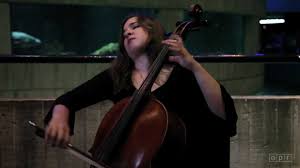
SOUNDTRACK: ALISA WEILERSTEIN-“Prelude from Bach’s Suite No. 5” (Field Recordings, February 16, 2012).

One thing I love about the Field Recordings series is the wonderfully unexpected places they have the performers play.  Like this Field Recording [Alisa Weilerstein: Playing Bach With The Fishes] which is set at the National Aquarium in Baltimore.

Strategically positioned above a tank full of stingrays, Weilerstein unpacked her cello to serenade the sea creatures — and dozens of pleasantly surprised aquarium visitors — with music by Johann Sebastian Bach. She chose the Prelude from Bach’s Suite No. 5 for unaccompanied cello. The music’s tranquil power and meandering melodies became an extraordinary soundtrack to the majestic rays as they roamed through the water, rising occasionally to catch a note or two.

The music is sublime–sad and powerful but ever so fluid.  And the setting is just perfect–you can almost see the fish appreciate it.

[READ: February 2, 2018] “Four Fictions”

Breytenbach confounds me with his stories.  This is a collection of four really short pieces and while I enjoyed parts of some of them, overall they were a big huh?

Race
This appears to be a race through the sea?  On foot?  A tractor charges into the waves and a Jeep follows. The route will take them through the sea to Germany and back to Stockholm.  Their friend Sven is running in the race (he’s from Lapland).  When the race is over he still has to run through the house to the balcony.  When they gather for the results , how many drowned, etc, the story ends with another man removing his top hat and his hair looking sunken and dry.

What? (more…)

Read Full Post »

(Field Recordings, January 12, 2012). 

This is a lengthy Field Recording [Mantra: Post-Minimalist Percussion In Aisle 12].  It has some interruptions by one of the guys.  Then he talks about how they have set up the board–suspending it on pegs.

There’s something primeval about guys banging on wood. But the New York percussion group Mantra takes such primitive pounding to a surprisingly refined level. For composer Michael Gordon’s mesmerizing new work — Timber, written for six two-by-fours — Mantra set up a public performance of the piece in the lumber department of a big-box hardware store in Alexandria, Va. Who knew 60 inches of processed pine could sound so good?

It’s unclear how long the piece is since there are constant interruptions.   Although it does run for about 2 and a half minutes uninterrupted.

For the most part the six players play a constant rhythm that creates overtones and resonances.  It’s a little monotonous until one of the starts to play a slightly different rhythm.  And by the end, there’s a couple of different rhythms that make it sound even better.

It’s a neat piece and would be fun to walk unto a hardware store and see that.

[READ: January 22, 2018] “Elf-Cio”

This is from a children’s book called Elves for Dignity.  It was published by a worker’s cooperative in Buenos Aires–one of 170 worker-run businesses in Argentina. The piece was translated by Burke Butler.

Once upon a time there was a greedy and merciless King.  One morning he awoke with the idea of converting one of his palaces into a hotel.  He hired a legion of elves whom he considered selfless and docile. They all abandoned their markets and farms to serve the King.

They worked night and day to ensure the splendor of the hotel. (more…)

Read Full Post »

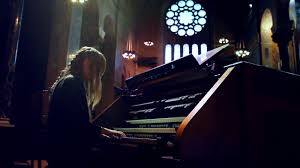
SOUNDTRACK: ANNA VON HAUSSWOLFF-“Funeral for My Children” (Field Recordings, November 4, 2013).

I remember exploring this Field Recording back in 2013 when it came out.  There is something otherworldly and magical about the pipe organ, even if it is played in a rather fast and clearly secular way like in this song.

One of my [Bob Boilen’s] most surprising discoveries of 2013 is an artfully poppy pipe-organ record called Ceremony, by Swedish singer Anna von Hausswolff. Though she doesn’t consider herself an accomplished pipe organist, von Hausswolff quickly learned the instrument’s power, as well as some of its subtleties.

I talked about this song back in 2013 and felt that the percussion was more interesting than the music.  I don’t feel that way now, although perhaps this live version is different.

When we learned that von Hausswolff was coming to New York City this summer, we started scouting for a church with a pipe organ that could accommodate a small video crew and some secular music. We found Christ Church, a United Methodist church on Park Avenue with a gracious staff who helped us make this work. [Anna Von Hausswolff Finds A Pipe Organ In New York City].

The recording opens with church bells and chimes, which Anna is playing gently on the organ (you can see the switches she presses to get sounds–how high tech!).  Then the drum comes in.  It is a simple beat on a floor tom–click click boom–a martial rhythm to offset the lofty pipe organ.

Once we were set for a location, we lit some candles and moved the pipe organ (not the pipes) into a position that allowed us get the best view of von Hausswolff while keeping percussionist Michael Stasiak distant enough so as not to bury the sound of her voice. In the process, we captured a beautiful rendition of “Funeral For My Future Children,” a song on Ceremony originally recorded at another church — this one in Gothenburg.

It almost comes as a surprise when Anna starts singing as you don;t often hear vocals with a pipe organ.  But her voice has the power and inflection to match this illustrious organ and that thumping drum.  I love when the sound of the organ changes about 4 and a half minutes in–the solo just adds a whole new depth to the piece.  And when she hits a high not just before that, it’s amazing.

[READ: January 18, 2018] “Jack”

This is an excerpt from Robinson’s novel Home.  It’s set in Gilead which is the title of a previous book of hers, so I assume it is some kind of continuation of the town, if not the family.  I’ve never read anything else by her.

Since this is an excerpt rather than a short story it takes a long time for much to happen.  But her writing is pretty great and everything that she writes is rather compelling.

The story opens with Glory, the youngest of six children arriving at her childhood home.  She is greeted by her father who is shockingly frail and thin and… old.  She is moving back home to take care of him now that he is by himself.

The story quickly flashes back to her childhood growing up in the house.  A house that seemed somehow too large, too ungainly for the neighborhood it was in.  How had it changed so much since she left? (more…)

Read Full Post »

SOUNDTRACK: ELI KESZLER & SO PERCUSSION-“Archway” (Field Recordings, July 12, 2013).

This Field Recording [Eli Keszler & So Percussion: Making The Manhattan Bridge Roar And Sing] takes place under the Manhattan Bridge. Installation artist and drummer Eli Keszler wonders, When does an instrument become a sculpture?  Or can it become something architectural?

I didn’t know Eli, but I know his partners Percussion [Eric Beach, Josh Quillen, Adam Sliwinski and Jason Treuting] from a fantastic Tiny Desk Concert.  But this was my first exposure to them in the real world.  Their combination of crotales and big strings is at once bizarre, otherworldly, interminable and very cool.

There is magic in pure sound. And few know that truth as well as the quartet called So Percussion and the installation artist and drummer Eli Keszler — artists who, before this spring, had never met. We thought that they might find kindred spirits in each other.  So as a matter of artistic matchmaking, we at NPR Music decided to invite them to meet and collaborate on a new work that would have its world premiere at Make Music New York, the annual summer-greeting festival of free outdoor concerts across the city. And along the way to creating a world premiere, they brought a New York landmark in as a sixth instrumental partner: the Manhattan Bridge. They named their piece Archway.

So Percussion says that they wrote this piece just for the installation.  The drummers are present at their drums, but what about the rest?

Using a scissor lift, Keszler and an assistant began the long process of fastening piano wires attached to two large weighted boxes to the tops of lampposts near the DUMBO Archway beneath the bridge. More wires stretched from one of the lampposts up to the Manhattan Bridge itself.

The piece juxtaposes light otherworldly rings and deep resonating, almost mechanical lows.   Complete with occasional drum smacks.

By the time that their performance rolled around at 6:30 PM, Keszler and So Percussion created fascinating layers of sound. The shimmering, nearly melodic lines produced by bowing small cymbals called crotales offset sharply articulated snare drums and the grunting roars, squonks and groans of the piano wire installation. It was urbane and thoroughly urban music for a signature city setting.

And so for about 11 minutes you get a combination of low grunting sounds–the engines or the wires?–and chiming crotales.  Occasional snare hits punctuate the sound.

It starts with the mechanical sounds and the sounds of the crotales reverberating.  About 3 minutes into the piece a snare drum and rhythm is added, but very minimally and only for a instant.   Around 4 minutes the drummers start adding more percussive and less tonal sounds, but that is brief and soon enough everyone is doing his own thing, while Keszler plays a very jazzy style of drum on the drum and crotales.  Others are hitting snares and sides of drums.

But by the 10 minute mark it is a full-on drum solo with the gentlest/flimsiest drum sticks around–making little taping sounds (but a lot of them).

I feel like not enough is made of the piano wires –I would love to hear more from them.  I assume that in a live setting all of the cool sounds (ones that become more audible around the 10 minute mark are just reverberating around and around the arch–something that even the best mic’s can;t pick up adequately.

It’s still neat to watch, though.

[READ: January 28, 2008] “The Only Sane Man in a Nuthouse”

This is an excerpt from And the Hippos Were Boiled in Their Tanks, a novel he wrote with Jack Kerouac.  They alternated chapters.  It was written in 1945 but unpublished until 2008.

On a Wednesday night, he went out with Al, Ryko and Phillips.  Agnes didn’t want to join them–she was broke–some people have some pride.  He joked at Philip that he was an artist so he didn’t believe in decency, honesty or gratitude.

They went to diner and a movie and then went to MacDonald’s Tavern, which is a queer place and it was packed with fags all screaming and swishing around.

The rest of the story is a tale of an older gay men checking out the younger men, straight men howling for women, and men hitting on anyone that moves. (more…)

Read Full Post »

SOUNDTRACK: WILD BELLE-“Love Like This” (Field Recordings, June 26, 2013).

This Field Recording [Wild Belle: Reggae-Tinged Romance Amid The Big Bikes] is set in the El Segundo-based South Bay Customs motorcycle shop.

It doesn’t seem totally appropriate for the keyboard driven pop of Wild Belle, but there’s something about singer Natalie Bergman’s voice–a little gravelly, a hushed kind of whisper that seems apt.

Wild Belle singer Natalie Bergman seemed a bit confused upon the band’s arrival. … But once we walked past the front doors, we quickly realized that this wasn’t your everyday L.A. bike shop. South Bay’s walls are lined with eccentric oddities, and the facility also houses an art gallery and a performance space for local musicians.

So it was fitting that in a coincidental twist, she told us that she’d be embarking on a motorcycle ride across the Midwest with a close friend in the next month.

“Love Like This” certainly has a reggae-tinged vibe.  I especially like the interesting echoing guitar sounds.  It’s got a catchy chorus, but the whole song seems to have such a relaxed vibe that it makes me laugh to here her nonchalantly sing

My heart’s on fire
You light me up, and I can’t cool down
Your love is wild
You’re dangerous

The song picks up and is certainly catchy.  And while I do actually like her voice, I can’t imagine more than one song from them.

[READ: February 6, 2018] “A New Paradise, or a New Hell”

This is an excerpt from the novel Death with Interruptions. It was translated from the Portuguese by Margaret Jull Costa.

It is a fascinating story with existential implications. Although I cannot imagine how this could be stretched into a novel.

On the first day of the new year, no one died.  In the whole country, not a single person died the whole day.  It was unprecedented.  There were many accidents, several life-threatening, bit no one actually died.  It was especially noticeable because the venerable queen mother who was known to be on the verge of her last breathe also did not die. (more…)

Read Full Post »

mar

SOUNDTRACK: SILK ROAD ENSEMBLE-“Saidi Swing” (Field Recordings, March 26, 2014).

I really enjoyed the Silk Road Ensemble’s Field Recording, so I was delighted to see that they did a second recording from the same session [A Field Recording Bonus Track: The Silk Road Swings].  I have no idea how they cleared everyone out and cleaned up the place for this video (how long did these four guys have to hang around?), but it was worth it.

What I find so magical about this piece is that it is four percussionists and yet they make such beautiful music.

They’re playing a piece written by Shane Shanahan called Saidi Swing. While it’s inspired by a traditional rhythm from Upper Egypt called saidi (which goes “dum tek dum dum tek” in its simplest incarnation, for those of you who want to find its seeds sprinkled through this piece), Shanahan uses that pattern just as a launching point. And with such fantastic collaborators — from left to right, Sandeep Das playing the Indian tabla, Shanahan playing the riq, or tambourine, Mark Suter on daff frame drum and Joseph Gramley playing the goblet-shaped dumbek — Shanahan can really let his imagination take flight.

The piece begins with the four drummers playing together.  Then comes the individual moments

First comes a solo by Sandeep Das playing the Indian tabla. I love that it’s mostly finger tapping–the tabla is a fascinating instrument.

Up next is Joseph Gramley playing the goblet-shaped dumbek.  To start his solo, he plays the side of the drum which rings out almost like a tambourine before returning to the proper method of playing.

The third solo comes from Mark Suter on daff frame drum (I assumed it was a bodhran, I wonder what the difference is…ah, the daf has metal rings inside of it and can be made of fish skin (!)).  Suter bangs it for a big open sound but then he rubs his fingers along the skin to create even more fascinating sounds.  It’s awesome.

Then they return to the main rhythm.  All four play loud then quiet and then it’s time for each of them to get a very brief (2 seconds, maybe) solo in order left to right.

Then it’s time for Shane Shanahan playing the riq, or tambourine, to get a solo.  It’s the most conventional instrument except it seems quite different from the one that we see in folk bands.  He does some pretty nifty tricks with it too.

In the last part they each play a solo that’s about a second.  Again, left to right, which sounds cool and probably sounds even better in person.

World music percussion is really fascinating and I’m glad it gets showcased in this way here.

[READ: February 7, 2018] “The Ecstasy of Alfred Russel Wallace”

I never understand why people write fictionalized accounts of true stories.  There must be a reason for doing it–maybe you can’t write a five-page biography and have it get published anywhere?  I don’t know.

This is the true (I assume) account of Alfred Russel Wallace.

Wallace was a student of nature–it filled whim with an ecstasy that sometimes felt like lust.  He was not one for theory–he was all about the search.

He collected specimens and he wrote letters home to his mother about his joyful expeditions.  He traveled endlessly, exhaustively.  Even when wracked with malaria he continued. (more…)

Read Full Post »

SOUNDTRACK: CAFÉ TACVBA-Tiny Desk Concert #794 (October 12, 2018).

Back in the 1990s I was quite the fan of Café Tacvba (I was exposed to a lot of rock en Español in the 90s and Café Tacvba stood out).

I’d never seen them and wasn’t even sure they were still together.  So it was great to see them in this Tiny Desk Concert.[“the four principal members together for almost 30 years”].  I didn’t know much about them back then (their liner notes are all in Spanish).

As usual, lead vocalist Rubén Albarrán is a captivating central presence, evoking a sense of down-home camaraderie with his ever friendly smile that has become the band’s most outward image. Having seen the band play in front of dedicated fans in massive stadiums in Mexico City, it’s striking to see his movements limited to a few careful spins and dance steps while still managing to embody the intense energy of their music.

The first song is “Olita del Altamar” (“Waves from the High Seas”) from the group’s 2012 album El Objeto Antes Llamado Disco.   Albarrán says it is “dedicated to the sacred water–not for mining, not for fracking but for humans and all living beings.”

It’s essentially an incantation of the magic that transpired during their performance behind Bob Boilen’s desk. The lyrics sing of the comings and goings of waves, symbolic of the passage of time and fueled by the Mexican folk rhythm son jarocho, a favorite of the band’s since their start almost 30 years ago.

The song has a real folk quality.  Their instruments are all acoustic (two of those tiny Mexican guitars and a full-sized guitar).  There’s a delightful solo on the melodica. Despite the song’s poppiness, at one point Albarrán begins screaming happily away from the microphone and dancing.

They then fast forward to “Diente de León” (“Dandelion”), from their 2017 album Jei Beibi. It’s a majestic, stripped-down version that puts the emphasis back on the lyric, a plea for existential and environmental harmony using the metaphor of the weedy flower.

It’s a beautiful song with Albarrán’s voice at times gruff and at times soaring.  The addition of electronic percussion is a little jarring, but it is quiet and works well with the music.

The third song is one that I knew and it was great to hear it again.  Introducing “The Flowers,” he says, “When we play this live we ask the people to raise heir hands so we can see a beautiful garden of different colors, different perfumes.  if you want you ca try it, it’s free.”

Their song “Las Flores,” from their 1994 album Re, slips into the ska groove that attracted fans to rock en Español in general and to Los Tacvbas in particular, a beat that captures the adventurous musical energy that swept all of Latin America in the early 1990s.

Clearly this energy is what swept over me in 1994.  Once again that melodica solo is delightful.  But so is everything else about this song–the guitar notes, the upright bass and of course, Albarrán’s infectious singing.

Not all bands would end their set with a power ballad, though very few bands hold their audience’s attention and dedication like Café Tacvba. But that’s just how they close their set.

“Que No” is their latest single, a pretty ballad.  Once the full band kicks in, it’s got a fun beat (that upright bass really keeps he beat).  Albarrán’s once again steals the show.

[READ: January 31, 2018] “The Death of Lazarus Averbuch”

This is an excerpt from The Lazarus Project.  It is story set in 1908 Chicago and one that I wasn’t very interested in until the very end.  Read as a short story it takes way too long to get where it is going, but as a part of a novel its a nice build up to the climactic scene.

A scrawny young man went to the house of the chief of police.  The chief’s wife told the man the chief didn’t see anyone before 9 AM.  The young man leaves and says he’ll come back.  Chicago is cold, bitter cold, and the man is sick of being so cold.  He had a nice summer here and even a  lovely autumn day in October, but he want the cold to end.

He decides to go into a grocery store because of the smell of warm bread.  The owners suspect of the man immediately–his stomach growls when he smells the fresh bread.  Meanwhile, another man walks in and has a friendly chat with the owners. (more…)

Read Full Post »

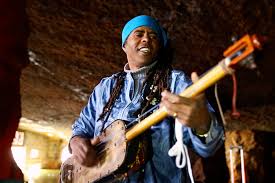
SOUNDTRACK: HASSAN HAKMOUN-“Balili (My Father)” (Field Recordings, June 11, 2014).

I didn’t know Hassan Hakmoun, but he is one of many West African musicians whose music I have come to really enjoy.  I absolutely love this song.

Hassan Hakmoun’s music is very much rooted in his homeland. Born in Marrakesh, he is from the Gnawa community, whose ancestors were brought from West Africa to North Africa as slaves in the 15th and 16th centuries. Gnawan music and dance, which are central to their spiritual tradition, fuse Muslim mysticism with sub-Saharan traditions in rituals meant to heal the body and lift the soul.

This Field Recording [On a Magical Mystery Tour with Hassan Hakmoun] has a different component to it–it is (so far) unlike any other one.

When we plan Field Recordings, we usually look far and wide to find off-the-beaten-path locations for filming musicians. But a unique opportunity presented itself when a duo called Wanderlust Projects — designers of “transgressive placemaking experiences” for urban explorers, usually in abandoned or otherwise places — invited us to come along on an adventure.

Wanderlust invited a crew of intrepid New Yorkers to accompany the fabulous Moroccan musician Hassan Hakmoun and his band on a mysterious day trip. So we piled into a van with the musicians, and off we all went to points unknown. After a long morning being driven to our secret destination — with no one but the organizers knowing where we were heading — we arrived upstate at the stunning Widow Jane Mine.

Along with providing spectacular visuals, the mine proved to be an oddly fitting location for Hakmoun and his musicians. The Widow Jane is a limestone mine that once supplied cement for such landmarks as the Brooklyn Bridge, the Statue of Liberty and the U.S. Capitol. Hakmoun’s music has found its fullest flower in New York with a highly transnational lineup of nomads.

The song opens with Hakmoun playing a fast riff on his instrument.  I cannot believe that they don;t say what it is–is it homemade?  is there one string or more?  how does he get such a great sound out of fit?).

He starts playing what will be the song’s main riff–a cool fast melody with some counterpoint loud notes.  The percussionist sings along , the flutist plays a solo of sorts and then after about a minute, the drums kick in and the song just rocks.

His band includes

Percussionist Chikako Iwahori is originally from Japan; guitarist Raja Kassis hails from Beirut; flutist Bailo Bah comes from Guinea; and drummer Harvey Wirht is from Suriname.

The sound is incredible.  Whether the caves enhance the music is unclear, but it sounds wonderful there.  The song is about 8 minutes long.  There’s not a lot to it–the riff is repeated almost throughout, but there are great variations throughout. The flute solo, the guitar solo or when he starts stomping his feet on the limestone while wearing bells on his ankles–it adds a great new component to the music.

This is just fantastic.

[READ: January 19, 2018] “Sprawl”

This is an excerpt from Dutton’s novel Sprawl (getting a reprint in 2018).

It’s a little hard to tell what the novel is about from this excerpt but I loved the whole take on suburbia that the export displays.

The excerpt is full of letters, presumably written by the same person (it’s unstated).

The first one is to Mrs Barbauld and is designed as a re-orientation to the neighborhood.  It is a bit confusing so I’m moving on.

The narrator is talking to us, I suppose as if setting the ultimate example: (more…)

Read Full Post »

« Newer Posts - Older Posts »