Feeds:
Posts
Comments

Archive for the ‘Humiliation’ Category

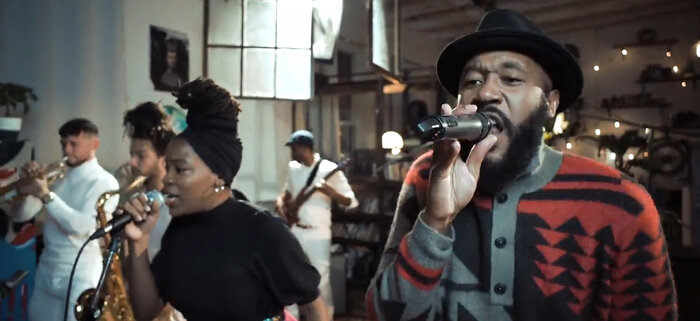
SOUNDTRACK: TH1RT3EN-Tiny Desk (Home Concert) #146 (January 18, 2021).

I had never heard of TH1RT3EN before this Tiny Desk Concert. But I was hooked from the beginning.  I liked everything about them.  The fuzzy distorted guitar from Marcus Machado, the excellent delivery of Pharoahe Monch and especially the fascinating drumming and drum style of Daru Jones (look at the way his drums are set up!).

Both the moniker TH1RT3EN and supergroup were born out of a frustration with the veneer of American society that underestimates the darkness of white supremacy.

“I knew 5 years ago where we headed,” Monch shared over the phone. “Sure, we’ve always done socially and politically aware music, but I’m tired of this “love will win” nonsense. Love may be the most powerful vibrating force, but consciousness is spreading and it’s impossible not to be more aware of the evil that has kept the world in complete darkness. TH1RT3EN is the musical personification of me and my comrades at combat.”

“The Magician” is based around the riff from Yes’ “Roundabout.”  Machado plays the riff throughout which I find much more interesting than if it was sampled.  Monch’s lyrics are smart and pointed.  There’s an incredibly fast rapping middle section with some amazing drumming.  I really like his delivery.

Moinch says that that song is about a student who was bullied and grew up to be a school shooter.  Ironically there hasn’t been any school shootings because we’re in the middle of a pandemic–a pandemic that has taken the lives of 250,000 Americans.  And yet Americans reman more afraid of Black Lives Matter than of COVID 19.

TH1RT3EN recorded this set in August 2020, as evidenced by Monch’s interlude, this four-song set still channels the discontent outside our windows today.  Shot in a padded “panic” room, this Tiny Desk (home) concert reflects the rage felt by this three-man battalion.

Monch continues “We are in need of cleansing and an exorcism.  “Cult 45” opens with a sample of a horn riff.  It’s quieter musically so it’s mostly vocals.  When the guitar joins in it’s mostly to add free jazz noises along with some wild drumming.

“Scarecrow” returns to the slow dirgy, aggressive guitar sound behind some fast rapping.

He says he started the band because he wanted a bit more authentic aggression by finding these two musicians.  And the set ends with “Fight” which has a nice big riff and crashing drums.

How’s this for an aptly aggressive verse

Burn a cross, water hose, dogs and nightsticks
Yeah, that’s what it used to be, see, they would usually
Just hang a nigga, fuck ’em
Now they don’t have the time to decorate the trees so they buck ’em

I’m going to have to check out this album.

[READ: February 28, 2021] You’ll Never Believe What Happened to Lacey.

Amber Ruffin is a writer and comedian, most notably from “Amber Says What” on Late Night with Seth Meyers and The Amber Ruffin Show on Peacock.  Amber is hilarious.

But Amber is also righteously angry about the way Black people are treated in America.  Somehow she manages to take the most horrible things you can imagine and report about them with enough humor to make you listen and laugh and still get outraged.

This book is a collection of stories of racist things that happened to her sister Lacey.   Lacey lives in Omaha, Nebraska, where they grew up.  I don’t know anything about Nebraska or Omaha.  Apparently Omaha is a big city and has sections that have a lot of Black folks.  White people who are not from the city find the thought of going to Omaha scary.  It also means that when Lacey gets jobs outside of Omaha she is typically the only Black person in the building.

Which seems to make all of the white people there think it is okay to say whatever crazy racist shit they want to say.  But even outside of work, it seems like Lacey is a magnet for racist comments.  Is it because she is tiny and good natured?  Maybe.  But she is a also a bodybuilder, so watch out.

About this book Amber says:

When you hear these stories and think, None of these stories are okay, you are right.  And when you hear these stories and think, Dang, that’s hilarious, you are right.  They’re both.

There are going to be a lot of time while you’re reading this book when you think There is no motivation for this action. It seems like this story is missing a part because people just aren’t this nonsensically cruel.  But where you see no motivation, you understand racism a little more.  It’s this weird, unprovoked lashing-out, and it never makes any sense. It’s why it’s so easy for people to believe the police when hey beat someone up–because no one would be that cruel just because the person was Black.  But the are!  So as you read this book, when you see there’s no motivation, know that there is: racism.

The Preface has an anecdote that really sets the tone for the rest of the book.  Lacey paid at a store with a check. The checks had Black heroes on them.  Lacey paid with one with Harriet Tubman on it.  The cashier who had been very nice up to that point said “Wow you have checks with your picture on ’em.”  There is then a hilarious juxtaposition of the check with Tubman and one with Lacey’s photo.

Amber contrasts her life in New Yorke City.

Everyone I work with is stark raving normal. We don’t have any crazy bigots (dumb enough to run up) and I’m no one’s first Black friend.  Now I’m not saying no one ever says anything crazy to me–I’m still a Black woman in America–it’s just that we all know there are consequences for talking to me as if you’ve lost your mind.

But in the Midwest it is an unchecked tsunami of dumb questions and comments.  People think it your job to answer “Why can’t I (insert the most nonsense shit you’ve ever head)?”

Lacey chimes in (in a different font) from time to time with things like that she’s happy her little sister is successful in New York:

where someone would get fired for out-and-out racism.  I love that that really happens.  Never seen it, but I love it.  Like Santa Claus.

Amber ends the preface by saying

Hopefully the white reader is gonna read this, feel sad, think a little about it, feel like an ally, come to greater understanding of the DEPTH of this type of shit, and maybe walk away wit a different point of view of what it’s like to be a Black American in the twenty-first century.

And I did.  Boy did I ever. (more…)

Read Full Post »

SOUNDTRACK: ROKIA TRAORÉ-GlobalFEST Tiny Desk (Home) Concert #136 (January 14, 2021).

Rokia Traore.GlobalFEST is an annual event, held in New York City, in which bands from all over the world have an opportunity to showcase their music to an American audience.  I’ve never been, and it sounds a little exhausting, but it also sounds really fun.

The Tiny Desk is teaming up with globalFEST this year for a thrilling virtual music festival: Tiny Desk Meets globalFEST. The online fest includes four nights of concerts featuring 16 bands from all over the world. 

Given the pandemic’s challenges and the hardening of international borders, NPR Music and globalFEST is moving from the nightclub to your screen of choice and sharing this festival with the world. Each night, we’ll present four artists in intimate settings (often behind desks donning globes), and it’s all hosted by African superstar Angélique Kidjo, who performed at the inaugural edition of globalFEST in 2004.

The final artist of the fourth and final night is Malian singer Rokia Traoré.

Rokia Traoré performed at globalFEST in 2005, the music festival’s second year, and it’s a thrill to present her meditative performance as part of Tiny Desk meets globalFEST. Her work is rooted in the Malian musical tradition, but defies the confines of a single culture. Born in Mali to a diplomat father, Traoré had a nomadic upbringing that exposed her to a wide variety of international musical influences. She joins us from Blues Faso, a theater inside her Foundation Passerelle in Mali, which she created to support emerging, interdisciplinary artists, from music and the performing arts to visual arts and photography.

She plays three songs that more or less segue into each other.  I don’t know a lot about music from Mali, but the little I know I can recognize from the Ngoni played by Mamah Diabaté and the guitar played by Samba Diabaté, with lots of speedy runs.   In “Souba Lé” melody is played on the balafon by Massa Joël Diarra (although I wish they’d have shown us it up close).  Both this song and “Tiramakan” feature subtle bass from Aristide Nebout.  The final song “Fakoly” is a little louder and drummer Roméo Djibré is a bit more prominent.

But all of these songs are all about Rokia Traoré’s vocals which soar and ring out.

[READ: February 25, 2021] March Book 3

Each book has gotten longer.  Book one was 121 pages, Book 2 was 187 and Book 3 is 246.

This book begins right after the bombing of the Sixteenth Street Baptist church in Birmingham, Alabama in 1963.   You meet the victims before they were killed.  It continues through until the passing of the Voting Rights Act in 1965.  Holy cow was there a lot of violence in these two years and the amazing art by Nate Powell never shies away from showing it.

Eagle Scouts at Klan rallies who then go on to kill Black teenager’s, hicks in pickups celebrating the deaths of the girls in the church with anti-integration chants and, as we see more and more in this book, police killing innocent people and not getting in any trouble because of it.

This book has opened my eyes to what Black people have known all along about police forces.  That they are completely corrupt and need to be restructured from the ground up.  When you see that it was their job to be racist in 1963, is it any surprise that they are still racist in 2021?

Reading a book like this I can’t help but think that the best thing we could have done for our country would have been to let the south secede.  Bring all people of color north and let the racists fester in their own lack of diversity.  Because their racism poisons the whole country.  And yet that is exactly the opposite belief that this book is based upon.

I’m embarrassed at how naïve I am. (more…)

Read Full Post »

SOUNDTRACKELISAPIE-GlobalFEST Tiny Desk (Home) Concert #136/156 (January 14, 2021).

ElisapieGlobalFEST is an annual event, held in New York City, in which bands from all over the world have an opportunity to showcase their music to an American audience.  I’ve never been, and it sounds a little exhausting, but it also sounds really fun.

The Tiny Desk is teaming up with globalFEST this year for a thrilling virtual music festival: Tiny Desk Meets globalFEST. The online fest includes four nights of concerts featuring 16 bands from all over the world. 

Given the pandemic’s challenges and the hardening of international borders, NPR Music and globalFEST is moving from the nightclub to your screen of choice and sharing this festival with the world. Each night, we’ll present four artists in intimate settings (often behind desks donning globes), and it’s all hosted by African superstar Angélique Kidjo, who performed at the inaugural edition of globalFEST in 2004.

The second artist of the fourth and final night is First Nations singer Elisapie.

Elisapie returns to Tiny Desk for a show-stopping performance from Montreal, with the disco globe of our dreams helping to light her set. Elisapie, in both her songs and work, is a resounding advocate of First Nations culture in Canada. In her set, she harnesses an incredible energy with electrifying, emotive vocals.

I had really enjoyed Elisapie’s previous Tiny desk.  I found her to be a less extreme, but no less dramatic performer than Tanya Tagaq.  Her band is outstanding creating all kinds of textures to surround her voice.

The first song is “Qanniuguma.”  It starts quietly with a single ringing guitar note from Jean-Sébastien Williams and little taps of percussion from Robbie Kuster.  Joshua Toal adds some quiet bass as the guitar plays some higher notes.  After a minute Elisapie starts singing.  Another 30 seconds later the drums get louder and Jason Sharp start sprinkling in some raw bass saxophone.  As the song grows more intense, Elisapie adds some breathing and chanting–throat singing.  Things quiet down and then build again with the sax and the guitar soloing as the drums and bass keep things steady

Behind her you can see Mont Royal, which has a lot of history.

The second song “Wolves Don’t Live by the Rules” is “a small song” but very meaningful.  It starts in a similar way with ringing notes an thumping drums.  She sings this one in  English and it feels like a much more conventional sounding song.  It’s pretty quiet but the instrumental breaks adds huge guitar chords and the end is really loud.

Introducing the final song, “Arnaq” (which means Woman) she says women tend to forget that we have a lot of strength and we should celebrate it loud and clear.  This one opens with a loud raw sliding guitar like an early PJ Harvey song.  The song’s chorus builds with an “ah ya ya ya” as the instruments add chunky noises–scratches from the guitar and skronks from the sax and all kinds of precious.  It’s a cool noise fest, although the guitar could be a smidge louder.

I’d really like to see her live.

[READ: February 25, 2021] March Book 2

Book Two picks up John Lewis’ life.

Like the first, it starts with Lewis’ preparations for the inauguration of Barack Obama.

Then it flashes back.  Lewis was in college and had moved to Nashville where the growing student movement was gaining strength.

The visuals are even more striking in this book.  The panels of the white woman pouring water and then soap (or flour) on the quietly sitting Black diners and then hosing them down is really arresting.  As is the sequence (which is almost entirely black) of a room full of peaceful protestors being locked in a room when the fumigator was set off.

I couldn’t believe that a man couldn’t really left us there to die.  Were we not human to him?

Then next round of protesta was at the segregated movie theaters.  I love that they chose the Ten Commandments to protest (the irony was lost on the whites in Alabama).  The Black protesters would line up and would be refused seating.  Hundreds of people who would then get back on line and be refused seating again.  Whites would throw things at them and hurl abuse at them. (more…)

Read Full Post »

SOUNDTRACKEDWIN PEREZ-GlobalFEST Tiny Desk (Home) Concert #136/155 (January 14, 2021).

Edwin PerezGlobalFEST is an annual event, held in New York City, in which bands from all over the world have an opportunity to showcase their music to an American audience.  I’ve never been, and it sounds a little exhausting, but it also sounds really fun.

The Tiny Desk is teaming up with globalFEST this year for a thrilling virtual music festival: Tiny Desk Meets globalFEST. The online fest includes four nights of concerts featuring 16 bands from all over the world. 

Given the pandemic’s challenges and the hardening of international borders, NPR Music and globalFEST is moving from the nightclub to your screen of choice and sharing this festival with the world. Each night, we’ll present four artists in intimate settings (often behind desks donning globes), and it’s all hosted by African superstar Angélique Kidjo, who performed at the inaugural edition of globalFEST in 2004.

The first artist of the fourth and final night is Edwin Perez.

From the basement of the Bowery Electric in downtown Manhattan, composer and vocalist Edwin Perez and his 10-piece band come together to put on a show. With a strong backbeat and enough room to move around, Perez’s up-tempo energy brings the party and keeps it going. The theme of the night is salsa dura music, which originated in New York in the 1970s and gained acclaim thanks to acts like the Fania All-Stars and Spanish Harlem Orchestra.

This set is a lot of fun (even with the seriousness of the second song).  Cuban music is so full of percussion and horns it’s hard not to want to dance to it.  And this band has three percussionists: Nelson Mathew Gonzalez: bongo, cowbell (from Puerto Rico); Manuel Alejandro Carro: timbales (from Cuba); Oreste Abrantes: (from Puerto Rico).  The horn section is also pretty large: Leonardo Govin (from Cuba) and Michael Pallas (From Dominican Republic): trombone; Jonathan Powell (from USA) and Kalí Rodriguez (from Cuba): trumpet.

They play three songs. “La Salsa Que Me Crió” has lots of percussion and a great trumpet solo.  Perez even dances during the instrumental breaks.  And throughout, Jorge Bringas (from Cuba) keeps the bass steady.

After introducing the band, he says “Say her name Breonna Taylor.  Say his name Philando castile.  Say his name George Floyd.  End the abuse.”  This is the introduction to the quieter “No Puedo Respirar” (I Can’t Breathe).   Despite the subject, this song is not a dirge.  I don’t know what the words are but there is joy in the music as well.  There’s a jazzy keyboard solo from Ahmed Alom Vega (USA).

Yuniel Jimenez (From Cuba) opens the final song “Mi Tierra” with a fantastic introductory solo on the Cuban tres guitar.  The rest of the song brings back the Cuban horns and percussion. There’s even a drum solo (or two) in the middle.

[READ: February 25, 2021] March Book 1

I had heard amazing things about this trilogy of books.  I don’t know why it took me so long to get around to reading them.  Now that John Lewis is dead for almost a year, it was time to read them.

This is essentially a biography so it’s not easy to write about.  It’s also an incredible story of selflessness, fortitude and unbelievable courage.

The framing device is very well executed.  After a brief prologue that shows John and is marchers getting attacked by police, the book shows us Washington D.C. January 20, 2009, the day that Barack Obama is being inaugurated President.  Since John is (in 2009) in office he will be attending the ceremonies.

As he is preparing and getting ready to leave, a woman and her two children walk into his room hoping to look at Mr. Lewis’ office–a inspirational moment for her young boys.  But it happens that John (or Bob as he is called) is still in his office. They are embarrassed to interrupt, but he welcomes them warmly and shows them some of the things around his office.

Like photos of him meeting President Kennedy when Lewis was 23.  And from the March on Washington in 1963, where Dr King gave his “I have a dream” speech.

Then the boy asks him why he has so many chickens in his office.

The story then flashes back to young John (called Bob by his parents).  His father purchased 110 acres in Pike County, Alabama for $300. John was incharge of the chickens on the farm.  He also loved preaching.  He learned to read at 5 and began preaching to the chickens (they never said Amen or anything).

He also loved going to school.  He would even away from his house on the days his father insisted all the children work in the field because he didn’t want to fall behind.  (Even if it meant getting in trouble).

One of the first being moments in his life wa when his Uncle Otis drove him North.

Otis knew which places offered colored bathrooms and the ones where you would never get out of the car: “Alabama, Tennessee, Kentucky.  These were the states we had to be careful in as we made our way North.”

It wasn’t until they got to Ohio that his uncle relaxed.  They arrive in Buffalo 17 hours later and John was amazed to see white and black people living next door to each other. (more…)

Read Full Post »

SOUNDTRACKTHE RAILWAY CHILDREN-“Brighter” (1987).

In Stuart David’s book, In The All-Night Café, he lists the songs on a mixtape that Stuart Murdoch gave to him when they first met.

Although I’ve been a fan of Belle & Sebastian for a long time, I knew almost none of the songs on this mixtape.  So, much like Stuart David, I’m listening to them for the first time trying to see how they inspire Stuart Murdoch.

In the book, David writes how much he does not like “rock,” especially music based around bluesy rock.  Most of these songs, accordingly, do not do that.  In fact, most of these songs are (unsurprisingly) soft and delicate.

A looping almost marimba-like sound opens before a jangly guitar and steady bass.  Here’s another song where the main instrument is the bass with guitar flourishes added on top.  This band reminds me of The Church (who had put outa couple of albums by now).

Singer Gary Newby has a nice crooning voice and the chorus is quite catchy.  The instrumental break allows the guitar to shine a bit with a meandering solo.  But the biggest surprise comes about 4 minutes in when there’s a drum solo of sorts–played on something like a metallic bongo.  After all of the short songs, this one pushes five minutes and is something of a surprise.

There’s some other good stuff on Reunion Wilderness, like “Gentle Sound” which I thought was a bit catchier.

[READ: January 30, 2021] “A Poor-Aunt Story”

In this story Murakami discusses a poor-aunt. I don’t know of this is a universal idea as I’ve never heard it before, although I do get where he’s coming from.

He says it was a beautiful day and he was out enjoying it when he suddenly had the idea of a poor aunt.  There wasn’t even a poor aunt around, the idea just came to him and it stuck.  He needed to write a story about a poor aunt.

He told his friend he wanted to write a poor aunt story.  She asked if he had a poor aunt.  He said no.  She said she did have a poor aunt bit didn’t want to write about her.

He admits that chances are “you don’t have a poor aunt relative, but you have seen one.”

Every wedding reception has a poor aunt.

No one bothers to introduce her.  No one talks to her.  No one asks her to give a speech.  She just sits at the table like an empty milk bottle.

When people look at the photo album they ask about her and the groom says she’s no one, just a poor aunt of mine.

He woke up the next day and a found that a poor aunt–a little one–was stuck to his back.

Nothing alerted him to her presence, he just felt it. She wasn’t heavy and didnt breathe across his shoulder. People had to look hard to see she was there.  But people did see her–she gives me the creeps, a friend said.  He said it felt like his mother was watching them.

The narrator was unable to see the poor aunt but other people cuid and they all saw her as something else–usually something unfortunate–a friend’s dog who had died.  Soon enough friends stopped calling him–they found it depressing.  But the media swooped in on him. He even made it on the show “Look What Else Is Out There.”  He tried to explain what had happened but the show tried to sensationalize him–looking for a horror story or a joke.

One of his friends said she wished it had been an umbrella stand on his back–that would be more pleasant to look at and more practical.  He could even have painted it different colors.

The poor aunt left him in autumn. He was on a train ride and watched as a mother tried to deal with her squabbling children.  The boy was teasing his sister–stealing her hat.  She was getting very upset and complaining to her mother.  The mother was trying to read and was getting angry at the daughter for bothering her. Finally the girl reached across the seat and slapped the boy’s face and took her hat, feeling very pleased with herself.

The mother was furious and made the girl sit in a different aisle–next to the narrator.  The child protested but the mother said “You’re not part of this family anymore.”  He wanted to say something to the girl, to cheer her up.  Like that she had done a good job, but he knew it would only confuse and frighten her so he said nothing.

Sometime during that interaction, the poor aunt left him.  He wasn’t aware of it, she was just gone.

This was one of Murakami’s first experiments with the short story form.  It was translated by Jay Rubin.

Read Full Post »

SOUNDTRACK: COCTEAU TWINS-“Oomingmak” (1986).

In Stuart David’s book, In The All-Night Café, he lists the songs on a mixtape that Stuart Murdoch gave to him when they first met.

Although I’ve been a fan of Belle & Sebastian for a long time, I knew almost none of the songs on this mixtape.  So, much like Stuart David, I’m listening to them for the first time trying to see how they inspire Stuart Murdoch.

In the book, David writes how much he does not like “rock,” especially music based around bluesy rock.  Most of these songs, accordingly, do not do that.  In fact, most of these songs are (unsurprisingly) soft and delicate.

Of all the bands on the list, Cocteau Twins were the one I know (and like) best.  I’ve been a fan since 1987, so just after this album came out.  I never remember which songs are which by them, because they have titles like “Oomingmak.”

Cocteau Twins are a magical band and at the time (and perhaps even now) no one sounded like them.  Their music is so ethereal, it practically floats away both because of the shimmering echoing guitars of Robin Guthrie and Elizabeth Frasier’s high pitched vocals–often with non-intelligible words. [I honestly never knew she was actually singing words, but I see she was].

This song is the shortest song on Victorialand.  It has a fast repeating guitar line and Fraser singing softly.  Toward the end, she sings harmonies with herself in her slightly more harsh sounding vocal style.  It’s a lovely song, as all of their are.

[READ: January 20, 2021] “Touched”

Reading this right after reading the Arthur Miller story was really strange.  Because here was another thirteen year-old boy possibly having sex with an adult woman.

The story opens on Ali, the thirteen year-old.  His Bombay family has visited him in England and are now returning to India.  Ali was very sad to see them go,

Ali was most upset because his cousin Zahida was leaving. She was a year older than him.  She had pressed her lips to his and then they ran up into the attic together and then

he continued caressinuntil, making his way through intricate whirls of material, he reached her flesh and slid his hand into the top of the crack.

He was suddenly concerned about being discovered they quickly separated.

Wow. (more…)

Read Full Post »

SOUNDTRACK: THE BLUE AEROPLANES-“Veils of Colour” (1987).

In Stuart David’s book, In The All-Night Café, he lists the songs on a mixtape that Stuart Murdoch gave to him when they first met.

Although I’ve been a fan of Belle & Sebastian for a long time, I knew almost none of the songs on this mixtape.  So, much like Stuart David, I’m listening to them for the first time trying to see how they inspire Stuart Murdoch.

In the book, David writes how much he does not like “rock,” especially music based around bluesy rock.  Most of these songs, accordingly, do not do that.  In fact, most of these songs are (unsurprisingly) soft and delicate.

The Blue Aeroplanes have been around forever, forming in 1981 and releasing their most recent album in 2017.  I feel like I’ve heard of them, but I’m not sure now.  I guess I’ve never actually heard them as this didn’t sound familiar at all.   Nor does the core lineup: the mainstays are Gerard Langley, brother John Langley, and dancer Wojtek Dmochowski.  Their wikipedia pages lists about 90 other people who have played on their records.

“Veils of Colour” opens with a quiet guitar riff that, surprisingly, progresses rather than repeats.  It’s a quiet song and when the lyrics come in, they’re mostly spoken in an almost excitable whisper.  You can certainly see why they appealed to Stuart Murdoch.

The chorus is almost sung, but the addition of horns makes the it swell beyond what you’d expect from the verses.  Indeed, the song has a kind of understated urgency, but never gets very intense.

[READ: January 24 2021] “Hansa and Gretyl and Piece of Shit”

This story was peculiar for many reasons.  Obviously the title shows that this is a twist on a familiar story.  But, wow, does it veer off form what you might expect (just as the title does).

Gretyl is a girl in high school.  She wakes with terrible stomach cramps–not the “normal” cramps a girl might feel, but something far worse.  Her mother believes she is faking because she feels like a loser at school.

She walks to school and sees a man at the bottom of the hill.  His car seems to be constantly broken and he regularly asks Gretyl for help–a scrunchie to fix his carburetor, a paper clip to connect his fan belt (she gave him one from her paper, and her teacher changed her grade from an A to a B- because it had no fastener).  Today he asks her to steer while he pushes.  When his car is free, he gives her a whistle. If you need help, blow it, maybe we’ll come.

Gretyl’s family is strapped for cash. Although her father has a yacht and her mother has expensive jewelry–they don’t seem to have money to buy new things.

Gretyl’s mother resents her: Gestating you destroyed my metabolism.  Now I can’t practice medicine (she does not mention that the mother bore Gretyl at forty). (more…)

Read Full Post »

SOUNDTRACKVOX SAMBOU-GlobalFEST Tiny Desk (Home) Concert #135/151 (January 13, 2021).

Vox SambouGlobalFEST is an annual event, held in New York City, in which bands from all over the world have an opportunity to showcase their music to an American audience.  I’ve never been, and it sounds a little exhausting, but it also sounds really fun.

The Tiny Desk is teaming up with globalFEST this year for a thrilling virtual music festival: Tiny Desk Meets globalFEST. The online fest includes four nights of concerts featuring 16 bands from all over the world. 

Given the pandemic’s challenges and the hardening of international borders, NPR Music and globalFEST is moving from the nightclub to your screen of choice and sharing this festival with the world. Each night, we’ll present four artists in intimate settings (often behind desks donning globes), and it’s all hosted by African superstar Angélique Kidjo, who performed at the inaugural edition of globalFEST in 2004.

The first band on the third night is Vox Sambou a Haitian band recording in Montreal.

There are few performers as “alive” as Vox Sambou, whose energy and soul transcends the virtual space. He starts his performance at Tiny Desk Meets globalFEST with a short moment between himself and his son, overseen by a painting of his mother, highlighting the ways we pass down traditions from generation to generation. Based in Montreal, Quebec, Vox Sambou writes and performs in Hatian-Creole, French, English, Spanish and Portuguese. His music is a joyous fusion of Haitian funk, reggae and hip-hop.

He starts with a call and response with his adorable son.  Then the music starts and doesn’t let up  There’s intense trumpet, lots of percussion and some fantastic dancing from he co-singer.  He introduces everyone, but between his accent and their very French names, I couldn’t pick out a single one.

“African Diaspora” has fast intense and fun rapping and singing in French.  The joyousness of the music is infectious, and i love watching everyone dance.

“My Rhythm” is slower with a pronounced beat.  It’s great watching them all move in synch to that rhythm.  The song pauses for a few seconds until another dancer comes out.  There’s a ripping trumpet solo followed by a cool sax solo with all three up front dancing.  There’s even a brief time to show off the conga players.

“Everyone” ends the set fast and intense.  So much drumming, so many horns. It’s pretty wonderful.

These guys must be exhausted!

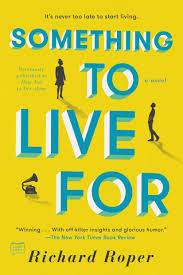
[READ: December 16, 2020] Something to Live For

S. read this book last year when it was called How Not to Die Alone.  In her post about it, she comments about what a great title it was.  I agree with that and am not sure why they changed it to the more generic Something to Live For. Although it was the cover/title that grabbed me when I saw it at work, so I guess this new title is good to.  But I think the Die title is better.

Compared to some of the more complicated stories that I’ve been reading lately–where I feel like a lot of background information needs to be filled in–this story was delightfully straightforward.  It was an enjoyably fast-paced read and resonated in a surprisingly powerful way.

Andrew is a middle aged British man.  He had worked in a public service role for many years until his position was terminated.  His boss helped him find a new job in the public service field.

This new job is absolutely fascinating to me and I have to wonder if we have such a job in the States.  Andrew’s job is to go to the house of a recently deceased person.  These are people who died alone and apparently have no contacts.  Andrew’s job is to determine if the deceased has someone to contact to come to (and pay for) the funeral or if the deceased has enough money in their apartment to pay for the funeral themselves. (more…)

Read Full Post »

SOUNDTRACKJAN VOGLER AND ALESSIO BAX-Tiny Desk (Home) Concert #128 (December 16, 2020).

This is the third of three Tiny Desk Home Concerts to honor Beethoven’s 250th birth anniversary. This was my favorite. The first was just piano the second was a quartet of strings.  But this one, a combination of the two, was the most exciting.  I love the way the cello (Vogler) played off of the piano (Bax).

For this Tiny Desk (home) concert, we pay a visit to the doctor’s office. Actually, the venue is called Rare Violins of New York and it’s something of a second home to cellist Jan Vogler, who pops in frequently to have the experts give his 1708 Stradivarius cello a thorough checkup. If your multi-million-dollar fiddle has a cough or the sniffles, or even needs a full-blown restoration, Rare Violins, which sits just a block away from Carnegie Hall, can help. The firm also has a lovely music room, kitted out with a fine piano – something Vogler lacks at his place.  With help from the fine pianist Alessio Bax, Vogler makes a convincing case for Beethoven as one of the great heroes of the cello. Beethoven, whose 250th birthday falls this week, wrote five cello sonatas, plus other works for the instrument, which, before his time, was primarily relegated to beefing up the bass line in various chamber music situations.

Beethoven, in essence, liberated the cello. Listen to how it dances and struts in the opening scherzo from the Sonata in A, Op. 69.

“Cello Sonata in A, Op. 69: II. Scherzo” starts with a piano and the cello quickly jumps back in.  The song builds and swells and then quiets down to a pretty piano and cello melody.

Like Jonathan Biss, these two are very chatty. They are mostly chatty with each other, but they do direct their answers to the camera sometimes too.

Up next is a short piece from the beginning of his career “12 Variations on a Theme from Handel’s Judas Maccabaeus: Variation XI: Adagio.”   In this piece the cello “sings sweetly.”  Vogler says that Beethoven was friendly with a fantastic cellist and he may have inspired the composer to write more pieces for the cello.

Although the piece starts with a lovely piano intro and has several moments of just piano, the cello adds so much to it.

Before the final song the two talk about how the pandemic has changed them and what they are looking forward to doing when it is over.

And finally there’s the opening to Beethoven’s last cello sonata, which Bax — whose role is far more than just an accompanist here — says is compact with emotion, yet “stretches the boundaries” for the instrument.

“Cello Sonata in D, Op. 102: I. Allegro con brio” feels like a call and response–two instruments in conversation.  And they had a lot to say.

[READ: December 20, 2020] The Disaster Tourist

In continuing with my around-the-world reading, I picked up this novel that was originally written in Korean (translated by Lizzie Buehler).

This story sounded really weird and interesting.

Yona works for a company called Jungle which specializes in offering vacations in areas that have suffered a disaster.

On a disaster trip, travellers reactions usually went through these stages

shock; sympathy and compassion, maybe discomfortable gratefulness at their own lives; a sense of responsibility that they’d learned a lesson and maybe a feeling of superiority for having survived where others didn’t.

For instance, a tsunami had hit Jinhae–in an instant everything was underwater.  Yona travelled there because Jungle currently didn’t offer any tours there.  But they would soon.  Yona would give donations and offer condolences to the community.  Then she would create a vacation package that involved viewing the aftermath along with volunteer work.

Yona had worked at Jungle for over ten years.  She was something of a star.  But apparently, her star was starting to fade because she had all of sudden been asked to handle some customer service phone calls–never a good sign.

Things got even worse when a supervisor named Kim got on the elevator with her.  He said:

Johnson is asking me to send my greetings to you.
Who?
Johnson.  My Johnson. Kim pointed to his crotch.

At this point I had to wonder.  Is this level of harassment something that happens in Korea?  Is this  shocking incident for any reader?  Is this a hyper real fiction in which everything is just a bit beyond reality?  I don’t know.

Then Kim grabs her bottom and put his hand in her blouse.  The gesture suggested that Kim didn’t care if he was caught.

Yona was upset, but not because of the sexual assault. Because Kim was known to only target has-beens. (more…)

Read Full Post »

SOUNDTRACK: CHLOE X HALLE-Tiny Desk (Home) Concert #123 (December 8, 2020).

Chloe x Halle’s album, with its arresting album cover, has been on all the top album lists this year.  I hadn’t heard anything off of it, so this is my introduction to this “powerful sister duo.”

Flanked by personal memorabilia supplied by their mother, the Bailey sisters did their best to make this studio performance really feel like a home concert.

I don’t know what he album sounds like, but this recording (complete with a full band, horns and strings) sounds pretty amazing.  Almost as amazing as Chloe and Halle’s voices.

As they volley off each other, swapping lead and harmonies, it’s amazing to watch how years of practice and innate genetic chemistry have them synced tight.

After introducing themselves, the sister play “Don’t Make It Harder on Me.”  There’s a clean bass opening from Elin Sandberg and quiet guitar chords (it’s fun to watch Lexii Lynn Frazier play as she is smiling a lot and really into it).  The addition of the trumpets (Arnetta Johnson and Crystal Torres) adding soft and then loud accents is a really nice touch.  But nothing can distract from the voices.

Halle takes the higher notes and wow does her voice soar.  But the two of them together, whether singer counterpoint or their gorgeous wordless harmonies are really amazing.

“Baby Girl,” the second song here, starts with notes reminiscent of Crystal Waters’ “Gypsy Woman (She’s Homeless),” and is preceded with Chloe sharing “I know this year 2020 has been absolutely bonkers for all of us. For those moments where you kinda feel less than and you’re not good enough … that’s why we wrote this song. … Whatever happens, we’ll be OK. And this is our world.”

The song is softer with keyboard splashes from Elise Solberg and soaring strings from Stephanie Yu (violin), Chelsea Stevens (cello) and Marta Honer (viola).

Halle sings the first verse with Chloe adding punctuation on this cool refrain

step up to the patio
listen to the radio
try to play it on my Casio

more great punctuation from the horns nicely flesh out this song.  The song ends with a short drum breakdown from Brandi Singleton with some ripping bass work as it segues into “Do It.”  “Do It” is a great moment to see the sisters play of of each other.  It’s fun watching them smile at each other as they bounce and bop and back and forth with the “do it”s and the “woo”s.

“Ungodly Hour” is upbeat but “Wonder What She Thinks of Me” is a very different song.  Chloe says it’s a song telling the perspective of the other woman and what does that feel like?  What would we do in that situation.  Chloe sings the first verses accompanied by gorgeous strings.  It’s a beautiful torch song and their voices are simply fantastic.  Their harmonies in the third chorus are, frankly, jaw dropping.

I don’t tend to like R&B albums, (and it’s possible the album doesn’t sound like this), but this set was really impressive.

[READ: January 3, 2021] “Preparing to Spin the Wheel of Fortune”

I like when an author I enjoy has a Personal History in the New Yorker.

This one was especially fun because David Gilbert relates his experience appearing on Wheel of Fortune.

The studio is cold.  There are contestant handlers who are mystically upbeat.  They tell them to clap without clapping (so they dont mess up the sound recording).

He rather enjoyed the make up because she makes him look very good (he’s very critical of himself).  Before talking about the whole process though, he gives some background on the show. (more…)

Read Full Post »

« Newer Posts - Older Posts »