Feeds:
Posts
Comments

Archive for the ‘History’ Category

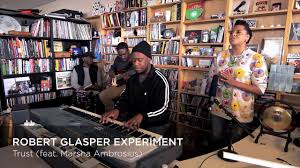
may16 SOUNDTRACK: ROBERT GLASPER EXPERIMENT-Tiny Desk Concert #332 (January 20, 2014).

glasperI am unfamiliar with Robert Glasper, but he is a whirlwind on the keyboard and a n excellent improviser.  He’s also pretty funny.  Before the show starts he made a few jokes including picking up a nearby phone and whispering that they were about to do a concert.

The band plays three songs.  I hated the first one, but really enjoyed the second two.

Glasper is classified as neo-soul or R&B.  He typically has a core band and many guests.  The first song is “Trust” which features Marsha Ambrosius on vocals and it is everything I dislike in R&B.  While she has a lovely voice, she does all kinds of trills and vibratos and frippery that turns the 6 minute song into an endless excursion (although everyone else in the room loves it, so it’s obviously just me).

The other two songs are instrumental and fare much better.

The first is called “NPR Tiny Desk Jam (Part 1)” and is an improvised piece. He talks to the other guys and they agree to “Make up something funner than playing something we know.” I love the bass sound on this song.  And for much of it bassist Derrick Hodge, is playing the main part (Hodge has his own albums out too).  When Glasper throws in the little splashes of keys they work really well too.  And the drummer Mark Colenburg, is doing some amazing things with just a snare drum and some bells.  It’s a great 7 minute jam.

  The final song”F.T.B. (Gonna Be Alright)” is one that he has done as an instrumental and with vocals.  Thankfully this version is instrumental.  Although after the opening notes he sings “hey, yeah” which makes the rest of the band laugh and stop.  As the song starts off, much to Bob Boilen’s delight, Glasper grabs the Tiny Desk gong and the drummer uses it in the song.   It’s another good jazzy song with some more excellent bass playing.  I might wind up calling this the Derrick Hodge Experiment instead.

[READ: July 6, 2016] “Seeing Double”

The May 16, 2016 issue of the New Yorker had a series called “Univent This” in which six authors imagine something that they could make go away. Since I knew many of them, I decided to write about them all.  I have to wonder how much these writers had to think about their answers, or if they’d imagined this all along.

This uninvent essay is about mirrors.  I enjoyed the opening of the essay in which Kleeman talks about the superstitions behind mirrors–things I didn’t really know about.  A Victorian superstition claims that a mirror captures a portion of one’s soul, which is why breaking a mirror is bad luck–it injures the soul.

And after someone died, mirrors were covered to prevent the soul from becoming trapped.

But Kleeman is more concerned with the surface level engagement we have now because of mirrors. (more…)

Read Full Post »

may16 SOUNDTRACK: AFRO BLUE-Tiny Desk Concert #331 (January 13, 2014).

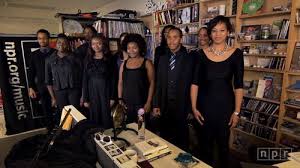
afroblueAfro Blue, a nine-member a cappella troupe from Howard University in Washington, D.C.

They sing three African American spirituals.  “Swing Low Sweet Chariot” is done very slowly, and you can really hear the power in the words of this often ill-used song.

“Motherless Child” I know from Richie Havens, but this version is much slower and impassioned.  The chorus is much different from any version I’ve heard before.

“Ain-a That Good News” is a song I didn’t know.  It has their most powerful chorus of vocals and ends the Concert in a great way.

[READ: July 6, 2016] “Telling Tales”

The May 16, 2016 issue of the New Yorker had a series called “Univent This” in which six authors imagine something that they could make go away. Since I knew many of them, I decided to write about them all.  I have to wonder how much these writers had to think about their answers, or if they’d imagined this all along.

Child says that he saw his 92-year-old father who was in very poor health.  Lee told him that he had been a good man (which was not true).  He says that his father probably said the same thing to his own father (which may or may not have been true).

He says that it is language (and syntax and grammar) that helped us become what we are–we could now plan and theorize and speculate. (more…)

Read Full Post »

maha SOUNDTRACK: MASHROU’ LEILA-Tiny Desk Concert #543 (June 24, 2016).

mashrouMashrou’ Leila is a band from Beirut.  And because I love this kind of thing, here is their name in Arabic script: مشروع ليلى

They are on their second ever tour in the U.S.  They sing in Arabic but their music is full of rock and indeed dance motifs.

There are five members of the band: singer and lyricist Hamed Sinno, violinist Haig Papazian, keyboardist and guitarist Firas Abou Fakher, Ibrahim Badr on bass and drummer Carl Gerges.  And the band make up is rather diverse:

Sinno is openly gay, and Mashrou’ Leila is well acquainted with the targeting of LGBT people. The band has faced condemnation, bans and threats in its home region, including some from both Christian and Muslim sources, for what it calls “our political and religious beliefs and endorsement of gender equality and sexual freedom.” And yet, when Mashrou’ Leila performs in the U.S., its members are often tasked with representing the Middle East as a whole, being still one of the few Arab rock bands to book a North American tour.

Their set took place on the morning after the dead club murders in Orlando (June 12), and since the band has had direct experience with this, they modified their intended set list.

I want their music to speak for itself, because it’s really good.  But since it’s sun in Arabic, some context helps

“Maghawir” (Commandos), is a song Sinno wrote in response to two nightclub shootings in Beirut. In the Beirut incidents, which took place within a week of each other, two of the young victims were out celebrating their respective birthdays. “Maghawir” is a checklist of sorts about how to spend a birthday clubbing in the band’s home city, but also a running commentary about machismo and the idea that big guns make big men.

It begins with a low menacing bass (keyboard) note and some occasional bass (guitar) notes until the echoed violin plays some singularly eerie notes.  Sinno’s voice is really interesting–operatic, intense and not really sounding like he’s singing in Arabic exactly.  He has rock vocal stylings down very well, and the guttural sound of Arabic aids the song really well.  I’m really magnetized by his singing.  And the lyrics:

“All the boys become men / Soldiers in the capital of the night,” Sinno sings. “Shoop, shoop, shot you down … We were just all together, painting the town / Where’d you disappear?” It was a terrible, and terribly fitting, response to the Florida shootings.

For the second song, “Kalaam” (S/He),Sinnos says it’s about the way “language and gender work in nationalism.  In Arabic, words are feminine or masculine and it’s about being in between while trying to pick someone up at a bar.”

Sinno dives deep into the relationships between language and gender, and how language shapes perception and identity: “They wrote the country’s borders upon my body, upon your body / In flesh-ligatured word / My word upon your word, as my body upon your body / Flesh-conjugated words.”

There’s interesting percussion in this song.  And more of that eerie echoed violin.  But it’s when the chorus kicks in and there’s a great bass line (which comes out of nowhere) that the song really comes to life.  There’s a cool middle section in which the keyboards play a sprinkling piano sound and there some plucked violins.  All along the song is catchy but a little sinister at the same time.

The final song, “Djin,” is based on Joseph Campbell’s archetypes.  Sinno describes the comparison between Christian and Dionysian mythologies but it’s also about just about “getting really messed up at a bar.”

“Djin,” is a perfect distillation of that linguistic playfulness. In pre-Islamic Arabia and later in Islamic theology and texts, a djin (or jinn) is a supernatural creature; but here, Sinno also means gin, as in the alcoholic drink. “Liver baptized in gin,” Sinno sings, “I dance to ward off the djin.”

It has a great funky beat and dance quality.  The way the chorus comes in with the simple backing vocals is great.

There’s some pretty heady stuff in their lyrics, and that works on the level of their band name as well:

The most common translation of “Mashrou’ Leila” is “The Night Project,” which tips to the group’s beginnings back in 2008 in sessions at the American University of Beirut. But Leila is also the name of the protagonist in one of Arabic literature’s most famous tales, the tragic love story of Leila and Majnun, a couple somewhat akin to Romeo and Juliet. Considering Mashrou’ Leila’s hyper-literary bent, it’s hard not to hear that evocation.

I hope they get some airplay in the States. Sadly their album is only available as an import, but it is downloadable at a reasonable price.

[READ: June 10, 2016] Omaha Beach on D-Day

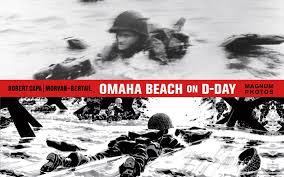
Nobody picks up this book for fun.  I mean, look at that title. You know this isn’t going to be a laugh.  But it is an amazing book and I think  perhaps the title does it a bit of a disservice.

This book is not exactly about the massacre that was Omaha Beach on D-Day.  It is about that certainly, but the book is really about Robert Capa, the photographer who took the most iconic photos of Omaha Beach on D-Day.  This book is far more of a biography of him than an account of the war.  And in typical First Second fashion, they have made a gorgeous book full of photorealistic drawings that really exemplify the work that the book describes.

The book opens in Jan of 1944 with Capa carrying bottles of champagne amid the burned out wreckage of war.  He is bringing the celebratory drink to his fellow reporters who have been hiding out for a few days. Capa says he is leaving for London. (more…)

Read Full Post »

mikesplace SOUNDTRACK: MONIKA-Tiny Desk Concert #529 (May 6, 2016).

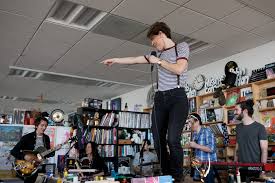
monikaMonika is a superstar in her native Greece (her full name is Monika Christodoulou).  She is a charming woman with a big voice and a bigger stage presence.  She incorporates theatrical notions in her performance too (the fact that she has a shirt that looks like a mime’s kind of encourages that idea): “throwing” stars, flying, sleeping.

It is hard to believe that the blurb says used to sing sad songs, as she is so fun and bouncy.  But there’s this biographical note:

her recent transition from singer of sad songs to purveyor of upbeat jubilance came after she nearly lost her life in a boat fire; she had to swim eight hours in the dark to safety without food or drinkable water. These days, it’s all about a great band grooving, her joyful voice, and that infectious smile.

Wow.

She sings four songs.  The first, “Yes I Do,” opens with what I assume is a lyric about the then current moment: “24th of March has arrived and I think it’s Thursday?  Washington is beautiful out there but we don’t really care.”  It has a kind of circus opera feel.  And Monika’s voice is a marvel–powerful and beautiful with a good range.

monika2For the second song, “Shake Your Hands” she asks if everyone is ready to dance a little.  She climbs up on the desk and as she sings the slow opening, when she gets to the “I love you” moment, she sings without the mike and is as loud as when she uses it.  Once the song kicks in, it has a big disco beat: wah wah’d guitars and a funky bass line.  She encourages everyone to sing along: “Even if you don’t understand, just repeat, okay.”  The song ends with a very fun extended ending of staccato chords.

“Hand in Hand” has a kind of gospel quality (a big group sing along of the opening lines), although it is a brief, transitional song before “Secret in the Dark” begins.  She straps on a guitar for this final song which has a discoey riff and a fuzzy keyboard sound.  It’s really fun.

I’d never heard of Monika, but she seems like the kind of pop/dance star that would be really fun to see live.

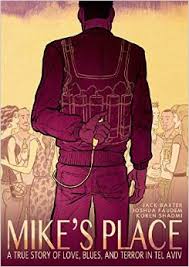
[READ: April 1, 2016] Mike’s Place

Somehow I missed that word in the subtitle: True.  I didn’t realize that this was a true story until the very end.  The story was really good before I knew that and it makes it even more amazing after I found the truth.

In Tel Aviv, Israel, John Baxter (Jack), a filmmaker has come to cover a story.  He goes into a local bar called Mike’s Place for a meal.  He is greeted warmly and is told that there is live music every night of the week.  They proudly state that Mike’s is a place where people of all stripes comes to congregate and do anything but talk about politics.

It turns out that there are already people making a documentary about the subject who John came to cover (Marwan Barghouti) so Jack  decides to give up. (more…)

Read Full Post »

marathon SOUNDTRACK: EIGHTH BLACKBIRD-Tiny Desk Concert #528 (May 2, 2016).

8thEighth Blackbird is described as a “new music ensemble” from Chicago.  That means they play classical music that is new and “different.”  The sextet says that looking at each other–being able to communicate–is essential for playing these complex pieces, which calls for an interesting arrangement behind the Tiny Desk.

The first piece is actually two pieces called “Wave the Sea” and “Brushy Fork” from a suite called Murder Ballads by Bryce Dessner (better known as being in The National) .  The piece opens with a flute solo by newest member Nathalie Joachim, and then some complex series of notes and timings from the rest of the band–this is cerebral music that you must really pay attention to.

“Pulse,” from Robert Honstein’s three-movement Conduit is a much more gentle piece, far less frenetic and more mellow. It opens with Matthew Duvall’s vibraphone, Yvonne Lam’s violin, Lisa Kaplan’s piano and Michael J. Maccaferri’s clarinet which all seem to get added in one at a time until it is all just one consistent piece.  Nicholas Photinos’ cello offers some low end while the flute seems to float above the whole piece.  The song seems like it could just keep going forever as a very slow, beautiful round.

The final piece is by David Lang (an artist they have played for many years).  “learn to fly” returns to that frenetic tempo of the first piece .  Opening with wild syncopated piano notes (it looks impossible to play) and added to by the flute, clarinet and cello.  And just when you think the whole piece will remain in this style of complex syncopation, a violin solo bursts forth and soars for a few bars before returning to the melody.

I don’t listen to a lot of classical music, but I really enjoyed this Concert a lot.

[READ: March 1, 2016] Marathon

While overall I have really enjoyed the First Second books that I’ve read, this one I found really confusing and not exactly enjoyable.

The story begins in 490 BC.  Unbelievably it says the temperature is 106 degrees Fahrenheit (but sure, why not).  A man is running from Athens to Sparta (distance 153 miles).  Then there’s the confusing title: Athens: Twelve Years ago. Which I assume means 12 years before 490 BC–where we see some young boys racing.  Eucles won the race.  It is shocking to everyone that he is the son of a slave.  The slave defeated the Kings “own bastard son Phillipus.”   And so the King cuts off Phillipus’ head.

When he fails a test shortly thereafter, Eucles’ parents are executed.

Yup it’s that kind of story.

The king is Hippias.  He is exiled soon after the events of 12 years ago. (more…)

Read Full Post »

425 SOUNDTRACK: JULIA HOLTER-Tiny Desk Concert #524 (April 22, 2016).

Jjuliahulia Holter also has a theatrical style although her touchstone would be someone more like Regina Spektor (I found a similar style in their delivery).

“Sea Calls me Home” has a cabaret style in her delivery and songs structure.  She plays piano with a small band of upright bass, violin and drum.  I really like the sound (and solo) of the violin later on in the song.

“In the Green Wild” has a very jazzy feel with the upright bass playing a jazz line and the drums playing a jazzy rushed sound.  The violin plays some random high almost dissonant notes that work very well.  For the beginning, Julia doesn’t play piano, she sing-speaks kind of like Laurie Anderson—including the unusual intonation and emphases.  The rest of the band sings backing vocals that are higher and ethereal.  About half way in, she begins playing piano and the song settles sown a bit. The way she sings is unusual and a little unsettling—she looks up at the ceiling more or less the whole time.  Her piano notes are simple and I like the way she plays without looking at the keys.

After that song she speaks briefly.  Her personality is pretty nonexistent–she doesn’t smile or even seem to look at anyone. She sounds rather bored as she says okay we’ll play another song.  Thanks for listening.  That turned me off of her music a bit.

The final song, “Betsy on the Roof,” is the longest, about six minutes long.  It sounds similar to the first one–theatrical and somewhat operatic.  There’s a story in the song, but my favorite part is the middle where she sings a scale up to the roof and then the band rocks out.  The end of the song is fascinating as she sings her nice melody and plays atonal tones on the piano.  I enjoyed t he theatricality of this music a lot, but I would have preferred not to see her performance.

[READ: June 10, 2016] “Waiting for the Miracle”

This is the story of Vadik and his arrival in New York from Moscow.  It was a snowy day as he landed at J.F.K.  Despite the snow blanketing the skyline, it was still exciting. as he descended.  He had just received his work Visa authorizing his stay in the U.S. for three years.  He was staring work in Avenel, NJ.

His friend Sergey, who lives in Staten Island, came to pick him up.  All that Vadik wanted to do was explore the city–walk aimlessly and see what happened, but Sergey wanted to take him to his house.  And Sergey’s wife Vica wanted to see him too–in their past Vadik and Vica had been an item although and Sergey stole her away.  Vica made dinner for him and so he agreed to go to the Island.

On the way to the house, the most improbable thing is that Sergey is listening to a Leonard Cohen CD and singing along.  (Vadik likes Sergey and admits that he is still handsome, but his voice is terrible and has always been terrible.  And it’s especially bad especially for Leonard Cohen.  I say this is improbable because Cohen’s music appears later in the story  too. (more…)

Read Full Post »

silence THEE SILVER MT. ZION MEMORIAL ORCHESTRA & TRA-LA-LA BAND-13 Blues for Thirteen Moons [CST051] (2008).

330px-13_Blues_for_Thirteen_MoonsThis album opens with 12 tracks of a kind of feedbacking noise.  The total time for this is about a minute before track 13 begins.  And this album feels very different from the more acoustic Horses.  Whereas Horses felt acoustic and organic, this album is noisy and raucous and very electric.  After the 12 brief tracks there are four lengthy ones that comprise the album.

“1,000,000 Died to Make This Sound” starts with scratched notes and pizzicato strings.  The choir quietly begins singing the title “one million died to make this sound.”  Their voices grow louder and then at about 3 minutes in there’s a great bowed riff that introduces the more rocking section–a guitar “solo” and drums as that bass riff continues.  About mid way through the song it takes on a real rocking feel–the guitars rock out and the steady beat keeps up.  The song feels sloppy and intense–like they couldn’t wait to get this out.  I would describe the song as fun (except that it’s pretty bleak).  Efrim’s voice sounds a bit like Johnny Rotten or some other British punk) on this song and the punk style suits it well.  I really love the way the violin-swells make the riffs even bigger until about 9 minutes when the song shifts dramatically again and it feels like a Crazy Horse jam–big, sloppy, noisy guitars.  The song reaches a sort of natural stopping point as the music all fades away and the voices resume–I love the choir of voices at the end of the song (although perhaps Efrim’s voice could be a tad quieter?  Efrim’s voice seems to be a polarizing thing for fans of this band.  I’m even polarized about it on different songs–sometimes I think it’s too much, but other times I think it works well.

“13 Blues for Thirteen Moons” is 16 minutes long.  It begins with thumping drums and bass before Efrim’s voice comes chanting in.  The song is noisy and chaotic–lots of drums and cymbals and then the backing vocals start a call and response with the lead vocals.  The song continues in the same vein–with a refrain of “I Just Want Some Action” but then around 5 minutes a big distorted guitar plays a kind of concluding riff before a quieter guitar begins a new section with some quiet picking.  And its in this section that the album title is sung.  This quiet guitar section goes on for quite a while with Efrim shouting various parts–and then second voice joins him.  It’s unusual that the band will play the same riff through so much of a song, but it’s a good riff.  The whole band picks up the riff as it grows louder and more rocking.  The final two minutes are filled with feedback and quiet guitars with Efrim shouting syllable after syllable until it feedbacks to an end.  It’s a pretty intense song.

“Black Waters Blowed/Engine Broke Blues” opens in a much quieter way with slow revered guitars.  The vocals are also slow and accompanied by a lone cello.  But after a minute and a half chaos erupts in the song–feedback squalls and wild guitars accompanied by chaotic drumming make the song sound like it is tripping over itself , but it soon resolves to a quiet part like the intro–this time with two singers.  The song builds again, with the chaotic drums fighting for dominance over the string section.  But they both cede again to the quieter vocals once more.  The band then acts in concert building the song and allowing the vocals to continue.  And after a musical interlude, the vocals begin again over a quiet organ.  And this next section builds as strings accompany the louder vocals and the drum gets a pounding martial beat.  The final section, which appears to be the “Engine Broke Blues” is a repeated refrain of “Building Trainwrecks in the Setting Sun.”

The final song “BlindBlindBlind” also opens quietly, with a simple guitar motif.  As the vocals continue, a ringing guitar and a feedbacking guitar join the song (each in a different ear).  And then a violin adds to the melody.  About 4 minutes in, the melody shifts to an organ heavy section with the lead vocal followed by backing vocals.  A pizzicato section begins next.  What’s interesting is that the vocal melody hasn’t really changed this whole time (in this song Efrim again sounds a bit like a British punk rocker).  At around 7 minutes, the song turns towards the end, with strings and drums.  This end bit is my favorite part on the record, not only for the melody, but for the excellent backing chanting.  The backing vocal melody is very cool in itself–I love when they add the high notes–repeating the refrain “Some hearts are true” over and over.  A guitar solo interrupts the proceedings for a bit and then they resume singing all the way to the end.  It’s a very cathartic conclusion.

For this album, the lineup stayed the same although Eric Craven replaced Scott Levine Gilmore on drums.

Back in 2009, I wrote a post about this album.  It’s pretty brief and mostly talks about the singing.

[READ: March 1, 2016] The Silence of Our Friends

This was the final First Second book that I had in a huge stack that I took out from the library.  I had been putting this book off because I was nervous about reading it.  Nothing pretty is going to happen in a Civil Rights book and I had to prepare myself for it.  Obviously, the era is staggeringly important–even more so today with the kind of political rhetoric being shouted around.  That’s not why i didn’t want to read it.  I was afraid about how ugly this book might get.

But in fact, this book doesn’t go in that direction at all.  It is a factual story and while it looks at racism, it also shines a light of hope on race relations. It’s another excellent graphic novel from First Second [#10yearsof01].

What I did not know is that this story is based on actual events–the author’s father was a journalist in Texas during a serious Civil Rights confrontation.  And his father was able to help offset a travesty of justice.  He risked his career and even his own safety to do the right thing.

Set in Houston in 1968, we see some kids playing army in the yard.  This is also during Vietnam, so that’s probably not a very uncommon sight.  When the kids go inside, their mom is watching the Saigon execution on TV.  She is horrified and begins crying. The talk that night is of the atrocities of war. (more…)

Read Full Post »

leotardSOUNDTRACK: THEE SILVER MT. ZION MEMORIAL ORCHESTRA & TRA-LA-LA BAND-Horses in the Sky [CST033] (2005).

This album is described as 330px-Horses_in_the_Sky_album_cover “6 busted ‘waltzes’ for world wars 4 thru 6” … the “first song’s about war and drug addiction, fourth song’s about kanada, and the rest of it is all love songs.”

This album proves to be their folkiest and most organic sounding album.  The songs are mostly pretty mellow, including one that was recorded at a campfire.

“God Bless Our Dead Marines” opens the disc.  It’s 12 minutes long and begins “They put angels in the electric chair, the electric chair.”  The melody is pretty catchy and the accompanying minimal strings accentuate the song nicely.  About 90 seconds into the song, the drums come in and the song takes on a rumbling field.  The vocals are repeated a lot, and Efrim’s voice is placed nicely in the mix.  The middle of song takes on a kind of shanty quality with lots of clapping and a loud electric guitar.  Around 3:30 the song stops and a new melody comes in, primarily on bowed bass.  The sound of this section is spare but very cool.  The piano returns (this is one of the first songs in a while to rely so heavily on piano) and a new melody (including the title of the song) is sung (again, a very catchy folk-song kind of melody) with occasional guitar chords.   The lyrics are also pretty straightforward and poetic.  While in no way suggesting this song could have been popular, it is certainly approachable and fairly conventional (even at 11 minutes).  At 9 minutes the song is stripped of all music except piano.  And several rounds of voices begin singing “when the world is sick, can no one be well, but I dreamt we were all beautiful and strong.”  When the third set of voices (these are bass) come in, it really sounds great.

“Mountains Made of Steam” opens with guitar harmonics and a contrasting simple guitar melody.  The vocals come in about 90 seconds in.  The song is also surprisingly stripped down.  The voices and bass grow a little louder at around 3 minutes, but not in a building and building kind of way.  After a few rounds of “Ya di da di di’s,” the instrumental section swells.  It is loud and soaring but not big the way GYBE is.   The low resounding bowed bass in this song is really fantastic–it’s very big and round and really satisfying

“Horses in the Sky” opens with acoustic guitars and Efrim singing quietly.  It sounds like a very traditional folk song.  There’s a second voice singing harmony (just about everyone is listed as doing vocals).  The lyrics sum up the tone of the song, “Schools look like prisons and our prisons look like malls / Downtown just a sick parade where no one cares at all.”  This is one of the few songs from the band that doesn’t really change over the course of the whole song (some keyboards are added, but it is otherwise pretty much just guitar and voice).

“Teddy Roosevelt’s Guns” starts with echoed guitars and strings and the vocals: “Kanada oh Kanada I ain’t never been your son.”  Strings slowly fill out the melody as more voices start singing that above refrain and Efrim’s indictments mount.  This continues with some swirling strings until about 7 minutes when the drums start pounding out three note blast.  When the vocals come back in, they are the harshest on the album, both from the lead and backing vocals.

“Hang on to Each Other” was recorded “next to a campfire by the river” … “at Garfield’s fire pit.”  You can hear the fire crackling as the song begins.  There’s some simple “ba dum da da dum” vocals before a harmonium grows louder.  Aside from that instrument, it’s otherwise almost entirely a capella with various voices singing different parts, primarily “hang on to each other,” “any fucking thing you love” and “birds toss precious flowers from the murky skies above” in various rounds and harmonies.  It’s really quite a moving song.

“Ring Them Bells (Freedom Has Come and Gone)”  is 13 minutes long.  The song opens with slow strings.  A voice, which follows  a piano melody, sings the “freedom has come and gone” part.  The song feels fuller than the rest of the album with strings and bass filing the background.   The instrumental part is the biggest and most dramatic on the record with swelling strings and occasional guitars ringing out until 4 minutes in when everything drops out except for one violin and a bass and a new vocal melody.  But soon enough a buzzy electric guitar comes in to add more drama to this song.  And then it quiets down again, with staccato guitar and strings getting softer and softer until it fades out entirely for a few seconds.  And then a new guitar line begins.  It is replaced by single piano notes and wild (but quiet) feedback.  Efrim sings over as the feedback builds louder and louder until the screeching end.

This is definitely one of my favorite overall SMtZ albums.  Even if it is quieter and less diverse than other ones, the melodies and song structures are really solid.

The band is back up to seven people for this recording with all of the former players playing but with Scott Levine Gilmore on drums.

  • Thierry Amar – contrabass, glasses, harmonica, voice
  • Becky Foon – cello, voice
  • Ian Ilavsky – guitar, harmonium, voice
  • Scott Levine Gilmore – drums, percussion, guitar, mandolin, voice
  • Efrim Menuck – guitar, piano, voice
  • Jessica Moss – violin, piano, glasses, voice
  • Sophie Trudeau – violin, trumpet, glasses, voice

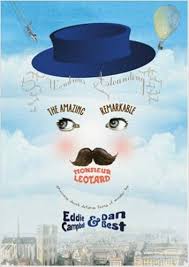
[READ: May 3, 2016] The Amazing Remarkable Monsieur Leotard

Eddie Campbell wrote The Black Diamond Detective Agency which I enjoyed, and The Fate of The Artist, which I enjoyed even more.  Both were pretty unusual–lots of different things going on.  Well, this book has even more stuff going on in it.

I genuinely didn’t know what to expect from this.  I assumed it would be a biography of Jules Léotard, the daredevil acrobat who developed the art of trapeze, popularized the one-piece item that bears his name and was the inspiration for the song “The Daring Young Man on the Flying Trapeze.”

But in this book that Jules Léotard dies on page 12.  Upon his deathbed, with no will written, his worldly possession (a fake mustache) is bequeathed to his nephew, Etienne.  So Etienne puts on the mustache and flies to Paris (in a hot air balloon, of course) to join Leotard’s troupe of circus performers.  When he finds out that they have eaten most of the animals because they were starving, his plans change somewhat.

And so this book is all about Etienne pretending to be the (possibly reincarnated) amazing Léotard and the fascinating adventures he gets up to. (more…)

Read Full Post »

naughty SOUNDTRACK: GEM CLUB-Tiny Desk Concert #181 (December 16, 2011).

gem clubGem Club is a quiet band.  During this set there are three members:  Christopher Barnes on keyboards and lead vocals, cellist Kristen Drymala and vocalist Ieva Berberian (who is eerily silent and still for much of the performance).

The first song, “Animal” features Barnes on keyboards, playing a simple melody and Drymala, playing a low and loud cello to accompany (when her first note comes in, it’s really striking).  She also sings a wonderful harmony vocal.  Barnes’ voice is almost a whisper, but between his voice and the vibrato on the keys, it sounds really big (but still quiet).  I really enjoyed the way the only “melody” she played on cello was at the very end of the song–a brief riff to signal the end.

“Breakers” opens with some rough cello playing and then a gentle echoed keyboard.  Ieva Berberian didn’t do anything in the first song, she just hovered mysteriously in the background. But for the second song she hits occasional tambourine notes (which sound practically like explosions amid the delicate echoing keyboards).  Perhaps the most interesting part of the song is watching Drymala tap on some  colorful bells with her foot to create a lovely melody.

For the final song, “252” Barnes says it is kind of a beast, (although it doesn’t sound any more complex than the previous two to me).  The piano is echoed and Ieva Berberian finally sings backing vocals.  Her voice is a little haunting and it works very nicely with Barnes’ voice.  The melody is beautiful.

Incidentally, the blurb says that this is the first time they’ve amplified a singer’s voice (they ran his voice through a chorus pedal to give it that otherworldly echo).  I have been listening to a lot of loud music lately, and this was a perfect counterpoint.

[READ: December 20, 2015] History’s Naughty Bits

This is the kind of book that promises to be very funny.  And then it turns out to be mostly funny but also rather scholarly.  Which is not bad thing, it’s just not as raucous as one might have imagined.

Dolby begins by dismissing the idea that “naughty” things are a recent invention and then proceeds to go through the history of human culture to show examples of things that would certainly be considered naughty today (some are quite shocking).

She starts with Classical Greece where women were expected to remain chaste, except for hetairai, high-class courtesans, who were well-educated and respected.  That’s some choice.  Adultery was considered less of a sin if was committed with a prostitute. (more…)

Read Full Post »

jan2016 SOUNDTRACK: STEVE EARLE-Tiny Desk Concert #123 (April 25, 2011).

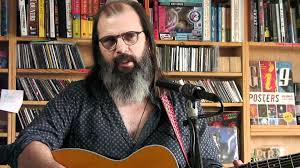
earleSteve Earle is pretty cool.  He’s a country outlaw who is a socialist and an outspoken Bernie Sanders supporter.  He is a vocal opponent of capital punishment.  He’s also written a song “directed towards the state of Mississippi and their refusal to abandon the Confederate Flag and remove it from their state flag.”

For this Tiny Desk it’s just him and his guitar as he sings songs from his then new album.

He opens with “Waitin’ On The Sky” and says it’s the first time he’s played it in front of people.  He has to restart the song because “debris from a Cobb salad shifted in his throat.”  He also forgets some of the words, but it still sounds great.

He is very chatty with lots of stories about the recording of the record and how a song that he mentions isn’t on the record, but it is on a download or vinyl.  “We used to make records for girls and now we make them for nerds.”

“Every Part Of Me” is a slow ballad, it’s quite pretty.  His voice sounds good and hard-worn as he sings.  He says it is “the song you’re most likely to hear on the handful of radio stations that actually play me.”

While tuning before his third song he says that he is  involved with a show called Treme “that’s ‘treme,’ just like it sounds… if you’re French.”  In the show he’s a street performer in New Orleans.  He says that there are non-traditional buskers–professional musicians who sing on the streets for tips (hundreds of dollars a day).  And he tells about the turf wars that began in the 80s.  Eventually an agreement was reached between the players.   That’s all a lead in to a song that is on the Treme soundtrack called “This City.”  It’s a touching song about New Orleans.

I’d always thought that he was much more “country” sounding, and maybe he is on record, but at least here, he is simply singing well writing and well-though out songs.

[READ: February 23, 2016] “To Laugh That We May Not Weep”

This is a brief essay about cartoonist Art Young.  Young would be 150 years old this year and Spiegelman says that Bernie Sanders would have been the best birthday present we could have given him.  Because Art Young was a radical! Political !! Cartoonist!!!  (the oblivion trifecta).  The only concept less inviting is a political radical.

Spiegelman says that once upon a time political cartoonists were very powerful (although in some respect they still are, as you can see by the the murdered Charlie Hebdo artists).

Young was a talented cartoonist who drew for all kinds of publications.  He was never convicted for his drawings, but he was put on trial for libel.  He was found not guilty; he drew a picture of himself sleeping with a caption “Art Young on trial for his life.”

Spiegelman contends that political cartoons are usually short-lived and timely but that Young’ are more timeless–and perhaps sadly still relevant.  And that he was never shrill or humorless. (more…)

Read Full Post »

« Newer Posts - Older Posts »