Feeds:
Posts
Comments

Archive for the ‘Graphic Novel’ Category

aboveSOUNDTRACK: DO MAKE SAY THINK-& Yet & Yet [CST020] (2002).

DmstandyetandyetAfter the previous album, keyboardist Jason McKenzie departed the band.  I’m not entirely sure how this impacted the band, but this album is warmer and a little more delicate feeling.  It’s also their first album that was recorded all in the same place (in band member Justin Small’s house).

The disc opens with static and effects before a jazzy drumbeat comes in.   “Clasic Noodlanding” is mellow with a complex (for them) riff on the guitar and nice washes of keyboards.  It is primarily atmospheric until about two minutes in when it suddenly changes with the introduction of a great bass line.  And then this atmospheric song turns really catchy. The five and a half-minutes feel too short in this song.

“End of Music” opens with jazzy drums and keyboards.  It’s a slow piece that stretches to nearly 7 minutes.  About half way through the song, the drums come crashing in and a brighter, noisier melody takes over.  This end section is really catchy with some great chords and excellent drumming.

“White Light Of” opens with a cool slow bass line and drum pattern.  As the song grows in complexity I like the new bass rumble that is added and the way the guitar lines seem to intertwine. About half way through horns get added to the mix, quietly at first and then they slowly take over the song. About five minutes in the song comes to abrupt halt with some interesting echoed effects on the drums. It resumes again with a stranger version of the song—it feels unsettled and really interesting, with a nice riff interspersed with one that feels off somewhat.

“Chinatown” opens unlike any DMST song.  The bass sounds electronic and skittery with some interesting keyboard sounds over the top (it actually sounds a bit like later period Radiohead).  The song is slow and moody for all of its 5 and half minutes with keyboard washes and skittery guitars.  There are quotes thrown in throughout the song but I can’t tell what they are saying.  This song was features in the film Syriana.

“Reitschule” is one of two songs that are 9 minutes long. It opens with a slow meandering guitar line interspersed with another guitar playing an interesting counterpoint.  A cool bassline comes in around 2:30 which takes the song in a new direction.  Horns propel the song along until about 4 minutes when a jangly guitar takes over the song. It builds with some abrasive guitar chords until everything washes away except the bass.  And then it rebuilds as something else.  Distant horns play in the back as the guitars play overlapping lines.  It’s an epic song that demonstrates how much this band can do.

“Soul and Onward” has a pretty conventional melody line. It’s warm and friendly It also features wordless vocals by Tamara Williamson. I love the little tiny guitar lick that works as a bridge between the two sections.  This is my favorite song on this record.

“Anything for Now” is the other 9 minute song. It is slow and pastoral to start with a beautiful multi-guitar piece with gentle drums. At around 4:30 all the instrument vanish except for a single organ note. It plays for a bout a minute and it seems like the disc will end that way but then the chords build up again from the drone.  An acoustic guitar lick begins around 7 minutes in and runs through the end of the song.

Overall this album is more mellow than their previous discs, and there are some amazingly beautiful sections of music on this album.

[READ: February 8, 2016] Above the Dreamless Dead

I’m continuing with books that I wouldn’t normally read, to celebrate First Second’s #10yearsof01 challenge and to read something out of my comfort range.

This is a collection of poetry about World War I, written before during and just after the war.  Each of the poems is illustrated by a different contemporary artist.

As you can imagine, the book is pretty gloomy.  But the poetry is pretty spectacular and the illustrations were really interesting.  Obviously this book is not going to be a happy one.  But some of the artists do add a more positive spin on the poems (while some are just brutally violent as well). (more…)

Read Full Post »

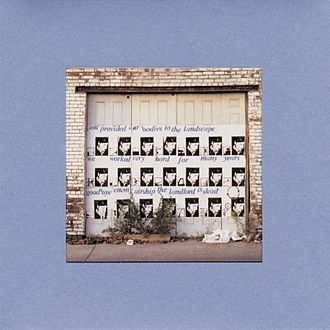
6SOUNDTRACK: DO MAKE SAY THINK-Goodbye Enemy Airship the Landlord Is Dead [CST010] (2000).

330px-DmstgoodbyeenemyAfter their debut album, Do Make Say Think made this second album which sonically fits together perfectly and really explores instrumental post-rock.  Most of the songs were recorded in a barn giving it a very big sound (complete with insects chirping).  While there were horns in the debut, they seem to be punched up a bit more on this record, and they really seem to help the record rock more.

“When Day Chokes the Night” song is 6 minutes long and I love the way the opening is a simple guitar melody slowly picked and strummed for 3 or so minutes. Then at 3:30 there’s a noisy “drum solo” that sets you up for the second half of the song which introduces wailing saxophone and it all really rocks out.

“Minmin” is 8 minutes long.  It opens slower but adds a steadily propulsive bass and drum pattern. Around 5 minutes the drums become martial and a new rhythm and bass pattern enters as the song gets bigger.  The riff is a solid rock riff and there’s some interesting feedback behind it.  It’s some of a classic construct of a slow building song that shifts gears midway through.

“The Landlord is Dead” (at a brief 5 and a half minutes). opens with a similar echoing riff, this one is more catchy than the others. Some horns fill out the background.  The song builds properly to a screaming guitar soloing wild ending.  It’s easily my favorite song on the record.

“The Apartment Song” is slower, with echoing guitars and a more trippy feel.  I love the way the really noisy guitars blast out for 8 notes and then recede again.  It’s the first of two songs under four minutes

“All of This is True” starts out with a noisy drum beat, open chords and a distant horn.   This song slowly builds for about two minutes before pausing entirely and then resuming as something else—more slow horns layering on each other the horns drift away and guitars take over again.  There’s something of a dancey beat on the drums all along.  The song ends with crowd noises and someone shouting “Merry Christmas Everybody” before seguing into “Bruce E Kinesis.”  “Kinesis” opens with a heavy bass line and insistent drum beat before the interesting guitar counterpoint plays over the riff.  For the first time, really, a keyboard riff takes over  It feels slightly sinister.  This song has a kind of claustrophobic feel, but with a kind of funky drum all the way through.  At only 3:40 this song feels compact and efficient, and as something of a lead in to the 12 minute album closer “Goodbye Enemy Airship”

The final takes a while to get where it’s going.  After some introductory drumming there’s plenty of one-note guitar and horns which keep growing louder and more insistent for the first 4 minutes.  It turns into a very bright guitar melody–bouncy and fun.  (This is one of the two songs not recorded in the barn).  It develops a distinctly jazzy feel.   The song gets bigger with some great bass chords alongside the repeating riff on the guitar.  At around 9 minutes the song morphs into the third part of this exploration of similar riffs and textures. This one is a bit trippier. The disc ends with some mildly dissonant keyboard notes as the guitar echoes to halt.

While I do enjoy their debut, this album feel like a giant stride forward in terms of composition and cohesion.

[READ: February 3, 2015] Moomin Volume 6

Moomin Book 6 is composed entirely of strips written and drawn by Lars Jansson.  Lars was 12 years younger than Tove.  He was a writer, translator and gold-miner (!).  He wrote his first novel at fifteen and then proceeded to write 8 more.  Lars translated the earlier strips into English as Tove wrote them in Swedish.  Tove’s contract was to expire in 1959, so he began teaching himself how to draw Moomins (Tove didn’t know).  Tove’s creative fatigue set in and so Lars wrote his first comic in 1956 and by 1960, he was ready to take over.  The newspaper syndicate approved the switch and so these final strips all belong to him.  He created Moomin for fifteen years–twice as long as Tove worked on it.  These stories originally ran in the Evening News, London 1960-1975.

I love that they must have agreed that each strip would open with a big Moomin behind as well.

The chapters are “Moomin’s Lamp” “Moomin and the Railway and “Moominpappa and the Spies” “Moomin and the Circus”

(more…)

Read Full Post »

catblackSOUNDTRACK: EL VY-Tiny Desk Concert #505 (January 29, 2016).

el vyMatt Berninger of The National and Brent Knopf from Menomena joined together to form EL VY.  I’m not sure what the band sounds like on record, but for this tiny desk, it’s just piano and voice.

It’s always interesting to see a singer with nothing else to do.  Berninger doesn’t really do a lot when he’s singing with the National, so here, he just stands with his hands in his pockets, singing his intensely personal lyrics.

In “No Time To Crank The Sun” Berninger’s voice is higher than usual.  It’s quite nice.  I especially like the piano melody and the way he created some really unexpected notes in the transition from verse to bridge (or whatever parts they technically are).  This song feels a little long at 5 minutes but there are a lot of parts to it.

Berninger’s speaking voice is quite deep, and that’s the way it sounds on the second song, “Careless.”  he introduces it as “another sad love song.”  Lyrically it’s a little obvious, especially given that there’s not much music to hide behind.  But it is a nice ballad.

My favorite of the three songs is the third one, “Need a Friend.”  Berninger is a fun performer, commenting, “Happy New Year and thanks for having us.”  Then looking at the audience and saying “Could you keep it down back there?”  This song is a bit more bouncy in the piano.  A little more upbeat, which is nice.

After most shows, the audience claps, and maybe you hear people chatting.  At the end of this one, people clap and there’s some silence and you hear Berninger joke, “Awkward,” before the show cuts off.

[READ: December 10, 2015] Cat Burglar Black

I’ve been reading so many graphic novels recently, that I haven’t had time to post about some of the ones I read a while back.  But since this is First Second’s #10yearsof01 month, now’s the time.

I wasn’t sure what to make of the title of this book until it was used in context–the girls are wearing “cat burglar black” to sneak around.

K. is a teenager.  She is an orphan and had been living in an orphanage until her Aunt learned about her and invited her to the Bellsong Academy.  She doesn’t know this Aunt and is a little apprehensive.

When she shows up there, things are mighty weird.  There are only four girls in attendance, the headmistress is scary (I hate the drawing style of her, although the other characters are pretty interesting), and there’s a ton of unusual things going on.  The most notable thing is that whenever anyone speaks their speech balloons are filled with ellipses, making it seem like they are hiding something….which they are. (more…)

Read Full Post »

alansSOUNDTRACK: DO MAKE SAY THINK-Do Make Say Think [CST005] (1999).

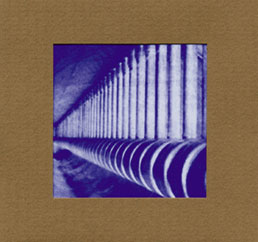
cst005web This album was self-released in 1997, but then the guys at Constellation took it and released it in a beautiful package in 1999.  And Constellation did it right: CD gatefold jacket made from 100lb. textured uncoated cardstock with foil-embossed text and window cut.  Three different two-sided duotone insert cards can be interchanged to show through the front cover window cut. Snazzy!

So this album was recorded in two different locations and it feels a bit more like  compilation of their songs than an album proper.  This doesn’t detract from the music at all, it’s just not as cohesive as their later releases.

“1978” has a raw sound.  It builds slowly, with waves of sorta static getting slowly louder for the first minute. And then the drums kick in. They sound very “live” and crisp. There’s a jazzy pattern accompanied by an unusual bass line.  At 3 minutes a big guitar riff breaks up the droning feeling as it rocks out and then disappears just as quickly.  There’s some saxophone and trippy headphone panning going on, too. This sets in motion a more funky bass line that runs like a lead instrument through the proceedings. There’s some noise bashing around at 8 minutes and a even wah wahed guitar solo at 9.  These occasional disruptions give an interesting melodic sense to this otherwise droney (in a good way) 10-minute song.

“Le’espalace”  feels a little warmer.  It opens with some analog synth trippy sounds and a pretty guitar riff. This is a lovely song that meanders around. The song gets more dense with a synth taking over the guitar line and another synth playing a contrasting melody, too.

“If I Only…”  is 7 minutes long.  It also has a rawer feel.  It’s more staccato with keyboard notes propelling the song forward. There’s a trippy middle section with a nice drum breakdown. It stops at about 5 & a half minutes and resumes with a fuller sound as it rides to the end.  “Highway 420” continues with that more raw sound.  It opens with washes of synths like Tangerine Dream or something.  There’s also a slick guitar line that begins about 3 minutes in.  It’s all rather atmospheric.

Do Make Say Think have always had a bit of jazz at their roots.  That’s evident in “Dr. Hooch” which has jazzy cymbals and slow atmospheric guitars.  About half way through, a wild synth riff comes in and takes over the song for a minute or so before returning to the atmospheric sound.

“Disco & Haze” is a warmer song that slowly builds with a spacey keyboard section.  Around 3 minutes in (of 9) a wah-wah’d guitar takes over—seemingly unrelated.   At 5 and a half minutes the song crashes into a big noisy “chorus,” probably the loudest thing on the record. There’s a noisy skronking sax solo to accompany this as well and it ends with washes of keyboards.   It really sounds like nothing else on the record.

“Onions” is only 90 seconds long.   It’s a simple keyboard riff with echo and little variation.  It’s an odd inclusion but maybe serves as a palette cleanser before the nearly 20 minute final song.  “The Fare to Get There” is warm with spacey keyboard washes and occasional woodwinds–there’s even flute at the end.  It’s 20 minutes long so just sit back and let it unfold over you.  Around 5 minutes in, eerie and spooky drums begin.  Then there’s some reverbed guitar chords and echoed notes which keep the song going.  About three-quarters of the way through, they add a simple guitar riff that continues for several minutes. With a couple of minutes left the song introduces some flutes as it mellows it way to close.

This is a pretty impressive debut.  The band knows the sound they are going for and they definitely achieve it.  Later records are more consistent (and consistently better), but this (especially the opening track) is a great place to start with this band.

[READ: February 7, 2016] Alan’s War

One of the things that First Second hoped for in their ten-year anniversary was that people might read books that they wouldn’t normally.  And boy was this ever one.  The title didn’t sound very appealing to me–I don’t really like war stories all that much.  And frankly I didn’t even know what to expect from the story, really.  Certainly not what I got!

This is the story of a man named Alan Cope.  And the origin of the story is as fascinating as the story itself (almost).  Turns out that Emmanuel Guibert met Alan Cope in the street in France.  Guibert asked the older for directions in June of 1994. Cope was 69, Gilbert was 30. They struck up a conversation.  And soon after, Cope began telling of his experiences in World War II.  What happened to him during and after the war and why this American solider now living in France.

Guibert asked if he could draw the stories that Cope was telling him and Cope said yes.  So this is a story of World War II but it is unlike any story I have ever read.  There is very little in the way of “familiar” WWII stuff in it.  Cope wasn’t in any of the major battles, he never came under heavy fire.  Rather, Cope had a fairly easy war, but he had a ton of stories that were interesting, funny, sometime unbelievable. And the number of famous people he encountered is pretty surprising.

I enjoyed this story so much.  On a side note, My father was in WWII and he also had a fairly easy war, although he was in the Pacific, he was on a small island that saw no action..  I wouldn’t say he enjoyed the war, but he came out with good experience and good friends, which is what Cope did, too.  My fathers stories were far less amazing than Cope’s, but it goes to show that everyone has interesting stories and that no amount of film or history channel commemoration will ever cover everyone’s story. (more…)

Read Full Post »

aareentry SOUNDTRACK: THE BLACK ANGELS-Tiny Desk Concert #132 (June 8, 2011).

I hblakangelsave The Black Angels’ 2013 album Indigo Meadow and I like it a lot.  It has a cool retro psychedelic vibe while still retaining a heaviness that sounds great.

For this Tiny Desk Concert, which is more or less in support of their 2010 album Phosphene Dream, the band strips down to almost a folk band.

There is an acoustic guitar, and hollow-bodied electric which I think is not plugged in (one guitar plays the bass lines and other one plays the solo notes), there’s a harmonium (the second one in a few weeks on the Tiny Desk), there’s a drummer (with basically a floor tom) and the lead singer with a tambourine.

No one is amplified except the singer–whose voice is processed to sound extra trippy (note especially the first lines of the second song, where he sounds like he’s singing from outer space).  His singing is very gentle (especially since they are basically unplugged, which makes the effects seem even more powerful).

The band plays four songs, “Bad Vibrations” which is a great way to start off.  “Haunting At 1300 McKinley” showcases that echoing voice very well.  One of the guitarist sings nice harmony vocals as well.  The harmonium has that vibrato sound that also makes the song seem trippy.

“Entrance Song” has the other guitarist singing harmony (deeper voice compared to the singer’s rather high voice).

For the final song, “Too Much Hate,” the singer plays the guitar (leaving the former guitar player with nothing to do).  The sentiment of the song is excellent, really showing off a hippy vibe.

I really like The Black Angels a lot, and this makes me think I need to check out their earlier stuff too.

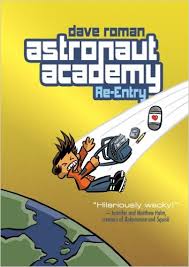
[READ: February 3, 2016] Astronaut Academy: Re-Entry

I enjoyed Book 1 a lot but I enjoyed this sequel so much more.  I’m glad that I put off reading this one until after the first because even though there were no mysterious things that I wouldn’t have gotten, the whole experience is definitely greater if you read these in order.

This book opens with a similar style–brief episodes about each person–and what they have been up to over the summer.  I enjoyed that Hakata Soy has been spending his time on earth (such a novel idea).  But that’s when he gets the devastating news that Princess Boots, the girl he gave his second heart to in the backstory, actually gave it away and is now dating his arch-nemesis Rick Raven.

Scab Wellington was released from prison (which makes Maribelle Mellonbelly happy).  And Thalia Thistle still hasn’t told her dad that she plays Fireball. (more…)

Read Full Post »

aazero SOUNDTRACK: FUTURE ISLANDS-Tiny Desk Concert #128 (May 16, 2011).

futureI don’t really know that much about Future Islands.  I know they were huge in 2014, but this Tiny Desk comes from three years earlier, when perhaps they were less known?

I didn’t really like the single that was very popular in 2014, but I can’t recall how it compares to this show. The band consists of a bassist and a keyboardist/electronic drummer and Sam Herring the lyricist/vocalist/melodramatic front man.

It’s odd seeing him sitting casually on the edge of the desk before he starts singing.  He seems so mellow and then he sings with a crazily arch voice and unexpected dramatic flourishes.

Given his general appearance and some of the faces he was making I kept thinking that Jack Black would do an aces impersonation of him.

The songs are simple musically–simple keyboard lines and, it must be said, some solid bass holding things down.  All the drama comes from the lyrics, like in “On the Water”: “Body of mine, body of Christ, can I be the one who saves your life.”

It’s funny to hear him talk between songs so deadpan and unaffected, before resuming that unusual singing style.

“The Ink Well” has some weird echoing keyboards sounds before the solid bass comes in again.  I have a hard time taking his vocals seriously, it seems so over the top.  Although the blurb says that “What Future Islands is really going for, with the mordant wit in the lyrics, the melodramatic chord progressions and Herring’s yowling, scratchy voice [I wouldn’t describe it like that, actually], is catharsis. And catharsis can happen in your head and in your heart.”    And I do like the line “the ghost of you still haunts me at night and that’s enough to keep me happy, sometimes.”

He says that the second song is hard to song quiet.  Perhaps his singing style would work better if the music was bigger, fuller (matching the size of the amp they brought with them).

“Walking Through That Door” works best of the three songs.  It is a little faster, with a more propulsive bass and it feels louder, so that Herring’s voice seems to work better. And when he wails his lines at the end it seems appropriate.

Still not sure if I’m a fan, but I appreciate them a little more than I did.

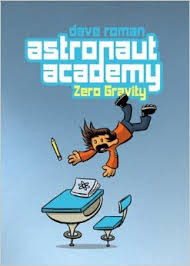
[READ: February 1, 2016] Astronaut Academy: Zero Gravity

Both of the libraries that I go to had copies of the second book in this series, and I waited and waited for the first book to be returned, but it just appears that neither one ever arrived.  So I finally put in a request for book one (I couldn’t read the second first even if this is from First Second).  #10yearsof01

I really didn’t know what this story was about, but I was surprised to discover that it was a series of small incidents (each with an End). Was this a series of single web comics, or is it just a fun way to tell a bigger story?  I’ll never know.  The whole story is set at the astronaut academy.

As the book opens we see a promotional guide to Astronaut Academy from the principal (who carries a big sword and has big spiky hair).  We learn what the school has to offer and we see some of the teachers like Mr Namaguci who has even bigger hair than the principal and “may or may not have magical powers but is still handsome.”  There also Señor Panda (still not extinct) who has a secret.

We also see that the application is for Hakata Soy. (more…)

Read Full Post »

moomin5  SOUNDTRACK: JAMES VINCENT McMORROW-Tiny Desk Concert #151 (August 25, 2011).

mcmorrowI don’t know McMorrow. He is an Irish singer who plays acoustic guitar.  His singing voice switches between a kind of raspy voice and a keening falsetto.

He plays four songs and his style and voice reminds me a lot of Bon Iver.

I don’t find any of his song especially compelling. They’re all nice–the humming part of “This Old Dark Machine” is pretty memorable.  As the part in the middle where he seems to get pretty intense.

“Sparrow And The Wolf” has some nice chord changes.  I think my favorite song is “Follow You Down To The Red Oak Tree,” which opens a little differently.

I have to say it’s a little awkward watching him up close as he does some pretty unusual things with his face when he sings.

The final song, “Red Dust” really shows off his falsetto.  I found his songs to be entirely pleasant and think they would sound great in a coffeeshop on a Sunday afternoon.

[READ: February 3, 2015] Moomin Volume 5

Moomin Book 5 is composed entirely of strips written by Lars and drawn by Tove.  These are the final strips that she contributed to.  And, as such, there are only three chapters in the book.  As with the others these stories originally ran in the Evening News, London 1953-1959.

The chapters are called “Moomin Winter” “Moomin Under Sail” and “Fuddler’s Courtship”

(more…)

Read Full Post »

primatesSOUNDTRACK: OTIS TAYLOR-Tiny Desk Concert #120 (April 13, 2011).

otisOtis Taylor is a big, burly, bearded man who plays the banjo. His band consists of fiddle, drums and electric guitar and bass.

The songs are bluesy without being like the blues, and they are folky without really being like folk music.  And the way he plays the banjo is unlike any typical banjo song I’d heard before.

The blurb explains what makes his songs sound so different:  He plays a style of music he calls trance blues.

Taylor’s music is trance-inducing, and he achieves that effect by playing songs that are modal: Sometimes, they sit on one chord for the entire song. Taylor says that by doing that, by eliminating chord changes, you also eliminate reference points, so songs can run as long as 10 or even 15 minutes in length.

And it’s true.  The basic melody of he first song, “Ten Million Slaves” (which is only 4 minutes) stays the same throughout the song.  It’s the fiddle (played by Anne Harris) that throws the new notes and riffs into the song that keep it so interesting,

He does throw in a simple but affecting solo at the end of “Ten Million Slaves” but it’s more fun to watch him rock out the end of the song.  That song also appeared in Public Enemies, the Michael Mann movie.

He calls his music trance blues music, came from Mali and Mississippi Hill Country.

The main riff of “Ran So Hard The Sun Went Down” is instantly familiar and a little dark.  I love the middle jam section where it just seems to gets bigger and bigger (I guess that’s the trance).

For the third song, “Talking About It Blues,” Taylor switches to acoustic guitar.  This is a fairly simple blues song, but I love the guitar riff that punctuates the verses.  The verse is simple enough “my daddy cut down a tree, make a guitar for me.”  This song features a lengthy solo by J.P. Johnson.

The drums (by Larry Thompson “Bryant Gumball of the drummers,”) and bass (by new bassist Todd Edmunds) are really simple but they sound great and really punctuate the song.

It’s a short song that segues into the final song, “Think I Won’t” which has a heavy five note riff to open with.  I love that it takes him forver to end this song.  Saying one more time even though they do more than one more time.

I don’t really like blues songs that much.  But this band is really tight and the addition of the fiddle really makes these songs stand out. Plus after those cool droning blues songs I was hooked.

[READ: December 15, 2015] Primates

I had been planning to post magazine stories this week.  Then I learned that it is First Second’s ten-year anniversary and they are trying to promote it with the cool hashtag #10yearsof01.   Since I’ve read a bunch of First Second books in the last couple of months, I’m going to give them a deserved shout out by posting a few in a row and including that hashtag.

This is a non-fiction graphic novel from First Second and it is outstanding.  In a wonderfully kid-friendly style, it talks about the incredible work done by Jane Goodall, Dian Fossey, and Biruté Galdikas.  And the man behind their success, Leonard Leakey.

The story opens on Jane Goodall.  After visiting a friend in Kenya, she spoke to Dr Leakey (who tells of his childhood growing up in Kenya).  Through their meeting, Leakey gained funding and sent Goodall to Gombe to study chimpanzees in 1957.  She soon discovered them using tools and eating meat.   Her work caused them to, as the book puts it, “redefine tools, redefine Man or accept chimpanzees as human.”

Then she went further and learned so much more about chimpanzees, using techniques that were not exactly scientifically approved (sifting through dung, setting up places for them to eat) but wound up being amazingly effective.

Jane married Hugo, her photographer and then they were visited by Dian Fossey. (more…)

Read Full Post »

moomin3  SOUNDTRACK: THE BLIND BOYS OF ALABAMA-Tiny Desk Concert #139 (July 5, 2011).

bboaI have of course heard of The Blind Boys of Alabama, but they only came on my radar maybe a decade or two ago.  And I never knew these things about them:

  • They formed under a different name in 1939.
  • The band has understandably experienced many lineup changes in the 72 years since.
  • Singer Jimmy Carter is the only participant in this lineup billed as a founding member, and even that term is up for debate.
  • They have released 60-plus albums and received a Grammy Lifetime Achievement Award
  • And that wherein these Blind Boys are young and old, blind and sighted.

There are six players for this Tiny Desk–a guitarist, a bassist and a barely visible drummer as well as three singers.

It makes me laugh that the guy on the far left sings much less than the others and seems to be less happy about being there.

They play four songs and, no surprise, they sound fantastic.  Their harmonies are outstanding and the music is quiet and subtle–a mellow accompaniment for this soulful music.

But their rendition of “Amazing Grace” is indeed amazing–they do it to the tune of “House of the Rising Sun” and it must be heard to be believed.  I happen to really like the original of “Amazing Grace” and I hate when it is done poorly.  But I love this interpretation–it’s original and still moving.

  • “Take The High Road”
  • “I Know A Place”
  • “Jesus Built A Bridge To Heaven”
  • “Amazing Grace”

[READ: January 23, 2015] Moomin Volume 4

Moomin Book 4 changes things pretty dramatically.  Because starting with this book, the stories were written by Tove’s brother Lars!

The colophon explains “[Chapters 14-17 were written by Lars [Jansson] and drawn by Tove.  Chapter 18 was to be run before Chapter 14 and be Tove’s farewell strip but she stayed on to draw 7 more chapters].”

So that means that the first four chapters in this book were written by Tove’s brother but she drew the art.  How fascinating.

This book contains the stories: “Moomin Goes Wild West,” “Snorkmaiden Goes Rococo,” “The Conscientious Moomins,” “Moomin and the Comet,” and “Moomin and the Golden Tail.”  As with the others these stories originally ran in the Evening News, London 1953-1959. (more…)

Read Full Post »

mermin2SOUNDTRACK: BOOKER T. JONES-Tiny Desk Concert #125 (May 2, 2011).

Booker T. Jones is the Booker T from Booker T. & the M.G.’s whose classic “Green Onions” is one of my favorite instrumentals ever (and probably why I enjoy the Hammond sound so much).

And he plays it here.  He says he wrote it when he was 17 years old (in 1962)–a senior in high school.  And he still enjoys playing it.

They did some furniture moving to get the desk-sized Hammond B3 organ and its sturdy wooden Leslie speaker cabinet to where Bob’s desk normally goes, and it is worth it.  Booker T. even gives a brief lesson about “crawling” on the organ and what drew him to it in the first place when he was ten years old.

After playing “Green Onions,” he switches sounds on the organ to play a wonderfully menacing version of “Born Under a Bad Sign” (a song he also wrote).  It’s so very different on the organ–and I much prefer this version to the familiar one.

The final song is called “Down in Memphis.”  It was a new song in 2011 but it is the song I like the least.  There’s nothing bad about it–it’s just kind of plain and simple.  It’s more of him singing (about Memphis, which doesn’t mean much to me) and less of his organ playing.  But that’s okay.  His voice is still amazing.

I’m all about that Hammond.

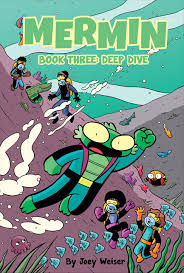
[READ: January 21, 2016] Mermin: Book Three

After waiting nearly three years between books one and two, I waited one day between books two and three.  I actually assumed that this series was a trilogy, but I have learned that there is a part four already out.

Book three opens up in the Kingdom of Mer.  Mermin is a little boy (uh, fish, uh, whatever) and he is having a really hard time learning to control the sea.  He should be able to use his thoughts to make the water move.  But he stomps out in frustration.

Then we jump back to the present where our gang (Pete, Toby and his sister Claire and Penny) along with Mermin and Benni are being driven in a ship to Mer.  And Mak is driving the ship (I don’t think I knew that my favorite walking whale had a name).

Their back home “plan” for heading to the sea involved having Randy tell everyone that they were away camping.  Of course, Randy is a bad kid and can’t be trusted, so it should come as no surprise to see that he stowed away on the ship (we never actually find out what happened back home). (more…)

Read Full Post »

« Newer Posts - Older Posts »