Feeds:
Posts
Comments

Archive for the ‘Graphic Novel’ Category

recessSOUNDTRACK: BUIKA-Tiny Desk Concert #298 (August 26, 2013).

buikaI had never heard of Buika before, so I had to rely on the blurb:

Concha Buika’s voice doesn’t come from inside her petite body: It comes from Africa, and from the past. There are obvious traces of flamenco, itself a historical mash-up of the Moors and various transitory cultures in southern Spain and north Africa.

During her flights of improvisation, we also hear the influence of Cuban vocalist Celia Cruz, a product of Afro-Cuban culture, mixed in with Ella Fitzgerald, who was the pinnacle of African-American jazz vocal expression.

In these two performances, we hear Buika interpret her own lyrics after a handful of albums in which she’s interpreted others’ words. With her eyes closed tightly, she inhabits these poems of love and heartache as if she were reliving them again before our eyes.

Buika’s singular voice has attracted a cadre of fans who’ve become enchanted by her voice and her leave-it-all-on-the-stage performances in clubs and theaters around the world. Watch this video and join the club.

So as the notes say, these two pieces are improvisations.  Not knowing Spanish all that well, I don’t know how much is made up or even how much is just sounds rather than actual words.  But it certainly sounds more off the cuff than written out.

The music is just a piano and a box drum and her voice.  Her voice is raw and pained, but quite pretty.  The two songs are called “La Noche Mas Larga” and “La Nave Del Olvido.”

[READ: April 15, 2016] Comics Squad: Recess

I found out about this collection in the back of a Babymouse book.

Comics Squad is a collection of eight comics from some of my favorite artists.  It basically works as a bunch of short, shall we say graphic novellas, from Jennifer L. Holm and Matthew Holm (Babymouse/Squish) ; Jarrett J.  Krosoczka (Lunch Lady) ; Dav Pilkey (Captain Underpants) ; Dan Santat ; Raina Telgemeier and Dave Roman  (Smile and Astronaut Academy); Ursula Vernon (Dragonbreath) ; Eric Wright (Frankie Pickle) and Gene Luen Yang.

Since it’s edited by the Holms and Krosoczka they sprinkle the book with marginal comments and interstitials from Babymouse and Lunch Lady.  But each artist/author gets a story, and I enjoyed them all.

GENE LUEN YANG-“The Super-Secret Ninja Club”  This was a really fun story about a group of boys who meet at recess.  Once they know that noone is watching, they put on their masks and become the super-secret ninja club.  But Daryl, a decidedly un-ninja like boy wants in…desperately.  He’s never had a passion for any club before but this one is totally him.  The one boy says that since winter break is about to start, when the get back to school, they can talk about him joining.  So Daryl spends all inter break practicing.  Will it be enough?  The answer is very funny.

DAV PILKEY-“Book ‘Em, Dog Man!”  This story begins with a letter to the parents of George (the main character in Captain Underpants) from his teacher saying that she asked for a written assignment and once again he drew a cartoon.  She has attached the offending (and offensive) cartoon for them to see.  Petey the cat is in jail .  He wants to beat the superhero Dog Man.  But Dog Man is too smart  So Petey realizes that if he removes all the words from books no one will be smart anymore.  He invents a ray which does just that.  What will the world do when they can’t read anymore?

JARRETT J, KROSOCZKA-“Betty and the Perilous Pizza Day”  “Lunch Lady” is a cartoon I didn’t really know before reading this collection. Lunch Lady appears in the margins of the pages of the book, but not in this actual cartoon.  Rather, the star of this cartoon is Betty, Lunch Lady’s helper. And since Lunch Lady can’t be there, Betty will have to deal with lunch.  But it is pizza day!  The only hope is the Pizzatron 2000.  Unless, of course, it develops a mind of its own and goes on a rampage.

URSULA VERNON-“The Magic Acorn”  I don’t know Dragonbreath all that well, although C.  has read all of them.  This story is pretty simple.  Although since I don’t know the characters I don’t know if it is representative of anything prior.  Scratch, a squirrel who is rather realistically drawn (Vernon’s drawings are great) is interrupted by Squeak, a far more a cartoony squirrel.  Squeak is excited because he found a magic acorn.  Scratch states that this is the 318th “magic acorn” that he’s found.  And besides they have recess in ten minutes.  Well, this acorn may not exactly be an acorn, but it is certainly magical.

JENNIFER L. HOLM & MATTHEW HOLM-“Babymouse: The Quest for Recess”  In this brief story Babymouse has a few fantasies that prevent her from actually getting outside for recess.  First she is late for school (dreaming about Camelot) then her locker brings her to Zeus, making her late for class.  A western dream makes her disrupt lunch and then the barbarian fractions invade during math class.  Can she keep it together and actually get outside?

ERIC WIGHT-“Jiminy Sprinkles in ‘Freeze Tag'”  So I don’t know this comic at all either. Jiminy Sprinkles is a new student to the school (he is a cupcake). He immediately befriends a peanut who tells him to watch out for The Mean Green Gang, a group of vegetables.  (Their leader is Russell from Brussels (ha)).  The Mean Green Gang is pretty tough but Jiminy has a secret weapon of his own–a very funny one that the Mean Green Gang actually gets a kick out of too.

DAN SANTAT-“300 Words” This is an interesting look at the story The Giving Tree.  The kids were assigned a book report on the story three weeks ago and it is due today.  John is one of the boys who didn’t do the assignment and he’s about to write his 300 words now.  It’s a tree. It gives things.  But another boy has a better idea–he’s going to ask Sophia for her paper.  Even though the last time he talked to her he threw up on her.   Sophia has an interesting answer for him.

DAVE ROMAN & RAINA TELGEMEIER-“The Rainy Day Monitor” is a wonderful take on kickball.  Since the kids can’t go outside to play because of the rain, their recess is indoors.  And they are closely watched by Boring Becca the totally boring fifth grader.  When they ask if they can play kickball inside she asks the kids if they have ever played Dungeons and Dragons.  They groan until she says they should play kickball using dice and imaginary characters.  Pretty great idea Becca!

The end of the book is set up with fun fake ads and useful tips.

One “ad” is an offer for Babymouse Binoculars.  I also really liked Lunch Lady’s tips on how to draw Betty (which skip from 3 to 12 while Squish sweats).

This was not only a great introduction to all of these fabulous comic writers, it was a really funny collection in its own right.

The end of the book says “Do you think there will be another one? As sure as there is syrup on pancakes there’ll be a Comics Squad #2.”  And indeed, there was a second one.

Read Full Post »

dragonpunchjohnny SOUNDTRACK: PEDRO SOLER AND GASPAR CLAUS-Tiny Desk Concert #216 (May 14, 2012).

edrogasparPedro Soler and Gaspar Claus are father and son.

Soler plays a delicate, intimate version of flamenco guitar, while his son turns the cello into an exquisitely expressive voice.

I feel like the two could not play any differently and yet their styles meld to create some beautiful music.  The blurb continues:

Though 45 years separate them, pay attention to how they communicate. Music as a living language, and an invisible emotional exchange, is clearly apparent in these improvisational compositions.

The two are pretty fabulous to watch and hear.  Pedro plays so many different styles with his guitar–finger picked flamenco delicacy all the way to aggressive powerful strumming.  Gaspar can also play beautiful soaring melodies–both low and high notes– and then at times he will bow so hard that you can hear the pressure he’s putting on the strings.

They play two pieces.  “La Petenera” is a new song which talks about a woman who was very beautiful.  She had a “love crisis.”  In order to get revenge she had all of the men in the village fight and they all killed each other over her.  Pedro also tells us that Federico García Lorca wrote  three poems about her.

About 4 minutes into the song he plays some crazy noisy stuff that would make any noise band proud. And then he comes out of that chaos with some incredibly delicate bowing.

Gaspar is also not afraid to make serious noise—sliding up the strings to the highest notes and squeaking them or sawing gently while Pedro plays some beautiful melodies.

But Gaspar also plays beautiful passages as well and he seems to be watching hm all the while

Bob asks if they can remember the earliest times they played together.  Pedro (in very broken English) explains that he was giving a flamenco guitar class and Gaspar was watching and then he repeated the exercises on the cello and Pedro says his eyes bugged out.

“La Graneña” is a kind of music from Grenada.  It starts slowly and is a beautiful piece with a lot of lovely guitar playing and Gaspar’s beautiful cello.  It’s very different from the noisy passages of the first piece.   There are some amazingly high soaring notes he plays on the cello, too–almost touching the bottom of the instrument.

About half way through the song it builds and builds with steady chords until it settles down into a quiet picked guitar and plucked cello melody.  It’s delightful and so very different from the rest.

[READ: February 11, 2016] Johnny Boo Meets Dragon Puncher!

It took four years for a new Dragon Puncher book to come out.  And it’s a crossover with Johnny Boo!  (You could also say it took one year for a new Johnny Boo book to come out and its a crossover with Dragon Puncher, but whatever).

This book is set in the winter and Dragon Puncher is looking for the Ice Dragon.

She demands silence as she prepares for battle.  Spoony-E is getting majorly impatient waiting for her to prepare.  And then while “meditating,” Dragon Puncher falls asleep. (more…)

Read Full Post »

zooms SOUNDTRACK: NOVALIMA-Tiny Desk Concert #208 (April 12, 2012).

novalimaNovalima is a band from Peru.  And the blurb really captures them quite well:

Something about tradition inspires reverence and creativity. Throughout Latin America and parts of the U.S., musicians are exhuming centuries-old musical cultures and infusing them with new life to create songs that sound both familiar and new. Peru’s Novalima is doing just that with Afro-Peruvian music.

Over the course of three superb albums, the group has addressed the legacy of slavery in Peru in the form of the traditional lando, a dance rhythm with roots in West Africa. The slow, deliberate beats are played out on a variety of traditional instruments — most notably the cajon, a big rectangular box that drummers hit before drawing sounds out with their palms and fingers. The result can be as deep as a bass drum, but can also hit the high-pitched pops of finely tuned bongos or Middle Eastern dumbeks.

They play three songs which feature acoustic guitar and five string bas anda  lot of percussion–including a donkey jawbone.

“Karimba”is sung by one of the men drumming.  There’s lots of group singing as well–a real party feel.

“Guayabo” and “Festejo” are sung by the female singer.  The bass line for “Guayabo” is just great–weird and almost punk.  It’s kind of sinister even if they don’t sound sinister singing over it.  He’s also wearing a strange kind of drum around his neck–like a box that opens and closes (and you store the sticks in it, apparently.  The middle of the song is all percussion and voice–a celebration of sorts, before that bass returns.

“Festejo” also has a strange, interesting guitar riff.  There’s some great call and response parts of the song–the men really getting into it.  As the song ends the guy with the box and the woman get up and dance in the crowd.  By the end of the song, you realize that it’ sa lot of fun–a groovy dance song like no song you’ve ever head before.

[READ: March 7, 2016] Johnny Boo Zooms to the Moon

As this fifth book opens Johnny is riding a skateboard and Squiggle is towing him.  They are going to go to the moon.  But even Squiggle Power cant get the skateboard to move more than a few inches.  But Squiggles never give up so they wind up falling asleep, no further than when they started.

In the dark, stars come down to see what Johnny is doing.  They tell him he needs star shaped wheels to go to the moon, and that “almost makes sense.”

The stars prove to be very funny–fighting over counting and them fixing his skateboard by braking the wheels of so the stars are now wheels.

And off they zoom, going very fast! (more…)

Read Full Post »

20SOUNDTRACK: ARTURO O’FARRILL-Tiny Desk Concert #303 (September 14, 2013).

arturo Arturo O’Farrill is not, as I expected, an Irish traditional musician.  He is, in fact, a Latin jazz pianist.  And the blurb states:

Latin jazz works best when the musicians involved are as fluent in Afro-Cuban rhythms as they are in the deep grooves and advanced harmonics of bebop. Arturo O’Farrill has that pedigree in his DNA: His father, Chico O’Farrill, was part of a groundbreaking group of musicians who created the mash-up of Afro-Cuban music and jazz back in late-’40s New York.

The octet you see in this video is a stripped-down version of the Afro Latin Jazz Orchestra, which is at least twice as large — don’t think I didn’t try to get the whole band behind Bob Boilen’s desk — and dedicated to both preserving the legacy of the elder O’Farrill and documenting the younger musician’s efforts to move the music forward.

The octet includes trombone, trumpet, sax, bongo, conga, drums, bass and of course, piano.  And they play three pieces (for quite a long set).

“In Whom…” has a good swinging feel with O’Farrill’s piano running wild.  At one point they cut to the conga player and the lady behind him is checking her phone (rudeness even in 2013!).  But it’s not all about the piano, there s sax solo and then a fairly lengthy bass solo.  Indeed there are many bass solo moments in this concert–Arturo certainly shares the spotlight.

The second song is “Compay Doug.”  He explains that “compay” means some who is not family but who is as close as family or maybe even closer.  The main melody has a cool fast/slow riff and then there’s another long bass solo.  There’s some great conga work in the middle of the song ( you can hear the percussionist use a rain stick, too).  Late in the song there a trumpet solo.  So even though this is ostensibly a pianist’s performance, there is much more–but don’t be fooled, his piano playing is intense!

The final song is called “Mass Incarceration Blues.” He says many years ago it was called “Blue State Blues,” then it became “Stop and Frisk Blues” and now it’s called “Mass Incarceration Blues.”  NPR’s Felix Contreras joins them (he ha so many cameos!).  There’s a super fast series of opening piano runs.  Then there’s a surprisingly fun (given the name) staccato melody and lots percussion.  And, as if to get everybody a moment to shine, this song includes a trombone solo, a sax solo and Felix even gets a conga solo.

[READ: July 5, 2016] Goes for the Gold

This book came out in time for the 2016 Summer Olympics, and Babymouse joins the swim team!

The book begins with her doing a fantastic dive (called the Reverse Messy Whisker Dive) only to wake up in her backyard kiddie pool.

Despite her fantasy of doing dramatic dives, she actually spends all of her time after school reading and eating cupcakes.  Her parents insist that she do something–join a team or whatever.  She chooses to join the school swim team, “The shrimps.”  She figures how hard can it be, “I mean, swimming’s not even a real sport.”

Well not when you wear the suit that Babymouse has on.  She is encouraged to wear a proper swimming suit and goggles and a cap (to much amusement of everyone).

But swimming proves to be hard–between trying to go straight, the way the chlorine dries out your fur and the whale living in her locker (Moby-Dick, anyone?), it’s more than just splashing in a pool.

Especially when we see the other team–actual sharks!  And is that a giant squid at  the bottom of the pool?

But The Shrimps are very good and when Felicia Furrypaws dismisses swimming as not even a real sport, Babymouse has second thoughts–or at least would rather stay up late eating cupcakes.  Will she feel guilty about letting her team down?  Of course, she will.

But what will she do about it?

Read Full Post »

19SOUNDTRACK: MARTIN HAYES & DENNIS CAHILL-Tiny Desk Concert #269 (March 11, 2013).

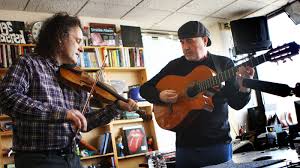
hayescahillEven though I have enjoyed much Irish music over the years, I was unfamiliar with Martin Hayes and Dennis Cahill.

The blurb says:

You’re about to watch one of the best fiddlers on the planet and a subtle guitar master work their magic. For too many of us, Irish music is something that merely gets trotted out around … St. Patrick’s Day and the coming of spring — and made a cliche by commercialism.

But for a moment, stop, put aside your notion of jigs and reels, and just listen. Martin Hayes plays his fiddle with an exquisite touch and tone, as well as a magnificent sense of melody and rhythm that never ceases to astonish.

Hayes has worked with many accompanying musicians, and some are equal partners, but with Dennis Cahill you get delicate support. It’s a rhythm that keeps the tune in; that accents and colors it but never overtakes it. It’s brilliant restraint that serves the music and perfectly suits his partner. So with fresh ears, come join us in a rare treat with a familiar sound.

And indeed, this is just beautiful fiddle playing and understated guitar work.  It’s a fantastic pair.

They play three pieces (some of which are actually made up of smaller independent pieces).

“The Mountain Lark/Tom Doherty’s Reel” I’m not sure when the first part ends, but I love as they get near the end of the piece—the fast bowing is just great.   Hayes gets some really amazing sounds.

As with many great Irish players, modesty is the key.  He talks about how he learned while watching his father and how he enjoys other players.  He talks about how traditional Irish music is not slavishly about the past, but it incorporates new elements into an old tradition.  As you can tell by the name of the second half of this next pair: “P. Joe’s Reel/The Barack Obama Reel.”

He also says that it’s good to see you get music breaks.  Music breaks should be part of all work—lunch break and music break.  The final piece is in fact a traditional piece called “O’Carolan’s Farewell To Music.”  It was originally written for harp by Turlough O’Carolan and is rumored to be the final piece that O’Carolan played before he died.  The transposition to fiddle and guitar is perfect.

[READ: February 8, 2016] Bad Babysitter

Babymouse continues to delight with the funny stories and amusing spoofs.

This story opens with Babymouse dreaming about “The Old Woman Who Live in a Shoe” (which is instantly transformed into a bunny slipper).  She wakes from her daydream about comics to see an ad for a Super Scooter, only $79.  There’s no way Babymouse’s mom will pay for this, so Babymouse better save up!

The next day at school one of her friends say that there’s a babysitting job available if Babymouse would like it.  Babymouse imagines herself as Mary Poppins until the dream kitten (who looks suspiciously like Felicia Furrypaws) complains about her whiskers.

Babymouse is set to babysit for Mrs Ladybug whose child (she swears) is a sweteahrt and only cries when he is hungry.  And, he should sleep the night. Ha!  He is up all night and, just like with her goldfish, Babymouse overfeeds the baby until it throws up all over her.  This job ends with her watching a zombie movie (called Babysitting Movie) and causing serious damage to the hosts’ house. (more…)

Read Full Post »

meanSOUNDTRACK: ENDANGERED BLOOD-Tiny Desk Concert #214 (May 7, 2012).

bloodThe Brooklyn jazz quartet Endangered Blood was formed so its members could play benefit concerts for their friend, saxophonist Andrew D’Angelo, who’d been diagnosed with a brain tumor. D’Angelo eventually made a full recovery, but the group — Trevor Dunn (bass), Jim Black (drums), Chris Speed (tenor saxophone) and Oscar Noriega (alto saxophone) — realized that this ensemble had potential to become a real working band. In 2011, the four released a self-titled debut album.

Endangered Blood’s music draws from the members’ diverse backgrounds and influences, combining post-bop, 20th-century chromaticism, traditional New Orleans funeral marches, avant-garde jazz and post-punk to create a sort of mad-scientist concoction. Its compositions are cerebral, but they’re also gritty and full of energy.

The band plays two songs and the description above really gives a feel for what they sound like–kind of all over the place

“Iris” is a slow song that has a real Tom Waits feel (although no vocals).  It has a slow nightclub jazz feel and I love watching the drummer do that kind of swaying lots of arms but quiet hitting drum sound.  There’s an interesting (although quiet) bowed upright bass solo in the middle of the piece.

“Uri Bird” opens with a lengthy bass and drum solo (the drummer seems to be having a ton of fun–including hitting his sticks off the walls and floor).  Then the two saxes come in playing the exact same riff.  This has a bit more bebop feel with the saxes trading off solos.  It ends with a fast wail and a solid beat.

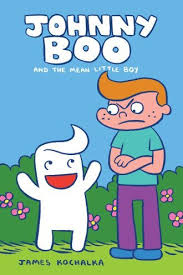
[READ: March 6, 2016] Johnny Boo and the Mean Little Boy

I love how the Johnny Boo universe is so small that characters keep returning.  Like in this one, the fourth book, Johnny Boo tells Squiggle that they can’t play today because his playing with his new friend Rocky the Rock.  This is the same rock that he threatened to make his best friend in the first book.

Johnny promises Squiggle that they will play together soon, as long as Squiggle can give him a “hooray.”  But Squiggle’s hooray is not very enthusiastic.

Squiggle says that he will go off and find other friends, too.  But it turns out to be not so easy.  And then a butterfly starts flying around him.  At first Squiggle is annoyed by it but then he thinks they can be friends. (more…)

Read Full Post »

applesSOUNDTRACK: SO PERCUSSION-Tiny Desk Concert #205 (April 2, 2012).

So Percussion is a quartet who plays nothing but percussion.  When we think percussion we often think rhythm, but these guys (Eric Beach, Josh Quillen, Adam Sliwinski and Jason Treuting) also provide great melody.

The band is inspired by John Cage.  He’s “their guy.”  They have written songs inspired by him and also perform his pieces.

Though audiences are still often puzzled or even infuriated by Cage, the composer brought essential joy and optimism to his work. Music is everywhere, Cage taught; frame sound, even the sounds of everyday life, and hear what is there. In the signature mix of serious play (or is that playful seriousness?) that So Percussion brought to this unusual Tiny Desk Concert, the group mixed a work by Cage (the first movement of his Living Room Music) with two pieces by Treuting: Life Is [ ] and 24 X 24, in which the text Quillen reads aloud comes from Cage’s own writings. Inasmuch as many of their instruments are quotidian tools, the sounds they create can be magical.

The first piece was written by the band’s Jason Treuting, called “Life Is [ ].”  It’s just under three minutes and is primarily wood blocks.  But there are also xylophones and bells (and many other things).

All four have mallets and are clacking on the wood blacks.  But each player has something else that makes a melody–tiny cymbals, the xylophone, bells that you tap with your hand–and they create a pretty melody (and the wood blocks provide interesting counterpoint rhythm).

Since John Cage is their guy they made a piece that celebrates the way he made music: “24 X 24.” Cage celebrated “time-based structures and task-based sound things.”  So this piece is flexible and malleable.  They are going to play an 8 minute version of the song which includes a spoken word of a Cage lecture [the entire lecture is reprinted at the bottom of the post].

The narrator counts down from 8, which is interesting.  Then he recites (including coughs and other noises) a piece by Cage about music and art.  While he is reciting, instruments include the melodica and harmonium, a musical saw, a coffee cup full of change (at one point instead of tapping the cup, he takes the change out and state each denomination out loud).  They also play the side of the desk, a cactus plant (that is pretty cool to see), even plucking the Emmy on the desk.

The final piece is a John Cage composition.  It is the first part of a longer piece called “Living Room Music.”  Back in the early 40s Cage wrote a piece called “Living Room Music” which was supposed to take place in a living room.  And this is our living room.  They play the first part   called “To Begin.” It’s just under a minute, but the sounds they get from a waste basket (like a bass drum), a package of paper towels, a stapler, the desk and the coffee mug is really cool.

Even people who don’t like John Cage have to appreciate what he was going for with this kind of music.

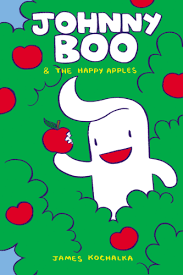
[READ: March 3, 2016] Johnny Boo & The Happy Apples

In this third book of the series, Johnny Boo, Squiggle and the Ice Cream Monster are back.

Johnny eats some ice cream and then shows off how strong it has made him. But when Squiggle accidentally “pops” Johnny’s muscle and it gets all floppy, there is much concern.  Things are even worse for Johnny when the ice cream monster (from the first book) comes and shows off his huge muscles that he got from eating apples.  If Squiggle laughs at Johnny’s floppy muscle you know there will be hurt feelings.  And there are.

Johnny runs off to find some happy apples to make his muscles strong, but he winds up eating apples from the ground, which makes his muscles super floppy (pretty hilarious looking). (more…)

Read Full Post »

johnny-twinkleSOUNDTRACK: SOWETO GOSPEL CHOIR-Tiny Desk Concert #209 (April 16, 2012).

sgcDressed all in black with pink accents the Soweto Gospel Choir certainly looks striking.  And their voices are superb.

The blurb notes that they

managed to tie the all-time record for most musicians squashed behind Bob Boilen’s desk for a single performance in the NPR Music offices. (They join the early-music a cappella ensemble Stile Antico, also with 12).

[I wonder if they keep statistics like this–I’d like to see numbers].

The Choir sings

in a number of South African languages, as well as English, Soweto Gospel Choir fuses the praise music of many Christian cultures, with nods to traditional African songs of celebration — complete with occasional clicks and bird songs.  To watch and sway along was to be blasted with some sort of ray gun that shoots beams of joy and hope.

They sing four pieces.   I don’t know what the songs area bout except for what the brief introductions tell us.

Two different women are the lead singers for the first two songs (no names are given). “Seteng Sediba” and “Emarabeni” which is a wedding song.  A man introduces the rest of the songs.  He says that “Emlanjeni/Yelele” is a traditional song and then he sings lead.  The final song “Kae le Kae” translates to Wherever I Go I Go with Jesus.

For each song the Choir sounds amazing together.  They only person not singing is the guy on the end who is playing the djembe to keep rhythm.  They sway in sync and hold hands up at the same time. They are something to watch.

As the final song ends, the Choir walks out of the room past everyone singing all the while.  It’s a great ending (and gives us a peek into the NPR offices).

[READ: March 3, 2016] Johnny Boo: Twinkle Power

This is the second Johnny Boo book and Johnny, Squiggle and the Ice Cream Monster are all back.

One thing that really cracks me up about the Johnny Boo books is how easily he and Squiggle get mad at each other.  And they always threaten to be mad forever.

In this book, Squiggle flies around Johnny’s head and makes his “hair” stand straight up.  This cracks up Squiggle and makes Johnny very angry and he threatens to never be friends with Squiggle again.

Of course this all started because Squiggle thinks that the stars have amazing Twinkle Power and he thinks it’s even better than Johnny’s Boo Power (GASP!).  Squiggle wants to go up to the stars to see if he can learn Twinkle Power. (more…)

Read Full Post »

johnny-1  SOUNDTRACK: RUDRESH MAHANTHAPPA-Tiny Desk Concert #201 (March 8, 2012).

rudreshRudresh Mahanthappa is a saxophonist whom I had not heard of but who is obviously very highly regarded (he won a Guggenheim Fellowship).

He plays jazz in very different styles, and totally wails (“a swarm of locusts rampaging through an irregular beat”), but has also experimented with different styles.  As the blurb says:

That latest album, 2011’s Samdhi, borrows a bit from … electric funk excesses … and integrates ideas from South Indian scales and modes, hip-hop and computer music programming.

The quartet here is top-notch:

Drummer Rudy Royston and Mahanthappa played in a Denver-based band together some 20-odd years ago, and have since reconnected in New York; electric bassist Rich Brown has played in just about every conceivable setting from his home base of Toronto, including the Canadian Indo-jazz group Autorickshaw; guitarist Rez Abbasi is a long-time confrere in the dual worlds of jazz and South Asian music.

They play two fairly long songs.

“Killer” starts the show.  I really loved the sound that the guitar had–a kind of electric organ/funk sound. Mahanthappa takes off right away.  One thing that was very cool was when I thought he was playing an improvised solo, but the guitarist was able to play exactly what he played both right after him and then with him (clearly it was part of the song–but it sounded great with the two of them together).  After about 4 minutes of wild noisy soloing it mellows out with a long groovy guitar solo–Rez is really impressive.  About a minute after that, the song picks up with some great drumming behind a wild guitar solo.   Around 8 minutes, the drummer gets his own impressive solo.  The ending is great and super fast.  The band sounds amazingly tight throughout.

I really love the sound of his backing band and while his sax playing is amazing and insanely fast, I actually prefer the middle section without the sax–it’s a little too frenetic for me (which is surprising, as I usually like this–I must not have been in the mood when listening).

“Playing With Stones” opens with a lengthy bass “solo” it’s a series of very quickly plucked notes that sounds almost like drums–its very cool. It lasts almost a minute and a half before the rest of the band kicks in.  There’s a great bass line throughout this track too–bouncy and a little funky.  I enjoyed the moment where Rich notices he’s on camera and gives a little smile.  As the song ends you hear them say “pretty pretty good” like Larry David.

Between songs Mahanthappa explains that all of the music on the album resulted from the Guggenheim Fellowship.  It went for research in India, looking for new ways to bridge certain areas of South Indian music and jazz with hip-hop and funk.  There’s also a funny moment when he introduces Rich and says, “He’s Canadian, don’t hold it against him.”  He mentions the CBC and then Rez says “And Tim Horton’s.”  Rich snaps “that’s not funny,” to much amusement.

[READ: February 1, 2016] Johnny Boo

Johnny Boo is a fun children’s series by James Kochalka.

Johnny Boo is a white ghost with a big swirl of “hair?” on top.  Has a pet ghost named Squiggle.  I love how simply these characters are drawn (as Kochalka tends to) and yet they are totally consistent.

As the story opens Johnny and Squiggle are playing around in the field.  Johnny is running while Squiggle is floating around   Squiggle has Squiggle Power and is able to float and swirl.  While Johnny has Boo power which is him shouting Boo very loudly and frightening Squiggle.

Squiggle is upset hat Johnny does this.  Squiggle gets mad, but Johnny says that they will get ice cream.  Which makes everything okay. (more…)

Read Full Post »

cardboardSOUNDTRACK: MARY HALVORSON QUINTET-Tiny Desk Concert #267 (February 25, 2013).

maryI had never heard of Mary Halvorson before.  And that makes sense because she is an avant-garde free-jazz guitarist, a sound I like (sometimes) but one which I do not follow.  So a little background is in order:

As a sidewoman, [Mary Halvorson] is often tapped to play in open improvising situations….  Among her sonic signatures are craggy distortions, bent strings and delay-pedaled blurts through a hollow-body guitar….  Halvorson has now recorded two albums with her quintet, one with alto saxophone (Jon Irabagon) and trumpet (Jonathan Finlayson) up top. (The rhythm section is also among New York’s finest, with John Hebert on bass and Ches Smith on drums.) From the way her songs balance order and entropy, you can hear that she’s studied how golden-era hard bop blended those voices, and how later generations morphed, rephrased and imploded those ideas.

The Quintet plays two pieces.  I would have guessed they were improvised but not only do they have titles, they have sheet music!

“Love In Eight Colors” (No. 21) starts out as a slightly dissonant mellow jazz piece.  Then about 45 seconds in, Mary throws in an unusual guitar lick—a slightly weird note.  And then a minute later things get noisy until a simple trumpet solo takes over.  When the music resumes, Mary is playing some strangely discordant chords over the solo—everyone seems to be doing their own thing.  Around 4 minutes in, it turns into something new with an interesting, mesmerizing guitar solo riff.  When the band resumes, the sax takes over and the trumpeter literally stands stock still like a statue staring forward–it’s almost creepy.  At 8 minutes, they introduce a two-minute drum solo.  It’s fun to watch all the strange things he does—elbow on the drum head, vibrato with his hands changing the sound, clicking the sides of his drum.  Then the band resumes until the end.  And it’s more dissonance.

She introduces “Hemorrhaging Smiles” (No. 25) without smiling.  There’s a lot more melody in this song–the sax and trumpet sound groovy.  Even the guitar is pretty. Then she throws in a bizarre scale which cycles throughout the song.  It’s strangely addicting and I enjoyed hearing it every time it came back–even though it wasn’t exactly pretty.  The guitar has a lot of vibrato on it, although about six minutes in she switches the sound of her guitar to a bit more conventional sound and she plays a wicked solo. The second listen through made me appreciate what was happening a lot more.  Even if the song is pretty out there.

Mary Halvorson’ Quintet is not for everyone.  It might not be for many at all, but if you like your jazz free, check her out.

[READ: June 19, 2016] Cardboard

I’ve had mixed feelings about TenNapel’s books.  I loved Ghostopolis, and didn’t love Tommysaurus Rex.  So I picked this up with some hesitation.

But I found that I really enjoyed this weird book a lot.

For a kids’ graphic novel it’s actually quite long.  And, for a kid’s graphic novels there’s a few adult themes (like unemployment and widowhood) that a kid may not get or care about all that much (or maybe they would, what do I know).

As the book opens we see Mike, a big burly carpenter, begging for work.  But he gets nothing.  And as he walks away we see a very strange-looking man (TenNapel’s book are chock full of weird-looking characters) who offers to sell him a gift for his son.  Mike has no money, so he can’t buy the cool gift.  But the man says that for 78 cents (the exact amount in his pocket) he can have this giant cardboard box.

Mike is appalled at the idea of getting his son a box (even if it can be a creative play toy–ha!), but he’s got nothing else.  So he drives home with this box muttering “worst present ever.” (more…)

Read Full Post »

« Newer Posts - Older Posts »