Feeds:
Posts
Comments

Archive for the ‘Stephen Fry’ Category

woosterSOUNDTRACK: JULIETA VENEGAS-Tiny Desk Concert #126 (May 9, 2011).
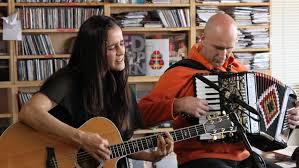
julietaJulieta Venegas has a sweet voice.  She plays accordion and guitar and, for this show, is accompanied by a clarinet and flute.  The whole concert is delicate and lovely.

She sings threes songs in Spanish but describes them in English.

“Si Tú No Estas” features her on the accordion.  She plays a delightfully simple riff that sounds jaunty on the little accordion.  The clarinet is a fitting accompaniment to her on this quiet song.  I love that it feels vaguely French, even though it is sung in Spanish.  This is about the people you leave at home when you travel.

“Debajo De Mi Lengual” (Under My Tongue) is a bit more folk sounding because she plays the song on guitar and is accompanied by a flute.  The song is about being insecure to talk to others.  The melody is simple, but the flute adds some lovely notes.

For “Bien O Mal” she stays on guitar but this time is accompanied by the accordion.  This song is the most rollicking (not very rollicking at all, of course, but the tempo is much faster.  The accordion mostly plays chords to flesh out the song.  The song sounds lovely, which is why it’s especially funny that at the end she seems unsure of just how good it was.

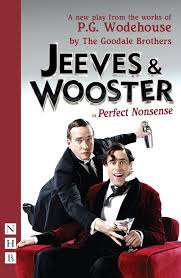
[READ: December 14, 2015] Jeeves & Wooster in Perfect Nonsense

I have never read any of P.G. Wodehouse’s Jeeves and Wooster stories, although I have seen most of the series starring Stephen Fry and Hugh Laurie (incomparably played).

This play is a “new” story written by the Goodale Brothers.  It is based on a bunch of Wodehouse’s pieces, particularly The Code of the Woosters (1938).  Robert and David Goodale were asked to put the above story on the stage.  So they worked on it and modified it and came up with this version.

They came up with the idea of Wooster telling one of his tales and Jeeves “helping” as only Jeeves can.  So in this production, there are only three actors.  But they play multiple parts each trying to flesh out Bertie’s story.  Wooster is Wooster, Jeeves is Jeeves and several others, and their friend Seppings plays many many roles, including some women and a nine foot tall man.

The story itself is intentionally convoluted and hilarious.  It involves an expensive creamer, a police officer, Bertie’s aunt and the ghastly woman Bertie might jut have to marry. (more…)

Read Full Post »

irl  SOUNDTRACK: THE DUCKWORTH LEWIS METHOD-Sticky Wickets (2013).

stickyThe cricket-loving songwriters are back with their second disc.  Although I bought their first disc because I love Neil Hannon, I found myself enjoying the songs by Pugwash’s Thomas Walsh even more.  (Which led me to get some discs by Pugwash, a great, sadly unknown band).

I’m inclined to say I like Walsh’s songs better on this disc as well–his title track has a groovy classic ELO-inspired guitar riff and Walsh’s great falsetto vocals.  But I also love the bouncy fun of “Boom Boom Afridi” (written by Neil Hannon). So maybe I just like the two of them together.

These are followed by the amusing “It’s Just Not Cricket” which features a group of rowdy indignant cricket fans singing along. See the awesome accompanying picture below which shows the kind of sort of naughty but not really way the sport is portrayed on the disc.  cricket“The Umpire” gives some real sympathy to the Cricket umpire (who eats his eggs and soldiers) as his position is taken over by machines.

I don’t know much about cricket, so I don’t claim understand what most of these songs are about, but the awesomely bouncy and catchy “Third Man” is a total mystery to me.  But that doesn’t stop me from singing along. It’s like a classic lost Pugwash song.  It even has a (weird) narration from Daniel Radcliffe.  “Chin Music” is a pretty, carnivalesque instrumental.

“Out in the Middle” is a slower Walsh song which is also very pretty.  “Line and Length” is a silly song which (in spoken word) explains how line and length are used in cricket. It has a very discoey chorus which differs nicely from the formality of the verse. “The Laughing Cavaliers” is a march with a big choral vocal line. “Judd’s Paradox” has a lengthy spoken section by Stephen Fry (at his most formal). It’s a very enjoyable song with an interesting perspective on cricket and history.

“Mystery Man” is a pretty, sixties-sounding song with bouncy jaunty keyboards and a catchy chorus–except that the verses are all about how he’s a tough bowler.  It’s also got a hilarious spoken word section read by Matt Berry “trod on wicket.”

“Nudging and Nurdling” ends the disc and is more or less 5 minutes of people saying the words “Nudging and Nurdling” set to a boppy silly melody.  The list of contributors is extensive, although I’ve only heard of Daniel Radcliffe, Neil Finn, Joe Elliott, Matt Berry, Graham Linehan, an Michael Penn (!) who sounds so American. I love they way they build something so simple (and kinda dumb) into such a big song by the end.

Hannon and Walsh know how to write gorgeous songs (even if they can be rather silly).  This is a great collection–even if you don’t know anything about cricket.  You too will soon be shouting along with the Laughing Cavaliers.

[READ: November 9, 2014] In Real Life

I was pretty excited when I saw this book.  I really like Cory Doctorow and here was a comic of his published by First Second, one of my favorite graphic novel publishers (I need to make a category for them…there, done).  I didn’t know Jen Wang’s artwork, but that hardly mattered as the cover was gorgeous.

So the story is an interesting one.  It begins simply enough with Anda, a young girl who has moved from San Diego to Flagstaff (of course, we don’t learn that she moved to Flagstaff for a few pages, so the fact that we are introduced to Flagstaff by a snowfall was confusing to me–I assumed she was on the East Coast).  However, this was not as confusing to me as the other character in the book who doesn’t know where Flagstaff is.  What high school aged person doesn’t know that Flagstaff is in Arizona?

Anyhow, we see Anda in school and her class is given a presentation by Liza the Organiza, a woman who is introducing the class to an online virtual game called Coarsegold (I’m also confused as to why this woman would be allowed to give this presentation in school, but maybe I’m too nitpicky here?).  Incidentally, I really enjoyed most of the art in the book, but the picture of Liza the Organiza on this same page is quite disturbing to me.  In fact, a few pictures in “real life” seem a little “off” to me, and I was worried that I wouldn’t enjoy the visual aspect of the book.  But when we get into the game, the pictures are simply fantastic, so I don’t know what that’s all about. (more…)

Read Full Post »

A few weeks ago on the Late Late Show, Craig Ferguson began inviting his guests to engage in an awkward pause with him.  Awkward pauses have been somewhat de rigeur in popular culture for a number of years now.  In fact, Ricky Gervais has pretty much built a career on them–and we have him to thank for such brilliant fare as The Office and even Modern Family.


But those sitcom awkward pauses were scripted, designed as responses to someone saying or doing something so bizarre that no response was even possible.  Craig Ferguson, who says that being Scottish has given him a lifetime of awkward pauses, is doing something a little different.  He asks his guests (most of whom are actors) to sit, silently, awkwardly with him.  Never has silence been so funny.

I think the first person I saw do this with him was Adam Greenberg (a master at awkwardness).  There have been many more since, including the awesome Lauren Graham, Topher Grace (another awkward man) and most recently John Cusack.  With Cusack, nearly the entire interview was an awkward pause, and it was hilarious (see the clip below). (more…)

Read Full Post »