 SOUNDTRACK: ERIC CHENAUX-Guitar & Voice [CST088] (2012).
 This album is indeed just guitar & voice. Chenaux is a performer who grows on me. His music is incredibly slow and drawn out. And I often find that his vocal melodies don’t always have much to do with the guitar parts he plays. It feels like everything is improv. And it’s unsettling at first. As is the fact that half the songs are pretty ethereal songs with words and the other half is wild and chaotic guitar solos, in which the guitars sound like anything but guitars.
But when you actually listen to the lyrics (which aren’t always easy to follow, he sings them so languidly) they’re quite lovely. Like, “With the clouds in the sky and the bags under my eyes I wrote your name a thousand times with an old flashlight last night.” But the more notable thing is the guitar work. In “Amazing Backgrounds,” he plays a simple, plucked acoustic guitar but the solo is a crazy electric guitar that is played backwards and sounds completely from outer space. “Dull Lights (White or Grey)” is another beautiful piece with overdubbed guitars playing some great low bass sections while the other guitar plays pretty, high notes (an a cool wah wahed section too).
“Put in Music” sounds the most traditional–the vocal melody is pretty straightforward and his vocal actually has weight (it’s usually up in the ether somewhere). And I think it works very well as a grounding for the album. Although the guitar solo sounds like he’s playing more with the tuning pegs rather than bending the strings–it’s cool and disconcerting at the same time. “However Wildly We Dream” is a very jazzy feeling song–upbeat finger plucking. It’s the most conventional song and it really packs a wallop (a gentle, airy wallop but a wallop nonetheless).
The second track “Simple/Frontal” is an instrumental. I assume it is all guitar but it sounds like slightly discordant violins playing against each other. “Sliabh Aughty” is a nearly nine minute solo that sounds reversed and is a wild meandering piece (played over a constant drone). It has an Irish feel, which makes sense as the Slieve Aughty (Irish: Sliabh Eachtaí) are a mountain range in the western part of Ireland. “Le Nouveau Favori” is a short instrumental–two minutes with what sounds again like a bowed violin/drone. And how can one not enjoy a piece called “Genitalia Domestique” another 2 minute droney instrumental. Chenaux definitely plays with sounds that don’t quite go together, often making an eerie collection of tunes. Especially when they are compared against the pretty acoustic of the songs with words.
The final track is “Glitzing for Stephen Parkinson” and it continues with that weird bagpipe/organ drone that he pulls out of his guitar (I’d love to see him perform this stuff live–although how would he do the overdubs?)
The stuff takes a few listens to get used to, and it’s certainly not for everyone, but the sounds he gets out of a guitar is truly amazing.
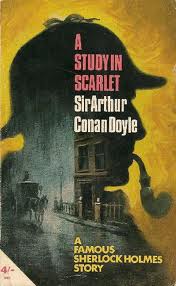
[READ: February 16, 2013] A Study in Scarlet
I mentioned recently that we have been watching a lot of Sherlock Holmes items. So it seemed appropriate to read some of his stories as well. I brought home a collection of the short stories not realizing that there were two novels written before the stories. Sarah read the stories, but I held out for the debut novel.
The show Sherlock laid an amazing ground work for the books because the show (despite being set over 125 years after the books) is quite faithful to the stories. Indeed, the way that Holmes and Watson meet is pretty much straight out of the book. And, also indeed, the first episode took much of the story form this first book. There were some very key changes to the story, ones that made the show very very different in the end, but the foundation is certainly there. Interestingly, the way the murder is performed in the book (which we learn very very late in the story) proves to be the same methodology used in a different episode of Sherlock. Two episodes from one book!
So in this book Watson opens it by giving a little backstory about himself and his quest to find cheap lodging in London (he’s back from the war in Afghanistan–a fascinating coincidence in terms of timeliness of wars) and he has blown through a lot of his stipend. A mutual friend introduces Watson to Holmes and they agree to live together I was a little concerned about the pace of the book at first, as it seemed like Watson was going to go into a lot about himself–but he doesn’t. It’s a brief chapter that gets all the details out of the way.
Then we meet Holmes. He explains his own eccentricities and how he is a consulting detective (Watson wondered why these people kept appearing and asking Hiolmes questions about who knew what). And then finally we (the reader and Watson) are invited into a case. A man was found murdered in a house. There were no stab wounds, although there was blood. The only other evidence was a word scratched in blood on the wall: Rache.
If you saw Sherlock this will sound familiar (except that the victim was a woman). It deviates quite a bit from here (Rache is used in a very different way from the show, which I really liked), but Holmes recognizes the tobacco and is able to deduce a ton of things just from the surroundings. He doesn’t tell the police right away, for fear that if the criminal knows the police know about him, he will flee). And as the first half of the book draws to a close, the murderer is apprehended.
Imagine my surprise though when the next chapter opens up in the American Southwest. All of a sudden the story has shifted utterly to a man and a girl trudging through the mountains, lacking food and water and clearly near death What? (more…)
Read Full Post »
 SOUNDTRACK: “Elementary, My Dear” (1973).
 You have to have a particularly cruel heart if you don’t love School House Rock.


 I Just Read About That...