Feeds:
Posts
Comments

Archive for the ‘Film & TV’ Category

SOUNDTRACK: KISS-Gene Simmons (1978).

Even all these year later I feel like there is something very “polished” about this album.  It feels different from the others for an intangible reason.  I like it quite a bit,and yet it doesn’t sound like a record from a demon with blood leaking out of his mouth.  Maybe it’s the surprisingly faithful (and delicate) cover of “When You Wish Upon a Star”?  Maybe it’s the cameo by Cher?  Maybe it’s the weird effects on “Radioactive”?  The whole things just seems different to me.

It starts out menacing enough with the creepy laughing and the crazy strings (like a Disney nightmare) and the chanting (what is that chanting–its sounds demonic but they seem to be saying Hosannah?).  And it all swirls into a…disco sounding guitar?  “Radioactive” is a wonderful ditty and shows that Gene, while not exactly a good singer, has more range than the God of Thunder would have suggested.   (That’s Aerosmith’s Joe Perry on guitar).  “Burning Up with Fever” opens with a bizarre, really out of tune guitar intro (that’s two songs with crazy intros).  This feels much more Kiss than anything else on the album, although again, it’s very slick feeling.  And surprisingly, I like the backing vocals on this track–especially the solo that the woman takes–hey is that Katey Segal?  No evidently it is Donna Summer (!!).  I guess Katey was one of the backing chorus on some other songs.  (And that’s Steely Dan’s Jeff “Skunk” Baxter on guitar).

Musically, I rather like “See You Tonite,” but I find his vocals a little weird on this one.  It’s such a sweet song…again, unusual for the demon (Skunk Baxter on guitar, again).  “Tunnel of Love” seems quite sinister in the beginning with a great bass line.  And then the chorus kicks in with these delicate la las (Skunk Baxter on guitars again–Katey Sagal must be in there somewhere).  “True Confessions” has a pretty hilarious choir in the middle of the song.  My mom felt that “Living in Sin” was bad publicity for the Holiday Inn.  Although I thought it was a very funny line (and yes, Cher is the squeaking fangirl and Joe Perry is on guitar again).  “Always Near You/Nowhere to Hide” is a really slick track in which Gene shows of his more delicate singing style.  The first half is a gentle acoustic track but it builds into a high concept highly produced track–and let’s not forget the amazing high notes he hits (is that really him?).

“Man of 1,000 Faces” is another song with sinister sounds in the verses (cool strings, and is that french horn?) and then a gentle, swelling chorus.  “Mr Make Believe” begins the delicate ending of the album (Skunk Baxter, again).  This is a sweet ballad, showing a very gentle side of Gene.  There’s a little diversion in his cover of Kiss’ “See You in Your Dreams.”  This version rocks harder than the Kiss version, and the backing vocals lend a weird edge to the song which is why I like it better than the one on Rock and Roll Over (that’s Cheap Trick’s Rick Nielsen on guitar).  And then yes, “When You Wish Upon a Star.”  My dad laughed about as hard at the demon guy singing this song as he did about the butch biker guy singing “Oh Danny Boy” in the Village People movie Can’t Stop the Music (which we watched as a family.

Gene’s solo album charted the highest when they were released, although now Ace’s has sold more.  It’s pretty great.

[READ: October 8, 2011] “To Catch a Beat”

There were four one-page pieces in this week’s New Yorker under the heading “Sticky Fingers.”  Each one was about theft in some way (this being the money issue, that ‘s a nice connection).

Lethem, who now appears here twice in just a few short days, also breaks the mould set up by Miranda July (so I guess 2 of four stories about shoplifting is not so much a mould as a half).  Indeed, Lethem goes against all the conventions of the other pieces, for in this story, Lethem is not the thief at all.  There is hardly any thieving going on here.

This story is about Lethem working in used book stores in Brooklyn as a kid.  He mentions several different places where he worked, nut the story focuses on one in particular.  The name isn’t important to the story (in fact it doesn’t exist anymore).  But what happens there is the crux of the story.  It’s basically about a friend of Allan Ginsberg’s armed Herbert Huncke (who I’ve never heard of).  Huncke was a major fixture for the Beats, and is written about (in disguised form) by Burroughs and Kerouac.   But he was also a junkie and an ex-con.  And he came into this bookstore regularly. (more…)

Read Full Post »

SOUNDTRACK: MC PAUL BARMAN-It’s Very Stimulating (EP) (2001).

So is this guy a joke? Well, he’s very funny.  Very funny, in fact.  But to my ear, not in a novelty sort of way.  He’s got the kind of rhymes that make you laugh but still work upon multiple hearings.  And, yes, Paul Barman is a squeaky, Jewish boy from Ridgewood, New Jersey (again!) and he really can’t rap on the beat and he really doesn’t have much in the way of rhythm, but got awesome skills in the lyrics department and he has production from Prince Paul (that’s the kind of credentials that anyone would like).

The theme of this EP is Paul’s utter failure to get with women (even in his fantasies).  He’s crass and vulgar and yet he’s also quite smart and rather witty (“I think about all the pube I got while reading the Rubaiyat“) .  The music is more or less inconsequential.  As Prince Paul noted, the craziness comes from the lyrics, so you don’t want to overkill the song.  But there’s some great samples and some solid beat work as well.  Nevertheless, we’re here for the words.  So, sample a few of these rhymes:

“The Joy of Your World”

It was time to copulate but we didn’t want to populate
So my bold groin reached for my gold coin proooophylactic
I unwrapped it, you can’t know how I felt
It wasn’t a gold coin condom, it was chocolate Chanukah gelt
The white part crumbled on her tummy and the rest began to melt
Foiled again…..

“School Anthem” or “Senioritis” (this song was renamed for the reissue of the disc it seems)

Homework is tell major lies or plagiarise encyclopedias, so boring
Fresh-faced teachers want to tickle ’em
but a test-based curriculum excludes exploring

I’ll let a mystery gas out of my blistery ass
Just to disrupt the misery of history class

“Salvation Barmy”

She said, “Go get a haircut”
So I showed her my bare butt
Pulled down my Carhartts put my moon in her star-charts

“I’m Frickin’ Awesome” ( I love this especially for the Lila Acheson bit)

It’s nice to be hypnotized by a man you don’t despise yet
He had a type of flow and I can’t quite label it
All I know it made me want to take off my cableknit
Sweater, Oh he better be hetero
I hope they don’t catch us in the Lila Acheson
Wallace Wing when Paulus brings the mattress in–rudely
He backlashed my booty
like I was Susan Faludi over the Grace Rainey Rogers Room rostrum

“MTV Get Off The Air, Pt 2”  (the first two lines are fantastic, but the whole thing is genius).

Smirkin’ jocks with hackysacks
in Birkenstocks and khaki slacks
I’m the hypest lyricist
while they’re like, “What type of beer is this?”

Just wait until the full length for the utter genius that is “Cock Mobster” (how can be s o smart and so stupid at the same time?)

[READ: October 10, 2011] E Pluribus Venom

Like most people, I learned the name Shepard Fairey because of his iconic prints for Barack Obama.   In addition to supporting Obama, I really liked the design of the prints–simple, bold, an easy iconic style (which has since been lifted, morphed and used everywhere).  I know that many of Fairey’s prints actually come from other people’s original photos.  He has a print of Muhammed Ali in this book, and he clearly didn’t take the original photo (I don’t know where it came from).  But since all art is theft, I’m okay with Fairey taking someone else’s work and making something new from it.  I’ve always felt that attribution should be enough if you modify the original enough to call it different (which I feel this print does).  [The fact that he didn’t acknowledge the source does bug me, of course].  But that’s neither here nor there because this book predates all of that.

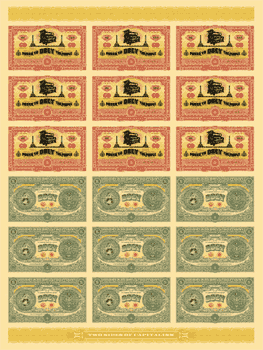
This book documents events that occurred in 2007.  The E Pluribus Venom show was based largely around two images that Fairey designed to reflect the two sides of capitalism.  The image to the right really doesn’t do any justice to the work itself, but you can kind of see that he created two-sided faux dollar bills.  The front showed all the good things that capitalism can do.  The back showed all of the evils that capitalism causes.  The images resemble dollars, but the text is straightforward in its message.  As with a lot of what Fairey does, it’s blunt and obvious but pretty cool.

As far as I’m concerned, though, this is the least interesting image in the book.  Although I love that they made dollar bill sized prints of these faux dollars and left them scattered around in cities to promote the show.  They way they were folded made them look at a glance like actual currency.  Very cool. (more…)

Read Full Post »

SOUNDTRACK: KISS-Alive II (1978).

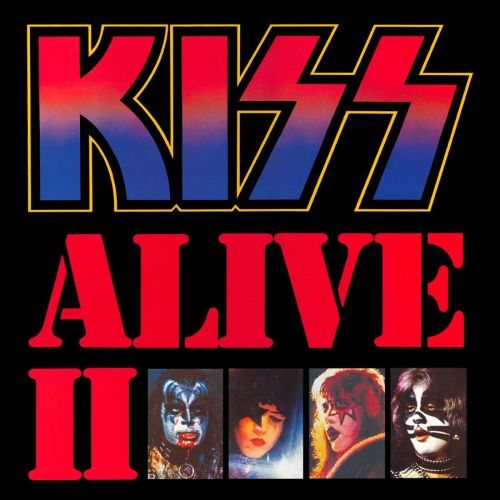
There’s not too many million-selling albums that have a man covered in blood on the cover.  And yet here is one.  (I’ve always been confused why Paul and Ace both look like they are not wearing the white makeup in these photos).  I must have listened to this 4 sided LP a thousand times as a kid (my poor mother–what did she do while I monopolized the only stereo in the house and made her listen to Paul Stanley rambling on and on? 

“Detroit Rock City” and “King of the Night Time World” open the concert just like they open Destroyer.  But unlike on Destroyer, the next songs keep up the fast pace with “Ladies Room” and “Makin’ Love.”  All four of these songs are a bit faster, a bit louder a but more intense than the album versions (especially the Destroyer tracks, which have all of the bombast removed).  This first side ends with an energy-packed “Love Gun.”  I mean, holy cow, what an opening, it’s all nonstop heavy rock.  Even though I like, nay, love the originals, these version have so much energy, so much presence (they would have it even without the crazed fans screaming–which is practically like static it is so continuous) that they blow away the studio versions.

“Calling Dr. Love” is a much faster tempo (with a wonderful intro about “rock and roll pneumonia”) and “Christine Sixteen” loses the piano (which I admit I liked, but it works great without it), and it’s far creepier here.  “Shock Me” picks up some rock from the studio version, but more importantly, it picks up a crazy guitar solo (which is yes, much better seen than heard).  “Hard Luck Woman” to me sounds funny in this setting.  Don’t get me wrong, I love it, but it’s hard to imagine them playing it amidst all the chaos of the rest of the show.  And then “Tomorrow and Tonight” is fine in this context, but you can kind of feel the fans wishing for “Rock and Roll All Nite.” 

Side three opens with “I Stole Your Love” which rocks equally as hard live.  It’s followed by “Beth” perhaps the strangest thing on a live album.  From what I’ve seen, Peter comes down from behind the drums, sits in the front of the stage and sings his mega-hit to piped-in piano music.  I guess it was something of a break for the rest of the band.  It’s followed by a truly intense version of “God of Thunder”–faster and heavier than the original and very cool.  The only surprise is that it contains a drum solo–the solo is not the surprise (it is the 70s after all), the surprise is that “God of Thunder” is so obviously Gene’s song, it seems odd that they would break it up with a drum solo (although if memory serves, he uses the time to clean off all the blood from his face and guitar).  “I Want You” sounds really great in this version (the guitars are wicked) and it gives Paul a chance to show some vocal acrobatics.

The LP version featured this awesome gatefold inner photo which I have to say may have really set the bar high for other bands in terms of concert awesomeness.  My vinyl copy has pencil lines etched into the cardboard from the number of times I traced the picture.  (Thanks to Porcelain Theology, a blog I am enjoying very much, for this picture).  The live portion of the show ends with “Shout It out Loud” which works as a very solid anthem to end the concert.

The fourth side of the LP always confused me.  When I was young and didn’t really understand how to read credits, I assumed that whoever’s name was after the song was the person who sang it (generally true, but not always).  So, when side four featured covers and songs written by people not in the band, it blew my mind.  I also didn’t understand why there were five non-live, indeed, brand new songs on this live album (they didn’t want to release any songs that were also on Alive!–perhaps the last time they didn’t reissue music).  I respect this decision, but at the same time, how much cooler would this concert be with “100,000 Years” or “Deuce” included? 

The five songs actually aren’t bad, but they don’t really have all that much excitement to them.  “All American Man” is a surprisingly gritty song from Paul and “Larger Than Life” is pretty interesting musically (and I just realized that love means penis in this song too and that it’s actually a pretty funny brag song).  “Rocket Ride” is probably the best song on this side.  Ace didn’t contribute to any of the other songs on this side, but he goes out with a blaze!  The chorus is a little cheesy but the verses are really cool, and the solo rocks. 

How I miss the excess of the 70s.

[READ: October 1, 2011] “Flick Chicks”

Mindy Kaling is a writer for and actor on The Office.  She is very funny.  I’m not sure if she has written for the New Yorker before, but I like her and wanted to include her here (just to get some of her magic mojo to appear on my blog).  This piece is labelled an “L.A. Postcard” and it is more or less broken into two parts. 

The introduction shows Mindy sitting down to pitch a new movie.  She claims that all TV writers want to write for movies because “At the Oscars, the most famous person there is, like, Angelina Jolie.  At the Emmys the huge, exciting celebrity is Bethenny Frankel.”  [I actually don’t even know if Bethenny Frankel is a real person, so I guess that proves the point].  Although this year there has been a lot of chatter about the movies stars who are now on TV shows–see the New Yorker event Bravura Television.  William H. Macy and Jeremy Irons  may not be Angelina Jolie, but they’re still pretty awesome.

Anyhow, the joke of her movie pitch is that she wants to write a romantic comedy, but the studio is now focusing solely on making movies based on board games (see the existence of Battleship: The Movie).  Pretty darn funny. (more…)

Read Full Post »

SOUNDTRACK: HELLBENDER-Hellbender (1993).

Hellbender is a band that Wells Tower was in before he became a professional writer.  He played guitar and sang backing vocals (and wrote some lyrics, but not on this album).  The drummer, Harrison Hayes is now the drummer for Les Savy Fav and the bassist and singer Al Burian is most notable for his zine Burn Collector (for a time he was the most famous former Hellbender, although I’d never heard of him).  They were always pretty small time, although their third album did receive some attention.

This first album is pretty rough–quickly made and cheaply mastered and yet there are good dynamics, cool breaks and a whole lot of punk.  Al Burian’s voice is in shouty punk mode (lyrics are not all decipherable) and although his voice works it’s a bit samey throughout the disc.  The drums don’t always sound great, but there are often cool drum breaks.  And the guitars are quite assured.  Despite the punk attitude, it’s not all flat out speed.

There are some dynamic breaks, like in the second track “Housebroken,” which has some cool moments when the drums highlight an unexpected tempo changed.  “Clocked Out” was the single they released prior to the CD and it has some real production values (and a very funny intro from a local DJ).  The guitar highlights the trebly end in a kind of ska riff which is quite different from the rest; there’s also some discernable bass lines and a cool bass/guitar solo (punk, yes, but branching out a bit).  It’s a great track.

“Two Twenty Two” made it onto a couple of local compilations.  It has a slightly less heavy feel, with some interesting guitar lines.  “Aisle Ten” has verses that end with some really heavy (reminding me of Metallica) riffs that really punctuate the vocals.  “Peeling” has some cool backing vocal chanting (as well as what sounds like an answering machine message) that sets it apart from the other songs.  “Clarence” has a really long instrumental opening (1 minute out of a 2 and a half-minute song) that shows of more of Burian’s bass lines.

“Couch” was the B-side to “Two Twenty Two” and it has better production values as well–and lots more dynamic parts.  The final song, Retread” is a sorta political song, “Do you remember when we were young–revolution seemed like fun.  I thought I could get things done by yelling at the top of my lungs.”  Not mind-blowing lyrically but a good sentiment nonetheless.

The band is very tight–their breaks and starts and stops are right on–many of their songs end suddenly and the band pulls it off very well.  When I first listened to the album, I thought it was kind of pedestrian, but after really listening, I realized this is a very well-formed debut. It’s an interesting addition to any punk fan’s collection and an interesting footnote for any fan of Wells Tower.  You can find a copy of the disc at Metro/Sea.

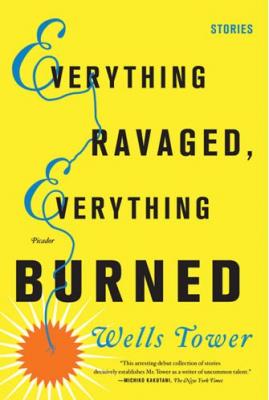
[READ: September 30, 2011] Everything Ravaged, Everything Burned

After talking about Wells Tower for a while and reading all of his uncollected stories and nonfiction, I finally got around to reading his short story collection.  And I think I have an interesting perspective on the book because at least two of the stories were totally reworked from their original release.  Not simply updating a thing or two, but totally revamped.  In my experience, aside from the David Foster Wallace essays that were truncated in their original form, this is the only book I know where the stories inside were totally rewritten for the compilation.

There are nine stories in the collection.  And I have to say as an overview to this book, I can’t get over how much I enjoyed them.  I mean, I knew I liked Tower from what I had read before, but I didn’t expect to enjoy this book quite so much because Tower writes a very manly kind of story.  He usually writes about tough guys and men who have a hard time interacting with their fathers and other situations that are out of my ken.  But Tower upends many conventions in his stories and his prose is tight and succinct and his stories are very quick to read and really enjoyable. (more…)

Read Full Post »

SOUNDTRACK: TOM WAITS-Small Change (1976).

Half-naked woman on the cover and all (Wikipedia say that this might be Elvira, before she was “Elvira”), this is what people thing of when they think Tom Waits: That gravelly voice is in full form here, with poetic rants and bluesy, drunken musings.

The opening track, “Tom Traubert’s Blues (Four sheets to the wind in Copenhagen)” (I love that many of these titles have parenthetical additions) features the repeated chorus from “waltzing Matilda” which is kind of cheating, but which certainly makes this song potent and memorable.  “Step Right Up” is a skit and scat sales pitch for a miracle product.  It’s a wonderful piece of snark aimed at hucksters (this actually makes sense given that nearly 40 years later he still hates advertising (according to this interview on NPR)).

“Jitterbug Boy” is a mournful piano ballad.  It makes me think of William Kennedy’s Ironweed (of course, Waits was in the film of Ironweed, so maybe that’s got something to do with it).  “I Wish I was in New Orleans (In the Ninth Ward)” has a very Louis Armstrong feel to it (I never noticed how close this early style is to Armstrong until I started playing “What a Wonderful World” for my kids (no Tom for them yet). And of course, the Ninth Ward was really devastated by Hurricane Katrina, so maybe they should have used this as their anthem.

“The Piano’s Been Drinking” is forever etched in my mind from Mystery Science Theater 3000–Tom Servo does a wonderful Tom Waits impersonation.  Incidentally, Waits himself had been drinking, quite heavily at the time.  The track “Pasties and G String” is a scat-fueled description of the lady on the cover, more or less.  It’s accompanied by simply drums and a cymbal and is not too dissimilar from “Step Right Up.”  “Bad Liver and a Broken Heart” begins and ends with the melody of “As Time Goes By” and ends with a confession to drinking too much.

A song like “The One That Got Away” is Waits rambling around with his poetry in his gravelly, slurry followed by a sultry saxophone.  It sets a mood faster than anything I know.  Of course, if you don’t want that mood, you won’t want this album.

Of his first four albums, this one is my favorite (just ahead of Closing Time).  I’m not a huge fan of his early work, and I don’t listen to it all that often, but it’s a perfect treat when the mood strikes.  Waits also was beginning to get into something of a rut.  Despite his varied styles per album, all of the albums were beginning to blend a little.   There are still some great songs coming, but it would take until Swordfishtrombones before he went really far afield from this comfort zone.

[READ: September 21 2011] “Dog Run Moon”

This is one of those stories that seems so pointless that you can’t stop reading.  The good thing is that it was so well-written and engaging that its pointlessness is part of its charm.

As the story opens, Sid is running stark naked through a desert landscape–his feet are bleeding, he is covered in the red dust from the ground and there is a white Spaniel running alongside him.

Essentially, the entire story is that Sid has stolen this dog from Montana Bob and his friend Charlie Chaplin.  They caught him and he ran away with the dog through the desert.  As I say, it’s kind of pointless because he’s running naked and barefoot and they are chasing him on ATVs–he’s obviously not going to escape.  But what makes the story worth reading is the way the plot is irrelevant (except that it tells you a lot about Sid), because it’s really the impetus for his actions that comprises the story. (more…)

Read Full Post »

SOUNDTRACK: TOM WAITS–The Heart of Saturday Night (1974).

What would be more shocking–hearing this and then going to Bone Machine, or listening to Bone Machine and then hearing this. Holy cow. Tom’s voice is so NOT Tom Waits on this record. It kept me thinking of The Eagles or something. The tone, the pacing, I kept expecting him to bust out “Desperado.”  He also has some crazy beat-inspired poetry (what the kids today call spoken-word pieces)  Indeed, these spoken pieces would stay with him in one form or another for his whole career.  But seriously, how much a man can change in thirty years!

Like Closing Time, this album has several different styles.  Primarily, it has a sloppy, bar sound, the sound that Closing Time‘s cover conveyed.  And that sound is all over “New Coat of Paint.”   But there’s also piano ballads.  And those ballads, combined with Waits’ non-gravelly voice, give “San Diego Serenade” and “Shiver Me Timbers” that Eagles’ ballady sound.  And then “Semi Suite” brings back that muted trumpet. 

“Diamonds on My Windshield” is a beat poem set to a walking bass.  It’s clichéd, except that no one actually does it as well as Waits.  And although I don’t really like the blues in general, I enjoyed “Fumblin’ with Blues” quite a bit.  There’s something about Waits’ sloppy (but not) style  that makes the song interesting.  Even though this is considered a classic, this album is just not really my style and it’s one I listen to quite infrequently.

[READ: September 21, 2011] “An Anonymous Island”

This story is translated from Korean by Heinz Insu Fenkl.  

I felt like the heart of this story was completely unoriginal in content; and yet I can’t tell if it is a common story, if it is a kind of folklorish story, if it’s sort of a story from ancient writings or if it’s just something that happens.

The beginning of the story shows a woman listening to her husband.  He is watching the television,bemoaning the fact that anyone can be anonymous these days (this struck me as a funny sentiment given how much everyone in America bemoans the lack of privacy or the fact that everyone is on the internet).  You can get off at one bus stop past your own and no one knows you.  Back when he was a kid everyone knew everyone else, a village was a family.  And as the woman listens, she flashes back.

The flashback is to when she was a teacher in a small village.  A village where everyone is related.  Everyone treats each other with respect and deference.  Except for one man, Ggaecheol.  Ggaecheol is a bum–he has no job, he has no home.  The village tolerates him because he is an idiot and he is impotent.  But whenever he wants a meal, he simply walks into someone’s house and sits down and says, feed me.  Which they do.  Typically he sleeps outside, but when it’s cold, he walks into someone’s house and sits at the foot of their bed.  He says he wants to keep the woman warm, so the men, amused by his impotence, allow this.

There’s an old Monty Python skit in which the town idiot, despite being mocked by all, does great with women.  The punch line, showing the idiot with a couple of hot girls in bed with him: “I may be an idiot, but I’m no fool.”  And so it is with this story.  The bum is sleeping with everyone in town.  (more…)

Read Full Post »

SOUNDTRACK: FANFARLO-“Replicate” (2011).

This is the final Fall Music song I’m going to mention.  “Replicate” was Robin Hilton’s song of choice for the fall, and I can see what he liked about it–there’s a lot of unusual sounds going on (in many ways it reminds me of Sparks or maybe sort of early Depeche Mode, although no one in the discussion mentioned them).  It opens with a series of staccato string notes over a repeated lyrics (“it’s gonna, it’s gonna, it’s gonna…happen soon”).  The strings build and build, but they stop before any major climax; they are replaced by a fast, kind of spazzing keyboard melody with more repeated vocals, (“it’s gonna, it’s gonna, it’s gonna…happen soon”).  The staccato notes come back and both sounds build to another near-climax.

Until the chorus comes in with its supremely catchy but very cold “oohs”.   Even the end builds but does not quite achieve the climax one would expect, although it is still satisfying.

It’s a very clinical song, cold and detached (the instrumental break has wood blocks that sound like a woodpecker banging a tree on a winter’s day).  But the vocals are so warm, that they disarm the song of its coldness even if the chorus is “Will it replicate inside our bodies now?”   At first I really didn’t like the song, but after a couple of listens, I really heard what Robin Hilton enjoyed.  And I would like to hear more from them.

The video is pretty neat too:

[READ: September 19, 2011] “Animal Art”

This article was probably the most “academic” and “scientific” of them all five of the JSTOR articles I read.  And by that, I mean, that it was researched and tested and full of abbreviations and as a result it reads very dry.  Which is a shame (well, actually it’s not a shame, the scientific requirements are essential for there to be an academic article published)–what it needs is a cool popular version to lighten it up a bit (and it needs better pictures as well).

The article looks at the bowers of the bowerbird.  The bowerbird is a family of 20 species of bird found in New Guinea and Australia.  Bowerbirds are noted and named for the bowers that the males construct to win a mate (see photo at right).  What’s interesting is that the different species of bowerbird construct similar nests but do things quite differently (some “glue” the sticks of their nest together with either spittle or insect secretions while others weave their sticks together).  But they are all very particular about the nests they build:

When I shifted the position of a decoration, the bower owner either restored it to the original position or else discarded it in the forest.  Decorations changed from day to day as birds replaced wilting flowers and rotting fruit with fresh ones.

The articles sets out to discover whether the traits that the male bowerbird develop in their nests are inherited or are learned.  Diamond believes that they are learned because birds that are not very far apart use different techniques, but immature birds are often seen observing the adult birds to presumably learn from them.  The nests are built by the males, but, similarly, the immature females go with the adult females to inspect the nests, thereby learning what traits to most look for in a nest.

But what seems to have inspired this paper was the bowerbirds’ proclivity for choosing colors to decorate their nests: most use flowers and mosses from the surrounding area, arranging them in beautiful colors.  What Diamond did was to take colored poker chips (a series of uniform shape, size and texture) with varying colors to see if the bowerbird would choose based on color (his scientific conclusion is that it’s really impossible to tell because who knows what other variables are at play, but his more satisfying conclusion.  is that the birds decorate by color.

So, Diamond put the poker chips in front of their bower (on the moss “mat” that looks like a welcome mat).  And with one group of birds:

Within 10-30 minutes [three birds] picked up all chips regardless of color and discarded the in the forest.

While for a different group of birds, they quickly discarded any white chips (and one bird discarded the yellow chips as well).  There was a marked preference for colors in this order: Blue>purple>orange>red>lavender>yellow>white.  While these birds not only embraced the chips and used them for their decorations, other birds stole chips from their rival makes’ nests:

When I placed three chips of each color at bower W6, bird W5 stole within 3hr all blue, orange and purple chips, two red chips and no yellow, lavender or white.

(Poor W6 bird–he really has nothing).  But the study shows that the birds hate the white chips!  He even created a chart that showed that most of the birds kept 100% 0f the blue chips, and most of the purple chips while dismissing almost entirely the yellow chips; none of them kept any white ones.  (One bird in the study seemed to be quite a pig–this is the one who stole from W6–he kept far more than the other birds, including 100 % of orange an 66% of yellow–i wonder if the females thought he was a gaudy show off?)

Incidentally, this study was done in 1986, so it does not account for the more recent discovery that bowerbirds will basically use any old crap to build their nests, provided it is colorful.  Many people find this sad, but the birds don’t seem to mind.   In the article, the author says that one of the birds came up to his colleague, stood on his shoe, and tried to steal the blue docks that he was wearing.  Here’s a picture of a bowerbird with a whole bunch of blue clothespins.

Read Full Post »

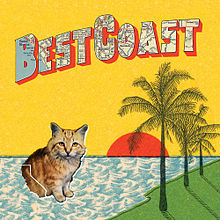
SOUNDTRACK: BEST COAST-Crazy for You (2010).

I really enjoyed the Best Coast concert that was downloadable from NPR.  I liked it enough for me to rethink my initial skepticism about this album.  But I have to say that I fall into a minority in that I really don’t like this album all that much.  In concert, the band is loud and raucous–the songs are poppy but they have a kind of growly edge and a punk veneer, and singer Bethany Cosentino has a sneer to her cutesy lyrics that gives them a nice edge.

But all of that is missing from the album.  In fact, to me this album sounds like a long-lost relic of girl groups from the 60s.  And, blasphemy as it may be, I just do not like girl groups from the 60s.  I hate the tinny sound and I hate the “my life sucks without a boy” sentiment that most of those songs project.  (I love a good love song, I hate an insecure love song).  And, for the first few songs at least, this album conveys both of those things. 

Nevertheless, there’s a lot I appreciate about this record.  I like that it’s lo-fi.  I like that it’s just the two of them making all this music.  I even like many of the lyrics (the lyrics that Cosentino describes as “about weed and my cat and being lazy a lot”).  I also like that the songs are super catchy and super short ( no songs are over 3 minutes and that most are only about 2 minutes long). 

So even if I don’t love the record sonically, I can appreciate the simplicity and ease of singing along that the album presents.  And there are a few songs on the disc that I do like.  I especially like “When I’m with You” (the bonus song) for being a stupid pop song but somehow transcending the stupidity. 

As for the lyrics.  They are little more than teen girl diary entries, except when they turn into college girl diary entries (and then they turn funny rather than sad).  From a lyrical standpoint I am much more in tune with “Goodbye” (“I lost my job, I miss my mom, I wish my cat could talk.  Everytime you leave the house, everything falls apart”) than with “Boyfriend” (“There’s nothing worse than sitting all alone at home.  And waiting waiting waiting waiting by the phone.  I hope that he’s at home.  Waiting by his phone”).

I guess, overall, there’s just something about California pop music that I don’t like as much as my East Coast bands.  [NYHC rules!].

[READ: September 14, 2011] The Emperor’s Code

Gordon Korman is back helming the series which is set in China. Now, I have seen pictures and movies of things in China, but the real scale of things has never come across to me until reading this book.  Which is kind of sad for me, but it’s really cool for the book.  I knew that the Great Wall of China was huge, but I never knew that it could stretch from Boston to San Diego with extra room at the end.  I never appreciated the kind of training the Shaolin monks undergo (the description of the statue of  Bodhidharma as being well over 750 steps up and taking over an hour to climb really sunk in for me just how big this place is!).  In short, while I know that parts of the story disregard history, the historical parts are fascinating and informative!

Dan and Amy’s first stop is the Forbidden City, where they sign up for a tour.  Dan sneaks out of the tour to enter an area where they think a clue is.  Much like with Pee Wee Herman looking for the basement of the Alamo, Dan Cahill looks for the attic of the Forbidden City.  And he finds it.  And then he is caught by guards.  But this little preview of Dan and Amy working separately doesn’t quite prepare us for the massive change in the series that Korman is preparing for us.  

Dan and Amy start talking about what the clues means and the fact that they are Madrigals–are they (and their whole family line) really killers?  This leads to much tension which ends with Amy wondering aloud if maybe their parents weren’t good people at all.  Dan and Amy fight and Dan storms off.  And through a series of scary events, he ends up in the clutches of Jonah Wizard (whom we have not seen for a long time).

And thus, for the bulk of the book, Dan is on his own.  Amy, Nellie and Saladin work hard to try to find Dan and maybe even a Clue.  Meanwhile, Dan is with Jonah, thinking that Jonah’s father is trying to contact Amy.  Dan is still pretty angry so he doesn’t really care what Amy is up to (and he believes she is not trying to find him).  But Amy is freaking out thinking of her 11-year-old brother in the most populous, hugest country all alone.  But he’s not alone, he’s got Jonah Wizard, yo.  And for much of the book, Dan lives the high life.  He hangs out with Jonah, plays video games, lives a first class lifestyle and even gets to be backstage to see what it’s like to have tens of thousands of fans screaming at you.  (more…)

Read Full Post »

SOUNDTRACK: EXPLOSIONS IN THE SKY-Take Care, Take Care, Take Care (2011).

I found out about Explosions in the Sky because of the events of 9/11.  Back when everyone was looking for albums to point fingers at in some kind of hysteria (that’s also how I found out about I am the World Trade Center who are not as exciting as Explosions…).

EITS make beautiful epic instrumental music (as well as the soundtrack for Friday Night Lights).  They play music in a similar vein to Mogwai, but they take their epic instrumentals in a different direction.  And this album is perhaps their most commercial to date (as commercial as you can be when you write 10 minute instrumentals).  And while “commercial” is not usually an adjective that I give as praise, for this album it is indeed.

Take Care, Take Care Take Care is a terrific album.  It ‘s not as visceral as past releases; rather, it seems like a more experienced band playing with their sound and tweaking it in subtle ways to make it less obviously dramatic but somehow more powerful.

On “Last Known Surroundings,” there are soaring guitars that give way to simple, pretty guitar riffs.  Martial drums propel the songs forward, even if they lead to unexpected places.  It’s soundtrack music that’s not background music.

Perhaps the biggest difference with this album and previous ones is that this album doesn’t quite live up to the band’s name.  There’s no major explosive crescendos.  There are noisy bits but they’re not climactic per se.   “Human Qualities” slows to a quiet drum beat and while you’d expect to come out of that with a cacophonous explosion, it doesn’t.  The explosion does come later, but only after it has worked up to it again.

“Trembling Hands” features “voices.”  Or maybe just one voice.  It’s on a loop that becomes more of a sound than a voice.  The song is only 3 minutes long, but it’s an intense 3 minutes–more great drum work on this one.

“Be Comfortable, Creature” has a beautiful delicate guitar opening that drifts into a kind of solo.  After 3 minutes it settles into the main riff, a winding guitar line that send you on a journey.  “Postcard from 1952” is a great song. It begins as quiet intertwining guitars and slowly builds and builds into a gorgeous rocking conclusion.  7 minutes of steady growth with a nice epilogue at the end.

The final song, “Let Me Back In” also has kind of spooky voices that appears throughout the song (distorted and repeated).  But you know this song is a winner from the get go (even if the opening chord structure is a bit like Duran Duran’s “Come Undone.”)  It’s a slow builder, a cool, moody ten minute piece.  When you get to the beautiful descending guitar riff that shoots out after about 2 minutes, it’s an ecstatic moment–air guitars are mandatory.

And let’s talk packaging.  The album comes in a gate-fold type of cardboard.  If you open it up all the way it can be folded into a little house (with windows and a door and a chimney).  That’s pretty cool, guys.

If I have one compliant about the album it’s that the quiets are really quiet and he louds are really loud.  That makes this a very difficult album to listen to say, at work, or basically anywhere where other people will be blown away by your speakers.  The middle of “Human Qualities” for instance, is really quiet, you feel like you need to turn it up to hear the drum beat–there’s too much volume fiddling (listening in the car by yourself negates any reason for this complaint, of course).

Keep it up, guys.

More “controversy” from the band

[READ: September 10, 2011] New Yorker essays

Ten years ago, The New Yorker published several short essays by famous and (to me anyway) not so famous writers.  They were all written directly in the aftermath of the attacks and they were moving and powerful.  I was going to wait until today to re-read them and post about them, but for various reasons, I decided to do it on May 12.

Now, ten years later, The New Yorker has published several more essays by famous and (to me anyway) not so famous writers.  I note that none of the authors are the same (that might have been interesting) although Zadie Smith does quote from John Updike’s piece of ten years ago.

The strange thing to me about these pieces is that ten years seems to have hindered the writers’ ability to focus on the incident and to talk about What It Means.  In this collection of essays, we have a few that talk about an individual and how his life has changed since 9/11.  These are pretty powerful, although it’s odd that they would talk about another person and not themselves. We have a couple of essays that talk about the writer him or herself, but these seem kind of unfocused.  And then we have ones that talk about the state oft he world; honestly, what can you say about that.

It’s possible that I’m jaded or in a bad mood and that’s why I didn’t appreciate these essays.  Or perhaps I’m just facing the futility of things.

This is not to say that I think that writing about 9/11 is easy (you’ll notice I’m not doing it).  Indeed, I think talking about it in any kind of meaningful, non-strident, non-cliched way is nigh impossible.

But these writers do give it a try.  And I am grateful for that. (more…)

Read Full Post »

SOUNDTRACK: RADIOHEAD-The King of Limbs: From the Basement (2011).

The TV channel Palladia has been showing this BBC production since it became available.  And it’s scheduled to be broadcast a few more times in the next couple of months. 

From the Basement is a show in which (very cool) bands play in this recording studio (presumably in the basement of wherever it is recorded).  The show is filmed in HD and the sound is fantastic.   The Wikipedia page gives some context for the show–it was originally designed as a program to showcase several bands playing a few songs.  Several of these episodes aired (the Wikipedia page gives details).  The show was created by Nigel Godrich, Radiohead’s producer.  Thus, it makes sense that Radiohead have now done live sessions shows for their last two albums.

So this is a recording of The King of Limbs.  I’m not sure if the album had come out by then, but this is basically the complete album and two extra songs: “The Daily Mail” and “Staircase.”

The session sounds amazing.  There’s a brass section for a number of songs, there’s two drummers (both completely bald, which is kind of neat to see), and you get to see Thom Yorke up close (sometimes a little too close) on all kinds of instruments.   I feel a little bad for Jonny Greenwood as it seems like Thom plays most of the guitar parts (unless Jonny is on keyboards too–it’s not always clear who is playing what).

I liked King of Limbs, but I must say that this live recording brings much more depth to the album.  While the band sounds tight as a drum, paradoxically, they also seem looser in their overall feel.  They seem like they’re really enjoying themselves.  It doesn’t have the same vibe as a concert (they’re not playing off the crowd or improvise at all), rather it has a feeling of jamming with friends–trying to get a perfect take, without the tension of fretting about the perfect take.  It’s really a great show and worth watching for any fan of Radiohead.

[READ: September 5, 2011:] ” What Have You Done”

I had a hard time getting into this story.  It’s about a man named Paul.  Paul is headed home to visit his family in Cleveland and he is more than a little apprehensive about it.  He deliberately hasn’t been home in about ten years, so this is quite a chore for him.  And it is quite clear from the outset that Paul is something of an asshole.  We don’t really learn why in the beginning (and that’s why the story was hard for me to get into–more on that)–he’s just sort of accepted as an asshole and that his family will give him shit.

And that’s what families do, this idea is in no way new.  But what’s is odd about the story is that we don’t really have any context for Paul’s attitude.  We seem to jump into the story with him feeling like an asshole and assuming that his parents will treat him like crap.  That they won’t believe anything he says and that they’ll give him a hard time.  Indeed, when he finally gets to his parents’ house (and his sister and her husband are there) he is so aggressively defensive that he’s quite unlikable.  And yet we still don’t know if he is defensive or if they are nasty.  Paul seems to flare up at anything anyone says and yet we don’t know if he has a right to.

The crazy thing is that Paul’s major fault seems to be that he’s fat.  Quite a bit is made of the fact that he is fat.  And he seems to be so very lonely–hateful of his family and resentful of his sister’s happiness–that when we finally learn the truth about him and what he’s been up to these last ten years, it’s hard to believe it’s really true.  His family doesn’t believe him, and the only reason we do is from a phone call that comes in to him.  But he’s so paranoid, it’s hard to know what to believe. (more…)

Read Full Post »

« Newer Posts - Older Posts »