Feeds:
Posts
Comments

Archive for the ‘Fantasy’ Category

SOUNDTRACK: THE ATTACCA QUARTET-Tiny Desk Concert #580 (November 18, 2016).

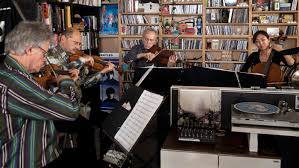
The Attacca Quartet are a fascinating group. The group consists of Amy Schroeder and Keiko Tokunaga (violins), Nathan Schram (viola) and Andrew Yee (cello).  And they play a huge variety of music (and really get into what they are playing).

The first two pieces are modern and a little wild, so I assumed that that was the kind of music they played.  But then they told us about a Haydn quartet that they loved as well.   The blurb says:

They revere the old school, having recently completed a performance cycle of all 68 string quartets by Joseph Haydn, the man who invented the genre. They also hunger for the new, exploring the music of three living composers each year in a project called Recently Added.

The composer of the first two pieces is John Adams, who I know a little because of the Kronos Quartet.  But I like the blurb’s comment:

One contemporary composer the group continues to champion is John Adams. The head-banging pulsations of “Toot Nipple” (titled after a character in an Annie Proulx story) contrast with the slippery and funky episodes in “Alligator Escalator.” Adams has said he imagined such a creature waddling up and down the floors of Macy’s department store. The two movements belong to John’s Book of Alleged Dances from 1994.

I love the beginning of “Toot Nipple” as the cello is sawing away furiously and then passing off that fast sawing to the viola.  The piece is only a minute and 13 seconds long.  The second piece plays with quiet squeaky sounds as the strings progress up and down the fretboard almost randomly.  When things settle down I enjoy watching how aggressively the cellist plays the heavy notes before returning to some smooth notes high up the fretboard.  The violins also show some really fast fingerwork near the end.  This piece is all of 4 and a half minutes long.

Haydn seems really traditional when compared to Adams, there’s still some intensity on his piece:

Next to Adams, Haydn sounds positively genteel, but you needn’t look far to find the composer’s own feisty side. Sunny skies suddenly turn threatening at the turn of a phrase — a trend in Haydn’s time known as Sturm und Drang, or “Storm and Stress” — when moods can swing wildly with impunity.

Of all of the 68 string quartets, this is their favorite part to play.  It is pretty with a lot of really fast fingerwork as well.  I’m most surprised by the note it ends on–it doesn’t go down a note as you might expect.

The concert ends with “Smoke Rings.”

Measured by the cello’s tick-tock pizzicato, the mood of Michael Ippolito’s Smoke Rings is languid, even a little trippy. Inspired by a 14th-century French song about a smoking society, the composer employs long, slow strokes and light bow pressure for a hazy texture. The music heats up dramatically midway through, only to drift back into the smoke.

While the blurb talks about the cello, I was more taken with the pizzicato violin that ends the piece.  But after listening as second time I see that the pizzicato passes around to different musicians, beginning with the cello and the moving from one violin to the next.  But it’s not all pizzicato, there is a an aggressive middle section with notes the gradually ascend and grow more rapid.  It’s when this section ends that the pizzicato violin comes in to bring us home.

[READ: May 6, 2016] Hilo: Book 1

Judd Winick is a cartoonist whom I have liked for a really long time.  He has done a bunch of really funny cartoons and a very serious graphic novel called Pedro and Me.

Winick (and Pedro) and Winick’s wife Pam were all on The Real World San Francsico.  I don’t believe that that has anything to do with Winick’s success as a cartoonist (how could it, really?), but it is fun to remember him from the show.

Anyhow, this story is outstanding.  Winick has an amazing sense of comic timing and pacing.  He uses repetitive jokes to excellent result here.  On top of that, the story is compelling, funny and bittersweet.  It’s a great start to what I hope is a long series. (more…)

Read Full Post »

SOUNDTRACK: JOSHUA BELL & JEREMY DENK-Tiny Desk Concert #568 (September 30, 2016).

After hearing a pianist and then a violinist, it was fun to hear a duet of the two.

Joshua Bell and Jeremy Denk are masters of their crafts.  Although I did not know that:

Bell and Denk have been chamber-music partners for 10 years, and they’re a bit wound up on Brahms these days. They’ve released a new album, For the Love of Brahms, and they’re performing the music, along with that of Brahms’ friend Robert Schumann, in concerts.

They play three pieces, two Brahms, and one Schumann.  And they all sound spectacular.

Brahms: Violin Sonata No. 3, IV. Presto agitato
“You gotta love Brahms,” Joshua Bell says, a little short of breath. He’s wiping sweat from his brow after the big rock ‘n’ roll conclusion to the composer’s D minor Violin Sonata. Bell and the astute pianist Jeremy Denk play it with all the turbulence and tenderness Brahms demands, and it’s an invigorating way to open this Tiny Desk concert. [I love that the focus jumps back and forth from violin to piano, with interesting riffs and trills from one then the other.  I also love the way the melodies seem to creep around and sneak up on us].

Schumann: Romance, Op. 94, No. 2
Contrasting with the fiery Brahms, Schumann’s Romance, Op. 94, No. 2 unfolds like a song without words. Bell makes his 1713 Stradivarius sing, capturing the bittersweet tone of the music. When the theme comes around for the second time, he lightens bow pressure for a more intimate, almost whispered disclosure.

Brahms (arr. Joachim): Hungarian Dance No. 1
Another of Brahms’ close friends figures prominently in Bell and Denk’s final offering. Violinist Joseph Joachim was something like the Joshua Bell of Brahms’ day, as well as the man for whom the composer wrote his Violin Concerto. Joachim’s gift to Brahms was creating piano and violin arrangements of the composer’s Hungarian Dances.  Brahms’ Hungarian Dance No. 1, powered by a sweeping theme and chugging piano topped with pearly descending runs, whisks you to a smoky café where gypsy fiddlers battle for supremacy. Starting off on the low G string, Bell’s tone is as rich as dark chocolate, the feeling a touch wistful.  [I really love Hungarian dances.  It seems like every composer’s take on Hungarian music is excellent.  I love how the violin plays a very simple yet dark melody and the piano sprinkles in all of these descending notes in a fairly dramatic scale.  And then of course as all the dances do, it speeds up, careening around in wild abandon and fun.  Wonder what made Hungary such a lively place].

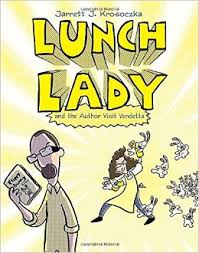
[READ: June 13, 2016] Lunch Lady and the Author Visit Vendetta

I rather like that the Lunch Lady books are sequential and mildly dependent on each other. Of course you can read them in any order you like, but reading them in the proper order allows you to see some continuity between books.

In the previous book, Dee mentioned that the author of the Flippy Bunny series was coming to the school. And in this book he does.

The kids are super excited that Mr Scribson is going to be there to read and sign books.  He is something of a primadonna though as he is upset that the reading will be taking place in the gym.  After his presentation, he signs books, but when Hector brings him a very old copy of the book Scribson says “I don’t sign opened books.”  Hector who has always love the Flippy Bunny books is devastated). (more…)

Read Full Post »

SOUNDTRACK: RACHEL BARTON PINE-Tiny Desk Concert #555 (August 5, 2016).

I’ll let the blurb do the introduction:

Violinist Rachel Barton Pine began playing Bach in church at age 4. Ever since, she’s been mastering and re-mastering Bach’s set of six Sonatas and Partitas—more than two hours of solo violin music that looms like a proverbial Mount Everest for any serious fiddler. The trick is getting the details down. Bach left us with the notes but not much else. Pine recently analyzed every measure of these works, and prepared a new edition of the music with her own dynamic markings, phrasing indications, bowings and fingerings.

For this performance, Pine chose three contrasting movements from the set and plays them on her Guarneri del Gesu violin, which was built in 1742 — eight years before Bach died. She highlights the spirit of the dance in the “Tempo di Borea” (a Bourée from the First Partita). She unfolds a serene melody, just lightly accompanied, in the “Largo” (from the Third Sonata), and she closes with the intertwining “Fuga” (from the First Sonata), which sounds like three violinists in deep discussion.

And the music is gorgeous (Bach is truly sublime) and Pine’s violin playing is stunning.

She plays three pieces:

  • J.S. Bach: “Tempo di Borea” (from Partita No. 1)
  • J.S. Bach: “Largo” (from Sonata No. 3)
  • J.S. Bach: “Fuga” (from Sonata No. 1)

The first she describes as dance music.  She says that even though this was not created for the dance, you can sense the implicit choreography.

She describes the second piece as the sorbet course in between the exciting stuff.  It is in the key of F major, which historically is an intimate key.  This piece is calm and peaceful with the sparest of accompaniments.

For the final piece she says she will finish by playing the most complex of violin pieces.  Bach wrote it as a fugue for solo instrument.  She describes a fugue as a musical pattern that the voices toss around in conversation with each other.  So this little four string violin sounds like a full string ensemble.  And it absolutely does.  The opening melody is followed by the same melody on a lower string (while the first string is playing something else at the same time).  And then that riff is continued on the next string while the other two continue.  It is amazing.  And then near the end, she plays some incredibly fast dervishes of flying fingers and that crescendo is not even the end.

You might say that Bach was cruel, except it sounds so amazing, it’s worth it.

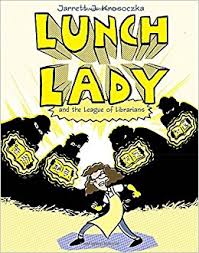
[READ: June 13, 2016] Lunch Lady and the League of Librarians

Librarians don’t really like when librarians are portrayed as villainous–unless they are done well.  And these librarians are pretty evil.

I enjoyed how this book also started out with a short clip of Lunch Lady stopping some bad guys before we even get to the story proper.

This book sees the Breakfast Bunch split between wanting to play video games (Hector is excited about the new X-Station 5000) while Dee is excited for the Read-a-thon contest.  Of course when they go to check out the Book Fair, the librarians insist that it starts tomorrow, not today.

Things seems calm and quiet for Lunch Lady.  In the meantime, Betty has come up with a new gadget: taco-vision night goggles. (more…)

Read Full Post »

SOUNDTRACK: EDDIE PALMIERI-Tiny Desk Concert #559 (August 19, 2016).

Eddie Palmieri is a jazz legend although I’m not exactly sure if I’ve heard of him or not (his name sounds familiar, but..).

But the blurb fills me in:

Eddie Palmieri is that once-in-a-lifetime musician, bandleader, composer and arranger. An icon for both modern and Latin jazz, he continues to break tradition and innovate within many musical styles, including salsa, fusion, Latin funk and more.

He is, indeed, a magnificent player.  A few minutes into “Iraida” you can hear him start to growl (I actually thought it was a buzzing on the piano at first).  I love watching him slide his fingers slow up the keys at the end of he song and then play a deep low note to end it.

He has an amusing introduction to “The Persian Scale.”  This next composition is called The Persian Scale and it’s quite an interesting composition….  It has a cool, interesting riff with staccato and counterpoint.  And he lays fast and loud (with grunts), although it does slow down.  Eventually, for such a wild opening. the song mellows out by the end with some very pretty, delicate trills.

“La Libertad” is uptempo and he says “if you want to dance, do it.”  He plays a brief intro and then when the melody kicks in on the low notes, it’s pretty great.  In the middle, he starts playing a very typical Latin American melody on the bass notes (is that a mambo?) and when an audience member starts clapping along (a rather complex pattern), he smiles and say very good.

This is a fun piano concert with lots of variety and different styles and he handles them all with much skill.

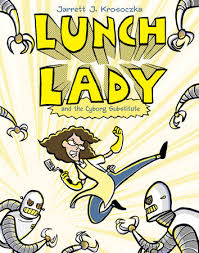
[READ: June 11, 2016] Lunch Lady and the Cyborg Substitute

I learned about Lunch Lady from the Comics Squad books which Krosoczka and the Holms’ edited.

Since I enjoyed the Lunch Lady mini comic, I decided it was time to read the real thing–Tabby also loved them (she’s a big fan of Babymouse as well).

Despite the fact that the title of the book kind of gives away the plot of the story, I suspect that the plot wasn’t really the main point. Rather, it was all meant to be good fun that Lunch Lady turns out to be a crime fighter complete with her own assistant who comes up with awesome gadgets. (more…)

Read Full Post »

SOUNDTRACK: THE NATIONAL-Tiny Desk Concert #279 (June 10, 2013).

I rather like The National and yet I haven’t spent much time really listening to them.  This Tiny Desk Concert really shows them off well.  It is extremely winning and enjoyable.

I enjoyed this part of the introduction:

we’d gotten word that the group would strip its sound way down for the occasion, sticking to two acoustic guitars and a bit of hand percussion. What we got instead was a fully fleshed-out septet, complete with horns and piano; the band showed up at 9:30 to rehearse and sound-check.

Though singer Matt Berninger had barely rested his voice from a show in the area the night before, The National dutifully performed gorgeous acoustic renditions of four tracks from its fine new album, Trouble Will Find Me.

I like the way the first song “This is the Last Time” starts quietly with just some acoustic guitars (playing quite interesting chords too) but builds, adding more and more instruments.  It grows and grows until it hits a new section where there’s a trumpet solo that fits perfectly in the song.  This new section introduces the second half of the song which never returns to the first part.  The backing vocals–between the guys singing the lines and the other guys singing the high “ahhh” that almost sounds like a horn–also work great together.  It’s a wonderfully full song.

“I Need My Girl” has a cool part with the two guitars.  They play a simple picked melody, but after the second verse, the second guitars plays it one step after the first, making it sound like an echo. And again that lone trumpet sounds terrific here.  This song is a bit more mellow.  In fact, this whole acoustic vibe sounds different from what I expect from the band.

The third song “Pink Rabbits” begins as primarily piano with lots of backing vocals.  But again the song builds slowly (with trumpet and trombone).  And again, after the horns go down there’s a backing voice that sounds a bit like muted trumpet.

Through the whole concert, I love Berninger’s casual demeanor while singing–hands in pockets, gently swaying.

Bob tells them that they are performing Tiny Desk’s first encore.  The blurb notes that the band:

even treated the hundreds of worshipful gawkers to Building 2.0’s first-ever Tiny Desk encore, in response to a roar of applause that could be heard in the far reaches of the newsroom downstairs.

Berninger says this is usually when they run back stage to piss but we’ll just go behind your desk.  Bob jokes that it’s no different from the trombone spit that he sees back there.

Berninger introduces “Sea of Love” by saying this is the only song we’ve ever written with a harmonica in it…and its the last one.

The full band sings and it sounds terrific.  I especially like the pause in the line “they say love is a virtue don’t….they” is pretty dramatic.  And I am tickled by the final lines of the song (while the backing singers do some great work: “I see you rushing down / tell me how to reach you / I see you rushing down / what did Harvard teach you.”

The National are usually more dramatic, I believe–almost theatrical, but this quieter version is really quite enjoyable.

[READ: April 2, 2016] Feathers

Jorge Corona introduces this book by explaining that he had an idea for a Beauty and the Beast kind of story that features a boy with feathers.  And it slowly expanded into the story we have here.

The story opens with a bright white city in the distance.  In the foreground, there’s some dark Victorian-looking houses.  And as we zoom in, we learn that the dark city is known as the Maze.  And in this Maze live the poor.  Little kids, called “mice” are street urchins who run all over the Maze.  And then there’s a man with a beard.  The man finds a baby in an alley.  The baby is born with feathers and he decides to take the boy in and raise him.

The scene jumps to eleven years later.  The boy, known as Poe has grown up and has stayed hidden.  He still has feathers and he goes out at night, but no one knows about him.  People just speak of the ghost–Poe–who swoops down unseen and does things (mostly to help the poorest) and then flees. (more…)

Read Full Post »

 socks kronosSOUNDTRACK: KRONOS QUARTET-Tiny Desk Concert #322 (November 25, 2013).

2013 was the 40th anniversary of Kronos Quartet.  I first heard of them about eight years after they started with their cool arrangement of “Purple Haze.”  And then I learned that they were like a sponge, soaking up and playing music from all over the world: In just one year they released albums with tango, songs by South African composers, Polish composers, jazz musicians and so much more.

I have many of their releases, although I realized I more or less stopped listening to new stuff from them around the turn of the century (since when they have released some 16 albums!).

Well, amazingly, the Quartet is still the same original players (except for the cellist–the cello is like Kronos’ drummer as they seem to replace her every couple of years).

They play three pieces here and the three range the gamut from dark and broody to rather sweet to quirky.  In other words, typical Kronos.

For more info:

The musicians —  David Harrington (violin) and longtime members John Sherba (violin) and Hank Dutt (viola) and new (as of 2013) cellist Sunny Yang — could reminisce over more than 800 new works and arrangements they’ve commissioned in 40 years. But instead, the new-music train pushes ever onward to new territories. They remain a living, breathing world-heritage site for music.

Now in the midst of its 40th-anniversary tour, Kronos brings to this Tiny Desk Concert a new arrangement, a work from a new album and, for Kronos, something of a chestnut, a piece the group recorded a whopping five years ago.

“”Aheym” (Yiddish for “homeward”) was written for Kronos by Bryce Dessner; a member of the Brooklyn rock band The National, he studied composition at Yale. The music thrives on nervous energy, pulsating with strumming and spiccato (bouncing the bow on strings) while building to a tremendous fever.”

I love this piece. It is intense and dramatic with its 4-3-3 bowing from all four members.  There’s an interesting cello melody with pizzicato strings from the rest.  The overall melody seems somewhat circular with different instruments taking on different leads.  But this song also plays with some interesting bowing techniques.  In addition to the spiccato (about 4 minutes in), the players drag the bow for momentary scraping and scratching sounds.

Another wonderfully dramatic moment comes at 7 minutes where each musician takes a turn bowing his or her note while the violin plays a super fast series of notes.  The song builds and build in dramatic until it gets to about nine and  half minutes and it reaches its powerful ending.

“Lullaby,” opens with plucked cello notes and strummed viola.  “It is a traditional song with Afro-Persian roots (from the group’s Eastern-flavored 2009 album Floodplain), [and] is woven from different cloth altogether. Colorful tones that lay between our Western pitches are threaded through the music, anchored by a gorgeous solo from violist Dutt; his contribution takes on the warm and weathered sound of a grandmother singing to a child.”  It is slow and moody and beautiful.

Harrington introduces the final piece by saying it’s by a performer that no one had heard of–including, until recently, even himself.

“Kronos caps off the concert with another hairpin turn, this time to a fresh arrangement of “Last Kind Words,” a little-known blues song from around 1930, recorded by singer and guitarist Geeshie Wiley. In Jacob Garchik’s exuberant arrangement (which Kronos premiered this fall), interlocking strums and plucks provide a kind of rhythm section, while Harrington’s violin stands in for the now-forgotten blues singer.”

There’s lots of plucked notes from everyone–including plucked bent note on the viola which gives it a real “early” guitar sound.  While I don’t know what Geeshie sounded like, so I can’t compare the violin to her vocal, the whole thing sounds great together.  In fact the whole thing is unlike any string quartet I’ve heard–so different and wonderful.

I’m going to have to bust out so Kronos CDs.

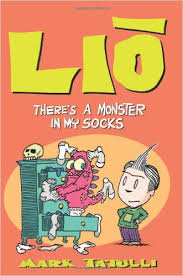
[READ: September 10, 2016] There’s a Monster in My Socks

I’ve been quite puzzled about the publication history of the Liō books.  And this just adds another layer of confusion.  This book covers the exact same time period as Happiness is a Squishy Cephalopod which was published in 2007.  The difference is that Cephalopod placed all of the strips in order, while this one seems to move things around quite a bit (the thinner format also means that it can’t quite handle the single panel strips very well.   But more egregious is that this volume (remember, the one printed after the previous one) prints the Sunday color strips in black and white.

The book also leaves some of the strips out.  It covers the date range from May 15, 2006 – Feb 16, 2007 (Cephaolopod went to May 23), but while it has the Feb 14 strip, it does not have the Feb 15 strip.  Weird.

So, basically this is an inferior version of the same book, but the publishers presumably wanted the books in this more friendly size (or some other nefarious reason).

I’ll include the review of Cephalopod below.

And, here’s the current list of existing Liō books. It’s a shame that there are years and years of strips thus far uncollected. (more…)

Read Full Post »

curswedSOUNDTRACK: MAYA BEISER-Tiny Desk Concert #283 (June 29, 2013).

mayaMaya Beiser is an Israeli-born American cellist.  And the blurb tells us that:

Maya Beiser’s Twitter handle — @CelloGoddess — says it all. She’s a brilliant cellist with a stunning command of her instrument, and she’s tightly tied to technology. Beiser takes the sound of her cello and runs it through loop pedals, effects and other electronics to make her instrument shimmer, drone and groove.  Time Loops, her 2012 album, is one of that year’s hidden gems.

The music feels experimental in that she’s using an age old instrument (and age old tuning) mixed with technology.  But the two songs she plays here are simply beautiful and the technology only serves to make the songs all the more enticing.

I don’t know what these pieces are “meant” to sound like.  In fact, I don’t even know the composers.  But her version of these pieces (with the wonderful drones and echoes of what she is playing) are terrific.

Osvaldo Golijov: “Mariel” One of the fascinating things about this piece is that it is impossible to tell what she is looping (especially since we miss the very beginning to see if she clicks any pedals).  But is she looping what she has played or is there some other music being added in?  This is a mournful piece with some great sounds (looped) accompanying her.  It’s seven and half minutes of beautiful cello music.

She introduces the second piece “Just Ancient Loops” Mvt. 1 by saying that Michael Harrison wrote the piece for her.  She plays 6 minutes of the 25 minute epic piece, or what amounts to the first movement (called Genesis). She also tells us that it was written in “just intonation” which is an ancient way of tuning the cello, but it is natural for the instrument which is all about pure fifths.

It opens with some plucked bass notes which are immediately looped and run through much of the piece (how is she controlling the loops?  I can’t see her feet at all).  By the middle, the piece is in full swing with different cello sounds echoing and looping. It sounds full and fantastic and over all just really wonderful.

I typically enjoy cello music, but there is something especially cool about this performance.

[READ: September 2, 2016]. Harry Potter and the Cursed Child

I wasn’t all that excited about this book.  It was a play.  Did Rowling even write it?  (I actually still don’t understand the provenance of the story)?  And did I really want to read about a grown up Harry?

Well, first T. read it and then S. read it and they both said it was great.  So I read it.  And I flew through it (and stayed up too late reading it, too).  And, man was it enjoyable.  More than enjoyable.  I immediately got right back into the Potterverse and I loved seeing the famous characters grown up.

So, what’s this book about, exactly?

Well, without giving spoilers (to those few to whom it applies), the plot starts off 19 years after the action of the last book.  (more…)

Read Full Post »

cardboardSOUNDTRACK: MARY HALVORSON QUINTET-Tiny Desk Concert #267 (February 25, 2013).

maryI had never heard of Mary Halvorson before.  And that makes sense because she is an avant-garde free-jazz guitarist, a sound I like (sometimes) but one which I do not follow.  So a little background is in order:

As a sidewoman, [Mary Halvorson] is often tapped to play in open improvising situations….  Among her sonic signatures are craggy distortions, bent strings and delay-pedaled blurts through a hollow-body guitar….  Halvorson has now recorded two albums with her quintet, one with alto saxophone (Jon Irabagon) and trumpet (Jonathan Finlayson) up top. (The rhythm section is also among New York’s finest, with John Hebert on bass and Ches Smith on drums.) From the way her songs balance order and entropy, you can hear that she’s studied how golden-era hard bop blended those voices, and how later generations morphed, rephrased and imploded those ideas.

The Quintet plays two pieces.  I would have guessed they were improvised but not only do they have titles, they have sheet music!

“Love In Eight Colors” (No. 21) starts out as a slightly dissonant mellow jazz piece.  Then about 45 seconds in, Mary throws in an unusual guitar lick—a slightly weird note.  And then a minute later things get noisy until a simple trumpet solo takes over.  When the music resumes, Mary is playing some strangely discordant chords over the solo—everyone seems to be doing their own thing.  Around 4 minutes in, it turns into something new with an interesting, mesmerizing guitar solo riff.  When the band resumes, the sax takes over and the trumpeter literally stands stock still like a statue staring forward–it’s almost creepy.  At 8 minutes, they introduce a two-minute drum solo.  It’s fun to watch all the strange things he does—elbow on the drum head, vibrato with his hands changing the sound, clicking the sides of his drum.  Then the band resumes until the end.  And it’s more dissonance.

She introduces “Hemorrhaging Smiles” (No. 25) without smiling.  There’s a lot more melody in this song–the sax and trumpet sound groovy.  Even the guitar is pretty. Then she throws in a bizarre scale which cycles throughout the song.  It’s strangely addicting and I enjoyed hearing it every time it came back–even though it wasn’t exactly pretty.  The guitar has a lot of vibrato on it, although about six minutes in she switches the sound of her guitar to a bit more conventional sound and she plays a wicked solo. The second listen through made me appreciate what was happening a lot more.  Even if the song is pretty out there.

Mary Halvorson’ Quintet is not for everyone.  It might not be for many at all, but if you like your jazz free, check her out.

[READ: June 19, 2016] Cardboard

I’ve had mixed feelings about TenNapel’s books.  I loved Ghostopolis, and didn’t love Tommysaurus Rex.  So I picked this up with some hesitation.

But I found that I really enjoyed this weird book a lot.

For a kids’ graphic novel it’s actually quite long.  And, for a kid’s graphic novels there’s a few adult themes (like unemployment and widowhood) that a kid may not get or care about all that much (or maybe they would, what do I know).

As the book opens we see Mike, a big burly carpenter, begging for work.  But he gets nothing.  And as he walks away we see a very strange-looking man (TenNapel’s book are chock full of weird-looking characters) who offers to sell him a gift for his son.  Mike has no money, so he can’t buy the cool gift.  But the man says that for 78 cents (the exact amount in his pocket) he can have this giant cardboard box.

Mike is appalled at the idea of getting his son a box (even if it can be a creative play toy–ha!), but he’s got nothing else.  So he drives home with this box muttering “worst present ever.” (more…)

Read Full Post »

slowreadSOUNDTRACK: DIRTY THREE-Tiny Desk Concert #245 (October 15, 2012).
dirty-3For a Murakami collection I should really have picked a jazz Tiny Desk Concert.  But none jumped out at my on my list.  So I decided to do something that might be jazzy in spirit, even if it is nothing like jazz at all.

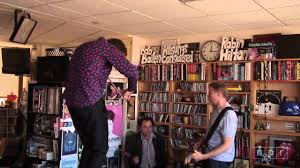
Dirty Three are a three-piece band which consists of violinist Warren Ellis (who works closely with Nick Cave), drummer Jim White (who I had the pleasure of seeing live with Xylouris White), and guitarist Mick Turner (who has released a string of gorgeous instrumental solo albums and worked a lot with Will Oldham).

I’ve liked Dirty Three for years, although I kind of lost touch with them back around 2000.  So it was fun to see that they are still working.  (They’ve released all of 3 albums since 2000).

Jim White plays an eccentric but very cool style of drum–it always feels improvised and random, and maybe it is, but it’s never “wrong.”  Turner is the only one who is keeping the song, shall we say, “stable.”  He’s got the rhythm and melody both with his strumming.  And Ellis is all over the place with melody lines and bowing.

For this Tiny Desk, they play three songs.  Their music is ostensibly instrumental although Warren Ellis is not above shouting and yelling and keening when appropriate.

The first two songs are from their 2012 album and the last one is from Ocean Songs.

“Rain Song” opens with Ellis strumming the violin while Turner plays slightly different chords.  Then Ellis takes off on a series of spiralling violin rolls.  As always, White is back there waving his arms around with the loosest grip on drumsticks I’ve ever seen.  He plays brushes on this song but the drums are far from quiet.  Meanwhile Ellis is soloing away, yelling where appropriate and doing high kicks when White hits the cymbals.   As the song comes to an end, White is going nuts on the drums and Ellis takes off his jacket (revealing a wonderful purple shirt) .  He starts screaming wildly as he physically gets into his violin playing.

“The Pier” is about realizing that it’s the rest of the world that is driving you crazy.  It’s about “trying to undermine Facebook and realize a new way of communicating with people beyond the internet.”  It’ about… are you ready Mick?  Okay.  “The Pier” is a slower song with some plucked violin.  Ellis climbs up on the desk and dances around as he plays.  This one feels a but more controlled but in no way staid.

For “Last Horse in the Sand,” white switches to mallets and adds a tambourine to his cymbal.  It’s really interesting to watch White play around with things–moving his gear around as he plays.  He switches sticks and seems to be not even paying attention, but without ever really losing momentum or timing.  For this song, Ellis and Turner are the mellow ones while White is just all over the place with his amazing drumming.

I haven’t said anything about Turner because he is really the grounding of the band, while the other two are taking flights of fancy.

This is a wild and untamed set and it’s a lot of fun.  It’s also amusing to watch the audience witnessing this seeming chaos.

[READ: December 16, 2016] Slow Reader Vol. 1

Madras Press had released 16 small books, which I enjoyed reading quite a lot.  I have posted about some and will post about more in the new year.  But word is that they have given up on the small books and have switched their attention to a new magazine/journal called Slow Reader.  The first issue came out this month and it collects stories, essays, poems, illustrations, and other things that center around novelist Haruki Murakami.

Support this small press!  You can order this issue directly (and name your price, although I think the asking price is $6).

From an article elsewhere I’ve learned that future issues will cluster around M.F.K. Fisher, Kazuo Ishiguro, and Patricia Highsmith.

This issue contains essays, fiction and illustrations, some dating back as far as 2000.

CHIP KIDD-cover illustration (wind-up bird)
Chip Kidd is awesome

GRANT SNIDER-Murakami Bingo Board
This bingo is hilariously apt–covering most of the bases of Murakami’s writing: cats, jazz, running, and even a Chip Kidd cover.

JESSE BALL-Sheep Man
A line drawing of a sheep standing upright with the caption “The sheep man’s peculiar tail was never visible to me.”

HARRIET LEE-MERRION-Diner illustration
A nice line drawing of a corner diner

KAREN MURPHY-Sputnik and two moon illustrations
Two simple drawings of Sputnik and two moons.

BEIDI GUO-Hard Boiled Wonderland and the End of the World map
A cool map of the locations of the novel.

DINA AVILA–Murakami Tasting Menu at Nodoguro in Portland, OR
I don’t really get if the menu items are related to the stories but it’s a neat idea that there are foods named after his works. But why are so many called IQ84?

EUGENIA BURCHI–IQ84 menus
A drawing of foods with what I think are character names (I haven’t read the novel yet).

FABIO VALESINI-train illustrations taken from the book trailer for Colorless Tsukuru Tazaki and His Years of Pilgrimage
No idea what the original context is, but it’s a neat, clean drawing of a train station.

JEFFREY BROWN-“In Conversation” What Jeffrey Brown Thinks About
The first piece is an amusing cartoon in which Brown scores a job at an indie bookstore by mentioning Murakami.  The little blurb says that it is an only slightly exaggerated account. There’s also a later picture by Brown of Murakami’s face posted on a bulletin board (with a lost cat flier), that’s really great.

DANIEL HANDLER-“I Love Murakami”
Handler begins his piece by apologizing to dozens of authors before saying that Murakami is our greatest living practitioner of fiction.  He mentions a few books but heaps a ton of praise on Wind Up Bird Chronicles and mentions his excitement at  finally getting Norwegian Wood in English (it had been untranslated for many years).  He wrote this essay in 2000.

YOKO OGAWA-“On Murakami’s “The Last Lawn of the Afternoon” [Translated from the Japanese by Stephen Snyder]
Ogawa writes about a house in her neighborhood which has a lawn that she finds unsettling–it’s perfectly manicured and a pale, cool shade of green.  She is reminded of the Murakami story in which a boy mows a woman’s lawn and she asks him an unexpected question.  Ogawa imagines a woman in that home asking the same kinds of questions.

ETGAR KERET-“What Do We Have in Our Pockets?”
This was inspired by Murakami’s story “On Seeing the 100% Perfect Girl One Beautiful April Morning.”  This story is about a man whose pockets are always bulging with unusual items.  People often say to him, “What the fuck do you have in your pockets?”  And his answer is that he carries things that he imagines the perfect woman needing–a stamp or a toothpick.  It is a wonderfully charming story.

RIVKA GALCHEN-“The Monkey Did It”
Of all of the items in this collection, this is  the only piece I’d read before.  I remembered parts of it (particularly the excerpts from “A Shinagawa Monkey,” and her talking about Colorless Tsukuru Tazaki.  I also recalled her saying that she liked his short stories better than his novels, but that she was perhaps wrong in thinking that.  The one thing I didn’t pick up on last time was that in the beginning of the essay she writes about Toricelli’s Trumpet or Gabriel’s Horn–an item with finite volume but infinite surface area.  She says this perfect describes Murakami’s work.  And I love that she ties it to translator Philip Gabriel who is a gentle and modest translator–perfect for the watery novel.

TESS GALLAGHER-“Murakami and Carver Meet at Sky House”
Before he had written any substantial works, Murakami translated Raymond Carver’s works into Japanese.  Ray was excited and bemused that Haruki and his wife Yoko would travel from Japan to meet with him.  This essay tells us that the following poem came about as Ray tried to imagine how his poems could possibly be appreciated in Japan.  Murakami told him how both the Japanese and American people of the 1980s were experiencing humiliation at being unable to make a decent living.  Gallagher says that if they were to meet today Ray would be awkward about Haruki’s stature.  But he would have loved knowing that Murakami had translated everything he had written.

RAYMOND CARVER-“The Projectile”
This poem is wonderful. It begins with Carver speaking about his meeting with Murakami and then flashing back to when he was 16 and was hit with an ice ball.  It was thrown from someone in the street through a small crack in the window of the car he was riding in–a chance in a million.

RICHARD POWERS-“The Global Distributed Self-Mirroring Subterranean Neurological Soul-Sharing Picture Show”
This is the most abstract and “intellectual” of the essays here.  It speaks of a team of neuroscientists discovering a lucky accident–that neurons in the brain fire when someone else makes a motion that we recognize.  Similarly, in Murakami–representation is the beginning of reality.  He speaks of the parallel narratives in Hard Boiled Wonderland.  He wonders at the universality of dreams and ideas in Murakami.  “But if his own stories are steeped in the endless weirdness hiding just inside everyday life, how then to account for Murakami’s astonishing popularity throughout the world?”

MARY MORRIS-“The Interpreter”
I loved this story.  An American business woman is giving a series of lectures in Japan.  She is assigned a translator who goes with her nearly everywhere.  She is a little annoyed that he is always there, but he is very respectful of her and only speaks when spoken to.  She assumes he is translating her speeches correctly, but during one, the audience laughs where there was nothing funny.  She doesn’t want to disrespect him, but she can’t imagine what he said to them.  In the next one, they are practically doubled over with laughter at what he says.  Finally she has to confront him about it.  He reveals astonishing insights into her personal life.  And the next day he is called away–just as she has begun to feel close to him.

In the author’s note, she says that the she was at an writer’s meeting in Princeton (where she teaches) and Murakami was there eating with them. He was by himself, and she talked to him because she was a fan of his work.  She relates a story of holding up a sign for him when he ran the New York City Marathon.  She says that the part about the translator and his family (which I didn’t mention) is from an actual translator she met in Japan.

AIMEE BENDER-“Spelunking with Murakami”
Bender speaks of trusting Murakami.  She says when the cat started speaking in one of his books, she began to mistrust him.  Nevertheless, she says, she loves a lot of writers but only trusts a few of them.  She’s not trusting Murakami’s honesty or his ability to make her smarter.  Rather, she trusts him like a man with a torch in a cave–someone who is willing to explore–and to be in front leading the way.

SUMANTH PRABHAKER-Editor’s Note
Prabhaker would like to ask the world’s philosophers why some things seem to happen to us in a random fashion.

Read Full Post »

[LISTENED TO: December 2016] A Boy Called Christmas

boyS. brought his audiobook home for us and we started it the night we went to pick out our Christmas tree.

This is a delightful story of Nikolas, an 11-year-old boy living in Finland in the olden days.  His parents called him Christmas, because he was born on Christmas day.

Nikolas’ life has been one of terrible hardship.  His mother was killed when she was attacked by a bear (a bear that lingers around their house to this day).  His father, Joel, is a woodcutter.  He cuts enough wood for them to survive, but otherwise things are bleak.  They eat mushroom soup for every meal and, in Nikolas’ whole life, he has received just two toys: a sled and a doll with a turnip head.

The only friend that Nikolas has is a mouse named Mika.  Now, this may be a fairy-tale kind of story but even Nikolas can’t understand Mika’s squeaks (although we can).  Mika is constantly on a quest for cheese–even though he has never tasted it.

Joel has noticed a man, a hunter, in their vicinity.  He turns out to be an excellent bowman with silver arrows.  In fact, once, when the bear that killed Nikolas’ mother is nearby, an arrow flies through the air and scares off the bear, saving Nikolas’ life.  The hunter finally comes to their house with a proposition for Joel.

The hunter is on a quest on behalf of the king.  They are setting off to prove that Elfhelm, the mythical land of elves, really does exist.  If they can bring proof to the king, they will be incredibly rich men. Joel and Nikolas believe very strongly in magic and in Elfhellm, and after much hemming and hawing, Joel decides to go on the quest.

This leaves Nikolas alone (with Mika).  So Joel calls his sister Aunt Carlotta to watch over Nikolas while he is gone.

There’s a lot of villains in the story, but Aunt Carlotta might be the worst of them.  She is mean from the start.  She takes all of the cushions for herself and forces Nikolas to sleep outside.  He is put to work immediately–gathering food and firewood–and cooking for her.  And finally she reveals that the only reason she came is because if his father does return–which she doubts–he will give her a lot of money.  As the section with Aunt Carlotta continues, she commits the gravest sin imaginable.  And that’s when the last straw is broken and Nikolas leaves. (more…)

Read Full Post »

« Newer Posts - Older Posts »