Feeds:
Posts
Comments

Archive for the ‘Essays’ Category

augSOUNDTRACK MAREN MORRIS-“I Wish I Was” NPR’S SOUTH X LULLABY (March 18, 2016).

marenMaren Morris was a buzz artist at SXSW.  I listened to about 45 seconds of her single “My Church” and determined it was way too country for me.  So I wasn’t really looking forward to this Lullaby.

However, Morris’s sound strips down nicely.  Although she still sings with a rich country twang, she also adds levels of soul to her singing (particularly after the guitar solo).  There’s two guitars (Morris in rhythm), and her two supporting dudes singing very nice harmonies.

And the setting for this video is quite lovely–the chirping insects would agree.

[READ: February 10, 2016] “Curling Parents and Little Emperors”

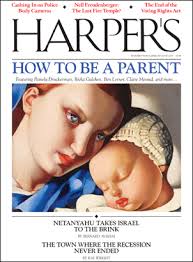
The August 2015 Harper’s had a “forum” called How to Be a Parent.  Sometimes these forums are dialogues between unlikely participants and sometimes, like in this case, each author contributes an essay on the topic.  There are ten contributors to this Forum: A. Balkan, Emma Donoghue, Pamela Druckerman, Rivka Galchen, Karl Taro Greenfeld, Ben Lerner, Sarah Manguso, Claire Messud, Ellen Rosenbush and Michelle Tea.  Since I have read pieces from most of these authors I’ll write about each person’s contribution.

Druckerman’s name sounded familiar.  It turns out she wrote the book Bringing Up Bébé in 2012.  The book compares the child-rearing practices of middle class parents in France with those of the United States.  She says that US parents tend to have a more anxious, labor-intensive child-centric style of parenting.  And that today, college educated American mothers spend nine more hours per week on child care than they did in the mid-1990s.  This style has taken hold in most countries.  Except France. (more…)

Read Full Post »

augSOUNDTRACK: HOLLY MACVE-“Sycamore Tree” NPR’S SOUTH X LULLABY (March 16, 2016).

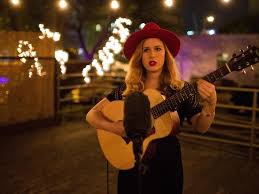
macveHolly Macve (pronounced Mac-vee) is a 20-year-old songwriter from County Galway. At the time of SXSW she only had some demos available.

For this Lullaby, it’s just her and her acoustic guitar.  Her low notes seem surprisingly low somehow (I ‘m guessing she plays very cleanly so her notes stand out).

But the thing that stands out most is her voice.  The song’s melody is pretty standard, but she often jumps octaves and nearly creaks her voice while getting there–it’s unsettling and charming at the same time.  She sounds very old school country to me.

Also notable is the length of this song.  It seems like a simple folk song with a pretty standard verse structure.  In good Irish tradition, it also tells a story.  But the slow pace seems to really stretch out the music.  The chorus seems a few lines longer than one might expect (I do love the past and future mixed together in the lyrics).  When she gets to a third part, which takes the song in a rather unexpected direction with very high notes, it’s unclear how long this song might just wind up being.

Macve has a lovely sound, and I enjoyed this song as a lullaby, but I think she’s too far into the country realm for my liking.

[READ: February 10, 2016] “Notes on Some Twentieth-Century Writers”

The August 2015 Harper’s had a “forum” called How to Be a Parent.  Sometimes these forums are dialogues between unlikely participants and sometimes, like in this case, each author contributes an essay on the topic.  There are ten contributors to this Forum: A. Balkan, Emma Donoghue, Pamela Druckerman, Rivka Galchen, Karl Taro Greenfeld, Ben Lerner, Sarah Manguso, Claire Messud, Ellen Rosenbush and Michelle Tea.  Since I have read pieces from most of these authors I’ll write about each person’s contribution.

I have enjoyed Rivka Galchen’s works.  Indeed, I have tried to write about everything she’s written.  One of the things I especially like about her is that she always defies expectations.  So, in this Forum, while everyone else is writing about being a parent, Galchen writes about writers who were or were not parents.

She lists dozens of writers and states their parental status.  I will not go through them all because it would be exhausting (and would basically just duplicate what she wrote). (more…)

Read Full Post »

augSOUNDTRACK: LUCIUS-“Dusty Trails” NPR’S SOUTH X LULLABY (March 15, 2016).

luciusI’m kind of mixed on Lucius. I love the vocals of Jess Wolfe and Holly Laessig, they are genuinely amazing.  But their music is often a little too poppy, too dancey for me.  So this stripped down version is just perfect.  It’s probably my favorite song of theirs now, (I haven’t even heard the original, yet).

The visuals of this lullaby are pretty awesome too.  The guitar players in the background, Jess and Holly stand on a bridge in electric blue body suits and shocks of red hair.  The image of party and dance is so contrary to the lovely music that they play.

The song starts as a kind of folkie, almost country song. The two guitars play nicely together.  And the women sing kind of gently, but with those harmonies intact.  Once they get to the chorus, though, Jess and Holly start belting out their song with their power and harmony.

And when they get to the middle section of “We’ll be alright,” the vocals are just amazing–powerful and loud and right on key.

The guitars drop out for a near a capella section–just a low drum keeping time–and they keep it up beautifully.  This song is a little too loud and intense to be a lullaby, but it’s great nevertheless.

[READ: February 10, 2016] “The Grand Shattering”

The August 2015 Harper’s had a “forum” called How to Be a Parent.  Sometimes these forums are dialogues between unlikely participants and sometimes, like in this case, each author contributes an essay on the topic.  There are ten contributors to this Forum: A. Balkan, Emma Donoghue, Pamela Druckerman, Rivka Galchen, Karl Taro Greenfeld, Ben Lerner, Sarah Manguso, Claire Messud, Ellen Rosenbush and Michelle Tea.  Since I have read pieces from most of these authors I’ll write about each person’s contribution.

I especially appreciated that the introduction which says “This forum…is not prescriptive but descriptive: not ‘how you should’ but ‘how we have.'”  Which is probably the best kind of advice a mother or father could give.”

I have enjoyed Sarah Manguso’s works.  Her last book talked a lot about her becoming a parent so this essay seemed right up her alley.

She begins by saying she never wanted to be a mother.  To her “mother” was a giving up of your self.  You couldn’t be a writer and a mother. And those writers who were mothers, she was sure that they gave up more of their writer-hood to have more motherhood. She says her fantasy at 23 when her friends were getting married was that she’d move upstate with them and seduce their neighbor’s children. (more…)

Read Full Post »

sept2015SOUNDTRACK: RIVER WHYLESS-Tiny Desk Concert #502 (January 19, 2016).

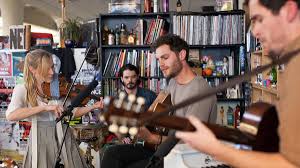
whylessRiver Whyless is an interesting band, at least during this Tiny Desk Concert.  They have several singers, different instruments and a whole bunch of interesting percussion on hand–including a typewriter!

The band has one EP out, from which the first song “Life Crisis” comes.  The female singer (none of the players’ names are given) says that this was their tiny desk submission.

On this song the male singer (actually everyone sings) plays typewriter and presents his typed document at the end of the show–although the audience never gets to see it–I imagine it’s gibberish, but it would be amazing if it wasn’t).  The female singer plays a violin solo in the middle of the song (which was unexpected since she doesn’t have it as the song opens).

Under the typewriter is a pump for a harmonium which has an accidental vibrato on it.  Shes says that one day it started doing that and they love it and hope it never fixes itself.

The other two songs are new–not on their EP from last year.  “Sailing Away” starts with violin and harmonium.  There’s also a guitarist who sings leads and a percussionist (who has all manner of gadgets and drums and mallets around him).  The harmonium player/typist also plays a melody on the toy piano.  All of these items may seem like novelties or goofs, but their songs are quite lovely and these little accents just add to the overall feel.

“Baby Brother” opens with a buzzy acoustic guitar and a whole landscape of percussion.  And this time the harmonium player switches to guitar while he sings lead (everyone sings lovely harmonies by the way).

I love everything about this band…except their songs.  All three songs are quite nice, and while I’m listening to them I certainly enjoy them, but they are really not that memorable.  There’s no hooks in them.  Despite the fact that all of their accouterments are not really gimmicks, those are the things I will remember most about River Whyless.

[READ: January 18, 2016] “Learning to Fly Part 4”

This is the final part of the 4 part essay.  A series like this is bound to be anticlimactic because presumably if his solo didn’t go well, he’d be dead.  And if he didn’t do the solo, there likely wouldn’t be a part 4 (unless he talked about chickening out instead).

But Ferris takes an interesting tact for this end section.

He opens the essay by explaining that he was commissioned by Popular Mechanics to write this essay.  This makes sense but is something  hadn’t thought about–they asked him to do it.

He says that he was full of anxiety the entire time–which we knew he would be.  He was terrified to fly–a wobbly commercial airplane takeoff would totally freak him out.  Plus, being a writer, he had an overactive imagination. (more…)

Read Full Post »

popjlu SOUNDTRACK: BENNY SINGS-Tiny Desk Concert #501 (January 15, 2016).

bennyBenny Sings is a Dutch singer songwriter.  I had never heard of him, and no wonder, this was apparently his first performance in the United States.  And “this is also where he performed with background vocalist Jennah Bell for the first time.”

The blurb says that he layers R&B, jazz and pop over hip-hop foundations.  Although the first of two songs, “Love” is just him on the piano.  For the second song “Beach House,” he busts out the drum machine.  But it still comes across as an orchestra pop song (maybe like slower Elton John).

It’s all fine, but nothing special.

According to my records, this was the 500th Tiny Desk Concert.  And if you count all of the concerts on their Tiny Desk Page, it tallies up to 500 today.  But I know that they are planning something big for #500.  So I don’t quite know what to think.

[READ: January 14, 2016] “Learning to Fly Part 3”

Part three of this story (see, I said it wouldn’t be too long before I continued with it) is all about the landing.  Ferris explains that the landing has always been the hardest part for him.  He managed turns and banks and rises and everything else, but frankly, had his teacher not been there he would have died dozens of times with bad landings.

He says that as you slowly (or quickly) sink towards the ground, your instinct is to pull up away from it, which is exactly what you shouldn’t do.

This particular part of the essay doesn’t have a lot of flying details in it, because most of it is taken up with his fears about his poor landings.  Although the way Ferris tells of the time he easily should have died from not slowing down is pretty harrowing and exciting–how is his instructor so calm?

He sums up landing though you need patience when things are most hurried, composure when things are most fraught.  You need focus when your attention is most scattered.  You need a light touch on the controls when the urge to yank hard and pull them off the panel is at it strongest.

Then he describes all of the things that his instructor appears to be doing at once to land the plane:

He was descending, turning the yoke, applying back pressures, lowering the flaps, adjusting the trim, peddling the rudder, adding power, nosing down–all more or less simultaneously.

Ferris swears that he will quit.  He cannot land the damned plane.  His wife will be pleased that he has quit ans she is terrified of him crashing.  But he knows that he will likely not quit–because it’s a challenge and any tough challenge is one you want to quit hundreds of times but which you never do,

But for his final lesson, he was going to go up once more and then quit.  “And that was the day I had my first perfect landing.”

Great cliffhanger

The final part comes next.

Read Full Post »

popmechSOUNDTRACK: NATALIE MERCHANT-Tiny Desk Concert #500 (January 12, 2016).

nat merch Natalie Merchant was supposed to appear on a Tiny Desk show in 2014, but she was ill on that day (she even tells the story of going to the hospital).  She had to cancel the entire tour.  Turns out we saw her on that tour a couple of days before she got sick!

When Sarah and I saw her we both remarked on how great her voice still sounded.  And it sounds great here too.  The same instantly recognizable voice from her albums with all of the power and inflection that she’s always had.

Although I still don’t understand where her speaking voice accent comes from (she’s from upstate New York after all).

“Motherland” (a 2001 song) she dedicates to the staff of NPR.  Her accompaniment is an acoustic guitar, upright bass and accordion and it works very well for this slow, rather sad song.

“Texas” is another pretty, slow song from her 2014 album which she was supposed to pay at the Tiny Desk show.  She says he most regretted missing the Tiny Desk show when she had to cancel her tour.  She had no idea the desk was not so tiny and that it could fit 1000 people standing around watching.

Then she plugs her new album, Paradise Is There: The New Tigerlily Recordings.  It is a reworking of her songs from Tigerlily (and there was a documentary that accompanied it (which they were filming when we saw her).  She plays “Cowboy Romance” from that album.  I don’t know the original (or I don’t recognize the song) but it sounds fine in this stripped down format.

Even though her songs are rather serious, she’s quite silly with the band and crew.  She emphasis “CONfiguRAtion of muSICians” before introducing “Cowboy Romance.”

Everyone assumes she will play only three songs (the standard), but she has a special treat planned.  She says that she heard a story on NPR about how office workplaces would benefit from singing together.  And they are all trapped with her.  So she says they are going to sing a Protestant hymn that she recently found in a songbook in the library.

She says that she and the guitarist are Catholic, the accordionist is Jewish (from Israel) and the bassist has no religion.  he says he’s from the West Coast (she jokes that he’s from a cult in Oregon).  Then when she asks the guitarist what key it’s in and he says, “What song? ” to which everyone laughs because she never mentioned the title.

It’s a lovely old song which she teaches to the whole room.  After the first verse, she says she approves of the group sing-along and says it should be a weekly thing.  I love the way they split the screen to show the whole staff singing along. It’s quite lovely and the staff’s accompaniment is really pretty.

This is a delightful show and a very intimate performance by Natalie Merchant.

[READ: January 12, 2016] “Learning to Fly Part 2”

I really enjoyed Part 1 of this essay, but as often happens to me with broken up pieces, I forgot about the next part until long after.  So here it is over six months since I read Part 1 finally getting around to Part 2 (but at least I have Parts 3 and 4 with me so I’ll be finishing them up soon). (more…)

Read Full Post »

skin SOUNDTRACK: LOS LOBOS-Tiny Desk Concert #90 (November 10, 2010).

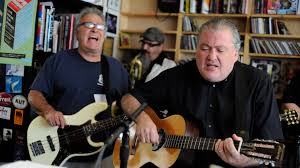
loslobosI don’t really know all that much about Los Lobos.  I frankly got sick of them because of “La Bamba” (which came out 20 years ago!) and I don’t think I’d ever heard much else by them.  So I wound up enjoying this Tiny Desk much more than I anticipated.

The one big problem with this tiny desk is that the drummer is playing one of those plastic mail bins and it sounds awful.  Especially on the first song.  I think anything would have had a better drum sound than that.

I really enjoyed the first song “Burn It Down.”  It has a propulsive minor key structure and an excellent bass line.  I would never have guessed it was Los Lobos, but that may be because it’s not the singer I most associate with them (he sings on the next two songs).

“Yo Canto” is a cumbia, sung by a different guy (in Spanish) who also plays lead guitar.  The mail bin sounds better on this song because of the placement (and use of) a cowbell.  The singer sounds amazing.  I rather like the riff that underlines the song.

Those two songs are from their then latest album.  And the band sounds really good all these years on.

The final song is “Don’t Worry Baby.”  It has the same singer as the middle song (this time in English) although it is a pretty standard blues song that I found just okay.  It also features a bunch of saxophone.  I didn’t realize that it was from their major label debut in 1984! and is something of a classic.

So three songs, all of them enjoyable, from a band I didn’t really think I’d enjoy.  The funniest part is just before the show stops and someone asks, “Okay, where’s the beer?”

[READ: October 1, 2015] How to Skin a Lion

This book sounded awesome–I love outdated things that we can laugh about now (because I’m a superior git, of course).

But this book proved to be not all that funny.  The outmoded advice wasn’t treated comically exactly (well, some was), rather it was looked at rather seriously–some as good advice that still stands, some as crazy advice that is way outmoded and a few things that are, yes, just comical.

Cock-Starkey (insert joke here) says that this is a collection of materials from the vast archives of the British Library.  It culls from medieval manuscripts, Victorian manuals and self-help guides from the early 20th century.  She explains that the book aims to reveal the secrets of lost arts, remind us of how modern conveniences have changed our lives, recall the complexities of etiquette, highlight changing attitudes and beliefs and furnish us with still useful tips and guidance.

Although she also points out that readers should be advised that some pieces of advice contained herein have stood the test of time better than others. (more…)

Read Full Post »

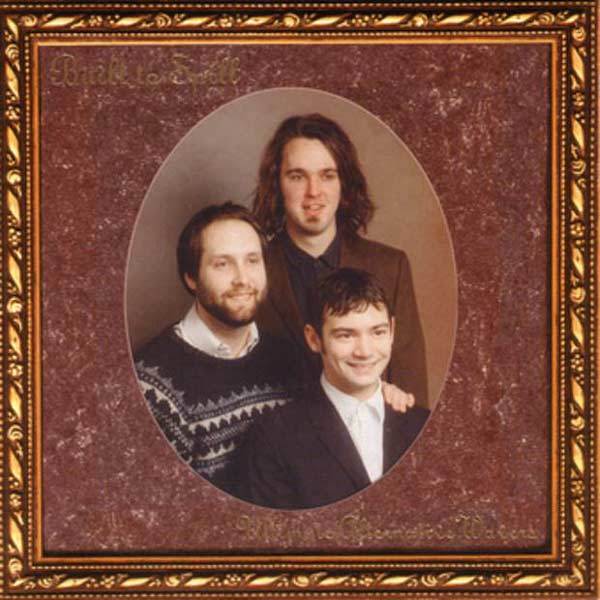
dfwSOUNDTRACK: BUILT TO SPILL-Ultimate Alternative Wavers (1993).

Bts I am going to see Built to Spill this Friday.  I was supposed to see them back in 2001, but then some bad things happened in New York City and their show was cancelled (or I opted not to go–I see on Setlist that they did play that night).  Since then, I have enjoyed each new album more than the previous one, so I am really excited to see them.

I thought it would be interesting to revisit their earlier records.  In reading about the band I learned that Doug Martsch was in Treepeople (which I didn’t know and who I don’t really know at all).  I also learned that his plan for BtS was to have just him with a different line up for each album.  That didn’t quite work out, but there has been a bit of change over the years.

Their debut album is surprisingly cohesive and right in line with their newer material.  It’s not to say that they haven’t changed or grown, but there’s a few songs on here that with a little better production could easily appear on a newer album.  Martsch’s voice sounds more or less the same, and the catchiness is already present (even if it sometimes buried under all kinds of things).  And of course, Marstch’s guitar skill is apparent throughout.  The album (released on the tiny C/Z label) also plays around a lot with experimental sounds and multitracking.  When listening closely, it gives the album a kind of lurching quality, with backing vocals and guitars at different levels of volume throughout the disc.

But “The First Song” sounds like a fully formed BtS song–the voice and guitar and catchy chorus are all there..  The only real difference is the presence of the organ in the background.  “Three Years Ago Today” feels a bit more slackery–it sounds very 90s (like the irony of the cover), which isn’t a bad thing.  The song switches between slow and fast and a completely new section later in the song.  “Revolution” opens with acoustic guitars and then an occasional really heavy electric guitar riff that seems to come from nowhere.  The end of the song is experimental with weird sounds and doubled voices and even a cough used as a kind of percussion.

“Shameful Dread” is an 8 minute song.   There’s a slow section, a fast section, a big noisy section and a coda that features the guys singing “la la la la la”.  Of course the most fun is that the song ends and then Nelson from The Simpsons says “ha ha” and a distorted kind of acoustic outro completes the last two minutes.

“Nowhere Nuthin’ Fuckup” is one of my favorite songs on the record.  There’s a sound in the background that is probably guitar but sounds like harbor seals barking.  I recently learned that the lyrics are an interpretation of the Velvet Underground’s “Oh! Sweet Nuthin.”  They aren’t exactly the same but are very close for some verses.  The rest of the music is not VU at all.  In fact the chorus gets really loud and angular.  I love the way the guitars build and then stop dramatically.

“Get a Life” opens with a wild riff that reminds me of Modest Mouse (who cite BtS as an influence), but the song quickly settles down (with more multitracked voices).  I love how at around 4 minutes a big swath of noise takes over and it is resolved with a really catchy noisy end section.  “Built to Spill” starts out slow and quiet, and grows louder with a catchy chorus.  In the background there’s all kinds of noisy guitars and superfuzzed bass.

“Lie for a Lie” is pretty much a simple song with s constant riff running throughout.  The verses are catchy, but the middle section is just crazy–with snippets of guitars, out of tune piano, a cowbell and random guitar squawking and even shouts and screams throughout the “solo” section.  “Hazy” is a slow song with many a lot of soloing.  The disc ends with the nine minute “Built Too Long, Pts 1,2 and 3”  Part 1 is a slow rumbling take on a riff (with slide guitar and piano).  It last about 90 seconds before Part 2 comes in.  It has a big fuzzy bass (with a similar if not identical riff) and wailing guitar solos.  Over the course of its five or so minutes it get twisted and morphed in various bizarre ways.  With about 30 seconds left, Chuck D shouts “Bring that beat back” and the song returns, sort of, to the opening acoustic section.

While the album definitely has a lot of “immature” moments (and why shouldn’t the band have fun?) there’s a lot of really great stuff here.

btstix

[READ: September 26, 2015] Critical Insights: David Foster Wallace

It’s unlikely that a non-academic would read a book of critical insights about an author.  Of course, if you really like an author you might be persuaded to read some dry academic prose about that author’s work.  But as it turns out, this book is not dry at all.  In fact, I found it really enjoyable (well, all but one or two articles).

One of the things that makes a book like this enjoyable (and perhaps questionable in terms of honest scholarship) is that everyone who writes essays for this collection is basically a fan of DFW’s work.  (Who wants to spend years thoroughly researching an author only to say means things about him or her anyway?).  So while there are certainly criticisms, it’s not going to be a book that bashes the author.  This is of course good for the fan of DFW and brings a pleasant tone to the book overall.

For the most part the authors of this collection were good writers who avoided a lot of jargon and made compelling arguments about either the book in question or about how it connected to something else.  I didn’t realize until after I looked at the biographies of the authors that nearly everyone writing in this book was from England or Ireland.  I don’t think that makes any difference to anything but it was unexpected to have such an Anglocentric collection about such an American writer (although one of the essays in this book is about how DFW writes globally).

Philip Coleman is the editor and he write three more or less introductory pieces.  Then there are two primary sections: Critical Insights and Critical Essays. (more…)

Read Full Post »
grant12SOUNDTRACK: BELA FLECK, EDGAR MEYER, ZAKIR HUSSAIN-Tiny Desk Concert #70 (July 26, 2010).

belaBela Fleck is a rather legendary musician, and yet I realized I don’t really know that much about him.  And somehow I never knew he was a banjo player (that’s a pretty serious omission on my part).  I had never heard of the other two musicians, although they are apparently world-class masters of the bass fiddle and the tabla.

I also didn’t expect this Tiny Desk Concert to be so interestingly world-musicy.

This set is only two songs but each is about 7 minutes long and they are both very cool (and from the album The Melody of Rhythm).

Fleck’s playing is amazing, with a tone that is often unlike a standard banjo sound.  And I absolutely love the tabla–I am fascinated by this instrument.  The first song, “Bubbles” is an amazing demonstration of Fleck’s banjo.  About midway through he is playing in a decidedly middle eastern style (which works great with the tabla).  And when the bass starts getting bowed around 1:50, it adds an amazing richness to this already cool song.   There’s a cool bass solo (I love that the tabla pauses a few times during the solo).  The ending is just wonderful.

Before the second song, “Bahar” (which means “springtime”) they talk about being nervous, which is pretty funny.  This song opens with the bass fiddle’s bowed notes (including a very very high note).  This one seems to be a more solo-centered, with some elaborate work from Fleck after the introduction. And the tabla solo, while brief, is really cool to watch.  I prefer the first song, but the more traditional nature of the second song is a nice counterpart to the first.

[READ: August 24, 2015] Grantland #12

I enjoyed this issue as well.  This was mostly the spring and summer of 2014, which sounds so long ago, and yet so many things seem so current.

CHUCK KLOSTERMAN-“The Life and Times of Kiss”
I love this article about Kiss.  And I wrote about it back here.

WESLEY MORRIS-“Poison Candy”
This is about the disastrous state of female comedies.  It focuses on the movie The Other Woman which is ostensibly a female centered comedy but is entirely other.

BILL SIMMONS-“Sterling’s Fold”
A drumming down of Donald Sterling.  It’s hard for me to believe that this happened over a year ago.

ZACH LOWE-“Building the Brow”
An article about Anthony Davis of the Pelicans, who is proving to be better than anyone imagined. (more…)

Read Full Post »

nyrbSOUNDTRACK: ALEC OUNSWORTH-Tiny Desk Concert #48 (February 22, 2010).

alecI didn’t recognize the name Alec Ounsworth.  But I see that he is the singer from Clap Your Hands Say Yeah, a band I don’t know at all.  He has created some other music outside of Clap Your Hands, like the band Flashy Python, which features members of Dr. Dog, The Walkmen and Man Man.  And in the fall of 2009, he released a solo record called Mo’ Beauty.

In this Tiny Desk it is just him and guitarist Matt Sutton.  They play three songs from Mo’ Beauty (on guitar and harmonica): “Modern Girl (…With Scissors),” “Holy, Holy, Holy Moses (Song for New Orleans)” and “When You’ve No Eyes.”

Since I don’t really know CYHSY, I can’t compare this to that band.  The songs are pleasant and a little catchy.  I feel like perhaps the wordplay is what draws you in (he refrains “all this useless beauty” in the first song).  His voice is distinctive and takes a little getting used to, but I warmed up to it by the end of the set.

After the set he says that the other three guys from the touring band were waiting in the van.  As the show fades you hear Bob Boilen mutter, “it was okay to invite them up.”

[READ: May 11, 2015] “Argentina: The Brothels Behind the Graveyard” 

Roberto Bolaño talked about this article in The Secret of Evil.  I was curious to read it and was happy to find it quite easily and for free online from The New York Review of Books.

I don’t really know Naipaul at all, although Bolaño spoke very highly of him.

This article looks at Argentina.  I don’t know how much time he spent there, but it sounds like NYRoB sent him there to write and essay or two..

He begins by talking about the death of Perón (in July of 1974).  Perón was in the ninth month of his third presidency and his legend had lasted for thirty years.  He was overthrown in 1955 and was exiled for seventeen years.  He had a triumphant return the previous year and a resounding failure shortly after. (more…)

Read Full Post »

« Newer Posts - Older Posts »