Feeds:
Posts
Comments

Archive for the ‘Essays’ Category

yorkernSOUNDTRACK: SOUL COUGHING-“Is Chicago, Is Not Chicago” (1994).

soul cI really enjoyed Soul Coughing’s output, and Ruby Vroom stands out as a great debut.  They had a terrific blend of great music played behind a more or less spoken word.  The idea wasn’t unique, but they made it work as more than a gimmick.

The musicians of Soul Coughing were tremendous and Mike Doughty’s voice has a wonderful resonance for telling is offbeat/absurd stories/poems.

This track seems especially appropriate when talking about Saul Bellow.

Starting with rhythmic guitar chunks, an upright bass plays a very cool rising and falling bass run.  It sounds like modern noir.

Then Doughty tells us “a man drives a plane into the Chrysler building.”  It’s difficult to hear it now, but in 1994 it was simply a fantastical image.   The drums come in as the guitar starts making shapes and slashes of sounds.

The chorus is a rather boppy moment amid the noise as things slow down for the recited “Is Chicago is not Chicago.”

Then the bridge(s):

Saskatoon is in the room
Poulsbo is in the room
Bennetsville is in the room
Palmyra is in the roomKhartoum is in the room
Phnom Penh is in the room
Pyongyang is in the room
Cairo is in the room

The song ends with a wonderful cacophony of guitar scratches and drum beats that definitively ends the song without it having to end itself.

[READ: September 1, 2019] “Re-Reading Saul Bellow”

I decided to read this article because I like Philip Roth and because I have never read any Saul Bellow.  In fact, although Saul Bellow is a name I was familiar with, I wasn’t entirely sure what he had written. So I was pretty surprised to read that he wrote The Adventures of Augie March, which I had without a doubt heard of, but which I knew very little about.  I was also really surprised to find out that he was still alive when Roth wrote this esay (Bellow died in 2005).

Roth knew Bellow, of course, and Bellow had once told him that his Jewish heritage led him to doubt himself as a writer.  This was mainly because “our own WASP establishment, represented mainly by Harvard-trained professors considered a son of immigrant Jews unfit to write books in English.”

By the time he wrote Augie March, he was prepared to open not with a line like “I am a Jew, the son of immigrants,” but “I am an American, Chicago born.”

Roth summarizes a few of Bellow’s works and talks about how he progressed as a writer.  Of course, he writes this re-reading as if we ourselves have read the books (so, spoiler alerts).

He more or less dismisses the first two novels Dangling Man (1944) and The Victim (1947) and moves straight on to The Adventures of Augie March (1953) saying how the transformation from the earlier writer to the writer of Augie is remarkable.  It won the National Book Award.

He especially likes “the narcissistic enthusiasm for life in all its hybrid forms” that is propelling Augie.  He cries out to the world “Look at me!”

What appeals to me about the way Roth describes this book is the “engorged sentences” as “syntactical manifestations of Augie’s large, robust ego.”  That sounds like a fun 500 page book to me.

Up next was Seize the Day (1956) which is a short novel and the fictional antithesis of Augie March–a sorrow-filled book about the culmination of a boy who is disowned and disavowed by his father.  Whereas Augie’s ego soars, Tommy Wilheim’s is quashed beneath its burden.  Tommy cried out to the world “Help me!”

Bellow seemed to alternate between comedy and tragedy and I would much rather read the comedies myself.

Next came Henderson the Rain King (1959) which contain an exotic locale, a volcanic hero and the comic calamity that is his life.  Henderson is a boozer, a giant, a Gentile, a middle-aged multimillionaire in a state of continual emotional upheaval.  He leaves his home for a continent peopled by tribal blacks who turn out to be his very cure. Africa as medicine.

According to Wikipedia, Bellow became very conservative and somewhat (or very) racist as he got older.  I hesitate to read this book although it was written when he was younger.  On the other hand, I do enjoy that Roth calls it “a screwball book but not without great screwball authority.”  So that’s a tentative maybe on reading this.

Herzog (1964) also won the National Book Award.  Moses Herzog is a labyrinth of contradiction and self-division. He is Bellow’s grandest creation.  Herzog is American literature’s Leopold Bloom.  Although in Ulysses, “the encyclopedic mind of the author is transmuted into the linguistic flesh of the novel and Joyce never cedes to Bloom his own great erudition… whereas in Herzog, Bellow endows his hero with a mind that is a mind.”

Much of the plot is given away in the review, presumably because a 50 year-old award-winning book is pretty well known.

Roth says that Herzog is Bellow’s first excursion into sex in a novel. Adding sex allows Herzog to suffer in ways that Augie March never did.  He also says that “in all of literature  I know of no more emotionally susceptible male, of no man who brings a greater focus or intensity to his engagement with women than this Herzog.”

In Herzog, there is barely any action that takes place outside of Herzog’s brain.  Roth suggests, the best parts of the book are the letters that Herzog writes.

This book sounds rather appealing.  Unlike Mr. Sammler’s Planet (1970) which also won the National Book Award (dang this guy must be good).  Roth gives it a rather short write up, but it appears to be about a man dealing with the culture around him.  It is a darker story, that sounds like a critique of the sixties.

That leads to Humboldt’s Gift (1975) which won the Pulitzer Prize for Literature [that is an impressive amount of awards Mr Bellow].  Roth describes it as the “screwiest of the euphoric going-every-which-way-out-and-out comic novels.”  It is “loopier and more carnivalesque” than the others.  It’s like the tonic that helps him recover from the suffering in Sammler.

Interestingly. Roth doesn’t really talk about the rest of Bellow’s works: The Dean’s December (1982); What Kind of Day Did You Have? (1984); More Die of Heartbreak (1987); A Theft (1989); The Bellarosa Connection (1989); The Actual (1997); Ravelstein (2000).  Rather he continues with Humboldt and talks about Bellow’s relationship with Chicago.

Roth says that in Bellow’s early books Chicago was barely mentioned–a few streets here and there, but by Humboldt Chicago infuses the book.

Perhaps Below didn’t seize on Chicago at the start of his career because he didn’t want to be “a Chicago writer” any more than he wanted to be “a Jewish writer.”

Roth does in fact mention The Dean’s December, but only to say that the exploration of Chicago in this book is not comical but rancorous.  Chicago has become demoniacal.

It feels like Bellow is no longer a part of Chicago.

Read Full Post »

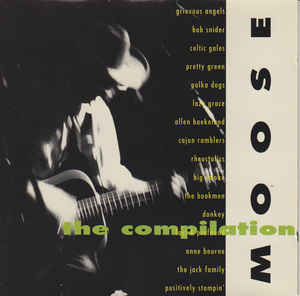
SOUNDTRACK: RHEOSTATICS-“Woodstuck” (Moose: The Compilation, 1991).

Back in the 1990s, it was common to buy a compilation or soundtrack or even a band’s album based on one song.  Only to then find that you didn’t really like anything else on it.

Maybe that single sounded like nothing else on the album.  Maybe the movie was almost entirely one genre, but they had that one song that you liked over the credits.  Or maybe the compilation was for something you didn’t know, but a song you really wanted was on it, too.

With streaming music that need not happen anymore.  Except in this case.

I bought this compilation, used, recently exclusively for one song, Rheostatics’ “Woodstuck.”  It’s a goofy song and this is the only place you can get the studio version.  The actual compilation was not well documented, so I didn’t know what the other bands on it might sound like.  It turns out to be a compilation for Ontario based Moose Records which specialized in Rock, Folk, World & Country.  They put out another compilation in 1992 and that’s all I can find out about them.

I’d heard this song on several live bootlegs, but I was very curious about the original recording.

It’s a stomping folk song with great backing vocals and a very funny chorus.

You can’t go back to Woodstock baby, you were just two years old You weren’t even born

And this wonderful verse

Before they were kissing the earth now they’re washing their cars
Before they were feeling stoned now they’re feeling bored
Sure you shed your clothes but you shed no blood
Poor hippie child don’t sit and wait for another summer of love

Was it worth getting this whole compilation for a two and a half minute joke song?  You bet.

[READ: July 20, 2019] “Just Keep Going North: At the border”

William T. Vollmann continues to amaze me with his dedication to writing about issues that matter.

This lengthy essay is Vollmann’s attempt to discover what is happening at the border after trump warned of migrant caravans coming up from Mexico in February of 2019.

He decided to go to the Arizona border, a place he knew little about, to save himself from prejudgment (he is from California and knows that border situation a little better).  He went to the internationally bifurcated town of Nogales.  Nogales said it would sue the federal government if it did not remove the new coil of razor wire.

He talks to an immigration lawyer from Tucson who says in the old days it was no big deal to cross the border–you could come and go. There were some small changes in the mid-eighties.  Then 9/11 caused big changes.  It had been bad before trump but trump’s policies at least opened peoples eyes to what was happening here. (more…)

Read Full Post »

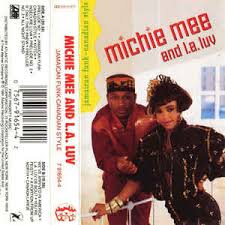
SOUNDTRACK: MICHIE MEE & L.A. LUV-“Jamaican Funk, Canadian Style” (1991).

I only know about Michie Mee because she has written pieces for the West End Phoenix.  I knew she was a rapper, but I had no idea she has been rapping since the 1980s!

I watched this profile about her and found out her first album came out in 1991.  The video for the title track “Jamaican Funk, Canadian Style” is so perfectly 1991–the backgrounds, the dance moves, the little kids, the kinda story.  It’s a perfect time capsule.

I like that Michie raps part of the song in her Jamaican patois and the rest of the song sounds pretty straight up feminist (she found it tough to break into the biz being A) Canadian B) female and C) very young.  I’m not sure what was the biggest impediment.  But she was the first Canadian rapper to get a U.S. record deal.

So good on her.  And she’s still going strong.

[READ: July 1, 2019] “That Summer, This City”

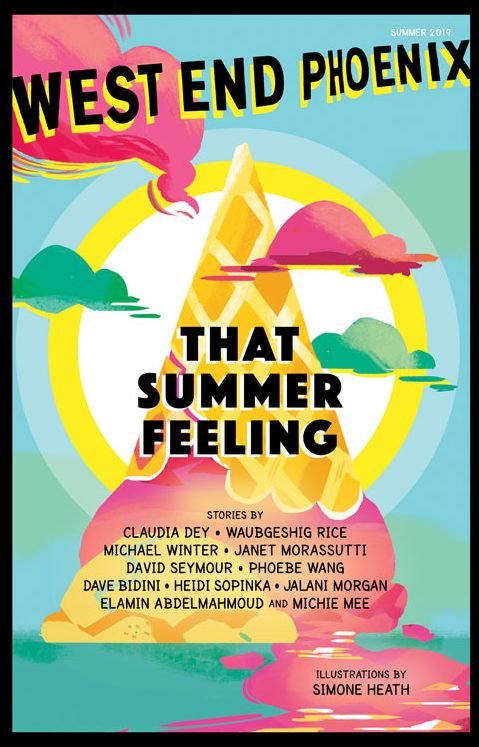
The Summer 2019 issue of The West End Phoenix was a special all comics issue with illustrations by Simone Heath.  Each story either has one central illustration or is broken up with many pictures (or even done like a comic strip).

Each story is headed by the year that the story takes place–a story from that particular summer.

Michie is a rapper who has written pieces in a number of the WEP issues.  This is a story about her 2007 summer (and if you read the blurb above, you’ll see she has been rapping for over fifteen years by then). (more…)

Read Full Post »

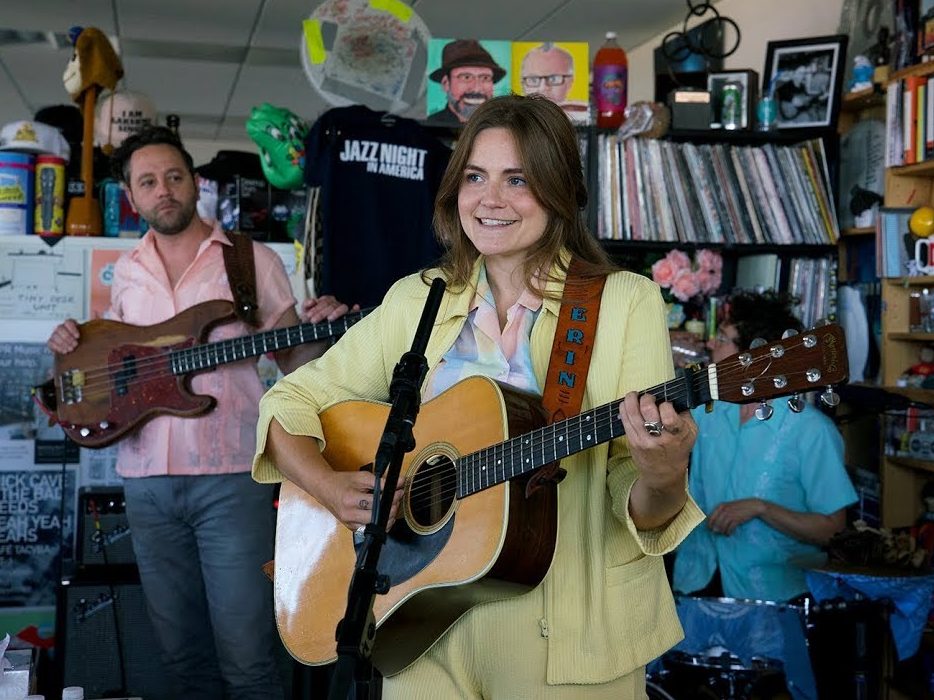
SOUNDTRACK: ERIN RAE-Tiny Desk Concert #867 (July 12, 2019).

Lars Gottrich is one of my favorite NPR personalities.  He picks some of my favorite loud music but he also loves a lot of quiet music.  So even though I have never seen Erin Rae, he has apparently seen her many times.

Every time I’ve seen Erin Rae live, she transforms her quiet storms into different hues of squalling introspection.

She opens with “Bad Mind.”  But before that,

Her performance at the Tiny Desk opens with a soft tide of ambient tones — both a way to ease into the song but also understand that life’s unease is ever-present.  Then a lilting acoustic melody introduces “Bad Mind,” a stunning statement of identity from a Nashville singer-songwriter who shares the secrets we keep close.

She’s joined here by Jerry Bernhardt, a treasured collaborator and a guitarist who knows how to play decorative but unobtrusive figures. He and drummer Dom Billet both appear on Putting On Airs, taking those arrangements and stretching them out at the Tiny Desk with Mellotron/Rhodes piano player Ben Tanner and bassist Joe Garner.

It’s a lovely melody and she avoids the dreaded country twang when she sings. In fact when Bernhardt and Billet sing along, their voices are pure folk gold.  Bernhardt introduces a quiet buzzing guitar solo which, along with the organ adds all kinds of neat sounds to this simple song.

Before the second song she says she and her sister used to make their own radio shows.  They were a big NPR family but she thought it meant Nashville Public Radio.

“Can’t Cut Loose” is a song about letting go of things that aren’t good for you anymore.  Its’a quiet slow song with a pretty chorus.

The Tiny Desk closes with “the summer jam,” as Erin Rae jokingly calls “Love Like Before,”

She says it’s their most upbeat song, although that is all relative.  It’s about learning to be content wherever you may be.

It’s definitely a bit more upbeat but it’s still a slow and thoughtful song.

I won’t be going to see Erin Rae, but I did enjoy this mellow little Concert.

[READ: July 1, 2019] “Radio Summer”

The Summer 2019 issue of The West End Phoenix was a special all comics issue with illustrations by Simone Heath.  Each story either has one central illustration or is broken up with many pictures (or even done like a comic strip).

Each story is headed by the year that the story takes place–a story from that particular summer.

2003:  Here’s another summer job story.  But this one is actually a happy summer job story.

Abdelmahmoud says that normally you want a summer job that starts in the evening so you can sleep in.  But there was one job worth getting up at 8AM for: being the summer DJ at CKVI 91.9 FM in Kingston.

It was part of a school program and for the summer he was the only DJ there from 8AM to 4PM.  You want jazz? Sure! A ska show from 2-3? Sure!

This was a dream job and one lucky person got it each summer. (more…)

Read Full Post »

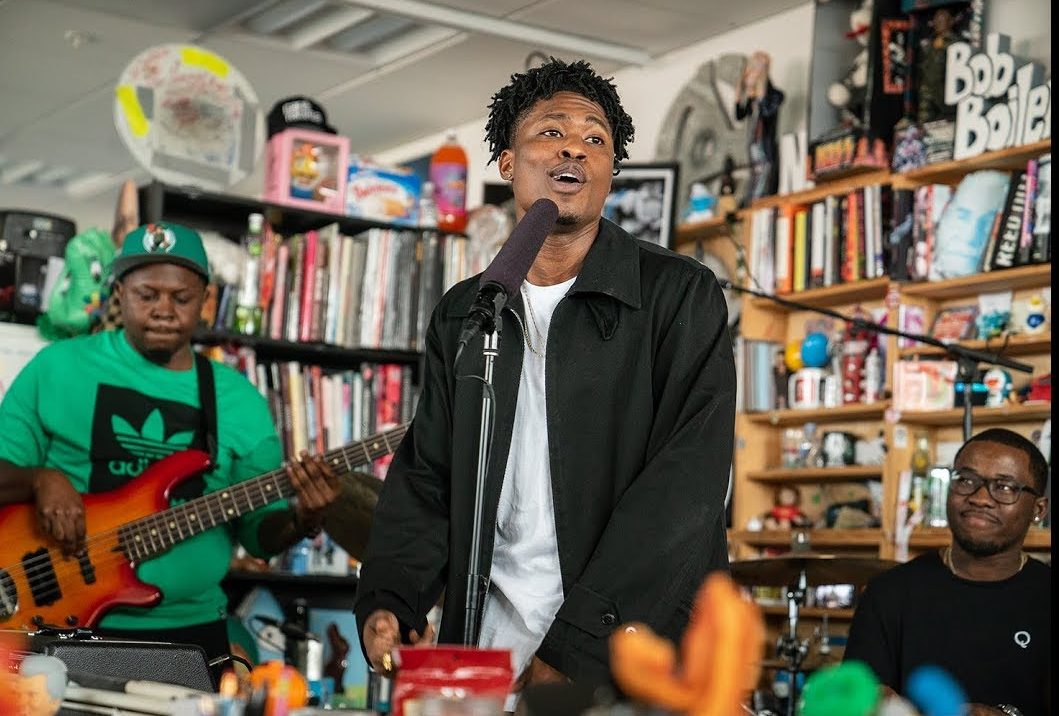
SOUNDTRACK: LUCKY DAYE-Tiny Desk Concert #852 (May 28, 2019).

I watched the Raphael Saadiq Tiny Desk Concert where he brought out Lucky Daye before watching this one.

I might have appreciated Lucky Daye’s guest spot more had I seen this first.  I wound up liking him quite a bit in this Concert.

In the blurb Sidney Madden writes:

NPR Music’s Bobby Carter and I have been checking for Lucky Daye since last year when we dubbed him one of the “Kings of R&B.” Then, after seeing Lucky perform live in Washington D.C., we knew his charisma and control would translate well to the Tiny Desk.

This set is fun for all of the horns that are included (which we’ll chalk up to his hailing from New Orleans).  I feel like the horns give the songs more excitement than if they hadn’t been there.

Hailing from New Orleans and inheriting a love of sticky, bass-bumping funk early on, Lucky wanted to bring the full flavor of his debut album, Painted to NPR. So he brought along a 10-person band, including a quartet of horns.

“Roll Some Mo” opens with a quiet guitar from Kenji Chan and twinkling keys from Quintin “Q” Gulledge.  There’s a soft cymbal escalation from Kendall Lewis when a cool bass line comes in from Daye’s go-to producer Dernst “D’Mile” Emile II.

The horns are quiet as the song starts.  The camera seems to really like trumpeter Crystal “RØVÉL” Torres as it zooms in on her a bunch.  Brandyn Phillips on trumpet and flugel gets some screen time too.  There’s not a ton of differentiation between the horns–no solos or anything.  But once in awhile you can pick out Chris Johnson on trombone and Corbin Jones on baritone sax.

Nikki Flores does the first backing vocal part but then Chelsea “Peaches” West adds a lot to the call and response.

“Misunderstood” is a quiet song with keys and Crystal “RØVÉL” Torres playing a muted trumpet.  This is my least favorite song because of the way he sings it–all of that moaning and ohhing is not my thing.  I don’t care for an R&B ballad, obviously.  But he won me over after the song.

“I’ve never performed that song in front of anyone with a band,” he said, trying to laugh off mid-set jitters and bask in the moment. “This is amazing, y’all. I’m really grateful.”

The final song, “Late Night” is a lot of fun.  It starts with some great wah wah guitar with horns and vocal hits.  I like the way his sings this song much better—deeper vocals and some fun backing vocals.

The end of this song with the horns swinging and singers singing is really fun.

[READ: July 1, 2019] “First Time”

The Summer 2019 issue of The West End Phoenix was a special all comics issue with illustrations by Simone Heath.  Each story either has one central illustration or is broken up with many pictures (or even done like a comic strip).

Each story is headed by the year that the story takes place–a story from that particular summer.

1998

This story is mostly visual.  Because there’s not a lot of text.

Grade 11.  A daily bus ride.  A beautiful girl.

He wore a school uniform (grey pants, green cardigan).

She had long straight hair, amazing eyes and was always alone.  She was out of his league. (more…)

Read Full Post »

SOUNDTRACK: LADAMA-Tiny Desk Concert #853 (May 30, 2019).

There’s a lot to like in this Tiny Desk, but I am immediately drawn to Mafer Bandola’s  bandola llanera.  Is it see through?  Is it hollow?  I have so many questions.

Some of which are answered in the blurb.

But what might be even more interesting than the instruments is the international makeup of the band.

During the course of their performance behind the desk, the four core members of LADAMA — Lara Klaus, Daniela Serna, Mafer Bandola and Sara Lucas — had a chance to display their individual cultural and musical roots as part of an engaging and mesmerizing whole. Represented in glorious musical virtuosity are Brazil (Lara Klaus), Colombia (Daniela Serna) and Venezuela (Mafer Bandola), with a dash of New York City (Sara Lucas and bassist Pat Swoboda) thrown in just to make it interesting.

Not to mention all four of them sing lead.

“Sin Ataduras” opens with great sounds from the bandola llanera and some really great bass work Pat Swoboda.  Daniela Serna sings, almost raps, the lead vocals.  The song is catchy with a middle parts that’s all rim shots from Lara Klaus and clap alongs.  Then Sara Lucas adds a little guitar work, but it’s Mafer Bandola’s solo that’s really fantastic.

For the second song, “Elo” Lara Klaus plays the pandeiro and it’s amazing how much sound a little tambourine-looking drum can make.  She also sings lead–a very different vocal style.  Daniela Serna moved over to the congas and the tambor alegre.  Mafer Bandola switches to a more traditional-looking bandola llanera but still plays some amazing leads.

Throughout the songs, Sara Lucas plays quiet electric guitar that acts a foundation to lead bandola.  Incidentally, Mafer Bandola is a stage name (I assume Mafer is her first names put together).  Her real name is Maria Fernanda Gonzalez.

“Tierra Tiembla” is a much slower ballad.  Sarah Lucas sings lead (in Spanish).  Has a slow, smooth rhythm with nice echoing sounds form the bandola.  Sara Lucas sings lead on this one.  Lara Klaus is back on the kit, so with her and Daniela on congas, there’s a lot of percussion.   Mafer plays some nice lead lines and everyone sings delicate backing vocals.

The final song is “Inmigrante”  this song is for everybody–para todos inmigrantes–we are all immigrants.

It’s the fiery “Inmigrante” that finally raised the BPM meter and got hips swaying in our corner of NPR’s HQ, with its call-and-response back-and-forth and a very enthusiastic audience. T

Mafer Bandola sings this last song.  The bandola is a echoed and very cool sounding as she plays an excellent riff.  The drums are mostly hi-hat while the congas supply most of the percussion.  Sara Lucas puts down her guitar to play the raspa.

The song ends with a clap along and some fast and furious congas from Daniela.

This is yet another great Spanish-language band that enjoyed quite a lot.

[READ: July 1, 2019] “A Love Story”

The Summer 2019 issue of The West End Phoenix was a special all comics issue with illustrations by Simone Heath.  Each story either has one central illustration or is broken up with many pictures (or even done like a comic strip).

Each story is headed by the year that the story takes place–a story from that particular summer.

1992: This is the story of tree planting and romance.  Claudia and her friend drove to the planting location with dreams of getting rich.

I have heard about tree planters from many different sources (it seems a very Canadian thing to do–I’m not even sure if people do there).  All sources suggest it is very hard, physically exhausting and pays little.  No matter how romantic the idea sounds, it’s not a fun job.

Claudia adds to this idea and includes that they slept in tents and were sleeping in an area where bears traveled.  They could hear the bears every night but the experience planters assured them they were safe (how does anyone do this long enough to become experienced?). (more…)

Read Full Post »

SOUNDTRACK: IDLES-Tiny Desk Concert #858 (June 28, 2019).

I had heard of Idles from All Songs Considered.  On the podcast, Bob Boilen raved about seeing them live.  Like this:

My first time seeing IDLES ended with guitarist Mark “Bobo” Bowen frenetically dancing on a bar, his guitar still keeping time, until the swinging neck suddenly shattered some low-hanging, glass lighting fixtures. The band’s set at South by Southwest was fierce and I knew it’d be a challenge trying to figure out how to bring that cathartic rage behind my desk. There was talk for a while of some members of the band strapping on pocket-sized guitar amps and beating on a single drum. But a week before this bunch of British madmen arrived at NPR, the instrument list had grown and what ensued was just about the loudest, most fun and most raucous Tiny Desk Concert in memory.

This is all true, for sure.  But this Tiny Desk, as amazing as it is, doesn’t come close to showing how incredible their live show is.   Idles live is a truly unforgettable experience.

However, seeing all of that energy and fun contained in a small place is awesome and this is one of my favorite Tiny Concerts as well.

The first song “Never Fight A Man With A Perm” opens with a siren sound from keyboardist Jeremy Snyder and the main constant of Idles’ music–steady bass from Adam Devonshire.  Add in the thumping drums from Jon Beavis and you have the ground work for Joe Talbot to start his singing/yelling.

The band also has two guitarists.  Mark “Bobo” Bowen thumps on the floor tom while Lee Kiernan jumps around, slashing at chords.

The title sounds funny and it is, but the song is a serious indictment of male aggression.

What lead singer Joe Talbot and his mates bring to their shows is a mix of love and outrage. Their songs are often bursts of fury, but the message is insightful and not intended to incite. Joe Talbot says their opening Tiny Desk song, “Never Fight A Man With A Perm,” from their album Joy as an Act of Resistance, is an “exploration of the horrid corners of my past.”

The chorus of “concrete and leather” thumps around before the song returns to the verses, with some cockney slang:

Brylcreem
Creatine
And a bag of Charlie Sheen

A heathen from Eton
On a bag of Michael Keaton

Bobo is a ton of fun to watch–shirtless, wearing American flag spandex pants, he climbs on everything: amps, desks, and other unseen things.

“Mercedes Marxist” starts with a thumping single bass note which will remain unchanged for two and a half minutes.  Snyder takes over on the floor tom while Bobo and Lee trade off guitar sections.

The song is almost entirely that one bass note (with all kinds of guitar melodies and riffs swirling around it).  Until a big chorus comes near the end.  Through it all,  Talbot is directing the fun with his scary vocals.

It only took a few seconds for Joe’s face to turn blood-red; as he growled, it stayed that way for the next 13-minutes, even as he curtseyed at the end of the first song and bounced his way into the second.

The one thing that this Tiny Desk misses is Talbot’s love and generosity.

Despite his tone and the roughness of the music, his kindness and consideration is paramount to the band.  Hearing him wish nothing but love on everyone is a pretty wonderful feeling especially after he sings “dirty rotten filthy scum.”

“We are not the Jonas Brothers,” Joe Talbot explained before their final tune. “People get confused.” He said this with his charming smile and began to run in place while singing “I’m Scum,” just to make it clear who they are.

Before the songs, he asks, what song are we doing?  Someone says “Scum.”  He smiles, “I like this song.”  Before it even starts he begins running in place, knees high as he chants “hey! hey!”  The energy of this band is incredible and certainly hard to contain.

 watching the hyperactive movements in this confined space, it’s actually hard to believe that so few things broke.

Mid song Bobo leaves the desk area to grab someone on the crowd.  He gives her percussion instruments to bang. Then Bobo grabs somebody else and he takes over percussion as well.    Then Bono crawls around on his knees, climbs on the desk and is having a great time.  As is everyone else.

I thanks All Songs Considered all the time for the band they’ve introduced me to, but Idles might be the best find ever.

[READ: July 1, 2019] “A Crowded Memory”

The Summer 2019 issue of The West End Phoenix was a special all comics issue with illustrations by Simone Heath.  Each story either has one central illustration or is broken up with many pictures (or even done like a comic strip).

Each story is headed by the year that the story takes place–a story from that particular summer.

1988: This story is written in paragraphs with drawings in between.

It is the story of a 7 year-old girl going to Hong king for the first time.

She was spending a month in Hong Kong without her immediately family.  She would be living with her Nai-nai and Gong-gong.

The place was total culture shock.  She had never heard only Cantonese before. She had never seen so many Chines people.  There were street vendors and apartments and the colors and smells were overwhelming.  Everything feels to loud, too big and too hot. (more…)

Read Full Post »

SOUNDTRACK: TASHA COBBS LEONARD-Tiny Desk Concert #860 (June 24, 2019).

Tasha Cobbs Leonard tells the crowd we’re gonna do some worship songs–gonna go to church some.  Everyone is wearing blue except Tasha who is in a very colorful outfit.  She is “regarded as one of the best gospel singers performing today — she’s won numerous awards, including a Grammy.”

“Break Every Chain” has the opening lyrics: There is power in the name of Jesus.”  It opens with David Williams II playing keys and after a verse or two Wellington “Boo” Britt adds some simple drums.

Her backing vocalists Kennya Miller, Breona Lawrence, and Emoni Robinson sound fantastic–adding a wonderful chorus.

After the first chorus Archie “Snoop” Pearson adds some bass and the whole song feels full.

Her Tiny Desk set started out with one of her favorite songs and her most popular tune, “Break Every Chain,” an anthem that reminds many of us that “there is power in the name of Jesus.”

Tasha gives a little preach about God’s plan for everyone before the next song

“You Know My Name,” is one Cobbs Leonard wrote a few years ago with South African musician and friend, Brenton Brown.

This songs starts out as a ballad with just guitar from Benjamin Forehand and voices.

I like the way Tasha was brought to the Tiny Desk:

I first saw Tasha Cobbs Leonard sing live in my church’s 4,000-seat sanctuary. Her voice easily powered-over the PA system and I was amazed by how well I could hear its beautiful resonance and clarity.

The final song is “The River of the Lord,”

a country-influenced tune, written by her husband, musical director and producer, Kenneth Leonard, along with some of their friends. Originally from Jesup, Georgia, Cobbs Leonard explained that “where I’m from, this is called a hand-clapping, foot-stomping, church song. We’re going to clap a little bit, put a smile on our faces and celebrate the river and the joy of the Lord.”

I grew up listening to religious music that was pretty bland and people who didn’t seem to like singing it.  But I can see why people get into gospel music.  Music that’s this fun–even religious music–is really enjoyable..

[READ: July 1, 2019] “First Powwow”

The Summer 2019 issue of The West End Phoenix was a special all comics issue with illustrations by Simone Heath.  Each story either has one central illustration or is broken up with many pictures (or even done like a comic strip).

Each story is headed by the year that the story takes place–a story from that particular summer.

1983: Waubgeshig and his family traveled more than 300 kilometers from Wasauksing to Mississaugas for his first powwow.

He doesn’t remember the journey or arriving.  He really only remembers the sound of the big drum.

The beat echoed in his chest and he was thrilled at the colors of the people dancing around the drum. (more…)

Read Full Post »

SOUNDTRACK: MIYA FOLICK-Tiny Desk Concert #864 (July 5, 2019).

I feel like I’ve heard of Miya Folick, but I’m not sure where.

Miya Folick was raised a Buddhist in Santa Ana, Calif., and is of Ukrainian and Japanese descent. She sings of conviction, not fiction. I find a stirring sense of truth driving that powerful voice of hers.

She portrays a nice mix of tough and vulnerable in this Tiny Desk Concert.  Between the pink hair and her at times gruff voice (and lyrics), she is bad ass.  But she also sings in a delicate falsetto.

Like on the opening song, Thingamajig” in which her voice (with minimal backing music) fills the room.

Miya Folick began her Tiny Desk Concert with an apology in the form of a song. “Thingamajig” opens with Wynne Bennett’s stark piano. The song is also the lead-off track on Miya Folick’s 2018 album Premonitions. On that version, the song crescendos with strings backed by a vocal loop. Here at the Tiny Desk, we get to hear why Miya Folick is such an astonishing performer, her classically trained voice taking charge, wrapping around those melodic piano lines while singing, “I am sorry / I know I am wrong / So take it all / I want to be out of control.”

For the last verse, Wynne Bennett adds some bass synth notes to flesh out the low end.

She is sweetly nervous after the song… I’m talking because I’m not ready.  I was surprised when she said “This song is called Dead Body,” but I enjoyed the way she turns that title around.

For her second tune at the Tiny Desk, “Deadbody,” she sings, “I need you to know I’m not powerless / My strength lies within my gentleness.” And by the time the chorus kicks in, her little band of two is in full throttle while Miya sings, “Over my dead body,” addressing the cruelty of men toward women.

The song opens with a cool shuffle on the drums from Garet Powell and a single repeated bass piano note while she sings.  For the chorus she adds some simple acoustic guitar chords that add a surprising amount of body to the otherwise stark song.  And she sings really powerfully and intensely for the end of the song.

The last song is called “Cost Your Love.”

I could see a deep appreciation for this day in Miya’s eyes. And before she played her final song, she took a moment to be thankful for being in this space. Miya stopped to say that she’s been watching Tiny Desk Concerts since before she was even playing music. Then she tuned her guitar, took a deep breath and launched into the darkness for her final tune.

Despite the intensity of her vocals and lyrics, she’s funny and personable.

She jokes: I only play one string so that string better be in tune.

Although it’s not a joke because she does only play one string.  But the melody is pretty cool and the songs shifts between that low string melody and very pretty piano.  She showcases both extremes of her voice–rough and growly and gentle and tender.  It’s an impressive performance.

[READ: July 1, 2019] “Kelso Lake”

The Summer 2019 issue of The West End Phoenix was a special all comics issue with illustrations by Simone Heath.  Each story either has one central illustration or is broken up with many pictures (or even done like a comic strip).

Each story is headed by the year that the story takes place–a story from that particular summer.

1979.  This story is sort of like a comic strip, but with more elastic panels than the standard boxes.

Every weekend that they could, David’s family would cram into the car with a cooler and towels and head off to Kelso Lake.

There’s even an illustration of Kelso Lake–a bent thumb near the Niagara escarpment.  It was light years from a Mississauga apartment and might as well have been Turks & Caicos. (more…)

Read Full Post »

SOUNDTRACK: BETTY WHO-Tiny Desk Concert #861 (June 26, 2019).

I had never heard of Betty Who before this show and my word did she win me over.  She is so much fun, so entertaining that it makes me want to explore her music (and maybe even see her live show).

However,  Betty Who is an Australian cellist who plays dance pop music.

Her third LP, Betty, falls squarely in the … sun’s-out, buns-out pop genre.

I suspect that as with most of the pop stars who play quietly at Tiny Desk, I will probably much prefer these version to the original–so maybe I should just leave it here.

Some background

She grew up in Sydney, Australia, and started playing [cello] at the age of four (just like Yo-Yo Ma). Maybe it had something to do with her mom being in the room, but emotions ran high for the charismatic and chatty singer. “I didn’t want to be the girl who played cello and sang,” she told the crowd gathered to watch. “‘Cause that girl feels really far away from ass-out, sparkle-covered pop-star me.”

I would not have guessed her pop star ambitions as the first song starts with just her voice and cello.

When all the studio production is stripped away, what’s left are intricate melodies that soar through Betty’s impressive vocal range and relatable lyrics. As the audio engineer for the Tiny Desk concert series [Josh Rogosin], I’m always curious how the vocals will translate without the aid of pitch correction and tons of effects you hear on the album. I’m a sucker for great melody and Betty Who’s raw vocal performance at her Tiny Desk had me in a state of aural ecstasy.

It sounds fantastic.

She plucks the cello for the beginning.  She has a terrific voice, although she sings a little too pop for my full appreciation.  After the first verse, Myla Bocage adds some keyboard notes to flesh out the song.  After another verse, Jemila Dunham adds some cool bass lines.  Her bass throughout the show is pretty excellent.

After a chorus or two, she throws in a bowed cello solo which works perfectly (and sounds great of course).

After the song she is so bouncy and bright and energetic.

She tells us that she always wanted to be a pop star–she likes sparkles and have her ass out.  She wanted to be the love child of Beyonce and Britney Spears.  But she studied classical music since she was little.  She says, “I told myself I would commit to pop star life and dance and do what I always wanted to do and make that vision come true.  And then one day I’d just whip out my cello and say oh P.S. By the way.…  And this is the first time I’ve been able to do this.”

One of my favorite things about Tiny Desk concerts is that artists are often inspired to experiment. Betty Who was in town recently for a three-night residency at D.C.’s famed 9:30 Club where her sound was larger than life. The subwoofers cranked out backing tracks you could feel in your gut and dancers flanked the pop star, punctuating every pulsating beat. But she began her Tiny Desk performance with only her cello and her voice — the first time she’s ever accompanied one of her original songs with the instrument.

Song two is “Friend Like Me,” which is one of her favorite songs she’s written.

She wanted to wrote a song that said, I love you but you make me fucking crazy and I want to punch you in the face or I love you so much but you’re your own worst enemy and you’re taking yourself down.

It’s just her on the acoustic guitar and her voice is really lovely (less loud and poppy)  After a couple of verses Bocage adds some keyboard twinkles.  Some bass fleshes out the song, but it remains a very pretty ballad.

Before the final song, “I Remember,” she introduces the band and says “Ian Barnett on the [drum] pad.  You should come see us, he does much more than this.”

Betty Who says she dreamed of having a Tiny Desk concert ever since she was a teenager. She chose to end hers by asking everyone to sing along to the track, “I Remember.”

Dancing under the stars
Kissing you in the dark
I remember your love, oh
Never giving you up, giving you up, oh.

I love that she gives hand motions and massive encouragement as she teaches everyone the words.  She says she has three plants in the audience.  They’re going to sing loud and you can all mumble along if you want.

She says this song is about real couples “not kind of Instagram we love each other so much.  People who don’t fight, ick, what is that.  The best couples know each other the best and can push each other’s buttons.  It’s an amazing feeling to love someone so much but also want to strangle the life out of them,  They make you the most crazy, but that’s what makes you love them so much.

Betty’s reaction to their singing is wonderful.

She’s great and I hope she starts selling bigger venues.

[READ: July 1, 2019] “Bad Dream Job”

The Summer 2019 issue of The West End Phoenix was a special all comics issue with illustrations by Simone Heath.  Each story either has one central illustration or is broken up with many pictures (or even done like a comic strip).

Each story is headed by the year that the story takes place–a story from that particular summer.

1978: Dave Bidini got his first job working in a record store at the Albion Mall (made famous (to me) in the Rheostatics’ song “Jesus Was Once a Teenager Too”).

It was a dream job–that’s where he bought his 45s and LPs.  It was right across from an Orange Julius! (more…)

Read Full Post »

« Newer Posts - Older Posts »