Feeds:
Posts
Comments

Archive for the ‘Martin Luther King, Jr.’ Category

SOUNDTRACK: DANIIL TRIONOV-Tiny Desk Concert #691 (January 12, 2018).

It has been quite a while since there had been a classical pianist on Tiny Desk.  And man, what a return.  Trionov is just stunning and he makes some of the more complex piano pieces in musical history seem easy.

NPR’s Tom Huizenga has written a splendid blurb which I’m putting here because he covers far more than I could:

When we invited Russian pianist Daniil Trifonov to play a Tiny Desk concert, we rolled out the big guns. In place of the trusty upright, we wedged a 7-foot grand piano behind Bob Boilen’s desk in preparation for the artist who The Times of London called “without question the most astounding pianist of our age.”

That’s a pretty lofty claim, but watch and judge for yourself. His performance here is extraordinary. Still in his 20s, Trifonov seems to have it all: jaw-dropping technique and interpretive skills beyond his age. He’s also a composer — the night before his NPR visit, he played his own knuckle-twisting piano concerto at the Kennedy Center here in Washington, D.C.

But for his Tiny Desk show, Trifonov focused on Chopin, beginning with the mercurial “Fantaisie-Impromptu” in C-sharp minor, a work that mixes sweeping melody, turbulent passion and wistful repose. Hunching close over the keyboard with feline agility, Trifonov’s slender fingers glide effortlessly. He coaxes the instrument to sing tenderly in the slow central section.

Trifonov follows with a pair of short tributes to Chopin by his peers. Robert Schumann’s “Chopin” accentuates the lyrical side of Chopin, filtered through the German composer’s forward-looking harmonies, while Edvard Grieg’s “Hommage à Chopin” offers volatility, lovingly rendered.

The smartly programmed set is capped with more Chopin, but with a nod to Mozart: the finale from a set of variations based on an aria from Don Giovanni. It gives Trifonov a chance to display his lightness of touch, plus a few pianistic fireworks. Smiling, he treats the tricky filigreed runs and hand crossings as if it were a child’s game. Look closely and you can see the piano shake.

So Trifonov plays four pieces.  The middle two are quite short.

Chopin: “Fantaisie-Impromptu, Op. 66”  This is one of my favorite pieces.  The fast part is jaw-dropping and the slow part is achingly beautiful.  His fingers flow over the keys like he was simply petting a cat.

Schumann: “Chopin. Agitato” (from Carnaval)  Trifonov says Schumann wrote a tribute to Chopin called “Chopin,” which was a portrait of the man.   This is a quiet, delicate piece and it is so much fun to watch his hands float seemingly weightless above the keys.

Grieg: “Hommage à Chopin, Op. 73, No. 5”  This tribute focuses on the more stormy and turbulent aspects of Chopin’s faster work.  It slowly builds in intensity with very fast finger work.

Chopin: “Variations on Là ci darem la mano‘ (from Mozart’s Don Giovanni) – Coda. Alla Polacca”  Chopin wrote a variation of Mozart’s Don Giovanni.  This is the finale. There are some amazingly intense runs up and down the keys in this piece as well. And again a lot more bouncing around with his left hand to high notes.

This was a tremendous Tiny Desk Concert.

[READ: December 13, 2017] Crafty Cat and the Great Butterfly Battle

I really enjoyed this third Crafty Cat book.  Anya continues to be an unreasonable character (and I want someone to stand up to her!), but her awfulness allows for some good humor and good setups in this book.

The book opens with Crafty Cat saving an ant after dusting it with glitter (the ant now feels pretty special).  But then it’s soon time for Birdie to get to school.  She tells us that they are picking roles for the class play about butterflies.  Everyone is supposed to pick a bug they want to be:  “Be creative in your choices, we don’t need ten ladybugs.”  Birdie confesses that she is going to be the butterfly she has even crafted a small model of the wings that she can make.

Then Evan shows up.  He rescues a glittery ant from the sidewalk (that was amusing)  and then reveals that he is going to be an ant for the play.  When Birdie says she’s going to be the butterfly, Evan has reservations.  When they enter the school we see 10 students all wanting to be the butterfly–especially Anya.  And image HER surprise when other kids want to be the butterfly–which is her role, after all. (more…)

Read Full Post »

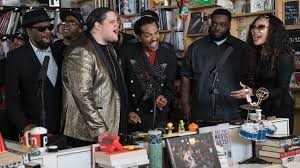
SOUNDTRACK: ARTISTS FROM THE “TAKE ME TO THE RIVER” TOUR-Tiny Desk Concert #692 (January 15, 2018).

This is a touring band playing classic soul.  But I found the modern updates to be unpleasant and almost undermined the tone of the show.  The blurb says:

“Take Me To The River” is a 1974 song from the legendary Al Green and guitarist “Teenie” Hodges. And though it wasn’t a big hit at the time, this song’s mix of religion and desire has become part of pop music’s canon.

Here at the Tiny Desk, some of the original players of this deep southern soul have come together to honor and update this tradition. It’s a celebration of Memphis soul old and new, with 13 musicians wedged behind the desk.

Some of those players of the old include singers Bobby Rush and William Bell; on the Hammond organ, Rev. Charles Hodges and LeRoy Hodges on bass. But it’s what’s new that makes this more than a look back – the addition of southern rappers Frayser Boy and Al Kapone – that truly puts this project on new musical ground.

But it is this update–Frayser Boy and Al Kapone who really ruined this show for me.

I’m not suggesting that the original lyrics to “Push and Pull” are profound.  They are not, but Frayser Bay’s rap is just up front and graphic whereas the original song is more understated (as much as something called “Push and Pull” can be).  Bobby Rush is a great singer and he looks spectacular in his sequined jacket.  Rush has a nice harmonica solo too.  That rap just seemed to come in and mess the whole thing up.

“I Forget To Be Your Lover” suffers from the same problem.  William Bell has a great sound–a cool rough voice.  And the original has this conceit: “I forgot to be your lover and I’m sorry.”  Al Kapone  comes in with a fairly explicit and hardly apologetic rap.  And what’s even stranger is that Rev. Charles Hodges who plays an outstanding organ throughout the show (I loved seeing the organ’s spinning fan that makes the great organ sound), plays really sour notes while Kapone is rapping.  Each verse has this weird nauseating sound. In every other section it sounds amazing, but during the rap it’s almost like he’s commenting on the rudeness of the rap.  The contrast is even more stark when Bell takes back the song mid way through and holds a high falsetto note for about 10 seconds–which really shows his power and range.

The backing vocals by Ashton Riker and Evvie McKinney are a nice touch.   Then on “Take Me to the River” Riker shares lead duties with Bobby Rush and they sound great together.  Riker hits some powerful high notes while Rush keeps it all together.  This is the song that really sells the show.  But look at how uncomfortable Frayser Boy looks during this song.

The rest of the band sounds just fine, playing quiet and understated:  LeRoy Hodges (bass), Edward Cleveland (drums), Andrew Saino (guitar), Jamel Mitchell (sax), Scott Thompson (trumpet), Martin Shore (percussion).

[READ: November 10, 2017] The Talented Ribkins

I saw Ladee Hubbard on Seth Meyers.  She was really interesting (and went to Princeton) and her book sounded fascinating.

On the surface the book is fairly simple, even fairly uneventful. Johnny Ribkin has to come up with $100,000 in a week because he has run afoul of a powerful man.

A few things separate this from similar books.  The first is that over the course of his life, Johnny buried various amounts of money and possessions in random places around the state of Florida.  He should be able to find the money fairly easily.  The reason why he buried all of this is part of the story.

Another thing is that he and his siblings all have special powers.  Not exactly superpowers, but certainly special powers.  And while these powers don’t exactly come into play in the quest, they are ever-present and unavoidable.

So what the heck is going on here? (more…)

Read Full Post »

6616 SOUNDTRACK: CHUCK BROWN-Tiny Desk Concert #217 (May 16, 2012).

chuckI’m puzzled by a few things with this Tiny Desk Concert.  The first is a note that This story originally ran on Sept. 28, 2010.  The second is the note that Chuck Brown, the Godfather of Go-Go music, died Wednesday. In 2010, he brought his full band to the NPR Music office — and put on a party like no one else.

That isn’t confusing in itself, but I have to wonder why it took them two years to air this concert, which is quite a fun rave up.  Are there other shows they didn’t air?

Okay, so I had no idea who Chuck Brown was.  And the blurb anticipated that

The name Chuck Brown might not mean a whole lot to people outside the Washington, D.C., area. … In D.C., Brown is widely known, even revered, as the Godfather of Go-Go, a title he’s held since the late ’70s. Though he started out as a jazz guitarist, Brown invented go-go, a style that incorporates funk, jazz, R&B, hip-hop and dancehall, and has mostly stuck with it ever since.

So, Go-Go, huh?  I never heard of that either.

No one in D.C. can really explain why go-go hasn’t traveled beyond the city’s environs — we love it here, it’s all over our commercial R&B and hip-hop radio stations and, at least when I was in high school, a go-go in a school’s gym was the most packed party of the weekend. Chuck Brown is a local hero. A few days after he played our offices, Brown and his whole band played at the Redskins’ stadium for the halftime show.  So to have Brown play a corner of our office — not a 90,000-capacity football stadium — was like a dream come true for a lot of NPR staffers. Sweat started pouring immediately, between the 11 musicians (that’s congas and a stripped-down kit; saxophone, trumpet and trombone; two backup singers and a rapper) and all the go-go-heads in our building.

Brown played four songs for about 25 minutes.

Go-go is mostly about the groove, though, and Chuck Brown just settles in and leans back. He showed up looking like a million bucks in a vest, Dior shades and his signature hat, and then he did what he does best — get the crowd on his side and hand its members something to dance to.

Go-go is based on a syncopated beat and the use of congas in addition to drums.  So “Senorita” is like a combination of reggae salsa and 50s singing (I can’t help but think he sounds like Frank Zappa when Zappa does his rather funny voice).  The song is slow but smoldering and fun to sing along to.  There’s a Santana guitar vibe too.

“Chuck Baby” is the hip hop element of his music.  His rapper is not very inspiring though.  She seems a little stiff.  And the song is a little flat when he’s doing the call and response–he sounds cool and seductive and they sound more bored than “naughty.”

Before the third song everyone starts chanting “wind me up chuck!” which he lets everyone know www.windmeupchuck.com is his website. “Wind Me Up!” / “Bustin’ Loose” starts with lots of call and response.  “Bustin’ Loose,” is a funky song with very James Brown accents and everyone singing the refrain: “Gimmethebridgenow, gimmethebridgenow.”  The song has been a hit in D.C. since 1979.  The backing vocalist on this song feels a bit looser (apparent as she sings “I feel like bustin’ loose).

The crowd was yelling out requests, too: “Chuck Baby” and “Run Joe,” a go-go cover of the Louis Jordan song.  “Run Joe” / “It Don’t Mean A Thing.”  “Run Joe” has a Jamaican flair “Policeman is on the premises.  What is he doin’ here?”  His guitar playing is really inspired throughout the set, but especially at the end of this song.   He does a lot of playing the same melody as he sings.  The song segues into a version of “It Don’t Mean a Thing” in which he slips in “It don’t mean a thing if it ain’t got that go-go swing.”

This set was really a party.  And Brown was just full of energy.

[READ: January 12, 2017] “Surrendering”

The June 6 & 13, 2016 issue of the New Yorker was the Fiction Issue.  It also contained five one page reflections about “Childhood Reading.” 

This reflection beings with Vuong explaining that his family moved to the U.S. from Vietnam when he was two.  He was an ESL student from a family of illiterate rice farmers who saw reading as snobby.

When he entered kindergarten, he found himself immersed in a new language.  He quickly became fluent in speech but not in the written word.  In fourth grade his class was given an assignment to write a poem in honor of National Poetry Month.  Normally his poor writing skills would mean that he was excused from such assignments.  He would spend time copying sentences out of books in the classroom.  But this time he decided to be ambitious and write a poem. (more…)

Read Full Post »