Feeds:
Posts
Comments

Archive for the ‘Drinking’ Category

ninthSOUNDTRACK: Thee Silver Mountain Reveries-The “Pretty Little Lightning Paw” E.P. [CST030] (2004).

lightpawAfter three albums, it was time to make an EP under yet another variant of the band’s name.  This is a fun release (which is interesting to say about a band who is typically quite serious).  What made this “fun” is that many of the band members switched instruments for this recording. Violinist Sophie Trudeau plays bass guitar.  Guitarist Ian Ilavsky, usually one of the band’s guitarists, plays drums.

Also when they finished recording, was complete, the EP was played on a boombox and re-recorded from that.  I can’t tell that it was recorded in this way, so who knows if that made any difference.

There are four songs, “More Action! Less Tears!” is the first.  It begins with Aimee shouting “Hello!  Hello!” and then messing up and laughing.  So she begins again, “The name of this song is More Action.  The name of this song is Less Tears.”  It sounds unlike anything that SMtZ have done so far.  The guitar that opens it is distorted and plays a fairly conventional riff while the violins play a suitable melody over the top.  The strings build and the songs oars.

“Microphones in the Trees” opens with a guitar melody that’s quickly joined by the same melody on upright bass.  Efrim begins singing (his voice is distorted and echoed and sounds almost more like an instrument than a voice, although you can hear the lyrics: “microphones in the trees, cameras in the sky.”  The choir starts singing along with him until about three minutes when a wash of noise over takes the song. This lasts for a few minutes and then fades, allowing the words to continue.  About half way into the song a rather shambolic chorus sings “we are the flood.”  The last two minutes or so are simply feedbacky noises wafting around.

“Pretty Little Lightning Paw”is the ten-minute title track.  It opens with bass notes and chimed notes.  The strings follow Efrim’s vocal lines (which sound ragged and quiet).  And then after a minute or so new strings come in, slightly unsettling sounding.  About three minutes in the 4 voice choir begins singing an alternate melody above Efrim’s repeated mantra.  The song continues in this vein for pretty much the rest of the song, only modifying at the end where the sounds and feedback resemble birdsong.

“There’s a River in the Valley Made of Melting Snow” is 5 minutes long and is basically a solo song from Efrim.  He plays guitar, sings and plays “toybox.”  The melody is fairly simple and his voice sounds pretty good–not too shrill.  It may be the most conventional song that SMtZ has recorded.

While this EP doesn’t deviate drastically from the band’s normal sound, it is fun to see them mix things up a bit.   For this recording, the band was

  • Thierry Amar – violin, bass guitar, vocals, pianohandle
  • Ian Ilavsky – drums
  • Efrim Menuck – guitar, piano, organ, vocals, feedback, toybox
  • Jessica Moss – violin, vocals
  • Sophie Trudeau – bass guitar
  • [Beckie Foon is absent]

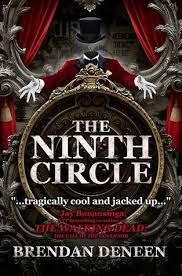
[READ: May 5, 2016] The Ninth Circle

Brendan and I went to college together.  In fact, I knew Brendan from his submissions to both the newspaper and the literary magazine.  He was a major talent back then (I still remember details from the story he submitted twenty some years ago) and continues to be one now.  He works in comics and has written for Flash Gordon, his own book Scatterbrain and something that I can’t wait to find a copy of: Charlie Sheen: Vatican Assassin Warlock.  Check out his output on Goodreads.

This is his first published novel, I believe. And I was hooked from the first chapter.

The story is about 16-year-old Dan.  His family is a disaster–his brother is obsessively mean to him, his father is an alcoholic, his mother is probably sleeping with someone else, and neither parent gives him the time of day.  For his 16th birthday they take him to the circus, even though he never said he wanted to go to the circus.  His brother promises to get revenge for having to go to this lame spectacle.

Dan’s not even sure that he’s going to like it, but he winds up being mesmerized from the moment he walks in.  The trickster tricks him, the freaks entice him (he finds the bearded lady especially enchanting) and the whole show is truly amazing.  Later that night, while lying in bed thinking about his crappy life, Dan decides to take action. (more…)

Read Full Post »

[ATTENDED: May 23, 2016] S.T.O.P.

stopIf you have a teen or pre-teen and you are concerned about how they will deal with bullying, sex, body issues or, heaven forbid, heroin, this performance is a must-see both for your child and you.  The performers are all high school students.  They wrote the pieces and they are intended for high school students (and middle school).  If you can’t see them yourself, contact your school or community group to arrange for them to do their show.  It is intense and really effective.

When the fifth grade completed the D.A.R.E. program at school, the ceremony included a piece by this group.  The piece was called “Jack & Jill” and it told the story of how an underage party led to the death of two teens.  There were a couple of moments of humor, but the message was intense and the acting was really good (they “rewound” the story and the actors did a great job of going backwards–including one boy who “fell up” the couch (he fell off it earlier).

After they were done, they said that the troupe would be doing their full hour-long show in May and that was open to anyone in 5th grade and older.  I was amazed that Clark wanted to go as it’s not really his thing.  And so we went.  He was bummed that only a couple of kids he knew showed up.  I was bummed at how few people showed up at all.   And so I wanted to post about the show to get the group some recognition because what they did was really powerful and I think should be seen by just about everyone.

When we arrived, the teacher in charge of the group Miranda DeStefano-Meene told us that the show would be uncensored and pretty intense.  The program says that the words on stage “may embarrass, hurt, offend, scare and anger you.  That is intentional.”  The second paragraph spoke of the heroin epidemic in our society which is bigger than any other drug epidemic in recorded history, which I did not know.

And so we sat back and watched this show.  Now, I happen to think that Clark may not have been exposed to a lot of what was going on in this play (which I’m grateful for).  So this show may have been really intense for him (I know I spent the whole show wondering what he thought).  After the show the only thing he said was that it made hm sad.  And we did talk a little about the messages, but he’s a tight-lipped kid, so I can only hope he’ll come back to me with more questions if they arise.

And what questions he must have.  For this show tackled so many problems facing teens.  (more…)

Read Full Post »

trickSOUNDTRACK: I WAYNE-Tiny Desk Concert #180 (December 12, 2011).

Tiwaynehis Tiny Desk Concert is just 7 minutes long.  I Wayne is a reggae singer and he’s accompanied by an acoustic guitar.

“Real and Clean” is a simple song with the appropriate reggae rhythms used as background to Wayne’s lyrics, part of which go like this:

“let nature take its course / no need to rush no need to force / no need to worry about child support / abandon abused in family court”

“Can’t Satisfy Her” seems to be about a prostitute.  The song is from 2004 and the blurb says “he’s largely credited with bringing the roots and rock back to mainstream reggae.”  I’m not sure if the NPR office knew the song, but by the end they are singing along.  With a comment at the end: “thanks to the NPR chorus.”

It’s certainly catchy and a bit more interesting than the standard reggae fare.

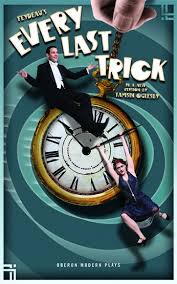
[READ: December 10, 2015] Every Last Trick

I found this book at work.  The cover was silly and the full title was “Feydeau’s Every Las Trick in a new version by Tasmin Oglesby.”  I saw that it was part of the Oberon  Modern Plays collection, which is a collection of short plays and I have read several of them (okay I just looked them up online and there are approximately 960 Oberon plays, I think I’ve read about 6).

Anyhow, this play is based on Le Système Ribadier by Georges Feydeau.  I’ve never heard of it or him.  But this version is a delightfully over the top farce.

There are four main players: Juan, Gus, Tom and Angela and a fifth one, Knowles.

As the play opens Gus, the servant of Juan and Angela is sneaking in through a window.  He steals some of the family’s booze.  Then Juan and Angela come in, arguing.  Angela is mad at Juan and accuses him of cheating on her. (more…)

Read Full Post »

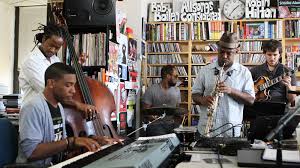
nessSOUNDTRACK: BEN WILLIAMS & SOUND EFFECT-Tiny Desk Concert #170 (October 24, 2011).

ben williasmBen Williams is a jazz upright bass player (I didn’t realize bass players made band leaders, but clearly they do).  In 2009, he won the Thelonious Monk Jazz Competition.  And is an up and coming star.

He plays two original songs from his album State of Art.

It’s not often that the blurb describes a song, but it does a better job than I could have so for the first song, “Home”

the guitar (Gilad Hekselman) and drums (John Davis) lay down an aggressive, snappy foundation. The bass and electric keyboard (Christian Sands) fill out the polyrhythms. That groove, with its snappy hip-hop flavor, feels at home cruising down Georgia Avenue, then turning right on U Street NW, the historic African-American commercial district of Washington [D.C. where Williams is from]. Then the saxophone (Marcus Strickland) enters, and it’s game on.

That saxophone really runs the show on this song.  There’s an interesting keyboard solo (I like the sound he chose, very Stevie Wonder-ish, but it’s a little quiet).

The sax switches to a smaller sax for the second song, “Dawn of a New Day.”  The song is much slower and is more than twice as long as “Home.”

There’s a pretty lengthy bass solo (which sounds very old-school to me).  It’s followed by an electric guitar solo that has an interesting effect on it which made me think at first that it was a horn.  The horn comes next with a lengthy sax solo.  The final solo comes from the keyboard (which now sounds like a piano).  And then the song returns to that interesting main riff.

[READ: April 20, 2016] The Rest of Us Just Live Here

Sarah brought this book home and told me the premise–imagine what the stories of the other kids in the Buffy Universe would be like–wondering about all of those weird kids fighting vampires or whatnot.

At first I thought she meant that the other kids didn’t know what was going on, which would have been funny.  But in this story, the kids know that there are vampires and other mystical things, they just aren’t any part of the action–they are not the Chosen Ones.

It’s a very funny premise for a book, and I looked forward to how Ness would create a story around people who aren’t “doing” anything.

But that’s not the only thing that the story is about.  Ness makes the lives of the other kids so compelling and so, human (even if one of them is a quarter god). (more…)

Read Full Post »

dec2015SOUNDTRACK: Y LA BAMBA-Tiny Desk Concert #143 (July 21, 2011).

ylabambaWith a name like Y La Bamba, I expected, a band, possibly from Mexico, singing in Spanish.  So imagine my surprise that the band is from Oregon and sings (almost) entirely in English.

The band’s musical make up is really interesting–accordion, percussion, guitar and lot of singers.  Lead singer Luz Elena Mendoza’s (who is Mexican..I was sort of right) voice is cool and unusual, passionate and anguished and perhaps a little intimidating.

For the first song “Crocodile Eyes,” Mendoza’s voice is right up front as she sings and plays guitars.  And her voice is a little surprising.  But it’s even more surprising when the (rather loud) drums come rumbling in after the first few seconds (it’s especially disconcerting because you can’t see the drummer).

But perhaps the most impressive thing about Y La Bamba is the backing singers.  Two bearded men sing wonderful “whoah ho hos” to accompany her as she sings.

For “Fasting In San Francisco” the guitar switches to one of the (unbearded) men.  And instead of percussion there is a wonderfully clear xylophone that adds a beautiful counterpoint to the plucked guitar.  On this song the backing vocals sound amazing.  I especially loved the middle section “I’m a fragile dandelion” where that line is repeated in many different ways (including spoken) and then all the singers break in to a series of fugue-like “doh” notes at different pitches–it is mesmerizing,.

“Hughson Boys” opens with fast acoustic guitar picking.  And the vocals are a duet with the guitarist and Luz Elena.  This song is not quite as anguished, but the harmonies are once again wonderful–and his falsetto vocals at the end are a great touch.

There’s a story about Luz Elena Mendoza on NPR (from a few months earlier) where they have some of their studio songs available to stream).

This was such an unexpected treat–totally not what I anticipated and a band I definitely want to hear more from.

[READ: January 11, 2016] “Too Good to Be True”

I didn’t know Huneven before reading this story.  And I was a little dismayed that the story was going to be about A.A.

However, it was about A.A. in a very unexpected way.

The protagonist is a woman named Harriet. Harriet had bottomed out not too long ago and lost the job that she really liked.  She was recently hired by a woman name Lois.  Harriet and Lois met at an Al-anon meeting and now Harriet is their housekeeper.  Well, Lois and her family are very wealthy and they have a maid and a babysitter.  So, technically, Harriet is more if a personal chef–making far more money than she ever would as a chef somewhere else.

As the story opens Harriet has agreed to take Gayle to A.A.  Gayle is Lois’ daughter.  Gayle is the middle child between a successful older sister in college and an adorable younger brother (he was a happy accident).  Gayle was an A student until she left one day at age 15 and didn’t come back for several months.

As they are driving to the meeting, Gayle tells Harriet the details of all the things she did (and people she did) to score drugs on the streets.  Gayle was dragged home once but left again twelve hours later.  She had been in forced rehab but it never took.  And now, this time, Gayle is getting clean on her own accord.  She saw a vision of her future as a successful international business woman and she intends to see that through.

So, in addition to A.A., she is studying Mandarin and being an exemplary daughter.

But then one night, as has happens so many times before, Gayle doesn’t return.  Gayle’s dad assumes that something bad happened to her–an assailant or the like.  But Lois assumes she hopped in the back of car and is getting high again.

Harriet has been told so many details of Gayle’s past.  She knows that yes Gayle wants to get clean but also, yes, she spoke so fondly of the highs she had. She doesn’t know what to think.  The police, aware of Gayle’s past, assume she has left as well.

Every phone call brings a charge of fear.  And while Lois says that she would rather Gayle were dead than missing–it would be so much better to know-of course, she also obviously hopes she isn’t.

This is an unhappy story and no real ending is going to shine a bright happy light on it.  But the route that Huneven went was unexpected.

I don’t really like stories like this in general, but it was well told and very engaging and the details (like the phrases that Gayle learned in mandarin) were great.

Read Full Post »

spoilsSOUNDTRACK: GABY MORENO-Tiny Desk Concert #149 (August 15, 2011).

gabyGaby Moreno surprised me in this set.  Her first song “No Regrets,” begins like a gentle bossa nova sung in Spanish.  The song switches to English about midway through, but it retains that lovely bossa nova feel.  Morena’s voice is lovely and clear. She plays guitar and sings and is accompanied by Adam Levy, also on guitar.

So far, so good.

The second song, “Ave Que Emigra” begins as a gentle ballad, but quickly morphs into a kind of upbeat folk song also sung in Spanish (Moreno is from Guatemala).  It is a lovely song with some beautiful oooohs.

It’s the third song the surprised me.

“Sing Me Life” opens in a much darker vein–rough strummed guitars and a blues solo from Levy.  Even Moreno’s voice has gotten deeper and bluesier.  The song is sung in English and although she sounds like herself, she also sounds really different–not exactly angrier, but less sweet, more intense.  The “Hey hey hey’s” are a far cry from the sweet “ooooohs” of the previous song.  Levy plays a nice bluesy solo on this song as well.

Moreno has a great deal of diversity in her set and she handles it all really well.

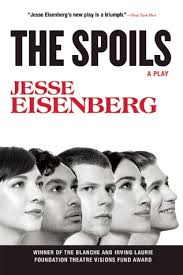
[READ: October 20, 2015] The Spoils

I have enjoyed Eisenberg’s writing in the past.  But this was the first full play I had read by him (he has two others). It is very funny (and surprisingly vulgar).

There are five characters. Ben (played by Eisenberg when it was performed) owns the apartment where the action is set. He is the son of a wealthy man, going to college for “film” and basically enjoying himself as much as he can. He drinks, he smokes pot and he picks on his roommate (who might just be his only friend). His language is shockingly vulgar, dropping curses left and right.

His roommate is Kalyan (who in the performance was played by Kunal Nayyar (from The Big Bang Theory). Kalyan is from Nepal. He has come to NYU to study business and has even written book about economic conditions in Nepal. Kalyan is a bit dorky (he loves PowerPoint, which is used to great comic effect throughout the story). And he is trying to win over Reshma.

Reshma is Indian, but she has lived in the States all of her life, so she is really American.  She has high hopes for Kalyan, but it seems she fears he might not live up to his potential.

In the opening scene Kalyan is showing her a PowerPoint and being incredibly sweet to her.  When Ben walks in he is all crass and vulgar—funny but very unlikable.  He essentially makes Reshma leave (although as soon as he shows up we know she wants to leave anyhow) and then begins his tale. (more…)

Read Full Post »

kokoSOUNDTRACK: CAR SEAT HEADREST-Tiny Desk Concert #506 (February 8, 2016).

carseatI only know of Car Seat Headrest from NPR.  They have really liked some of his previous songs and both Bob and Robin raved about his new song “Vincent” (which is really good).

For this Tiny Desk Concert, Will Toledo (who is kind of the only guy in the band, although not currently if you know what I mean) plays acoustic guitar on a tall stool.  Accompanying him are two friends from Leesburg, Va, who don’t actually do anything, and his two band mates who also don’t do anything (well, the drummer plays a toy “desktop” drum set for the song “The Drum”).  And yes, they all sing along during the sing along at the end of song three.

It’s worth mentioning that Toledo has released some 12 albums under the name Car Seat Headrest since 2010 (and Toledo is only 23).  Find them at bandcamp.  Unlike someone like Robert Pollard who has written hundreds of songs that are about 30 seconds long.  Most of Toledo’s songs are really quite long, with multiple parts.  And amazingly, all the parts are pretty catchy,

He plays three songs in this set.  His voice is a little creaky and high-pitched, but it is really-spot on for the kind of songs he writes.  By contrast,. it’s funny to hear how deep his speaking voice is.

“The Drum” opens with a riff that is almost out of tune seeming (like his voice).  The melody lines in the verses are simple but often unexpected.  And lyrically, the song is quite interesting (“the drum reads James Joyce,” “the drum’s in debt”).  And just when it seems like the song could end, it switches to a slower middle section, after which it all comes back to that catchy chorus.  By the end of the song it’s totally grabbed you.

For “Drunk Drivers/Killer Whales,” he pushes his falsetto pretty high.  The  song starts out rather slow but once the verses start properly it picks up.  I love the way in the drunk drivers part he adds vocal melodies that are not in the music to make the song even fuller.   And then unexpectedly, the song shifts gears from the melancholy drunk driver section to the powerfully sung (and I’m not exactly sure how it’s related) “Killer Whales” part. It runs to 6 minutes and is constantly shifting and always stays interesting.

“Sober To Death” is also about 6 minutes long. There’s some great lyrics in here as well “every conversation ends with you screaming.  Not even words just ah ah ahhhhh” (with his voice breaking during the ahhs).   The sing along part at the end has a neat intro where the first guitar line is plucked slowly and the second line picks up speed.  And when everyone sings along it really elevates the song.

After just two listens to this show I was totally hooked and I’m really looking forward to hearing his last album, which is reworking of his earlier songs for Matador Records, and his soon to be released new album with “Vincent” on it.

[READ: February 25, 2016] Koko Be Good

I absolutely adored the art in this book.  I really thought it was outstanding and it has made me search out more of Wang’s stuff (she has a number of online comics at her website).  I also didn’t realize that she drew In Real Life–with Cory Doctorow–her style is similar there but a but less wild as it is here.  And the story is pretty great too.

So this is the story of two main protagonists and a third character who plays a smaller but pivotal role.  Koko is a wild Chinese girl who is carefree and careless.  Jon Wilgur is a tightly wound young man who is planning to change his life pretty drastically.

koko2The story opens with Jon–he is drawn so perfectly, I can’t get over it–a great combination of realism and cartoon style.  He is listening to an audiotape sent by his girlfriend (I love that he is listening to an audio cassette).  He and his girlfriend are planning to move to Peru together very soon. She is currently there and he is about to pack up and head down there himself. (more…)

Read Full Post »

redSOUNDTRACK: LE FLY PAN AM-fpamCeux qui inventent n’ont jamais vécu (?) [CST019] (2002).

After their previous EP, Le Fly Pan am (note the addition of the Le) come back with an album that can be described as funky.  True, it’s weird funky that gets dismantled while its going along, but it’s still pretty funky.

They wouldn’t be them if there weren’t some crazy noises.  And so the first song (parenthetical translations are from Wikipedia), “Jeunesse sonique, tu dors (en cage)” (“Sonic Youth, You Sleep (In a Cage)”) is just noise and static for 90 seconds before leading to the first song proper:

“Rompre l’indifférence de l’inexitable avant que l’on vienne rompre le sommeil de l’inanimé” (“Break the Indifference of the Inevitable Before We Come to Break the Sleep of the Inanimate”) which kicks in with a really funky bass guitar and drum section. It’s really catchy and almost danceable. But throughout the song’s ten minutes there are elements of destruction going on. There’s screeches that sound like a dentist’s drill. About a minute in, the guitars just seems to stop playing riffs and just tart going crazy–playing loosened strings and just random notes like a beginner (even though the original rhythm is still there).  That funkiness stays for about 5 minutes until the songs shifts gear into a loping melody with a big bass and simple repetitive guitar lines. And then it kind of falls apart all together with some sounds like broken strings and lots of chatter (in French).  At 7 and a half minute it resumes at breakneck speed with the drums and bass pounding away and all kinds of effects splashing on top. The song ends with low rumbling noise before jumping into….

“Partially sabotaged distraction partiellement sabotée” (“Partially Sabotaged Distraction Partially Sabotaged”) This song opens with a four-note, slightly off-key guitar and then loping bass riff that reminds me of SST Records bass guitar of the 80s. It switches between this and a slightly funkier sounding section. But the destruction is apparent from the get go as early in the song, the sound just completely drops out on a couple occasions, making you think the disc is broken (it isn’t).  The song starts to get more intense as the notes seem to get faster and more insistent (those repetitive notes and ringing guitars just seem to scream tension).

“Univoque/Équivoque” (“Univocal / Equivocal”) opens with static and then a very funky bass line.  There a music box playing over the top and some quiet guitars. About half way through the bass ends but the music box (tiny and distorted) continues.  At 3:30 a new bass line, similar to the previous but with a new section added pops up.  It’s a simple song showcasing their groove and their noise.

“Arcades-Pamelor” starts with low distorted noises.  Like the first “song” this is mostly sound effects and things slowed down. Until a screaming noisy static takes over about half way through.  It’s really quite unpleasant.

“Sound-support surface noises reaching out to you” opens with another funky bass and drums and some simple guitar notes. About a minute in a sound emerges that sounds like a skipping CD (but it’s not your CD).   And then a new, different bass pattern emerges with lots of noisy percussion(sounds like people banging things). The skipping sounds seems to work as a segue between section, with some great funky parts and and then the final section which opens with what sounds like a mildly out of tune guitar ran and more great bass. This really enjoyable section winds up glitching to a halt with the  sound of a skipping record player.

“Erreur, errance: interdits de par leurs nouvelles possibilités” (“Wandering Error: Prohibited by Their Opportunities”) has the sounds of sticks clacking together and silverware dropping and mechanical sounds.  And they all seem to somehow settle into a rhythm of piano notes. Unlike the other tracks this one is pretty consistent—strange noises and a simple piano motif.  It’s also probably the least interesting of the bunch.

The disc ends with “La vie se doit d’être vécue ou commençons a vivre” (“Life Must Be Lived or Begun to Be Lived”) another great, funky bass and piano line, with some interesting guitar sounds round the corners. This song is so catchy, it’s wonderful.  After about 2 minutes there’s another breakdown. The music all stops except for the guitars which sound like they are getting strangled.   The second half of the song has the same funky bass but very different guitars and lots of squeals and feedback. After a couple more glitches at 6 minutes in, the bass takes off playing fast rocking riff as the guitar tries to keep up. It’s such a satisfying ending that it’s hugely disappointing that it only last 45 seconds before the album ends.

While it was always obvious that Fly Pan Am were going to play weird experimental stuff, it wasn’t clear before just how funky and dancey they could be too.  If you can handle some noise in your dance, this is a great album.

[READ:January 10, 2016] Red Handed

I absolutely loved this graphic novel.

I had never heard of Kindt before and I didn’t really know what to expect from the book, but I certainly didn’t expect the complicated and super clever plot and structure that this book had.

It opens with a newspaper story that tells us about Detective Gould’s ten years on the force.  Since his arrival there have been no unsolved murders.  He credits the rise in technology for his success.  (continued on A12) and then it moves into the graphic format.  It is headed Detective Gould (in black and white).  Then it shows some mug shots of suspects in color.  And it turns out that these people’s stories will comprise the bulk of the book.

The next chapter opens with a woman fleeing a diner with a stool.  She worked there and is told the stool is coming out of her paycheck,.   We learn that stealing chairs is kind of her thing.  And then we see what her next acquisition after this stool is.

The next chapter is called the Jigsaw and it involves a man who is an art dealer.  As the story opens he steals a giant painting form a woman he has picked up at a bar. And then we learn what he did with it and how he made his reputation.

After he is caught, the story shifts to a series of dialogue boxes on a black background in which Sgt Gould is speaking to a woman who Sgt Gould assumes is connected to all of the cases in the book.  She is playing innocent and has explanations for everything.

After this there is another black and white section designed to look like newspaper stories of The Detective’s Wife  (in which the two are sweet together) and then Tess’s True Heart in which we learn that Tess (whoever that is) is a very smart girl.

The next chapter is The Ant in which an artist wants to tell a story told from the point of view of an ant.  But since the ant cannot write, it must collect letters from the newspaper.  This turns into an art installation in which the author’s editor begins finding the words all over town and using them to tell the story (it’s much more convoluted than that and really clever).  Then we learn that Tess is the author’s editor–the first connection is built.

And after that short piece, we see more black and white stories from Detective Gould and Tess’ True Heart.

The next chapter is The Forgotten about a sleight of hand magician who has stopped doing magic and has become a pickpocket.

The Repair Man is about an elevator repair man who takes pictures up women’s skirts when they are stuck between floors.  And then he begins selling them to a smut dealer.  The way these pictures connect to the rest of the story is amazing.

The next section is The Performance Artist in which a woman is set up to look like she is cheating on her husband (elaborate ruse once again).

The Escape Artist tells the story of a car thief and how so many thieves think they are going to stop but they are afraid of losing the rush.  Well, this guy retired for real.  Until he ran into Tess.  He knows from long ago.  And she brings him back to the city.

Finally, The Fire Starter is about a guy who gets paid to start fights with the intention of a payout coming somewhere down the line.

The last fifty or so pages show how all these crimes, all these cases solved by Detective Gould, are tied together.  And the way it is told just gets more and more interesting.

This was an outstanding book.  I loved the art and design–the various ways that the medium was used to tell the story.  I loved that it was confusing but not too confusing and that it unraveled in the way it did.   I really can’t say enough about this book.  This was another big win for First Second in their #10yearsof01 celebration.

Read Full Post »

flypanam templarSOUNDTRACK: FLY PAN AM-Fly Pan Am [CST008] (1999).

In the Constellation canon, there were four originators: Godspeed You Black Emperor were orchestral, Do Make Say Think were jazzy, and A Silver Mt Zion had vocals.  But Fly Pan Am was the weirdest one—the played with noise, they broke up their songs, they deconstructed their own work and, especially novel to me, everything was in French on the discs.

Roger Tellier-Craig, the main force behind FPA was in GYBE as well.  So he knows post-rock.

Their debut album is a long affair–an hour’s worth of music (in all of 5 songs) taken from two different recording sessions.  (All translated titles are taken from Wikipedia).

“L’espace au sol est redessiné par d’immenses panneaux bleus…” (“The Floorspace Is Redesigned by Huge Blue Signs…”) is a 13 minute song.   There’s ringing noises as a simple melody is plucked out.  The full instrumentation kicks in adding a repetitive guitar line that seems to fall into the background behind the opening notes that are still playing out.  The guitar lines slowly gets longer and longer, almost like a game of Simon.  By around 6 minutes the song has built up a serious head of steam with the bass and drums moving quickly and the guitar getting really complex. By 7 minutes that pretty guitar has turned into a ringing feedback skronking solo which carries on for a minute or so before fading back. At around 9 minutes the song seems to retreat on itself again. The guitars fade away and the bass seems to get a bit louder with the guitars ringing out. The last minute or so resumes a kind of noisy static sound that tells you the song is over.  That’s a heck of an introduction.

“…Et aussi l’éclairage de plastique au centre de tout ces compartiments latéraux” (“…And Also the Lighting of Plastic in the Center of All Its Lateral Compartments”) is a 9 minute song that opens with more scorching guitars and rumbling bass.  The guitar switches back and forth between a two note melody and a chord (dissonant, of course). The other guitar then plays a different three note melody.  About 2:30 in some noisy feedback and samples start taking over the song.  All the music drops away except for the bass.  By 3:15, all the music had dropped out and its just noisy effects and feedback and then outer space sounds.  After about 4 minutes of that (yes, indeed) the bass comes back in playing a kind of discoey rhythm with the guitar supplying a dancey counterpoint which runs to the end of the song.  It’s their first song where something really catchy is utterly dismantled by noise.

“Dans ses cheveux soixante circuits” (“In Her Hair Are Sixty Circuits”) is 17 minutes long (!) and is one of the most abrasive songs I can recall. The song opens with both guitars each playing a two-note melody which rotates through a round. They sound lovely together as the bass and drums play a slow rhythm. The melody changes a few times and then by around 3 and a half minutes the main guitar line grows faster (6 notes instead of 2) and the background feels a bit more tense.   And then at 5:46, the whole song seems to get stuck on repeat. The bass plays a 2 note rhythm, the drums play the same pattern and the two guitars each play one note over and over.  And over.  Evidently it’s “a half-tone interval.”  And this goes on for 12 minutes.  TWELVE!  The only differences through this whole section come from the digitalia of guest electronic musician Alexandre St-Onge, but they are the most unobtrusive electronics I’ve ever heard and just seem to bubble and prickle gently onto the repetition.  It’s maddening and then trance-like and then maddening all over again.  How can they play the same thing for twelve minutes—and their rhythm remains perfect?

“Bibi à nice, 1921” (“Bibi Nice, 1921”) opens with noises and feedback (which is a nice break from the 12 minutes of repetitiveness. But you soon realize that that’s all you’re getting (aside from some distant rumbling noise in the background). It’s a very silent song. For four minutes (out of ten) and then the full band kicks in for a really rocking section—great guitar lines and propulsive bass and drums. But after two minutes, the sound drops out entirely—pure silence (enough to make you assume the disc froze). It slowly returns after 20 seconds–they are messing with us again.  At 7 minutes a new guitar line comes in—slow and pretty with a slow drum beat.  A solo plays over the top—it is primarily electronic, and sounds pretty cool.   The guitars start playing louder and the song feels like it’s going to build up into something huge, but it soon ends and turns into….

“Nice est en feu!” (“Nice Is on Fire!”) seems like it should be connected to the previous song, but it starts off very different with big bass notes playing a very slow riff.  The guitar starts playing a nice accompanying riff. At 3 minutes in, voices come in singing Ahhs in a nice melody. The liner notes say that Kara Lacy and Norsola Johnson do vocals on “Bibi à nice, 1921” and “Nice est en feu!” but I didn’t hear any vocals on “Bibi.”  At 4:30 the guitar line turns to something else and there’s suddenly a whole bunch of noise flooding the track—sounds of water rushing, maybe—but that goes away and a new melody (slightly dissonant) resumes.  With about a minute left the voices resume—angelic and soaring over the rumbling song.  It ends this weird disc on a very pretty note.

I love the crazy stuff that Fly Pan Am creates, even if some of it is hard to listen to.

[READ: February 23, 2016] Templar

I had actually started to read this graphic novel before Prince of Persia.  But when I saw in the introduction that Mechner talks about Prince of Persia, I decided to grab that one and read it first.  The two have nothing to do with each other, but sometimes it’s nice to get things on order.

Who doesn’t love stories about the Templar knights?  The whole premise of the National Treasure is predicated on them after all.  Not to mention, The Da Vinci Code and the book that he says far surpasses all Templar stories: Foucault’s Pendulum [RIP Umberto Eco].

So Jordan Mechner has done a lot of research (there’s a sizable bibliography at the end of the book) to create the story about a couple of Knights Templar.  He says that “much nonsense has been written about the Knights Templar over the years. I’m proud to say that this book has added to that sum.”  He explains that thousands of knights were indeed killed.  Some knights did escape, but the main plot he constructed probably never happened.   One of the histories he read said that “figures of no importance” did escape, and so that was the basis for Martin, Bernard, Isabelle and their gang–inconsequential Templars and their own story.

He also says (in the preface) that all of the movies about the Knights focus on the treasure, but the Knights’ actual story–their rise and shocking downfall– is even more interesting.  He gives a brief backstory.  Formed during the crusades, the Templars gained fame as the noblest and bravest knights in Christendom.  Their legend grew which increased their numbers.   “They were the Jedi of their time.”  They peaked in the 13th century under the protection of the Catholic Church and The Pope.  Then in October 1307 the king of France ordered the mass arrest of All Templars in his kingdom (15,000 of them).  They were brought before the Inquisition and accused of witchcraft, heresy and sodomy.  Guillaume de Nogaret the king’s chef minister staged a huge show trail.  Prisoners who denied the charges were tortured until they confessed, which made everyone who refused to confess seem like a liar. Despite knowing the truth, the Pope bowed to pressure and Templars were destroyed.  Wow. (more…)

Read Full Post »

vamplove SOUNDTRACK: DO MAKE SAY THINK-You, You’re a History in Rust [CST045] (2007).

rustYou, You’re a History in Rust feels very different from DMST’s previous album.  That record felt kind of insular and tight.  This one feels expansive and experimental.  Like the first song which has multiple sections that feel completely unrelated and which are only connected by silence.  Or the fact that there are lyrics in a song, or even a fairly conventional song.

“Bound to Be That Way” This song opens in a peculiar way.  There’s a drum rhythm, that slowly builds and some piano chords are laid over the top. This goes on for about 45 seconds and then fades out.  And then a new melody–completely different–with horns and guitar peeks its way out. And then it too fades.  Then around 2 minutes a pretty guitar melody comes through followed by big crashing distorted drums. Eventually a new riff enters the song and it really starts grooving.  It’s fantastic, but it too is just a portion of a song which ends at around 4:30.  And then another new section comes in. Then acoustic guitar riff is counterpointed by some horns.  The final melody is the catchiest one of the bunch and it ends this strange song on a high.

But if that was strange, “A with Living” offers the biggest shock to fans of the band.  There are words in this song!  And they are sung! Words were co-written and sung by Alex Lukashevsky and the Great Lake Swimmers’ Tony Dekker.  Akron/Family also joins in doing “oohs” and “ahs.”  It opens with rumbling drums and then the singing begins.  The song has a conventional verse chorus verse structure with big horns.  It’s catchy (the vocals are great).   But it’s also a 9 minute song and at 4 and a half minutes the song moves way from the melody and enters a lengthy instrumental section with deep rumbling guitars.  The chorus of voices returns briefly before the mellow guitars lead us to the end.

“The Universe!” is one of my favorite DMST songs.  It rocks and rollicks.  It has two notes and then five bashing chords.  Repeated several times.  It’s one of the most straightforward songs they’ve done.  It has screaming guitar solos and a cool sliding bass. It’s also very raw sounding, with all kinds of noise floating around it.  And just like that, it’s gone.  Seguing into the quiet, “A Tender history in rust” which opens with processed guitars or keyboards, layered upon each other.   There are voices fighting through (saying all kinds of sounds—including laughing), before it switches to a pretty acoustic guitar riff.  It’s a delightfully conventional folk melody–another unusual addition for the band.

“Herstory of Glory” has another pretty acoustic guitar melody with some rattling drums (in the right ear).   Then there’s a rumbling bass and distant voices before more and more instruments add to the beautiful song–pianos, trumpets, claps.

“You, You’re Awesome,” is the shortest song on the disc at under 4 minutes.  It opens with slow electric guitars and a e-bowed solo.  After a minute or so, the rest of the band comes in with a slide guitar and banjo making a kind of sloppy folky romp.

“Executioner Blues” is another favorite.  Its 8 minutes long with some lovey guitar riffs and sounds.  It opens with some big guitars and a repeating riff.  A martial drums enters the song and keeps it moving until the next big section.  Horns repeat a similar melody and then a romping bass guitar takes over.  More instruments kick in making the song noisy and slightly distorted.  There’s piano trills, glockenspiel, electric guitar, noises and more.   and the instruments all go up the scale slowly for a few bars and then play a punch of staccato notes.  It’s rather dramatic.  After several permutations of this, they just keep going up and up the scale until the reach the top and then they gradually descend again.  The last minute is a series of quiet bass notes, as if everyone has totally come down from that intensity.

“In Mind” is a quiet disc closer.  A simple guitar melody, it is joined by banjo and trumpet.  Then some bass lines come in followed by a very distorted chorus singing “When you die, you’ll have to leave them behind/You should keep that in mind/When you keep that in mind, you’ll find a love as big as the sky.”  The disc ends with some quite banjo plucking.

This disc goes all over the place and really explores different avenues.

[READ: February 10, 2016] Vampire Loves

Joann Sfar created Little Vampire (and apparently about 100 other comics, some of which have been translated into English by Alexis Siegel and published by First Second).  Of the things I’ve read by him, (and there have been a few) I enjoyed this the most.  It seems like a lot of his books (like Little Vampire) are for kids, bu this one is absolutely for adults (there;’s curses in it and talk of sex and everything).

There are four stories in this book (I just learned that Sfar has written six in total, so maybe there will be more translated). After the third book in this collection, there’s a question as to whether or not Ferdinand, the vampire in this story is Little Vampire.  There’s a little drawing of Little Vampire which says that Ferdinand is him.  “But vampires don’t grow up!  No, but they can grow little.  Ferdinand was me before!  You mean that before being little you were grownup? Yes.”  So there’s that sorted.

“Could Cupid Care Less?” starts us off with Ferdinand the vampire’s woes.  His girlfriend, Lana, (a kind of plant creature) has just come back.  She cheated on him, but turns the conversation around to say that it is his fault–if he weren’t so jealous he never would have found out.  He freaks about this and she storms off again.  Furious, he sets off for his nightly feeding.  Ferdinand is a nice vampire–he takes little sips and only with one fang so it looks like mosquito.  While he is feeding on a woman, a red-haired vampire storms in and shows him how to do it right.  She is a vixen with an ankh necklace and after feeding, she comes on to Ferdinand hard.  She says she likes old, proper-looking vampires–not goth wannabes.  She brings him back to her house but before they can do anything, her sister walks in.  She’s also red-haired and has a shapely figure and actually has more in common with Ferdinand.  And that’s when we learn that the first woman’s name was Aspirine and her sister’s name is Ritaline (ha!).

All of the stories cut back and forth to different sections.  So we cut over the Lani who is staying with the Tree Man.  He is trying to hit on her, but she’s having nothing to do with it.

We return to Ferdinand where he just can’t get rid of Aspirine, even when he wants some alone time.  He can’t get a woman he wants and can’t get rid of the ones he doesn’t.

“Mortal Maidens on My Mind” opens with a Japanese woman meeting Ferdinand in Paris and falling for him.  They do all kinds of things together and she even writes home about him.  But Ferdinand had to return home and that was the end of that.

We cut back to the Tree Man who is still pining for Lani but is having no luck with her.

Back home, Ferdinand runs into the man who slept with Lani, Michael.  He also argues that it was Ferdinand’s fault that things wound up as they did.  He says that he was just looking for fun.  He didn’t want to hurt anyone, so why did Ferdinand have to get involved?  After a fight Ferdinand leaves to go to a bar where he tries to hook up with a woman but it all falls apart.

Then we cut to a man who has created a golem.  He wanted the golem to do bad things, but the golem is so kind that he couldn’t possible have made the him do the evil things he planned.

The postscript of the story contains a few notes on the protagonists of this story which sort of retroactively tries to make sense of the seemingly disparate story lines and lets us know how these characters belong here.

“Lonely Hearts Crossing” shows Ferdinand on a cruise.  But first we meet a woman named Alas, and her spiritual ghost-creature-friend named Sigh.  Alas is looking to score with the captain of the ship (who is the invisible man).

Meanwhile Lani is going shopping with Tree Man.  He has become her buddy and he can’t get out of it.

On the ship, Ferdinand runs into a werewolf who turns into a wolf when he sees a girl.  He only transforms back if he can kiss a girl.  But he is a such charming creature that he has no problems scoring–much to Ferdinand disgust and amazement.

The story turns very exciting as there are armed criminals on board and a shootout.  And by the end of the story Ferdinand is making out with the spirit ghost creature (who teaches him how to go through walls which turns them both kind of ghostly for a time).

“Moonstruck Post Mortem” ends the book with Ferdinand trying to pick someone else up.  His conscience is bothering him lately though so he manages to get rid of it.  The woman is interested in him but already had two boyfriends so she kind of blows him off.

The scenes shifts to Ferdinand at the police station.  He’s not n any trouble.  in fact, the police would like him to help with their investigation of suspicious murders.  Since he’s nocturnal they figure he can look at night.  That’s how police work, right?

Ferdinand decides to go out drinking again. He meets a woman he likes, but she seems disinterested. So he quickly moves on and finds a  creature who is into him.  But he is quickly utterly disgusted by her.  And the first woman just came back. Oh no!

Frustrated, he leaves and goes to see the dentist–because the dentist has some secret information about the investigation. But before he will give the information to Ferdinand, he needs to give him a compete check up.  By the end, he tells Ferdinand not to get involved. And as the story progresses and the criminal is found…  Ferdinand is shot and thrown into a hole!  Can Ferdinand’s conscience come to the rescue?

The whole story concludes with Ferdinand going back to find Ritaline (but of course finding Aspirine instead).  She offers to let him bite her–but when one vampire bites another it’s “catastrophe.”

It’s a totally nuts book but very funny.  Another fun book in my #10yearsof01 February.

I think the reason I don’t enjoy the Sfar books as much as I might is because they are printed so small.  I don’t know what the original size was, but the format makes everything feel really squished.  This makes the dialogue hard to read and means you can’t see all of the details that well.  I think if these books were bigger it would really help their appeal.

Read Full Post »

« Newer Posts - Older Posts »