Feeds:
Posts
Comments

Archive for the ‘Death’ Category

SOUNDTRACK: DESSA-Tiny Desk Concert #325 (December 9, 2013).

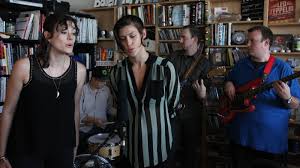
I had never heard of Dessa before.  Evidently she is a rapper, singer, poet and songwriter and is part of the Twin Cities hip-hop collective Doomtree.  As versatile as she is, Dessa faced down a string of challenges in getting to the Tiny Desk. Near the tail-end of a tour — during which thousands of dollars’ worth of her band’s gear was stolen — her voice started to give out as she battled a bad cold. (Keep an eye out for her expression of relief at the completion of “The Man I Knew” in this set.) And, of course, Dessa and her band had to come up with ways to perform three songs from Parts of Speech in such a way that the drums and guitars wouldn’t drown out the unamplified voices of herself and singer Aby Wolf.

I wouldn’t have known she was sick at all, as her voice is pretty powerful.  She raps the first song, “Fighting Fish” (I love that it references Zeno’s Arrow)  I like the grooves of the music and the simple guitar licks.   But it sounds amazing when Wolf starts singing.  Wolf has a great voice.  For the second verse, Dessa speaks more than raps—if only they could both make better use of the mic.

For the second song, “The Man I Knew,” the two sing a duet quite lovely.  And I like the way they each seem to highlight the end of each others’ lines with a harmony note.  I can’t help but think that Aby steals the how a bit.  The guitar and bass have simple but delightful riffs.  And the middle part with the counterpoint is very cool

I like the guitar sounds of “The Lamb,” and Dessa’s voice is great on this one.

Her lyrics are somewhat aggressive but really spot on: “You’ve got a way with words / you got away with murder” and “They can sew your hands together but they can’t make you pray.”

I am curious to see what her full band sounds like because this stripped down version is really good.

[READ: August 28, 2016] “Vladivostock Station”

This story opened my eyes to something I was unaware of.  The narrator’s father was a Korean refugee from the second world war. After the war his father settled in Russia and had children with a local woman.  Evidently this was quite common, although I’d never heard this before.  So the narrator is half-Korean with a Russian name.  I’s never heard of such a thing.

But that’s not the point of the story at all.  Rather, it is the story about Misha and his old friend Kostya.  They have known each other for ages.  Kostya worked at Misha’s father’s hotel for many years, but the two lost touch.  In the meantime, Misha had become an employee of the railroad –he repaired the insides of older trains. (more…)

Read Full Post »

SOUNDTRACK: ANDERSON .PAAK & THE FREE NATIONALS-Tiny Desk Concert #558 (August 15, 2016).

I had heard so many great reviews of  Anderson .Paak but I didn’t really like his album.  But I love this Tiny Desk—there’s something great about this live set.  First off, I love that he’s on the drums–and I love Paak’s drumming—all high hats and rim shots and total funk.  Especially when he starts tapping with his fingers on the snare.  And I really love the funky sound of the keys and the bass.

For this Tiny Desk, they reworked three cuts from Malibu,

Guitarist Jose Rios and bassist Kelsey Gonzalez inject a hard-rock edge into the Hi-Tek-produced “Come Down.”  He opens this by saying, “This song is appropriate since its like a sauna in here right now.”  (The opening lyrics are: Y’all niggers go t me hot.”  It is fun and funky and a great opener.  At the end, he asks the bassist: “What is that song about, Jose?  Coming down off of what?  Substances?  That’s what you into?”  “No. Naw.”  “I like water myself.”

The second song “Heart Don’t Stand A Chance” features a lot of keyboards.  It’s a slow, groovy song.  Much more soulful than funky.

“Put Me Thru” is really funky.  He says “This song is about Jose’s ex-girlfriend.  She still your ex-right?”  “Yea.”  When it ends he jokes Tiny Desk, Big Heart.

Normally bands play 3 songs, but everyone is so into the set that they get to play one more.  “What else y’all wanna play?  Should we do requests?” Someone shouts, “Suede”  And he shouts, “OH!  I though this was a more cultured, mature….  So you all like being called bitches over here?”  He cautions, “I talk a lotta shit on this song, is that okay?”  We’ve never done this song like this.  He asks Jose, “Go over the notes. You know the chords?”  “It’s only a loop—only two chords.”  They all laugh.

“Suede” is a super funky, pretty vulgar song.  But .Paak is so charming, it’s hard to criticize.  Especially at the end of the show when he says, “That actually my mom’s favorite song.”

[READ: September 5, 2016] “Let’s Go to the Videotape”

This was a fascinating story about a widow who submits a video of his child to Americas Funniest Home Videos.  His son, Gus, was riding a bike for the first  time.  As he was going along, he hit a rock and flew over his handle bars into the bushes.  His helmet pulled down over his eyes.  Nick kept filming, seeing that he wasn’t hurt.  And then Gus looked up and said “Daddy, am I okay?”

Nick sent the video to some friends and they all thought it was very funny.

The video had made it to the finals and they were in the studio watching the other finalists’ videos.  And then it was their turn.

Gus was very uncomfortable–mostly because of his clothes but also because of the attention. (more…)

Read Full Post »

harpers-magazine-march-2017-4 SOUNDTRACK: GUCCI MANE-Tiny Desk Concert #586 (December 12, 2016).

gucci

Usually when someone is popular I have heard of him or her.  So I’m always surprised when someone gets a Tiny Desk Concert and I don’t know them (especially given his story).

Gucci Mane sounds kind of familiar, but I don’t think I’d ever heard of him before.  So what does the blurb say:

Gucci Mane’s smile makes you feel like there’s still some good in the world. He’s really earned it, and that thing is infectious. We asked him to come to NPR because we wanted to be a part of the victory tour he’s been on this year: In the past six months or so, Gucci Mane was released early from the federal penitentiary; he proposed to his girlfriend on the kiss cam at a Hawks game, and she said yes; he’s releasing a total of three albums, all over which he celebrates his newly committed sobriety; he and Courtney Love look like they get along; and he remade “Jingle Bells.”

In this Tiny Desk concert, Gucci Mane performed with just his longtime producer and friend, Zaytoven, on piano. Their version of stripped-down is a minimal backing track and plenty of church-groomed trills. They performed with the understanding that everyone in the room knew their songs — one from 2009 and two from this year — and knew that this performance would represent a surreal dip into a parallel universe where ingenuity is rewarded, snobbery is gone and love is real. Gucci Mane agreed to this unlikely set as a gesture to those people — for remembering his work while he was away, and for cheering on his resurgence, his health, his charm and his singular nature.

Gucci does the three songs, “First Day Out,” “Waybach,” and “Last Time,” all accompanied by Zaytoven, easily my favorite stage name and the absolute highlight of this show for me.

Gucci Mane’s flow is a kind of slow drawl.  It’s kind of charming and engaging.  I find it really strange that he’s rapping over himself (I guess).  But it’s so stripped down that it’s weird to hear his backing track so clearly.  But that live piano totally make the show fantastic–Zaytoven has some amazing chops.

[READ: February 21, 2017] “Sinking Ships and Sea Dramas”

The introduction to this story was pretty fascinating.  This piece is an except from a manuscript in progress inspired “in part by lines from the work of Ben Lerner, the poetry editor of Harper’s

This was translated from the German by Isabel Fargo Cole.

I’m not sure what Lerner wrote that inspired this, but this “cycle” consists of 6 ruminations on death and the sea. (more…)

Read Full Post »

semonSOUNDTRACK: RUN THE JEWELS-Tiny Desk Concert #597 (February 6, 2017).

When Killer Mike and El-P walk out to the Desk, El-P drinks from a formerly unopened liquor bottle (E&J), which Bob says has been aging for 8 years.

Then as the music from DJ Trackstar begins, EL-P says “I insist that you clap your hands like this, lets see if NPR has rhythm”–and after a few claps everyone is way off, to much laughter.

The blurb says

Like any good pair of twins, Run the Jewels have a freaky sort of unspoken fraternity. When El-P (née El-Producto, née Jaime Meline) — rapper, producer, and all-around godfather of the backpacker scene of the late-90’s — and Killer Mike strode in with their usual uniforms — Mike in a gold chain as thick as a garter snake, El in a fitted Yankees cap and pair of blue-mirrored sunglasses — the two didn’t have to do as much as nod to one another before upending three tracks from their latest LP, RTJ3, in strange and perfect symbiosis.

On “Talk to Me,” I feel like Killer Mike’s flow is a little better than El-Ps at least in the beginning.  El-P also says fuck a lot, which I noticed when I first downloaded their album, as well–lots of fucks, which is kind of lazy, I think.  Or maybe I just like Mike’s lyrics better.  Like this:

Born Black, that’s dead on arrival
My job is to fight for survival
In spite of these #AllLivesMatter-ass white folk

After he says this line, they stand back to back, middle fingers raised.  El-P says “this is the pose we do in this song.”

Before “Legend Has It” El-P grabs a banana like a microphone and says it feels more natural that way (Mike then signed the banana for Bob and he had it laminated).  As the song begins, Mike says, “y’all can dance to it your boss ain’t looking.  It’s a little slower and El-P has his flow on and has some great lines:

I am the living swipe right on the mic, I’m a slut
I don’t know how to not spit like a lout
I’ll spill a pound of my kids on your couch

and

I don’t play chicken, you prick, I’m a fox
You wanna kick it, I’ll give you the rocks
You kiss the wood chipper blade if you balk
I’m fuckin’ magic, in fact I’m a warlock of talk
I got a unicorn horn for a (stop)

But the crowd is on it this time when they chant and the crowd goes “RTJ!”

As the song ends, El-P says “You know why they do these things because for that least one week you cannot complain about your jobs.”

The final song is “A Report To The Shareholders.”  Before it begins, El-P says.  “It’s oddly awesome to be here.”  Then he takes one more swig.  Mike shouts, who got the weed?

It is much slower, almost spoken. Each guy gets a verse, between them, there s little instrumental and El-P says ” we haven’t figured out to so in this part.”  My favorite line of the show comes in this song:

“ooh, Mike said ‘uterus'”
They acting like Mike said, “You a bitch”
To every writer who wrote it, misquoted it
Mike says, “You a bitch, you a bitch, you a bitch”
Add a “nigga” for the black writer that started that sewer shit

The two do indeed play off each other perfectly–echoing the last lines of each other’s words.  And despite how angry they sound i the words, they are a surprisingly genial bunch.

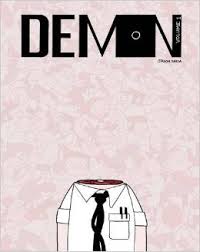
[READ: December 8, 2016] Demon Vol. 1

I’ve really enjoyed pretty much everything that Jason Shiga has created.  I love the style of his characters–seemingly very simple yet very expressive.  And I love that his stories are bizarre, complex and mind-blowing.

I’m delighted that this series is being distributed by First Second since I like just about everything they do.  Although I am a little surprised that the published it, given how icky it gets.

Shiga has drawn some books that were kid friendly, but this book IS NOT!  It is about suicide and murder and bad language and all manner of adult things.  Indeed in the forward Shiga notes, “It’s been a dream come true working on this project, pushing past the limits of common decency–of good taste–with every new page. (more…)

Read Full Post »

2010 SOUNDTRACK: ANTIBALAS-Tiny Desk Concert #243 (October 4, 2012).

antibAntibalas (Spanish for “bulletproof”) is a Brooklyn ensemble.  Eleven members turned up for the Tiny Desk.  And they are quite the ensemble.  There are trumpets, saxophones, two guitars, a bass and a ton of percussion.  There’s a percussionist/keyboardist wearing a lucha libre mask (!) and the lead singer (singing in English and some other language) has what looks like tribal paint on his face. (He also plays conga and cowbell).

The blurb states:

There just aren’t many bands like Antibalas. These are jazz players making dance music: Their music is big and fun, and their guiding spirit is Fela Kuti, the brilliant big-band leader and Nigerian Afrobeat pioneer. Afrobeat is a musical style featuring nearly endless songs, mixing funk and jazz, grooves and riffs, with the rhythm carried by not only the drums, but everyone. Everyone — horn players, bass players, guitarists — plays rhythm in Afrobeat music.

It’s one thing for a big group to make a big sound — and, sure, Antibalas does that — but what stands out is the subtlety of this ensemble; the way the horns weave in and out of each other, sometimes complementing and at other times inspiring and creating musical conversation between players. That extends to all the players, from vocals to guitar. When you start to listen to that conversation and you hear that build in a rhythm, it’s so powerful, so full of joy. If they come to your town, drop what you’re doing and go see them. Wear dancing shoes.

They play two songs, but they are long and full of rhythm.  “Dirty Money” runs just under 6 minutes. I really like the way the horns seems to echo and answer each other during the slow sections.  While the whole band sings the backing voices.  And when the masked guy switches from percussion to keyboards, it’s got a  groovy 70s sound coming out of that machine.   All of it is anchored by the bass, keeping a steady rhythm.  One of the trumpeters switches to trombone for a solo as well.

“Him Belly Go No Sweet” has an even funkier feel–lots of percussion and staccato horns slowly working with each other to create a big sound.  Even though there’s plenty if music in this song it’s impressive how much they use silences—things are never quiet (there’s always a bass line or percussion) but for such a big outfit they can really get things to quiet own.  The end half of the song sees the band singing “go up  go down” while the lead singer seems to improvise a whole bunch of stuff.

It is, indeed, hard not to dance to this.

[READ: July 10, 2016] “Baptizing the Gun”

This was a very dark story and, if nothing else, it made me never want to go to Lagos, Nigeria.

The story is told in first person by a priest.  He is not wearing his collar and is driving a borrowed VW Beetle through the traffic of Lagos.

As the story opens, a woman is screaming because a thief just pulled an earring out of her ear–tearing her earlobe. He is caught and, astonishingly, “ringed with tires, doused in petrol, and set ablaze.”  Even though there is barely any fuel to be had “there’s always enough for the thief.”

The priest believes his trip was a success and many parishes have promised his parish in the Niger Delta money and materials.

But on his way back (at 18:03) the car dies in traffic. (more…)

Read Full Post »

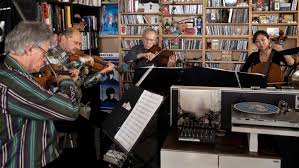
 socks kronosSOUNDTRACK: KRONOS QUARTET-Tiny Desk Concert #322 (November 25, 2013).

2013 was the 40th anniversary of Kronos Quartet.  I first heard of them about eight years after they started with their cool arrangement of “Purple Haze.”  And then I learned that they were like a sponge, soaking up and playing music from all over the world: In just one year they released albums with tango, songs by South African composers, Polish composers, jazz musicians and so much more.

I have many of their releases, although I realized I more or less stopped listening to new stuff from them around the turn of the century (since when they have released some 16 albums!).

Well, amazingly, the Quartet is still the same original players (except for the cellist–the cello is like Kronos’ drummer as they seem to replace her every couple of years).

They play three pieces here and the three range the gamut from dark and broody to rather sweet to quirky.  In other words, typical Kronos.

For more info:

The musicians —  David Harrington (violin) and longtime members John Sherba (violin) and Hank Dutt (viola) and new (as of 2013) cellist Sunny Yang — could reminisce over more than 800 new works and arrangements they’ve commissioned in 40 years. But instead, the new-music train pushes ever onward to new territories. They remain a living, breathing world-heritage site for music.

Now in the midst of its 40th-anniversary tour, Kronos brings to this Tiny Desk Concert a new arrangement, a work from a new album and, for Kronos, something of a chestnut, a piece the group recorded a whopping five years ago.

“”Aheym” (Yiddish for “homeward”) was written for Kronos by Bryce Dessner; a member of the Brooklyn rock band The National, he studied composition at Yale. The music thrives on nervous energy, pulsating with strumming and spiccato (bouncing the bow on strings) while building to a tremendous fever.”

I love this piece. It is intense and dramatic with its 4-3-3 bowing from all four members.  There’s an interesting cello melody with pizzicato strings from the rest.  The overall melody seems somewhat circular with different instruments taking on different leads.  But this song also plays with some interesting bowing techniques.  In addition to the spiccato (about 4 minutes in), the players drag the bow for momentary scraping and scratching sounds.

Another wonderfully dramatic moment comes at 7 minutes where each musician takes a turn bowing his or her note while the violin plays a super fast series of notes.  The song builds and build in dramatic until it gets to about nine and  half minutes and it reaches its powerful ending.

“Lullaby,” opens with plucked cello notes and strummed viola.  “It is a traditional song with Afro-Persian roots (from the group’s Eastern-flavored 2009 album Floodplain), [and] is woven from different cloth altogether. Colorful tones that lay between our Western pitches are threaded through the music, anchored by a gorgeous solo from violist Dutt; his contribution takes on the warm and weathered sound of a grandmother singing to a child.”  It is slow and moody and beautiful.

Harrington introduces the final piece by saying it’s by a performer that no one had heard of–including, until recently, even himself.

“Kronos caps off the concert with another hairpin turn, this time to a fresh arrangement of “Last Kind Words,” a little-known blues song from around 1930, recorded by singer and guitarist Geeshie Wiley. In Jacob Garchik’s exuberant arrangement (which Kronos premiered this fall), interlocking strums and plucks provide a kind of rhythm section, while Harrington’s violin stands in for the now-forgotten blues singer.”

There’s lots of plucked notes from everyone–including plucked bent note on the viola which gives it a real “early” guitar sound.  While I don’t know what Geeshie sounded like, so I can’t compare the violin to her vocal, the whole thing sounds great together.  In fact the whole thing is unlike any string quartet I’ve heard–so different and wonderful.

I’m going to have to bust out so Kronos CDs.

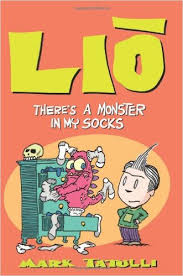
[READ: September 10, 2016] There’s a Monster in My Socks

I’ve been quite puzzled about the publication history of the Liō books.  And this just adds another layer of confusion.  This book covers the exact same time period as Happiness is a Squishy Cephalopod which was published in 2007.  The difference is that Cephalopod placed all of the strips in order, while this one seems to move things around quite a bit (the thinner format also means that it can’t quite handle the single panel strips very well.   But more egregious is that this volume (remember, the one printed after the previous one) prints the Sunday color strips in black and white.

The book also leaves some of the strips out.  It covers the date range from May 15, 2006 – Feb 16, 2007 (Cephaolopod went to May 23), but while it has the Feb 14 strip, it does not have the Feb 15 strip.  Weird.

So, basically this is an inferior version of the same book, but the publishers presumably wanted the books in this more friendly size (or some other nefarious reason).

I’ll include the review of Cephalopod below.

And, here’s the current list of existing Liō books. It’s a shame that there are years and years of strips thus far uncollected. (more…)

Read Full Post »

sahrakSOUNDTRACK: NO BS! BRASS BAND-Tiny Desk Concert #280 (June 15, 2013).

nobsWith a name like No BS! Brass Band, you think you know what you’re getting: brass and lots of it.  And while that is true, the Band goes way beyond what I anticipated a brass band would sound like (nothing like the far more traditional Canadian Brass for instance).

The blurb states:

Funky and danceable, the NO BS! Brass Band takes after the full black-music continuum you hear in groups like Rebirth or the Hot 8. But it’s also proggy, and a bit brutalizing, and full of pride in a different Southern outpost. The group’s new album is called RVA All Day, after all.  [I don’t know what that last line refers to].

Recently, Koehler, Pace and nine other musicians piled into a bus and journeyed up the freeway to NPR Music’s Tiny Desk in Washington, D.C. They blasted us with songs from the new album — it was so loud, you could hear the music on the other side of the building, a floor down.

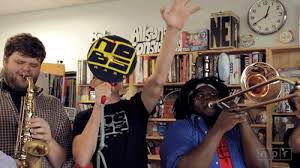
The band includes:  Lance Koehler, drums ; Reggie Pace, trombone ; Bryan Hooten, trombone/vocals ; John Hulley, trombone ; Dillard Watt, bass trombone ; David Hood, alto saxophone ; Marcus Tenney, trumpet ; Sam Koff, trumpet ; Ben Court, trumpet ; Taylor Barnett, trumpet and Stefan Demetriadis, tuba.  And they play three super high energy largely instrumental songs that are obviously jazzy but which also have elements of the most fun marching band you’ve ever heard along with some rapping, some chanting and lots and lots of clapping.

The first song is all about “RVA All Day.”  And yet since that’s all they chant, I still don’t know what it means.   While the whole band plays loudly and powerfully, there’s a few solo moments as well.  First a trombone solo followed by a sax solo, then a trumpet and a super wild trombone solo (he gets some truly great, crazy sounds from that thing).  And then a huge surprise, midway through the song is a rap through a megaphone.

“Run Around” has a sing along to begin the song (and again, vocals through the megaphone).  It is also lively and a lot of fun.  The final song, “Infamous”sounds a lot more jazzy/big band.  It’s got a really nice groove.  The middle has a section with just tuba and trumpet where the rest of the band claps and shouts “Ho!” and it sounds great.  It’s also interesting watching how the different players “store” their instruments in different ways while clapping.

No BS! Brass band will totally make you wiggle your hips.

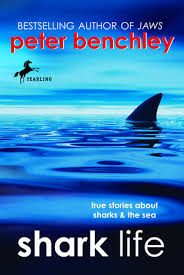
[READ: August 20, 2016] Shark Life

C. had to pick a book for summer reading and he chose this one.  He enjoyed it so much, that he encouraged me to read it too.  And I’m really glad I did.  Although it wasn’t until writing this that I realized that this book was adapted for young people by Karen Wojtyla.  And yet I can’t find any mention of a grown up version of this book anywhere.  So who knows.

Anyhow,  Peter Benchley (who died in 2006) is the author of Jaws, and this book is full of stories of his life in and on the sea.  For, in addition to being an author, Benchley was a diver and explorer.  And his tales are both exciting and full of conservationist ideas.

The book opens in 1974. After the success of Jaws, Benchley had been invited to Australia to be on The American Sportsman.  He was going to be swimming in a cage with sharks feeding around him.  They put him in the cage, strapped all kinds of good food to it and left him there (okay they were close by).  But a few things went awry and suddenly things weren’t quite as safe as they could be. The shark got caught in Benchley’s air line and then panicked.  And a panicking shark is never a good thing. (more…)

Read Full Post »

wildrobot efterklangSOUNDTRACK: EFTERKLANG-Tiny Desk Concert #270 (April 8, 2013).

Efterklang is a Danish group whose recent album Piramida took its members to an abandoned mining town between the North Pole and Norway. There, they recorded sounds of empty oil tanks, old pianos and pretty much anything they could strike or record.

That blurb made me think this would be a noisy chaotic Concert.  And yet despite the found sounds, their music is really peaceful and lovely.

“Dreams Today” builds on a series of echoing keys and guitar notes.  After nearly two minutes the singer sings a series of high “ahhs and oohs” until the vocals officially kick in.  And then the whole band starts playing a series of fast looping notes while the percussionist plays some water bottles and mugs.  The songs builds and builds, with a steady bass keeping the melody strong and then just as it seems it should turn the corner into a new section, it abruptly ends, leaving you wanting much more.

Before the second song, “Danish Design” they explain that they “never went public” with this song. They played it once before in a huge power plant in Copenhagen.  It was a big room–very reverby (if you can say that).  The office is a very different place and they want to compare how it sounds.   They also sampled the worlds northernmost grand piano for this song.  They were in Piramida, a ghost town in the arctic.  The song begins with slow notes from the sampled piano while the keys play pinked notes. The singer sings in a baritone that is quite lovely.  When the loud drums kick in it’s quite a shock to the mellow music.  The song is only a bout 2 and a half minutes and, once again, it ends just as it seems like it might soar into something new.

“Alike” is from their previous album.  It opens with keys and percussion (all kinds of things like a fork on a mug).  They sing in harmony for much of the song.  It doesn’t use much in the way of guitar or bass (the bassist is keeping time with a pair of scissors and then a beer bottle on a step stool) until the end of the song when the guitar chords kick in fast (but not too loud).  It’s the longest song but the way it builds slowly it feels like it could go on for much longer.

This Tiny Desk really made me want to learn more about this interesting group and to hear more from them.

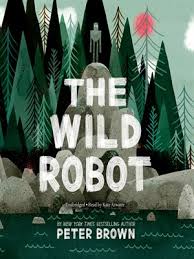
[READ: April 20, 2016] The Wild Robot

I love Peter Brown’s picture books.  I think Chowder is absolutely genius and The Secret Garden brings me to tears each time I read it.  So I was pretty excited to read this novel–his first.

It’s quite a fast read (with about 70 chapters all about 3 pages long) and lots of pictures.  The blurb on the book said that a robot woke up on a remote island. She has to learn to survive from the animals. And once she starts to feel comfortable, her past comes back to haunt her.

And that is a fair summary of the book.  The plot is very simple, but Brown adds a lot of details and a lot of characters to make the plot interesting. (more…)

Read Full Post »

cardboardSOUNDTRACK: MARY HALVORSON QUINTET-Tiny Desk Concert #267 (February 25, 2013).

maryI had never heard of Mary Halvorson before.  And that makes sense because she is an avant-garde free-jazz guitarist, a sound I like (sometimes) but one which I do not follow.  So a little background is in order:

As a sidewoman, [Mary Halvorson] is often tapped to play in open improvising situations….  Among her sonic signatures are craggy distortions, bent strings and delay-pedaled blurts through a hollow-body guitar….  Halvorson has now recorded two albums with her quintet, one with alto saxophone (Jon Irabagon) and trumpet (Jonathan Finlayson) up top. (The rhythm section is also among New York’s finest, with John Hebert on bass and Ches Smith on drums.) From the way her songs balance order and entropy, you can hear that she’s studied how golden-era hard bop blended those voices, and how later generations morphed, rephrased and imploded those ideas.

The Quintet plays two pieces.  I would have guessed they were improvised but not only do they have titles, they have sheet music!

“Love In Eight Colors” (No. 21) starts out as a slightly dissonant mellow jazz piece.  Then about 45 seconds in, Mary throws in an unusual guitar lick—a slightly weird note.  And then a minute later things get noisy until a simple trumpet solo takes over.  When the music resumes, Mary is playing some strangely discordant chords over the solo—everyone seems to be doing their own thing.  Around 4 minutes in, it turns into something new with an interesting, mesmerizing guitar solo riff.  When the band resumes, the sax takes over and the trumpeter literally stands stock still like a statue staring forward–it’s almost creepy.  At 8 minutes, they introduce a two-minute drum solo.  It’s fun to watch all the strange things he does—elbow on the drum head, vibrato with his hands changing the sound, clicking the sides of his drum.  Then the band resumes until the end.  And it’s more dissonance.

She introduces “Hemorrhaging Smiles” (No. 25) without smiling.  There’s a lot more melody in this song–the sax and trumpet sound groovy.  Even the guitar is pretty. Then she throws in a bizarre scale which cycles throughout the song.  It’s strangely addicting and I enjoyed hearing it every time it came back–even though it wasn’t exactly pretty.  The guitar has a lot of vibrato on it, although about six minutes in she switches the sound of her guitar to a bit more conventional sound and she plays a wicked solo. The second listen through made me appreciate what was happening a lot more.  Even if the song is pretty out there.

Mary Halvorson’ Quintet is not for everyone.  It might not be for many at all, but if you like your jazz free, check her out.

[READ: June 19, 2016] Cardboard

I’ve had mixed feelings about TenNapel’s books.  I loved Ghostopolis, and didn’t love Tommysaurus Rex.  So I picked this up with some hesitation.

But I found that I really enjoyed this weird book a lot.

For a kids’ graphic novel it’s actually quite long.  And, for a kid’s graphic novels there’s a few adult themes (like unemployment and widowhood) that a kid may not get or care about all that much (or maybe they would, what do I know).

As the book opens we see Mike, a big burly carpenter, begging for work.  But he gets nothing.  And as he walks away we see a very strange-looking man (TenNapel’s book are chock full of weird-looking characters) who offers to sell him a gift for his son.  Mike has no money, so he can’t buy the cool gift.  But the man says that for 78 cents (the exact amount in his pocket) he can have this giant cardboard box.

Mike is appalled at the idea of getting his son a box (even if it can be a creative play toy–ha!), but he’s got nothing else.  So he drives home with this box muttering “worst present ever.” (more…)

Read Full Post »

manner SOUNDTRACK: BEN GIBBARD-Tiny Desk Concert #251 (November 19, 2012).

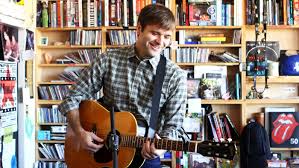
benBen Gibbard is the voice of Death Cab for Cutie.  His voice is instantly recognizable and his melodies are surprisingly catchy.

This Tiny Desk Concert (they say it’s number 250, but I count 251) is just him and his acoustic guitar.  I didn’t know he did solo work, but apparently he does (in addition to being in The Postal Service and All-Time Quarterback).

Gibbard just released a solo album, Former Lives, which he’s said is a repository for material that didn’t work as Death Cab for Cutie songs; from that record, only “Teardrop Windows” pops up in his Tiny Desk Concert. For the rest, he draws from Death Cab’s most recent album (“St. Peter’s Cathedral,” from Codes and Keys) and, of all places, last year’s Arthur soundtrack (“When the Sun Goes Down on Your Street”).

As mentioned he plays three songs and his voice is so warm and familiar I felt like I knew these songs even if I didn’t.

I knew “St. Peter’s Cathedral.” It is a lovely song with very little in the way of chord changes.  But the melody is gentle and pretty.  And the song appears to be entirely about this church.  Which is interesting because the second song is also about a building in Seattle.  “Teardrop Windows” is a surprisingly sad song about an inanimate object.  It’s written from the building’s point of view as he mourns that no one uses him anymore.  And such beautiful lyrics too:

Once built in boast as the tallest on the coast he was once the city’s only toast / In old postcards was positioned as the star, he was looked up to with fond regard / But in 1962 the Needle made its big debut and everybody forgot what it outgrew

The final song “When the Sun Goes Down on Your Street” was indeed for the Russel Brand movie Arthur.  Somehow I can’t picture those two together.  It’s a lovely song, too.

I prefer Gibbard’s more upbeat and fleshed out music, but it’s great to hear him stripped down as well.

[READ: January 2017] “My Writing Education: A Time Line,” “The Bravery of E.L. Doctorow,” “Remembering Updike,” and “Offloading for Mrs. Schwartz” 

I had been planning to have my entire month of February dedicated to children’s books.  I have a whole bunch that I read last year and never had an opportunity to post them.  So I thought why not make February all about children’s books.  But there is just too much bullshit going on in our country right now–so much hatred and ugliness–that I felt like I had to get this post full of good vibes out there before I fall completely into bad feelings myself. It;s important to show that adults can be kind and loving, despite what our leaders demonstrate.  Fortunately most children’s books are all about that too, so the them holds for February.

George Saunders is a wonderful writer, but he is also a very kind human being.  Despite his oftentimes funny, sarcastic humor, he is a great humanitarian and is always very generous with praise where it is warranted.

The other day I mentioned an interview with Saunders at the New York Times.  Amid a lot of talk with and about Saunders, there is this gem:

Junot Díaz described the Saunders’s effect to me this way: “There’s no one who has a better eye for the absurd and dehumanizing parameters of our current culture of capital. But then the other side is how the cool rigor of his fiction is counterbalanced by this enormous compassion. Just how capacious his moral vision is sometimes gets lost, because few people cut as hard or deep as Saunders does.”

These first three pieces are all examples of his love and respect for other writers–both for their skill and for their generosity.

“My Writing Education: A Time Line”

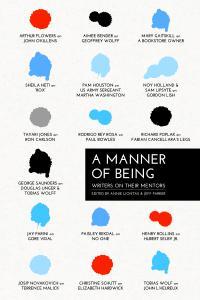
“My Writing Education” comes from a book called A Manner of Being: Writers on Their Mentors.  Saunders’ mentor was Tobias Wolff.  And for this essay, his admiration takes the form of a diary.  (more…)

Read Full Post »

« Newer Posts - Older Posts »