Feeds:
Posts
Comments

Archive for the ‘Culture Shock’ Category

hpl;oveSOUNDTRACK: PINKISH BLACK-“Razed to the Ground” (2013).

pinkishblackAfter playing No Age, Lars Gottrich came in to show what real heaviness is with a new song from Pinkish Black.  Unlike most of Lars’ songs, this was neither death- nor speed- metal.  Rather it has a very 80s goth sound.  But it’s more Birthday Party than Sisters of Mercy.

There’s no guitars, just loud drums (with a lot of cymbals), a pulsing bass keyboard riff and some spacey high keyboard notes thrown along the top of the song.  There are elements that I liked about the story.  However, the synths in the solo give it a very cheesy horror movie feel and I have to admit that although I like a lot of bands from the era, this feels like a pale imitation.

[READ: June 20, 2013] “The Call of Cthulhu” and “The Whisperer in Darkness”

Both of these stories appeared in Michel Houellebecq’s H.P. Lovecraft book, but I wanted to treat them separately for ease of searching and discovery.

After my long history with Lovecraft and after reading Houellebecq’s book, I anticipated being blown away by these stories.  And so, with my expectations so high, I was naturally disappointed.  I was especially disappointed with how normal these stories seemed.  Houellebecq made me think the stories were practically non-narrative in form—that they eschewed all manner of conventional storytelling.  That his writing was so weird that no one would publish it.  But in these two stories everything seems completely normal.  Psychologically these stories are different, but aside from content, they are fairly conventional stories.

Maybe they aren’t mind blowing because they were written nearly 100 years ago and the entire world has changed drastically since then.  It may also be because I have read all of the derivatives of Lovecraft enough that there’s nothing new in his work.  And it may also be that in the past 80 years, we have thought of things that are much scarier than these, in part because of Lovecraft himself.  Or maybe I would have been into them a lot more had I read them when I was a teenager.

“The Call of Cthulhu.” (more…)

Read Full Post »

hpl;oveSOUNDTRACK: NO AGE-“No Ground” (2013).

An ObjectI’ve been hearing a lot about No Age lately, but I don’t really know much about them.  I keep thinking they are a different, older band (although I can’t think of which one for some reason).  Anyhow, this new song from their new album is a simple, propulsive rocker.  It starts out with some echoing guitar notes until the fast, fast bass comes in.

It’s followed by some quickly strummed guitars and low sung, almost chanted vocals.

The song feels like it builds speed throughout, although I don’t think it actually does.  I didn’t realize that there were only two guys in the band—and that explains their limited musical sound.  But unlike a number of other two person bands that I’ve really enjoyed as of late, this song feels a little flat.  There is some appeal to it, but overall I want a little bit more.

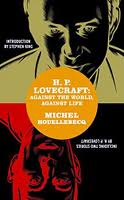
[READ: June 16, 2013] H.P. Lovecraft: Against the World, Against Life

I have been “into” H.P. Lovecraft for about thirty years.  Interestingly, I had never read anything by him in that time.  I got into him via Dungeons and Dragons which had a whole selection of monsters from the Cthulhu mythos.  And then Metallica did a song called “The Call of Cthulhu” and even though I bought several of his paperback collections and proudly displayed them, I never read them.  When McSweeney’s imprint Believer Books published this little title by the practically Lovecraftianly named Michel Houellebecq, I was excited to read it, too (because at this time I had assumed that I had actually read some Lovecraft).  But like my Lovecraft books, it languished on the shelf.

Until now.

I decided that it was time to finish off some of those McSweeney’s books that have been sitting on my shelf for years.  And this was on the top of my list. (more…)

Read Full Post »

220px-The_Invention_of_Morel_1940_Dust_JacketSOUNDTRACK: RODRIGUEZ-“Sugar Man” (1971).

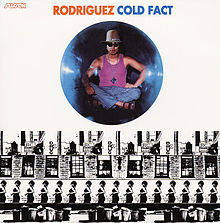
RodriguezcoldfactThis song was played a lot on WXPN, and when I first heard it I couldn’t imagine what new artist was talking about “sweet Mary Jane.”  So it turned out that this song was over 40 years old but it had been resurrected for a movie called Searching for Sugar Man, which is a documentary about Sixto Rodriguez and how he released two albums and then disappeared.

There’s something extremely catchy about this song–the loud down strums that stand out over the quieter strumming, the crazy high frequency sound that sails throughout the song and that hint of horns that gives more depth to this simple folk song.   All of these elements make this song more complex than it might have been.  In fact, the song seems like it’s going to end after about two minutes but there’s the instrumental section full of crazy sounds and electronics.

And even though it seems over after that there’s one more verse and chorus to go.  And then the song just drifts away echoing into nothingness.  It’s quite a catchy little number.

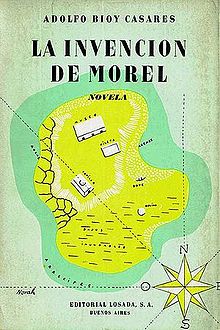
[READ: June 4, 2013] The Invention of Morel and Other Stories

Roberto Bolaño recommended this main story (the other ones as well, I assume).  He’s a big fan of Bioy Casaraes.  But also, Jorge Luis Borges has a prologue to the story in which he states of “The Invention of Morel”

“I have discussed with the author the details of his plot.  I have reread it.  To classify it as perfect is neither an imprecision nor a hyperbole.”

Holy crap.

I can’t say exactly that it I perfect although it is quite fine.  It deals with all kinds of interesting issues and is inspired by (maybe that’s not exactly the right word) The Island of Dr Moreau.  The funny thing is that Morel is neither the main character, nor even a major character for half the book.

The story starts on an island with the narrator writing this book down to leave a  record of “the adverse miracle.”   We learn that the narrator is a fugitive and he was told by an Italian rug seller in Calcutta that the only possible place for a fugitive like him is an uninhabited island.  And on this particular island in 1924 a group of white men built a museum, a chapel and a swimming pool.  But no one dares to go there—not Chinese pirates, not even the Rockefeller Institute because there is a fatal disease located on the island—anyone who has visited there has been found later dessicated. (more…)

Read Full Post »

CV1_TNY_05_06_13Schossow.inddSOUNDTRACK: BOY-“Little Numbers” (Live at The Current, April 6, 2013) (2013).

boyI am totally hooked by this single–a song which sounds like the next huge Feist hit.  It’s got a great piano melody that just grabs on and won’t let go.

So how does the song hold up on acoustic guitars?  In a recent interview the two Swiss/German band members, Valeska Steiner and Sonja Glass, say that the song was originally written in this slower more acoustic vein.  On first listen this version is not very appealing–there’s something so bubbly and bouncy and joyous about the single version.

The immediacy of the song is gone and the “woah-o” section seems more mournful than joyous.  I suppose it is actually more true to the original intent of the song (I read your name on every wall, is there  cure for me at all).  Although this version features Boy’s beautiful harmonies, especially the concluding moments, I still prefer the more upbeat single version.

[READ: May 21, 2013] “The Gray Goose”

When this story started, I was a little concerned that it was going to be another story about a repressed childhood under the thumb of an oppressive Jewish mother.  It begins by telling us that Miraim’s father left in 1948, when she was little.  One of the only presents she had been given was an album by Burl Ives.  And that album could be played on her family’s hi-fi/radio housed in a rosewood cabinet—“the most fantastical item of furniture in their lives.” Her father hated that they gave into consumerism to buy such a thing, but it was revered.  And all vinyl was held very delicately, as if a breath of air might warp it.

“The Gray Goose” was her favorite song and she listened to it often, trying to scrutinize the songs—just what was this gray goose that could not be killed, Lord, Lord, Lord.  (The traditional meaning of the gray goose that could not be killed appears to have something to do that with the hunter went hunting on the Sabbath, so the goose could not be killed). Although in the story, Miriam’s mother, Rose, says that the goose represents the heart of the working class.  For Rose and her husband, Albert were fiercely Communist.  We learn about Rose and Albert’s marriage—they were passionate about their beliefs, and this passion seemed to transmit to each other.  And then Rose got pregnant, so they married.  And then Rose had a miscarriage, but now they were stuck with each other so they decided to have a child—Miriam.  (His parents didn’t approve of any of it, especially Rose).

Then Albert was offered a job back in Germany—the only Jew to return to Germany so soon, and Rose and Miriam were on their own.  Well, Miriam was on her own, Rose had many many suitors, although none could stay the night.

That’s all back story for the evening of the action—the evening that Miriam and some friends have gone to Greenwich Village to a jazz club.  Miriam is precocious, having finished school a year early and started college (and apparently already dropped out).  She is out with some friends, the wonderfully named Rye Gogan, the horn-rimmed glasses-wearing Porter, assorted girlfriends and Miriam’s boyfriend who is referred to hilariously as Forgettable.  As in “of course Forgettable weighed in with, ‘What?’” (more…)

Read Full Post »

sign4SOUNDTRACK: GOAT-“Run to Your Mama” (2012).

goatI was intrigued to hear this song by Goat (whom I don’t know) because of the picture below.  Now that is a band photo!

Goat are a Swedish band and, like a bunch of Swedish bands recently, their guitar sound is very retro–a big open clean guitar sound.  But the riffs that they play are also very retro, this song sounds incredibly 70s–classic rock/heavy metal 70s.

The lead singer is the female of the trio, and she has a great raspy voice (and I assume she does the backing vocals as well).

The song feels like it could be an epic workout (especially when the solo kicks in and it is lengthy and, apparently, on a xylophone).  But right after the solo (at just under 2 and a half minutes), the song just ends.  It’s fantastic and I’m looking forward to hearing more from the album.

Goat

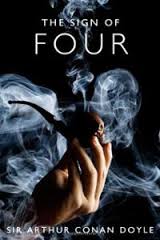
[READ: May 12, 2013] The Sign of (the) Four

I recently found out that the Sherlock Holmes book that I was supposed to have read in high school (from a reading list that I know I read at least some of) was actually not by Sir Arthur Conan Doyle.  Rather The Seven Per Cent Solution was a relatively recent (1974) book by Nicholas Meyer.  The only thing I remember from the book was learning that Holmes was an addict (and passing that news along to my mother with a tone of “see people have always been bad”).

Anyhow, in The Sign of (the) Four, the book opens with Holmes shooting up a seven per cent solution of cocaine.  The reason being that the cocaine kept his brain active when he had nothing else to do.  Holmes is bored, just waiting for something new to come along.  But Doyle doesn’t keep us waiting long.  A young woman, Mary Morstan, calls on Holmes for help with a case.  Or actually more like a series of interesting puzzles.  The first is the disappearance of her father, Captain Arthur Morstan in December 1878.  He came home from the war and then disappeared.  Holmes asks if he could be hiding, but she says no, he was very excited to come home and see her.  Since he has been gone, she has been employed as a governess and the family she assists have more or less taken her in as a member of the family.

The second puzzle is that she has received in the mail one very expensive pearl a year since 1872.  It always comes on the same date and the sender has remained anonymous.  This all started when she answered an anonymous newspaper ad that asked about her.  With the last pearl she received a letter that said she has been wronged and the sender asks to meet her.  He also says that she shouldn’t come alone.  So she asks Holmes and, by extension, Watson to accompany her.

Through a series of vehicles, they meet Thaddeus Sholto, a friend of Captain Morstan, who confirms that the Captain died in 1882.  Sholto’s father and Captain Morgan were in the war together.  Six years ago they had a fight over a treasure.  During their argument, the Captain suffered a heart attack and died.  Sholto’s father totally freaked out and hid both the body and the treasure.  Some time later, in declining health, his father confessed his sins, but on the night he died, he saw a man out the window who later broke into the house and left a note that said The Sign of Four (incidentally, the title of the book is variously The Sign of The Four and The Sign of Four; Doyle himself had written it both ways).  Thaddeus and his brother Bartholomew take over the treasure.  Well, Bartholomew takes it over and allows Thaddeus to send Mary the annual pearl as a payment for what happened to her father.

On the night that the story takes place, they travel to Bartholomew’s because he is in declining health.  But when they arrive, they find him dead–from a poisoned dart.  And the treasure is missing. (more…)

Read Full Post »

wim SOUNDTRACK: GIRAFFES? GIRAFFES!-“Fucking Ants Man! Where They Coming From? (Let’s Hang The Carroll Footnoteitsists)” (2005).

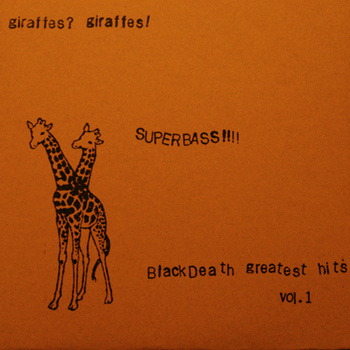
girafI just learned that there is a band named Giraffes? Giraffes!, which is the name of a silly book published by McSweeney’s.  I was so delighted to find out about this band, that I immediately went to their band camp site, where I was further delighted to find out that they are an instrumental post-rock kind of band with some great tunes.  And, of course, when your songs are instrumental, you get to make up the best titles.  Like this one.

There’s only two guys in the band which must mean overdubs (I hope so, otherwise they defy physics).  This song starts out with a riff in what I think is 5/4 time which discombobulates for a while until it becomes a wild guitar riff (and the drums come more to the fore).  While that speedy riff is going on, another more pleasant solo plays over the top.  Then the song plays some really fast drums with chords that sound like mid 70s Who, which is followed by another pretty guitar solo.  The end resorts back to some mild chaos and fun until it ends very prettily.

If you like post rock, give Giraffes? Giraffes! a try.

This song comes from their debut album, Superbass!!!! (Black Death Greatest Hits Vol. 1).  Which you can hear here.

[READ May 5, 2013] Places, Strange and Quiet

This is a book of photographs by Wim Wenders, filmmaker extraordinaire.  What I fouond very interesting about this book is that it is not a book of art (as far as I define it).  It is rather a book of documentation.  These pictures are not beautiful, they are not artistically arranged, they are not profound.  Rather, it is the combination of picture and text that really makes the story.  In some ways this becomes a book of stills from a never-to-be-made film.  And as such, it’s very cool.

The first one is a picture of a family in front of a dinosaur (which looks like it is from the 1970s—huh turns out to be 1983).  It is under-lit and not very impressive.  Until you read the sidebar: “A picture is defined twice.  When you see the whole at first glance: “A dinosaur!  A family!” And then when you find a detail that changes everything…Mom reading in the backseat.  He’s absolutely right.

I loved “Sun Bather” with a crazy scene of polka dotted sun benches in Palermo.  Wender’s text: “Nothing exists without its opposite…But what could the opposite of this be?”  To me the most profound pictures are the series Ferris Wheel from two different angles. His comment “Sometimes only the reverse angle tells the truth” is really powerful, because from one angle the Ferris Wheel shows one scene and yet from the other the background is entirely different.

I loved the wall with sink and the Armenian alphabet—although the Armenian cemetery was even more impressive.  And the gorgeous gorgeous (this one is art) pictures of the islands off of Japan is simply beautiful. (more…)

Read Full Post »

#20SOUNDTRACK: SUGAR-File Under: Easy Listening (1994).

fuelI  always thought File Under: Easy Listening was a very funny title.  But it’s possible that people took it too literally as it didn’t sell all that well. And in Mould’s autobiography he says he didn’t have much time to write songs for this disc and he thinks it suffered.  Of the three Sugar discs, this is definitely the weakest, although there are some great moments on it.

The disc opens with “Gift” which has some ragged distorted guitars. It’s got some noises and grungy sounding solos showing that FU:EL was a joke.  Although, the overall sound is kind of a cleaner version of the angry songs on Beaster.  “Company Book” is kind of a pounder, until the voice comes in and you realize…it’s not Mould!  It’s got a catchy chorus, but after the kind of underwhelming opener, it’s a strange place for a song that’s also not so dynamic.  Especially when it’s followed by “Your Favorite Thing” another great pop song from Mould—not top tier but a really strong second tier (although that bright, simple guitar solo is a real winner).  “What You Want It To Be” is a another decent song (the addition of that extra guitar playing the melody line really makes the song shine.  “Gee Angel” is also a high point.  A catchy song, but which never quite reaches the heights of the previous albums.

“Panama City Hotel” has the same feel as the opening of Beaster: bright acoustic guitars and a similar riff.  But it never really goes anywhere, and the 4 minutes seem.  The “do do do do’s” that open “Can’t Help You Anymore” are certainly the brightest spot on the album, and a big pop song as well.  “Granny Cool” has a nicely abrasive riff although it seems kind of mean spirited.  It’s funny that he tucked “Believe What You’re Saying” at the end of the album.  It’s a minor song but it sounds so bright on this album after the other songs. It’s really quite pretty.

And the closer, “Explode and Make Up” is one of Mould’s great angry songs.  Unlike Beaster, this one has a happy acoustic field—bnright guitars with that raging distorted guitar underneath.  It’s a great slow burner of a song and at five minutes it ends a somewhat lackluster album in a great way.

[READ: March 31, 2013] McSweeney’s #20

McSweeney’s #20 is an issue that I have read before.  At least I think I have.  My recollection is that it was the last one I read before I started writing about them on this blog.  I was hesitant to read it soon again, which is why I waited until now.  And while I remember the issue itself (with all of the art), I didn’t remember the stories.  So who knows if I actually read it six years ago.

Anyhow, this issue comes jam-packed with art.  Every fourth page has full-color artwork on it–many of them are quite famous.  It makes for a very beautiful book.

In between these artworks are a number of stories–ranging in size from 2 pages to 30-some pages.  There are no letters, and the explanatory and copyright information is on the cover of the book–which would be fine, except that it is covered up by a kind of 3-D artwork.  I wonder if the whole text is available anywhere?

The book also comes with a separate pamphlet–an excerpt from Chris Adrian’s Children’s Hospital.  I intend to read the novel eventually so I didn’t read the excerpt–although maybe if I put off the novel for six years I should just read the excerpt now. (more…)

Read Full Post »

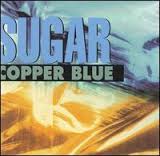
#15SOUNDTRACK: SUGAR-Copper Blue (1992).

copperblueAfter Bob Mould made some solo albums, he created another band.  Another trio, this one called Sugar.  Sugar seems to take Mould’s poppiest elements and wrap them in a big 90s grunge sound–a sound that Mould pretty much invented in Hüsker Dü.  And in many ways Sugar is not all that different from Hüsker Dü–maybe a bit less experimental and a little more commercial.

One thing I noticed about this album that, once I noticed it I couldn’t avoid it, was that when the drummer plays the cymbal (it might even be a hi hat with a tambourine on it), which he plays a lot, the tinny shimmer of that sound is so pervasive, I find it rather distracting.  Or should I say it adds an almost minute level of static over the proceedings.

The disc opens with “The Act We Act,” where big grungy guitars and a simple chugga chugga riff burst out of the speakers. I love the Pixies feeling of “A Good Idea” both that up front bass and the buggy sounding guitars provide an almost false introduction to the catchy verse and chorus that’s to come.  I also enjoy the unexpected break after the chorus.

It’s followed by the ringing guitars that introduce “Changes” a classic poppy rock song that is unmistakably Mould.  The uneasy almost nauseating sounds at the end of the song are again like a feint in the wrong direction as “Helpless” easily the most pop song Mould has ever written comes out.  Of course, as with Mould, this outrageously poppy song is all about feeling helpless.

Keyboards open the next song, “Hoover Dam” (something of a surprise for this album), which proves to be yet another big Mould single.  The song is so open with multiple acoustic guitars (and that cool synth solo) and a really wild reverse guitar solo.  It’s one of my favorite Mould  songs and yet another example of why this album was such a huge hit.

“The Slim” brings back the darker songs that Mould is also known for.  And just when you think that Mould can’t pull out another huge big single, he gives us “If I Can’t Change Your Mind,” one of his great big bouncy acoustic guitar songs.  It is almost obscene how catchy this song is, right down to the simple scale solo at the end.  Mould has this little technique that I find irresistible where he plays a song normally and then plays two fast chord changes segueing into another section.  It’s so cool.

“Fortune Teller” is a fast rocker with Mould’s trebly guitar taking the lead.  “Slick” is the only song I’m not crazy about. There’s something about it that kind of slows the momentum down, which is odd for a song about a car.  It’s got a real middle-period-Who feel to it, which I do like (and I really like the bridge) it just feels odd in this place in the disc.  The end of the song has some snippets of chatter that could have been edited out but lend an amusing air to the final track, “Man on the Moon” which ends the disc with that same air that the rest of the album has—big guitars and Mould’s slightly distorted vocals.  The solo is weirdly processed and kind of fun.  The end of the track with its repeated half step has a very Beatles feel to it. And the very end of the disc has the sound of tape rewinding, an amusing nod to the digital era.

Copper Blue was Mould’s first huge success and in his book he talks about not realizing quite how huge it was until he was in the middle of it.

[READ: March 20, 2013] McSweeney’s #15

I was a little disappointed with McSweeney’s #14, but #15 was once again fantastic.  This issue is a smallish hardcover (I like when their books are this size).  The bottom half of the cover features a cool 2 color painting by Leif Parsons.  The issue is known as the Icelandic Issue because of a few things.  The first half of the book features stories by the usual suspects.  Each of these stories is accompanied by an illustration of a Scandinavian rune that dates to the Viking era.  The stories in the second half of the book have illustrations that are taken from Icelandic grimoires–magician’s handbooks.  It is these second half stories that are all from Scandinavian authors.  It’s a fascinating peek into a culture few of us probably get to read.

There’s no letters in this book, which removes some of the levity, but that’s okay.  The front page has a brief story that it was being written on November 2, 2004 in New Mexico, hoping to bring some voting power to “the good guys “in this “completely fucking terrifying election.”  (The bad guy eked out a victory 49.8 to 49.1).  They went canvassing door to door with an Iraqi veteran named Joey (who was 21).  He was very pro-Kerry and may have even convinced a young girl to vote (she thought her vote didn’t count because she was poor (!)).  It really evokes the feeling on that dark night in 2004 when the iota of hope was snuffed out. (more…)

Read Full Post »
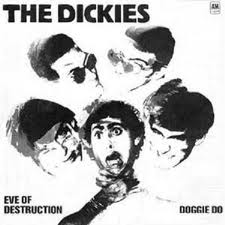
peach6SOUNDTRACK: THE DICKIES-“Eve of Destruction” (1979).

dickiesI didn’t know the original of this song until I listened to it just now (man it is depressing).  I have known this Dickies cover since the 90s, which speeds up the original almost twice as fast and makes the lyrics pretty much inaudible (which makes it less depressing).

The Dickies have done a lot of great covers, and while this one was never one of my favorites (I’m a “Town without Pity” and “Hair” man, myself), I always enjoyed the “over and over and over again my friend” part (and the squeaky guitars).   And now after listening to the original, I really prefer the cover.

[READ: April 2013] Lucky Peach Issue 6

I haven’t been reviewing Lucky Peach issues in their entirety because they are mostly about food and cooking and recipes and I don’t really have anything to say about that (I enjoy the articles a lot, but I don’t need to comment on them).

But I wanted to bring special attention to this issue, which is all about the Apocalypse.  And there’s a couple reasons for that.  Zombies are huge, that Mayan end of the world business was all fun, and of course everyone seems to think that Obama will cause the end of the world.  But on a more serous level, global warming is unchecked and no one seems to care about the environment at all, and with the weather being as crazy as it is, all bets are off as to what our world will look like even ten years from now.  So why not read a magazine that has recipes for all kinds of things that might still be around in a decade.

The first half of the magazine is all about preparing for the apocalypse.  There’s a degree of tongue in cheekedness in it but it is entirely sincere: there’s plenty of recipes for canning, there’s information about seed savers and a fascinating article about Seafarming, which I seriously hope takes off, as it sounds like it could be a real solution.  There’s some fascinating information about Shelf Life and even a recipe entitled “pollution” which looks like a polluted sea but seems very expensive to make.  I also really enjoyed the brief story about the couple who won a honeymoon in a bomb shelter for two weeks (compete with all of the canned food they could eat–oh, the Fifties). (more…)

Read Full Post »

mouldbookSOUNDTRACK: BOB MOULD-Silver Age (2012).

silverage

I was a huge fan of everything Bob Mould put out.  And then he more or less gave up on music.  So I just enjoyed his past and ignored what else he did.  But then I heard great reviews of his new album Silver Age.  So great in fact, that I couldn’t help but listen to it.  And it is amazing.  It’s a major return to his punkier roots.  The guitars are loud and fast but the melodies are still present.  And what’s more important, his voice sounds great and the album is mixed really well–previous Mould records have suffered in production quality.  But this is a great great record.

“Star Machine” opens the disc with loud guitars, a simple melody and lots of attitude.  I love the repeated “Said It” that appears throughout the song.  “Silver Age” is something of a manifesto for Mould.  The guitars are harsh and jagged with lots of distortion and the lyrics tell you everything: “Never too old to contain my rage  This is how I’m gonna spend my days gonna fight gonna fuck gonna feed gonna walk away.”

“The Descent” is classic Mould–big guitars, great catchy vocals and really nice harmonies/backing vocals.  “Briefest Moment” starts with a thudding drum and a sparse fast guitar (which somehow reminds me of Cheap Trick).  The bass comes in with a galloping line rather than playing the same notes and it adds a lot of depth to the album.  “Steam of Hercules” slows things down a bit but “Fugue State” comes crashing back in with more fast thumping drums and sparse but effective guitars.

“Round the City Square” picks up the noise level and includes a wild guitar solo.  “Angels Rearrange” again sounds like classic Mould.  While “Keep Believing” has a great bridge that reminds me a lot of Hüsker Dü (yes I mentioned the band that should not be named).  “First Time Joy” ends the disc on a gentle note.  It’s a ballad (where you can really hear Mould’s voice and how clean and strong it sounds).  There’s keyboards on this song that add some nice dimension.  By the end the song gets bigger and more powerful, ending on a really strong chord.  It’s an awesome return to the rock fold for Mould and I look forward to more from him.

[READ: March 5, 2013] See a Little Light

After getting The Silver Age, I remembered that Mould had written an autobiography and that I’d heard it was quite good.  I don’t really read a lot of autobiographies, but my history with Mould is pretty deep and I was curious to see what had happened in his life to make him abandon his rock roots.  So I tracked it down.  And I really enjoyed it.

The fascinating thing is what a reasonable man Mould presents himself as.  I’m not disputing this–I don’t know really anything else about the guy–but every time someone dumps on him, he accepts partial responsibility for the problem and moves on.  If he’s really like that, that’s very cool.  But he almost seems too nice sometimes.

As I’ve said, I didn’t know much about Mould.  My friend Al got me into Hüsker Dü and I’ve been a fan ever since.  I’ve bought some of his solo records and all of his band records, but I kind of lost interest in him the last decade or so (during his experimental phase).  But I didn’t even really know why Hüsker Dü broke up.

Some interesting things about Bob: he was born numerically gifted–I really enjoyed the section about his childhood and the genius-y stuff he did.  Although he had a pretty rough childhood–his older brother died when Bob was young and so Bob was seen as a golden child (especially after something that happened to him which he didn’t learn about until much later).  And he started drinking at a very young age.

When he got to college he formed Hüsker Dü with Grant Hart (Greg Norton came a little later).  I enjoyed hearing about the early days of Hüsker Dü because I only learned of them much later.  And man were they productive!  They’d release an album and have new material ready to record before they even toured for the album that came out already.  It’s cool reading about the punk scene back in the days before the internet when bands had to rely on each other for support.  There’s also a lot of people who Bob name checks and it’s fun to hear all of the punk names again, especially the names of people who are still active.  (There’s also some bad vibes against SST, but since this is Mould, the bad vibes are pretty mild). (more…)

Read Full Post »

« Newer Posts - Older Posts »