Feeds:
Posts
Comments

Archive for the ‘Russia’ Category

SOUNDTRACK: CLEM SNIDE AND SCOT AVETT-Tiny Desk (Home) Concert #26 (May 23, 2020).

I’ve never given a thought to Clem Snide.  Well, my thought is that he was a country guy that I didn’t want to listen to  Turns out, Clem is not a guy but a band founded by Eef Barzelay, who had a solo Tiny Desk back in 2010.

I do know Scott Avett from The Avett Brothers (although I never really know which brother is which).

Barzelay and Avett not only maintained social distancing throughout their set, but also rigorously enforced it with the aid of a visible tape measure.

This is my favorite Tiny Desk Home concert so far since it is done in a barn–and the sound is great!

Recording a Tiny Desk concert at home naturally subtracts a lot of familiar elements…. But when Clem Snide (the three-decade-old project of singer-songwriter Eef Barzelay) and special guest Scott Avett (the Avett Brothers co-founder who produced and performs on Clem Snide’s latest album, Forever Just Beyond) performed together in Avett’s barn, they added a few new features you’ve never gotten to hear at the Tiny Desk — most notably a noisy flock of birds and the unmistakable cries of a nearby rooster.

We’ve had a few disruptive animals at the Tiny Desk over the years, from the occasional dog to Bob Boilen himself, but this had to be our first rooster.

Their voices blended warmly as they tackled three spiritually searching songs from the (great) new record, Forever Just Beyond.

For the “The Stuff of Us” they both play guitar.  Eef’s is a full size while Scott’s is a smaller one (I can’t tell how many strings).  Avett sings the rather impressive high notes.

After encouraging everyone to brew their own fermented ginger beer for the immune system.

He introduces “Jews for Jesus Blues” by saying “A doubtless faith is a dead faith.”  The song from Clem Snide’s 2005 album End of Love, is a bouncy folk number.  Avett plays banjo.  The lyrics are interesting: “Now that I’m found, I wish I was lost” and “now that I’m saved, I wish I was dead.”  When the song’s over, Eef says, “not too offensive.”

Before “Some Ghost” the roosters start crowing.  Clem jokes, tell them chicken to shut the hell up.  Avett plays a full sized guitar and even sings some lead vocals.  Their harmonies are wonderful, too.  As the song ends, the rooster crows: “chicken go it right that time.”

Clem picks up a different,smaller, guitar for “Roger Ebert,” a song based on Ebert’s actual dying words: “This is all an elaborate hoax.”  Avett provides only percussion and vocals on this lovely song.

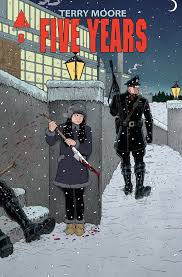
[READ: May 22, 2020] Five Years #8

Terry Moore seems like a very nice guy.  He draws people in love so wonderfully.  He draws adorable children and he specializes in a mischievous grin.

It’s easy to forget that he can be incredibly violent.  Well, I don’t know about him personally, but his art sure can be.

This issue has two violent deaths in it.  One is bloody, the other is not.

The one that is not is Stephanie.  The woman who wrapped Katchoo up in the mystery.  In several pages of wordless panels, Stephanie breaks into a secure building. She walks through a series of rooms activating secret panels.

She gets what she came for and heads out.  But when she steps outside, an unkindness of ravens swarms on her.

She drops her satchel and one of the ravens picks it up and flies off. (more…)

Read Full Post »

SOUNDTRACK: BUDDY & KENT JAMZ-Tiny Desk (Home) Concert #25 (May 22, 2020)

It’s fascinating to learn that there’s an artist (or two) who are apparently well-known enough to not need an introduction that you have not heard of.

Or that you have not only heard of one of them, but even posted about his Tiny Desk Concert just five months ago and since then you have completely forgotten about him.

Such is the case with Buddy, who had a Tiny Desk in January, although I don’t think that Kent was there.  All I remember about that Tiny Desk (after looking it up) is that Buddy wanted to smoke a joint in the office.  And maybe that’s all I needed to take away.

Buddy and Kent Jamz aren’t just the life of the party, they’re the last two to leave. … So in the vein of Method Man and Redman, Cheech and Chong, and other mischievous pairings, they bring us the after-afterparty. For their Tiny Desk home session, or Jank session as they put it, they mirror the cover of their new project, Janktape Vol. 1: seated on a couch, red cups and bottles scattered, with the 1990s cult classic cartoon Bebe’s Kids projecting on the wall behind them. From their quarantine quarters in Los Angeles, they trade melodic bars and hooks from Janktape, with a little help from socially distanced Brody Brown on bass and keys.

I was surprised to see that this set was only 11 minutes long. The songs flow together pretty seamlessly.  Their rapping and singing is chill  and they are clearly enjoying themselves.  I enjoyed some of the lyrics

“She Think” has this fun intro

She saw me on TV and she think she falling in love
she smoke up all my weed and she think she falling in love

Kent says this is by Axel Foley who I know is an Eddie Murphy character, so is that the name of a rapper or are they just messing?

“For The Ladies” has a cool retro dance sound.  I wonder if the songs are more than just a loop when properly played without just Brody Brown (appropriately masked) playing everything.  Obviously this song is for the ladies.  This verse made me smile

one time for the groupies
two times for the hoochies
hop in the Jacuzzi
this is gonna be a doozy

Pretty much the entire lyric of “Inconsistent” is “she says I’m inconsistent.”  But “Terrified” has a bouncy melody.  I guess like an after party, this is nice to hear but easily forgotten.

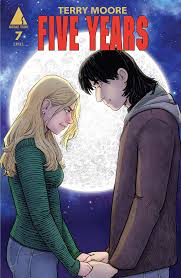
[READ: May 20, 2020] Five Years #7

There’s not much left in this story, so how can Terry Moore spend an entire issue where nothing (really) happens?

Because this issue is wonderful.

There’s some great art, an amazing flashback and a fascinating action sequence.

Katchoo flies to Russia and in the voice over she says she’s never been there before (which is surprising) and doesn’t know the language.

Tambi got her a room so she doesn’t have to worry about that.  It’s no Marriott, thats’ for sure. (more…)

Read Full Post »

SOUNDTRACK: SYLVAN ESSO-Tiny Desk (home) Concert #24 (May 21, 2020).

Is it possible to make dance music while sitting on a couch?  Is it possible also to dance to that music while sitting on a couch?

These pressing questions are answered in this Tiny Desk Home Concert

Sylvan Esso, the Durham, N.C., couple of Amelia Meath and Nick Sanborn gives us three songs from their home couch using modular synths, a rhythm machine and Amelia’s heartfelt vocals.

Sanborn sits in front of box with all kind of wires patched into it. It’s an unholy mess and he manages to make the melody by pushing the buttons between those wires.

Meath sits in front of another box and supplies most of the beats. It’s neat watching her sing verses and then push a button as the drums enter or leave “Die Young,” a fun dancey song.  She answers one of the above questions in the middle of this song which has a “dance break” as Meath waves her arms and gently bounces on the couch.

“Rewind” is a slower song.  Sanborn walks off camera while Meath starts the simple drum rhythm.  I assume he’s playing a synth, although midway he picks up a guitar (how frustrating that he’s off camera–c’mon Esso!).

In keeping with Tiny Desk tradition, bands I actually like–like this one–do a set that is less than 15 minutes, while artists I’ve never heard of or don’t especially like ramble on for over 20.

So they have only one more song.  But before playing it, they plug their new release

This home concert stands in sharp contrast to Sylvan Esso’s remarkable new film, WITH, which features a host of their dear friends reshaping and reimagining their brilliant catalog of songs during the duo’s 2019 tour. Add that to your list of things to do while sitting on your couch, hopefully with someone you like.

After some technical troubles (the sound is totally wrong), they start “Radio” a very familiar dance song.  There’s more couch dancing and even some dancing from Sanborn as his finger move all over that cluttered machine.

[READ: May 20, 2020] Five Years #6

This issue makes everything seem like things are going according to plan, there’s even a lot of levity.

We see Rachel in Russia. The morgue attendant, Yana, has brought her home.  They speak Russian, although Rachel’s Russian “sounds ancient, like something she only heard at university once or twice.”  Yana wonders why she is not dead.

Rachel doesn’t die.

Then some short scenes: (more…)

Read Full Post »

SOUNDTRACK: RAUL MIDÓN-Tiny Desk (Home) Concert #23 (May 16, 2020).

Raul Midón performed a Tiny Desk Concert back in 2018.  He was solo then (the blurb says he usually has a band with him) and he’s solo here now.  So there’s not a lot of difference between the two.

Except that in this home concert he plays five new songs.

It kicks off with two tracks from The Mirror, an album released just as we entered our quarantine period in mid-March: “I Love The Afternoon” and “I Really Want To See You Again,” a song that poetically captures the joy of friendship.

For both of these songs, Midón plays a very percussive guitar.  Whether it’s actually slapping the guitar like a drum to open the first song or the way he practically has the strings slap back against the guitar as he plays his complicated melody, there’s all kinds of rhythm going on.

He also has a light, fast, handpicking style.  And in “I Love the Afternoon” he adds a trumpet solo just with his mouth.

Midón’s jazz-influenced vocal phrasing throughout comes to the fore with just his acoustic guitar as accompaniment, illustrating once again why he’s normally one of the bright spots on our musical landscape and even more so at this moment.

Introducing “A Certain Café” he says Boris Karloff played bass.  Then he stops himself and laughs, Boris Kozlov–that’s from too much old-time radio.  It’s a slower, pretty song with a much gentler playing style.

He says that “Disguise” has fluegelhorn on the record but he’ll replace it here with his vocal fluegel, which is pretty cool.

“You’re The One” ends the set with a beautiful guitar introduction.  I was disappointed to hear that he raps the verses because the chorus is really catchy.

[READ: May 20, 2020] Five Years #5

This issue has two components.

In the first, Zoe is taken to see “Rachel’s” body. She fantasizes about killing Vlad in two spectacularly violent ways.  Zoe obviously realizes the body is not Rachel and the morgue attendant signals her in someway–although I can’t decipher it.

As they leave, Vlad offers Zoe a job since she has so much talent and potential.

Then we see Tambi parachute out of the sky with someone (is that Kathchoo?  It’s hard to tell). (more…)

Read Full Post »

SOUNDTRACK: ASHLEY McBRYDE-Tiny Desk (Home) Concert #21 (May 14, 2020).

Ashley McBryde is the latest country singer who I enjoyed very much until she started singing.

Ashley is charming and funny.  She tells us that she and her band mates self-quarantined and then washed their hands in front of each other for 20 seconds.  And she is so happy they did because she had taken it for granted hearing other people sing with her.

She even drew her own little Tiny Desk sign (she googled it) because she was supposed to be behind the Desk but was denied.

We were scheduled to host a Tiny Desk performance by Arkansas-born country singer Ashley McBryde on March 31. Obviously, we had to postpone McBryde’s visit.

McBryde sang four songs (which I assume is one more than she would have gotten at an actual Tiny Desk).  All four songs are country songs.  Which means they are catchy and have (mostly) interesting lyrics, but that Arkansas twang is just too much for me.

The first song,

“Hang In There Girl” which opens both the album and this set — is a perfect song for this moment, not that there’s ever a wrong time to hear someone sing, “Trust me when I say, you’re doing fine.”

Matt Helmkamp plays a solo, so I guess it is nice to have three guitars.  Chris Harris sings nice backing vocals.

Before the next song she says that they are playing live and she even made a setlist.  But that she misspelled “One Night Standards” as “Standars”  NPR called it “one of our Best Songs Of 2019.”

For “Velvet Red” Harris switches to mandolin and has to tune all eight strings–“it was in tune when he bought it” and they play the bluegrass- (and wine-) inspired love story featuring “basically all of the rule-breaking.”

McBryde is sporting a “Wash Hands Please” T-shirt, and encourages everyone to follow CDC guidelines before ending the set with “Sparrow.”

She’s very funny and I’d enjoy watching her banter between songs.  If she is going to have a proper Tiny Desk soon, what songs will she play if she played all of these already?

[READ: May 16, 2020] Five Years #4

This book’s voice over is by Kachoo.  In addition to getting everyone up to speed about the Phi bomb, she has been sitting on the beach for hours.

Francine doesn’t like it.  She knows what a visit from Tambi means (I haven’t seen Francine this angry in a while–I didn’t like it).

Francine is distracted so the girls get to take advantage of it: “can we have ice cream [for breakfast]?” “Mm Hmm.”  The scenes with the girls are the only levity in this dark issue. (more…)

Read Full Post »

SOUNDTRACK: FRANCES QUINLAN-Tiny Desk Concert #974 (May 13, 2020).

I Wanted to like Hop Along, but there was something about them that I didn’t.  I think it came down to Quinlan’s voice which I almost like but I think ultimately don’t.

That’s true here too, although I like it better on these quieter songs than the bopping of Hop Along.

Quinlan is a Tiny Desk veteran, having played here in 2015 with her indie-rock band, Hop Along. You could argue she has even more Tiny Desk experience than that; as Quinlan pointed out during her set, a can of Hop Along-branded beer has been sitting on the Tiny Desk shelves through numerous previous concerts, including Lizzo’s.

This time around, she performed songs from her debut solo album, Likewise. She was accompanied by two musicians who played on Likewise: her Hop Along bandmate Joe Reinhart, on bass and guitar, and Molly Germer on violin.

There’s something weird in the first song”Your Reply.”  From time to time a note rings flat or out of tune.  I can’t decide if it’s intentional or not.  And the middle of the song sounds like bassist Joe Reinhart is just messing up all over the place.  Although he does add a nice solo at the end.  I do like the melody at the introduction of the chorus though.

She tells a joke about Presidents Day that I don’t get.  I don’e even know if it can be classified as a joke.

The second song, “Detroit Lake” has a note that sounds wrong but which I is intentional–it’s part of the opening guitar melody.  This song is primarily just Frances and Molly Greene adding interesting violin textures.  Mid way through, Reinhart starts adding nice bass harmonic notes.

She tells us a fun fact that George Washington did not have wooden teeth–they were made of animals and other people’s teeth.  How about that.

“Lean” opens with a pretty guitar melody and Quinlan’s whispered vocals.  Reinhart switches to acoustic guitar to flesh out her sound nicely.  This is my favorite song of the set as it feels the most complete.

[READ: May 15, 2019] Five Years #3

The voice over for this issue is by Tambi.  She is going to Washington D.C. to meet Ivy Raven and Julie Martin, two characters from the Echo series.  Julie Martin is the living Phi bomb.

Ivy reveals that there’s an alloy in the bomb that affects those around Julie.  It messes with their DNA. If you’re a threat to her, it destroys you.  If you’re not, well, Ivy looks younger and radiant.

Turns out the Cleopatra papyrus (from SiP XXV) has gotten out and seven countries are developing their own phi weapons programs. (more…)

Read Full Post »

SOUNDTRACK: CHIKA-Tiny Desk Concert #959 (March 13, 2020).

I’ve never heard of Chika, but she proves to be really fun and funny (while rapping some serious topics).

Her band is jazzy and stripped back:

Chika was also the first hip-hop act to anchor her set with just a Peruvian cajón instead of a full, hard-hitting kit. The surprisingly stripped-down performance allowed her lyrics, with all their nuance, to take center stage — and the result was remarkable.

In addition to the band, were her terrific backing vocalists

The impressive harmonies from Chika’s four backup singers brought all the feels right out of the gate.

She starts with “Industry Games.”  Lovely ooohs from the backing vocalists then David Levitan plays an echoing guitar (“both catchy and eerily haunting” that I found reminiscent of the Close Encounters melody).  Up comes that cajon with gentle thumps from Dominic Missana.  Then she starts rapping.

Moving seamlessly between rap verse and melodic hooks, Chika showcased her unusual tonality, multi-cadence delivery and vocal range, with an effortless, double-time lyrical bounce.

She has a fantastic fast flow (smiling as she goes).  It’s interesting hearing the gentle backing vocals that repeat her (sometime harsh) final lines.

She even starts giggling in the middle.  She explains later “I say ‘tightest around’ and they sing ‘hottest around’ and it is hysterical to me.”

Before the next song she says, “Everyone brings nice things to the Tiny Desk, like lights…  I didn’t bring anything, or so you thought.  I brought this Chapstick and I’m gonna place that right here.  Fuck anyone who underestimated me.”

She says that “Songs About You.”  No shade to anyone.  It’s not about y’all. its about you.  The song features more nice backing vocals and then a grooving bass line from Chris McClenny.

Before the third song she sends a shout out to her sister who is there.  “Shout out to our parents… genetics!”  She asks, “What kind of shows are you wearing?”  “Puma…”  “You should have been wearing ‘Balencies,’ which is the name of the next song. She pauses and waits for the laughter.  Then says, “I’m funny.  We’re not gonna argue about that.  You all didn’t want to laugh… something about that felt racist.”

The backing vocals are wild and weird as it starts, Danielle Withers sounds like a perfect loop of an eccentric vocal line.  It’s pretty magnificent–I really hope she goes somewhere with a distinctive voice like that (I see that she has sung with some pretty big names already).

The other singers are (l-r) Jabri Rayford; Darius Dixson and Rachel Robinson (she’s standing on a box).

“Crown” has some great lyrics

I got a habit of rapping ’bout tragic sh-
I think I’m just passionate
Tryna steer the way while in the dark
Hope I ain’t crashin’ it (Woah)
Now my little hobby turned to cashin’ out
Thinking ’bout who I’d be if I listened to doubt
Said I’d never do it, well look at me now

Okay
This is for the kids with depression
The one’s whose parental expectations got them stressin’ (Woah)
The one’s who would rather persevere, bust they ass, tryna make it ’cause-
They ain’t really livin’ in the present

The set ends, oddly enough with “Intro” which is a very quiet song.  Gentle guitars and  a quiet rap.

This was a really satisfying set.  her songs were short and to the point.  The lyrics were powerful and affecting and the music was a nice accompaniment.

[READ: April 2, 2020] Astronauts: Women on the Final Frontier

Jim Ottaviani & Maris Wicks worked together on the awesome book Primates.  Now they are back sending some primates into space.

I just love Wicks’ artwork.  She manages to do such amazing things with such simple-seeming drawings.  Her eyes are (mostly) dots, the faces are almost all simple shapes and yet everything she draws is so expressive and conveys exactly what she wants.  It is a pleasure to look at anything she draws.

Ottaviani did a lot of research for this book (obviously) and the end is chock full of resources that you can look at to learn more.

As for the book itself, it is “told” by astronaut Mary Cleave.  It starts with young Mary being told (by the President) that she was too young for the Astronaut Corp.  The letter (from President Eisenhower) did not go on to say that no women were accepted into the Corp, she had to find that out herself.

She was already a practicing pilot at age 14, but that wasn’t good enough.  She then jumps over to another girl her own age over in the Soviet Union.  Valentina Tereshkova was jumping out of planes and training to be a pilot, because the Soviet Union did not have a sexist component in their system.

But in 1959, even though women like Jerrie Cobb were certainly (physically) capable of becoming astronauts, women simply weren’t chosen.  Jerrie Cobb and Janey Hart testified before Congress where sexism (and simple, painful examples are provided) ruled the day.  They were even shut down by Jacqueline Cochran, a director at an airline, who said women should not even be pilots because they get married and leave after two years. (more…)

Read Full Post »

SOUNDTRACK: KIRILL GERSTEIN-Tiny Desk Concert #958 (March 11, 2020).

I can’t really keep track of classical pianists. There are so many who are truly amazing.  But I love hearing them.  I also like it when they have a good sense of humor, which most of them seem to have.

The last time pianist Kirill Gerstein was at NPR we gave him a full-size, grand piano to play in a big recording studio. But for this Tiny Desk performance, we scaled him down to our trusty upright. “What will you ask me to play the next time,” he quipped, “a toy piano?”

Even if we had handed him a pint-sized instrument, I’m sure Gerstein could make it sing. Just listen to how Chopin’s lyrical melodies, built from rippling notes and flamboyant runs, flow like a song without words in Gerstein’s agile hands.

What sets Gerstein apart?  Perhaps its his connection to jazz.

The 40-year-old pianist, born in Voronezh, Russia, taught himself to play jazz by listening to his parents’ record collection. A chance meeting with vibraphonist Gary Burton landed him a scholarship to study jazz at Boston’s Berklee College of Music. At age 14, Gerstein was the youngest to enroll at the institution.

He opens the set with Chopin: “Waltz in A-flat, Op. 42.”  It is fast and amazing with some slow, jaunty parts.  Near the end, wow, doe he pound out those bass chords.

Before the second piece he says that it hasn’t been heard on a recording yet–it’s a newly written piece by Thomas Adès.  Two lovers want to hide in the closet and … sleep with each other.  They emerge dead in the morning, so its lascivious and morbid and a very beautiful piece.

The Berceuse for solo piano was written for Gerstein by Thomas Adès, adapted from his 2016 opera The Exterminating Angel. The work, both brooding and beautiful, receives its premiere recording at the Tiny Desk.

It is slow and beautiful, full of sadness and longing.  Until the end when the bass comes pounding and rumbling, full of ominous threat and dread.  And listen to how long he lets those last bass notes ring out!

Up next is a piece by Liszt who I am particularity fond of (even if I only know a few of his pieces).  Gerstein says that Liszt is perhaps the greatest composer that ever touched the instrument.  There are several hundred not famous pieces.  This is a late piece called “A quick Hungarian march.”  Technically it’s called “Ungarischer Geschwindsmarsch”

Gerstein follows by dusting off a truly neglected – and quirky – Hungarian March by Franz Liszt. To my knowledge it’s been recorded only once.

It is jaunty and spirited until the middle where it goes back and forth between fast runs and bouncy melodies.

Since I hadn’t read about his jazz background the first time I listened to this concert I was really surprised when he said he’d be playing the Gershwin-Earl Wild standard “Embraceable You” which he says is for dessert at this lunchtime concert.

Gerstein’s jazz background is still close to his heart. Which brings us to his lovely-rendered closer: Gershwin’s “Embraceable You,” arranged by the American pianist Earl Wild.

Like all master performers, Gerstein gives you the illusion that he’s making it all up as he goes along, even though the virtuosic transcription is intricately mapped out. And somehow, he makes that upright piano sound nine feet long.

It really does sound like he is working on the fly–playing beautiful runs. It’s hard to imagine transcribing and learning all of those notes instead of just improvising them, but that’s what make a great pianist, I guess.

[READ: November 2019] The Abyss

I saw this book at work and thought, a turn of the 20th century Russian author writing about the Abyss?  What’s not to like?

I had not heard of Leonid Andreyev, perhaps because much of his work has not been translated into English.  He died in 1919 and is considered “the leading exponent of the Silver Age of Russian literature.”

This book was translated by Hugh Aplin and it is remarkable how contemporary these stories sound (aside from obviously nineteenth and twentieth century details).

Bargamot and Garaska (1898)
Bargamot was a policeman–a big, thick-headed policeman.  His superiors called him numskull.  But the people on the streets he looked after were quite fond of him because he knew the area and what he knew he knew very well.  This story is set on Easter Saturday night.  People would soon be going to church.  But he was on duty until three o’ clock and he wouldn’t be able to eat until then. The day was going smoothly and he would soon be home until he saw Garaksa, clearly drunk, heading his way: “Where he had managed to get sozzled before daylight constituted his secret, but that he had got sozzled was beyond all doubt.”  Bargamot threatened to send Garaska to the station, but Garaska talked to him about the festivities of the day and was about to present to him an egg (a Russian custom).  But Bargamot’s rough handling smashed the egg.  This story turns surprisingly tender and sad, with a rather touching final line.

A Grand Slam (1899)
This has nothing to do with baseball.  It is about a card game called Vint, which is similar to bridge.  For six years these four people have been playing it: fat hot-tempered Maslennikov (whose name is Nikolai Dmitriyevich, we find out about five pages in) paired with old man Yakov Ivanovich and Yevpraksia Vasilyevna paired with her gloomy brother Prokopy Vailyevich.  Dmitriyevich desperately wanted a grand slam but he had been paired with Yakov Ivanovich who never took risks. Ivanovich was very conservative and never bet more than four–even when he ran an entire trick, he never bet more than four–you never know what might happen. They speak of news and local happenings (like the Dreyfus Affair), but Dmitriyevich stays focused on the game because his cards are lining up for a Grand Slam.  As he goes for that last card, he falls out of his chair, presumably dead.

Silence (1900)
This story is divided into sections.  Fr. Ignaty and his wife need to speak with their daughter Vera. They have a fight and Fr. Ignaty refuses to speak to her any more.  Soon enough she goes out and throws herself under a train [I would hate to be a train conductor in Russia].  In Part II silence has fallen over the house.  In Part III he tries to talk to his wife about his feelings and his sadness over their daughter, but she remains silent.  In the final part, Fr Ignaty finally breaks down.  But is it the silence that has gotten to him?

Once Upon a Time There Lived (1901)
Laventy Petrovich was a large man. He went to Moscow for someone in the city to look at his unusual illness.  He was a silent and morose man and he specifically asked for no visitors.  The hospital assigned Fr. Deacon to him.  Fr. Deacon was another patient, unfailingly positive.  He and Petrovich were at opposite sides of the spectrum.  But even as it became clear that Fr. Deacon was deathly ill, he remained positive.  Until Petrovich told him that the doctors said that Fr. Deacon has a week to live.  There was also a young student who was daily visited by the girl he loved.  They liked Fr deacon and did not like Petrovich. I’m not sure if the ending is a surprise, but it is certainly sudden with happiness doled out in very specific ways.

A Robbery in the Offing (1902)
That night there was to be a robbery and maybe a murder.  A man, alone with his thought is scared by nearly everything–he is very jumpy because he is the one about to do the robbery.  The man was frightened by a noise until he saw it was a little puppy.  The puppy was shivering and the man tried to frighten him to get him to go home. But the puppy seemed too ignore him.  So began the battle of wits between a big strong man and a tiny freezing puppy.  Imagine a man with a robbery in the offing worrying about a little puppy.

The Abyss (1902)
Two young lovers went for a walk.  Zinochka was 17 and very much in love.  Nemovetsky was 21 and similarly in love.  They wandered into an area they didn’t recognize and happened upon three men.  The men punched Nemovetsky and knocked him out then they chased Zinochka . When he came to, he found her body, naked but still alive.  This was a hard story to read.

Ben Tobit (1903)
This was one of the first stories in the book that I really really liked.  It is set on the day of Jesus Christ’s crucifixion.  On that day, Jerusalem merchant Ben Tobit had a terrible toothache.  Ben was a kind man and did not like injustice, but it was hard to be kind with this much pain.  His wife tried to help by giving him various medicines (like purified rat droppings). She then tried to distract him when the thieves came trudging past on their way to the crucifixion site.  It distracted him somewhat but mostly didn’t interest him.  She said, “They say he healed the blind.”  He replied, “If only he’d cure this toothache of mine!.”  The next day he felt better and they walked to the site to see what they missed.

Phantoms (1904)
Yegor Timofeyevich had gone mad so his relatives collected money to send him to a clinic.  He knew he was in a madhouse but also knew that he could make himself incorporeal and walk wherever he wanted.  He was exceedingly happy. There was a patient who would continually knock on any locked door.  He would walk through all the unlocked doors but when he got to a locked one he would knock and knock and knock.

There was a doctor’s assistant the hospital named Maria Astafeevna, whom Yegor was certain liked him.  He thought very highly of her.  But another man Petrov could say nothing nice about her.  He felt that she was like all women: debauched deceitful and mocking. This attitude upset Yegor tremendously.  Maria was actually in love with Dr Shevyrov. But she hated that he went to Babylon–where he drank three bottles of champagne each night until 5 AM.  She imagined that one day she would ask to be his wife bit only if he stopped going there.

The man Petrov was also terrified of his mother, believing that she had bribed officials to lock him up. He would become hysterical when she would visit.  It was only Yegor’s assurances to her that her son was a decent man that made her feel okay.

Most days things went on exactly the same, the same faces, the same conversation and the same knocking.

The Thief (1904)
Fyodor Yurasov was a thrice-convicted thief.  While on the train, even though he had plenty of money, he stole a gentleman;s purse.  As he tried to blend in, he imagined everyone thought he was an honest, young German (he came up with the name Heinrich Walter).  But when he tried to be civil, everyone ignored him.  Some were downright rude to him.  Later when he hears that the gendarme are looking for someone, he assumed it is he.

Lazarus (1906)
This story looks at what Lazarus’ life was like after he came back–appearing a few days dead and with a shorter temper.  People understood and forgave him, but still.  Soon, however, people began to avoid him and claimed that all of the madmen in the village were people whom Lazarus had looked upon.   It’s such an interesting (if exceeding dark) tale that no one bothered to investigate before.

A Son of Man (1909)
As Fr. Ivan Bogoyavlensky grew older he grew more disatisfied with his role in life.  He wanted to remove his surname and replace it with a five-digit number (The church elders assumed he’d gone mad).  He then bought a gramophone and listened only to stories of Jewish and Armenian life.  His wife hated it and it drove their puppy mad (?!).  Indeed he kept trying to get the puppies to listen to the gramophone and they consistently went crazy and eventually died.  The church sent a deacon to help Fr Ivan through this but he the deacon and Fr Ivan butted heads immediately.  Fr Ivan began mocked everything about their religion.

Incaution (1910)
A priest arrived at a railway station and saw a steam engine for the first time. There was no one around, so he climbed aboard.  It wouldn’t be dangerous to flick some switches and pull some levers.  Would it?

Peace (1911)
A dignitary was dying and an devil–an ordinary devil–came to his bedside offering him eternal life in hell.  The man didn’t want to suffer but the devil said that suffering was terrible until you got used to it and then it was nothing.  The devil makes a stronger and stronger case if only the man would take this pen and sign.

Ipatov (1911)
Nikolai Ipatov was a rich merchant who went bankrupt. Soon he became silent and despondent.  The local priest chastised him saying that the house of god was a house of joy.  He refused to let the merchant back in until he grew happy again.  Which he didn’t.  Eventually his children took over the situation and and put his house up for sale.  But when someone came to look at the house, they heard Ipatov’s moaning and grew existential realizing that a man without guilt could still be afflicted this way.

The Return (1913)
The narrator had been in a cell n St Peterburg for three years because of a political incident.  His wife, who was supposed to be waiting for him in a hotel room had stepped out with another man.  He hired a cab to follow them.  They kept driving around and around, some streets seeming to stretch on endlessly.  Then the cab driver told him that they had been at the same intersection many times.  He finally arrived at the gate and when he banged on it, who should open the gate but his prison guard.

The Flight (1914)
Yury Mikhailovich was an experienced pilot.  Twenty eight flights and no troubles.   He always felt, “If I crash, I crash, nothing to be done about it.”  Despite everything he had on earth, he longed to be up ion the sky…possibly forever.  It’s incredible that Andreyev wrote a story like this in 1914!


Read Full Post »
SOUNDTRACK: JOYCE DiDONATO-Tiny Desk Concert #933 (January 15, 2020).

I was sure that Joyce DiDonato had performed a Tiny Desk Concert before, but I actually knew her from a gorgeous NPR Field Recording from 2015.

the last time we filmed the down-to-earth diva, she insisted on singing an opera aria at the Stonewall Inn, the iconic gay tavern in Greenwich Village.

DiDonato is an opera singer and her voice is amazing–she can soar and growl and everything in between.  But this Tiny Desk is not what you’d expect.  For although DiDonato sings in her beautiful operatic voice, the music the band is playing is anything but.

When opera star Joyce DiDonato told us she wanted to sing centuries-old Italian love songs at the Tiny Desk we weren’t surprised. But when she said she was bringing a jazz band to back her up, we did a double take. But that’s Joyce, always taking risks.  On paper, the idea of jazzing up old classical songs seems iffy. At the least it could come across as mannered and at worst, an anachronistic muddle. But DiDonato somehow makes it all sound indispensable, with her blend of rigor, wit and a sense of spontaneity.

The first song is by Alessandro Parisotti.  “Se tu m’ami” sets the stage for what this show is going to be like.  Gorgeous jazz with DiDonato’s impressive voice.

The musical formula for these unorthodox arrangements makes room for typical jazz solos while DiDonato molds her phrases to the flexible rhythms and inserts old-school trills and flamboyant roulades.

A cool trumpet solo from Charlie Porter takes a cool trumpet solo while DiDonato admires his skill.

After three minutes they segue seamlessly into Salvator Rosa’s “Star vicino.”  This one features a piano solo from Craig Terry which he begins with a line from “Twinkle Twinkle Little Star.”  The song also features a muted trumpet solo with a few drum breaks for Jason Haaheim

My favorite moment in the set comes just before 6 minutes where she sings a beautiful lilting melody and then hits a growly note that I was sure was the trumpet until Porter played the same note on his muted trumpet.  It was very cool and kind funny.  Especially when she says

there’s no soprano in the world who could get away with that

Less than a minute later she runs through her enormous vocal range from low to very high to soaring.  It’s amazing.

She says that in the classical world, the standard is perfection–rarely achieved.  Young singers try so hard to get it perfect that they lose the “grease” as the jazz players say.  So this project was designed to put the swing back in these old love songs.

The third song she says is by anonymous, but it is credited to Giuseppe Torelli. “Tu lo sai” is a love song that says, “you have no idea how much I love you.  No matter how much you scorn me, I still love you,”  She says they giving this the Chet Baker treatment.  I’m not exactly sure what that means, but there is some wonderful trumpet work in this song.

It has a slow opening with piano and voice.  The other instruments slowly come in and there is a wonderful moment during Porter’s trumpet solo where she picks up the note from him and runs with it.

Bassist Chuck Israels (who has played with everyone from Billie Holiday to the Kronos Quartet) never solos but he keeps the whole enterprise running perfectly.

For the final song Francesco Conti’s “Quella fiamma” they bring out Antoine Plante on the bandoneon.  She says, “Yea we’re going to South America in a minute.”

Porter uses a different kind of mute which creates a unique sound.  Then the bandoneon comes in and the South American flair is complete.  There’s an incredible moment at the end of the song where Joyce just trills away–showcasing so much of what she can do.

As the blurb says, despite how great the band is

the star of the show is the continually amazing DiDonato, whose voice is certainly one of the great wonders of her generation. The flexibility of the instrument, the colors she conjures and her fine-tuned dynamic range are a few of the reasons she’s still at the peak of her powers. She looks and sounds like she’s having the time of her life.

I see that she sings in Princeton pretty often.  Next time she;s in town I will make sure to check her out.

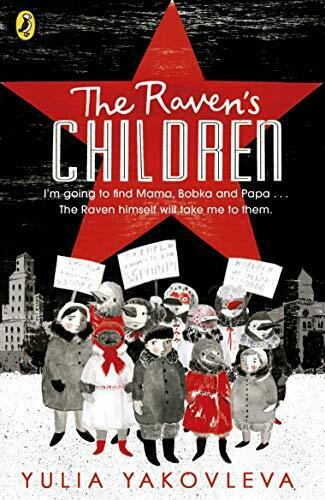
[READ: December 20, 2019] The Raven’s Children

This story was fascinating in the way it started as a very real story, suddenly added magical realism and then turned into an utterly fantastical story.  And yet it all works perfectly well as an allegory of the oppressive regime under Stalin.

Not bad for a book with talking animals.

This book was translated by Ruth Ahmedzai Kemp and she brings this story to life.

Shura is a young boy living in Leningrad.  He lives with his mama and papa as well as his older sister and a little brother.  They live in an apartment building and he and his sister are lucky enough to have a room to themselves.  The amusing set up is that they have to walk through a wardrobe that their father set up to separate the rooms (he removed the back but you can’t tell from the front).  This weird construction actually saves them later in the story.

Shura’s friend is named Valya.  His parents don’t want him hanging out with Valya, but they like to do the same things, so he disobeys.  Today they are putting pennies on a railroad track.  They had been doing this for long enough that they can tell how heavy a train is by the way the resulting items come out.

On this occasion the train that went by seemed to be full of people.  People crammed into each car.  As it sailed past, a piece of paper sailed out.  Valya grabbed it. Neither of the boys could read very well but they could see some numbers on it.  Shura was sure that the paper was important and he desperately wanted it. But he didn’t know how to get it from Valya without making him want it more.

They walked home and by the time they got to Shura’s place, they were physically fighting.  Shura manged to snatch the paper and Valya threw a rock at him.  The rock smashed a window of an older lady’s apartment in their building.  Shura knew he was in trouble for the window.  But it was Valya’s fault.  Of course, he wasn’t supposed to be playing with Valya. (more…)

Read Full Post »

SOUNDTRACK: PEARL JAM-“Santa God” (1993).

On December 2, Pearl Jam announced that their fan club holiday singles will be released to streaming services.  Their first holiday single was released back in 1991.  It was “Let Me Sleep (Christmas Time).” They are rolling out the songs one at a time under the banner 12 Days of Pearl Jam.

These releases are coming out as a daily surprise.

The song opens with a quiet guitar melody and Eddie’s droning style of vocal until the bass comes in and the song starts really moving.

It’s a flashback to childhood

Now and then I remember when
Us Adults were little Kids
And our only worry was
What we get from Santa Claus

There’s a little synth melody in between verses as the song seems to grow more positive.  The chorus is simple and reminds me in style of some of the later Nirvana songs (with the backing vocals especially).

It seems like it’s a sarcastic song, but indeed, it’s not

How I learned from right and wrong
Had to be good for Santa Claus
He made me, stop misbehaving
And once a year if I did my job
I’d be given my favorite toys
So simple, the principles

It’s a catchy enough song, but probably won’t run up the holiday music charts anytime soon.

[READ: December 7, 2019] “An Errand in the Country”

This year, S. ordered me The Short Story Advent Calendar.  This is my fourth time reading the Calendar.  I didn’t know about the first one until it was long out of print (sigh), but each year since has been very enjoyable.  Here’s what they say this year

The Short Story Advent Calendar is back! And to celebrate its fifth anniversary, we’ve decided to make the festivities even more festive, with five different coloured editions to help you ring in the holiday season.

No matter which colour you choose, the insides are the same: it’s another collection of expertly curated, individually bound short stories from some of the best writers in North America and beyond.

(This is a collection of literary, non-religious short stories for adults. For more information, visit our Frequently Asked Questions page.)

As always, each story is a surprise, so you won’t know what you’re getting until you crack the seal every morning starting December 1. Once you’ve read that day’s story, check back here to read an exclusive interview with the author.

Want a copy?  Order one here.

I’m pairing music this year with some Christmas songs that I have come across this year.

This is a short short story.  It concern a Russian man who has been living in the United States for most of his life.  Gregory has been a successful businessman in New York City.  He was exacting and always on time.  Actually, he’s rather a a jerk.

He returned to Moscow infrequently, and when he did, his visits were brief.  He wanted to stay at the Ritz but his mother was always upset with him if he didn’t stay with her.  So he agreed to stay in her run down place, where he knew he would not be able to get the smell of her apartment out of his clothes. (more…)

Read Full Post »

« Newer Posts - Older Posts »