Feeds:
Posts
Comments

Archive for the ‘Children’s Books’ Category

SOUNDTRACK: DAKHABRAKHA-“Kolyskova” NPR’S SOUTH X LULLABY (March 21, 2017).

I loved DakhaBrakha’s Tiny Desk Concert.  It was mesmerizing and beautiful.  And so the performers came to SXSW and did a lullaby.  And as the blurb says, they brought their “cello, keyboard, accordion – and tall, wool hats! — to the balcony of the Hilton Austin hotel.”

This lullaby of “Kolyskova” quiets things down a bit.  The song opens with simple keyboard notes.  One of the women sings, and when they reach the end of the verse, the male accordionist sings a falsetto that matches the women’s tone.  The woman on drums makes a strange sound–like a baby crying or animal yelping.

Then he winds up singing lead on the second verse in that falsetto with the women singing backing vocals.  Then the cello and drums kick in to build the sound.   The third verse is sung by the cellist as the keys play a pretty melody.

The song is upbeat with lots of bouncy vocals, even though the lyrics seem rather dark.  ‘The band only ever calls it “Lullaby.” It’s a quiet, contemplative song that the band says is a “connecting of several lullabies” with “philosophical lyrics that [say] we have time for everything — time to laugh and cry, time to live and die.’

I love at the very end as the song slows down to just the keyboardist singing because the drummer adds a very cool breathing as a kind of percussion accompaniment.  And then as the camera pulls back the two attack the keyboard making a cacophony of fun notes.  I bet they’re a lot of fun live.

[READ: June 2 2016] Explorer: The Hidden Doors

This is the third (and I assume final) in a series of graphic novel short stories edited by Kazu Kibuishi, the creator of Amulet.

I really enjoyed the first one a lot and was pretty excited to read the rest. As with the other two I was delighted by the authors involved and the quality of these stories.

The three books are not related to each other (aside from thematic) so it doesn’t matter what order you read them in.

This book revolves around the theme of “hidden doors.”  I like the way each author takes a concept that seems like it would be pretty standard and turns their stories into things that are very different indeed. (more…)

Read Full Post »

SOUNDTRACK:  NINA DIAZ & Y LA BAMBA’s LUZ ELENA MENDOZA-“January 9th” & “Living Room” NPR’S SOUTH X LULLABY (March 20, 2017).

I was intrigued by this pairing because Luz Elena Mendoza has a shirt buttoned up to her neck and, from the angle of the first song, it appears that she has her long sleeves down, while Nina Diaz (originally from Girlfriend in a Coma) is wearing a sleeveless T-shirt with tattoos showing up and down her arms.  They seem somewhat mismatched.  Until they sing.  (And also during the second song when it becomes obvious that Luz Elena’s arms are covered in tattoos as well).

The two have never played together, but after NPR Music paired them in the courtyard of St. David’s Episcopal Church for a late evening performance, we’re beginning to wonder why not. They’ve both played the Tiny Desk (Diaz twice, once with Girl In A Coma) and both navigate complex emotions and notions of identity in their music. Also, they just sing beautifully together, Mendoza’s yodel swirling in Diaz’s gritty croon.

Luz Elena’s song “Living Room” is first.  She plays guitar and sings. It’s a short song with Nina’s nice high harmonies over Luz Elena’s deeper voice.  The blurb also notes: Mendoza shares a brand-new song here, “Living Room.” When the two harmonize its confession — “I feel like I’ve been undressing all my thoughts in front of you” — it is, in tandem, starkly intimate and separate.

Nina Diaz’ song “January 9th” is a bit more fun (partially because I know it from her Tiny Desk Concert, but also because it’s a bit more upbeat).  I like Diaz’ singing quite a bit.  Mendoza’s backing vocals add nicely to the “bad one/sad one” part of the chorus.  The blurb adds: “It’s a bluesy ballad with a through line of ’60s pop, a tribute to her late grandmother, cooed and howled into a warm Austin evening.”

Future collaborations should be called for.

[READ: June 27, 2016] Explorer: The Lost Islands

This is the second in series of graphic novel short stories edited by Kazu Kibuishi, the creator of Amulet.

The three books are not related to each other (aside from thematic) so it doesn’t matter what order you read them in.

This first one is all about “lost islands.”  What was neat about this book was that since the premise of an island is so broad, the stories were all very different. (more…)

Read Full Post »

SOUNDTRACK: L.A. SALAMI-“Day To Day (For 6 Days A Week)” NPR’S SOUTH X LULLABY (March 17, 2017).

L.A. Salami’s full name is Lookman Adekunle Salami.  I really enjoyed Salami’s song “Going Mad As The Street Bins.”  His delivery is great and there were some rather unexpected chords.

For this performance of “Day to Day,” he is standing on the balcony of the Hilton Austin hotel overlooking the downtown skyline.

I usually try to pair kid-friendly songs with books, but there’s some curses in this song).

The music is basically the same for 7 minutes (although it does build by the end), which means you must focus on the lyrics. And they are pretty dark.  It talks about boredom on public transportation as well as gruesome deaths on the news.  There’s talk of mental health, like this section:

Went to work for the NHS –
Mental health, people depressed.
Met Joanne – Scared of living,
Afraid of dying, terrified of being.
Then met Paul, a schizophrenic,
Shaking limbs, paranoid fanatic –
Unwashed 10 days in a row –
So afraid almost paralytic.
I tell them that I do the same –
In certain moods, on certain days…
But despite the sane ways I can think
I could not do much to convince them…

But mostly I enjoy his delivery which has his slightly accented voice and charming mannerisms.  The first time I heard this I wasn’t as drawn to it as I was his other song, but each listen unveils something more to like about it.

[READ: June 1, 2016] Explorer: The Mystery Boxes

This is the first in a series of short graphic novel short stories edited by Kazu Kibuishi the creator of Amulet.

Sarah brought these home for the kids to read and they were sitting around our house for a while so I picked one up.  When I flipped through it and saw all the great authors in it I knew I had to read them.

The three books are not related to each other (aside from thematic) so it doesn’t matter what order you read them in.

This first one is all about “mystery boxes.” (more…)

Read Full Post »

SOUNDTRACK: LET’S EAT GRANDMA-“Deep Six Textbook” NPR’S SOUTH X LULLABY (March 16, 2017).

Let’s Eat Grandma is a duo consisting of two girls from England–Jenny Hollingworth (17) and Rosa Walton (16).  I love that they took their name from the grammar joke about removing a comma.  But the somewhat sinister reality of the name is representative of the somewhat sinister tone of their pop songs.

Not all South X Lullaby venues are worth describing, but this one sure it.  It takes place in an airstream trailer. The setting is wonderful–all wood-paneled and streamlined. And it seems to make the sound echo perfectly.

The song begins with an electric drum–much louder than one might imagine–and then the girls do a little hand clapping game before the music starts.

Rosa on the keys has really long hair.  She sings lead and has an incredible, unique voice–a heavy accent and a menacing but childlike delivery.  Jenny sings occasional lines (they intertwine very nicely).  When the verses end, the chord change is fairly dramatic before it returns to this pretty and slightly creepy melody.

After 3 and a half minutes Jenny pulls out a saxophone and plays a short, weird muffled solo.  And then the song continues on to the end. It is utterly mesmerizing and as fascinating as the duo are.  I’m really excited to explore more of their music.

[READ: January 27, 2017] Cleopatra in Spaaaace!

While looking up Book 3 on Goodreads I saw this book called Cleopatra in Space Book .5 (that’s point five).  It is the original webcomic that inspired the series.  if you’re thinking about reading it, I’d wait until after Book 3 of the graphic novel.  You’ll see why.

Maichak introduces us to the series by saying he wrote it from August 2009 to October 2012 and that it ends abruptly because he began working on the graphic novels.

These pages will never appear in printed form because while they are the basis for the comic, they are a little different and, as he says, they are aimed at a slightly older audience.  But most of the elements are in place like Khensu The Space Kitty, the humor, the pacing and the great hieroglyphics that the aliens speak.  She’s even got her Sphinx space scooter.  Although Cleopatra herself is a bit older (and sexier). (more…)

Read Full Post »

SOUNDTRACK: VALERIE JUNE-“Astral Plane” NPR’S SOUTH X LULLABY (March 15, 2017).

I have been hearing a lot about Valerie June lately, but I actually didn’t know her music before this lullaby.

For this song it is just her and her guitar sitting on a wall underneath some fairy lights.  “Astral Plane” is a 3/4 time song (with a kind of plucked strumming) .  The melody is simple and comforting, call it “a softly swaying, country-tinged soul song.”  But I  feel like it’s her voice that stands out.

Her voice is unique, and based on it I have no idea where she is from.  It sounds accented but also almost cartoony.  But there’s nothing funny about this song–it’s a pretty song about dancing on the astral lane.  I found that I didn’t really like her voice at first, but it slowly grew on me.  And I find myself somewhat addicted to this song now.  Must hear more.

[READ: January 28, 2017] Cleopatra in Space Book Three

I ended the previous review by saying I couldn’t believe I had to wait forever to read the next book.  And here it is almost a year later and book three is out.

As with the previous books in this series there is a lot of action–a lot of fighting sequences.  But Maihack once again does a great job in keeping the action easy to follow even while lasers and knives are zapping all over the place.

As the story opens, we see Cleo’s ship surrounded by Octavian and a massive Xerx fleet.  Cleo’s team is obviously afraid but we hear Octavian tell his crew that he wants everyone on Cleo’s ship alive.  Unfortunately for Cleo, Zaid, a rather impulsive youth has joined them and fires on one of the ship’s lasers.  This causes all kinds of chaos and a chase sequence. (more…)

Read Full Post »

SOUNDTRACKJEALOUS OF THE BIRDS-“Goji Berry Sunset” NPR’S SOUTH X LULLABY (March 14, 2017).

Jealous of the Birds is, I believe, just the two women in this video.  This song is a beautiful, short, sweet song.  Naomi Hamilton, a singer from Northern Ireland sings (and whistles) and plays the guitar while backing singer Hannah McConnell sings the deadpan-ish lines in the response two the lead vocals.  But when the chorus comes in their harmonies elevate the song just a little higher.

This video was filmed under a soft, glowing light installation. The Amsterdam-based audiovisual design studio Circus Family conceived TRIPH as an immersive experience — as people enter the room, the lights change color, and as people leave, it falls to sleep.

So, while the song is lovely, it’s really satisfying to watch this video as the colors change and the camera moves all around.  And the sound is great, too.

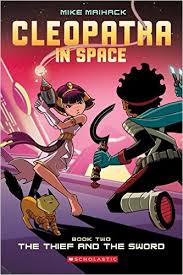
[READ: February 8, 2016] Cleopatra in Space Book Two

I really enjoyed book one of this series a lot.  So I was delighted to see that Book Two had come out.  I brought it home and C. enjoyed it and so did I.  T. enjoyed it too.  So much so, that I brought home book one for her to read so she could get all caught up.

This book follows the day after the previous book ends.

The only problem I had with the book is one that I tend to have with action  stories.  The first chapter was almost entirely action/fighting.  Typically I find this sort of plot development hard to follow and unsatisfying. Fortunately, Maihack has an excellent artistic style and very clean lines and coloring, so there was nothing confusing about the action at all.  But I had enjoyed the dialogue in the first book so much that I wished there was more in this one. (more…)

Read Full Post »

SOUNDTRACK: OLIVER ‘TUKU’ MTUKUDZI-Tiny Desk Concert #307 (September 30, 2017).

The blurb says that this guitarist is a legend, which makes me feel bad that I’ve never heard of him.

He seemed so casual — sitting on a bar stool behind the Tiny Desk, acoustic guitar in hand — but when you hear that husky voice, you’ll know why he’s a legend. Oliver Mtukudzi, or “Tuku” as his fans lovingly call him, plays spirited music, born from the soul of Zimbabwe. He’s been recording since the late 1970s, with about as many albums as his age: 60.

But Mtukudzi’s new record reveals a heavier heart than before: Sarawoga is his first recording since the loss of his son Sam. He and Sam — also a guitar player, as well as a saxophonist — had a special relationship touring together. But in March 2010, Sam Mtukudzi was killed in a car crash at the age of 21. Oliver Mtukudzi recently told NPR’s Tell Me More that “the only way to console myself is to carry on doing what we loved doing most. Sitting down [to] cry and mourn — I think it would have killed me.”

All three songs, “Todii,” “Huroi” and “Haidyoreke” are all gentle, with Tuku’s guitar playing mellow meandering melodies and his gravelly voice being soothing at the same time.  It’s interesting that for “Todii,” a more upbeat song he is clearly singing not in English, but the chorus (sung by the backing musicians) is “What Shall We Do.”  The backing musicians are there for percussion–congas, and maracas–and backing vocals.  And their vocals are done in a traditional way.

[READ: January 2, 2017] Volcanoes

This Science Comics book was very different from the previous two.  It was designed as a fictional story full of with factual information.

At first I found this really weird and off-putting, but by the end, I thought the story was pretty compelling and that the factual information was presented in an interesting and informative way.  And what I realized afterward was not that I didn’t like the fictional aspect but that I really didn’t like the illustrations.

For some reason, Chad chose to have the main characters with very distinctive and unusual features.  Aurora, the main character had a line of black hair down her forehead.  Her sister, Luna, has really really big eyes and their guardian, Pallas, has a block of gray hair.  I found all of these choices to be unsettling and unpleasing to look at (although it does allow us to tell them apart quite easily).  However the volcano and other nature images were really fantastic. (more…)

Read Full Post »

tyrantSOUNDTRACK: CHRISTINE SALEM-Tiny Desk Concert #326 (December 14, 2013).

As with many artists behind the Tiny Desk, I had never heard of Christine Salem.  So who is she?

Christine Salem sings songs that are old: They’re work songs and chants from the maloya tradition on Réunion Island in the Indian Ocean. I first heard her in New York City as she shook a flat board called a kayamb, made of cane reeds, with two percussionists flanking her to provide rhythm.

Salem makes powerful, strongly focused music in which all the elements are essential, with nothing superfluous. She says it feels like the spirits move through her when she plays, and though you may doubt her if you’re a nonbeliever, you’d be hard-pressed to deny her your attention once you hear her.

And that’s pretty spot on.  She sings like a woman possessed–but in a good way–serious catharsis for these intense pieces which are amazingly musical for songs with no instruments except percussion.

“Listwar” showcases her strong, powerful voice when she sings by herself but the whole thing grows amazing when the other voices come in.  But even that doesn’t even prepare you for the wonders of the percussion that come next—that kayamb is mesmerizing, the big drum is so deep and the percussive sticks (which seems like he’s hitting what might be a lectern) all work perfectly.  All of the melody comes from their voices.  The backing guys also seem possessed by the music and the drummer is even laughing he’s so filled with joy.

“Alouwe” begins with claps and rhythmic chanting, which is pretty cool, but again, when the drums come in its even better. Halfway through the tempo picks up and she grabs that kayamb again and the intensity ratchets up.  There’s chanting from the men with lots of laughing and clapping at the end.  The final song is “Komor Blues.”  For this one, she is just by herself playing the drum.  While not as big as the other songs, it is just as intense, especially when the pace speeds up about halfway through.

I have no idea what she’s singing about, but I was mesmerized by the whole thing.

[READ: May 15, 2016] Tiny Tyrant

I read this book last year, never even imagining that it could somehow be comparable to our then highly unlikely leader.  Reading back on it now, I can’t get over the similarities between this fictional character and our television-inspired president.  I mean, look at how King Ethelbert is described: “Selfish, short-tempered, unscrupulous, stubborn, and willing to do anything to get what he wants.”

This book collects all of the Tiny Tyrant stories into one volume (Volume One: The Ethelbertosaurus & Volume Two: The Lucky Winner) were published by First Second with six stories each).  They were originally collected into four books in French (and translated into English by Alexis Siegel).

First Second had a lot of books by Lewis Trondheim in their earlier publication days but that seems to have gone by the wayside somewhat this decade.

Perhaps it is because his books are hard to classify.  They are basically kids books but they are pretty dark kids books–there’s usually death and blowing up and horrible things happening to people.

Tiny Tyrant is one of the sweeter Trondheim books that I’ve read.  Because even though the Tyrant is a tyrant, he is mostly unsuccessful  in his demands and nobody blows up [let’s hope we are so lucky with our country’s current wanna-be-dictator]. (more…)

Read Full Post »

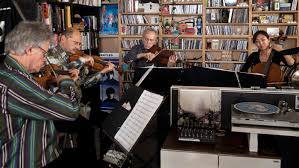
 socks kronosSOUNDTRACK: KRONOS QUARTET-Tiny Desk Concert #322 (November 25, 2013).

2013 was the 40th anniversary of Kronos Quartet.  I first heard of them about eight years after they started with their cool arrangement of “Purple Haze.”  And then I learned that they were like a sponge, soaking up and playing music from all over the world: In just one year they released albums with tango, songs by South African composers, Polish composers, jazz musicians and so much more.

I have many of their releases, although I realized I more or less stopped listening to new stuff from them around the turn of the century (since when they have released some 16 albums!).

Well, amazingly, the Quartet is still the same original players (except for the cellist–the cello is like Kronos’ drummer as they seem to replace her every couple of years).

They play three pieces here and the three range the gamut from dark and broody to rather sweet to quirky.  In other words, typical Kronos.

For more info:

The musicians —  David Harrington (violin) and longtime members John Sherba (violin) and Hank Dutt (viola) and new (as of 2013) cellist Sunny Yang — could reminisce over more than 800 new works and arrangements they’ve commissioned in 40 years. But instead, the new-music train pushes ever onward to new territories. They remain a living, breathing world-heritage site for music.

Now in the midst of its 40th-anniversary tour, Kronos brings to this Tiny Desk Concert a new arrangement, a work from a new album and, for Kronos, something of a chestnut, a piece the group recorded a whopping five years ago.

“”Aheym” (Yiddish for “homeward”) was written for Kronos by Bryce Dessner; a member of the Brooklyn rock band The National, he studied composition at Yale. The music thrives on nervous energy, pulsating with strumming and spiccato (bouncing the bow on strings) while building to a tremendous fever.”

I love this piece. It is intense and dramatic with its 4-3-3 bowing from all four members.  There’s an interesting cello melody with pizzicato strings from the rest.  The overall melody seems somewhat circular with different instruments taking on different leads.  But this song also plays with some interesting bowing techniques.  In addition to the spiccato (about 4 minutes in), the players drag the bow for momentary scraping and scratching sounds.

Another wonderfully dramatic moment comes at 7 minutes where each musician takes a turn bowing his or her note while the violin plays a super fast series of notes.  The song builds and build in dramatic until it gets to about nine and  half minutes and it reaches its powerful ending.

“Lullaby,” opens with plucked cello notes and strummed viola.  “It is a traditional song with Afro-Persian roots (from the group’s Eastern-flavored 2009 album Floodplain), [and] is woven from different cloth altogether. Colorful tones that lay between our Western pitches are threaded through the music, anchored by a gorgeous solo from violist Dutt; his contribution takes on the warm and weathered sound of a grandmother singing to a child.”  It is slow and moody and beautiful.

Harrington introduces the final piece by saying it’s by a performer that no one had heard of–including, until recently, even himself.

“Kronos caps off the concert with another hairpin turn, this time to a fresh arrangement of “Last Kind Words,” a little-known blues song from around 1930, recorded by singer and guitarist Geeshie Wiley. In Jacob Garchik’s exuberant arrangement (which Kronos premiered this fall), interlocking strums and plucks provide a kind of rhythm section, while Harrington’s violin stands in for the now-forgotten blues singer.”

There’s lots of plucked notes from everyone–including plucked bent note on the viola which gives it a real “early” guitar sound.  While I don’t know what Geeshie sounded like, so I can’t compare the violin to her vocal, the whole thing sounds great together.  In fact the whole thing is unlike any string quartet I’ve heard–so different and wonderful.

I’m going to have to bust out so Kronos CDs.

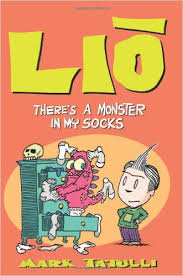
[READ: September 10, 2016] There’s a Monster in My Socks

I’ve been quite puzzled about the publication history of the Liō books.  And this just adds another layer of confusion.  This book covers the exact same time period as Happiness is a Squishy Cephalopod which was published in 2007.  The difference is that Cephalopod placed all of the strips in order, while this one seems to move things around quite a bit (the thinner format also means that it can’t quite handle the single panel strips very well.   But more egregious is that this volume (remember, the one printed after the previous one) prints the Sunday color strips in black and white.

The book also leaves some of the strips out.  It covers the date range from May 15, 2006 – Feb 16, 2007 (Cephaolopod went to May 23), but while it has the Feb 14 strip, it does not have the Feb 15 strip.  Weird.

So, basically this is an inferior version of the same book, but the publishers presumably wanted the books in this more friendly size (or some other nefarious reason).

I’ll include the review of Cephalopod below.

And, here’s the current list of existing Liō books. It’s a shame that there are years and years of strips thus far uncollected. (more…)

Read Full Post »

dressSOUNDTRACK: IMANI WINDS-Tiny Desk Concert #277 (May 29, 2013).
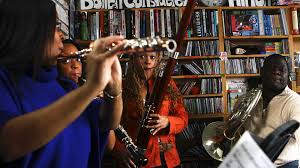
windsFor some reason this video and audio has been removed from the NPR site (no explanation is given).  But I found it elsewhere and was able to really enjoy it.

But they have left up the blurb:

When Igor Stravinsky began composing The Rite of Spring, his ballet for vast symphonic forces, he could hear the music in his head but couldn’t quite figure out how to write it down. It was just too complicated.

Today, 100 years after The Rite‘s premiere, the fearless musicians of Imani Winds make it all sound remarkably easy, given that they’ve condensed Stravinsky’s massive walls of sound down to just five instruments: bassoon, clarinet, flute (doubling on piccolo), oboe and French horn.

Make no mistake: Many of the jagged rhythms and crunching chords remain viscerally intact, albeit on a more intimate scale. As the group huddled behind Bob Boilen’s desk, bassoonist Monica Ellis noted the opposing ratios, saying, “It’s apropos in some strange way that we are playing one of the most massive pieces in some of the smallest instrumentation in one of the smallest settings that it could possibly be played in.”

The setting might be small, but in this clever arrangement by Jonathan Russell, we learn that a wind quintet, when called upon, can make a mighty and sonorous wail. Just listen to how the Imanis cap off “Dances of the Young Girls” with the entire quintet in full cry (at about 4:30 into the video). The bassoon repeats a fat bass line while the clarinet runs its snaky scales. The piccolo, in piercing chirps, serves as a foil to a frenzied oboe and snarling “whoops” from the French horn.

But not everything in The Rite is all pound and grind. Stravinsky’s transparent introduction, almost impressionistic, is a fluttering aviary of winds — even in the original — with individual colorings for each instrument. It’s all rendered beautifully here by Imani Winds, musicians brave enough to play David to Igor Stravinsky’s imposing Goliath.

This concert is fascinating to watch (and listen to) because even though this piece is familiar (to me) in theory, it’s apparent that I don’t really know it.  And I can see why this piece was so controversial when it came out–it is weird and chaotic and almost random at times.  I imagine that seeing it as a ballet might make it more cohesive, but it’s still pretty out there.

I love that the bassoon seems to be the primary instrument–one that doesn’t typically take center stage.

The group breaks up their selections into three primary chunks.

Selections from The Rite of Spring:

For “Introduction” the bassoon is the primary instrument playing the initial melody.  Then the clarinet and oboe give the whole thing an unsuaul sound–to say the least.  The French horn actually works as the the bass for this part.  It’s also neat watching the flautist switching between flute and piccolo.  I’m not sure when the second part “Augurs of Spring” begins, but I assume it’s when the bassoon repeats that initial melody and then the French horn plays a staccato bass note. The music sounds kind of threatening but whimsical at the same time.

Somewhere in here “Dances of the Young Girls”  begins.  I assume once the piccolo starts chirping and swooping.   And then the band grows very loud before abruptly stopping.

The second segment she describes as incredibly picturesque. “Ritual of Abduction” begins nosily with almost total chaos from all the instruments–the piccolo stands out as sharp and piercing.  As with the other segments, I’m not sure when “Spring Rounds” begins, but I have to wonder if this is when the music seems to go circular and then slow down. There are low notes from the French horn while someone is playing accent notes that sound, not off, but dissonant–providing stark contrast with the rest of the slow movement.  There are some blares of music from the French horn as well.

I’m guessing that “Dancing Out of the Earth”  begins with the fast bassoon melody: up down up down up down up down with trills and swirls from the flutes and clarinet.  It rises and rises very dramatically and then stops.

They tell us that it’s not possible to play the entire ballet so they have taken the “greatest hits” and for this show it’s the greatest hits of the greatest hits.  Consider it a deconstruction with five instruments. But it still evokes the spirit of this sacrificial dance.

She talks about how controversial this was in 1913, “when ballet was meant to be about… I was going to say flamingos…. fairies swans, the other water animals.”   This is the final moment the virgin who sacrifices herself dances herself to death.  And they are going to exemplify trombones and timpani and all that loud stuff (the French horn player laughs and says “Grr I am trombone”).

“Sacrificial Dance: The Chosen One” begins with a three note melody–again it is somewhat threatening.  There’s lots of little fast runs by the French horn with accents from everyone else.  It stops dramatically at one point and then resumes with so many different melodies.  And then comes the surprise ending with a rising flute line and then a low end from the horn.

Without taking away anything from Imani Winds, I ‘m sure this performance doesn’t do the whole thing any justice.  But it is amazing to imagine how much more there is to it.  And it is amazing that these five instruments can evoke so much.  It’s an uncomfortable and somewhat shocking first listen.  It’s amazing that is over 100 years old, although it sounds so contemporary.

I don’t know why it’s not on NPR any more. I found it on YouKu (whatever that is).  I have been able to watch it twice but on two other times I was unable to watch it.  So keep trying, it’s worth the effort.

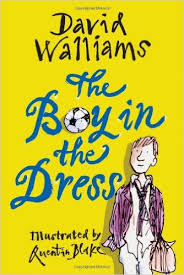
[READ: May 5, 2016] The Boy in the Dress

David Walliams is best known (if he is known at all) as the tall one on the sitcom Little Britain.

I had no idea he wrote books (he has done over half a dozen children’s books), and I was happy to start with this, his first one.

This book is illustrated by Quentin Blake, who is best known (if he is known at all) as the illustrator for the Roald Dahl books.  So his simple, somewhat sloppy, style might look familiar.

The story is, as the title suggests, about a boy who wears a dress.  And the story is very funny–not because it makes fun of him for wearing a dress, oh no.  In fact, I love the story for going out of its way to show that it is normal that a boy might want to wear a dress. (more…)

Read Full Post »

« Newer Posts - Older Posts »