Feeds:
Posts
Comments

Archive for the ‘Canadian Music’ Category

silence THEE SILVER MT. ZION MEMORIAL ORCHESTRA & TRA-LA-LA BAND-13 Blues for Thirteen Moons [CST051] (2008).

330px-13_Blues_for_Thirteen_MoonsThis album opens with 12 tracks of a kind of feedbacking noise.  The total time for this is about a minute before track 13 begins.  And this album feels very different from the more acoustic Horses.  Whereas Horses felt acoustic and organic, this album is noisy and raucous and very electric.  After the 12 brief tracks there are four lengthy ones that comprise the album.

“1,000,000 Died to Make This Sound” starts with scratched notes and pizzicato strings.  The choir quietly begins singing the title “one million died to make this sound.”  Their voices grow louder and then at about 3 minutes in there’s a great bowed riff that introduces the more rocking section–a guitar “solo” and drums as that bass riff continues.  About mid way through the song it takes on a real rocking feel–the guitars rock out and the steady beat keeps up.  The song feels sloppy and intense–like they couldn’t wait to get this out.  I would describe the song as fun (except that it’s pretty bleak).  Efrim’s voice sounds a bit like Johnny Rotten or some other British punk) on this song and the punk style suits it well.  I really love the way the violin-swells make the riffs even bigger until about 9 minutes when the song shifts dramatically again and it feels like a Crazy Horse jam–big, sloppy, noisy guitars.  The song reaches a sort of natural stopping point as the music all fades away and the voices resume–I love the choir of voices at the end of the song (although perhaps Efrim’s voice could be a tad quieter?  Efrim’s voice seems to be a polarizing thing for fans of this band.  I’m even polarized about it on different songs–sometimes I think it’s too much, but other times I think it works well.

“13 Blues for Thirteen Moons” is 16 minutes long.  It begins with thumping drums and bass before Efrim’s voice comes chanting in.  The song is noisy and chaotic–lots of drums and cymbals and then the backing vocals start a call and response with the lead vocals.  The song continues in the same vein–with a refrain of “I Just Want Some Action” but then around 5 minutes a big distorted guitar plays a kind of concluding riff before a quieter guitar begins a new section with some quiet picking.  And its in this section that the album title is sung.  This quiet guitar section goes on for quite a while with Efrim shouting various parts–and then second voice joins him.  It’s unusual that the band will play the same riff through so much of a song, but it’s a good riff.  The whole band picks up the riff as it grows louder and more rocking.  The final two minutes are filled with feedback and quiet guitars with Efrim shouting syllable after syllable until it feedbacks to an end.  It’s a pretty intense song.

“Black Waters Blowed/Engine Broke Blues” opens in a much quieter way with slow revered guitars.  The vocals are also slow and accompanied by a lone cello.  But after a minute and a half chaos erupts in the song–feedback squalls and wild guitars accompanied by chaotic drumming make the song sound like it is tripping over itself , but it soon resolves to a quiet part like the intro–this time with two singers.  The song builds again, with the chaotic drums fighting for dominance over the string section.  But they both cede again to the quieter vocals once more.  The band then acts in concert building the song and allowing the vocals to continue.  And after a musical interlude, the vocals begin again over a quiet organ.  And this next section builds as strings accompany the louder vocals and the drum gets a pounding martial beat.  The final section, which appears to be the “Engine Broke Blues” is a repeated refrain of “Building Trainwrecks in the Setting Sun.”

The final song “BlindBlindBlind” also opens quietly, with a simple guitar motif.  As the vocals continue, a ringing guitar and a feedbacking guitar join the song (each in a different ear).  And then a violin adds to the melody.  About 4 minutes in, the melody shifts to an organ heavy section with the lead vocal followed by backing vocals.  A pizzicato section begins next.  What’s interesting is that the vocal melody hasn’t really changed this whole time (in this song Efrim again sounds a bit like a British punk rocker).  At around 7 minutes, the song turns towards the end, with strings and drums.  This end bit is my favorite part on the record, not only for the melody, but for the excellent backing chanting.  The backing vocal melody is very cool in itself–I love when they add the high notes–repeating the refrain “Some hearts are true” over and over.  A guitar solo interrupts the proceedings for a bit and then they resume singing all the way to the end.  It’s a very cathartic conclusion.

For this album, the lineup stayed the same although Eric Craven replaced Scott Levine Gilmore on drums.

Back in 2009, I wrote a post about this album.  It’s pretty brief and mostly talks about the singing.

[READ: March 1, 2016] The Silence of Our Friends

This was the final First Second book that I had in a huge stack that I took out from the library.  I had been putting this book off because I was nervous about reading it.  Nothing pretty is going to happen in a Civil Rights book and I had to prepare myself for it.  Obviously, the era is staggeringly important–even more so today with the kind of political rhetoric being shouted around.  That’s not why i didn’t want to read it.  I was afraid about how ugly this book might get.

But in fact, this book doesn’t go in that direction at all.  It is a factual story and while it looks at racism, it also shines a light of hope on race relations. It’s another excellent graphic novel from First Second [#10yearsof01].

What I did not know is that this story is based on actual events–the author’s father was a journalist in Texas during a serious Civil Rights confrontation.  And his father was able to help offset a travesty of justice.  He risked his career and even his own safety to do the right thing.

Set in Houston in 1968, we see some kids playing army in the yard.  This is also during Vietnam, so that’s probably not a very uncommon sight.  When the kids go inside, their mom is watching the Saigon execution on TV.  She is horrified and begins crying. The talk that night is of the atrocities of war. (more…)

Read Full Post »

alieeenSOUNDTRACK: THEE SILVER MT. ZION MEMORIAL ORCHESTRA-Hang On to Each Other EP [CST105] (2014).

Hang_on_to_each_otherI try to go in sequence with a band’s records.  But this release is, inexplicably, a dance remix Ep of a song from the album Horses in the Sky.  The original is basically an a capella song with a harmonium.  Efrim sings the main melody and the chorus sings the repeated refrains.

It’s pretty cool and the spareness of it really resonates.  About four minutes (of 6 and a half), the refrain switches to “any fucking thing you love.”  Then about 5 minutes in he switches to “birds toss precious flowers from the murky skies above” while the chorus starts singing, “Any fucking thing you love.”

This EP features vocals by Ariel Engle of AroarA, and virtually nothing of the original song except the words.

The first side “Any Fucking Thing You Love” is 11 minutes long and is as promised, a dance remix.  And it is a serious, get your butt on the dance floor remix.  No irony, no winking, just butt shaking.

It opens with roars and a boat (ocean liner) whistle and then some dance drums.   Then there’s what sounds like lions roars, a middle-eastern-sounding instrument and screams.  Then the female vocals come in singing “Hang On To Each Other.”   The majority of the song is an instrumental dance section with washes of keyboards and drums.  There’s roaring noises as the beat keeps up the pace.  About 9 minutes in she starts chanting “Any fucking thing you love” and the song continues to dance on until the feedback sounds at the end.

Side two is “Birds Toss Precious Flowers” which opens with that same boat whistle.   Some skittery keyboards come in and out and then a big bass drum starts keeping the beat.  It doesn’t start getting dancey until after about 90 seconds.  That’s when the vocals come in—echoey and very cool.  About four minutes in the music cuts away and it’s just the thudding bass drum and vocals, then the song picks up again  At around 7 minutes the “birds fly” part kicks in.  The song turns really dancey with a vocal solo   The last two minutes are more or less the keyboard winding going through a very slow reverb pedal.

Of the two, I like the second one better as there’s more interesting things going on, but I have to assume that the first is a better club song.

[READ: February 15, 2016] A.L.I.E.E.E.N.

Lewis Trondheim found this book while on vacation.  It is the first collection of extraterrestrial comic strips every discovered.  And Trondheim convinced First Second to publish it [#10yearsof01].

A.L.I.E.E.E.N. stands for Archives of Lost Issues and Earthly Editions of Extraterrestrial Novelties.  (The book was originally published in France with the title A.L.I.E.E.N.)

The book is adorable, with cute and cuddly aliens creatures on a fascinating world.  There’s a blue four-legged guy and a yellow two-legged guy with a long tail and they are frolicking amidst butterfly-looking creatures.  The aliens only speak in alien tongue (I wonder if the characters can be translated or if it is just gibberish).  Then on page two, the blue guy runs into a tree and has both his eyes poked out in pools of blood.

WHAT?! (more…)

Read Full Post »

leotardSOUNDTRACK: THEE SILVER MT. ZION MEMORIAL ORCHESTRA & TRA-LA-LA BAND-Horses in the Sky [CST033] (2005).

This album is described as 330px-Horses_in_the_Sky_album_cover “6 busted ‘waltzes’ for world wars 4 thru 6” … the “first song’s about war and drug addiction, fourth song’s about kanada, and the rest of it is all love songs.”

This album proves to be their folkiest and most organic sounding album.  The songs are mostly pretty mellow, including one that was recorded at a campfire.

“God Bless Our Dead Marines” opens the disc.  It’s 12 minutes long and begins “They put angels in the electric chair, the electric chair.”  The melody is pretty catchy and the accompanying minimal strings accentuate the song nicely.  About 90 seconds into the song, the drums come in and the song takes on a rumbling field.  The vocals are repeated a lot, and Efrim’s voice is placed nicely in the mix.  The middle of song takes on a kind of shanty quality with lots of clapping and a loud electric guitar.  Around 3:30 the song stops and a new melody comes in, primarily on bowed bass.  The sound of this section is spare but very cool.  The piano returns (this is one of the first songs in a while to rely so heavily on piano) and a new melody (including the title of the song) is sung (again, a very catchy folk-song kind of melody) with occasional guitar chords.   The lyrics are also pretty straightforward and poetic.  While in no way suggesting this song could have been popular, it is certainly approachable and fairly conventional (even at 11 minutes).  At 9 minutes the song is stripped of all music except piano.  And several rounds of voices begin singing “when the world is sick, can no one be well, but I dreamt we were all beautiful and strong.”  When the third set of voices (these are bass) come in, it really sounds great.

“Mountains Made of Steam” opens with guitar harmonics and a contrasting simple guitar melody.  The vocals come in about 90 seconds in.  The song is also surprisingly stripped down.  The voices and bass grow a little louder at around 3 minutes, but not in a building and building kind of way.  After a few rounds of “Ya di da di di’s,” the instrumental section swells.  It is loud and soaring but not big the way GYBE is.   The low resounding bowed bass in this song is really fantastic–it’s very big and round and really satisfying

“Horses in the Sky” opens with acoustic guitars and Efrim singing quietly.  It sounds like a very traditional folk song.  There’s a second voice singing harmony (just about everyone is listed as doing vocals).  The lyrics sum up the tone of the song, “Schools look like prisons and our prisons look like malls / Downtown just a sick parade where no one cares at all.”  This is one of the few songs from the band that doesn’t really change over the course of the whole song (some keyboards are added, but it is otherwise pretty much just guitar and voice).

“Teddy Roosevelt’s Guns” starts with echoed guitars and strings and the vocals: “Kanada oh Kanada I ain’t never been your son.”  Strings slowly fill out the melody as more voices start singing that above refrain and Efrim’s indictments mount.  This continues with some swirling strings until about 7 minutes when the drums start pounding out three note blast.  When the vocals come back in, they are the harshest on the album, both from the lead and backing vocals.

“Hang on to Each Other” was recorded “next to a campfire by the river” … “at Garfield’s fire pit.”  You can hear the fire crackling as the song begins.  There’s some simple “ba dum da da dum” vocals before a harmonium grows louder.  Aside from that instrument, it’s otherwise almost entirely a capella with various voices singing different parts, primarily “hang on to each other,” “any fucking thing you love” and “birds toss precious flowers from the murky skies above” in various rounds and harmonies.  It’s really quite a moving song.

“Ring Them Bells (Freedom Has Come and Gone)”  is 13 minutes long.  The song opens with slow strings.  A voice, which follows  a piano melody, sings the “freedom has come and gone” part.  The song feels fuller than the rest of the album with strings and bass filing the background.   The instrumental part is the biggest and most dramatic on the record with swelling strings and occasional guitars ringing out until 4 minutes in when everything drops out except for one violin and a bass and a new vocal melody.  But soon enough a buzzy electric guitar comes in to add more drama to this song.  And then it quiets down again, with staccato guitar and strings getting softer and softer until it fades out entirely for a few seconds.  And then a new guitar line begins.  It is replaced by single piano notes and wild (but quiet) feedback.  Efrim sings over as the feedback builds louder and louder until the screeching end.

This is definitely one of my favorite overall SMtZ albums.  Even if it is quieter and less diverse than other ones, the melodies and song structures are really solid.

The band is back up to seven people for this recording with all of the former players playing but with Scott Levine Gilmore on drums.

  • Thierry Amar – contrabass, glasses, harmonica, voice
  • Becky Foon – cello, voice
  • Ian Ilavsky – guitar, harmonium, voice
  • Scott Levine Gilmore – drums, percussion, guitar, mandolin, voice
  • Efrim Menuck – guitar, piano, voice
  • Jessica Moss – violin, piano, glasses, voice
  • Sophie Trudeau – violin, trumpet, glasses, voice

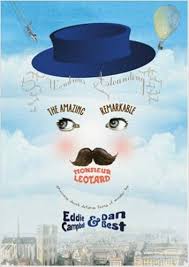
[READ: May 3, 2016] The Amazing Remarkable Monsieur Leotard

Eddie Campbell wrote The Black Diamond Detective Agency which I enjoyed, and The Fate of The Artist, which I enjoyed even more.  Both were pretty unusual–lots of different things going on.  Well, this book has even more stuff going on in it.

I genuinely didn’t know what to expect from this.  I assumed it would be a biography of Jules Léotard, the daredevil acrobat who developed the art of trapeze, popularized the one-piece item that bears his name and was the inspiration for the song “The Daring Young Man on the Flying Trapeze.”

But in this book that Jules Léotard dies on page 12.  Upon his deathbed, with no will written, his worldly possession (a fake mustache) is bequeathed to his nephew, Etienne.  So Etienne puts on the mustache and flies to Paris (in a hot air balloon, of course) to join Leotard’s troupe of circus performers.  When he finds out that they have eaten most of the animals because they were starving, his plans change somewhat.

And so this book is all about Etienne pretending to be the (possibly reincarnated) amazing Léotard and the fascinating adventures he gets up to. (more…)

Read Full Post »

ninthSOUNDTRACK: Thee Silver Mountain Reveries-The “Pretty Little Lightning Paw” E.P. [CST030] (2004).

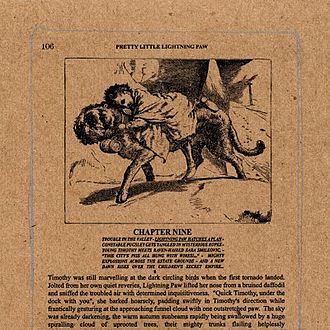
lightpawAfter three albums, it was time to make an EP under yet another variant of the band’s name.  This is a fun release (which is interesting to say about a band who is typically quite serious).  What made this “fun” is that many of the band members switched instruments for this recording. Violinist Sophie Trudeau plays bass guitar.  Guitarist Ian Ilavsky, usually one of the band’s guitarists, plays drums.

Also when they finished recording, was complete, the EP was played on a boombox and re-recorded from that.  I can’t tell that it was recorded in this way, so who knows if that made any difference.

There are four songs, “More Action! Less Tears!” is the first.  It begins with Aimee shouting “Hello!  Hello!” and then messing up and laughing.  So she begins again, “The name of this song is More Action.  The name of this song is Less Tears.”  It sounds unlike anything that SMtZ have done so far.  The guitar that opens it is distorted and plays a fairly conventional riff while the violins play a suitable melody over the top.  The strings build and the songs oars.

“Microphones in the Trees” opens with a guitar melody that’s quickly joined by the same melody on upright bass.  Efrim begins singing (his voice is distorted and echoed and sounds almost more like an instrument than a voice, although you can hear the lyrics: “microphones in the trees, cameras in the sky.”  The choir starts singing along with him until about three minutes when a wash of noise over takes the song. This lasts for a few minutes and then fades, allowing the words to continue.  About half way into the song a rather shambolic chorus sings “we are the flood.”  The last two minutes or so are simply feedbacky noises wafting around.

“Pretty Little Lightning Paw”is the ten-minute title track.  It opens with bass notes and chimed notes.  The strings follow Efrim’s vocal lines (which sound ragged and quiet).  And then after a minute or so new strings come in, slightly unsettling sounding.  About three minutes in the 4 voice choir begins singing an alternate melody above Efrim’s repeated mantra.  The song continues in this vein for pretty much the rest of the song, only modifying at the end where the sounds and feedback resemble birdsong.

“There’s a River in the Valley Made of Melting Snow” is 5 minutes long and is basically a solo song from Efrim.  He plays guitar, sings and plays “toybox.”  The melody is fairly simple and his voice sounds pretty good–not too shrill.  It may be the most conventional song that SMtZ has recorded.

While this EP doesn’t deviate drastically from the band’s normal sound, it is fun to see them mix things up a bit.   For this recording, the band was

  • Thierry Amar – violin, bass guitar, vocals, pianohandle
  • Ian Ilavsky – drums
  • Efrim Menuck – guitar, piano, organ, vocals, feedback, toybox
  • Jessica Moss – violin, vocals
  • Sophie Trudeau – bass guitar
  • [Beckie Foon is absent]

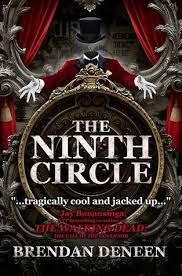
[READ: May 5, 2016] The Ninth Circle

Brendan and I went to college together.  In fact, I knew Brendan from his submissions to both the newspaper and the literary magazine.  He was a major talent back then (I still remember details from the story he submitted twenty some years ago) and continues to be one now.  He works in comics and has written for Flash Gordon, his own book Scatterbrain and something that I can’t wait to find a copy of: Charlie Sheen: Vatican Assassin Warlock.  Check out his output on Goodreads.

This is his first published novel, I believe. And I was hooked from the first chapter.

The story is about 16-year-old Dan.  His family is a disaster–his brother is obsessively mean to him, his father is an alcoholic, his mother is probably sleeping with someone else, and neither parent gives him the time of day.  For his 16th birthday they take him to the circus, even though he never said he wanted to go to the circus.  His brother promises to get revenge for having to go to this lame spectacle.

Dan’s not even sure that he’s going to like it, but he winds up being mesmerized from the moment he walks in.  The trickster tricks him, the freaks entice him (he finds the bearded lady especially enchanting) and the whole show is truly amazing.  Later that night, while lying in bed thinking about his crappy life, Dan decides to take action. (more…)

Read Full Post »

breachSOUNDTRACK: THE SILVER MT. ZION ORCHESTRA & TRA-LA-LA BAND (WITH CHOIR)-“This Is Our Punk-Rock,” Thee Rusted Satellites Gather + Sing, [CST027] (2003).

MtzionthisisourThis album is a pretty massive change for A Silver Mt Zion.  It both brings this band closer to their alter ego GYBE but also pushes them further away at the same time.  How?  Well, musically, this album sounds a lot more like GYBE–epic songs all over ten minutes with lots of strings and soaring moments.  But the big difference now is that every song has vocals (hence the new title of the band).  The line up has stayed the same although they have many guests for the choir.  The choir is referred to on the album as Thee Rusted Satellite Choir.

“Sow Some Lonesome Corner So Many Flowers Bloom” opens the disc with someone counting of “1234… 12345678.”   And then a simple guitar and bass melody starts up.  The song sounds fairly conventional, in fact.  And then the choir kicks in.  Many many voices singing, “Ahhhh.”  And then a solo voice continues the “Ahhhs” in another pitch while the choir continues.   I love this whole introduction–the various keys the voices are in, how the bass voices start singing “fa fa fa la la so” and on and on in varying formats.  The choir (a bunch of friends and bandmates) sounds great–not perfect but perfect for this song.  This lasts for about 7 minutes before the choir fades and the rest of the song begins with a swelling of droning music.  Strings come in and the song stays quiet for a couple of minutes before the guitar riff from the beginning returns this time with string accompaniment instead of voices.   Around 12 minutes the strings change to something else–more grandiose music which sounds amazing.  About a minute later the drums begin and the song takes on a whole new style.  This more rocking sound continues until the end of the song.  It’s awesome.

“Babylon Was Built on Fire/StarsNoStars” opens with staccato echoed guitars (it also feels a bit like Pink Floyd).  There’s ambient washes of guitars that float around, but the whole things sounds very trippy (not a sound I associate with this band).  About six minutes in, Efrim begins singing.  This is the first time he’s sung quite so loudly and clearly.  His voice is anguished and a bit harsh, but it works pretty well with the violins and the cool bassline that walks throughout the song.  With about 4 minutes left, the music changes direction.  The guitar starts playing a single note, growing louder and louder as the strings surround the guitar and voice: “Citizens in their homes and missiles in their holes.”  Efrim (I assume) sings a round with himself as more and more lines of text fill the song.  Although his voice doesn’t sound radically different in each one, he does adjust volume and tone enough to make it sound pretty interesting.

“American Motor over Smoldered Field” is the shortest song on the disc at 12 minutes.  It begins with a simple acoustic guitar melody (quite pretty) and Efrim singing over it (I appreciate the different vocal styles in this song).  It’s really quite a compelling song as that guitar continues and the strings come in behind it.  Around four minutes in, the drums crash and the song takes off.  The strings change and the song becomes very intense–faster and louder.  This lasts about three minutes before a staccato guitar picks up and choral voices are heard way in the background.  The voices (all Efrim, I believe) build and build as the guitar maintains.  Around nine minutes the strings and guitars change and the song flows as a new vocal line joins in “this fence around your garden won’t keep the ice from falling.”

The final song, the 14 minute “Goodbye Desolate Railyard” also opens with acoustic guitar and Efrim’s vocals. The song (an elegy for a dying city) remain simple–acoustic guitar, simple violin and bass notes.   The song is repetitive, lulling the listener into as sense of contentment.  Although at around 5 minutes, the violins swell and become a little unpleasant–kind of harsh and a little staticky.  This continues for some 5 minutes until it is replaced by the rather close up sound of a freight train going slowly down a track.  After two minutes of this, the acoustic guitar returns with Efrim singing (in a very Neil Young kind of voice) “every body gets a little lost sometimes.”  The full choir joins in to sing these final words for a several rounds before fading out.

[READ: May 10, 2016] Breach Point

Steve and I are pals of Facebook.  If I may wax jealous for a minute, Steve has done everything that I’d ever wanted to do when I was younger–he’s been in a band (cuppa joe–they released several really good albums); he’s a graphic designer, something I always imagined being when I grew up; and now he has written a novel.  So, yes, basically I hate Steve.  Except that, of course, I don’t hate Steve.

I hate him even less because this book is not only really good, but it has brought back a part of my childhood that I had forgotten about.

When I (and anyone else who grew up in the New Jersey area in the 70s) was a kid, there were always commercials for Brigantine Castle in Brigantine NJ.  The commercials scared the hell out of me and I was always terrified to go to this place.  I knew it was down the shore but never exactly where.  And there were times when we drove to the shore and I was convinced we were going to the castle instead (totally false, Brigantine was way further north than any beach we would have gone to).  And then Brigantine Castle burned down.  Interestingly, after watching these commercials again coupled with The Haunted Mansion (another commercial played quite often), I learned that the Haunted Mansion was in Long Branch.  I never went to that Haunted House either, although I have since been to the convention center that now stands where the Haunted Mansion once stood before it burned down.

Yes, Both Brigantine castle and the Haunted Mansion burned down.  People know what happened in the Haunted Mansion fire, but the Brigantine Castle fire is shrouded in mystery.

This is all a long way to say that Steve has written a book that is based around this mystery.

Clara is a 16-year-old girl who travels to Breach Point for the summer.  She has gotten a job at an engineering firm and she is going to live with her Aunt Maureen.  When the book first opens, we see her on the bus, happy to get away from her mother and excited but nervous about gong to this place that she vaguely remembers. (more…)

Read Full Post »

earnestSOUNDTRACK: THE SILVER MT. ZION MEMORIAL ORCHESTRA & TRA-LA-LA BAND-Born into Trouble as the Sparks Fly Upward [CST018] (2001).

Born_into_Trouble_as_the_Sparks_Fly_UpwardNotice that the band’s name has gotten longer.  That could be because they have added three new members (which means they are slowly growing to be the size of GYBE anyway). In addition to Efrim, Thierry and Sophie, there is now Becky Foon on cello, Ian Ilavsky on guitar and organ and Jessica Moss on violin (all Constellation stalwarts).

The first song is the nine minute “Sisters! Brothers! Small Boats of Fire Are Falling From the Sky!”  Echoed drum sounds slowly grow louder before a slow violin plays a mournful melody.  But with the new members, there is now a cello to accompany the violin, making this album sound even more classical.  Three minutes in, the piano takes over (and the strings slowly fade).  The piano is a bit prettier and more accomplished sounding (even if it has only been a year since the last album).  Despite the addition of all of the extra instruments, the song still veers pretty far from GYBE territory.  It feels very acoustic (what with the piano), and while the song is repetitive it never feels like it is epic or building towards something–it just grows bigger and more beautiful as more instruments enter the mix.

“This Gentle Hearts Like Shot Bird’s Fallen” opens with what sounds like bird noises, but may actually be a child.  The song is primarily echoed guitars which lay a foundation over which the violins and cellos play slow mournful notes.  The song grows as more instruments  play along, including some gentle percussion, and it all seems to end too soon.

“Built Then Burnt [Hurrah! Hurrah!]” is a spoken piece.  Efrim doesn’t recite the words–it sounds like a child (but may be a young woman).  The reading is dramatic and works very well with the slowly building strings that comprise the bulk of this song.

some lines:

Why are we all so alone here
All we need is a little more hope, a little more joy
All we need is a little more light, a little less weight, a little more freedom.
….
Good words, strong words, words that could’ve moved mountains
Words that no one ever said
We were all waiting to hear those words and no one ever said them
And the tactics never hatched
And the plans were never mapped
And we all learned not to believe
And strange lonesome monsters loafed through the hills wondering why
And it is best to never ever ever ever ever ever ever ever ever ever wonder why

As that song fades, the aggressive strings of “Take These Hands and Throw Them in the River” take over. This song features Efrim singing in full voice–the recognizable voice of SMtZ.  On this song his voice is processed and echoed and so the strange timbre of his voice doesn’t quite register because it sounds so…unusual anyway.  I really enjoy the way this song sounds so much bigger than the rest.  At around 4 minutes, while the song begins to build –both instrumentally and vocally, new strings bring more intensity until the whole thing just fades away to the sounds of actual birds which chirp for about 2 minutes.

“Could’ve Moved Mountains…”is eleven minutes long and shows incredible restraint, especially in the vocals.  It opens with slow bass notes.  The whispered spoken vocals return and the song is kind of ominous..  About three minutes in quiet harmony vocals accompany him and soon after, strings are added and continue to grow louder.  The instrumental section is quite pretty although still melancholy.  Around 8 minutes in, a guitar riff begins playing a similar melody to the strings. It plays for a bit and then the strings rejoin the song, playing a more hopeful melody.  The song ends with some kids talking and singing as the song melds into….

“Tho You Are Gone I Still Often Walk W/You”  This song opens with piano and cello, a sad intro indeed.  I like that after a minute the song jumps keys unexpectedly while keeping the rhythm otherwise the same.  The song doesn’t vary much from this simple piano and strings feel although it ebbs and flows in intensity.

“C’monCOMEON (Loose An Endless Longing)” breaks the melancholy of the previous son with a big buzzy electric guitar chord.  Strings eventually come in and the song builds and builds, complete with interesting percussion.  This song is probably the closest to a GYBE song with a dramatic build and very satisfying chord progressions.  When the fast bass notes kick in around 3 minutes it seems like the song is going to grow even faster, but instead, it fades away to some ringing chimes–what sounds like a giant echo chamber (a really neat effect).  That calm is broken by a series of horns playing one note at a time, louder and louder (this whole middle section reminds me of the middle of “Atom Heart Mother” by Pink Floyd–in fact I have found a number of comparisons to some of Floyd’s trippier moments on this and other albums).  And then the drums come crashing back in.  It’s a very different song that resumes–loud bass, lots of drums and everything mixed loud enough to distort the sound.

The final song is “The Triumph of Our Tired Eyes.”  It opens with guitar harmonics and Efrim’s disatnat voice.  It’s a pretty and delicate song, joined by strings and a genuinely pretty vocal melody: “There’s beauty in this land, but I don’t often feel it.”  And as the strings swell and swell, the voices sing the refrain: “musicians are cowards” over and over.  The song and disc end on a surprisingly quiet and beautiful note.

When the songs ends, there’s a few seconds of children singing lyrics to the “Twinkle Twinkle Little Star” melody although the words don’t fit like: “when we finally cross the barricade…”

I really like the way this album plays with the new style of music the band has embraced but also admits some of the strengths from pretty much everyone else’s other band.

[READ: April 4, 2016] The Importance of Being Earnest–The Graphic Novel

This play is one of the great plays in English literature.  Oscar Wilde is at his best, writing witticism upon witticism–each line is a funny rejoinder to the previous one and the wit is infectious.

The story is fairly simple, but he adds so many twists that it’s almost easy to get lost in the story.  In fact, it’s entirely possible that reading the play is a sure way to get lost in the deceptions.  And that’s why this graphic novel is so excellent.

I’ve always maintained that it is difficult to “read” a play, especially if there are dozens of characters.  The short, one act plays that I’ve been reading over the last years are fairly easy to follow, but when you have 20 named characters in three acts, it’s not always easy to keep people straight.  And that’s why to really appreciate Shakespeare you need to see it.  Well, this graphic novel effectively performs the play for us.  The dialogue is exact and there are no changes from the original (except for any stage directions, which are left out of the text, but are presumably addressed in the art).

What’s (intentionally) confusing about this play is that the two main characters are trying to deceive other people about their identity.  Algernon Moncrieff and John Worthing are two gentlemen–well off, single, clever.  Algy talks about how he likes to go Bunburying.  Which means he has “invented an invaluable permanent invalid called Bunbury, in order that I may be able to go down unto the country whenever I choose.  …If it wasn’t for Bunbury’s extraordinarily bad health, I wouldn’t be able to dine with you.”  This comes up because John has informed Algy that he “has always pretended to have a  younger brother of the name Ernest, who lives in the [city] and who gets into the most dreadful scrapes.”

They have lies in common: each man lies to a group about a phony other person whom they use as an excuse for bad behavior. (they are old friends as well, of course). (more…)

Read Full Post »

HarpersWeb-Cover-2016-01-410SOUNDTRACK: A SILVER MT. ZION-He Has Left Us Alone but Shafts of Light Sometimes Grace the Corner of Our Rooms… [CST009] (2000).

smtzWhile working with Godspeed You Black Emperor, Efrim decided to start another band.  Ostensibly this was an attempt to “learn music” and to be able to communicate better with his fellow musicians.  Apparently, this didn’t work.  So rather he created another band A Silver Mt. Zion (whose name has changed on nearly every album).  Strangely enough, he took two other members from Godspeed with him Thierry Amar (bass and more) and Sophie Trudeau (violins).

So how different can this band sound, then?

Well, quite different, actually.  Efrim’s main instrument for this album is piano (there was no piano in Godspeed as far as I can recall).  And virtually the entire album plays like a slow modern classical piano album.

This album being made by the folks from GYBE, there’s bound to be some differences between the vinyl and the CD.  The vinyl lists two songs, while the CD breaks those two songs into four parts each.

“Lonely as the Sound of Lying on the Ground of an Airplane Going Down” is the first song.  It has four parts.

“Broken Chords Can Sing a Little” opens with some piano chords, slowly meandering through a slightly dark melody.  The song is 8 minutes long and about 3 minutes in, there’s some staticky recorded voices that speak over the melody.  A slow mournful violin comes in about 4 minutes in.  Another voice fights for dominance during the song (they may both be religious speakers, although it’s not always clear).  The last minute or so of the song is simply the two voices speaking over each other.

“Sit in the Middle of Three Galloping Dogs” introduces some drums into the mix.  It’s the only song with drums–provided by GYBE member Aidan Girt.  Those voices continue into this song.  The drums give the song momentum as they play under an echoing guitar and some cool overdubbed violin parts.  The song seems like it will continue the same, but about half way in, the music drops off except for a fast bowing violin and then it shifts tone completely, with a more intricate drumbeat and new layers of violin.

The end of the song merges with the next track’s opening piano notes.  “Stumble Then Rise on Some Awkward Morning” returns to the sound of the first track–spare piano and plaintive violin.  The song slowly builds, but in a very different way from GYBE.  The pianos grow more insistent, but don’t seem to be heading towards a cathartic conclusion, just toward a new location.  And the song ends with a series of descending piano notes.

“Movie (Never Made)”is only three minutes long and it marks yet another departure from the GYBE/SMtZ instrumental world.  Efrim sings! His singing voice is whispered and quiet (occasionally anguished) and works pretty well in this quiet song.  The beginning lyrics: “A Silver Mt. Zion / all buried in ruins / we was dancing the hora / until we vomited blood.”  (Efrim described recording the album as a “Jewish experience”).  The music is spare piano and a rather jazzy contrabass until the end when a violin is added.  But it is primarily a spare piano and vocal song.

Disc/Side Two is called “The World Is SickSICK; (So Kiss Me Quick)!” and also has four parts.

“13 Angels Standing Guard ’round the Side of Your Bed” opens with what sounds like distant voices fading in and out amid washes of guitar chords.  The bass and violin anchor the song to a melody.  The “voices” might actually be guitars, although they sound almost like angels singing amid the ambient waves.

“Long March Rocket or Doomed Airliner” is listed as being only five seconds long and is all silence.  The CD suggests that all of the songs are timed as round numbers (9:00, 3:00) which isn’t true according to the CD.

“Blown-Out Joy from Heaven’s Mercied Hole” begins with a slow jazzy bass and Efrim singing gently.  Harmony vocals (from Sophie) can be heard as well.  The song is nearly ten minutes–the longest on the disc.  And the vocals stop pretty quickly.  The rest of the song is violin over the bass with a sprinkling of piano notes as well (sometimes playing a lengthy riff or run).  This song also features two guests: Gordon Krieger on bass clarinet and Sam Shalabi on guitar (both of which come in around 8 minutes, I believe).

“For Wanda” is apparently the inspiration for the disc.  The album was born out of Efrim’s desire to record something for his dog Wanda, who died while GYBE were on tour.  This song is a slow melancholy piano with ambient sounds in the background (unclear what they are although they sound like fireworks).  Eventually, the violin comes in as well and continues the melancholia.  The song fades only to be followed by a quiet coda on the organ.

So yes, this is quite a different sound and feel from GYBE.  And, perhaps surprisingly, this would prove to be Efrim’s main musical outlet, releasing several albums and couple of EPs before GYBE would reunite.

[READ: January 19, 2016] “‘We’ve Only Just Begun'”

I was sure I had finished off all the older Harper’s stories, but here’s one that I missed.  And it is pretty peculiar.

The story is elliptical. not really having an opening and not really having an ending.

And as such, a review has to be somewhat elliptical as well.  The story opens:

“They got into our car at a stoplight. It was cold. We never lock the doors in back. There were two of them. At the apartment they terrorized us.”

One of “them” was named Grimaldi. (more…)

Read Full Post »

2016-05SOUNDTRACK: GODSPEED YOU! BLACK EMPEROR-‘Asunder, Sweet and Other Distress’ [CST111] (2015).

Godspeed_You!_Black_Emperor_-_Asunder,_Sweet_and_Other_DistressIn 2015, GY!BE released their so far last record.  And it lasts a mere 40 minutes.

As with the previous record, there are two longer songs and two somewhat shorter ones.  The album’s four tracks are based on “Behemoth,” played live numerous times since 2012 and previously recorded onstage for the concert series We Have Signal. (Absolutely worth a viewing if you like the band–this is a good recording).

“Peasantry or ‘Light! Inside of Light!'” has perhaps my favorite opening from any GY!BE album.  After a series of drum beats, the big monolithic riff kicks in.  It begins as two notes but slowly grows and morphs into something bigger.  The bands rocks the riff for about 3 minutes, when there’s a brief guitar solo and a change in direction (with lots of chaos and noise).  And then the song turns pretty and strangely uplifting–the violin riffs that punctuate the middle of the song are quite beautiful.  For the last two or so minutes, the song really slows down, keeping that same basic melody but adding a slow guitar playing the riff.  It’s capped off with more of those soaring violin riffs.  At ten minutes total, it’s one of their shorter “epic” pieces, but I think it’s a great one.

“Lambs’ Breath” (almost ten minutes) begins as a seamless continuation of the previous part, opening with noisy static guitar sounds and droney chords.  This track is almost ten minutes long and it goes through many different waves of noise.  There’s some echoed sound effects and static that more or less drop out into a quieter drone about 3 minutes in.  The quiet (very quiet) drone is accompanied by electronic sounds.  The last nearly 3 minutes are all one note, oscillating somewhat, but feeling like it never stops.  On the vinyl, this track ends in a locked groove, so it actually does go forever.

“Asunder, Sweet” (6 minutes) continues with that same note until it is punctuated by echoed guitar notes and buzzing sounds.  Around three minutes in, more sounds start rising out of the murky noise.  It feels like a beast slowly waking.  There’s some pretty feedback as the drone grows louder….

“Piss Crowns Are Trebled” is nearly 14 minutes long. It continues of the growing drones of the previous song but immediately adds a violin.

For this album there is one minor change:

  • Thierry Amar – bass guitar, double bass
  • David Bryant – electric guitar, Portasound, organ, drones
  • Aidan Girt – drums
  • Karl Lemieux – 16mm frames artwork, photography
  • Efrim Menuck – electric guitar
  • Mike Moya – electric guitar,
  • Mauro Pezzente – bass guitar
  • Sophie Trudeau – violin, drones
  • Timothy Herzog drums, drone [replacing Bruce Cawdron]

[READ: April 11, 2016] “Witness”

I really enjoyed this story and the wonderful direction it went at the end (I’ve been worried about The Walrus’ dark stories as of late).

The story is about an older woman (she is over 70), Harriet.  Harriet is a painter.  She lives alone by the lake, despite her son’s protestations.   And as the story opens, we see her attacked by someone in her home.

What was so interesting about the way the story was constructed was that Harriet remained wonderfully calm through the whole ordeal.  She remembered to turn her head while the man (who smelled of Juicy Fruit) put his arms around her throat (this prevents you from losing oxygen).  She could tell that the boy was one of the local kids who hung out down by the 7-Eleven.

But instead of freaking out, she remains calm through it all.  She talks to him in a friendly manner.  When he asks for the money, she says it’s in the bedroom.  But he forces her down the hall to the room.  As they are about to head in, she tells him that there’s a mirror in there.  She doesn’t want to see is face or know who he is (such good thinking).

He pauses, thinks this over, then throws her to the floor and proceeds to take her money.  (So I didn’t love that part of the story). (more…)

Read Full Post »

walrusaprilSOUNDTRACK: GODSPEED YOU! BLACK EMPEROR-Allelujah! Don’t Bend! Ascend! [CST081] (2012).

330px-Godspeed_You!_Black_Emperor_-_Allelujah!_Don't_Bend!_Ascend!After ten years, GY!BE came back with a new album.  It fits on one CD, but, just to be different, the band released the vinyl as one 12″ and one 7″ record.  The 12″ contains the two longer songs and the 7″ contains the two shorter ones.

“Mladic” (20 minutes) opens with sampled voices: “with his arms outstretched.”  Then comes a hurdy-gurdy and violins and droning sounds with incidental guitar notes.  This goes on for about 4 minutes before the drums and ringing chords slowly enter the song.  By about 6 and a half minutes, a buzzy guitar starts playing a feedback-squalling riff, while a second guitar follows along (in the other ear).  And by 7 and a half minutes, the drums begin and the song really takes off.  At around 9 minutes a new riff begins, slightly Middle Eastern sounding.  The whole band joins in, including some fierce drumming and the song gets bigger and bigger.  Then around 11 minutes, everything drops off except for bass and drums.  And that’s when the noisy chaotic guitar solos begin.  Things slow down, but don’t great less intense.   And then at 14 and a half minutes, everything pretty much drops out save a cello and feedback.  But that’s only a precursor to the big riff that follows.  Things slow down one more time, although it’s more of a quiet rumble with the drums going throughout.  And then they launch into the final cascade of music, saving the last 2 minutes for echoes, feedback and a rackety percussion section.  It’ fantastic.

“We Drift Like Worried Fire” (20 minutes) opens slowly with pizzicato violin notes and other sounds in the background.  A guitar riff starts at around 3 minutes which leads the song in a very different direction.  A slow violin plays over the top of the guitar riff.  The violin and drums grow more complex and at 6 minutes, the ringing guitar overtakes the rest of the music.  At around 8 minutes a series of ringing guitar “solos” enter the song. Combined with the percussive noise and the bass, it’s surprisingly catchy.  When everything drops out and there’s simply a violin playing, it seems like the song will end, but no.  Guitars play around the violin and then at 12 minutes, a new section develops around a two-note motif and complex percussion.  I love the ominous direction the song takes those two notes, and when the steady beat kicks in at 15 minutes, it makes the whole thing that much more intense.  It resolves itself into a wonderfully catchy melody.  At 17 minutes everything drops away except for a ringing guitar and strings. It seems like it might be an ending coda, but soon enough the drums come back and the song picks up again heading towards a proper climax, complete with crazed drumming that takes us until nearly the end of the song.  Another really satisfying conclusion.

The two shorter pieces are on the 7″ disc.  “Their Helicopters’ Sing” begins with a droning sound in the background.  And nearly all of its 6 minutes sound like screechy violins trying to break through the rumbling drone.  It more or less resolves itself by the end of the song into something a bit more tuneful.

“Strung Like Lights at Thee Printemps Erable” is the final 6 minute song.  Like “Helicopters” it is primarily a drone song.  This one is a little prettier at the beginning, with some delicate notes punctuating the noise, but it’s the screeching violin and feedbacking guitar that really create the noise.  By four and a half minutes that all drops away into a gentle, but still disconcerting, drone.

I don’t really love the droney stuff compared to the longer songs.  I find the two long songs to be some of their best work.  Perhaps if the droney parts were actually a part of the whole piece they would work better.

  • Thierry Amar – bass guitar, double bass, cello
  • David Bryant – electric guitar, dulcimer, Portasound, kemençe
  • Bruce Cawdron – drums, vibraphone, marimba, glockenspiel
  • Aidan Girt – drums
  • Karl Lemieux – 16mm frames artwork, photography [new]
  • Efrim Menuck – guitar, hurdy-gurdy
  • Mauro Pezzente – bass guitar
  • Mike Moya – guitar [replaced Roger Tellier-Craig]
  • Mauro Pezzente – bass guitar [new]
  • Sophie Trudeau – violin, Casio SK-5
  • [exit Norsola Johnson – cello]


[READ: April 10, 2016] “Hackles”

This issue of The Walrus was pretty bleak and this story is similarly bleak (what’s going on in Canada?).

The story is about a woman (told in first person) and her reflections back on a summer when she was fifteen, living in Enniskillen.  Her memories revolve around two dogs: Mort and Julie.  When she first encountered them they were guarding a farm house.  They saw her and snarled and growled at her causing her to trip and fall, but they would not cross their property line.  She says the thing that amazed her was their self-restraint–they never put one paw onto the road.

She began stopping by, looking at the dogs, for six or seven visits when the farmer’s son happened by.  He had come to tell the dogs to stop barking and then her saw her. (more…)

Read Full Post »

nov2015SOUNDTRACK: GODSPEED YOU BLACK EMPEROR!-Slow Riot for New Zerø Kanada [CST006] (1999).

epAfter the success of their debut album, GYBE released an EP.  Being ever cryptic, the EP cover is a series of letters in Hebrew, with no mention of the band.  The Hebrew says: “Tohu va bohu” (formless and empty)

There are two tracks on this disc.  The first is called “Moya” and is something of a reworking of Gorecki’s third symphony.  The second is “BBF3” which refers “Blaise Bailey Finnegan III” the man who rants through much of the song.

“Moya” is ten minutes long (on vinyl it is played at 45 RPM).  Ominous strings open the song.  Indeed, much of the song is made of violin and cello passages intertwining.  Until about 4 minutes when the guitar starts playing.  Drums bring drama to the song about half way in.  And that’s when the guitars and strings intertwine to make a huge sound.  By around 7 minutes the song has built to a huge crescendo, but the addition of pounding bass makes everything even more intense.  It resolves with a great fast riff from the strings which the band plays for a few minutes until it settles down with just a cello and violin playing the end.

“BBF3” is a nearly 18 minute piece (on vinyl it is played at 33 RPM) with waves of music behind Finnegan being interviewed.  He tells about the American government and then about his speeding ticket (and what he told the judge–“shut your fucking mouth and listen”).  After about 3 minutes, the music changes to a new chord, a brighter sound.  As BBF3 declares that America is a “third world, third rate, third class slum,” the drums get very loud and then drop away to near silence.  The guitar pokes around quietly for a bit until it turns into a big song–drums and strings and guitars that only grows bigger as it progresses.  It builds more and more and then drops away again as BBF3 begins talking again, this time about his gun collection.  And then he reads his “poem” (which is actually the lyrics to an Iron Maiden song, “Virus”).  And then the song builds once again.  This time faster and more intensely.  It more or less grinds to a halt at around 15 minutes and then resumes after a few second of silence with some strings resuming a mournful melody until the end.

This is a pretty intense collection of music. And according to Wikipedia, Users of the website Rate Your Music rate it as the greatest EP of all time.

Godspeed You Black Emperor! has had a few lineup changes over the years.  For this EP, they changed violinists and lost the french horn. 

  • Thierry Amar — bass guitar, double bass
  • David Bryant — guitar, tapes
  • Bruce Cawdron — drums, percussion, keyboards
  • Aidan Girt — drums, percussion
  • Norsola Johnson — cello
  • Efrim Menuck — guitar, keyboards
  • Mike Moya — guitar
  • Mauro Pezzente — bass guitar
  • Sophie Trudeau — violin [replaced Christophe – violin]

no longer with the band: Thea Pratt – French horn

[READ: January 26, 2016] “How to Become a Mascot”

This story is indeed a how-to account of becoming a mascot.

It is even told in a technical manual type of style.  Although the beginning is pretty unexpected: “First, quit you day job and go back to school, even though you’re thirty-two already.  Do this because your boyfriend is dead and you will never get to run your fingers trough his curls again.”

But aside from this rather dark opening, the rest of the story is kind of funny.

The narrator is aware of a gingerbread man costume at the local outdoor shopping centre–her aunt works administration there.  No one knows how the costume got there, but she thinks it would be a good idea to take it on as a job–$15 an hour.

The first few paragraphs describe fitting it and getting used to wearing it.  “Burn 700 calories trying to undo the zipper.”  Then you must learn routines and dances. (more…)

Read Full Post »

« Newer Posts - Older Posts »