Feeds:
Posts
Comments

Archive for the ‘Canadian Content’ Category

SOUNDTRACK: BIDINIBAND-The Land Is Wild (2009).

Dave Bidini was a driving force behind Rheostatics.  Although when I think of the band, I think of Martin Tielli’s wackiness and Tim Vesely’s hits, which kind of makes Bidini the sort of stable, middle of the road guy.  But I don’t think that’s right either as Bidini has both a wacky side and a hit-making side.  But this “solo” project focuses mainly on Bidini’s storytelling skills.  Most of the songs are little narratives, which is always enjoyable.

“Desert Island Poem” is actually a story of the dissolution of the Rheostatics–when they survived a plane crash in Drumhella and ate the drummer.   “Memorial Day” surprises because of the clarinet solo (which works wonderfully).  “We Like to Rock” and “Song Ain’t Any Good” are the other kind of song that Bidini writes–songs about playing music.  These kind of songs are always dopey and “We Like to Rock” is no exception–I think I ‘d like it more if it weren’t so tinny sounding.  “Song Ain’t Any Good” is kind of funny, especially if you get through the whole song, although I don’t know if multiple listens are rewarded.

On the other hand, “The Land is Wild” is a great song about Bidini’s other passion: hockey.  This is a lengthy (nearly 7 minute) story about Bryan Fogarty, a young hockey player who was a star at 21 but a forgotten addict by 31.  It’s a sad, cautionary tale about how the hockey establishment all but ignored him as he wasted away.   “How Zeke Roberts Died” is a very similar song,  it’s an 8 minute biography of Liberian singer Zeke Roberts.  This song has lead vocals by a variety of singers.

“Last Good Cigarette” is a delightful ditty about smoking with famous people (and it is super catchy–ha-cha!).  “Pornography” is a funny political song about George W. Bush that is also quite catchy.  And the wonderfully titled, “The Story of Canadiana and Canadiandy” is about living close to America.

Although the album is mostly folky and kind of mellow, “Terrorize Me Now” shows some of Bidini’s more wild guitar noises.  And the final song, “The Ballad of 1969” is a great song that is reminiscent of the kind of highs that the Rheos would hit.  There’s a bonus untitled song [later called “The List (Killing Us Now)”] which is a simple song of people who have aggrieved him.  It’s funny, especially in the live context it is given.

While not as great as a Rheostatics album, this release is like an extension of the band.  Bidini has a new album out which I haven’t heard yet, but I’ll certainly be checking it out.

[READ: March 5, 2012] “Haven”

Munro is back (talk about prolific!) and she has created a darkly claustrophobic house in which to place the young protagonist of this story.

The story is set in the seventies.  The protagonist is from Vancouver, but her parents are heading off to Africa for a year so they have sent her to live with her Uncle Jasper and Aunt Dawn.  Despite this mission to Africa, they are not going there for a missionary purpose, they are going there to teach (and haven’t come across many heathen).  They’re also Unitarian.  Uncle Jasper, on the other hand, insists on saying grace before meals and gets on the protagonist when she starts eating before the prayers.

It turns out that Uncle Jasper is the man of the house.  Aunt Dawn does not begin eating her meal until the discussion of grace is over (after receiving an invisible nod from Jasper).  More examples of her deference are given, but the quote that sums up Aunt Dawn (whether she said it or not) is “A Woman’s most important job is making a haven for her man.”  Although, given that, Jasper does show her some affection: a gift and some closeness towards the end of the story. (more…)

Read Full Post »

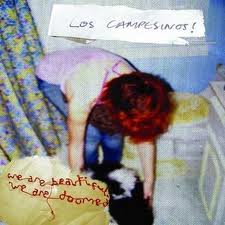
SOUNDTRACK: LOS CAMPESINOS! We Are Beautiful We Are Doomed (2008).

This is Los Campesinos! second disc in a year (after the smashing success of their debut).

The disc opens with a blast in “Make It Through the Walls”–great male and female shared vocals as well as gang screamed vocals; and by the end: violins.  It’s like the Los Campesinos! catalog packed into four minutes.  It’s followed by “Miserabilia” a perfect three-minute pop song (except for all those rough edges, of course), but it very nicely combines melody and punk attitude.

The title track continues with the frantically happy sounding music that backs off for lyrics like “We kid ourselves that there’s future in the fucking, but there is no fucking future.”   Meanwhile, “You’ll Need Those Fingers for Crossing” emphasizes their low end, which doesn’t often get a lot of emphasis.  “It’s Never That Easy Though, Is It?” has some great violins and group vocals (not screamed for a change).  “The End of the Asterisk” is an under two-minute blast of fun nonsense (with a fun chorus).

I’ve talked about the music but not much about the lyrics–but rest assured they are just as literate and darkly comic as on Romance is Boring.  Although the titles are certainly a giveaway, none sum up Los Campesinos! as much as “Documented Minor Emotional Breakdown #1” (which has some very cool sound effects thrown in too).

“Heart Swells–Pacific Daylight Time” is one of their achingly slow songs that reminds me of “The Sea Is a Good Place to Think of the Future” (I know, that song came later, but I’m reviewing them backwards).  Although this one is much shorter.  The disc ends with “All Your Kayfabe Friends” which has these fun triplet notes that ascend and descend with each line.

My copy came with a bonus DVD.  The disc contains a 30 minute home movie of the band on tour.  It’s nothing terribly revelatory, although it is amusing in places.  The home movie quality of it makes it a bit more personal, but also means that some shots are totally missed, which is a shame.   There’s also a few minutes of the band on various stages, which is quite a treat as I’ve never seen them live–they really embody their music and Gareth Campesinos! is a great front man.

At only 32 minutes, this is certainly a short release.  Wikipedia says that they argued that this was not a cash grab after the success of their first album.  And that’s believable, even if the only thing that makes this more than half an hour is the fiddly instrumental “Between an Erupting Earth and an Exploding Sky.”   Nevertheless, Los Campesinos! released some wonderfully cool songs.

[READ: February 28, 2012] “Laikas”

I complained recently that although Kuitenbrouwer calls this piece “Laikas” when you click on the link to Significant Objects, it is listed as “Greek Ashtray-Plate.”  This evidently has something to do with the nature of its publication.  Although I don’t know the pre-publication information, underneath the story it says:

The bidding on this object, with story by Kathryn Kuitenbrouwer, has ended. Original price: 69 cents. Final price: $30. Proceeds from this auction go to Girls Write Now

So, one assumes that Kuitenbrouwer wrote this short (very short) story about the ashtray-plate–after all, the full name of the website is Significant Objects…and how they got that way–so it all pieces together nicely.

As I said this is a very short piece (a page and a half, tops) that works as a quick sketch of why the ashtray-plate looks the way it does as well as a brief sketch of its owner. The details about the ashtray-plate are wonderful, vivid and violent in ways that I wouldn’t have expected–the placement of the burns is wonderfully described.

The rest of the story is strange, though. (more…)

Read Full Post »

SOUNDTRACK: NICK CAVE AND WARREN ELLIS-The Road: Original Film Score (2009).

I haven’t seen The Road, and I probably never will.  Nor have I read it.  The only reason I was listening to the soundtrack was because I like Nick Cave.  So this is a contextless review.  Of course, I know what the book is about and I rather assume that the film is equally harrowing.  I expected the soundtrack to be full of desolation and horror.

So I was quite surprised that most of the main themes are played on a piano with gentle strings or simply violins.  True there is a sense of emptiness and loss in these songs (they’re not jaunty piano pieces or anything) but they are still unexpectedly pretty.

Of course,a song like “The Cannibals” is bound to be more disconcerting, which it is.  It starts with creepy scratchy violins and then tribal drums take over–all set over a buzzing background.  This is more of what I expected the whole score to be like.   Similarly, “The House” must be a very frightening scene, as the music is threatening, loud, intense and quite scary with, again, more creepy percussion.  Unsurprisingly, a track called “The Cellar” is also spooky; it is only a minute long.

But then songs like “The Church” are so delicate and beautiful and not even all that sad–it actually makes me wonder what the scene in the film is showing.  The end of the score feels like the end of a movie, which I know it is, but it feels like a conventional movie, with closure, something I’m led to believe the book doesn’t have a lot of.

Taken away from the movie, this soundtrack is quite nice.  Aside from the three scarier tracks, this would make for some nice listening on a sad, rainy Sunday.

[READ: February 28, 2012] “The Longest Destroyed Poem”

I enjoyed Kuitenbrouwer’s “Corpse” so much that I decided to see what else she had written.  It comes to three books and four uncollected short stories.  There’s “Corpse” from The Walrus, this one here, another one called “Laikas” (which has a different title on the site where it lives) and a fourth with a broken link.  Boo.

But that’s okay because I’ll certainly investigate her books too.

Like “Corpse,” this story explores women’s sexuality, but it explores it in a very different way.  In fact, I loved the way it was introduced–especially because of the wonderfully convoluted way the sentence reveals it (and how it’s not even the main point of the sentence):

She looked fabulous. Better than back then, when she’d thought she wanted to be an artist, and Victor had made a point — she realized this as she realized many many things, that is she realized it in retrospect — of dropping into the conversation — the one she hadn’t actually been having with him, because she was instead focused almost solely on the fact his much younger roommate had a hand under the blanket her crotch also happened to be under — that he was off to bed early so he could work on a poem he’d been having trouble with.

I had to read it twice because I thought it was funny the first time, and when I fully parsed it, it was even funnier.

So yes, sex.  But as the story opens, years after the above event, Rosa sees Victor and decides to crash into him with her car.  It’s shocking and it’s shockingly well told.

I love the way Kuitenbrouwer uses language.  I could probably quote from this story six or seven times, but I love this sentence that forecasts the trouble ahead:  “Victor noticed her in that split second, too, and he knew what Rosa was up to, for his face changed, channel surfing from neutral smug — well, this was his everyday face — to impending doom.”

As she’s about to ram him (with a Prius, no less), we flash back to their spirited relationship. (more…)

Read Full Post »

SOUNDTRACK: THE FEELIES-Crazy Rhythms (1980).

Not too many albums start out with clicking blocks and quiet guitars that build for a minute before the actual song kicks in.  Not too many albums sound like early Cure sung by Lou Reed and not too many albums are called Crazy Rhythms when the thing that’s crazy about them is their vocals and guitars.  But that’s what you get with The Feelies debut.

In addition to the blocks, the opening song also features some sh sh sh sounds as a rhythm (techniques used by The Cure on Seventeen Seconds, also 1980).  There’s two guitar solos, each one vying for top spot in different speakers and, yes, the rhythms are a little crazy.

The album feels like it is experimenting with tension–there’s two vocalists often singing at the same time, but not in harmony.  There are oftentimes two guitars solos at the same time, also not in harmony.  The snare drum is very sharp and there’s all manner of weird percussion (all four members are credited with playing percussion).

That early-Cure sound reigns on “Loveless Love” as well, a slow builder with that trebly guitar.  There’s a lot of tension, especially with the interesting percussion that plays in the background.  And there’s that whole Lou Reed vibe in some of the vocals.

But not every song sounds like that, “Fa Cé-La” is a punky upbeat song with two singers trying to out sing the other.  “Original Love” is another short song, it’s fast and frenetic and fairly simple. It’s as if they couldn’t decide if they were going to be The Velvet Underground or New Wave punks.

The next surprise comes from their choice of covers: “Everybody’s Got Something to Hide (Except for Me and My Monkey”).  It goes at breakneck speed with some surprising pace changes after the chorus.  And a wonderful ringing percussion that makes the song sound even more tense than it is.  “Moscow Nights” is a more traditional song (although the backing vocals seem very spartan.

“Raised Eyebrows” is almost an instrumental, until the last-minute when the seemingly random vocals kick in.  And the final track, “Crazy Rhythms” seems to combine the speed of the faster tracks with the insanity of the other tracks.  It’s a pretty amazing debut, really heralding an age of music.

  It’s a shame it took them 6 years to make another (very different sounding) record.

[READ: February 8, 2012] “To Reach Japan”

I love Alice Munro’s stories, but I found this one a bit confusing.  Now, I admit that i read this under poor circumstances (while I was supposed to be attending a company-wide presentation), so that may have led to my confusion. But it felt like there was some questionable juxtapositions of the timeline in this story.

It opens simply enough with Greta and her daughter Katy waving goodbye to Peter (the husband and father) as they pull away from the train station.

The story immediately jumps back to Peter’s mother and how she fled on foot from Soviet Czechoslovakia into Western Europe with baby Peter in tow.  Peter’s mother eventually landed in British Columbia,where she got a job teaching.

The second time jump comes a few paragraphs later.  It seems like we’re back in the present, but the section opens, “It’s hard to explain it to anybody now–the life of women at that time.”  This describes how it was easier for a woman if she was a “poetess” rather than a “poet.”  But I’m not exactly sure when that was.  Presumably when Greta (who is the poet) was younger, but how long ago was that?  In Toronto, even?

The story jumps back to the present to say why Greta and Katy are on the train and Peter isn’t.  They are going to housesit for a month in Toronto while Peter goes to Lund for a summer job.

Then it jumps back to when Greta was a poetess and actually had poems published.  The journal was based in Toronto, but there was a party in Vancouver for the editor.  So she went.  And she had a lousy  time among the local literati.  She gets drunk and sits in a room by herself, but soon enough a man approaches her and offers to take her home. There is the potential for something more to come of it but it never materializes.  But she never forgot the man’s name: Harris Bennett, journalist. (more…)

Read Full Post »

SOUNDTRACK: YUCK-Yuck (2011).

If you’re like me, you love alt-rock from the 90s, however that may be described.  Typically, we’re talking loud guitars, but we’re also talking shoegazer music and alt folk and basically anything that might have appeared at Lollapalooza.

Yuck is like comfort food for anyone starved for new music from that ear.  There’s hardly anything new or original in it, but it sounds great.  It’s fun to play spot the influences (Dinosaur Jr. Nirvana, melodic Sonic Youth), but it’s more fun to just sit back and listen.

When the first song, “Get Away” opens up with that phased, distorted guitar I’m instantly transported back to the 90s.  And then when the solo begins (before the verse) it’s like adding screaming punk to shoegaze.  Blissful.

“The Wall” sounds like yet another style of 90s alt rock, with some more screaming guitars.  Then comes “Shook Down” in which the band slows down with acoustic guitars (think Teenage Fanclub).  It’s a little slow, but there’s a surprise third part which adds some wonderful distorted guitars to the song.

“Holing Out” brings a more punk edged guitar sound to the album (still distorted just edgier).  “Suicide Policeman” is a pretty straightforward folk rock song: acoustic guitars and whatnot and it never really rocks out.  The nice part is when the second, electric guitar plays slow wobbly chords over the top (think The Smiths).

“Georgia” rips right into a My Bloody Valentine song (female harmonies over washes of guitars).  This is the first song that I don’t love.  It’s got something to do with the chrous.  The verses are great, but the chorus is just a little too…blah.  But I love the sound of the song.

“Suck” is probably my least favorite song on the disc.  It’s really really slow and drags a bit.  Although, amusingly this song stays in my head the longest, especially the line “did you see the fire briagde.”  Maybe I secretly like it best

“Stutter” continues this slow mood–I think I like these songs individually, but they drag down this section of the album when played together like this.

Because when “Operation” bursts back, the album picks up (more great use of little guitar solos-think Smashing Pumpkins).  “Sunday” does the My Bloody Valentine thing much better–great chorus on this one.  Amusingly the verses are not very MBV-sounding at all, but it’s a nice blend.

“Rose Gives a Lilly” is an instrumental and, although it’s nothing amazing, it’s still nice.  The disc ends with “Rubber” a 7 minute retro blast.  It’s a slow builder, with big distorted guitars (the vocals are almost inaudible).  Just add more and more layers of guitar over the melody and you’ve got a great album ender.

It’s nice to see a band absorb influences rather than just aping them.

[READ: January 27, 2012] “Underbrush Man”

Once I saw Mohsid’s story in The Guardian, it was just a quick look to see that Margaret Atwood had a story there too!

I really enjoy Atwood’s stories, and this one is no exception.  But this one was rather unexpected for me because it begins with the point of view of a dog.  There are actually four points of view in this story.  I was delighted that the first two were more or less the same, that the third one was unexpectedly unrelated to the action and then the final one cleared everything up.

But we start with a dog. (more…)

Read Full Post »

Stop the presses…  I just received an email that I was given a Versatile Blogger Award!

The super cool folks at tripsfor2 ranked me as one of 15 bloggers deserving this award.  And just as I was fearing I would have to reduce my output, they rave about my output!

The rules of the award state that I must write some details about myself and also pass along this award to fifteen other bloggers.  Since I just found that out, that will have to wait until probably next week, when I have a moment to think about it.

But in the meantime, I want to thank Hadi and Kathleen who have really wonderful posts about traveling (I swear, they’ve been everywhere) including, but not limited to some wonderful posts about aboriginal art.  And the photos are really great.  They are (just about) all by Hadi.  I mean, check out the birds here and the hummingbird that attracted me to his photos in the first place (on a different site but the same folks).

This was a delightful way to start of 2012.  As was a wonderful selection of short story recommendations from Karen Carlson over at A Just Recompense.  She has given me a selection of really intriguing stories to read and I’m quite grateful for them.  I hope to start those this week.  Oh, and just when I thought that Karen was only about the books, a quick browse over to her site shows that she’s also a Project Runway fan.  I’ll be checking in with her as the year progresses.

A final note, my wife has been taking beautiful pictures for over two years now.  She posts a picture every day at her site The Fair View.  For her end of the year post at her other blog Sew Buttons, she posted her favorite photos of the year.  And while I’m biased (and even more because there’s several of my kids), I think she takes some really stunning pictures. So, if you like nature photos (and photos of other people’s kids, pop on over.  And if you like what you see, spread the word.  I know there’s a million photographers out there, but I happen to think she’s terribly under-recognized (she needs some work on the shameless self promotion side of things). (more…)

Read Full Post »

SOUNDTRACK: LAND OF KUSH’S EGYPTIAN LIGHT ORCHESTRA-Monogamy [CST066] (2011).

The Land of Kush makes music that I would describe as challenging to Western ears.  Sam Shalibi has always played middle eastern music (he’s a master of the oud) and he has usually incorporates it with varying degrees of poppiness into a western style.  The LoKELO is one of the most overt blendings of the two styles.

Land of Kush pretty much throws all rules into the wind.  My first listen to this record I thought it was just too all over the place to be any good.  But after really digging in to it…man, is it solidly cool.

The first track “The 1st and the Last” has a robotic voice reciting a modified lyric of “Helter Skelter” which seems to be called Helter Smegma (“When I get to ass I go back to top….you may be a dancer but you ain’t no porno.”)  The more you listen to the voice, the more you realize the lyrics are just really vulgar and obscene.  This creepy computer voice is layered over the top of a middle eastern keening female voice.  (I’m sure there’s a name for this kind of singing, but I don’t know what it is).  There’s beautiful middle eastern music in the background, but the combination is very unsettling.  Then there’s 2 minutes of simple oud instrumental.

The song morphs into the 17 minute “Scars.”  “Scars” opens with a hypnotizing middle eastern melody and sultry vocals from Elizabeth Anka Vajagic.  After about 7 minutes, the computerized voice comes back.  At the 11 minute mark, the music stops and Vajagic comes back with some solo vocals–she has a very beautiful voice.  The song ends with a somber string section (which I assume is not a violin).

Track 3, “Boo” is listed as an improvisation of clarinet and contrebasse based on “Scars.”  I don’t really see the connection and although I like imrov, I actually prefer the written out pieces on the disc.

Track 4 is the 9 minute “Tunnel Vision.”  It opens slowly with Katie Moore’s delicate voice singing over acoustic music and bird sounds.  At about 7 minutes, a wild saxophone solo kicks in.  It’s low and bassy and very different from the rest of the song, as is the tempo, provided by some wild drums.

“Fisherman” brings back the computer voice (“How I love to fuck a dyke…” this is the easiest to understand and probably the dirtiest.  It really seems like lyrics from another song, but I can’t find it online–although  listening closely there is some spin on “Magic Bus” going on (“stick in the test tube to impregnate you–too much magic bus…I’m so nervous because all the while–too much magic bus–you don’t know you’re going to pop out a child”)).  After about 3:15, the song proper starts.  This is my favorite song of the bunch.  Ariel Engle’s vocals are transcendent.  I’m still not even sure what she’s singing about but her voice is amazing.  There’s an intermission of computer voice which rewrites the lyrics to “Total Eclipse of the Heart”–think x-Rated Weird Al than anything else.  And then at the 9 and a half-minute mark, Engle returns with an amazing vocal line over a great baritone sax riff.  And when Engle starts wailing, it is amazing. I could listen to that section for ten minutes easily–shame it’s only two.  But there’s another beautiful middle eastern string solo at the end of this song too.  Must be the oud.

“Monogamy” opens with a slow and steady drumbeat while Molly Sweeney sings a fascinating alphabet (B is for Beelzebub…F is for the fucking that you did, outside).  There’s a cool chorus to this recitation, it’s another real highlight of the disc.  The middle section sounds a bit like Pink Floyd’s “Several Species of Small Furry Animals Gathered Together in a Cave and Grooving with a Pict”

The final track is “Like the Thread of a Spider.”  It is a slow acoustic song with vocals by the people of the Syrian Arab Republic. It’s a beautiful somber ending to an exciting disc.

This is not for everyone; it’s not even for most people.  But if you’re looking for something adventurous, try this out.  It’s challenging and rewarding.

[READ: December 14, 2011] “Stone Mattress”

I haven’t read a Margaret Atwood piece in a while and this one was totally worth the wait.

It’s a very simple story and it opens with a wonderful grabber: “At the outset Verna had not intended to kill anyone.  What she had in mind was a vacation, pure and simple.”

Verna decided to go on a trip to the Arctic.  We learn through the course of the story that Verna chose the Arctic because although she is older, she’s still quite fit–not bathing suit in the Caribbean fit, but certainly arctic wear fit.  And since she’s just lost her 4th husband, she’s sort of on the prowl again.

As the story progresses we learn a bit about Verna’s history.  She’s been married four times, and in each case her husband has died–never under suspicious circumstances, although, maybe, Verna’s medical knowledge could have assisted in saving (or dispatching) them.  But that’s all the past.  She’s a wealthy older woman now.  (more…)

Read Full Post »

SOUNDTRACKART OF TIME ENSEMBLE WITH STEVEN PAGE-A Singer Must Die (2009).

According to their website, “Art of Time Ensemble is one of Canada’s most innovative and artistically accomplished music ensembles. Their mandate is to give classical music the contemporary relevance and context it needs to maintain a broader audience to survive.”

So what you get is a modern orchestra playing contemporary music.  It’s not a unique idea, but in this case, it works very effectively.  And what you also get is Steven Page, former singer of the Barenaked Ladies as the vocalist.  Page has an awesome voice.  I’ve often said I could listen to him sing anything.  And here’s a good example of him singing anything.

The great thing is that the song choices are unusual and wonderful–not immediate pop hits or classic standards–it’s a cool menagerie of songs with great lyrics and equally great compositions.  This is no heavy metal with strings, this is majestic songs with orchestral scoring.  The orchestra includes: piano, sax/clarinet, cello, violin, guitar and bass.

And the song choices are fascinating.  And with Page’s amazing theatrical voice, the songs sound quite different, mostly because the original singers don’t have powerful voices.  They all have interesting and distinctive voices, but not operatic ones.  So this brings a new aspect to these songs (I knew about half of them before hand).

THE MOUNTAIN GOATS-Lion’s Teeth.
This is a very dramatic reading of this dramatic song.  It pushes the boundaries of the original song.

ELVIS COSTELLO-I Want You.
I had never heard this Costello song.  With Costello you never know what the original will sound like–punk pop, orchestral, honky tonk?  It’s a fascinating song, though and Page hits some really striking and I would say uncomfortable notes.

RUFUS WAINWRIGHT-Foolish Love
I don’t know Rufus’ work very well, although I immediately recognized this as one of his songs.  Page plays with Wainwright’s wonderful theatrics and makes this song his own.

BARENAKED LADIES-Running Out of Ink
Covering one of his own songs, this is fascinating change.  The original is a fast, almost punky song, and it seems very upbeat.  This string version brings out the angst that the lyrics really talk about (Page is definitely a drama queen).

LEONARD COHEN-A Singer Must Die
This is one of the great self-pitying songs and the lyrics are tremendous.  Page takes Cohen’s usual gruff delivery and fills it with theater. It’s a great version.

JANE SIBERRY-The Taxi Ride
Coming from her early album The Speckless Sky, this is a wonderfully angsty song with the premise that is summarized: “it’s a long, long, lonely ride to find the perfect lover for your lover.”  Page hits one of the highest notes I’ve heard from him here.  Very dramatic.

THE DIVINE COMEDY-Tonight We Fly
This is one of my favorite Divine Comedy songs.  Of course it is already string filled, so this version isn’t very different.  But its wonderful to hear it in another context.

THE WEAKERTHANS-Virtute the Cat Explains Her Departure
I love this song.  This is a guitar filled pop punk song, so the strings add a new edge to it.

THE MAGNETIC FIELDS-For We Are the King of the Boudoir
I know the Magnetic Fields but not this song.  It’s quite clever and funny (as the Fields tend to be) and Page makes some very dramatic moments.

RADIOHEAD-Paranoid Android
I recently reviewed a covers album of OK Computer, wondering how someone could cover the record.  The same applies to this song.  A string orchestra is a good choice for it, as there is so much swirling and crescendo.  And while nothing could compare to the original (and they don’t try to duplicate it), this is an interetsing choice.  As is Page’s voice.  He has a much better voice than Thom Yorke, but that actually hinders the song somewhat when he gets a little too operatic in parts.  Nevertheless, it is an interetsing and enjoyable cover.

The whole record is full of over the top drama.   It’s perfectly suited for Page and it’s a side of him that has peeked out on various releases but which he really gets to show off here.  As an album, the compositions all work very well–they are, after all, trying to make classical pieces out of them–not just covering them.  And the choices of songs are really inspired.  Dramatic and interesting and when the music slows down, the lyrics lend to a wonderfully over the top performance.

If you like Page or orchestral rock, this is worth tracking down.

[READ: November 28, 2011] “Leaving Maverly”

For some reason I was under the impression that Alice Munro was no longer writing.  I’m glad that’s not true, and really, what else would she do with herself–she has so many more stories to tell.

I think of Munro’s stories as being straightforward, but this one was slightly convoluted and actually had two things going on at once.  It opens by discussing the old town of Maverly.  Like many towns it once had a movie theatre.  The protectionist and owner was a grumpy man who didn’t deal well with the public, and that’s why he hired a young girl to take the tickets and be the face of the theatre.  When she got in the family way, he was annoyed, but immediately set out to hire someone else.  Which he did.  The new girl, Leah, came from a very religious family.  She was permitted to work there under the stipulation that she never see or hear a movie or even know anything about them.  And that she get a ride home.  The owner balked at this second idea–he surely wasn’t going to drive her home.  So instead, he asked the local policeman Ray, to walk her home.  Which he agreed to do.

The next section of the story looks at Ray.  And although the story is ostensibly about Leah, we get a lot more history of Ray.   He was a night policeman only because his wife, Isabel, needed help at home during the day.  We learn about the scandalous way he met his wife and how they managed through the years until she became ill.

Ray talks with Leah on their walks home, something he found terribly awkward because of how cloistered she was.  Then he would get home and talk with Isabel about Leah. This young girl who meant nothing to him was suddenly a significant part of his life.

And then one day the theater owner came to report that Leah was missing.  They went to see her father at the mill, but she wasn’t there.  And there was really no other place where Leah went, so they were at a loss.  It was winter and they feared the worst. (more…)

Read Full Post »

SOUNDTRACK: DAVE BIDINI-“The List” (2007).

This song appears as a bonus track on the Bidiniband album.  But I’ve been aware of it since 2007 when he played it on his solo tours.  It is essentially a list of 4 Canadians who are “killing us, killing us now.”  The list includes Tim Horton’s (purveyor of delicious donuts), Chad Krueger (from Nickelback), Zack Werner (a judge on Canadian Idol), and Stephen Harper (I shouldn’t have to tell you).

But the key to the song is the chorus: “where are the angry young ones….”  This song should become the unofficial song from Occupy Wall Street.  It would be very easy to modify.  Hey Dave, if you’re free you should head on down and serenade these angry young ones.

Here’s a great live version done in a record store in which he is close enough to have a casual chat about the very song he is singing in the middle of the song.

He also ends it a little differently than the original.  It’s catchy and easily adaptable.  Good on ya, Dave.

[READ: November 19, 2011] “Who Wrote Shakespeare?”

No one has traded off of his Monty Python fame as much as Eric Idle.  All of the other Pythons have moved on in one direction or another, but Eric keeps the torch alive (see Eric Idle Sings Monty Python and Spamalot).  He even has a little nod to MP in this essay with the asterisk next to his name which leads to (*Most likely Michael Palin, really).  This refusal to let go of Python has at least kept his wit sharp, as we see in this Shouts & Murmurs.

My main problem (as I’ve said before) with the Shouts & Murmurs is that they are usually too long.  But, as Python knew, keep it short and funny and you’ll succeed.  So this two-column piece never really flags in its simple premise.

Which is that everyone knows that Ben Jonson really wrote all of Shakespeare.  Idle presents a list of all of the famous books that were really written by someone else.  For example, “Simone de Beauvoir wrote all of Balzac and a good deal of ‘Les Misérables,’ despite the fact that she was not born yet when she did so.”   And my favorite: “‘Moby Dick’ was written not by Herman Melville but by Hermann Melbrooks, who wrote most of it in Yiddish on the boat from Coney island.”  The joke about Henry James is very funny and too good to spoil. (more…)

Read Full Post »

SOUNDTRACK: QUEENSRŸCHE-Rage for Order (1985).

Thinks looked to be very different for Queensrÿche on Rage for Order.  I mean, look at them.  On the back of The Warning they were leather-clad hellions.  On Rage, they are quite the dandys (man, I wanted Geoff Tate’s coat!).   This would be the first of many times that they confounded their fans with a style change.

Yet despite the look of them, the album opens with a scorcher, “Walk in the Shadows.”  It’s not as heavy as their earlier songs, but it has perfected many of the elements of those earlier records: the chanted vocals, the great riffs and the screaming solos.  “I Dream in Infrared” shows their they’ve always been interest in technology.  It’s ballady, but it’s got some really sharp guitars and some more soaring vocals.

The keyboards at the end of the song segue into “The Whisper,” the first indication that things would be different on this record–orchestra keyboards hits (which I have always loved) are used to punctuate verses, and there are cool, whispered words (which would be used prominently on Operation: Mindcrime

Then comes the big shock, “Gonna Get Close to You” a weird synth/metal hybrid with a strikingly catchy and poppy chorus (that seems ever-so-80s to me)–see below for a fun surprise about this song.

Then “The Killing Words” opens with a keyboard riff that sounds not unlike 80s-era Marillion–Tate even whispers words not unlike Fish does on early Marillion albums.  Of course, when the chorus comes in it is pure Queensrÿche .  There’s more orchestral hits and cool effects on “Surgical Strike.”

I love everything about the opening of “Neue Regel,” from the unusual guitar to the “steam” sounds used as percussion to Tate’s processed, minimized voice–it makes for a wonderfully claustrophobic song.  It’s made even more so by the overlapping, intertwining vocals later on. 

“Chemical Youth (We Are Rebellion)” is a cool sparse song (the opening in particular). But it also shows their interest in, if not politics, then at least contemporary society (again, more foreshadowing of Mindcrime).  “London” just builds and builds in intensity, while “Screaming in Digital” takes the technological aspect one step further with all kind of sinister synthesized sounds and the crazy way it ends.

The album ends with “I Will Remember,” an acoustic song complete with mournful whistling from Tate.   But even as a ballad, it’s not your typical lyrical content: “And we wonder how machines can steal each other’s dreams.”  I don’t love it as an album ender, although it does wind things down pretty nicely.

This is my favorite Queensrÿche album, hands down.  I know most people like Mindcrime better, but for me, this one is more progressive and showcases a lot of the risks the band was willing to take.

Incidentally, there’s a wonderful review of Rage here, in which I learn that “Gonna Get Close to You” is actually a cover of a song by the Canadian singer Dalbello (who is really crazy and fun, and whom I’ve never heard of until I just looked her up).  How did I not know it was a cover?  (Or more like, I knew it, but forgot it over the last twenty some years)?  I might actually like the original better.

[READ: October 25, 2011] “This Cake is for the Party”

This was a very short story that crammed a lot of emotion into two pages.

As the story opens, Bonnie is finishing a cake for a party.  The party is to celebrate the engagement of Janey and Milt.  Janey is one of Bonnie’s older friends and she’s happy for Janey.  She likes her fiancée, Milt (even if he did just get a black eye).  The black eye came from a misunderstanding.  Milt was in a pub “lasciviously” twirling the mustache that his high school class dared him to grow.  Someone in the pub thought he was making advances on his woman and punched Milt in the face. 

But Bonnie’s boyfriend, David doesn’t like Milt.  He won’t say why, he just doesn’t.  It could very well have to do with the fact that he and Janey used to date, and it’s possible that Janey dumped David for Milt (that’s a little unclear in the story). (more…)

Read Full Post »

« Newer Posts - Older Posts »