Feeds:
Posts
Comments

Archive for the ‘Canadian Content’ Category

movingSOUNDTRACK: BEACH HOUSE-Bloom (2012).

bloom  I loved Beach House’s previous album–the way it was magically lighter than air with swelling melodies and the unearthly vocals Victoria Legrand.  Bloom opens with “Myth” which continues the magic–the simple but beautiful opening melody and then a soaring chorus which is just amazing.

But something happens after that first song, and the album suddenly comes down to earth.  Perhaps it is the fairly conventional guitar and drum sound that opens “Wild” (it’ sa very cool 90’s ear guitar sound, but I feel like it doesn’t quite work with her voice.  The song is still pretty, but I kind of lose interest before it ends.

Similarly, I like the simple synth opening to “Lazuli” and her voice soars nicely here, but I’m not compelled to pay attention all the way through.  As I’m writing about the songs, I want to say that they are all pretty with nice melodies.  And as each song opens, I smile with recognition at the quality of the song.  But I keep drifting away from the song before each one ends.  Is it because each song is nearly five minutes?  Maybe.

The more I listen to the album the more I like most every song–there’s something about each one that I find engaging, and yet overall the album just doesn’t grip me as much as the previous album did.

It still sounds magical, but something is missing, and I’m not quite sure what that is.

[READ: October 24, 2014] Moving Pictures

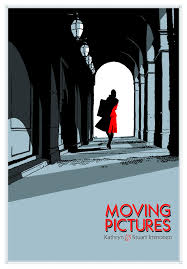
This graphic novel was simply fantastic.  It was one of the most powerful and moving stories I’ve read in graphic format in a long time.  I loved everything about it (even if some of the details of the story were a wee bit confusing–see below).  The story explores the relationships that formed during the Nazi occupation of Paris.  Specifically between a Canadian museum curator and a German soldier.

Primarily, I loved the artistic style of this book.  It is black and white with some very dark sections–especially in the interrogation room where harsh shadows obscure so much. As the book opens, we see a woman sitting at a table under a harsh lamp.  It is only when the POV shifts to her profile that we see the very fine and delicate lines that comprise her face.  And that balance of fine lines and huge swaths of black is really stunning.
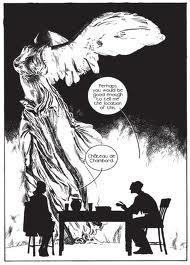
mobing2There is then a flashback.   The woman from the room, Ila, is speaking to another woman who looks more or less like her (it is hard to tell the women apart as they are both blonde, with such think lines for features).  They are at a train station and Ila is encouraging the other woman to take Ila’s papers and flee.  She says she won’t be needing them.

Then we return to the room, where a man, who we learn is Rolf the soldier, enters and begins interrogating her.  He asks her questions, but after a few, she asks him if he has been drinking–something is clearly unusual about this interrogation.  In the course of the questions, we learn that Ila is the curator at a museum.  And he begins asking her the locations of certain works of art. What is gorgeous here is that the two remain silhouetted, but the artistic pieces are blown up to full size as background images.  And they are wonderfully rendered.

Then he asks about some small things “hidden” in the basement.  And then he asks if she is still mad at him.  This interrogation seems more personal than political.  We also learn that he asked her to keep one small artifacts and that she can’t remember where it is. (more…)

Read Full Post »

june2014SOUNDTRACK: BATTLES-Glass Drop (2011).

220px-BattlesGlossDropI didn’t know anything about Battles before I heard the single, “Ice Cream.”  Battles are an experimental band comprised of the guitarist from Don Caballero (one of my favorite post-rock bands) and the drummer from Helmet.   And they write music that is very angular, with lots of stops and starts and direction changes.  There’s some story about their first album (which I have not heard) having a singer who left just before the recording of this album.  And the remaining trio’s solution was to have outside singers sing on certain songs.  And it all works very well.

The majority of the album is instrumental though.  And the songs feature a very distinctive sound that I feel is close to a steel drum, but which I know is actually a keyboard–but that echoing sound is so drumlike, that when the drummer’s pounding is added, the whole album feels like a percussive explosion.

“Africastle” opens the disc with ringing guitars and a melody that uses those steel drum sounds.  After about 2 minutes of slow intro, when the ferocious drums kick in, the song rockets to life in a frenzy of activity and counterpoints.  It’s really quite something.

“Ice Cream” is the song that introduced me to this album.  The guitars are modified to once again a steel drum sound, but the melody and rhythm are so fast staccato that it removes any sense of steel drum especially when the notes are clearly electronic. This song features vocals (no idea what they are saying) by Matias Aguayo.  They compliment the sound of the music.  Despite all the overlapping disparate elements the song winds up being strangely catchy. The way the chaos ends with a simple Dum duh duh dum dum… is very cool.

“Futura” continues in that staccato style but it features an aggressively catchy melody.  “Inchworm” has a fun almost reggae feel amid the staccato noises.  “Wall Street” brings the drums to the fore again as it propels the jumpy melody along.  “My Machines” has a guest vocal from Gary Numan. I have never liked Gary Numan (I need to never hear “Cars” again) but his voice (he actually sings…sort of) works well with this cacophony.

“Dominican Fade” adds some heavier bass and wild percussion notes to this 2 minute track. It even has hand claps and cowbells at the end.  “Sweetie and Shag,” has vocals from  Blonde Redhead’s Kazu Makino.  She adds a whole new element to the album with her high pitched yet breathy vocals.  A definite highlight.

“Toddler” is a 1 minute sng that feels like a transition into the manic and bouncy “Rolls Bayce” (which Dave Konopka describes as almost wholly an experiment).

“White Electric” start slow with some echoed notes. Then a martial beat keeps time as the notes seems to swirl around. The song builds and builds with more layers until it crashes apart at around 5 minutes.  At which point the song slowly rebuilds itself into a pretty coda.

The final song sounds like a reggae singer but it is actually Yamataka Eye from The Boredoms.  Konopka says that Eye sent vocals and told them to do whatever they wanted with the track.  The band thought “he was speaking Japanese, but he’s just making up his own stuff and he’s repeating stuff that he’s making up.”  The backing noises sound like a whale song.

Despite the weirdness of the album, there’s a lot of poppiness to it, and I think it is a great release.  It also is a great headphones release, if you like that sort of thing.  I need to check out their debut as well.

[READ: October 15, 2014] “Who Will Water the Wallflowers?”

I don’t quite know what to make of this story.  It seemed to me to be full of individual incidents that were all wiped away by the flood that is mentioned in the very first line.

I enjoyed the details of the story quite a lot.  In it, the girl (unnamed) looks after her neighbor’s cat Cha-Cha while Ms Feliz is away.  Cha-Cha is a a Turkish angora, a delicate breed.  And there is an interesting description of the cat after he has gotten wet in the rain.  Sometime the girl sleeps at Ms Feliz’ house (her mom doesn’t mind since they live across the street).

The girl finds sanctuary in Ms Feliz’s house.  Except for Mr Bradley.  Mr Bradley is an enigmatic neighbor–he seems to be home all the time, dressed in work clothes and slippers. It is clear that the girl is uncomfortable around him, but he seems to always be around.  He seems pleasant enough.  He sees her almost every day and always asks “learning something?” to which she doesn’t know what to say.  She tries to avoid him by looking for Cha-Cha, but he doesn’t leave (and Cha-Cha doesn’t show up).  She tells him that she watched a film about geysers .

He replies, “I know a joke about geysers….it probably wouldn’t be appropriate.” (more…)

Read Full Post »

2014-07SOUNDTRACK: SLOAN-Commonwealth [Spade Side–Andrew Scott] (2014).

commonFor Sloan’s 11th album, the four members of the band each wrote the songs of a side.  I originally thought that they recorded all of the music alone, but that seems to be wrong–and would hardly be a Sloan album).  In conjunction with the album, each guy was given a suit of cards (and an actual deck was made as well).  While this doesn’t necessarily mean the album is very different from their others (it still sounds very Sloan), it seems to have given the guys a bit more room to experiment.

The final side of Commonwealth is by drummer Andrew Scott.  Scott has written three singles for Sloan over the years: “500 Up”, “People of the Sky”, and “I’ve Gotta Try.”  But for this album, he has created a 17 minute and 49 second epic called “Forty-Eight Portraits.” This makes it seem like it could be 48 small songs which it isn’t.  But it also isn’t one long song exactly.  There are, by my count 15 sections–although there could be more or fewer depending on how you break it up.

So my demarcations:

  1. The song opens with a dog barking.  There’s complex percussion and a smattering of piano seemingly searching for a melody.
  2. At 3 minutes the first real song proper starts.  We’ll call it “You say you’re going with me.” There’s acoustic guitars and a bouncy melody.  It’s a great song with a neat guitar riff that overlays around 4 minutes in.  But
  3. At 4:23 the song changes dramatically.  It grinds to a slow pensive section, call it the “Don’t ask for a second chance.”  But it doesn’t last long,
  4. At 5:16, the next part jumps in, it’s a bit faster and feels like it could be an extension of the previous section.  Call it the “Do the things I do” section.  It speeds up
  5. At 5:41, to a similar style as the “first song.”  It has a sing along starting “How Does It Feel?”  It’s got one verse before a time signature change and instrumental break.
  6. At 6:40 the next section comes in.  Aggressive guitars and spoken word lyrics “There’s something happening here.”  It also has one of the few uses of the word “fucking” in a Sloan song.
  7. At 7:25 it shifts to a falsetto style and higher pitched guitars.  It’s vaguely Beach Boys-like for a verse “Do you think she loves you?” until
  8. At 7:48 it’s back to a reprise of the “How does it feel” section.
  9. At 8:15 it shifts to a new slow piano section.  This feels like the most fully realized song section of the epic.  “I can’t believe you never told me the truth.”   It leads into a big chorus sounding section (two lines) around 8:40 (“What it is us unsustainable”).  There’s even a repeat of this “verse” and  “chorus” as well.
  10. At 10:26 a new guitar section is introduced.  It works as a transition “You said you’re coming with me.” It morphs
  11. At 10:52 into a very cool slowed down section “I asked for a proper glass.”  And then
  12. At 11:22 the song again returns to the “How did it feel” section.
  13. At 12 minutes the song transitions with a “ba ba ba” and horns which move into the “Sometimes I feel like I’m slipping away” section.  The song feels like it might end at 13 minutes as the last notes seem to ring out.  But
  14. At 13:21, the song rebuilds again with the “inside a cloud” section.  This feels like the final section of the song is built around a similar construct. It’s a guitar riff that introduces a children’s chorus at around the 14 minute mark.  There’s a slow guitar solo and pizzicato strings that keep this section from being to easy, but that guitar riff and children’s section reunite the end which concludes with the spoken “W.W.L.R.D.?” (which I assume the L.R. refers to Lou Reed).
  15. At 16 minutes, the chaos of the beginning returns with a dog bark, but the concluding riff is strong and seems to really draw out the end.

I really haven’t listened to the lyrics that carefully to know exactly what’s going on, but I really enjoy the “choruses.”  While a 17 minute song is not everyone’s cup of tea, there are so many parts and so many interesting and catchy sections, that it feels like a whole collection of short songs rather than one long song.  It’s a cool experiment and one that I find myself singling out as I try to parse it a bit more.

[READ: October 11, 2014] “Part of the Main” and “Watching the Cop Show in Bed”

The Walrus’ summer reading issue presents three stories and two poems in which: “The Walrus presents fresh takes on old crimes.”  Each story is about a crime of some kind, but seemed from an unexpected way.  I rather enjoyed the way the writers played around with the crime genre to make them something very different.  These were two poems.

I’ve don’t normally review the poetry in The Walrus, but since I had four sides and only three stories it seemed worthwhile to throw the two poems in as well 9especially since the finally song was so unusual).

The first one “Part of the Main” is written with wonderfully evocative language as it talks about something so base.

The first stanza talks about the inevitability of the tide, of life.  With beautiful language like: “the contours of the and effaced by the saintly patience of the tide.”  But the second stanza shifts gears.  In it, the narrator says that you can show him dire things on the television: “bloated bellies…bomb blasts” and he will weep and clench his fists “but otherwise do nothing.”  It is sadly an uncomfortably relatable attitude. (more…)

Read Full Post »

2014-07SOUNDTRACK: SLOAN-Commonwealth [Shamrock Side–Patrick Pentland] (2014).

commonFor Sloan’s 11th album, the four members of the band each wrote the songs of a side.  I originally thought that they recorded all of the music alone, but that seems to be wrong–and would hardly be a Sloan album).  In conjunction with the album, each guy was given a suit of cards (and an actual deck was made as well).  While this doesn’t necessarily mean the album is very different from their others (it still sounds very Sloan), it seems to have given the guys a bit more room to experiment.

I’ve always had trouble telling whose songs are whose in Sloan, primarily because they all write such different songs all the time.  But also because their voices aren’t radically distinct.

According to the CBC website, Patrick Pentland is responsible for some of the band’s biggest hit songs, including “The Good in Everyone,” “Everything You’ve Done Wrong” and “Money City Maniacs.”

Pentland only wrote four songs for his side.  And none of them are especially long.  Overall his songs are heavier fuzzier and rockier.

“13 (Under a Bad Sign)” is a heavy rocker at only two minutes.  Even though it’s the same length as Murphy’s also heavy “Get Out” it just rocks a lot harder.  It also opens with a bass–one of the few songs on the album that does so.  It’s a big loud rocking riff.  “Take It Easy” is even noisier.  The guitars feedback as the bass propels along.  It’s a simple song, with a simple heavy chord structure, and it has a simple catchy chorus.  Good rocking Sloan.

“What’s Inside” slows things down a bit—it has a familiar bass line and swirling guitars.  There’s lots of echo on this song, especially in the chorus which seems almost shoegazey.  It’s probably my least favorite song on the album because of the way it kind of meanders–it rather slows the momentum of the disc.  But his final song, “Keep Swinging (Downtown)” totally redeems it, with a super catchy classic rock sound classic.  It has a great got sing along chorus.  This could easily be a huge single and a live concert favorite.  It’s 3 and a half minutes, but nearly the last minute is an extended outro with a great pretty acoustic guitar riff.

For only four songs, Pentland makes a huge statement.

[READ: October 11, 2014] “Brute”

The Walrus’ summer reading issue presents three stories and two poems in which: “The Walrus presents fresh takes on old crimes.”  Each story is about a crime of some kind, but seemed from an unexpected way.  I rather enjoyed the way the writers played around with the crime genre to make them something very different.  This story is about murder.

Of the three stories I liked this story the least.  Not because it from the point of view of a dog–that part I liked.  In fact I enjoyed a lot of details in the story–like that there was a character named Grassy Noel, that the narrator believes all golden labs have a Scottish accent and that the narrator speaks as if he is not a dog.

First we learn about Big Cy’s (the narrator) history.  He used to hang around the bus station grubbing for food.

Then he witnessed a Lab rescue a baby and saw that dog praised and held high.  He wants to know:

Who is better. The dog who is … naturally good or the one who struggles to be good. (more…)

Read Full Post »

2014-07SOUNDTRACK: SLOAN-Commonwealth [Heart Side–Chris Murphy] (2014).

commonFor Sloan’s 11th album, the four members of the band each wrote the songs of a side.  I originally thought that they recorded all of the music alone, but that seems to be wrong–and would hardly be a Sloan album).  In conjunction with the album, each guy was given a suit of cards (and an actual deck was made as well).  While this doesn’t necessarily mean the album is very different from their others (it still sounds very Sloan), it seems to have given the guys a bit more room to experiment.

I’ve always had trouble telling whose songs are whose in Sloan, primarily because they all write such different songs all the time.  But also because their voices aren’t radically distinct.  According to Wikipedia, Murphy has written several Sloan songs that have been released as singles, including “Underwhelmed” from the album Smeared, “Coax Me” from Twice Removed, “G Turns to D” from One Chord to Another, “She Says What She Means” from Navy Blues, “The Other Man” from Pretty Together, and “The Rest of My Life” from Action Pact.

 Murphy, like Ferguson writes some really catchy songs here.  They are no connected like Ferguson’s though, and they feel more like discrete songs.  “Carried Away” is another amazingly catchy song that I get stuck in my head for hours.  The song opens with a full sound including strings. The verses are slow. But the chorus just kicks in catchy and easy to sing along with this great line: “She carried on buit she got carried away…”

“So Far So Good” is a slow piano ballad. The chorus swells in a big classic-rock-with-piano way and is also catchy.  “Get Out” is a short rocker, under 2 minutes.  It comes in, rocks hard and gets out. “Misty’s Beside Herself” is another song with an infectious chorus.  It’s a slow ballad, but with a big powerful chorus full of harmonies. It’s really pretty. “You Don’t Need Excuses to Be Good” has rawer guitar sound and sounds a bit more like older Sloan. Although it’s not as catchy as the other songs, there’s something about the sound (how different it is from the other songs) that really makes it stand out (that guitar solo s pretty great too).

Like Ferguson, Murphy knows how to write great catchy songs, and these five songs really showcase his strengths as a writer.

[READ: October 11, 2014] “Care and Feeding of the Amish”

The Walrus‘ summer reading issue presents three stories and two poems in which: “The Walrus presents fresh takes on old crimes.”  Each story is about a crime of some kind, but seemed from an unexpected way.  I rather enjoyed the way the writers played around with the crime genre to make them something very different.  This story is about kidnapping.

I’ve enjoyed Kuitenbouwer’s peculiar vantage point in a number of stories before.  Since this was a “crime” story I was curious about what this title could possibly have to do with a crime.  And then it’s laid out–a bunch of kids in a Montessori class (who are camping out in the woods) are lying in await for an Amish buggy to come by.  (While waiting for the ambush one of them farts, which really sets the tone for the story: “The fart hovered at nose level as the nostalgic clop of horses sounded and a decision became necessary”).

And then the decision is made.  Becky ran out into the street with a stick which made the buggy driver stop.  While Becky was asking him how many Amish it took to change a light bulb, the rest of her class snuck behind the buggy and grabbed the buggy’s little boy occupant.  She then frightened the horses and the buggy took off–with the driver unaware of the kidnapping. (more…)

Read Full Post »

2014-07SOUNDTRACK: SLOAN-Commonwealth [Diamond Side–Jay Ferguson] (2014).

 commonFor Sloan’s 11th album, the four members of the band each wrote the songs of a side.  I originally thought that they recorded all of the music alone, but that seems to be wrong–and would hardly be a Sloan album).  In conjunction with the album, each guy was given a suit of cards (and an actual deck was made as well).  While this doesn’t necessarily mean the album is very different from their others (it still sounds very Sloan), it seems to have given the guys a bit more room to experiment.

I’ve always had trouble telling whose songs are whose in Sloan, primarily because they all write such different songs all the time.  But also because their voices aren’t radically distinct.  According to Wikipedia, Ferguson’s more famous songs are: “I Hate My Generation” from the album Twice Removed, “The Lines You Amend” from One Chord to Another, “Who Taught You to Live Like That?” from the album Never Hear the End of It, and “Witch’s Wand” from Parallel Play.

Jay Ferguson has the more falsetto’s/delicate voice of the bunch.  He writes five songs that all works as kind of a suite.

“We’ve Come This Far,” opens the disc as a minute and a half piano intro.  It blends right into “You’ve Got a Lot on Your Mind” one of several super catchy songs on this record. The verses are gentle with an acoustic guitar playing along with Ferguson’s singing.  It’s a simple song with a great sing along chorus (and even a long Yeah- h- h ).   “Three Sisters” also starts with a piano (and reminds me of Twin Peaks theme in tone).  It is slower than the other songs, which suits Ferguson’s voice very well.  I enjoyed this lyrics which plays to the album art: “I Played a diamond where her heart should land. She recognized the tune but not the band.”  The mellow song has a cool buzzy guitar solo laid over the top.

And It jumps right into the much faster “Cleopatra” which is a simple (and again catchy) track with a boppy “talk to ya later” bridge. The piano and guitar solos are quiet affairs which play against the type of song and really showcase the Ferguson’s songwriting skills.  “Neither Here Not There” opens with, in sequence: a gentle organ, a quiet electric guitar riff and then a 12 string guitar  (not bad for 20 seconds). The song is barely 2 minutes long and is pretty ballad.

It’s a really pretty song cycle and shows of the kinds of songs that Sloan has been doing so well for so many years.

[READ: October 11, 2014] “Ultrasound”

The Walrus’ summer reading issue presents three stories and two poems in which: “The Walrus presents fresh takes on old crimes.”  Each story is about a crime of some kind, but seemed from an unexpected way.  I rather enjoyed the way the writers played around with the crime genre to make them something very different.  This story is about rape.

I’ve mentioned before that I feel kind of hit or miss about Stephen Marche’s short stories.  But I loved this one.

I was a little concerned at first because of the very cold and distant way it began: “On a scale of 1 to 10, with 1 representing “of no interest to me” and 10 representing “of maximum interest to me,” the rapes in my neighbourhood rated a 2.3.”

It’s a cold way to open a story.  But the narrator is not finished with his detached tone.  Indeed, he looks at everything in this detached way–on scales of 1-10 or in percentages.  He shares the same outlook as the protagonist of American Psycho, but this story is not about a psycho, just about a person who is exceedingly rational.

And it is a love story too (sort of).  We learn that he dated Catherine Anne Doran and he rates his time with her at 9.3 out of 10.  But by the end of the story something changed.  It wasn’t how he felt about her, it as something intangible.  Thus we learn the problem with the narrator: “Despite this high level of personal significance, the measurable changes our relationship produced were negligible. The numbers were the same, but everything changed. This is what I fail to understand.” (more…)

Read Full Post »

anoukSOUNDTRACK: THE DECEMBERISTS- We All Raise Our Voices to the Air (Live Songs 04.11–08.11) (2012).

220px-The_Decemberists_-_We_All_Raise_Our_Voices_to_the_Air I have been a Decemberists fan for a while, so I was bummed that they went on hiatus.  Although I understand they have a new album in the works for next year.  Yay!

This live album came after the tour of their then last record, The King is Dead.  I had heard a number of concerts (mostly on NPR) of their previous tour in which they played the entire epic playing live for The Hazards of Love album in sequence.  That was pretty awesome, both because of its complexity and because they had so many guests with them.

The King is Dead was a decidedly simpler record–one of the simplest they have made–and the live show proved to be an interesting mix of simple and complex rockers.  This collection of songs is not from one show–songs were cherry picked from throughout the tour.

While the show relies heavily on the King is Dead (7 songs out of 20), there’s a bunch from their other records as well.  There’s only one from Hazards of Love (a rollicking “Rakes Song”) but there’s all three parts of the titular “Crane Wife” trilogy.  And then there’s a few classics thrown in as well.  I love that they have an audience participation of the “Mariner’s Revenge Song” (but I do wish there was a visual as to what the signal that Chris Funk sends out is).

There are only 20 songs since three of them are over 10 minutes long,

This album is a really great summary of The Decemberists live music. The sound quality is different–rawer and less “perfect” sounding than the records.  There’s also nice changes of instrumentation in some of the tracks, with Jenny Conlee’s accordion taking center stage from time to time and lord only knows how many things Chris Funk is doing.

And Colin Meloy proves to be a chatty and funny host, as you might expect from his lyrics.

This is a great document that could have been the band’s last.  Although I’m glad they’ll be releasing more music next year.

[READ: October 10, 2014] Benson’s Cuckoos

My oh my this is a strange book. I am unfamiliar with Ricard’s work.  Evidently she does mostly children books (a series called Anna and Froga) and this is her foray into more adult themed stories,.

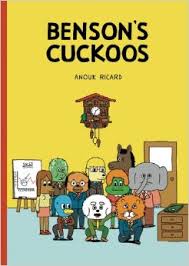
In this graphic novel all of the characters are animals with human bodies.  And each character is a different species.  The drawing style is simple and child-like but very effective in conveying emotions and feeling. You can tell a lot from the cover image above.

The story opens with a blue headed duck (Richard) applying for a job at the titular Cuckoo factory.  He hands in his resume the boss (the big poodle looking guy on the cover) And the boss says, “What kind of lousy paper is this?”  Confused, Richard replies, “Uh… printer paper.” To which the boss responds, “Yes it is.  That’s one point for you.”  The boss is clearly cuckoo.  He draws a mustache on Richard’s picture and then tell him he look stupid.  Then he asks if he can touch his toes, and then basically hires him without even actually saying that he is hired.  Richard is pleased except that he has to bring his own computer to work.

The rest of the staff proves to be just as weird. The frog looking lady with the Annie wig gets mad that he doesn’t want to see her panties in the elevator and then offers curt responses to everything he says for the next few pages.  But it’s during the first conference meeting (in which Richard is expected to do a presentation even though he was given no materials to work with) that we learn that he was hired because George has gone missing.  (more…)

Read Full Post »

gulpSOUNDTRACK: PET SHOP BOYS-Elysium (2012).

220px-PSB_ElysiumPet Shop Boys are known for big dancey singles.  And so perhaps it’s something of a surprise to get this album which is pretty but certainly low key.   It’s not like they haven’t written low key songs before, but there’s very little to get up and sing about here.

Which is not to say the album is bad.  It’s actually very good once you accept the lack of big songs.

Of course, having said that, there are one or two anthemic tracks, but the album overall is more introspective (unlike their album Introspective).  The title, Elysium refers to the afterlife where those chosen by the gods would live a happy (after)life, indulging in whatever they had enjoyed in life.  Yes, mortality is on Tennant’s mind.

“Leaving” opens the disc with a great chorus, which leads to this somber opening verse: “Our love is dead but the dead don’t go away.”  And that certainly sets the tone–nice synth rock, but nothing to loud and frenetic.  “Invisible” is a similarly low key song.   This is one of their quiet ballads, with just touches of synth melody: “I’m here but you can’t see me, I’m invisible.”  It’s a definite downer of a song but it’s very pretty.

Of course all that I said about mellow low key albums is belied by the third track: “Winner.”  This was written in time for the 2012 Olympics in London and it is very much an anthem about, well, winning.  It’s kind of obvious (although lyrically it is more in depth than many similar songs), but the melody is just simple and uplifting–(just what you’d want for Olympic documentaries).

“Your Early Stuff” is a much darker song–it is a song written to a “washed up” performer: “you’ve been around but you don’t look too rough and I still quite like some of your early stuff.”  It’s funny but also tender.  “A Face Like That” is the closest thing to a dance single on the album–it’s fast and synthy and the vocals are echoed and repeated.  But even the verses are more low-key than you might expect from the chorus.  “Breathing Space” is another pretty ballad.

“Ego Music” is another faster song, with a very funny premise: “ego music–it’s all about me.”  It’s a slight song but good for a laugh.

“Hold On” also aspires to anthemicness, but it is slower than a typical PSB anthem.  It also has a synth line that is vaguely classical.  Although of all the songs, this one is lyrically the most tautological:  “Hold on, there’s got to be a future or the world will end today.”  “Give it a Go” is a slower, simpler track. Not too memorable, although the chorus is bouncy and catchy h.

“Memory of the Future” has a great synth line and Tennant’s cool accompanying vocals–it’s a classic PSB song and one of my favorites on the disc.  Although I don’t love “Everything Means Something,” the final song, “Requiem in Denim and Leopardskin” is a great ending–slow but very catchy and rather wry and funny.

So this album overall is certainly more, dare I say it, “mature” for the Pet Shop Boys, but they haven’t lost any lustre in songwriting.

[READ: Summer 2013] Gulp

Yes, that date is correct, I read this book over a year and a half ago.  I meant to write about it then, but I loaned it out to someone and I like to have the book nearby when I write about it.  So I put it off and put it off and now that I have the book back, I will do my best to remember whatever I can about it.

But the thing about this book is that it was so memorable, I won’t have much trouble writing about it anyhow.

Mary Roach investigates the physical properties of eating from pre-digestion through to the end.  And she does it with thorough research and a boatload of humor (sometimes gross out humor, although she warns that that is not her intent–“I want you to say, ‘I thought this would be gross, but it’s really interesting.’  Okay, and maybe a little gross.” (19).

She begins with the nose.  Most people know that the nose contributes tremendously to your sense of taste.  But Roach really explicates how much.  She speaks to a woman, Langstaff, who is a professional sniffer and who is currently staffing the Olive Oil taste Panel at the Olive Center.  She is training novices to be be better at tasting flavors.  But Langstaff herself for instance rarely drinks beer for pleasure even though she is an expert at tasting it.

The most amusing (or not, depending) information here is that there are people who were paid to taste cat food.  Yes.  And that humans prefer cat food with a tuna or herbal flavor over those that taste “rancid,” “offaly,” “cereal” or “burnt.”

Fortunately, the second chapter shows that it is actually dogs who test the dog food.  It turns out that dogs and cats really shouldn’t enjoy dry dog food (cats and dogs are not grain eaters by choice).  Dry dog food was created as a means of convenience for people (and as a way to stop tinning food during the war).  As for your pets, “pet foods come in a variety of flavors because that’s what we humans like, and we assume our pets like what we like.  We have that wrong.  ‘For cats especially…change is often more difficult than monotony.'” (43).  Some other pet observations: cat’s can’t taste sweet (although dogs can and rodents are slaves to it).   (more…)

Read Full Post »

oloveSOUNDTRACK: “WEIRD AL” YANKOVIC-“Jackson Park Express” (2014).

jpaThe final song on Mandatory Fun is a nearly 9 minute epic which is a parody of Cat Stevens’ style of music.  I would never have guessed that without having read this information online.  However, on listening to it more and more I can hear a lot of Cat Stevens-isms (piano lines and style of chord progressions, although definitely not in the singing style).  I also don’t know if the content is meant to be in reference to the Cat (well, a twisted version of the Cat, of course).

I typically love Al’s longer epic songs, but this one didn’t grab me at first.  Yet after a few listens, I’ve really come to appreciate the twisted humor going on here.   The song starts with some simple pretty acoustic guitars but quickly turns epic with swelling strings and backing vocalists.

The story is about two people on the Jackson Park Express bus in Chicago.  The entire relationship that unfolds is entirely in the narrator’s head.  He bases everything that happens upon the looks she gives him and implies everything through his own looks to her.  As with many Al songs, it starts not just mundanely, but actually sweetly.

I was riding to work on the
Jackson Park Express
Seemed like any other day
Then my whole world changed
In a way I never could have guessed
Cause she walked in
Took the seat right across the aisle
I knew we had a special connection
The second I saw her smile

Pretty nice, right?  And so we see the two communicate (in his mind) nonverbally

She smiled as if to say
“Hello, Haven’t seen you on this bus before”
I gave her a look that said
“Huh, Life is funny, you never know what’s in store
By the way, your hair is beautiful

Again, pretty sweet, until we get to the first wonderfully odd Al line (about her hair)

“I bet it smells like raisins”

And it just gets funnier as it goes on:

Then, she let out a long sigh
Which, I took to mean, “Uh”
“Mama, What is that deodorant you’re wearing?
It’s intoxicating
Why don’t we drive out to the country sometime?
And collect deer ticks in a zip-lock baggie”
I also really enjoyed this punchline:
I gave her a penetrating stare
Which could only mean
“You are my answer, my answer to everything
Which is why, I’ll probably do very poorly
On the written part of my driver’s test”

The song gets really dark and creepy, with (hilarious) lines like:

I gave her a look, that said
“I would make any sacrifice for your love–
Goat, chicken, whatever

And the far more creepy:

Whoa-o-Oh, “I’d like to rip you wide open
And french-kiss every single one of your internal organs
Oh, I’d like to remove all your skin, and wear your skin, over my own skin–
But not in a creepy way”

This is also Al’s most “sexual” song ever, with a line about french kissing (true, it is her organs, but whatever), and this hilarious dramatic pause:

Then, I glanced down, at her shirt, for a second
In a way that clearly implied–
“I like your boobs”

and this other hilarious dramatic pause:

I want you inside me…
oh, like a tapeworm”

But the romance was not to be.  She leaves the bus, despite his nonverbal pleading

Think of the beautiful children we could have someday
We could school them at home, Raise them up the right way
And protect them from the evils of the world
Like Trigonometry and Prime Numbers, oh no
Baby, please don’t go”

There is to be no romance on this bus line.

This is truly a love it or hate it song, but as with most of Al’s epic songs, the more I hear it, the more I love it.  And I can’t wait to see if he plays it live.

[READ: August 3, 2014] On Loving Women

This book is a collection of brief stories about women’s first crushes on other women.  I don’t know how the collection was compiled exactly, but it appears that various women told Obomsawin their stories and she made these fun little comic strip panels out of them.  (Helge Dascher translated them into English–she also did Pascal Girard’s book, that I posted about yesterday).

Each story is named (presumably) after the woman who related it to her.  And each one becomes a simple (but not overly simple) version of the attraction.

Mathilde is obsessed with horses and falls for girls with horse faces (the drawing that accompany this are funny because Mathilda is drawn like a kangaroo or something and the girls she likes are horses.  The ending of this one, about how she learns sign language was very touching.

Indeed, in all of the stories, the women have animal heads and human bodies (but not weird hybrid creatures, just cute cartoony creatures). (more…)

Read Full Post »

pettySOUNDTRACK: “WEIRD AL” YANKOVIC-“Now That’s What I Call Polka” (2014).

npwpolkI knew that Al wouldn’t make a video for his polka medley (always a highlight of his albums).

I was surprised that I knew so many of these songs (on the last album I knew hardly any of the apparently huge songs that made up the medley).  So either I listen to more mainstream music now (or, perhaps I have kids who know more mainstream music) or the music was just much huger this time around.

This batch includes: “Wrecking Ball” by Miley Cyrus “Pumped Up Kicks” by Foster the People “Best Song Ever” by One Direction (I didn’t know this one, and I crack up at the childish way he makes the “best song” sound like gagging) “Gangnam Style” by Psy “Call Me Maybe” by Carly Rae Jepsen “Scream & Shout” by will.i.am featuring Britney Spears (I didn’t know this one) “Somebody That I Used to Know” by Gotye featuring Kimbra (I can’t believe how different this one sounds) “Timber” by Pitbull featuring Ke$ha (I didn’t know this one) “Sexy and I Know It” by LMFAO (or this one) “Thrift Shop” by Macklemore and Ryan Lewis featuring Wanz (or this one, amazingly) “Get Lucky” by Daft Punk featuring Pharrell Williams.

It’s in these medley’s that Al’s lyrics are the most graphic, because he’s actually singing other pop lyrics, not his own.

It’s always fun when he sings this live because he matches up the original videos to his new sped-up tempo.  Looking forward to Mandatory Fun Live in 2014 (or 15).

[READ: August 3, 2014] Petty Theft

I was intrigued by this story because of the strange cover art–two people in a book store–a hunched over guy and a pretty girl–both reading books.

The story is about Pascal.  He and his long time girlfriend have broken up and he is in a hellish limbo. He’s staying in a friend’s spare room and he is not drawing anymore.  In fact, he’s looking for a major change in his life–the whole cartooning thing isn’t working out for him.  The only comfort he has left is running, but on his last run he hurt his back and has been laid up practically immobile for weeks.

He goes to the chiropractor who helps him out some (although it hurts him as much as his back already hurts).  But she tells him that he cannot run for a couple of months.  He is despondent.  So he decides to go to the bookstore, his favorite local indie shop of course, and look around.  While he’s looking around he sees a girl pick up his own book (Bigfoot)…and steal it.  He is offended and intrigued at the same time.  He tries to follow her but loses her in a crowd.  And now he has to decide what to do.  Especially since he hears the clerks talking about how many books have gone missing lately.  And because he thinks the girl is really cute (and she likes his book!) (more…)

Read Full Post »

« Newer Posts - Older Posts »