Feeds:
Posts
Comments

Archive for the ‘Books about writers’ Category

6616 SOUNDTRACK: PATRICK WATSON-Tiny Desk Concert #221  (May 31, 2012).

pat-watsPatrick Watson is a Montreal-based singer songwriter with whom I was unfamiliar.  But he has received many accolades, including being nominated for the Polaris prize many times (and winning once).  It turns out that Bob Boilen also really likes him a lot. And I can see why.

Watson and his band make sounds that are quite unexpected (but are still melodic and pretty).  The first song “Adventures In Your Own Backyard” itself is amazing the way it unfolds.  The first sounds we hear are the drummer using a violin bow on Boilen’s Emmy statue (which I’m sure Bob was genuinely delighted by).  There’s two acoustic guitars and the violinist’s beautiful ooohs.  About one minute in, there’s a big drum sound as the drummer starts playing snare and bass.  And then the acoustic guitar is is put through some kind of filter to give it a very electric sound.  Once you get used to the acoustic guitar sounding electric and the electric guitar sounding acoustic, the violin comes in (sounding like a violin).  And then there’s backing vocals oohing until Watson comes back with more vocals, but this time through a microphone that is hugely distorted and mechanical-sounding (he and the violinist shared oohing duties and their voices get processed together).  All of this sounds like chaos and yet the melody is catchy and constant (and yes, the song ends with the drummer bowing that Emmy one more time).

Watson explains that for “Words In The Fire” the band was “nine hours north of nowhere” north of Quebec with these kids who invited them to a campfire party.  They had nowhere else to be so they went.   The kids requested a Bob Marley song, but they didn’t know any.  So they wrote this song.  For the start, it’s just Watson singing with the acoustic guitar.  Midway through the song, the percussionist plays a saw, giving it an eerie quality.  Despite the craziness of the first song, this song is delicate and pretty and Watson’s voice is high and sweet as well.

“Into Giants” opens with some lovely guitar intros and lots of harmonies.  This song is especially fun to watch because the five of them are all squeezed in behind the desk and seem more crammed than before.  Watson even has to move out of the way to let the violinist take her solo.  The whole band sings in a big folksy chorus “started as lovers don’t know where it’s gonna end” with appropriately big bass drum sounds.  The song seems like it’s going to end with Watson’s oooohing, but with a minute left, the song picks up again, with Watson playing a cool riff on the keyboard.  He even gets out that distorted mic again to build the song back up.

I love watching a Tiny Desk by someone I don’t know and immediately falling for a band.

[READ: January 12, 2017] “The Book”

The June 6 & 13, 2016 issue of the New Yorker was the Fiction Issue.  It also contained five one page reflections about “Childhood Reading.” 

Matar’s story is quite different from the others.  He says that his earliest memory of books is being read to, not actually reading.  Many of the classics were read to him: One Thousand and One Nights, and the Arabic literary renaissance of the twentieth century.   But there were hardly any books for children in the house.

He says that during his life he has had a passionate affair with books in English and Arabic.  And he makes this wonderfully succinct comment about youthful reading: some books were “undeserving of my youthful fervor, a few … I encountered at the wrong moment, [but there were] plenty of others that still light up rooms inside me.”

But, for him the book that affected him the most if one that he hasn’t read.  He doesn’t even know the title or author. (more…)

Read Full Post »

6616 SOUNDTRACK: DANIEL JOHNSTON-Tiny Desk Concert #224 (June 11, 2012).

danDaniel Johnston makes me uncomfortable.  I find his music to be simple and his voice isn’t very good.  And yet he is beloved by so many other people.  The fact that he is schizophrenic makes me worried that there’s some kind of exploitation going on.  But who knows.  He has had rather a lot of (relative) success.

The blurb tells us

Johnston has been diagnosed with bipolar disorder and schizophrenia, and he’s been institutionalized, but these days he travels and performs. It’s amazing to see and hear a spark of candor in what he does, all while he’s shaking like a scared child. There’s an odd sort of curiosity to watching Johnston perform, but it’s easy to root for him: He’s endearing and sloppy and unmistakably talented.

He and his guitarist Friend McFriendstein (actually Shai Halperin who plays under the name Sweet Lights) play four songs.

“Mean Girls Give Pleasure” is a pretty funny fast romp.  “Sense of Humor” is a slower song.

Between songs, they show off Johnston’s book Space Ducks.  There’s an iPad app and video game which is “Much beter than checking out Starbucks on yelp.”

“American Dream” is a clever song that’s full of monsters as metaphors.  “True Love Will Find You In The End” is a pretty, uplifting song.

His songs are short and unadorned, and surprisingly catchy.  But I don’t think I’d ever listen to him intentionally.

[READ: January 12, 2017] “Uninhabited”

The June 6 & 13, 2016 issue of the New Yorker was the Fiction Issue.  It also contained five one page reflections about “Childhood Reading.” 

Young says that when he was in fifth grade he read Robinson Crusoe (not the abridged version) in one weekend.  But he wasn’t showing off.  He saw an image or cartoon of the book and picked it for a book report not realizing how massive the actual book was.  He delayed until Friday for a report due Monday and thus had to cram in an entire novel.  He did the same thing with Gulliver’s Travels, “Who knew Gulliver met more than just Lilliputians?”

But he says that these masterpieces didn’t seem that different from non-fictional travelogues like Thirty Seconds Over Tokyo, the gory account of the U.S. bombing of Japan.

Crusoe is apt because he says he felt shipwrecked when they moved from New York to Topeka, Kansas.  (more…)

Read Full Post »

6616 SOUNDTRACK: YANN TIERSEN-Tiny Desk Concert #219 (May 21, 2012).

yannYann Tiersen scored the soundtrack to Amélie.  But he also writes and sings lovely chamber-pop music.

The first song “The Gutter”  opens with Tiersen playing a swirling violin melody accompanied by an acoustic guitar, a ukulele and keys.  Tiersen doesn’t sing, but the lead singer’s voice is yearning and delightfully accented as well.  (No names are given for the rest of the band).  I liked the way the song built in intensity even while his voice retained that quiet style of singing.

For the second song, “Monuments” everyone switches around.  Tiersen plays a lead 12 string acoustic guitar, the ukulele player is on keys and all four sing harmony lead.  You can tell that Tiersen is not American because of the way the word “Monuments” is sung “all monYOUments…” which adds an exotic flavor to the song.  The delicate keyboard sounds float nicely over the acoustic guitars.

They stay with this lineup for “Tribulations.”  The singer from the first song and the acoustic guitarist sing lead.  And everyone else joins on harmony.  “The Trial” opens with the four singing a beautiful “ooh” in harmony.  Then the other three sing a complex backing vocal while Tiersen sings lead.

There’s some really lovely melodies in this concert.

[READ: January 12, 2017] “Where is Luckily”

The June 6 & 13, 2016 issue of the New Yorker was the Fiction Issue.  It also contained five one page reflections about “Childhood Reading.” 

Having a child is like rereading your own childhood.

Galchen has a young daughter and that daughter has a some favorite stories.  One is a Moomin (which I love), another is a Piggy & Gerald.  Galchen says that if you read children’s book enough times, “they start to seem like Shakespeare.”

But she says that her daughter doesn’t read in a linear fashion.  “What happens next” doesn’t seem to cross her mind.  She reads them more like eternal landscapes: “In that sense, nothing is happening, and she reads for that nothing.” (more…)

Read Full Post »

6616 SOUNDTRACK: CHUCK BROWN-Tiny Desk Concert #217 (May 16, 2012).

chuckI’m puzzled by a few things with this Tiny Desk Concert.  The first is a note that This story originally ran on Sept. 28, 2010.  The second is the note that Chuck Brown, the Godfather of Go-Go music, died Wednesday. In 2010, he brought his full band to the NPR Music office — and put on a party like no one else.

That isn’t confusing in itself, but I have to wonder why it took them two years to air this concert, which is quite a fun rave up.  Are there other shows they didn’t air?

Okay, so I had no idea who Chuck Brown was.  And the blurb anticipated that

The name Chuck Brown might not mean a whole lot to people outside the Washington, D.C., area. … In D.C., Brown is widely known, even revered, as the Godfather of Go-Go, a title he’s held since the late ’70s. Though he started out as a jazz guitarist, Brown invented go-go, a style that incorporates funk, jazz, R&B, hip-hop and dancehall, and has mostly stuck with it ever since.

So, Go-Go, huh?  I never heard of that either.

No one in D.C. can really explain why go-go hasn’t traveled beyond the city’s environs — we love it here, it’s all over our commercial R&B and hip-hop radio stations and, at least when I was in high school, a go-go in a school’s gym was the most packed party of the weekend. Chuck Brown is a local hero. A few days after he played our offices, Brown and his whole band played at the Redskins’ stadium for the halftime show.  So to have Brown play a corner of our office — not a 90,000-capacity football stadium — was like a dream come true for a lot of NPR staffers. Sweat started pouring immediately, between the 11 musicians (that’s congas and a stripped-down kit; saxophone, trumpet and trombone; two backup singers and a rapper) and all the go-go-heads in our building.

Brown played four songs for about 25 minutes.

Go-go is mostly about the groove, though, and Chuck Brown just settles in and leans back. He showed up looking like a million bucks in a vest, Dior shades and his signature hat, and then he did what he does best — get the crowd on his side and hand its members something to dance to.

Go-go is based on a syncopated beat and the use of congas in addition to drums.  So “Senorita” is like a combination of reggae salsa and 50s singing (I can’t help but think he sounds like Frank Zappa when Zappa does his rather funny voice).  The song is slow but smoldering and fun to sing along to.  There’s a Santana guitar vibe too.

“Chuck Baby” is the hip hop element of his music.  His rapper is not very inspiring though.  She seems a little stiff.  And the song is a little flat when he’s doing the call and response–he sounds cool and seductive and they sound more bored than “naughty.”

Before the third song everyone starts chanting “wind me up chuck!” which he lets everyone know www.windmeupchuck.com is his website. “Wind Me Up!” / “Bustin’ Loose” starts with lots of call and response.  “Bustin’ Loose,” is a funky song with very James Brown accents and everyone singing the refrain: “Gimmethebridgenow, gimmethebridgenow.”  The song has been a hit in D.C. since 1979.  The backing vocalist on this song feels a bit looser (apparent as she sings “I feel like bustin’ loose).

The crowd was yelling out requests, too: “Chuck Baby” and “Run Joe,” a go-go cover of the Louis Jordan song.  “Run Joe” / “It Don’t Mean A Thing.”  “Run Joe” has a Jamaican flair “Policeman is on the premises.  What is he doin’ here?”  His guitar playing is really inspired throughout the set, but especially at the end of this song.   He does a lot of playing the same melody as he sings.  The song segues into a version of “It Don’t Mean a Thing” in which he slips in “It don’t mean a thing if it ain’t got that go-go swing.”

This set was really a party.  And Brown was just full of energy.

[READ: January 12, 2017] “Surrendering”

The June 6 & 13, 2016 issue of the New Yorker was the Fiction Issue.  It also contained five one page reflections about “Childhood Reading.” 

This reflection beings with Vuong explaining that his family moved to the U.S. from Vietnam when he was two.  He was an ESL student from a family of illiterate rice farmers who saw reading as snobby.

When he entered kindergarten, he found himself immersed in a new language.  He quickly became fluent in speech but not in the written word.  In fourth grade his class was given an assignment to write a poem in honor of National Poetry Month.  Normally his poor writing skills would mean that he was excused from such assignments.  He would spend time copying sentences out of books in the classroom.  But this time he decided to be ambitious and write a poem. (more…)

Read Full Post »

922 SOUNDTRACK: CORINNE BAILEY RAE-Tiny Desk Concert #566 (September 16, 2016).

cbrI don’t really know Corinne Bailey Rae.  Her name sounds familiar, but I don’t think she’s who I thought she was.  Evidently she won a Grammy a few years ago, but that doesn’t really help me.

For this Tiny Desk, she sings three songs.  She plays an acoustic guitar with a folky flair.  The rest of her group consists of an electric guitar, a keyboard and a box drum (I love those).

Rae’s voice is delightful and her backing band gives the songs a 70s soft rock feel.  It’s an interesting mix of sounds.

“Paris Nights / New York Mornings” is a catchy song based around her guitar.  It’s an upbeat song with some cool dramatic slow downs.  It sounds incredibly 1970s.

She says that “Hey, I Won’t Break Your Heart” is about falling in love with a person again, a second time.  And how you have to rebuild trust. It’s a slow ballad, although it builds into a kind of R&B song.  The interesting thing about Rae is that she always has a smile on her face.  She seems so happy during every song even when she sings, “I won’t break your heart like you broke mine.”

“The Skies Will Break” is about a point in your life when you think things are hopeless.  But you should just know that things will change.  It has a 70s keyboard vibe.  I really like the chord progressions of the chorus.  The fact that it’s her acoustic guitar that plays the loud chords of the chorus is pretty cool.

It has been about six years since Rae made an album, and it’s nice to have her back (even if I didn’t know she was gone).

[READ: March 8, 2016] “The Noble Truths of Suffering”

The story is about an American abroad.  He says he was speaking Bosnian and was in the American Ambassador’s house.  The house was ugly, built by a Bosnian tycoon.  But he decided that he needed more space, so he rented it out.

There’s a funny moment were the narrator sees the cultural attaché whose name is Jonah.  He says he mistakenly called him Johnny once and has been playing up that joke “Johnnyboy!” ever since.

This seems like a political story until we realize that the narrator is there to meet Dick Macalister, the author and Pulitzer Prize winner.  The narrator had received an invitation a few weeks ago.

I enjoyed that the invitation had reached his at his parents house in Sarajevo where he was briefly staying (he lives in Chicago). He couldn’t figure out how they knew where he was, but he had lots of wild speculative ideas.  He wasn’t going to go–he was trying to clear his head of Americans, until he read a little more about Macalister.  He had heard of him but hadn’t read him.  So he read some pullout quotes by the man and decided he was okay. (more…)

Read Full Post »

kalfusSOUNDTRACK: XENIA RUBINOS-Tiny Desk Concert #552 (July 25, 2016).

xeniaI am fascinated by the music of Xenia Rubinos.  Every song in this Tiny Desk Concert has something interesting going on.  But for two of the songs, I can’t stand her voice.  Rubinos seems to sing in a free form jazzy / R&B/ improvised manner.  And it bugs me.  No matter how fun she is to watch (and she is), I just don’t like the way she sings (except on the second song).

But the music!  I love the way “Lonely Lover” opens with some interesting drumming and occasional weirdo samples. But the main melody is created by two bassists! (no guitars or anything else).  It’s such a great melody, slinky and smart, with each bassist playing a different aspect of the melody.  It’s super catchy (and when she sings actual words it works well).  It’s just the moaning and groaning that I can’t stand.

Between the first and second song she takes a dance break.  Then “Mexican Chef” open with a cool staggered bass line that is echoed by the guitar (the guitar (not the riff) sounds kind of 80’s punk) and some funky drums.  The lyrics of this song are right on, too.  It’s  a ruthless critique of the way brown people are treate.  It’s sung in a kind of rap style, with no room for soaring vocals.  It’s a really great song:

French bistro, Dominican chef/Italian restaurant, Boricua chef/Chinese takeout, Mexican chef …. Brown walks your baby/Brown walks your dog/Brown raised America /Brown cleans the house/Brown takes the trash/Brown even wipes your granddaddy’s ass …  Brown breaks his back // Brown takes the flack / Brown gets cut coz his papers are wack. … Brown has not / Brown get shot brown gets what he deserves coz he fought.

Right on.

For the final song, “Laugh Clown,” Rubinos plays solo bass and sings.  The bass is just occasional notes as Rubinos scat/sings.  It’s less interesting than the other two songs, but it makes for a  nice change of pace.

Once I got past her vocal delivery, I found I really liked these songs a lot.

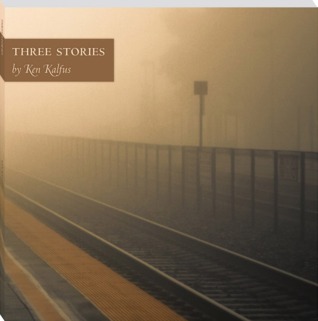
[READ: November 18, 2016] Three Stories

Back in 2014, I ordered all 16 books from Madras Press. Unfortunately, after publishing the 16 books they seem to have gone out of business (actually they are switching to non-fiction, it seems). They still have a web presence where you can buy remaining copies of books.  But what a great business idea this is/was

Madras Press publishes limited-edition short stories and novella-length booklets and distributes the proceeds to a growing list of non-profit organizations chosen by our authors.  The format of our books provides readers with the opportunity to experience stories on their own, with no advertisements or miscellaneous stuff surrounding them.

The format is a 5″ x 5″ square books that easily fit into a pocket.

Proceeds from Kalfus’ book go to the Free Library of Philadelphia.

As the title suggests, there are three stories in this book. (more…)

Read Full Post »

talkingSOUNDTRACK: HOSPITALITY-Tiny Desk Concert #212 (April 30, 2012).

hospitalHospitality are a four piece band from New York.  They play fairly quiet, kind of delicate music.  Most of the songs have a delicately picked out guitar line on the electric guitar and strummed chords on the acoustic.  Amber Papini is the lead singer and rhythm guitarist.

“Sleepover” the first song, starts out even more quietly, with Papini picking out notes on the acoustic guitar while singing in what is practically a whisper.   There’s an interesting part in the middle where both guitars are picking out melodies and its the bass that is playing the most prominent line of the melody.

“The Birthday” picks things up a bit with a relatively more intense song.  The chords are louder and Papini sings more intensely.  This song ends with a whole series of “la da de das.”  Some songs can’t pull that off, but it works perfectly with this one–especially when the bassist adds harmony vocals–it’s super catchy.

“Betty Wang” opens with just the acoustic guitar and drums as Papini sings.  She won me over immediately with the echoed and rising notes of “so shy so shy so shy.”  With the electric guitar bursts and rather loud drumming this song is practically raucous.

The band is quite but their melodies are really catchy.

[READ: December 28, 2016] Talking as Fast as I Can

I was so excited that they were making a continuation of Gilmore Girls.  And while it was no doubt hard to live up to all the expectations of all of the fans, I thought the new series was great.  It captured the old show very nicely even though everyone had moved on ten years.

I wasn’t expecting a new book from Graham, and certainly not a memoir.  But, with some down time, she was able to push this book out as well as doing everything else she’s been doing lately.

For a memoir, this book is a little skimpy (208 pages), and yet, if that’s all she had to say I’m glad it wasn’t padded out with a ton of fluff.  Plus, Graham doesn’t tell us everything about everything.  She talks about her childhood, about acting, about being single and about Parenthood and Gilmore Girls.  It’s all done in what has become Graham’s trademark style (although since we are reading it and not hearing her, the pace is probably much slower). (more…)

Read Full Post »

6916SOUNDTRACK: MARGARET GLASPY-Tiny Desk Concert #560 (August 22, 2016).

margaretI really love Glaspy’s 2016 album Emotions & Math.  Her lyrics are sharp, her voice is unusual and mesmerizing and her guitar licks are simple but just chock full of hooks.  What’s not to like?

This Tiny Desk sees her playing songs from that album. Her band is just a bassist, a drummer and her on guitar and voice.

“Emotions & Math” starts off quietly with just bass and drums while she sings in that unique way of hers.  Then the guitar comes in–it’s nothing fancy, but it plays off the bass notes in a very cool way.  And it’s super catchy too.

“Love Like This” opens with a cool bass and drums rhythm–bouncy and tribal.  And when her guitar comes in, it’s with a ripping couple of chords before disappearing again.  Once again, the bass is rumbling along with her chords accenting in a neat way.

“You and I” bounces along with some low chords and bass and Glaspy’s most growly vocals. This song features the first “solo” which is really just the notes of the chords played, but it really stands out among the deep notes.  And once again, the whole business is really catchy.

“Somebody to Anybody” is just her singing and playing guitar.  Although it feels a little quiet without the rhythm section, she fills in more guitar parts on this song and it feels quite full.  And the chorus is, that word again, very catchy.

It was this Tiny Desk that sold me on getting her album, and I’m glad I did.

[READ: March 17, 2016] “The Running Novelist”

This essay appeared in the Summer Fiction issue of the New Yorker.  Since I really like Murakami, and hope to read more of him one of the days, I’m going to include this essay because it is as surprising as some of his fiction.

This is the story of how he became a runner and how he became a novelist.

He had been the owner of a small jazz club (which I feel he has written about in one of his stories).  It stayed open late and was a novelty in Tokyo at the time.  He had a niche audience and while many people didn’t like the place, he had a steady clientele.

His friends said it would never work, but he didn’t listen and he became quietly successful.  He was there in the morning and worked late at night.  And once he made a profit he hired people to help him out. (more…)

Read Full Post »

slowreadSOUNDTRACK: DIRTY THREE-Tiny Desk Concert #245 (October 15, 2012).
dirty-3For a Murakami collection I should really have picked a jazz Tiny Desk Concert.  But none jumped out at my on my list.  So I decided to do something that might be jazzy in spirit, even if it is nothing like jazz at all.

Dirty Three are a three-piece band which consists of violinist Warren Ellis (who works closely with Nick Cave), drummer Jim White (who I had the pleasure of seeing live with Xylouris White), and guitarist Mick Turner (who has released a string of gorgeous instrumental solo albums and worked a lot with Will Oldham).

I’ve liked Dirty Three for years, although I kind of lost touch with them back around 2000.  So it was fun to see that they are still working.  (They’ve released all of 3 albums since 2000).

Jim White plays an eccentric but very cool style of drum–it always feels improvised and random, and maybe it is, but it’s never “wrong.”  Turner is the only one who is keeping the song, shall we say, “stable.”  He’s got the rhythm and melody both with his strumming.  And Ellis is all over the place with melody lines and bowing.

For this Tiny Desk, they play three songs.  Their music is ostensibly instrumental although Warren Ellis is not above shouting and yelling and keening when appropriate.

The first two songs are from their 2012 album and the last one is from Ocean Songs.

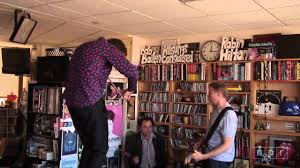
“Rain Song” opens with Ellis strumming the violin while Turner plays slightly different chords.  Then Ellis takes off on a series of spiralling violin rolls.  As always, White is back there waving his arms around with the loosest grip on drumsticks I’ve ever seen.  He plays brushes on this song but the drums are far from quiet.  Meanwhile Ellis is soloing away, yelling where appropriate and doing high kicks when White hits the cymbals.   As the song comes to an end, White is going nuts on the drums and Ellis takes off his jacket (revealing a wonderful purple shirt) .  He starts screaming wildly as he physically gets into his violin playing.

“The Pier” is about realizing that it’s the rest of the world that is driving you crazy.  It’s about “trying to undermine Facebook and realize a new way of communicating with people beyond the internet.”  It’ about… are you ready Mick?  Okay.  “The Pier” is a slower song with some plucked violin.  Ellis climbs up on the desk and dances around as he plays.  This one feels a but more controlled but in no way staid.

For “Last Horse in the Sand,” white switches to mallets and adds a tambourine to his cymbal.  It’s really interesting to watch White play around with things–moving his gear around as he plays.  He switches sticks and seems to be not even paying attention, but without ever really losing momentum or timing.  For this song, Ellis and Turner are the mellow ones while White is just all over the place with his amazing drumming.

I haven’t said anything about Turner because he is really the grounding of the band, while the other two are taking flights of fancy.

This is a wild and untamed set and it’s a lot of fun.  It’s also amusing to watch the audience witnessing this seeming chaos.

[READ: December 16, 2016] Slow Reader Vol. 1

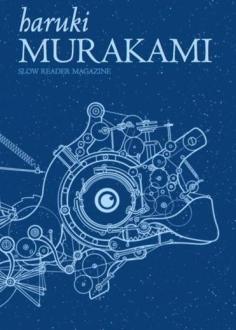
Madras Press had released 16 small books, which I enjoyed reading quite a lot.  I have posted about some and will post about more in the new year.  But word is that they have given up on the small books and have switched their attention to a new magazine/journal called Slow Reader.  The first issue came out this month and it collects stories, essays, poems, illustrations, and other things that center around novelist Haruki Murakami.

Support this small press!  You can order this issue directly (and name your price, although I think the asking price is $6).

From an article elsewhere I’ve learned that future issues will cluster around M.F.K. Fisher, Kazuo Ishiguro, and Patricia Highsmith.

This issue contains essays, fiction and illustrations, some dating back as far as 2000.

CHIP KIDD-cover illustration (wind-up bird)
Chip Kidd is awesome

GRANT SNIDER-Murakami Bingo Board
This bingo is hilariously apt–covering most of the bases of Murakami’s writing: cats, jazz, running, and even a Chip Kidd cover.

JESSE BALL-Sheep Man
A line drawing of a sheep standing upright with the caption “The sheep man’s peculiar tail was never visible to me.”

HARRIET LEE-MERRION-Diner illustration
A nice line drawing of a corner diner

KAREN MURPHY-Sputnik and two moon illustrations
Two simple drawings of Sputnik and two moons.

BEIDI GUO-Hard Boiled Wonderland and the End of the World map
A cool map of the locations of the novel.

DINA AVILA–Murakami Tasting Menu at Nodoguro in Portland, OR
I don’t really get if the menu items are related to the stories but it’s a neat idea that there are foods named after his works. But why are so many called IQ84?

EUGENIA BURCHI–IQ84 menus
A drawing of foods with what I think are character names (I haven’t read the novel yet).

FABIO VALESINI-train illustrations taken from the book trailer for Colorless Tsukuru Tazaki and His Years of Pilgrimage
No idea what the original context is, but it’s a neat, clean drawing of a train station.

JEFFREY BROWN-“In Conversation” What Jeffrey Brown Thinks About
The first piece is an amusing cartoon in which Brown scores a job at an indie bookstore by mentioning Murakami.  The little blurb says that it is an only slightly exaggerated account. There’s also a later picture by Brown of Murakami’s face posted on a bulletin board (with a lost cat flier), that’s really great.

DANIEL HANDLER-“I Love Murakami”
Handler begins his piece by apologizing to dozens of authors before saying that Murakami is our greatest living practitioner of fiction.  He mentions a few books but heaps a ton of praise on Wind Up Bird Chronicles and mentions his excitement at  finally getting Norwegian Wood in English (it had been untranslated for many years).  He wrote this essay in 2000.

YOKO OGAWA-“On Murakami’s “The Last Lawn of the Afternoon” [Translated from the Japanese by Stephen Snyder]
Ogawa writes about a house in her neighborhood which has a lawn that she finds unsettling–it’s perfectly manicured and a pale, cool shade of green.  She is reminded of the Murakami story in which a boy mows a woman’s lawn and she asks him an unexpected question.  Ogawa imagines a woman in that home asking the same kinds of questions.

ETGAR KERET-“What Do We Have in Our Pockets?”
This was inspired by Murakami’s story “On Seeing the 100% Perfect Girl One Beautiful April Morning.”  This story is about a man whose pockets are always bulging with unusual items.  People often say to him, “What the fuck do you have in your pockets?”  And his answer is that he carries things that he imagines the perfect woman needing–a stamp or a toothpick.  It is a wonderfully charming story.

RIVKA GALCHEN-“The Monkey Did It”
Of all of the items in this collection, this is  the only piece I’d read before.  I remembered parts of it (particularly the excerpts from “A Shinagawa Monkey,” and her talking about Colorless Tsukuru Tazaki.  I also recalled her saying that she liked his short stories better than his novels, but that she was perhaps wrong in thinking that.  The one thing I didn’t pick up on last time was that in the beginning of the essay she writes about Toricelli’s Trumpet or Gabriel’s Horn–an item with finite volume but infinite surface area.  She says this perfect describes Murakami’s work.  And I love that she ties it to translator Philip Gabriel who is a gentle and modest translator–perfect for the watery novel.

TESS GALLAGHER-“Murakami and Carver Meet at Sky House”
Before he had written any substantial works, Murakami translated Raymond Carver’s works into Japanese.  Ray was excited and bemused that Haruki and his wife Yoko would travel from Japan to meet with him.  This essay tells us that the following poem came about as Ray tried to imagine how his poems could possibly be appreciated in Japan.  Murakami told him how both the Japanese and American people of the 1980s were experiencing humiliation at being unable to make a decent living.  Gallagher says that if they were to meet today Ray would be awkward about Haruki’s stature.  But he would have loved knowing that Murakami had translated everything he had written.

RAYMOND CARVER-“The Projectile”
This poem is wonderful. It begins with Carver speaking about his meeting with Murakami and then flashing back to when he was 16 and was hit with an ice ball.  It was thrown from someone in the street through a small crack in the window of the car he was riding in–a chance in a million.

RICHARD POWERS-“The Global Distributed Self-Mirroring Subterranean Neurological Soul-Sharing Picture Show”
This is the most abstract and “intellectual” of the essays here.  It speaks of a team of neuroscientists discovering a lucky accident–that neurons in the brain fire when someone else makes a motion that we recognize.  Similarly, in Murakami–representation is the beginning of reality.  He speaks of the parallel narratives in Hard Boiled Wonderland.  He wonders at the universality of dreams and ideas in Murakami.  “But if his own stories are steeped in the endless weirdness hiding just inside everyday life, how then to account for Murakami’s astonishing popularity throughout the world?”

MARY MORRIS-“The Interpreter”
I loved this story.  An American business woman is giving a series of lectures in Japan.  She is assigned a translator who goes with her nearly everywhere.  She is a little annoyed that he is always there, but he is very respectful of her and only speaks when spoken to.  She assumes he is translating her speeches correctly, but during one, the audience laughs where there was nothing funny.  She doesn’t want to disrespect him, but she can’t imagine what he said to them.  In the next one, they are practically doubled over with laughter at what he says.  Finally she has to confront him about it.  He reveals astonishing insights into her personal life.  And the next day he is called away–just as she has begun to feel close to him.

In the author’s note, she says that the she was at an writer’s meeting in Princeton (where she teaches) and Murakami was there eating with them. He was by himself, and she talked to him because she was a fan of his work.  She relates a story of holding up a sign for him when he ran the New York City Marathon.  She says that the part about the translator and his family (which I didn’t mention) is from an actual translator she met in Japan.

AIMEE BENDER-“Spelunking with Murakami”
Bender speaks of trusting Murakami.  She says when the cat started speaking in one of his books, she began to mistrust him.  Nevertheless, she says, she loves a lot of writers but only trusts a few of them.  She’s not trusting Murakami’s honesty or his ability to make her smarter.  Rather, she trusts him like a man with a torch in a cave–someone who is willing to explore–and to be in front leading the way.

SUMANTH PRABHAKER-Editor’s Note
Prabhaker would like to ask the world’s philosophers why some things seem to happen to us in a random fashion.

Read Full Post »

2016-12-05-21-06-09SOUNDTRACK: EXITMUSIC-Tiny Desk Concert #228 (July 2, 2012).

I’d published these posts without Soundtracks while I was reading the calendars.  But I decided to add Tiny Desk Concerts to them when I realized that I’d love to post about all of the remaining 100 or shows and this was a good way to knock out 25 of them.

exitmusicI didn’t know Exitmusic before this show.  The band is a 4 piece and they make a really big sound .  In fact, when I was only listening to the show I forgot that they were at a Tiny Desk.  Their sound is not loud, but it’s enveloping.  They have two keyboards a guitar and an electronic drum.  The guitar is gauzy, playing high chords.  But it’s the keyboards, and washes of sound that really create the whole show.  Lead vocals are provided by Aleksa Palladino and her voice is stark and wavery, slightly scary and scared at the same time.

The blurb says that they tend to play big spaces, but

Palladino and Devon Church, the married couple behind Exitmusic, began playing music together several years ago in their New York home, layering textures and shimmering voices, each awash in echoes and cinematic anguish. To work within the challenges of our space, the two — along with new band members Dru Prentiss and Nicholas Shelestak — returned to their living room to practice a set in a pared-down configuration which still captured its essence.

I love at the end of “White Noise” as the keyboards aren’t changing what they are playing but the guitar changes chords—a repetitive downward progression that works perfectly with what everyone else is playing.

The second song, “The Modern Age” sounds like it could be a track from The xx, but her voice is so different that it totally changes the feel of the song.  Aleksa also switches guitar on this track, layering in fast chords.  And the chorus is wonderfully raw sounding.  The melody she sings is just great and the song builds accordingly.

It’s funny to see her smile so broadly after each song where she sings so dramatically and sounds heartbroken.

“The Cold” is a slow song (she’s on guitar again), short and moody while the final song “Storms” is much bigger.  On this track she is playing fast chords on a very quitter guitar while the other guitar plats slow, building chords over the top.   She make a funny comment at the end of the song: “I know I was all over the place timewise.” But it still sounded great.  They really won me over with this set.

[READ: December 13, 2016] “Obscure Objects”

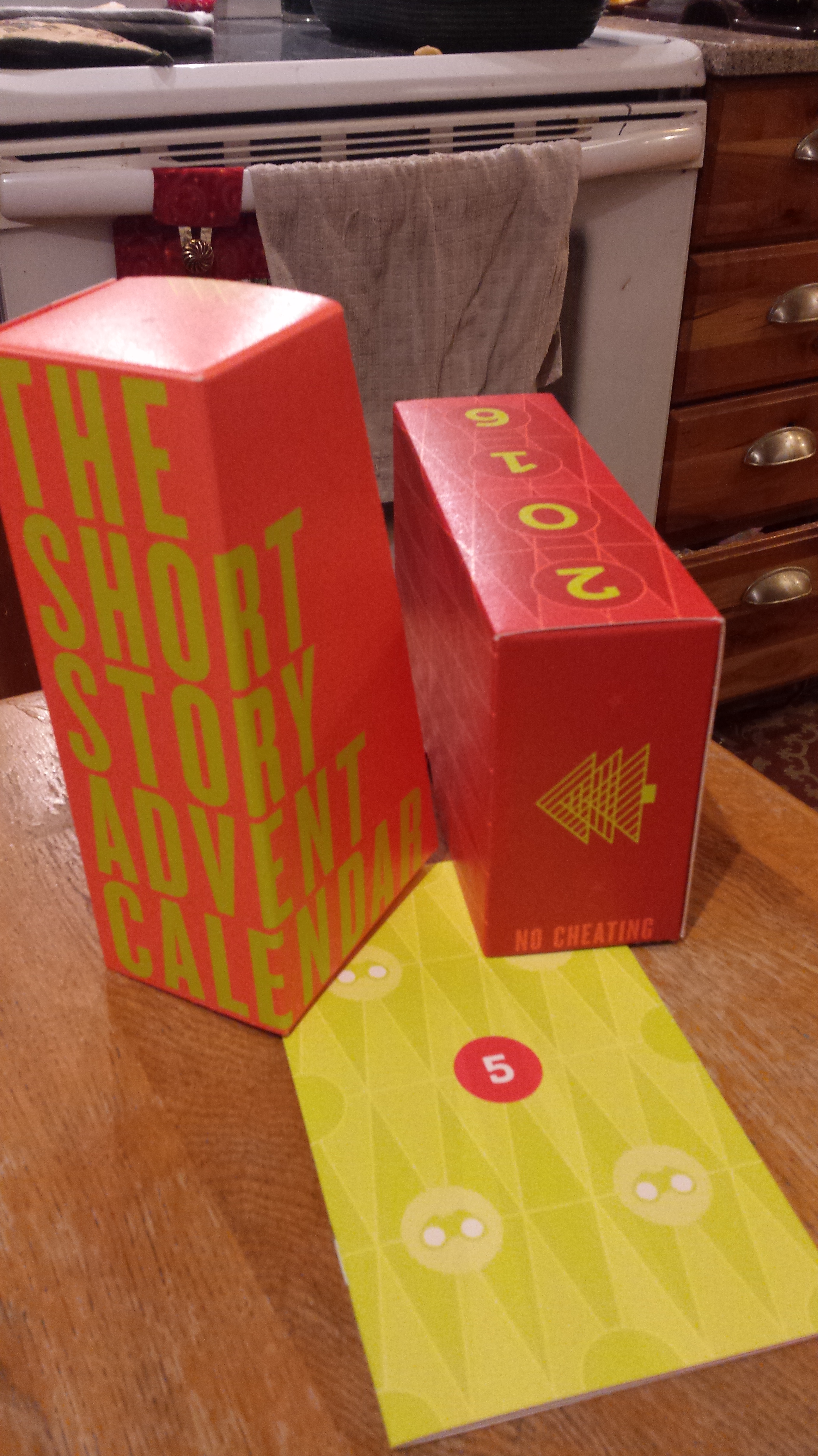
Near the end of November, I found out about The Short Story Advent Calendar.  Which is what exactly?  Well…

The Short Story Advent Calendar returns, not a moment too soon, to spice up your holidays with another collection of 24 stories that readers open one by one on the mornings leading up to Christmas.  This year’s stories once again come from some of your favourite writers across the continent—plus a couple of new crushes you haven’t met yet. Most of the stories have never appeared in a book before. Some have never been published, period.

I already had plans for what to post about in December, but since this arrived I’ve decided to post about every story on each day.

This story was really cool, although I had to read it twice to make sure I knew exactly what was going on.

Told in first person, this is the story of a woman who has just come back to Canada after some time abroad.  She is a writer (published in literary magazines) and has a teacher’s certificate, but she needed a job quickly so she took one a:

a private ESL college that recruited students from all over Asia.

Or, it was a private tutoring agency that catered to children of wealthy immigrants and ADD-afflicted offspring on the Canadian born-rich.

I haven’t decided yet.

That’s the first clue that something is unusual about this story.  (more…)

Read Full Post »

« Newer Posts - Older Posts »