Feeds:
Posts
Comments

Archive for the ‘William Gibson’ Category

SOUNDTRACK: DAVID BYRNE AND BRIAN ENO-My LIfe in the Bush of Ghosts [Remix website] (1981, 2006).

I’m stealing the bulk of these comments from a Pitchfork review of the album reissue because I have never actually listened to this album which I’ve known about for decades.

When Eno and Byrne released My Life in 1981 it seemed like a quirky side project.  But now, Nonesuch has repackaged it as a near-masterpiece, a milestone of sampled music, and a peace summit in the continual West-meets-rest struggle. So we’re supposed to see Bush of Ghosts as a tick on the timeline of important transgressive records.  Nonesuch made an interesting move that could help Bush of Ghosts make history all over again: they launched a “remix” website, at www.bush-of-ghosts.com, where any of us can download multitracked versions of two songs, load them up in the editor of our choice, and under a Creative Commons license, do whatever we want with them.

The only thing is, at the time this review was written, the site was not up yet.  And as I write this in 2019, there’s nothing on the site except for a post from 2014 about Virgin Media and Sky TV.  Alas.

[READ: May 1, 2019] “The Ecstasy of Influence”

Back in the day I was a vocal proponent of free speech.  It was my Cause and I was very Concerned about it.

It’s now some thirty years later and I don’t really have a Cause anymore.  It’s not that I care less about free speech, but I do care less about the Idea of free speech.

Had I read this article in the 1990s, I would have framed it.  Right now I’m just very glad that people are still keeping the torch alive.

Lethem begins this essay about plagiarism by discussing a novel in which a travelling salesman is blown away by the beauty of a preteen girl named Lolita  That story, Lolita, was written in 1916 by Heinz von Lichberg.  Lichberg later became a journalist for the Nazis and his fiction faded into history.  But Vladimir Nabokov lived in Berlin until 1937.  Was this unconscious borrowing or was it “higher cribbing.”

The original is evidently not very good and none of the admirable parts of Nabokov’s story are present in the original.

Or Bob Dylan.  He appropriated lines in many of his songs.  He borrowed liberally from films, paintings and books.  Perhaps that is why Dylan has never refused a request for a sample. (more…)

Read Full Post »

neuroSOUNDTRACK: CHVRCHES-Tiny Desk Concert #356 (May 12, 2014).

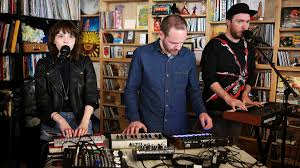
chvChvrches are just on this side of the kind of synth pop that I like.  I simply can’t deny the awesomely catchiness of “Recover” which must be due to Lauren Mayberry’s wonderful voice, or perhaps the bubbly synth sounds that the three of them generate.  In this Tiny Desk version, they brought all kinds of synths along with them.  I don’t know what they normally play live, but this is an amusing sight to see 4 keyboards (for three players)—all of the musicians with their arms hanging down as they play their instruments (synths that are about a foot long and boxes with lots and lots of dials).

“Gun” is a darker sounding song, but again Mayberry’s voice is so clear it cuts through the dark sounds.

I enjoyed that before they played “The Mother We Share” she asked if she could curse.  NPR says yes and she says good for them.  (There is a parental advisory for that one curse word too).  She also says this is the nicest but oddest gig that they have played.  She is charming and it just makes me like them even more.

[READ: June 3, 2014] Neurocomic

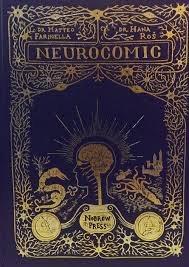
First I saw the name of the publisher–Nobrow Press–then I saw the name of the graphic novel–“Neurocomic” and I imagined some sort of sci-fi riff on Gibson’s Neuromancer.  Then I saw that both authors were doctors and I thought that it was going to be some kind of science book.  But the cover has a drawing of a brain and a squid and some other kind of creature and from there I just decided I had better see what this was.

So, this actually proves to be a very basic history of neuroscience.  With a plot.

As the story opens our hero, a rather generic looking fellow, is walking along a landscape when he sees a woman (presumably beautiful) with whom he seems to fall in love.  He is suddenly sucked into someone’s brain and then onto a forest floor.  He is confused and upset and has to find a way out.

Welcome to chapter 1: Morphology.  Our hero learns he is not in a forest, he is in a brain and those trees are neurons.  And he has run into Santiago Ramon y Cajal (1852-1934) and Camillo Golgi (1843-1926).  They explain to our guy about neurons and axons, but really he just wants out.  So they tell him to enter a neuron and on we go… (more…)

Read Full Post »

SOUNDTRACK: SURFER BLOOD-Tarot Classics (2012).

I really enjoyed Surfer Blood’s debut album.  This EP is a little stopgap until the next one. Although the sound is unmistakably Surfer Blood–poppy hooks and a very recognizable singing voice, the band sounds a little bit different here.  They haven’t lost any of their catchiness–there may be even more on the opener, “I’m Not Ready” (who doesn’t love when the guitar and vocals match each other?)  “Miranda” has that fun thumping chorus that is always fun to sing along to.

“Voyager Reprise” moves away from the surf-styled songs of their debut into an alt-rock of the 90s sound–when guitars were noisy (until they were quiet for a bit) and guitar solos happened between verses instead of as the third verse.  And “Drinking Problem” has a kind of early Depeche Mode (in vocals, not synths) feel–quite a departure from their debut.

In the way of EPs, the final two songs are remixes.  I’ve never been a fan or remixes and these don’t do much for me, but i do wonder if they will have any impact on their future sound.

[READ: June 14, 2012] “Olds Rocket 88, 1950”

All this time I thought there were only five of these short essays in this sci-fi issue of the New Yorker.  And yet tucked away near the back was the sixth one by William Gibson, a pioneer in science fiction.

Gibson’s recollection is of being a child and having everything seem like science fiction–something that is notably absent these days.  Like the chrome trim on his father’s Oldsmobile Rocket 88, the prevalence of spacemen and space-themed ideas everywhere.  Even the word Tomorrow was capitalized.

Then he recounts a personal incident.  He got in trouble with his parents for arguing with an Air Force man.  The man said space travel would never happen. But Gibson knew it would.  How could it not?  And science fiction shaped this worldview.  Not that he believed the stories would come true, but that his entire mindset was that in the future “things might be different…and different in literally any way you could imagine, however radical.”

What a wonderfully freeing notion.  To me, this sort of future-looking lifestyle accounted for the unprecedented achievements of post 1950 America.  Now that we no longer think of tomorrow with a capital T, we don’t seem as enchanted by the future.  Perhaps it was a naive outlook, but you need a certain degree of naiveté if you hope to do anything radically new.

Gibson ties in the sci-fi books he bought for a dollar to other fantasists: J.G. Ballard, Ursula K. Le Guin, Michael Moorcock, and how these thinkers weren’t all that far off from the likes of Kerouac and William S. Burroughs.  And he believes that without science fiction, he might not have been interested in what these other radical writers had to say.

It’s a short piece, but it really made me wish for more chrome and space-age technology in our lives–when people weren’t afraid to dram big.

Read Full Post »