Feeds:
Posts
Comments

Archive for the ‘Sarah Selecky’ Category

SOUNDTRACK: QUEENSRŸCHE-Rage for Order (1985).

Thinks looked to be very different for Queensrÿche on Rage for Order.  I mean, look at them.  On the back of The Warning they were leather-clad hellions.  On Rage, they are quite the dandys (man, I wanted Geoff Tate’s coat!).   This would be the first of many times that they confounded their fans with a style change.

Yet despite the look of them, the album opens with a scorcher, “Walk in the Shadows.”  It’s not as heavy as their earlier songs, but it has perfected many of the elements of those earlier records: the chanted vocals, the great riffs and the screaming solos.  “I Dream in Infrared” shows their they’ve always been interest in technology.  It’s ballady, but it’s got some really sharp guitars and some more soaring vocals.

The keyboards at the end of the song segue into “The Whisper,” the first indication that things would be different on this record–orchestra keyboards hits (which I have always loved) are used to punctuate verses, and there are cool, whispered words (which would be used prominently on Operation: Mindcrime

Then comes the big shock, “Gonna Get Close to You” a weird synth/metal hybrid with a strikingly catchy and poppy chorus (that seems ever-so-80s to me)–see below for a fun surprise about this song.

Then “The Killing Words” opens with a keyboard riff that sounds not unlike 80s-era Marillion–Tate even whispers words not unlike Fish does on early Marillion albums.  Of course, when the chorus comes in it is pure Queensrÿche .  There’s more orchestral hits and cool effects on “Surgical Strike.”

I love everything about the opening of “Neue Regel,” from the unusual guitar to the “steam” sounds used as percussion to Tate’s processed, minimized voice–it makes for a wonderfully claustrophobic song.  It’s made even more so by the overlapping, intertwining vocals later on. 

“Chemical Youth (We Are Rebellion)” is a cool sparse song (the opening in particular). But it also shows their interest in, if not politics, then at least contemporary society (again, more foreshadowing of Mindcrime).  “London” just builds and builds in intensity, while “Screaming in Digital” takes the technological aspect one step further with all kind of sinister synthesized sounds and the crazy way it ends.

The album ends with “I Will Remember,” an acoustic song complete with mournful whistling from Tate.   But even as a ballad, it’s not your typical lyrical content: “And we wonder how machines can steal each other’s dreams.”  I don’t love it as an album ender, although it does wind things down pretty nicely.

This is my favorite Queensrÿche album, hands down.  I know most people like Mindcrime better, but for me, this one is more progressive and showcases a lot of the risks the band was willing to take.

Incidentally, there’s a wonderful review of Rage here, in which I learn that “Gonna Get Close to You” is actually a cover of a song by the Canadian singer Dalbello (who is really crazy and fun, and whom I’ve never heard of until I just looked her up).  How did I not know it was a cover?  (Or more like, I knew it, but forgot it over the last twenty some years)?  I might actually like the original better.

[READ: October 25, 2011] “This Cake is for the Party”

This was a very short story that crammed a lot of emotion into two pages.

As the story opens, Bonnie is finishing a cake for a party.  The party is to celebrate the engagement of Janey and Milt.  Janey is one of Bonnie’s older friends and she’s happy for Janey.  She likes her fiancée, Milt (even if he did just get a black eye).  The black eye came from a misunderstanding.  Milt was in a pub “lasciviously” twirling the mustache that his high school class dared him to grow.  Someone in the pub thought he was making advances on his woman and punched Milt in the face. 

But Bonnie’s boyfriend, David doesn’t like Milt.  He won’t say why, he just doesn’t.  It could very well have to do with the fact that he and Janey used to date, and it’s possible that Janey dumped David for Milt (that’s a little unclear in the story). (more…)

Read Full Post »

SOUNDTRACK: TINDERSTICKS-35 Rhums (2008).

This is a charming and very French sounding soundtrack. A delightful melody runs throughout the disc (which totals just over 25 minutes).

When Sarah first heard it, she said, “What’s this French music you’re listening to?”  And indeed, it is very French-sounding. There are very simple instruments: melodica, acoustic guitars, piano.  And that melodica is a prominent sound–giving it a sense of intrigue as well as a sense of solitude (the melodica can sound so yearning).  But it’s not all melodica and intrigue; for instance, there’s some delicate xylophone on “Night Time Apartments.”

There are also several snippets from the movie online.  Here’s one clip (with Tindersticks score underneath):

Of the new soundtracks releases this one is my favorite.  And it’s one that I could see listening to for fun.

[READ: June 16, 2011] “The Rules of Engagement”

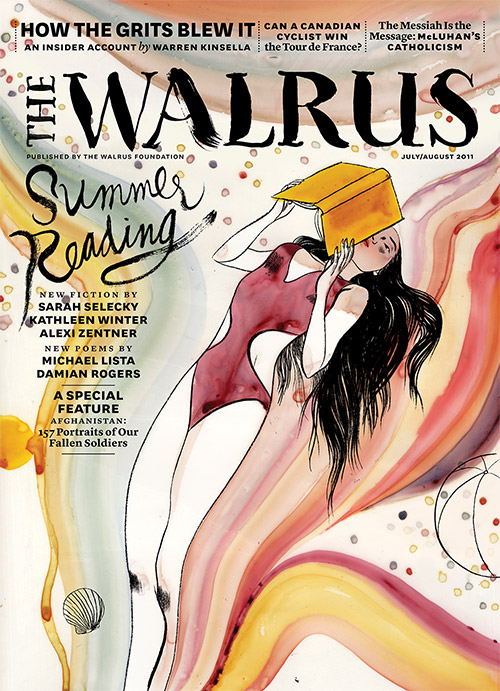
This is the final story in The Walrus‘ Summer Reading issue.  As I mentioned, the intro states: “We asked five celebrated writers to devise five guidelines for composing a short story or poem. They all traded lists–and played by the rules.”  Alexi Zenther was given rules by Sarah Selecky (which I posted below).

I really enjoyed this story, despite the immoral behavior.  Susan and her friends from high school (it’s ten years after high school now) are enjoying a foreign vacation for a week.  The first thing we see is a man seducing Susan.  They call him “Fork” because after a few hours of flirting, he asked, “And now we fork?”  Amusingly, for someone who made a living seducing women, he was bad in bed.

The other women also meet and bed these professional gigilos.  After sex, one of them simply walked over to the woman’s wallet and took money when he was ready to leave.  She notes that he took “probably less than I would have given him if he had asked.”

The women are in various stages of relationships, one woman is divorced, another is serially monogamous and a third is married (that’s the immoral part).

There’s a wonderful diversion in the story that flashes back to Susan’s grandfather Bert.  Bert had a U-pick apple stand and the girls worked there for many summers.  There’s an especially tender moment in which Susan and Bert are wandering the island and they see a wild horse.  And the scene fills Susan (and the reader) with a sense of wonder at her grandfather. (more…)

Read Full Post »

SOUNDTRACK: TINDERSTICKS-Claire Denis Film Scores 1996-2009: Vendredi Soir [CST077] (2002).

This score was created by Dickon Hinchliffe and the liner notes indicate that it was something of a jumping off point for his future film scores.  This was the third score that the band created for Denis (after Nenette & Trouble).  Stuart Staples was working on the latest Tindersticks album so Dickon took over all of the duties on this one.

This is a beautiful, melancholy soundtrack, full of gorgeous swelling strings and simple piano notes.  It doesn’t remind one all that much of  Tindersticks, but it’s not terribly far removed from their sound either.

The whole score (which is paired here with the score from L’Intrus) is 25 minutes, which made me wonder whether this is a full length film, or just a film with lots of silence (or, perhaps non-Hinchcliffe music that wasn’t included here).  [The film is 90 minutes long].

Pairing it with L’Intrus makes sense in terms of space, but the two scores could not be more different from each other.

[READ: June 15, 2011] “The Cat”

This is the first story in The Walrus’ Summer Reading issue.  As I mentioned, the intro states: “We asked five celebrated writers to devise five guidelines for composing a short story or poem. They all traded lists–and played by the rules.”  Sarah Selecky was given rules by Kathleen Winter (which I posted below).

The first line of the story really sets up the whole thing: “I am not at all surprised that my father has come back to earth in the form of a grey and white cat.”  And indeed, the rest of the story discusses her relationship with her father (those awful fishing trips when she could neither speak nor move) and how he never seemed to be pleased about her.

Now that he’s back as a cat, the dynamic has changed.  Although there’s still fish in their relationship.

I really enjoyed this story,  For although it was brief, it was wonderfully evocative.

Kathleen Winter imposed these rules on the story: (more…)

Read Full Post »

SOUNDTRACK: BLUE ÖYSTER CULT-Cultösaurus Erectus (1980).

BOC came back with a vengeance on this disc.  From the cool title (c’mon that’s a cool title) to the futuristic fossil on the cover, this album is all heavy.

The opener, “Black Blade” puts us firmly back in the heavy sci-fi world of BOC.  There’s cool time changes, there’s a wild end section with weirdo distorted vocals.  And the lyrics are by Michael Moorcock.  It’s followed by my favorite BOC track of all time: “Monsters.”  This is a fairly straightforward metal song.  It’s starts with a fast riff and big power chords but after the second verse it bursts into a full on jazz section: walking bass, wailing sax solo (!)  for several measures, until it jumps right back into the song as if nothing happened.  Thre’s even a third, even heavie part that comes later.  It a terribly underrated song.

The next two songs flirt back with their more recent gentle releases.  “Deadline” is keyboard fueled little ditty (and the general BOC rule is, the more keyboards, the less metal.)  Yet, in small doses, Allen Lanier’s keyboards really define BOC’s sound.  “Hungry Boys” and “Fallen Angel” show the band really trying to find its sound (and not being terribly successful there).

“The Marshall Plan” gets the band back on heavier terms, with that classic theme of metal songs: playing in a metal band.  (There’s a humorous musical quote from “Smoke on the Water” AND a spoken line from Don Kirshner).  Finally, the wonderfully weirdly titled “Lips in the Hills” gets the band back on familiar rocking territory.

While this isn’t their best disc, it is certainly better than the previous one, and ranks up pretty high in their catalog.

[READ: March 7, 2010] “Paul Farenbacher’s Yard Sale”

This was a cool story with a bunch of twists.  The simple premise is that the story is set at a yard sale.  The sale is being held by the wife (and new boyfriend) of Paul Farenbacher, a recently deceased man.  The narrator was the family’s neighbor (and on one occasion kissed their son).

In the intervening years she has become closer to the family.  She helped sell some products that Farenbacher was selling, and also sold new (home made organic cleaning products) to Farenbacher’s wife (and the rest of the community).

The story is a way for secrets to get revealed and truths to be told. (more…)

Read Full Post »