Feeds:
Posts
Comments

Archive for the ‘Authors’ Category

givingtuesToday is #GivingTuesday.  Giving Tuesday is a campaign to create a national day of giving at the start of the annual holiday season.  It encourages a national day of giving to kick off the giving season added to the calendar on the Tuesday following Thanksgiving, Black Friday and Cyber Monday.

In honor of GivingTuesday I wanted to post about two young people whom I have encountered recently (in print, not in real life).  Each one of them has blown me away with his and her selflessness and resourcefulness.

freethechild

The first was in the book Breakfast on Mars and Other Essays (which will get a post tomorrow) from Craig Kielburger, a Canadian man who was just 12 when he made a difference.

Craig Kielburger wrote an essay called “A Single Story Can Change Many Lives.”  In it he recounts his own personal experience of outrage at reading a horrible news story.  In 1995, when he was 12 years old, Craig saw a headline in the Toronto Star newspaper that read “Battled child labour, boy, 12, murdered.” The accompanying story was about a young Pakistani boy named Iqbal Masih who was forced into bonded labour in a carpet factory at the age of four.  Masih eventually snuck out and began telling people about what had happened.  When he was 12 he was shot dead.

Kielburger, at age 12, immediately wanted to do something about this.  He took the article to school, gathered friends founded a group called the “Twelve-Twelve-Year-Olds.”  In December 1995 before he started eighth grade, he took two months off of school and backpacked through Asia, Kielburger traveled to Asia with Alam Rahman, a 25-year-old family friend from Bangladesh, to see the conditions for himself.  His group evolved into the Free The Children fund, and international organization.  And his foundation has to date built over 650 schools and school rooms and implemented projects in 45 developing countries through its approach of “children helping children”. The majority of the organization’s annual funding comes from funds raised by young people.

marys

The second story is in the most recent Lucky Peach Issue (#9).  In an insert entitled “Guts,” there is a story about Martha Payne, a Scottish ten year old girl who has made a huge difference.

Martha was nine years old and was asked for a class to write like a journalist.  She thought it would be fun to make a blog about her school meals (this would allow her to include pictures).  So she created NeverSeconds. In one of her posts she wrote “I need to concentrate all afternoon and I can’t do it on 1 croquette. Do any of you think you could?”  Her dad tweeted it and soon it was a sensation.  People really responded to the size of her meal.

And then someone posted that she was lucky to get a meal at all.  She had been helping to raise money for Mary’s Meals for years–in her words, “they provide free school dinners in a place of education in sixteen of the poorest countries in the world.  Children can go to school instead of working or looking for food.”

never secondsBecause of the attention, she set up a JustGiving page that sends money to Mary’s Meals.  She raised £2,000 in a short time.

Back at home, her school began improving their meals and she began rating them (one even got a 10 out of 10).  And she started gaining fame in the region, making the paper and meeting chefs who were curious about her.  And then her school told her she had to shut down her blog.  She wrote about it here.

Of course, that made her blog explode.  She received thousands of messages and emails and began raising more and more money.  She had hoped to raise £7,000, as I write this she has raised £131,219 (that’s 1874% of her goal)–remember, she’s only 10.

Martha notes that $20 will feed a child for a year.  Here’s that link again JustGiving.

It’s amazing what determination can do.  Happy holidays.

Read Full Post »

cover-10-9_largeSOUNDTRACK: SIGUR RÓS-“Svefn-g-englar” (1999).

220px-SvernCoverAThis was the first I heard of Sigur Rós.  I suspect my friend Lar told me about them and I was just blown away by the first track on this single–a 9 minute swelling, string-filled, otherworldly enterprise.

The first song on the single is “Svefn-g-englar.”  It opens with overlaying chords and the beat is kept by an echoing keyboard note.  It’s very spacey and mellow.  And the vocals are unlike anything i had heard before–not just falsetto, but practically alien falsetto.  There are noisy guitars but they work into the background washes of sound and don’t really register as guitars exactly.  Gorgeous soaring vocals on the chorus, which I’ve always heard as “its you” but is apparently “tjú.”  It’s otherworldly and beautiful  Then at 6:30 the drums kick in and the song gets grounded, taking on more gravitas as the chords grow louder.  This lasts for one minute as the song then slows itself back into its original style.

The second track is “Viðrar vel til loftárása.”  It has a louder bass and great chords.  This slow airy song is grounded by the acoustic piano–a very pretty melody with the strings behind it.  Jonsi’s vocal line is beautiful but mixed very low as if he is so far away.  The song ends with a great string section until the abrupt end.  It clocks in at 10 minutes.

Two live songs “Nýja lagið” and “Syndir Guðs” (live at the Icelandic Opera House, June 12, 1999) show that the band can work this magic live.  The guitar is more intense bring a bit more drama to the sound.  But Jonsi’s voice is still amazing in the live setting.  The first one is funny because you don’t really realize it’s live until the end when people start clapping.  And at 9 minutes it’s an amazing listen.  When it goes into a minor chord at around 5 minutes, it’s really something.

The final song “Syndir Guðs” comes from their debut album Von.  It is only 5 minutes, but it’s really quite good here.  It’s nice to see them translate their style to this older song.  The song is quite a short one for this EP, which totals nearly 35 minutes.  This is a great EP for fans of the band.  Hearing those live recordings is totally worth it.

[READ: December 2, 2013] “Daniel Boone, By Himself”

I don’t know a lot about Daniel Boone, truth be told.  So this story may be very accurate or maybe it’s based-on-actual-research about Boone’s possible mental state at the time of his death.  Or maybe he just made it all up.  Whatever the case, I did not enjoy it.

From the beginning, in which we learn the proper way to scalp someone, to the death of Boone’s son, the story was explicitly violent.  And while I’m no shrinking violet when it comes to violence, there just wasn’t much more to it. I’m sure that Boone’s life was nonstop violence, and that this story is not inaccurate in that way (I don’t even know if he had a son).

And perhaps it was that nonstop violence that prevented me from learning much about him in the first place. (more…)

Read Full Post »

gb4SOUNDTRACK: MOONA LUNA-“Vamos! Let’s Go!” (2012).

Moona_Vamos_cover-300x267This song opens with a surf guitar lick and then is dominated by keyboard chords.

The first verses are sung in Spanish (by a delicately voiced woman).  The chorus of “vamos, let’s go” is super fun and easy to sing along to.  But the second half of the song is sung in English (I assume it’s the same words–my Spanish is okay).

It’s a simple song, catchy as anything and you learn some Spanish too!  And check out how cute that cover is.

I also just learned that Moona Luna is a side project of the band Pistolera whom I’ve heard of but not heard.  This one came on the Kids Corner 25th Anniversary CD.

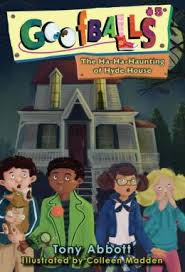
[READ: October 23, 2013] Goofballs #4: The Mysterious Talent Show Mystery

Goofballs #4 proved to be my favorite of all of the Goofballs because the main new character in the book is a redhead named T. (just like my daughter!)  [I secretly believe that Tony Abbott read our blog and saw a picture of T. and decided to name a character after her–even if it was C. who was the one who read all the Droon books with me].

Our four goofy sleuths Jeff Bunter, Mara Lubin, Kelly Smitts, and Brian Rooney are of course present and this time they are preparing for a talent show.  This year’s new director of the talent show is T. Rinkle, a genuine goofball in her own right.  For one thing, she has scheduled the Talent Show for Friturday!  And worse yet, no matter how good (or bad) someone’s talent is, Ms Rinkle tells them that they are great.

But then things get really weird–things start happening which seem like the Talent Show will never happen.  A giant tuba goes missing, the costumes come back in all the wrong sizes and the scripts are missing pages.  What is going on? (more…)

Read Full Post »

gb3SOUNDTRACK: LUNCH MONEY-“Ate too Much of My Favorite Food” (2009).

lunchmoneySurely everyone has experienced this horrible feeling–you love some kind of food so much that you eat too much and get sick.  My example was peanut butter Rice Krispie treats, an invention that I assume was my mothers.  They were sooooo good.  But I have never eaten them since that day (over 30 years ago.  In fairness, no one has offered them to me either).

So this is a fun song–opening with snapped fingers and a solo female voice before the horn fueled simple melody comes in.  I enjoyed the way the “ba ba ba” section turned into baba ghanoush.

There’s a shout-out section about the foods that did you right and wrong.  My only quibble with the song is that the foods that they list are really strange–foods that no one thinks of as their favorite foods–zucchini??, creamed spinach??.  Even gummy bears?  Where’s the heavy foods that kids actually overeat?

Lunch Money has another song called “I Love My Library” that I may have to check out.  This one came on the Kids Corner 25th Anniversary CD.

[READ: October 25, 2013] Goofballs #3: Superhero Silliness

This book introduced me to a word that I evidently should have known for some time: derder.  A derder is the cardboard roll inside of toilet paper or paper towels.  You put your lips up to it and go “der der der” and it’s a musical instrument.  Seriously.

But what does that have to do with Superheroes?  Well, in this case, plenty.

The kids are on line at Pizza Palace, the site of their very first mystery (which we never saw).  Luigi, the owner, had named a pizza after them for their brave deeds–cheese, garlic, pineapple and peanut butter.  And now it was one year after that deed and he was adding a new mystery topping.  Everyone was waiting to see what it would be when a lino pulled up to the line and called the Goofballs over.  It is Randall Crandall’s driver and he says that Randall Crandall needs their help.

Randall has the world’s largest collection of derders and he is afraid that someone is planning to steal it.  He is having a superhero costume party and he fears that the thief will try to steal them during the party. Will the Goofballs come dressed in original superhero costumes and catch the thief?

Will they ever! (more…)

Read Full Post »

flesh

SOUNDTRACK: SIGUR RÓS-Von (1997).

von

This is Sigur Rós’ debut album. It is a far cry from the gorgeousness that their later albums would bring.  In fact it is primarily an excuse for washes of songs, trippy sound effects, otherworldly vocals and the occasional song.  You can hear elements of that later Sigur Rós, but for the most part this is some pretty simple space rock.

 “Sigur Rós” opens the album with spacey sounds and a distant hi hat.  It’s a series of swirling notes and waves of chords for 9 minutes.  Some vocals (okay screams) come in around 6 minutes making it a bit more scary than trippy.  It morphs into “Dögun”which is closer to the famed Sigur Rós sound–swirls of notes and ethereal voices.  At 3 minutes some really distant crazy voices start singing as most of the music drops away. “Hún Jörð …”   brings some beats (backwards) until the song proper starts.  There are two vocals singing high swooning sounds over a simple bass (two note) melody and drums.  It’s a very simple song but especially after 12 minutes of space music that preceded it, it really coalesces as a song.  And when the band crashes in and the drums start pounding (a great build up) the album really hits its stride.  It’s a pretty great precursor to their later great songs and the studio trickery at the end of the song (making it go backwards) is pretty fun too.

“Leit að lífi” is a 3 minute song of spacey noodling. maybe backwards guitar and theremin.  “Myrkur” reintroduces some bass guitar (this actually sounds like a riff from an 80s alt rock band). It may be their most conventional song.  “18 sekúndur fyrir sólarupprás” is 18 seconds of silence.  “Hafssól” is a trippy swirly song with waves of music and distant voices for over 12 minutes.  “Veröld ný og óð” is mostly percussion, which then morphs into people talking and laughing.

Title tack “Von” also begins with percussion, but in a more song oriented way.  The vocals also come in nicely in the mix letting you know that a proper song is coming–although it stays very spacey and fragile.  “Mistur” is only 2 minutes of percussion.  “Syndir Guðs (Opinberun frelsarans)”  has a simple bassline with trippy squeaky guitars and whispered vocals.  For 7 minutes.  It’s simple and repetitive but very enjoyable.  The final track “Rukrym”  is six minutes of silence and then “Myrkur” played backwards.

Never reaching the heights of their later albums, this does give a glimpse into what they might get up to.  However, it mostly feels like early trippy Pink Floyd.

[READ: November 27, 2013] Both Flesh and Not

Sarah got me this book for Christmas last year.  I had intended to read it but I realized that I had read all of the essays individually before, so it became a lower priority.  The only thing in the book that is “new” is the list of DFW’s definitions of words that he saved on his computer.  Before each essay there is an alphabetical list of words he found interesting with their definitions (and some annotations).  They help you appreciate the kinds of things he was interested in and the complexity of words.  It’s pretty cool.  I particularly liked: “muntin–strip of wood or metal that separates & holds various panes in a window, like a window w/four individual panes arranged in a big rectangle etc (that’s putting it well Dave).

But when I recently read Wittgenstein’s Mistress, I decided to reread his essay, so i looked in the book.  And it all spiraled from there–so much that I’m going to compare the book versions to the original articles next week.

And but so, this is a very enjoyable collection of essays. The essays are arranged chronologically from 1988-2007 (except for the first article which gives the book its title and is a great opener, but which I argue is the one that should be read after a different essay).  There’s a couple of essays on tennis, some book reviews, some essays about writing, and some thoughts on the (then) current political climate.  Nothing is too too academic (well, a couple are), and while many of the stories do come from DFW’s younger writing days when he was a little pedantic, his later ones are a lot of fun (and his love for tennis is palpable). (more…)

Read Full Post »

[LISTENED TO: November 21, 2013] “You Must Know Everything” podcast

podcastIn the fourth New Yorker fiction podcast, George Saunders reads Isaac Babel.  I know Saunders very well, although I knew next to nothing about Isaac Babel.

Saunders sets up this story very briefly before diving in to the read.  There’s something fantastic about the way Saunders read the story–full of emotion and affect.  He absolutely made the story come to life and his commentary at the end made the story even better.

Babel was 21 when he wrote this story (he was amazingly prolific–his Complete Works is over 1,000 pages), and Saunders is blown away by the amount of depth such a young writer fits into the story.  Saunders says that for him Babel is a combination of Hemingway and Kerouac–Hemingway because Babel edited his storied very intensely and Kerouac because he wasn’t afraid to add the occasional poetic touch.

In the story, a young boy is going to visit his grandmother.  As the story opens, he explains that he was always very observant.  He knew everything about the streets of his city, Odessa.  He knew the stores and the anomalies in the buildings.  He observed every new window.  Until someone teased him for looking in a lingerie store. (more…)

Read Full Post »

[LISTENED TO: November 20, 2013] “Urban Planning” podcast

podcastIn the third New Yorker fiction podcast, Donald Antrim reads Donald Barthelme.  I know both writers, but neither one all that well.

The story is absurdist and very funny.  In it, the narrator buys “a little city,”Galveston, Texas.  He keeps things pretty much the way they are–he doesn’t want anything too imaginative going on.  He tears down several houses and builds new developments (cut in the shape of puzzle pieces).  But he’s a little bored so he goes out and shoots 6,000 dogs, and then makes a front page announcement that he had done it.  This causes some upset (naturally), and he’s appreciative for the excitement.

But overall he is unsatisfied because he is in love with a married woman.  And she won’t leave her husband (and may not even know who the narrator is–except that he owns the city).  Eventually he had to sell the city back (and he took a real soaking financially on that deal).

The story has many many funny lines–laugh out loud funny–and (dog killing aside) it is a funny and delightfully weird story that retains its voice no matter how odd it seems. (more…)

Read Full Post »

[LISTENED TO: November 20, 2013] “The Dating Game” podcast

outkoudIn the second New Yorker fiction podcast, Edwidge Danticat doesn’t read Díaz’s story but rather she discusses it and her connection to Díaz after listening to the audio from the New Yorker Out Loud 2 CD (the story is read by Junot Díaz with Gail Thomas doing the female voices).

I have yet to read Díaz’s Drown (for no real reason, I just haven’t), which is where this story appears.  And I enjoyed that this story is written in the same style as his later stories about Junior (sure, I suppose he will need to move beyond Junior as a character but it seems like he has plenty of stories to tell).  And I found this story unsettling and very enjoyable.

The story is a funny/obnoxious (I mean, re-read the title) story about, as the title suggests, how to date a girl–there are different specifics depending on her race (white girls will put out, but local girls you need to take to the fancy restaurant).  And be sure to take the government cheese out of the fridge so she doesn’t see it–but be damn sure to put it back before your mom gets home.

The reading is wonderful and having Thomas do the female voices really adds a nice touch.  I would say more about the story, but Danticat says a lot of what I was thinking about it.  (more…)

Read Full Post »

2000_05_15_p323

SOUNDTRACK: DR. DOG-Tiny Desk Concert #7 (October 20, 2008).

drdog

I have been hearing a lot about Dr. Dog lately (they are from Philly and the radio station we listen to is from Philly, so that makes sense).  But I had assumed they were a new band.  So imagine my surprise to see that they were the 7th Tiny Desk Concert and the first full band to play the Tiny Desk.  (Their first album came out in 2005!).

It’s fun to watch a five piece band squeeze into the Tiny Desk (the drummer is playing a small pink suitcase) and the fifth member of the band is playing some various percussions (I wonder if he does more in the band).  It’s also funny when one of the guitars breaks a string and the singer says “son of a bitch.”

Dr. Dog proves to be quite interesting.  Their first song is “The Beach.”  It’s a rocking awesome track–the guitar is great and bassist Toby Leaman’s move is raspy and powerful.  I really like this song a lot.  The second song is quite different, it’s a bouncy boppy song that sounds a bit like a more rocking Grateful Dead (that bass).  This song has a different singer–Scott McMicken, who plays lead guitar on “The Beach,” but acoustic guitar here.  (The other guitarist, Frank McElroy  played acoustic on The Beach and electric on this one).

After a lengthy discussion they play the third song (in a different version from the record) “How Dare.”  This song opens with their great harmonies (a wonderful feature of the band).  It also has a jam band quality (Toby’s back on vocals but less raspy and powerful, and more bluesy)/on this track.

The band seemed to think they were only to play two songs, and frankly it’s a shame they only play 3. At 12 minutes it one of the shorter Tiny Desk concerts.  But I am a convert to Dr. Dog, and I need to hear more from them.

[READ: November 10, 2013] “Reunion”

After listening to Richard Ford in yesterday’s podcast, I decided I wanted to read his take on the Cheever story “Reunion.”  And while I can definitely see that it was inspired by a kernel of an idea in Cheever’s story, I probably never would have put the two together had I not known.

Ford’s story opens the same way as Cheever’s with someone waiting in Grand Central Station.  It turns out that the person is Mack Bolger.  Bolger is waiting intently for someone.  We quickly learn that the narrator who spies Bolger had had an affair with Bolger’s wife, Beth about a  year and a half prior to this meeting.  It ended abruptly when Mack confronted them in their hotel room (in St. Louis).  Mack (who is a large man) boxed the narrator’s ears a bit and sent him running from the room in varying stages of dress (and without a precious scarf which his mother had given him).

He had not seen Mack again, although he did see Beth on one final instance–a sort of final closure.  They met in a bar and tied up loose ends, and that was that.

So when the narrator sees Mack he gets this sudden urge to speak to him:

just as you might speak to anyone you casually knew and had unexpectedly but not unhappily encountered. And not to impart anything, or to set in motion any particular action (to clarify history, for instance, or make amends), but just to speak and create an event where before there was none.  (more…)

Read Full Post »

[LISTENED TO: November 19, 2013] “Reunions” podcast

podcastIn the very first New Yorker fiction podcast, Richard Ford reads a story by John Cheever from 1962.  This is an especially apt pairing because Ford explains that when he does author appearances, he often reads Cheever’s story “Reunion” before reading his own story “Reunion.”  The reason, he explains, is that the Cheever story inspired his own.  [I haven’t read the Ford story although it too appears in the New Yorker, but from the way he describes it, it doesn’t sound like it’s all that similar, just “inspired” by the Cheever piece].

I don’t know a lot of Cheever (which Ford says is a common and sad problem for American readers), but I have always loved his story “The Swimmer,” which I think is fantastic.

“Reunion” (the Cheever story) is very simple and yet it speaks a lot about family. (Both Ford and the New Yorker host talk about how remarkably short (about 1,000 words) and yet how powerfully concise it is.)  In the story, a young man has time to kill between trains in Gran Central Station.  He is en route from school and had about 90 minutes before his next train arrives. So he contacts his father to see about having lunch.  He hasn’t seen his father in about three years and he thinks this will be nice. (more…)

Read Full Post »

« Newer Posts - Older Posts »