Feeds:
Posts
Comments

Archive for the ‘Authors’ Category

SOUNDTRACK: NATALIE PRASS-“Short Court Style” NPR’S SOUTH X LULLABY (March 14, 2018).

I did not enjoy this Lullaby at all.  Prass’ voice is very conventionally poppy and the synth sounds were really cheesy.  I would without question turn this off it was on the radio.

Evidently the original has “a laid-back disco cool and bouncing bassline groove” but then Prass

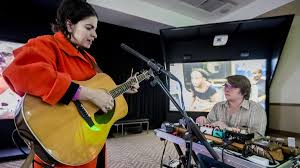
shows up to her South X Lullaby session with keyboardist Jacob Ungerleider, slows down the tempo just a mood lighting dimmer and turns the song’s breezy funk into the soft murmurs of late-night devotion.

Still doesn’t make me like it.

This version of “Short Court Style” was filmed in an interactive art installation by Caitlin Pickall called FEAST, which is part of the SXSW Art Program and was created as part of the Laboratory Artist Residency program in Spokane, Wash. Prass and Ungerlieder sit at a dinner table set with plates and towers of wine glasses, onto which images and patterns are projected. The projections are triggered by the movements of guests at the table, so the experience changes every time someone sits down.

[READ: March 15, 2018] “No More Maybe”

This story looks at immigrants in the land of trump’s america.  But it also looks at how in-laws can drive us crazy.

The narrator’s in-laws have come to visit them because she is pregnant.

Her mother-in-law has been very busy taking advantage of all that America has to offer (cheaply): blueberries, the clean air, the stars, and English-language classes (which are expensive in China).

She is puzzled by them being free: “America is a capitalist country….  What about so-called ‘invisible hand’s” (She learned about that phrase two days earlier).  The woman is confident (she is a volleyball coach) and is not shy about expressing herself. (more…)

Read Full Post »

SOUNDTRACK: MAL BLUM-“See Me” NPR’S SOUTH X LULLABY (March 13, 2018).

I feel like I was pretty lucky to see Mal Blum just days before they went to SXSW and made a Lullaby.

Without the band, Mal sings more quietly which certainly lets you hear the words more clearly–and Mal is a gifted lyricist.  But Mal also writes catchy tunes.

I love that the verses are quiet and muted, but there’s loud strumming in between.

And as the song nears the end, the intensity ratchets up for a line of “why can;t they see me?”  …before the quiet conclusion: “I was right there.”

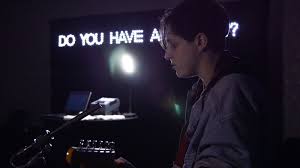
Mal performs in front of the Future of Secrets art installation.

The Future of Secrets was conceived by Sarah W. Newman in collaboration with Jessica Yurkofsky, Rachel Kalmar and metaLAB at Harvard. The installation, which is part of the SXSW Art Program, asks those attending to anonymously type a secret into a laptop and in exchange someone else’s secret is given to you. Those secrets are then projected on a wall, which is the backdrop for this video.

“‘See Me’ is an unreleased song that will be on our next record (sometime next year),” Blum tells NPR. “It’s about the disparity between how one sees oneself, or the struggle of being seen as we are, versus how others view us, which can result in an unintentional hidden self or a perpetual feeling of invisibility. Being transgender informed the song, but it’s not exclusively about that.”

[READ: September 10, 2017] “An Education”

This is a short piece about two girls in school  I assume it is set in Hungary as it is translated from the Hungarian by Len Rix.

The narrator said she was always a hard-working child filled with self-discipline.  But her parents never understood that she did it all for herself–not for them or to make anyone else happy.  Her father was the school principal and was absolutely proud of her–she was hardworking and punctilious like he was.

Her mother, on the other hand, was clearly more loving to her sister Blanka–when she lost her temper with Blanka “there was something frenzied and indiscriminate about the way she pummeled her.”  Her father tried to push her very hard to make her learn more.  Her father was far more proud of the narrator than Blanka, but “no one was ever as proud of me as Blanka [was].” (more…)

Read Full Post »

SOUNDTRACK: JOHN PRINE-Tiny Desk Concert #717 (March 12, 2018).

For all of the legendary status of John Prine, I don’t really know that much about him.  I also think I don’t really know much of his music.  I didn’t know any of the four songs he played here.

I enjoyed all four songs.  The melodies were great, the lyrics were thoughtful and his voice, although wizened, convey the sentiments perfectly.

The blurb sums up things really well

An American treasure came to the Tiny Desk and even premiered a new song. John Prine is a truly legendary songwriter. For more than 45 years the 71-year-old artist has written some of the most powerful lyrics in the American music canon, including “Sam Stone,” “Angel From Montgomery,” “Hello In There” and countless others.

John Prine’s new songs are equally powerful and he opens this Tiny Desk concert with “Caravan of Fools,” a track he wrote with Pat McLaughlin and Dan Auerbach. Prine adds a disclaimer to the song saying, “any likeness to the current administration is purely accidental.”

I thought the song was great (albeit short) with these pointed lyrics:

The dark and distant drumming
The pounding of the hooves
The silence of everything that moves
Late in night you see them
Decked out in shiny jewels
The coming of the caravan of fools

That song, and his second tune, the sweet tearjerker “Summer’s End,” are from John Prine’s first album of new songs in 13 years, The Tree of Forgiveness.

He introduces this song by saying that.  This one is a pretty song.  It might drive you to tears.  He wrote this with Pat McLaughlin.  We usually write on Tuesdays in Nashville because that’s the day they serve meatloaf.  I love meatloaf.  We try to write a song before they serve the meatloaf.  And then eat it and record it.

For this Tiny Desk Concert John Prine also reaches back to his great “kiss-off” song from 1991 [“an old song from the 90s (whoo)…  a song from the school of kiss off 101”] called “All the Best,” and then plays “Souvenirs,” a song intended for his debut full-length but released the following year on his 1972 album Diamonds in the Rough. It’s just one of the many sentimental ballads Prine has gifted us.

He says he wrote it in 1968…when he was about 3.

Over the years, his voice has become gruffer and deeper, due in part to his battle with squamous cell cancer on the right side of his neck, all of which makes this song about memories slipping by feel all the more powerful and sad.

“Broken hearts and dirty windows
Make life difficult to see
That’s why last night and this mornin’
Always look the same to me
I hate reading old love letters
For they always bring me tears
I can’t forgive the way they rob me
Of my sweetheart’s souvenirs”

The musicians include John Prine, Jason Wilber, David Jacques and Kenneth Blevins.


[READ: December 11, 2017] X

I really enjoyed Klosterman’s last essay book, although I found pretty much every section was a little too long.  So this book, which is a collection of essays is perfect because the pieces have already been edited for length.

I wasn’t even aware of this book when my brother-in-law Ben sent it to me with a comment about how much he enjoyed the Nickelback essay.

Because I had been reading Grantland and a few other sources, I have actually read a number of these pieces already, but most of them were far off enough that I enjoyed reading them again.

This book is primarily a look at popular culture.  But narrowly defined by sports and music (and some movies).  I have never read any of Klosterman’s fiction, but I love his entertainment essays. (more…)

Read Full Post »

SOUNDTRACK: KUINKA-Tiny Desk Concert #716 (March 9, 2018).

Kuinka are a happy band.  Smiles are on all four members’ faces as they play their three songs.

Miranda Zickler says that they spend all of their time in the van listening to NPR, so this is pretty exciting for them.

The blurb says:

Last year I came across Kuinka (coo-WINK-uh), a band from Seattle… Kuinka’s live performance knocked me out even more than the creative video they’d submitted for the contest.

Since then, Brothers Zach (guitar) and Nathan (mandolin) Hamer, along with Miranda Zickler (keys) and Jillian Walker (cello), have come to D.C. for an official performance at the Tiny Desk, bringing with them their great harmonies and unique blend of energetic, string-band music with a dose of synth.

I’m not sure what the band sounds like normally–if they typically play electronic drums or what, but as the blurb notes

The songs are performed here on relatively tiny instruments, including a ukulele, a drum pad, a small synth, a mandolin and a banjo, along with an electric guitar. But the performance is fleshed out beautifully with rousing vocal harmonies.

All three tracks performed here are from Kuinka’s 2017 EP Stay Up Late, and each one has its own charm.

“Curious Hands” has lead vocals by Miranda.  There’s a cello, keys and Nathan playing a small acoustic six string guitar (or ukulele?).  He gets a pretty big (largely percussive) sound out of that little thing.  But it’s the harmonies that are really spectacular.  I feel like the electronic drums are a little too electronic for this largely folk band but whatever.

For “Spaces,” Zach switches from electronic drums to electric guitar.  He also sings lead with an unexpected twang.  Nathan has switched to mandolin which gives the whole song a kind of Americana vibe.  The electronic drums sound they chose is awful, but there’s a really cool synth sound between verses that prevents this from being overtly in one genre.

Miranda “explains” the name of the band: Kuinka is like kuinka-dink but it doesn’t have anything to do with that, it’s just a coincidence [that’s our ‘bit’].

The blurb’s recommendation to stay until “Mistakenly Brave” is a good one as it is the most rousing song.  They revert back to previous instruments, although Miranda plays banjo.  The harmonies are terrific (much better than the solo vocals, honestly).  It’s got that whole The Head and the Heart vibe going on.  Big soaring vocals and a cool break that leads to a rollicking coda.  Mid way through, Zach switches back to electric guitar to add some oomph.

[READ: April 20, 2016] Endpoint

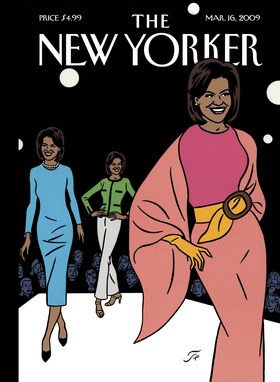
John Updike died in January 2009 after decades of writing for the New Yorker and elsewhere.  As the news settled in the magazine ran this tribute to him in the March 16 issue.

Rather than running a story, they published a ten-poem sequence called “Endpoint,” (I didn’t even know he wrote poetry).  Most of these poems were written in 2008, while presumably, he knew he was dying from lung cancer.

Endpoint (more…)

Read Full Post »

SOUNDTRACK: RED BARAAT-“100+ BPM” (Live in front of the Brooklyn Public Library) (Field Recordings, June 2, 2014).

Continuing with the fun that is Red Baraat, I stumbled upon this Field Recording [What Happens When 350 Musicians Meet For The First Time In Brooklyn?] from the NPR studios.

As part of the Make Music New York Festival, NPR commissioned new music from Red Baraat and Sunny Jain created “100+ BPM.”  And as the blurb informs us:

“We put out a call and they came — by the hundreds. When we invited wind, brass and percussion players to join us yesterday in Brooklyn to perform a world premiere by Red Baraat‘s Sunny Jain for the annual Make Music New York festival, we were hoping that lots of different kinds of musicians would join us. And boy, did they ever.

On this absolutely gorgeous Saturday afternoon, about 350 musicians assembled on the steps of the Brooklyn Public Library to play Jain’s 100+ BPM. Young, older, professional drumlines, community marching bands, seasoned jazz players, Indian wedding band musicians, Brazilian samba drummers and scads of amateur players came out to play. It was just incredible.

I don’t know how they managed to record the music so perfectly, but it sounds fantastic.  You can really hear the different instruments (well, except maybe the poor violins and that piccolo) as they zoom in on one section or another.

The whole group plays along perfectly.  And there’s even some great sax solos (how did they decide who got to solo?) an excellent trombone solo and lots and lots of drums and percussion.

I love that after the wild soloing everybody joins back in for that great melody once again.

At 6:15, the song stops (and you get to see how psyched Sunny is).  Then after a short pause he starts clapping and selects which group of instruments will keep the beat going.  First it’s drums, then percussion, then the tubas and then the brass comes into play a new staccato riff that is fun and catchy and easy to speed up. Which it does.

He drops out the drums and selective instruments until it’s just the tuba and percussion.  Then the drums come back in and he starts picking up the tempo of that riff again.  Faster and faster do they get to 100BPM? According to this excellent free BPM counter, they make it to 106/107 BPM during the main part.

Then after a breather it’s time to keep going, faster and faster until they reach 126 BPM by the end and Sunny gives an exultant leap to end the song.

What an excellent way to spend a Saturday afternoon.

[READ: February 26, 2018] “Pardon the Intrusion”

Lydia Davis stories are usually really short–a paragraph or two or three.

This one is very different.

It is a series of posts–requests and thanks for various items.  And that’s it.

It’s hard to tell if a story can be constructed from these requests–at times it seems like you can follow a narrative.  But mostly it just seems to be people requesting goods and services. (more…)

Read Full Post »

SOUNDTRACK: ALEX CLARE: Tiny Desk Concert #715 (March 7, 2018).

Alex Clare’s band is clearly having a beard-growing contest.  The drummer (Christopher Prendergasp) isn’t playing but everyone else suggests the stakes are high.  The bassist (Christopher Hargreaves) is winning.

Vocalist and songwriter Alex Clare is yet another soul disciple from the UK, and his visit to Bob Boilen’s desk is the perfect setting to bask in the power of his voice.

The first song, “Three Hearts,” is a love song dedicated to the moment he heard the heartbeat of his first child coming from his wife’s sonogram. Backed by a tight four-piece band, Clare’s tale of his family’s road to domestic tranquility captures the joy as well as the uncertainty of impending parenthood.

Lyrically it’s okay and sweet, it just sounds fairly typical.  Especially musically.  I thought we;d be getting 20 minutes of straight ahead soul with a little less charisma than The Commitments.

Next is “A song called ‘Love Can Heal.’  True story.”  The guitar (Jordan Peters) is far more interesting on this song.  In fact I found myself enjoying the guitar more than Clare’s voice.  I love the cool guitar licks at the end and the nifty harmonic note that ends the song.  Although, having said that, his voice is quite powerful.  And he shows it off even more on the next song.

In “Caroline,” he inhabits the words with passion and heartfelt pleading, bringing to mind some of the best soul shouters, completely lost in the sentiment of the lyric.

That is very true, he is completely swept up in this song (even he says it’s not about anyone in particular).

I really like the guitar on the final song “Open My Eyes.”   I like the whole vibe of this song–the way the song unfolds and the backing vocals as well.  Indeed I feel like each song has gotten a better as the show progressed.

While I found his music to be fine–nothing I’d go out of my way to listen to but I wouldn’t turn it off either. I found his backstory far more interesting:

The British singer-songwriter released his debut album, The Lateness of the Hour, on Island Records last summer. But the label soon discovered how serious Clare was about his faith [he is an Orthodox Jew, which I didn’t know when I made the beard contest joke] — especially when it came to the sabbath and high holy days, on which Orthodox Jews are forbidden to perform.

“When I signed to Island — you know, obviously a shomer Shabbos Jewish person — I don’t think they quite realized what that means,” Clare says. “I got offered a tour at Pesach, at Passover, and couldn’t perform.”

The offer Clare turned down was a slot opening for Adele. About four months later, he was dropped from Island’s roster, having failed to generate significant album sales or radio play. As Clare was figuring out his next move, he received a call from Microsoft, which was interested in using his song “Too Close” in a commercial. It was a deal that would make the song a hit and restart his career.

He doesn’t play that song here, which is too bad.  And the poor percussionist’s name is never given.

[READ: February 28, 2018] “Violations”

This is a story about writing stories and how autobiographical they are or are not.

It is written in close third person.  And the first sentence is really, really, really long.

It begins, “He had wanted to make sure she wouldn’t write about him…” and then it goes on in his mind about why he didn’t want to be written about and narcissism and all that kind of thing.  The short of it is that he never asked her not to write about him, but he never stopped craving assurance that she wouldn’t (and there’s a long entangled reason why not).

The “she” is his now ex-wife.  She moved out but he still gets her mail.  And she has not written about him.  He tries to get her mail to stop coming but he doesn’t cancel her magazines–especially the one that she always wanted to be published in but had never been. (more…)

Read Full Post »

SOUNDTRACK: RED BARAAT-Bhangra Pirates (2017).

Although Red Baraat’s first two albums were good, this one leaps beyond the other two.  Perhaps its the addition of the guitar–bringing a(nother) new element to their sound.  Or perhaps it’s that the whole thing just sounds so much bigger.  Half of the songs were recorded live at KEXP which might explain the fresh (and live) sound.

And as one review puts it

Clearer production makes it easier for each of Red Baraat’s chosen musical styles to stand out as they blend together. Jazz, funk, and rock and roll all play important parts on Bhangra Pirates, and it’s clear early on the album, even to newcomers, that Red Baraat is less about sticking to a genre than to doing what makes the whole band – and the whole audience — have a genuinely great time.

It’s here in their discography that I get a little confused.  Before this album, they put out an album called Gaadi of Truth which features about half of the same songs as this one.  There’s also something called Big Talk which seems to be a remix album of sorts.  Talk  is available from their bandcamp site but Gaadi is not (although it did get full on reviews when it came out).

There’s a tremendous riff that opens “Horizon Line” and the moody guitar drones really balance it out nicely.  Plus the dhol and the rest of the percussion sounds really clear–much more obvious than on the past two records.

“Zindabad” opens with a Middle Eastern guitar riff .  After a horn fueled intro the main riff kicks in.  And then the vocals come in.  No idea what they’re singing about and that’s all the better–it’s fun to chant along.  The riff after the first verse is another great brassy one.

There’s some big guitars that open “Banghra Pirates,” and once the song starts the vocals come in.  There’s lots of get your body moving sentiment and then some other words which who knows what they are, but rhythmically they’re great.   The middle has a great heavy almost metal chugging of chords for a nice slow down before the party starts again.

“Tunak Tunak Tun” is a song they recorded on their debut album.  It’s even better here.  It’s a cover of a song made popular worldwide by Daler Mehndi (and how much fun is the original).  “Rang Barse” opens with what sounds like a sitar although it’s not listed in the instruments.  “Bhangale” features guitars from  Delicate Steve.  There’s some great chanting up front that sounds like “Bhangale ooch oolay wah wah wah.”

“Gaadi of Truth” opens with a big guitar and some very cool effects (particularity on the sousaphone which has a cool underwater sound).  The middle has some interjections: “horn please” bwaaaaaaaah  “horn please” bwaaaaaaah.  There’s a pretty wild and noisy guitar solo too.

“Se Hace Camino” adds Spanish/Latin music to their reprtoire.  The song is sung in Spanish and English: “we make the road by walking.”  “Akhiyan Udeek Diyan”  goes through many different sounds and styles over its 6 minutes, ultimately with a fast rollicking pace before ending.

“Layers” ends the dis with an upbeat almost poppy instrumental.  It’s sweet with a kind of call and answer from the horns.  It’s a delightful ending to a party disc.

The lineup is largely the same, although they’ve added the guitarist and have changed a few members:

Sunny Jain – dhol & effects/vocals; Rohin Khemani – percussion; Sonny Singh – trumpet/vocals; Ernest Stuart – trombone; Jonathan Goldberger – guitar (all tracks except 5,10); Delicate Steve – guitar (track 5); MiWi La Lupa – bass trumpet/vocals (tracks 3,5,6,8-10); Chris Eddleton – drumset (tracks 1,2,4,7); Tomas Fujiwara – drumset (tracks 3,5,6,8-10); John Altieri – sousaphone & effects (tracks 3,5,6,8-10); Jon Lampley – sousaphone & effects (tracks 1,2,4,7); Jonathon Haffner – soprano saxophone (tracks 1,2,4,7) / alto saxophone (tracks 3,5,6,8-10); Mike Bomwell – soprano saxophone (tracks 3,5,6,8-10) / baritone saxophone (tracks 3,10);  not on this recording: Arun Luthra – soprano sax ;   Smoota – trombone.

[READ: March 6, 2018] “The Poltroon Husband”

I tend to like Joseph O’Neill stories–there’s usually something in the style and the structure that is pretty enjoyable.

And that was true for this one.  I wasn’t blown away, but I really enjoyed it and there were some parts that I enjoyed a lot.

A man and his wife move from Phoenix to Flagstaff.  They build a house there from shipping containers (I love that details and I’d love to see what it looks like). He tells his wife that it is going to be their “final abode.”  Jayne doesn’t like this designation.  But he defended the merits of the phrase with “an argument from reality.” Jayne said he was using “an argument from being really annoying.”

He says that abode means a residence, of course, but it comes from an Old English verb which means To wait.  Abide comes from the same root.

One night they are in bed and Jayne hears a noise.  They listen, hear a few more noises and what sounds like a cough  However, “although the house has two stories and numerous dedicates zones…only the bathrooms are rooms.  Otherwise the house comprises a single acoustical unit.  Often a noise made in one zone will sound as if it emanated from another.” (more…)

Read Full Post »

SOUNDTRACK: RED BARAAT-Shruggy Ji (2013)..

Red Baraat’s second album feels a lot bigger than their debut.  The production is bigger, there’s (even) more diverse sounds.  And there’s a lot more vocals album.

I enjoyed the brrrrrr ah! vocals, but I’m a little less excited by the rapping. Primarily because the lyrics are pretty lame (party type lyrics for the most part). But that doesn’t diminish from the music, which is super throughout.  It feels big and solid–evidently the band was recorded playing all together with only minimal overdubs.

“Hala Bol” opens with a wild melody and some singing “bol bol bol, hala bol–RAISE YOUR VOICE!–baby baby bol hala bol.”  The song is pretty long (as most of these are and the middle features the guys chanting all manner of things in possibly different languages.

“Tenu leke” opens with a celebratory “Brrrrrrrrr ah” and chants of  “hoy hoy hoy.”  There’s a wonderful uplifting sense to the melody especially when the song takes a breath and the notes spring forth once more.

“Shruggy Ji” opens with some slow, ominous horns for about 25 seconds and then the dhol, percussion, and drums kick it up into a furious meld of go-go funk, hip-hop, jazz, and South Asian groove.  The powerful funk makes way for a good-natured rap: “Move your body and shake those hips / just feel the rhythm all under your skin / drip drop the sweat / shruggy ji lets begin.”  Nothing exciting, but fun.  The rap in the second half is less successful although I’ve read that it’s meant to be all in fun, so I guess a line like “I’m gonna ask you some question like I was Biz Markee” is just comical.  About the song band leader Sunny Jain says, “We like to think of ‘Shruggy Ji’ as that shadow lurking next to us, waiting to take over when the night falls and move our body with no inhibitions.”

“Burning Instinct” has the kind of booty shaking vibe that make you wanna move.  The dueling horn solos add to the fun chaos that the percussion is creating.

“Dama Dam Mast Qalandar” has lyrics in Hindi (I assume) which seems to work better because I’m not trying to figure out what he’s singing about.  “Sialkot” opens with some thundering dhol paying and lots of “brrrr ahs!”

“Private Dancer” also features rapping party vocals over some slow rolling funk.  I love that it begins with someone shouting “yo, turn that dhol up!”   “F.I.P.” is full of more fun and dance and lots of call and response. “Apna Punjab Hove” has a bit of an upbeat  reggae feel and a smidge of klezmer for a change of pace.  It’s still dancing, just a different step.  Lots of chanting of “ah -ha” and the like.

“Azad Azad” is an album highlight.  It’s got great percussion and a fun riff from the horns and lots of chanting.  Unlike some of the more partying songs, this one is more political: “no borders, no walls, freedom [sings / dances / rings] through us all.”

“Mast Kalander” is a fun song which proves that the more nonsensical the lyrics, the better the party: “jump in the sauce / throw your hands up and go crazy.”  I love how it gets faster and faster as it progresses.”

“Aarthi”ends the album with a cool, jazzy melody.  The party is over and it’s time to go home so lets chill things down a bit.  I love that the song opens with what sounds like someone blowing into a bass saxophone and making vocals sounds at the same time.  It’s pretty cool.

The lineup remains the same as the first album:
Sunny Jain – dhol ; Rohin Khemani – percussion ; Tomas Fujiwara – drumset ; Arun Luthra – soprano sax ; Mike Bomwell – baritone sax ; Sonny Singh – trumpet ; MiWi La Lupa – bass trumpet ; Smoota – trombone ; John Altieri – sousaphone.

[READ: January 24, 2018] “Maps and Ledgers”

I haven’t really enjoyed the stories by Wideman that much.  So I wasn’t really looking forward to this one.  But it proved to be pretty straightforward and quite compelling.

As the story opens we meet a man who says that in his first year teaching at the university, his father killed a man.  The narrator was barely established in the school–he had no phone in his office–so the call went to the English Department chair’s office.  It was his mother, sobbing and blubbering.  He had told her to call there only in an emergency, which this was, obviously.

The chair was a southern gentlemen and he respectfully left the room once the narrator had been called down.

But the story isn’t just about him.  The narrator’s Aunt C got his father a lawyer.  Aunt C was a pioneer.  She had served as a WAC office in WWII and submitted applications for jobs through the Veterans Administration.  She managed to get a job in the city planners office before they realized she was black.

They did not convict his father–the victim was black after all.  But things got worse for him.

And this is when another one of Wideman’s stories gets confusing.

My father’s son, my youngest brother, convicted of felony murder. And years later my son received a life sentence at sixteen. My brother, my son still doing time. And my father’s imprisoned son’s son a murder victim. And a son of my brother’s dead son just released from prison a week ago. And I’m more than half-ashamed I don’t know if the son, whose name I can’t recall, of my brother’s dead son has fathered son or daughter.

Gets confusing doesn’t it?

Yes it does. (more…)

Read Full Post »

[ATTENDED: March 10, 2018] The Comedy of Errors

Our friends Jonathan and Carrie take their kids to the Shakespeare Theatre regularly and they invited us along for The Comedy of Errors.

I’m not the only one who enjoys performed Shakespeare about 100 times more than reading Shakespeare, and I felt like this show really brought the play (which I didn’t know) to life.  It also made me laugh at how this play is basically the foundation of every mistaken identity slapstick story every written.

The play ran for a little over an hour–perfect for kids (it was listed as appropriate for grades 3 and up).  It’s usually around 90 minutes, so they cut out some stuff, I guess, which was fine.

The story itself is very funny with “two sets of identical twins, mistaken identities, colorful characters and a madcap chase sequence.”

What really impressed me about the production was that rather than having two people in the twins’ roles, they had the same actor (and actress, in this case) play both roles.  Antipholus the main character was very funny.  But Dromio, the servant, was an awesome comic character who stole the show.  I’m sorry I can’t find the woman who played him.  When it came time to have them both on stage, there was lots of very clever misdirection to allow the “double’s” face never to be seen. (more…)

Read Full Post »

 SOUNDTRACK: RED BARAAT-Chaal Baby (2010).

Red Baraat is one of the few bands to play two Tiny Desk Concerts. I’ve also had the fun experience of seeing them live.

The band was founded by dhol player Sunny Jain as a way to bring Bangrha music to Brooklyn.  The band speaks to many disciplines and plays a wonderful mash up of styles.  So while the foundation is bangrha music, there’s elements of funk, go-go, Afro-Cuban, Brazilian, and jazz–all designed as one big party.

This debut album features the dhol, soprano and tenor sax, trumpets, trombones, sousaphone and drums and percussion.

To my ear the sousaphone is the grounding instrument–often standing out as the bass while the rest of the brass is playing melody or soloing.  And yes, sometimes the sousaphone gets a solo or two as well.

I love the vocal interjections–whether nonsense or actual words I can’t tell, but they are often fast and fun–good punctuation to the melody.  And the band knows melody.  The main riff of “Tunak Tunak Tun” is a blast.  And the vocal phrases are there to humanize the party.  I didn’t realize that this was a cover of Bhangra pop singer Daler Mehndi’s song of the same name, but that explains the catchiness.

In fact there are several covers on the album.  “Hey Jamalo” (a reworking of Malkit Singh’s popular “Hey Jamalo Tootak Tootak Tootiyan”) opens with a rousing introduction with a solo from dhol.  I rather wish there was more obvious dhol playing (which is so much fun to watch live) but it blends in pretty perfectly with the rest of the music and fits perfectly with the percussion solo in the middle of this song.

They play three Bollywood soundtrack hits “Dum Maro Dum,” “Samaro Mantra,” and “Mehndi Laga Ke Rakhna.” “Dum Maro Dum” has some cool percussion sounds an a real jazz feel–I love the way they stretch out the notes in the middle.

The word Baraat (Hindi: बरात) (Urdu: برات‬‎) means a groom’s wedding procession in North India, West India and Pakistan.  Unsurprisingly, they play two covers of traditional Indian wedding songs “Punjabi Wedding Song (Balle Balle),” which has some fun stop and start melodies and a real marching band kind of vibe and “Aaj Mere Yaar Ki Shaadi Hai” which opens with some dramatic percussion before settling into some very pretty processional music.

But it’s not all raucous party music.  “Arcana” slows things down with a cool riff or two and nice accompaniment.

However, other songs like “Drum and Brass,” escape easy categorization with a clarinet reminiscent of Eastern Europe combined with percussion and melodies from Western Asia.

The title song “Chaal Baby” has some great chanting and dramatic horns moments which I saw described as “the Dirty Dozen Brass Band gone Bollywood” or belonging at a Punjabi football halftime show.

Speaking of marching band, there are a few moments on this album that felt kind of like a marching band to me.  “Mehndi Laga Ke Rakhna” was an example of a marching band vibe.  That kind of sound is hard to avoid (if indeed they are trying to) with that kind of instrumentation, although perhaps that is the inevitable comparison to processional music. My experience is that it works better live than on record.

But songs like the original “Baraat to Nowhere,” showcase a great original melody and some fun soloing.  Nearly every song features a solo by one or more members of the band allowing everyone to show his chops.  And back to that sousaphone–I’ve never heard anyone make sounds like that from an instrument before.  Great stuff.

“Samaro Mantra” the Bollywood song, ends the album on almost a down note.  The melody is somber, the drums are martial.  It’s kind of an odd choice for an otherwise upbeat and celebratory album.  But maybe it works as a calm down after an exiting wedding–time to go home everybody, party’s over.

Sunny Jain – dhol / drumset / percussion ; Rohin Khemani – tavil / doumbek ; Tomas Fujiwara – drumset ; Arun Luthra – soprano sax ; Mike Bomwell – tenor sax ; Sonny Singh – trumpet ; MiWi La Lupa – bass trumpet ; Smoota – trombone ; John Altieri – sousaphone

[READ: January 14, 2018] “Pieces”

I rather enjoyed Hye-Young Pyun’s previous story and was intrigued to read another one.  This one was translated by Sora Kim-Russell.

The previous one was thoughtful and disturbing and so is this one.

In this story, which is surprisingly unspecific about the characters, a man’s wife went missing a month earlier.  She slipped off off of a gorge and was presumed drowned.

He has just gotten a call from the police that a body part has been found and they would like him to identify it.  The part that was found was a right leg. (more…)

Read Full Post »

« Newer Posts - Older Posts »