Feeds:
Posts
Comments

Archive for the ‘Authors’ Category

SOUNDTRACK: NEGATIVLAND-Helter Stupid (1989).

Helter Stupid was the follow-up to Negativland’s “smash hit” (maybe 10,000 copies sold?  I have no idea) Escape from Noise.

It is a concept album based on a hoax that they perpetrated.  Wikipedia summarizes:

In 1988, the group released a mock press release to suggest that the song “Christianity Is Stupid” was connected to murders by David Brom, and that the group was forced to cancel a planned tour in support of Escape from Noise. However, there were no connections with the murders, and the tour was cancelled only due to shortage of funds and free time. Their next album, Helter Stupid, made use of the event by sampling news reports of the controversy surrounding Negativland.

So they generated their own controversy and then made art from it.  Can you imagine the attention that would get in 2019 compared to the minor coverage they got in 1989?

The first half of the album is composed of the tracks “Prologue” and “Helter Stupid” which form an extended piece lasting over 22 minutes. The concept, and some of the sampled material, came from a San Francisco television news program that was taken in by the media hoax. Other samples used included those from Rev. Estus Pirkle (further samples from the same sermon used in “Christianity Is Stupid”), an interview with Charles Manson, and “Helter Skelter” by The Beatles.

The disc opens with a man reciting lewd(ish) rock lyrics.  Then comes clips of ads for murder movies–murder, mayhem, marauding!

The prologue continues with extended samples of the news reports that talks about them being connected to the murder case.  At the end of the track a phone rings.

Song 2 begins with a call from Rolling Stone asking if there is any backward masking on “Christianity is Stupid.”

The rest of the 18 or so minutes is a mashup of all kinds of samples, spliced and cut up.

we don’t have enough data ; S-I-M-P-L-O-T ; murder and music–this isn’t the first time controversial music has been linked to tragedy.  A lengthy quite from Charles Manson and one from John Lennon

There is section where engineers hear something on a tape when you run it backwards–play it backward and you hear (rather amusing) evil messages.

Then comes the riff of Helter Skelter with The Beatles singing Helter and then “Stupid” sampled over “Skelter.”  The middle of the track goes on to emphasize how stupid the controversy is by continuing to use the “stupid” sample in all places

It’s believed night stalker suspect Richard Ramirez was influenced by AC/DC’s Highway to Stupid album. Ozzy Osborne song “Stupid Solution” became the focal point of an actual stupid case involving a Southern California teenager

And then a clever splice to create: “Christianity is triggering the murders.”

It’s intense and thought provoking and sometimes funny.

Side Two is completely different.  There’s 7 tracks all called “The Perfect Cut” with different parenthetical names after each one.  It’s introduced as Dick Vaughn’s Canned Music Moribund Music of the 70s, brought to you in authentic 70s stereophonic format with music, news reports, contests, and more.  The tracks contain samples from “The Winning Score”, a 1977 presentation by TM Century, producers of radio jingles and imaging.

“The Perfect Cut (Canned Music)” talks about short IDs and promos for radio and loops the phrase “execute a perfect cut.”

“The Perfect Cut (Rooty Poops)” features someone talking about being the greatest radio personality in the world.  He then says he spins the dial and finds nothing good–what a bunch of rooty poops.  There’s lots of samples from 70s funk and the absurdly high note of “Loving You.”  There’s also a bit of Casey Casem.

“The Perfect Cut (Good as Gold)” is all about “staying power and the announcer wondering who will still be around 7 years from now in 1992.  Their list: Bruce Springsteen will not burn out’ Prince (unless he gets a whim and decides to drop out of music) ; Michael Jackson ; Lionel Ritchie ; U2 ; Bryan Adams ; Talking Heads; Eurhythmics.  [That list was about half right].   There are samples of : Fragmentation and standardization.

“The Perfect Cut (Piece of Meat)” mostly features a sample of someone growling “I’d like a piece of meat.”  And the admission that the music industry suffered from denationalization but it became big business.  All of this over disco bass and strings.

“The Perfect Cut (White Rabbit And A Dog Named Gidget)” opens with a high school student saying “I’d like to become a lawyer and go to UCLA.   I hear it’s got nice weather and lots cute guys.  I’d like a white rabbit convertible a dog named Gidget.  The most important thing in my life is to go to heaven when i die.”  There’s more Casey Casem talking about learning to appreciate new music.

“The Perfect Cut (11 Minutes)”  A Top 40 listener’s average listening span is only 11 minutes.  Jingles need to be shorter and more frequent.  A shotgun intro with accents on each of your call letters.   I enjoyed hearing this promo.

LPs sale priced at $2.66. 8-track tape $4.44 including this Billboard toppers: The Jackson 5, The Carpenters, Elton John, Neil Young,Cat Stevens, Black Sabbath, James Taylor, Ike & Tina Turner.

There’s also this news headlines for Dec 1978–the average price of gas soars to 76 cents per gallon (!).

Dick Vaughn–From Jan 1, 1970 to Dec 31, 1979, we’ve got your moribund music.

“The Perfect Cut (48 Hours)” is inspired by an ad “You’ve got 48 hours to save a lot of money.”

Someone says it’s so annoying I used to shut the radio right off.  Then there’s silence for 10 seconds followed by, “just when you thought it was safe to turn on your radio.”  And the promise/threat: “Nothing happens until someone buys something.”

The Weatherman shows up to talk about “sewer mouth.”

And then there’s this gem: Take 2 high quality stereo LPs, put them in a full-color jacket, add a beautiful sexy gal on front and candid photos of the KQ jocks inside and you’ve got a bombshell [EXPLOSION].

This is a fun and interesting experiment.  Some tracks do actually bear repeated listening to hear just what they’re trying to do.

Personnel: Richard Lyons (credited as “Dick Vaughn”) ; David Wills (uncredited) ; Don Joyce (uncredited) ; Mark Hosler (uncredited) ; Chris Grigg (uncredited)
Musical Samples The Beatles – “Helter Skelter” ; King Floyd – “Groove Me” ; Carol Douglas – “Doctor’s Orders” ; Minnie Riperton – “Lovin’ You” ; Tavares – “Heaven Must Be Missing an Angel” & “It Only Takes a Minute” ; Zapp (unidentified) ; Brothers Johnson – “Strawberry Letter 23” ; Brick – “Dazz” ; Natalie Cole – “This Will Be” ; Joe Tex – “I Gotcha” ; Donna Summer – “Love to Love You Baby” ; Bebu Silvetti – “Spring Rain” ; Bill Summers & Summer Heat – “Jam the Box” ; Mungo Jerry – “In the Summertime”

[READ: April 20, 2019] “The Seven Circles”

This story started as one thing and then turned into something else very dramatically.

It begins with Vinod completing his B. Com and being told by his parents that he should get ready for marriage.  They had the girl picked out and since he had no objection to her, they went ahead with the plans.

He found himself at his future in-laws looking at the gifts that his bride-to-be, Sheetal, would bring with her.  He glanced at her during this surveying of the gifts and he was sure he saw her looking back at him with distaste.

He desperately tried to get her to look at him over the next few weeks, but even during the ceremony she would not look him in the eye.   He thought about running away during “the seven circles” of the ceremony, but he went through with it.

That first wedding night was awkward as they slowly got to know each other.  The had a little, but not much, in common.  And he didn’t even consider doing anything physical.  He did manage to get one kiss in before the night was over. (more…)

Read Full Post »

SOUNDTRACK: NEGATIVLAND-Escape From Noise (1987).

This was my introduction to Negativland.  And I loved it.  I loved everything about his album.  I used to play songs from it on my college radio show all the time.

I loved that the first track, “Announcement” opens with this ponderous statement

This announcement from the producers of this record contains important information for radio program directors, and is not for broadcast. The first cut on this record has been cross-format-focused for airplay success. As you well know, a record must break on radio in order to actually provide a living for the artists involved. Up until now, you’ve had to make these record-breaking decisions on your own, relying only on perplexing intangibilities like taste and intuition. But now, there’s a better way.  The cut that follows is the product of newly-developed compositional techniques, based on state-of-the-art marketing analysis technology. This cut has been analytically designed to break on radio. And it will, sooner or later.

After a count down comes the “radio hit” they call “Quiet Please” which opens with a cacophony of noise–smashing cymbals jagged guitars and bizarre sound effects with a man yelling “Quiet Please!”  It’s insane and really quite catchy–at least by 2019 standards.

After we hear David say, “I’m going to record all the noise,”, his mom talks about how much noise they don’t have there before a Girl says Michael Jackson and then a loud voice lists a whole bunch of 1980s bands indulging Weird Al and David…Booie (Bowie).

AND WE ESPECIALLY CALL FOR THE JUDGMENT IN THIS HOUR AND THE DESTROYING OF ROCK MUSIC DIRECTED SPECIFICALLY AGAINST CHILDREN AND WORKING SPECIFICALLY THROUGH THESE INDIVIDUALS FOR WHOM WE CALL FOR THE JUDGMENT IN THE SACRED FIRE IN THIS HOUR BEFORE THE THRONE OF ALMIGHTY GOD

This rant is followed by a catchy bouncy synth riff which opens the next song “Escape from Noise.”  It continues the premise of breaking music on the radio.  But then a man starts shouting about the noise all around us.  “Is there any escape from noise?”  This line always made me chuckle: IT’S NO WONDER YOU’RE EXHAUSTED AFTER A DAY OF SHOPPING.

Then David states in his inimitable voice:

Supposing you’re watching the Playboy Channel, (“Ooooh yes! Oh….”) and it’s just about time for them to have an orgasm(“….Oh! Oh! Harder! Oh! Oh! I think I’m gonna explode! Oh! Oh!”) When all of a sudden: Wham! The horrible noise comes in, and completely destroys your orgasm on the Playboy Channel. (“Oh yes-“).

“The Playboy Channel” also features Jello Biafra, flushing a toilet.

The bouncy riff returns for “Stress in Marriage.”  Along with other various song snippets, the announcer tells us, there’s enough built-in stress in marriage without noise contributing.

“Nesbitt’s Lime Soda Song” is a straight up folk song (and very catchy too.  But there’s a surprisingly dramatic temp throughout as a bee gets into the last bottle of the previous lime soda.

I brought a case of Nehi, and Double Cola, too
A half a dozen Upper 10’s, and good old Mountain Dew
I bought a quart of Cola-Up, to get me through the day
But just one bottle of Nesbitt’s Lime Soda
And we had to throw it away

“Over the Hiccups” features a little girl (Louisa Michaels) singing “Over the Rainbow” while suffering from the hiccups  It’s cute and bizarre.

“Sycamore” is a fascinating song that splices spoken clips about guns and a planned community.

“Car Bomb” is two minutes of thumping drums and screaming vocals.  Each “verse” ends in a shout of CAR BOMB! and a humongous explosion.  It’s awesome.

“Methods of Torture” has various synth sounds and then describes how sound was used as methods of torture: “put someone’s head in side a bell and ring it.  And eventually they’ll go insane.

“Yellow Black and Rectangular” is a pretty song–various bell-like sounds looping while a man and woman talk about a sign that’s yellow and black with wedge shapes inside.  The splicing is exquisite.

“Backstage Pass” has samples of presumably Jerry Garcia and Mickey Hart (see below) with a sitar, I guess?  Not the best song on the record, for sure (and an homophobic slur).  But it leads into the masterpiece that is “Christianity Is Stupid.”

“Christianity Is Stupid” is a four-minute track that samples the propaganda movie If Footmen Tire You, What Will Horses Do?, with primarily the narrator saying over and over “Christianity is Stupid, Communism is Good.  Give up!”    It’s awesome.

Shop as usual and avoid panic buying.

You can only follow that up with something more ridiculous and sublime: “Time Zones.”  I’m not sure why, but this track was a personal favorite among myself and my friends.  After a musical interlude, a narrator talks about the Soviet Union before a transistor radio begins talking about how many time zones there are in the Soviet Union.  Eleven.  Eleven.

“You Don’t Even Live Here” is a great recording of a hearing in which a woman yells about a nuclear reactor being built in their community.  It’s pretty inspiring, actually (even if it is rather distorted).  The music is pretty cool, too.

“The Way of It” ends the disc in a kind of recap–”this is not the way of it…all that shouting, all that noise.”  Followed by “Endscape” a little cheering section to close the record.

I haven’t listened to this is many years, but it sounded even better this time through.  This album is so far ahead of it’s time it’s ridiculous.  Its not even funny.

The creators of this masterpiece were:

  • Mark Hosler: Singing, synthesizers, guitars, voice tapes, percussions, rhythm loops, bomb parts, David manipulation, tiny metal banjo, recorder, lots of other noises, mix
  • Don Joyce: Yelling, talking tapes, electric tympani, synthesizer, lyrics, singing, Booper bee, bomb parts and assembly, noises everywhere, mix
  • Chris Grigg: Drums, synthesizer, singing, computer & software, field recordings, mix
  • David Wills: Talking, shortwave, family tape, bomb parts, regular Booper
  • Richard Lyons: Singing, lyrics, voice
With contributions from
  • Ian Allen: Helicopter (on “Sycamore”), Rhythm Loop (on “Car Bomb”), Bell (on “Time Zones”)
  • Jello Biafra c/o Dead Kennedys: Toilet Flushing (on “The Playboy Channel”)
  • Das c/o Big City Orchestra: Voice Tapes (on “Quiet Please”)
  • Dina Emerson: Wordless Vocals (on “You Don’t Even Live Here”)
  • Steve Fisk: Optigan and Voice Tapes (on “Michael Jackson”)
  • Tera Freedman: Voice Tape (on “Backstage Pass”)
  • Phil Freihofner: Bomb Parts (on “Car Bomb”)
  • Ray Briem: radio talk show host (on “Time Zones”)
  • Ed Markmann: Paid Voice
  • Fred Frith: Urban Drum and Halfspeed Violin (on “Michael Jackson”)
  • Jerry Garcia c/o Grateful Dead: Mouth Sounds and Chimes (on “Backstage Pass”)
  • Alexander Hacke c/o Einstürzende Neubauten: Metal Noises (on “Christianity Is Stupid”)
  • Mickey Hart c/o Grateful Dead: Percussion and Processed Animals (on “Backstage Pass”)
  • Tom Herman c/o Tripod Jimmie: Torture Guitars (on “Methods of Torture”)
  • Henry Kaiser: Doublespeed Disco Guitars (on “Quiet Please”)
  • Louisa Michaels c/o Step One Nursery School: Singing (on “Over the Hiccups”)
  • Mark Mothersbaugh c/o Devo: Jazz Bass, Jimi Hendrix, E-cussion, Saxophone and Noises (on “The Playboy Channel”)
  • The Residents Hoots and Clanging (on “You Don’t Even Live Here”)
  • Rev. Ivan Stang c/o The Church of the SubGenius: Larynx (on “Christianity Is Stupid”)
  • Rand Weatherwax c/o CBS: Orchestra Hits and E-cussion (on “Quiet Please”)
  • Rob Wortman c/o Kingshouse: Leaf blower (on “You Don’t Even Live Here”)

[READ: April 20, 2019] “Quality Time”

This story was sitting on my kitchen table and my mother-in-law picked it up and wondered why I had a 19 year-old story from the New Yorker.  She bristled at the early sentence: “She had her husband’s permission.”

This shaped my view of the story before I read it and I looked at it with a 2019 viewpoint to see if the story was retrograde.

The fact that a woman is hit by a car and killed didn’t help very much.  Especially since, although her death affects him, it is never given a justification.  Nor is it even a plot point, per se. (more…)

Read Full Post »

SOUNDTRACK: NEGATIVLAND-A Big 10-8 Place (1983).

After the cut-and-paste craziness of the first two Negativland albums, this third one was a bit more thought through as a whole.  It’s still a bizarre pastiche of samples and sounds, but there’s a more unifying theme.  And a lot of cursing.

There are six tracks on the disc.  It opens with “Theme from a Big 10-8 Place.”   Many of the sounds that you’ll hear throughout the disc are sampled here, but the main point of this song is a simple drum beat and David speak/singing “very stupid, very stupid” as well as some other thematically appropriate lines.

One two stupid
Three four dumb
Five six idiotic
Seven eight seat bee sate
Very stupid very stupid very stupid very stupid!
I like Concord
And 180-G
I like Pleasant Hill
No other possibility

The track ends with fascinating instructions like, “I want you to put parakeet feathers into your television set if you’re watching MTV” and “I want you to trip over your grocery cart if you’re shoplifting from Safe Muffins.”

The bulk of side one is “A Big 10-8 Place –Part One”: 13 and a half minutes of samples placed back to back.  These include: A woman screaming “Tommy?”; a clip from what sounds like a butchering video (“the second thing that happens is that the butcher loses control”) ; car commercials (“then the door closes behind you in safe and secure comfort”) ; house shopping commercials and the piano from “Clowns and Ballerinas.”  After about 6 minutes the bad language comes in–insults from what sounds like a CB radio.

“Clowns and Ballerinas” is 90 seconds of a little girl singing the song “Clowns and Ballerinas” to a simple piano accompaniment.

“Introduction” brings David out as he prepares us for him to talk about 180 and the Letter G.  “In a few moments we’re going to be 10-8.”

“Four Fingers” is a surprisingly catchy song played on an acoustic guitar with a whistling solo.  The vocals are smooth and clean and the lyrics are almost creepy but are actually funny:

I am a man, a man with two fingers
A man with two fingers on my hand
I am a man, a man with two fingers
But that doesn’t count my middle finger, my index finger, or my thumb.

Then comes “180-G: A Big 10-8 Place –Part Two” a 16 minute pastiche of David telling us how to get to 180 and the Letter G.  There’s cut up music behind them with choice lines like this:

Okay people we are 10-8 and the number is 180 and the letter is G.  There is no other possibility.

But before you get onto the bridge, around one big turn, you’ll come up to the place where the sex chemicals burned up.

First of all it’s very important that you turn on your AM radio. Set it to 1010 on your dial, and let the radio frequency energy from K-101 overload your little tuner until it distorts very highly [crazy extreme distortion] . And right at the point of that extreme distortion, there’s the big chairs. I’m not exactly sure, but I think that’s where all the sewer water from Oakland goes.

my favorite ham radio repeater station — that’s WR6 Automatic Bowel Movement.  And any of you who are into jamming, keep talking, keep jamming, because I’ll be listening on my scanner radio, and just maybe…you’ll be on the next album.

And just before you get to the top of the hill, you’ll notice the green slime oozing out from under the house at 180 and the letter G.

I repeat, you’re gonna have to shoplift the HR Steam Cleaning System from Safe Muffins.

About half way through it turns more jazzy (with guitars and bongos)

The door opens automatically, and the first thing you see is the orange carpet inside 180…and you’ll see the dog juice, the horrible dog juice all over the orange carpet at 180 and the letter G.

And then comes another well-known section from Negativland, a lengthy argument between David and his mother about where he put her cigarettes.

“I think I’d like to have a cigarette now. Where are my cigarettes, David?”
“They’re on top of the refrigerator.”
“I looked on top of the refrigerator. They aren’t there. will you please tell me what you did with my cigarettes?”
“Maybe you left them in the car.”
“I haven’t been in the car all day. You must have put them somewhere and I can’t find them. You better tell me now or I’m going to really get mad.”
“Oh yeah, I think I know where they are. They’re in back of the TV set, where all the parakeet feathers are.”

It’s all crazy and bizarre, but it’s kind of fun as a fractured narrative.

[READ: April 19, 2019] “Le Mooz”

This story is set in Ojibweg land.  Margaret has survived three husbands.  Nanapush has survived six wives.  They got together, “they were old by the time they shacked up out in the deep bush.”

They were both heated and passionate–both in love and in anger, “they made love with an amazed greed and purity that astounded them.  At the same time it was apt to burn out of control.”

To survive their passions, they rarely collaborated on any task, finding solitary work was more productive for both of them.  One day Margaret came swiftly home.  She beached the boat and was running up shouting “Le Mooz!”

Nanapush was sleeping and was irritated to be awoken by the yelling.  But if there was a Mooz, a moose, that would be meat for them for a long time. (more…)

Read Full Post »

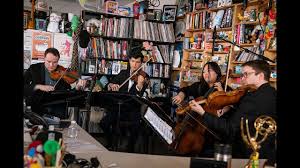
SOUNDTRACK: THE CALIDORE STRING QUARTET-Tiny Desk Concert #843 (April 22, 2019).

Whenever I hear a wonderful string quartet, I yell at myself for not listening to more classical music.  I’m not sure why I don’t–I just like my rock too much I guess.  But these 18 minutes of strings are really fantastic.  And I’m adding The Calidore String Quartet [Jeffrey Myers, violin; Ryan Meehan, violin; Jeremy Berry, viola; Estelle Choi, cello] to the list of quartets I particularly admire.

The blurb is great for unpacking what’s going on, so I’ll let it do just that.

The [string quartet] genre was born some 250 years ago and pioneered by Joseph Haydn, but composers today are still tinkering with its possibilities. Consider Caroline Shaw. The young, Pulitzer-winning composer wrote the opening work in this set, First Essay: Nimrod, especially for the Calidore String Quartet [back in 2016].

Over a span of eight minutes, the supple theme that opens this extraordinary work takes a circuitous adventure. It unfolds into a song for the cello, is sliced into melodic shards, gets bathed in soft light, becomes gritty and aggressive and disguises itself in accents of the old master composers. Midway through, the piece erupts in spasms that slowly dissolve back into the theme.

I love the pizzicato on the cello–there’s so much of it, from deep bass notes to very high notes.  Including the final note.

Their new album explores composers in conflict.  In the case of of the next song, loveless marriage.

The Calidore players also chose music by the quirky Czech composer, Leoš Janáček who, in 1913, set one of his operas on the moon. He wrote only two string quartets but they are dazzling. The opening Adagio, from “String Quartet No. 1, ‘Adagio'”, is typical Janáček, with hairpin turns that veer from passionate romance to prickly anxiety.

This piece is much more dramatic with powerful aching chords ringing out.

Reaching back farther, the ensemble closes the set with an early quartet by Beethoven, who took what Haydn threw down and ran with it. The final movement from Beethoven’s “String Quartet Op. 18, No. 4, Allegro – Prestissimo” both looks back at Haydn’s elegance and implies the rambunctious, even violent, risks his music would soon take.

2020 is the 250th anniversary of his birth.  They are celebrating by playing all of his string quartets in various cities.  He says that this piece is the most exiting part.

I love the trills that each instrument runs through in the middle of the song.

All of these pieces sound amazing.

[READ: April 22, 2019] “Cut”

This story started out is such an amusing way:

There’s no good way to say it–Peggy woke up most mornings oddly sore, sore in the general region of her asshole.

But it’s not an amusing scene at all.  It burns when she uses the toilet and she finds blood in her pajamas.

There are so many great moments in this story that I feel th eneed to quote so much of it.

She could see a cut but only when using a hand mirror while she was crouched at the right angle.  But even so, her groin “was that of a middle-aged woman and not as strictly delineated as it once had been.”  Nevertheless, whenever she looked for it she always “paused to appreciate the inert drapery of her labia.”

The cut was there, but it seemed to migrate.   She tried to look it up online, but only found porn.  Adding Web MD brought back porn in doctor’s offices.  And adding Mayo Clinic introduced her to people with a fetish for mayonnaise. (more…)

Read Full Post »

SOUNDTRACK: NEGATIVLAND-Points (1981)

Negativland’s second album continues with the noisy nonsense of the first.  This disc actually has track titles, which is nice.  It’s about 38 minutes of experimental sounds, home recordings and all manner of noisy sound effects.

“Harry to the Ferry” features David teasing his mom who is playing the accordion–retake after retake with laughing and frustration.  Totally covered by jamming noises.  At the end his, aunt sings while his mom plays the title song.

“The Answer Is…” is simple synth sound–possibly even a demo from a synth?  It sounds like an ice skating rink.  It’s quite nice.  After three minutes we get the title sampled and then the music begins again with a bit more improv.

“Scolding Box” over menacing synths, David says “Green boy is extremely mad, he’s going to start scolding.”  The rest of the nearly six minutes is wavery, unsettling synth waves and what might be clarinet samples.

“That Darn Keet” David shouts, “Blue boy escaped!” followed by thumping and more menacing synths.

“Dear Mary” with a buzzing sound underneath and amid slamming noises, a man recites a stiff, formal letter to Mary about how hard it is to be yourself.  The end is a TV clip from a game show.

“Clutch Cargo ’81” piano improv with weirdo synth sounds bouncing in an out.

“Babac D’babc” all manner of weird chirping sounds and maybe balloons and then people arguing about their marriage.  The argument comes in chunks with each one getting more intense.

“A Nice Place to Live” a promotional audio for Countara Costa county.

“A Bee Fly” mechanical sounds and high pitched noises for a minute before it jumps to a track that actually talks about a bee.

“No Hands” starts as a song of sorts under lots of echo.  Then come voices of people at a barbecue (with more bee interruption) and meat sizzling.

“Potty Air” is basically six minutes of various electronic noises and static–seems like they are testing out to see just what their electronic machines can make.

[READ: April 20, 2019] “White Walls” 

This story is set in Russia and was translated from the Russian by Jamey Gambrell.

It begins with the tale of Mikhail Avgustovich Janson, a pharmacist of Swedish descent.  In 1946 he built a dacha near Leningrad intending to rent it out to city folk.  He was soon ready for tenants and a family.  But “The Lord had something else in mind,” and Janson died soon after finishing everything.

The narrator’s family were his tenants and they bought the land from Janson’s widow.   But that was years before the narrator was born–she never met Janson.  But she and her brothers found all kinds of artifacts in the house.  Items in the attic and a large iron object that the kids assumed was a bomb even though they were told it wasn’t.

In 1997, the narrator and her family decided to strip the wallpaper and make the place their own at last.   They bought new wallpaper that they rather liked and began stripping the old. (more…)

Read Full Post »

SOUNDTRACK: NEGATIVLAND-Negativland (1980).

Negativland was (is?) a weird “band” who released absurdist sound collages.  Their purpose was culture jamming and they created quite a stor throughout their “career.”    The band was more or less created by David Wills (born 1954) also known as “The Weatherman”.. He was a cable repairman when he joined the group with a then-teenage Mark Hosler (1962) and Richard Lyons (1959-2016) also known as Dick Vaughn, Dick Goodbody, and Pastor Richard Seeland.

Their first record came out in 1980 and had twenty untitled tracks.  The “songs” were mostly sound effects, radio broadcasts and home recordings. There was some original guitar and drum machine, but mostly it is just collage.

About the tracks:

[SIDE 1]

1. You can hear a spoken word news announcer in the background as a guitar line comes in followed by a drum machine.  Then comes a woman (David’s mother, I believe ) reciting “This is Negativland.”

2. A ticking clock with a pretty guitar melody and then increasingly loud table saws (one in each ear)

3. A drum machine with a spoken word announcer.  This blurb comes from a fan on YouTube:

The man speaking, Mitch Werbell, worked for U.S. covert operations. At the time, (late 70s) there was a big problem with urban terrorism in Argentina. They had threatened to kidnap Coca-Cola reps in Buenos Aires. Werbell is explaining (on the ABC TV show 20/20) what he told the terrorists would happen if they tried, when he was hired to go help the executives escape the area.

4. Horns playing single notes.  It abruptly ends with ringing alarms

5. Guitars (electric and acoustic) playing and echoing.  This is the longest track at almost 5 minutes. Lots of spoken words among the trippy sounds and boopers.

6. Drum machines and noises and then after a violin line comes the most famous early phrase from NegativalndL “Seat Be Sate” (Play Black Sabbath at 78).  The “poem” is soon taken over by noise and a looped spoken word.

7. A menacing static noise and very sci-f sound effects couple with a German language instruction tape.

8. Static noises and de-tuned acoustic guitar strumming as someone sings a bit

9 A looping string of interesting sounds–booper, waves of sound and a clip o kids singing and then Don’s family speaking, all looped into a rhythm.  Finally a classroom rule about silent E

10. Drum machine with a whispered singing vocal and a catchy guitar riff with (of course) lots of distorted noises.

The lyrics:

Cara mia, why
Must we say goodbye
Each time we part
My heart wants to die
Darling, hear my prayer
Cara mia fair
Here are my arms
You alone will share

All I want is you
Forever more
To have, to hold
To love, adore
Cara mia mine
Say those words divine
I’ll be your love
Till the end of time

My cara mia
My cara mia
My cara mia

[SIDE 2]

11. French speaking and the an a loop of an older man saying “everything’s going fine, no trouble just get set and get going. Amen.

12. Warbled distorted vocals of a man and woman reciting the Hail Mary.

13. A family scene with people talking over a news broadcast (WCBS news time).  You can hear David saying “It’s not alive, Drew.”

14. Some more kids talking with all kinds of jammer sounds over them.  The final line has a woman saying “Reading the book by the seamen within would be very helpful.”

15.  Blues on an acoustic guitar (pretty well played) although by the end the solo is out of tune and crazy.

16. Boopers and outer space sounds.  Multiple radio broadcasts overlapping including one about a bedpans in hospitals.  And a joke ( I can’t guess the comedian, but he sounds a bit like Bob Goldthwait or Les Claypool, but it obviously isn’t) “I wouldn’t marry you if you were the last man on earth.”  The punchline is obscured then the laughter come in.

17. A slow drum beat and random noises on a guitar

18. A family scene David’s mother talking about the affordability of buying meat by the pound.

19. A low deep siren sound followed by this dire message from the Emergency Broadcast Network: “The office of civil defense has issued the following message “this is an attack warning” this is an attack warning.  An attack warning means an actual attack against this country has been detected.  Then there’s David inviting Everett to a barbecue that afternoon.  It’s followed by some audio from the American Airlines 191 plane crash from 1979.  This segues into a family scene where the dad is telling a joke about cannibals.  A man walked among cannibals with cases of Pepsi.  The cannibals drank the Pepsi and ate the man.  All except his thing.  When they were later asked why they didn’t eat his thing, they sang, “Things go better with Coke.”

20. The final track states, “Now hear how a real parakeet should sound.”  Then a woman says good morning and then a crazy raspy voice repeats here.  The album ends with this oscillator sound that my parents had in the 1970s–a kind of looping really fake bird chirping.  No idea why they had it.

This actual release of this record was accomapnied by all kinds of original magazine clippings and artwork. And the CD came with pins and other cool things.  It’s a weird artifact from the dawn of culture jamming.

[READ: April 20, 2019] “The Glass House”

I decided it would be interesting to go back to the year 2000 and to read all of the New Yorker stories up to the present.  I think as of now I have read through 2005.  By the time I have finished (next year, I’m sure) I’ll have 20 years of stories read.

This story is set during the Civil War.  The main character, Will, has just enlisted.  His brother, Sam, was killed at Bull Run and Will came to take his place.  His Captain was very happy to have him because Sam was a brave and well-liked man.  But Will, as he himself would admit, was neither of those things.

After Sam’s death, the Captain intended to go to Sam’s house personally to pay his regards to their family.  Had Sam’s mother seen the Captain, she would have spit on him.  But before that could happen, Will decided to enlist.  He forged his mother’s signature and didn’t tell anyone when he left. (more…)

Read Full Post »

SOUNDTRACK: A-Hi-Fi Serious (2002).

Many bands are hard to search for online.  A may have topped the roster of most unsearchable bands (they were named in 1993 way before Google was even a thought and when they would be at the front of record store racks).  A are also the alphabetically first CD I own.  So my collection literally goes from A to Z

A are a band from Suffolk England.   They formed in 1993, broke up in 2005 and have been sort of reuniting off and on every since.

Their second album A vs. Monkey Kong was well received and this, their third album had a solid single in “Nothing.”  I’m not sure how I heard of them (probably well reviewed in Q magazine back in 2002) so I grabbed this album.  This album comes with a Quicktime video!  When I learned about this band back in 2002, scads of information were not available about them.  So as I was looking them up I learned all kinds of things about them (like that they cite Rush as an influence).  And that this album name comes from the name of the hi-fi electronics store Alan Partridge buys a stereo from in the last episode of I’m Alan Partridge series 1.

This album is pretty punky/grungy.  Lead singer Jason Perry has a distinctive voice with some good power.

There are all kinds of hit-making elements in here.  Big crunching guitars coupled with soaring vocals dominate most of the songs, like “Nothing” and “Pacific Ocean.”   “The Distance” also revels in the grunge punk guitar sound with a totally metal guitar solo

Songs like “Something’s Going On” have a distinctly pop-punk bratty sound.  So does “Starbucks” with the line: “don’t wanna get a job at Starbucks”  The title track also works in this snarky, funny, catchy vein.

“Six O’Clock” mixes some cool electronics in the verses while the chorus is, once again, big and catchy.  “Going Down” has a much smoother sound with anything distinctive coming from his vocal delivery.

“Took It Away” does the quiet/loud verse thing very well.  Some deliberate glitching is a fun surprise too.  While “The Springs” introduces acoustic guitar and lots of oohs–a real flick-your-lighters kind of song.  “W.D.Y.C.A.I.” is also catchy with a sing along (woah oh) bridge and a super poppy chorus.

“Shut Yer Face” sounds like the quintessential grunge song–snarky lyrics, big grungy guitars, and a soaring chorus.  It even has vulgarish lyrics, record scratching and other samples!  And man is it catchy.  If this didn’t crack the States for them, nothing would.

[READ: April 15, 2019] “Djinn”

I was shocked to see that Esquire had published a story by Russell Banks in both March and June of 2000.  I was also shocked to see that a man gets shot in this one as well (that’s four of the first five stories in Esquire in 2000 in which someone is shot).

This is a story of a man who works in Hopewell, New Jersey.  They manufacture and sell women’s and children’s high end rubberized sandals.  The sandals were manufactured in Gbandeh, the second-largest city in the Democratic Republic of Katonga, a recently desocialized West African nation.

One of his jobs was to travel to Gbandeh and make the acquaintance of the local managers with hopes of facilitating communication.  And of course to make sure the Katongans could adapt the the fast paced technology in place. (more…)

Read Full Post »

SOUNDTRACK: THEODORE-Tiny Desk Concert #842 (April 17, 2019).

I recall NPR’s SXSW coverage last year in which they raved about Theodore (and then ran into him walking the street while they were recording their nightly dispatch) and his beguiling music.

Theodore is a Greek composer/performer who is fairly difficult to search for online.  I was really surprised but quite intrigued to see that he now had a Tiny Desk Concert.  And what a Concert!

He plays three songs that last nearly 19 minutes and they are full of twists and turns with great instrumental passages and incredible sounds from all of the instruments.  Whether it is thanks to Theodore’s own set up or the Tiny Desk crew, the sound quality is amazing.

He began with “Disorientation” which

explores the complete loss of inner direction as Theodore examines his inner dualities in search of clarity and, perhaps, new ways to look at the world.

“Disorientation” begins with a terrific throbbing bass from Nikolas Papachronopoulos and occasional guitar notes from Emmanouil Kourkoulis or Ioannis Lefas (not sure who is who).  Theodore starts singing in his husky voice.  After a verse he adds some keys and then just as suddenly the whole band kicks in–drums and soaring guitars which all drop away just as suddenly.

A minor shift occurs at around 1:20 and then at 1:45 the whole song slows down into gentle washes and piano trills with (again) some gorgeous bass notes (the bass sound is phenomenal).  The song feels like it’s going to end but it sound jumps back with the dramatic entry of a pick slid along guitar strings and then back it’s to the delicate moments.  Bob Boilen says the songs have the “spare elegance you can hear in Sigur Rós or Pink Floyd,” and you can clearly hear echoes of mid 70s Pink Floyd with splashes of Sigur Rós for drama.  At 3:45 it jumps again, with some great drumming and more cool basswork.  Then at 4:46 Theodore starts “oohing” in the microphone, his voice is processed and echoing and the whole thing feels like it is drifting off into space

It is spectacular.

“For a While” starts quietly with two notes repeated quietly on the guitar  Theodore adds piano as washes of guitar follow shortly.  The guitar and piano resolve into intertwining pretty melodies.  After the bass and drums come in Theodore starts singing.  He has a very European kind of croon, a bit like latter Morrissey or Guy Garvey from Elbow.  The song builds to a cool moody and then settles down delicately to washes of guitar and single piano notes.

“Naive” ends the set with another great bass sound and intense guitars .  Theodore sings while Ashley Hallinan adds some nifty rim hitting on the snare.  Midway through the song some instrument gets all kinds of processed adding a kind of fat synth sound as the rest of the band builds the song.   Great guitar effects from both guitarists flesh out the moody wild middle section.

This Concert was spectacular and I would love to see him in person.  He only comes to the US for SXSW, so maybe this Tiny Desk will bring him to a wider audience.

[READ: April 15, 2019] “Lobster Night”

Russell Banks is the kind of author I have known about for a long time and am incredibly familiar with the covers of many of his books and whom I’ve considered reading again and again and yet I never seem to.

He is also one of the reasons why I chose to read Esquire fiction in general.  There are many excellent writers who write for Esquire and not all of them write stories about men killing other men.

Well, maybe all the stories don’t have someone or something killed, but this one does.

Stacy is a former potential Olympian.  She used to ski until a bad fall left her with a broken thigh bone.  She can still ski but she has lost her edge so she teaches in the winter.  But during the warmer months she has to waitress or bartend.  She has recently gotten a job at Noonan’s Family Restaurant. (more…)

Read Full Post »

SOUNDTRACK: GARY CLARK JR.-Tiny Desk Concert #841 (April 16, 2019).

WXPN has been playing “Pearl Cadillac” by Gary Clark Jr. and I quite liked it.  I knew of Gary as a blues guitarist.  But I didn’t really listen to too much by him–I don’t love blues music, generally.  But Gary adds a rocking and Prince-like atmosphere to his blues which elevates his music for me.

But “Pink Cadillac” is unlike the other two songs because he sings in a delicate falsetto (like Prince) whereas the other songs he sings quite gruffly.

The first song, “What About Us” surprised me.  First because he sang with such a deep voice (with a wonderful falsetto at the end) but also because I knew that Gary was supposed to be a great guitar player, but it was Eric Zapata who was playing all the slide guitar parts. The whole band builds the song nicely for the chorus.  They keys flesh things out nicely.

The middle has a cool funky part with great washes of keys and a funky bass sound from Johnny Bradley.

When the song ends, he says, “It’s a little bit warmer than I thought it would be.  But I feel sexy in this jacket so I’m gonna sweat thought it.  This is my life, people.”

Gary Clark Jr. had good reason to sweat. The blues-rock singer and guitarist opted to play his first-ever Tiny Desk concert — in front of a huge crowd that warmed the room considerably — while clad in a thick knit cap and heavy jacket.

I had heard that this new album, This Land, was quite political but he left the albums

more politically incendiary material for louder live shows.  Clark’s set leaned toward some of This Land‘s softer sentiments — “When I’m Gone” is about missing his family on the road, while “Pearl Cadillac” exudes gratitude for his mother’s sacrifices —

He dedicates “When I’m Gone” to his son.

He’d brought his young son on tour with him and had to contend with a traditional parenting dilemma: How do you bring your kid to the office and still get work done?

He says I’m trying to do the dad thing and brig them out here.  I’m tired, people.

“When I’m Gone” sounds like a traditional love song from the fifties with that simple bass line and stabs of guitar.  And it is a love song, only to his son, not a woman.  Clark’s gruff voice works perfectly.  Zapata plays the guitar licks between the first two verses.

He says “Pearl Cadillac” was written for his mother… who I’m gonna ask to babysit for me next time…  damn…”

Jon Deas starts on keys with simple snare and hi-hat from Johnny Radelat.  Gary gets to show off his guitar chops here.  I love the slightly distorted, slightly retro sound of his guitar as he plays all the licks throughout the song.  This song has a total Prince vibe and it works perfectly.

He sings the whole song in his gorgeous falsetto

I remember when I left home in that pearl Cadillac
I was searching for some kinda way to pay you back
For your love, your love, your love

He even handles a guitar solo flub with the ease of a parent who is overworked–a little grunt and then start again.

[READ: April 11, 2019] “The Wish”

One of the reasons I didn’t want to consider reading a lot of Esquire-published short stories is because I assumed they’d all be something like this one.

Full of death and misery and whatnot.  I mean the story starts “Kamon Gilbert woke up on the morning of the last day of his life at 6:19.”

Now, in fairness, this story isn’t about a manly man shot down in a blaze of glory.  Rather, it is a look at racism and violence and how a man’s life can change in an instant (a couple of times).  And as such it is a powerful and affecting story.  It’s still really dark though.

Kamon Gilbert is a black boy in high school school.  He is very smart and very successful.  He does well in his classes and has been selected as the lead in many of the school plays.

But none of the other kids like him: (more…)

Read Full Post »

SOUNDTRACK: KARINE POLWART TRIO-Tiny Desk Concert #840 (April 10, 2019).

I had never heard of Karine Polwart and her beautiful and thoughtful music.   And I suppose that’s not surprising.

Scottish singer, songwriter and essayist Karine Polwart seldom comes stateside. She prefers to limit air travel in order to minimize her carbon footprint. She took exception, however, to fly from Edinburgh to New York City to participate in the Carnegie Hall Migrations festival, a celebration of the history of the movement of people all around the world. Polwart and her brother, guitarist Steven Polwart and multi-instrumentalist, Inge Thomson, then escaped New York for a day to play the Tiny Desk here in Washington, D.C.

They play three beautiful songs.  Steven seems to play the main guitar melody while Karine adds lovely accents.

The first song is “Ophelia.”

Polwart writes songs about hope, music that harnesses spiritual power and lyrics that address important social justice themes. Stories of human emotion and the human experience are also commonplace as in the first tune, “Ophelia.”

“There’s a wind in from the desert
Red dust blows across the sun
It bleeds into the evening
We watch it from the garden
Your hair glints in the strange yellow light
We let go of all our fighting
Ophelia”

There’ some very cool sound effects–wind and warped sounds echoing–surrounding this song and I can’t quite tell where they are coming from (presumably from Thomson).  It’s a cool if unsettling backdrop for this pretty song on acoustic guitar with lovely vocals (wondrous backing vocals from Thomson, who also plays a gorgeous accordion solo.

Indeed, the music is wonderful and the blurb describes it perfectly

Lyricism and messages of hope and beauty heard throughout punctuate a stunning accompaniment of inventive instrumentation. The steady, resonant guitar riffs played by Steven Polwart ground the delicate vocal harmonies. Inge Thomson’s accordion lines, combined with an array of percussion instruments and synth-generated effects, add a complimentary layer of sound without overpowering the music. Karine Polwart’s bellowing and drone-like Shruti box provides a sweet serenity.

She speaks with her wonderful accent between songs, introducing the band and then introducing the second song, “I Burn But I Am Not Consumed.”   It features a mesmerizing spoken word denunciation of trump, from his hated golf course back in Scotland to everything he does now.

Your mother was a wee girl once,
who played upon my rocky shore.
And you, you are broken boy,
and you want more and more and more.
You build a tower. You build a wall,
You live in fear that they might fall.
You who see nothing but your face
in the sheen of The Hudson River.

The music is wonderful too.

Read the whole thing here and watch a performance on the eve of the inauguration with an orchestra for the BBC.

How does one follow that up?  With a song called “King of Birds” which praises the power of small things.–in their guile and their nimbleness.

In it Polwart recounts the legend of a wren who piggybacks a lift on an eagle’s wing. Just as the large bird is unable to fly any higher in the sky, the tiny wren catches a breath of air, soars higher than the eagle and is crowned the king of all birds.

Tinkling bells and gentle guitar introduce this verse

“At Ludgate Hill
where the towers of smoke and mirrors bruise the sky
the pilgrims huddle in
as the tiny King of Birds begins to cry
the people start to sing
to light glory in the dark
to ring the bell
and to breathe hope in every heart”

And as the song reaches its loudest Thomson is playing a cymbal and the accordion while she is singing.  Wow.

This concluding blurb is spot on

This performance will quite likely inspire you to learn more about Polwart. The NPR program, Thistle and Shamrock often features her music. This recent episode features cuts from Polwart’s latest album, plus her ideas on movement and migration.

[READ: April 14, 2019] “Medusa”

This is a brutal story about a woman who has been raped.  But the brutality isn’t in the way it happened–in fact, when I first read it I wasn’t entirely sure it had actually happened.  It’s in her reaction to the event and how it changes her life.

It was raining and the narrator left her back door open as she went outside to take out the garbage bags. How could this man have gotten in in that short time?  When she first saw him she thought he was a lost student from across the way.  But it soon dawned on her that that was not his reason for being there.

She introduced herself, trying to humanize herself to this man.  He said his name although she could tell he was just “trying it on for size.”  She got a good look at him–his hair, his tattoos, a good smell of him.  She tried to run but fell in her front hall–leaving her in the perfect position for what he wanted. (more…)

Read Full Post »

« Newer Posts - Older Posts »