Feeds:
Posts
Comments

Archive for the ‘Lydia Davis’ Category

harper septSOUNDTRACK: THE AVETT BROTHERS-“Open Ended Life” (2013).

AvettBrothers_CVR-560658fd89bf96b9dd1bf2b2be57013e64cb38cd-s1The folks at NPR love The Avett Brothers, and while I can see the appeal of their live show, their studio output just sounds like typical Americana to me.  Not bad by any means, but nothing all that special–honky tonk swing, occasional harmonica and expected harmonies.

The album was produced by Rick Rubin, which would have surprised me a few years ago but after his work with Johnny Cash it makes a lot of sense.

This song is a pretty rollicking good time (and the pretty ooohs are something of a surprise) especially by the end when everybody joins in–I’ll bet this is a hoot live.  The melody is certainly catchy.  I just want to like it more than I do.

[READ: October 1, 2013] “The Two Davises and the Rug”

Even though I recently complained about flash fiction, there is one author who does a very good job with it.  And that author is Lydia Davis.  She can generate an entire story out of a very simple concept . And while some of her flash fiction falls into that “it’s just a sketch, not a story” world, her longer short stories pack a lot in.

Like this one.  The entire premise of this story is that two people are interested in the same rug.  And they are both named Davis (bt are unrelated).

This Davis purchased the rug many years ago and has grown tired of it.  When her apartment complex has a sale for charity she puts in the rug and asks $10 for it.  But the sales people mark it up to $50 (it’s for charity after all).  No one buys the rug but another tenant across the way (also named Davis) is interested in it. But that Davis doesn’t buy the rug.  And when the sales is over this David takes the rug back home while that Davis wishes he had bought it.

The fun part of the story is that both Davises are indecisive.  So, this Davis wonders if she should sell the rug to that Davis and if so, for how much.  But if he really wanted it, maybe she should keep it, maybe it’s better than she realized.  And that Davis is unsure how well it will go in his house and he wonders if may be he could try it for a time first.  But this Davis is reluctant to give it up in case he really likes it or in case she really likes it.  And maybe she should give $50 to charity since she didn’t sell it.

And the story goes on like the, with insecurities running rampant. Fortunately it’s not a very long story (this is one instance where the short version pays off handsomely). And after we have gone through the various permutations, it may be hard for even us to know what those Davises should do.

Read Full Post »

42SOUNDTRACK: IRON MAIDEN-Iron Maiden (1980).

Steve Harris was on That Metal Show recently.  Harris is the baimssist and primary songwriter for Iron Maiden and has been since their first album in 1980.  When I was in high school Iron Maiden was my favorite band hands down.  I had all their albums, I had all their singles, all their hard to find British vinyl 12 inch singles, even a few pictures discs.  Wonder if they’re valuable?

Every album was an epic event for me–I even played “Rime of the Ancient Mariner “off of Powerslave to my English class (not telling anyone it was 13 minutes long).

And then, after Somewhere in Time, I just stopped listening to them. Almost full stop.  I did manage to get the first four albums on CD, but the break was pretty striking.  I actually didn’t know that they’d had personnel changes in the ensuing years.  I’d vaguely heard that Bruce Dickinson  left, and that others followed, but I don’t think I quite realized that they were back to their big lineup these days.

Anyhow, Harris was so earnest and cool that I had to go check out some of their new stuff. Which was okay.  I’d need more time to digest, but then I had to listen to the first albums again.

And wow I had forgotten how much the first Iron Maiden album melds punk and prog rock into a wild metal hybrid.  There’s so much rawness in the sound and Paul Di’Anno’s vocals, not to mention the speed of some of the tracks.  And yet there’s also some epic time changes and starts and stops and the elaborate multipart Phantom of the Opera….  Wow.

The opening chords of “Prowler” are brutal.  But what’s surprising is how the second song “Remember Tomorrow” is a lengthy song that has many ballad-like qualities, some very slow moody sections–although of course each chorus rages with a great heavy riff and a blistering solo.  On the first two albums Paul Di’Anno was the singer.  He had a fine voice (it was no Bruce Dickinson, but it was fine).  What’s funny is that Bruce does the screams in “Remember Tomorrow” so much better in the live version that I forgot Paul’s vocals were a little anemic here.

However, Paul sounds perfect for the rawness of “Running Free” a wonderfully propulsive song with classic Harris bass and very simple metal chugga chugga riffs.  And this has one of the first real dual guitar solos–with both players doing almost the same riff (and later Harris joining in on bass).

“Phantom of the Opera” is the band’s first attempt at an epic multi-secton kinda-prog song.  It opens with a memorable, if slightly idiosyncratic riff and some wonderfully fast guitars/bass.  There’s a great slow bit that morphs into an awesome instrumental soloing section with bass and twin guitars playing a wonderful melody.

“Transylvania” is an instrumental that is challenging but probably not one of the best metal instrumentals out there, although again when Dennis Stratton and Dave Murray play in synch solos it’s awesome.  This track segues into “Strange World” a surprisingly trippy song (with effects that seem like keyboards but which aren’t).  It’s slow in a “War Pigs” kind of way, but it doesn’t entirely break up the album, because there are other slow bits on the disc.  It is a little out of place though.

Especially when “Sanctuary” blasts forth.  True, it wasn’t originally on the album (in the UK), but man, blistering punk or what!  “Charlotte the Harlot” was always one of my favorite songs (it taught me what a harlot was after all), it’s quite proggy, with a lot of stuttered guitar work and a middle section that features some loud and complex bass.  The disc ends with the by now almost immortal “Iron Maiden.”   A great raw riff opens the song, a harmony guitar partners it and the band blasts forth.  Who even knows what the lyrics area about, the song just moves and moves–There’s even a great chaotic bass/drum break in the middle.  And listening to the guitar noises in the solos at the end.  Amazing.  It’s quite the debut.

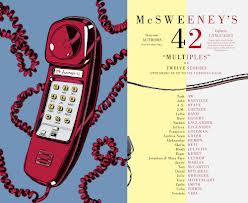
[READ: June 7, 2013] McSweeney’s #42

I have made it a point of (possibly misguided) pride that I have read every word in every McSweeney’s issue.  But this issue has brought that to an end.  As the title states, there are twelve stories in the book.  But there are also sixty-one authors writing in eighteen languages.  And there’s the rub.  One of my greatest (possibly misguided) shames is that I don’t speak any other languages.  Well, I studied Spanish and German, I know a few dozen words in French and I can read the Greek alphabet, but none of these would help me read any of these stories.  So, at least half of this book I didn’t read.

But that’s kind of the point.  The purpose of this book is to make a “telephone” type game out of these stories.  Stories are translated from one language to another and then re-translated back into English.  The translators were mostly writers rather than translators and while some of them knew the second language, many of them resorted to Google Translate or other resources to “read” the story.  Some people read the story once and then rewrote it entirely, other people tried to be as faithful as possible to the original.  And so what you get are twelve stories, some told three times in English.  Some versions are very similar and others are wildly divergent.

I normally write about the stories in the issues, but that seems sort of beside the point as the original stories were already published and were selected for various reasons (and we don’t even see any of the original stories).  The point here is the translation(s).  So, in a far less thorough than usual way, I’ll list the contents below. (more…)

Read Full Post »

HarpersaprilSOUNDTRACK: DUCKTAILS-“Letter of Intent” (SXSW, March 22, 2013).

ducktailsDucktails is a side project from the guy from the band Real Estate.  I liked some Real Estate songs, but this is the first I’ve heard of Ducktails.  The write up on NPR talks about them being an experimental  live band, so I was anticipating something wild.

But this proves to be a very sedate, kind of dull synth heavy track–the guitars are kind of tossed on there in a very 80s new wave fashion, and there’s very little beyond the washes of synths.  There’s really nothing here I’d want to hear again.

It’s available here.

[READ: March 19, 2013] “Not Interested”

I’m always mixed about Lydia Davis’ stuff.  She writes very very short pieces and most of them seem to be not so much stories as observations, ideas or even things that just seem to pass through her mind.  Some of them are amazing–insightful or funny–which convey a lot in a concise piece of writing.  And others seem just kind of flat.  This is one that I am utterly ambivalent about (which is maybe the point?).

It’s not often that you read something that starts, “I’m simply not interested in reading this book.” (more…)

Read Full Post »

SOUNDTRACK: BELLE AND SEBASTIAN-Live at KEXP, April 13, 2006 (2006).

This four song set samples a broad swath of Belle & Sebastian’s career.  It takes place after The Life Pursuit‘s release, but they only play one song from it “To Be Myself Completely” (with Stevie on vocals).

It’s amazing how quiet and shy the band seems i the interviews (or is that bored and petulant) especially after being through the mad swings of success.  Indeed, the interviews are almost embarrassing how unresponsive the band is (but not rude unresponsive, just unresponsive).  Like “where did the soul influence on this album come from?”  “Probably black America.”  “Did the new producer have any influence on the soulfulness?”  “Not really.”

But they do let the music speak for them.  And they don’t just do the horn songs or the strings songs.  They play “She’s Losing It” from Tigermilk (with lots of horns–it sounds great), they play “A Century of Fakers” with strings (although the female vocals seem a little too subdued on this track).  They also play a rollicking cover of Badfinger’s “No Matter What.”  It’s a delightfully poppy song which I didn’t know but which Sarah did (and I thought was the Beatles, and the DJ guessed Paul McCartney wrote it–he didn’t).  It’s when discussing this song that the band finally gets animated, perhaps they just don’t want to talk about themselves.

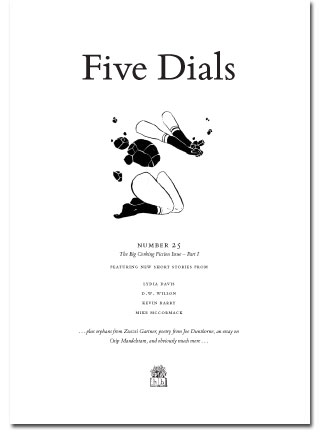
[READ: October 15, 2012] Five Dials #25

The issue is all about the short story.  Five stories from Lydia Davis, a short story contest from Zsuzsi Gardner, and a couple longer stories as well.   But there’s also some poetry and an essay.  And I fear I have to say I didn’t enjoy this issue as much as some of the other ones.  I love short stories, but I didn’t really love these very much.  And, the essay at the end was a lot of fury about very little.  I have to assume Part Two will simply kick ass.

CRAIG TAYLOR-A Letter from the Editors: On Orphans and Cork
Taylor name-checks the Cork International Short-Story Festival and mentions how this issue is a sort of tie in to the festival (and just how many writers wanted to be in this Cork issue).  Taylor says that many readers wanted more short stories in the Five Dials issues, and that Noel O’Regan, short story editor says that the short story is always alive–witness the great success of the Cork Festival.  Writers flock to it (and a hefty prize is given).  This issue is only Part I of the fiction issue because they simply had to break it into two parts. (more…)

Read Full Post »

SOUNDTRACK: THE TRAGICALLY HIP-Up To Here (1989).

Up to Here is a pretty big leap from their first EP.  There’s more guitar soloing (not grandiose solos, just little guitar noodling in the songs “Blow at High Dough,” which was used wonderfully for the show Made in Canada (also known as The Industry).

Downie’s voice is more in keeping with what we’d come to know later, and lyrically the songs are esoteric and interesting.

“Blow at High Dough” opens the disc with a very cool guitar intro (“They shot a movie once, in my hometown”) “I Believe in You (Or I’ll Be Leaving You Tonight)” a not terribly good song has some proto-Downieisms: spoken passages, stories in a breakdown of the song, but the subject matter is not that exciting.  Of course, it’s hard to sound good when you’re followed by “New Orleans is Sinking” another fantastic song that still sounds great today (especially in their live versions).

“38 Years Old” is a surprisingly moving song with some slides guitars…a nod to their country/folk roots that they tend to bury under raw rock guitars.

But even some of the less memorable, less exciting songs have great aspects to them.  Songs like “She Didn’t Know” are pretty standard rock songs.  Better than average, but not exceptional.  But the band puts little things into them that bring them up from the mundane: the guitar licks, the backing vocals (slightly R.E.M.-ish).

Even “Boots to Hears” which sounds a bit too much like John Mellencamp in the intro really wins you over by the end (the lyrics are great).  For what really is a debut album, it’s solid and shows great songwriting skills and promise.

They still haven’t quite gotten the hang of cover art yet, though.

[READ: January 26, 2011] “You Go First”

This was the first of four flash fictions in this issue.  Flash fiction doesn’t really have a definition per se (except that it is very short).  There are some masters of flash fiction who can write very compelling stories with astonishing brevity.  These stories are all short (one magazine page a piece), but they feel kind of bloated compared to the writers like Lydia Davis.

Gibb’s story actually feels a lot longer than it is.  It opens with us meeting the narrator’s next door neighbors, Carl the cremator, his obese wife Brenda and their son Jason.  The narrator doesn’t really like Jason, but he’s the only person who will hang out her because he wasn’t around for her birthday party last year.  At that party, her hippie parents encouraged everyone to play a game called Getting to Know Our Bodies. (more…)

Read Full Post »

SOUNDTRACK: BUILT TO SPILL-There is No Ememy (2009).

I’ve liked Built to Spill for quite a few years (I first encountered them on Perfect from Now On), but they always hang just below my radar when I think about great albums.  Nevertheless, many of their songs have landed on compilations I’ve made.

I listened to this disc a few times when it came out and when I popped it in again today I couldn’t believe how well I knew the whole album and how much I really, really liked everything on it.

This may in fact turn out to be my favorite BtS disc.  It isn’t radically different from other releases of theirs, but there’s some ineffable quality that seems to raise the whole disc above the fray.  The total package is fantastic.  The first few songs are quite short, just over three minutes each (which is surprising after the release of the live album which had so many extended songs and solos (a 20 minute cover of Neil Young’s “Cortez the Killer”).

Of course there are a few extended jams as well.  Four songs are over six minutes long (and three of them make up the last four tracks, so the disc does to tend feel a little heavy at the end–although “Things Fall Apart” has a horn solo (!) and “Tomorrow” has some unexpected time changes).  But the first long song, “Good Ol’ Boredom” has a great chugging riff that hold ups to the six minutes very well.  The nearly seven minute “Done” has a wonderfully effects-laden end section. The solo is pretty lengthy, but the backing music/sounds keep the whole thing interesting.  Of course, there’s also “Pat” a two and a half-minute blast of punk abandon.

Doug Marsch has a pretty high voice, but it never grows whiny or annoying, and in fact, it has a kind of gravitas to it.  And it is more than matched by the full band sound on the disc.  Martsch’s lyrics are also wonderfully unexpected [“Is the grass just greener because it’s fake?”].

BTS has made a great album and I’m going to have to revisit their back catalog too.

[READ: November 14, 2010] “Twilight of the Vampires”

This was a banner issue of Harper’s (I’ve felt kind of down on the magazine lately, but it made up for itself this month).  We have the Lydia Davis/Flaubert stories, a lengthy piece by William T. Vollmann and the cover story about Rupert Murdoch (which I won’t be posting about).  In fact, normally I don’t post too much about non-fiction (recent obsessions notwithstanding), but this particular piece was by Téa Obreht, one of this year’s New Yorker 20 Under 40.  Obreht had barely had anything published when they selected her, and so I figured it would be easy to keep tabs on her.  So here’s a nonfiction to add to her two stories.  (And it’s about vampires!)

Obreht is originally from Russia (her family is apparently still there).  As the essay opens, she is going to meet her mother in Belgrade for their trip to Serbia.  Their ostensible reason to travel to the Balkans is to find out about vampires.   (But when her mother injuries herself before the trip is about to commence, it convinces her mother that the whole trip is possessed by devils).

But why travel to the Balkans in search of vampires when her adopted homeland of America is overrun by vampires right now?  Because as she relates, our vampires are rather different from theirs. (more…)

Read Full Post »

SOUNDTRACK: PREFAB SPROUT-Let’s Change the World with Music (2009).

This album was unreleased back in 1992 (it was supposed to be the follow-up to the wonderful Jordan: The Comeback).  Record label confusion left it shelved for many years.  It’s been released now because lead Sprout Paddy McAloon has been having health issues and won’t be releasing any new Sprout music anytime soon.  So he has released this album in what is essentially demo form.

Unlike many demos, though, this one is pretty fully realized.  It’s full of keyboards (where there might be strings for instance) and there are no backing vocals (or any other musicians), and yet for all of that, it doesn’t sound like a scratched out demo or a home-recorded cassette (and Paddy sings his heart out).  There are certainly moments (most evident in the drums at the beginning and end of songs) that sound kind of sparse, but the bulk of the disc is fully formed and quite well realized.

The opening is pretty odd, with Paddy (who normally has a soaring tenor voice) speaking a deep almost rap over a funky beat.  In fact, as the song continues, with Paddy’s voice returning to “normal,” that funky beat continues.  Nevertheless, but the time the sweeping dreamy chorus kicks in we’re back to less funky, more smooth sounding Sprout that I know and love.

Like Steely Dan, Prefab Sprout is not really meant to be enjoyed by the young.  It’s borderline treacly, it’s very sweet and earnest, an my high school self would have scoffed at my enjoying them at all.  And yet for all of that, the songwriting is really magical.  There is religious imagery all over the disc, but it’s there to convey the magical power of music.  And it’s entirely authentic.

And when you combine that with Paddy’s voice its adult contemporary music that is still interesting (certainly too interesting to be played on pop radio).  I think the real key to the success of the disc is the unpretentious, unforced and completely unironic joy that Paddy gets from music.  And there’s nothing wrong with that.

[READ: November 14, 2010] “Five Stories from Flaubert”

I really enjoyed Madame Bovary many many years ago when I read it.  Recently, writer Lydia Davis translated Madame Bovary and her translation is supposed to be exceptional, light years above the translation that I read.  One of these days I plan to read her version.  In the meantime, I’ve got these little short short stories.

I had a hard time deciphering what these little stories were, exactly.  The introduction says that they are “adapted from letters Flaubert wrote to his lover.”  So I guess Flaubert gets a co-writing credit?  There’s a couple more stories online at The Paris Review (but you need to buy the issue to get all ten). (more…)

Read Full Post »

SOUNDTRACKMcSweeney’s #6 comes with a CD.

Most of the music on the CD is performed by They Might Be Giants (a rather perfect fit for McSweeney’s).  Some other musicians who appear are: M. Doughty, Philip Glass, Michael Meredith. Roger Greenawalt & S.E. Willis

Instructions included with book:

#3. The compact disc contains music.  There are 44 discrete pieces of music –“Tracks”–on this compact disc.  Each Track corresponds to a picture, series of pictures, or story–a Piece–in this journal.  When you are reading or looking at a certain Piece, we ask that you cue your compact disc to the corresponding Track on the disc.  The appropriate track number will appear prominently, usually under the title of each Piece.  Note: The track number will no appear on subsequent pages of the Piece.

#6. Please note that you may listen to Tracks without reading their Pieces and you may read Pieces without listening to their corresponding Tracks.  But this is not recommended.  You fucking bastard.

[READ: December 8, 2009] McSweeney’s #6

I’m finally getting back to reading some older McSweeney’s issues.  This was the final issue that I received from my initial subscription.  I distinctly remember being excited by the CD and maybe reading some of the book, but clearly never finishing it.

So yes, this issue comes with a CD.  The intro note explains that each Piece in the book has an accompanying  Track on the CD, and, you are to only listen to the Track that accompanies the Piece you are reading…never read a piece while listening to the wrong track.  Ever!  It explains that each Track has been created to be as long as it would take you to read each Piece.  But there are obviously many exceptions. The first story for instance is well over ten pages but the song is about 5 seconds long.  And, the Arthur Bradford Track is 8 minutes long when anyone could read the Piece much more quickly.

The bulk of the songs are by They Might Be Giants.  Anyone who knows TMBG knows you can’t summarize their work, and this book exercise is ideal for them: there are several pieces that are just a few second long.  But they also write some nice longer pieces as well.  And, of course, they are perfectly suited for mood music that works well with the writing.  Some of the songs have words which is a bit distracting while trying to read, but that’s okay.  I did try my best to follow the prescription about only listening to the appropriate song, but I admit to getting off pace from time to time.  (more…)

Read Full Post »

lydiaSOUNDTRACK: SONIC YOUTH-SYR8: Andre Sider Af Sonic Youth (2008).

syr8This final (so far) SYR release is another live recording and it sees the bands joined by saxophonist Mats Gustaffson and electronic wunderkind Merzbow.  This EP comes from the 2005 Roskilde Festival in Denmark (and the language is all written in Danish).  According to the SY website, the day before this, they had performed a set in support of Sonic Nurse. However, this set, “The Other Side of Sonic Youth” is an hour or so improvisation. It is basically broken down into 5 minute intervals:

1 min.  Kim (guitar) & Steve (drums) start
5 min. Thurston (guitar) joins
10 min. Lee (more guitar) joins
15 min. Jim O’ Rourke (bass/synth?) joins
20 min. Mats Gustaffson (saxophone) joins
25 min. Merzbow (laptop) joins
30 min. Kim & Steve leave
35 min. Thurston leaves
40 min. Lee leaves
45 min. Mats leaves
50 min. Merzbow finishes

All times are approximate, and even listening to the disc it’s not entirely clear when the new players come on (or when they leave). For the most part, the set is varying levels of noise and dissonance.  But it’s not just a wall of chaos. It starts fairly simply with the guitar and drums (although when Kim and Steve play it’s never really simple).  By the time Jim comes out, the band has morphed into all manner of sound scapes.

When Mats comes in and that saxophone starts squealing, it’s a whole new ballgame. I don’t find Merzbow’s entrance to be all that noteworthy, but by the end, when it’s just him and Mats (or him by himself) he’s doing some pretty amazing stuff.

It’s hard to imagine what the Roskilde people thought of this (although crowd noise seems to be positive).  This set was followed by Black Sabbath, which in and of itself is pretty funny.  Especially since the SY set seems far more dissonant.

[READ: September 6, 2009] Samuel Johnson is Indignant

This collection of Davis’ work contains fifty-six of stories.  The stories range from one sentence (!) to some twenty pages.

The book is disconcerting in that it opens with several of the one to two page stories, leading you to suspect that they will all be that length. Then, when you actually get to the longer pieces it kind of throws you.

Those first stories are I guess what you’d call flash fiction.  Except that for the most part, it’s hard to tell whether the pieces are even meant to be fiction.  They are aphoristic, often.  Talking about neighbors and friends, uncomfortable moments, and mostly, lots of thinking about everyday activities.  Some of them are funny.  Some of them are thought-provoking.  Some of them are just weird.  And some of them make you wonder why they were written at all, or more to the point, why she would name this collection Samuel Johnson is Indignant, when this story,consists of this:

“Samuel Johnson is Indignant: that Scotland has so few trees.” (more…)

Read Full Post »

back coverSOUNDTRACK: HÜSKER DÜ-Metal Circus EP (1983).

HuskerDuMetalCircusAfter the insane hardcore mess of Land Speed Record, this EP is a bit of a change.  It’s still pretty hardcore, but now you can tell that the noisiness of the guitar is deliberate.  Bob Mould is playing around with multiple layers of feedback and distortion to create a wall of noise that sometimes hides, sometime accentuates the overall sound.

What strikes me as odd in retrospect is that I think of Bob Mould as one of alternative rock’s poppier songwriters.  And yet when you listen to this disc the two poppiest (which is a relative term to be sure) tracks are by Grant Hart.

The first two tracks are fast and furious.  But what separates them from 4 x 4 hardcore is, mostly Greg Norton’s bass.  He’s all over the place.  There’s also some diversity within the songs themselves (a little guitar squeal in “Deadly Skies”).

“It’s Not Funny Anymore” (Hart’s song) is surprisingly upbeat (with guitar harmonics) and is not quite as noisy (although it’s still pretty noisy, and is not going on the radio anytime soon).

The next two track are more of Mould’s screamy hardcore.

The longest song (4 and a half minutes) is also by Hart. “Diane” is a creepy song about abduction and murder (yet with something of a  singalong chorus).  I actually know the Therapy? version better because I had listened to that disc a lot when it came out.  But the Hüsker’s version is even creepier.  Wikipedia says it is about a real incident (which makes it less creepy than if Hart has made it up, I suppose).

It ends with Mould’s least hardcore song, although the guitar solo is pretty insane.

And then it’s over.  7 songs in twenty minutes.  That’s nearly half as many as on Land Speed Record.  You can see the songs changing already.  Just wait till the next disc!

[READ: June 29, 2009] McSweeney’s #5

McSweeney’s #5 plays with cover ideas again.  On this one, frontthe cover idea is actual different covers and slipcovers.  The book is hardcover, with three different cover designs.  It also has 4 different slipcover designs. The colophon explains that if one wanted one could have requested for free) each of the cover designs because they did not intend to make people buy multiple issues.  Click on the covers to see them enlarged on flickr (all images are copyright McSweeney’s).

This is the Koppel front cover.

I will quote from the McSweeney’s site their description of the covers:

As many of you know, the new issue of our print version is out, and by now is in most stores. This issue is a hardcover book, and features four different dust jackets. One dust jacket has on it a man who seems to be suffering from terrible skin lesions. The second cover looks very much like the cover of Issue No. 1, with the addition of a medical drawing of a severed arm. The third cover is blank, with all of its images hiding on the back. Hiding from the bad people. The last cover is just red. Or, if you will, simply red.

In addition, under each dust jacket is a different cover. One features pictures of Ted Koppel. One features new work by Susan Minot. And a third features a variation on the second cover, described above, though this version is legible only with aid of mirror. This inner cover also is featured under the red dust jacket.

I was quite surprised when I took the slipcover off mine, (more…)

Read Full Post »

« Newer Posts - Older Posts »