Feeds:
Posts
Comments

Archive for the ‘Charles Schulz’ Category

peanuts1956SOUNDTRACK: ESKMO-Tiny Desk Concert #439 (May 8, 2015).

 eskmoEskmo is a guy from Iceland (Brendan Angelides).  He plays electronic music.

His music is pretty and rather mellow.  What makes this Tiny Desk so enjoyable is the objects he uses to makes sounds with.

He loops a lot of noises (something that I love) as they build to really add textures to the song.  But the things he uses for sounds are awesome.  In the first song (“Blue and Gray” about 4 minutes), he crinkles a water bottle to make a percussion sound.

Before the second song “Can’t Taste” (which is about 8 minutes), he asks the audience to bring up random objects for him to play with.  So he gets a set of keys that he uses as a chime sound.  He opens a can of seltzer for percussion.  He plays a metal water bottle.  And then he also takes things from the shelves behind him, like the shelves themselves and even a Paul McCartney bobble head.

The music itself is almost an afterthought, as the melody is pretty but he doesn’t really do a lot to lot–he just has a ton of fun playing with the items around (he gets a big smile with the bobble head).

This is a show that works much better visually than audibly, so watch it here.

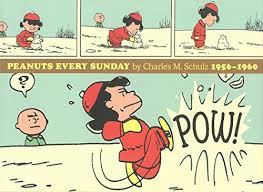
[READ: April 10, 2015] Peanuts Every Sunday 1956-1960

Fantagraphics has been releasing volumes of Peanuts daily comic strips.  They are looking to do 50 years of strips in 25 books! (they are up to 1990).  And now they have begun releasing the Sunday color strips in their own volumes.

This book picks up where the last one left off.  And of course, Snoopy is still the star.  There’s some very funny jokes with snoopy–like the one where he tries to fly—there’s something wonderful about Snoopy being insecure (and clumsy).

Linus can’t let go of his blanket (July 1956).  And in an early baseball one, the blanket actually causes him trouble (instead of later ones where it is a benefit).

Pigpen gets a strip devoted to himself in July 1956  and then there’s a very funny one about sand in his shoe in 1958.

Lucy yells to make the kites fall out of the tree.  And the first full acknowledgment of her pulling football away comes in December of 1956.

I also enjoy how violent the cartoons were.  Like this exchange between Linus and Lucy:

Linus: Give it to me or I’ll slug ya.
Lucy:  Mom, Linus says he’s gonna slug me.
Mom: Linus that’s no way to talk.
Linus: Well, that’s the way they talk on TV if they can talk that what, why can’t I?
Mom: That’s just one of those things I can’t explain.
Lucy: Listen dope. If you slug me I’ll slug you right back.
Linus: Never mind Mom, it’s just been explained to me in language that I understand.

There’s some really great one liners coming in now too.  Lucy: I feel torn between the desire to create and the desire to destroy.

There almost isn’t as much Charlie Brown in this book.  Although he is certainly there.  In June 1957 he realizes that he won’t ever be president.

And the gang all starts to look pretty much as we know them at this point (except Snoopy still).

There’s lots of funny strips (visual mostly) of Snoopy chasing Linus to try to get his blanket (a joke that recurred for years).

And there’s a very meta joke of Lucy wearing one of CB’s shirts

Sally Brown, CB’s sister is born around August 1959 and CB gains a pencil pal.  The following week Aug 16 1959 is a great sibling rivalry with Lucy and Linus.  And there’s a wonderful strip where Sally and Snoopy gang up on Linus Oct 25 1959.

The Snoopy jokes are very funny with him (still) walking on all fours and wishing to be a bird or pretending to be a mountain lion.

The 1960 new years strip in which Lucy gives Linus the resolutions he should work on is hilarious.

Later Linus gets so mad at Lucy that “she hath caused me to rend my garment” is one of the funnier punch lines I’ve seen.

The great pumpkin makes its first mention on October 23 1960.

The Snoopy/Linus rivalry is really wonderful throughout with Snoopy trying to steal Linus’ blanket and then later getting into boxing matches—this is the classic Peanuts.  Some of these jokes have now been around for ages (the boxing glove on the nose). And Snoopy is starting to look a lot more like his familiar self (although not exactly the same yet).

It’s a great collection, once again.  And it looks amazing.


Read Full Post »

peanutsVIJAY IYER TRIO-Tiny Desk Concert #438 (May 4, 2015).

vijay I was unfamiliar with Vijay Iyer, but I really enjoyed this Tiny Desk Concert.  Iyer is a jazz improv artist and composer (although all of these pieces have titles and come from previous albums).  The first four (of five) pieces are fast and eccentric, with interesting rhythms both in the drums (by Marcus Gilmore) and the piano.  There’s an  upright bass too (Stephan Crump) but I feel like he’s not very audible during the early medley.

I really enjoy the kinds of beats (from clicks to snares to cymbals) that Gilmore does.  And even if you can’t really hear the bass, it’s really fun to see how into it Crump is, keeping time to something or other.

While the four songs have fairly distinct starting points (and are labelled in the video), they flow pretty seamlessly, which is cool.  “Time, Place, Action” slows down just enough that “Questions of Agency” (a more staccato piece) is able to start fresh.  And then the opening of “Hood” is quite distinct.

The four songs are

  • “Diptych”
  • “Time, Place, Action — Excerpt 1 (Libra)”
  • “Questions Of Agency”
  • “Hood”

At around 13:31 “Hood” begins, and I love the staccato playing style and practically morse code drums.  It’s a dynamite piece (and you can really hear the bass too).  I’m amazed at how different what his left and right hand are doing.  And then the shift at 19 minutes, back to that earlier sound is very dramatic.  The final minute is tense and dissonant, really building to something big.

The band pauses for applause after nearly 21 straight minutes and then they play the final piece “Time, Place, Action — Excerpt 2 (For Amiri Baraka)” which mellows things out considerably, although is still kind of dissonant.

I don’t listen to a lot of jazz, but this really hit the spot (maybe because his new album is called “Break Stuff”).  And if you like this, there’s a 90 minute video of his trio playing on NPR.

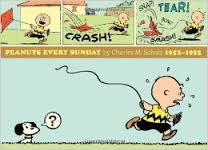
[READ: April 10, 2015] Peanuts Every Sunday 1952-1955

Fantagraphics has been releasing volumes of Peanuts daily comic strips.  They are looking to do 50 years of strips in 25 books! (they are up to 1990).  And now they have begun releasing the Sunday color strips in their own volumes.

The reproductions are absolutely top notch.  I’m quite certain they look better here than they ever could have in the papers (the coloring alone looks phenomenal).

Schulz started doing Sunday strips for Peanuts (he hated the name Peanuts by the way, which was assigned him by the syndicate who agreed to publish him) in 1952.  And he continued up through his death in 2000.  Between black and white and Sunday color strips, he hand wrote, colored and lettered 17,897 comic strips.  That is amazing.

And the strip really evolved over the years (for better and worse).  These original cartoons are fascinating to see–especially now that the images from Peanuts are so ubiquitous that I doubt I could go an entire week without seeing an image of Snoopy somewhere.  So it’s amazing to see Snoopy look so different (and so much more like a real dog) in these early strips. (more…)

Read Full Post »

McSweeney’s #13 (2006)

13SOUNDTRACKPARTS & LABOR-Stay Afraid (2006).

partslaborParts & Labor have changed t heir style over the years going from noisemakers who have a melody to being melodious noisemakers.  This album is one of their earlier releases when noise dominated.  Right from the opening you know the album is going to be a challenge.  The first song has pounding drums (electronics that sound like bagpipes) and heavy distorted shouty vocals.  By the end of the songs there is squealing feedback, punk speed drums and screaming distorted vocals (complete with space sound effects).  It’s an aggressive opening for sure.  Song two opens with a long low rumbling and then “Drastic Measures” proves to be another fast-paced song.

“A Pleasant Stay” is 5 minutes long (most of the rest of the album’s songs are about 3 minutes).  It continues in this fast framework, although it has a bit more open moments of just drums or just vocals.  The way the band plays with feedback in the last minute or so of the song  very cool.

“New Buildings” has a hardcore beat with a guitar part that sounds sped up.  “Death” is a thumping song (the drums are very loud on this disc), while “Timeline” is two minutes of squealing guitars.  “Stay Afraid” has a false start (although who knows why–how do these guys know if the feedback sounds are what  they wanted anyhow?).  The song ends with 30 seconds of sheer noise).  The album ends with the 5 minute “Changing of the Guard” a song not unlike the rest of the album–noisy with loud drumming and more noise.

The album is certainly challenging, it’s abrasive and off putting, but there;s surprising pleasures and melodies amidst the chaos.   Indeed, after a listen or two you start to really look forward to the hooks.  If you like this sort of thing, this album s a joy.  It’s also quite brief, so it never overstays its welcome.

[READ: April 15, 2011] McSweeney’s #13

I have been looking forward to reading this issue for quite some time.  Indeed, as soon as I received it I wanted to put aside time for it.  It only took eight years.  For this is the fabled comics issue.  Or as the cover puts it: Included with this paper: a free 264 page hardcover.  Because the cover is a fold-out poster–a gorgeous broadside done by Chris Ware called “God.”  And as with all Chris Ware stories, this is about life, the universe and everything.  On the flip side of the (seriously, really beautiful with gold foil and everything) Ware comic are the contributors’ list and a large drawing that is credited to LHOOQ which is the name of Marcel Duchamp’s art piece in which he put a mustache on the Mona Lisa.  It’s a kind of composite of the history of famous faces in art all done in a series of concentric squares.  It’s quite cool.

So, yes, this issue is all about comics.  There are a couple of essays, a couple of biographical sketches by Ware of artists that I assume many people don’t know and there’s a few unpublished pieces by famous mainstream artists.  But the bulk of the book is comprised of underground (and some who are not so underground anymore) artists showing of their goods.  It’s amazing how divergent the styles are for subject matter that is (for the most part) pretty similar: woe is me!  Angst fills these pages.  Whether it is the biographical angst of famous artists by Brunetti or the angst of not getting the girl (most of the others) or the angst of life (the remaining ones), there’s not a lot of joy here. Although there is a lot of humor.  A couple of these comics made it into the Best American Comics 2006.

There’s no letters this issue, which makes sense as the whole thing is Chris Ware’s baby.  But there are two special tiny books that fit nearly into the fold that the oversized cover makes.  There’s also two introductions.  One by Ira Glass (and yes I’d rather hear him say it but what can you do).  And the other by Ware.  Ware has advocated for underground comics forever and it’s cool that he has a forum for his ideas here.  I’m not sure I’ve ever read prose from him before. (more…)

Read Full Post »

SOUNDTRACK: A CAMP-Studio Sessions on WFUV [available on NPR] (2009).

I rather enjoyed A Camp’s latest album Colonia.  I discovered this session while browsing through NPR’s archives.  There’s a pretty lengthy (and amusing) interview with the band and then they play three acoustic songs: “Love Has Left the Room,” “Stronger Than Jesus” and “I Signed the Line.”

Nina’s voice sounds fantstic, and in such a simple acoustic session it’s her voice that really sells the music.  But this is another instance where an acoustic, stripped down session reveals the strength of the songs themselves.  The album has a lot of production, but when it’s just bare bones guitar and bass, the melodies still hold up.  And again, Nina’s voice just soars through these meloides.  Anyone who got sick of The Cardigans needs to hear what Nina Persson can do in other settings.

Check it out here.

[READ: October 29, 2010] “The Comfort Zone”

The subtitle gives the foundation of the article: Franzen loved Peanuts when he was growing up.  This article was timed to coincide with the release of the awesome Fantagraphics collection of original Peanuts cartoons. I’ve only read the first of these Peanuts books, but it was really eye-opening and quite fascinating to see that such odd thoughts were published on a daily basis on the comic section!  And, I hate to sound curmudgeonly (that’s Charlie Brown’s job) but Franzen is right, the original Peanuts cartoons are far more existentially dark and satisfying than the fluffy Snoopy & Woodstock cartoons of the late 70s and 80s.

Anyhow, Franzen loved these early comics (and he makes a wonderful comment about spending a lot of time (probably age-inappropriate time) with talking animals: Snoopy, Narnia, A.A. Milne).   But as with all of these longer Franzen articles, it’s about much more than just Charlie Brown.   One night when he was a young boy, his older brother Tom had a huge fight with their parents and stormed out.   Franzen sets this up in the context of generation gap that was sweeping through the country in the late 60s/early 70s.

And it’s this unsettledness that also explains the popularity of the Peanuts cartoons. Despite all of the differences between generations, everyone agreed that they loved Peanuts (except for Franzen’s parents, evidently–his dad never read the funnies, and his mom only liked a strip called The Girls, which sounds like a prototype of Cathy).

The other angle that this article takes is about losers.  Charlie Brown was a loser, there’s no doubt.  But Franzen himself was a winner.  He was the king of spelling bees in his school. (This relates to Charlie Brown misspelling “maze” as MAYS, a perfect misspell for a sports fan).  And when a new kid comes to challenge him he steps up his game…and makes the kid cry.

This, of course, leads to guilt. Charlie Brown one said, “Everything I do makes me feel guilty.” And now Franzen feels guilty about the boy in his class, and about being mean to a frog as a kid and about the wash cloths at the bottom of the closet which don’t get used enough (Sarah and I have jokey guilt about that too) and even about the stuffed animals who don’t get cuddled enough. (more…)

Read Full Post »

« Newer Posts