 SOUNDTRACK: CHARLIE SIEM-Tiny Desk Concert #134 (June 15, 2011).
 When he was 3 years old, Charlie Siem heard violinist Yehudi Menuhin play Beethoven’s Violin Concerto. That was all it took to inspire him to pursue the violin. Siem studied at Eton and the Royal College of Music, and now he plays one of Menuhin’s old violins—a stunning 1735 Guarneri del Gesu. Upon describing this centuries old instrument he says “it helps me a lot when I’m doing my… little thing.” He is also greatly amused when NPR’s Stephen Thompson asks if he can borrow it.
Siem recently discovered that he’s related to the 19th-century Norwegian violin virtuoso and composer Ole Bull. So he started off his Tiny Desk show with Bull’s bucolic Cantabile. His introduction is great. He says that Bull was a precursor to Paganini, who emigrated to the States and set up a colony on Pennsylvania. He calls him a “really crazy guy.” It’s a beautiful piece with occasional really high notes. This violin seems to have an unreal sound to it, bringing it what sounds like harmonic notes or something.
Paganini’s Introduction and Variations on Paisiello’s “Nel Cor Piu” (an aria from a now-forgotten Paisiello opera), contains a grab bag full of violin special effects. This is just incredible. His fingers move faster than can be believed. There are trills all up and down the neck, there’s pizzicato plucking with his left hand (how?). In a section of “harmonics” he even whistles the final note. It’s amazing to watch.
Leopold Godowsky: Alt Wien (“Old Vienna”) (arr. Heifetz) This is a lovely piece with lots of high keening notes in an arrangement by the incomparable Jascha Heifetz.
It’s amazing that Siem can be so good and yet somehow I’d never heard of him. His kind of virtuosity is amazing. And, as it turns out he’s a total hunk with a deep resonating actor’s voice as the pages of Italian Men’s Vogue magazine. He’s also the 2011 spokesman for Dunhill, the men’s fashion house. The write up says that for his Tiny Desk Concert appearance, you could say Siem dressed “casual, but with an understated elegance,” right down to his left-hand pinky, with its pink-painted fingernail.
I definitely need to hear more from him.
[READ: December 8, 2015] Victory
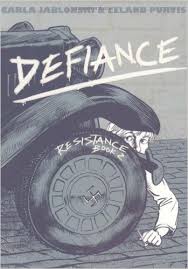
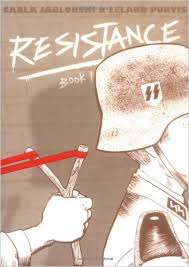
This final book in the trilogy sees the culmination of French Resistance against the Nazis.
We learn in the introduction that it has been four years since the occupation began and although victory seems within sight, things have been getting worse. There’s hardly any food or resources and the Nazis are growing even more angry and vicious. On June 6, 1944 the Allies landed in Normandy. But they had a lot of fighting to do before they could liberate Vichy.
As this book opens we see Paul called into the prison because of his drawings. He looks older now (a great detail on the drawing) and he finds it much easier to lie to the guards. After an interrogation, Lucie’s father–the policeman we saw in the previous book who seemed to turn a blind eye to Paul’s activity–accuses him of sneaking around to see Lucie. Paul catches on quickly that the man is helping him and when they are free together, Paul learns that there are people on his side who he never suspected. (more…)





 I Just Read About That...