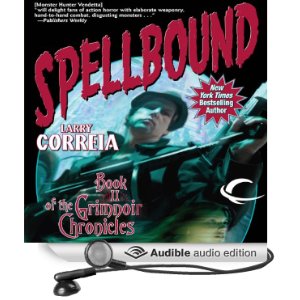
I loved Book I and Book II of The Grimnoir Chronicles immensely. The first was an amazing introduction to this new world and the second upped the scale and intensity to an amazing level (nearly destroying Washington D.C.).
And since the beginning of Book II picked up shortly after the events of Book II, it seemed pretty safe to assume that we would be heading into the giant conflict that was predicted at the end of Book II–fighting the creature that was coming to kill The Power. For real context, read the other two reviews first (I mean, really), but for simple context, a sizable minority of the population has the gift of Magic. This gift comes from The Power and it allows people to do all kinds of things–bend gravity, transport from one place to another, talk through animals, fade into walls, etc.
It has only been recently, through the work of our heroes, that people understood just how people got the power. It came from The Power, a creature that gave humans magic and then fed off of them when they died. It was a symbiotic relationship. But of course people who did not have Power hated those with Power. Even though the people with Power often use their power for good, there were of course people who didn’t. Consequently all people with The Power were scapegoated. This is all laid on a backdrop of alternate reality 1930s America, where the Nipponese are ascending and offer a very credible threat–especially since their Magicals are organized and brutal. (more…)
[LISTENED TO: November 8, 2013] Daniel Alarcón reads “Gomez Palacio”
The New Yorker has a Fiction podcast of current authors reading a story from the New Yorker archives. I was unaware of this podcast until I recently stumbled upon this Alarcón reading. I am trying to find out the breadth and depth of this podcast, but I find the navigation really unclear. It seems like there are a lot of stories in this series. (You can see the archives list here, although I wish it was a little easier to navigate).
The podcast is 30 minutes long. What you get is a brief interview with Alarcón, in which he talks primarily about his exposure to Bolaño and his interpretation of this story. And then he reads the story itself.
The interview was very interesting. He talks about reading Bolaño when 2666 had come out in Chile. What I enjoyed hearing him talk about was the Bolaño universe and him “sampling himself.” And also how the shorter works reference each other and different characters appear and reappear–that Bolaño has created an entire world in which all of his stories are set. These are things that I noticed, of course, but it is always comforting to hear others confirm your ideas. (more…)
I had seen the cover of this book in the library almost every time I went in. I loved it but I wasn’t sure if the book was too old for the kids (it’s rated 8 and up, but it turns out there’s nothing too intense that my 5 year old didn’t love it too (she didn’t get it all, but she liked it). Angleberger is best known for the Origami Yoda series–I haven’t read it and frankly without knowing anything about it, the entire concept of the series baffles me. But I enjoyed this book so much that I may have to dive into the folded paper series too.
This audio book was read by Jonathan Todd Ross and Jessica Almasy. And while I liked Almasy, I really enjoyed Ross’s two sections–there was something about is style that really appealed to me.
This is the simple (albeit complicated) story of a boy whose friend buys a fake mustache. In the town of Hairsprinkle, young Caspar lives with his parents who believe in wholesomeness—in other words, they don’t have a TV. Nor do they believe in an allowance—material goods are not so good. But every year Caspar’s aunt gives him a couple hundred dollars to by something frivolous. And this year, Caspar has his sites set on a man-about-town suit. Not just any cheap suit, but a very nice tailored, man-about-town suit (this phrase, repeated throughout the beginning of the book cracked me up. I’m sure my kids didn’t know what it meant but it made me laugh every time it was used). After buying the suit, he went to the Heidelberg Novelty Store to buy the Heidelberg Handlebar #7—a glorious fake mustache which is made from real human mustache hair (ew). With suit and mustache, Caspar looked like a short man-about-town. And the citizens of Hairsprinkle were impressed
The main character and narrator of the story is Lenny Flemm, Jr. Lenny is something of a loser and his only real friend is Caspar. Turns out that he himself is responsible for giving Caspar the extra ten dollars that he needed to get that mustache (they had raised the price). When Lenny goes shopping with Caspar, he is excited not to buy a suit or a mustache but to buy a sticky grabber hand (for $1). The lady at the desk, Sven, is hilarious (and Ross’ voice for her is dynamite).
That night a bank is robbed—by a short man in a man-about-town suit. And the next day Caspar gives Lenny his money back, with a lot of interest. Then another bank is robbed. And then another. The next time Lenny visits Caspar’s room, there are stacks of gold bars against the wall. Lenny decides to call the police, but they don’t believe him—Caspar is a boy, they are looking for a man. But now that Caspar knows that Lenny is onto him, he tries to make trouble for Lenny.
But before Lenny can prepare for this, there is a new player in town—Fako Mustacho—a man who plans to save the town, the country, the world, from itself. Fako Musatcho is a short man with a glorious mustache and a suit—not a man-about-town suit, mind you, but a different kind of suit. And it seems that whenever Fako speaks, people automatically listen–including the mayor who agrees to step down because she can’t catch the bank robber. Except for Lenny who seems to be the only one who can see that Fako is really Caspar. So, what is a kid with no friends supposed to do?
Call for help from Jodie O’Rodeo, of course. Jodie is the star of the now cancelled kids show The Jodie O’Rodeo Showdeo. On the show she sang and did trick riding stunts. Turns out that she can really do them (the stunts, not the singing) and she also knows that Fako Mustacho is a kid wearing a mustache. By the middle of the book, when Part 2 opens, we hear Jodie’s side of things (in the audio book this is where Jessica Almasy takes over). Interestingly Jodie and Lenny meet because Lenny is dressed like Jodie O’Rodeo (long story). Lenny always thought she was cute (and was embarrassed to say so) but the show has been off the air for a few years and Jodie is really cute now. And she still has her horse, Soymilk. And she wants to help Lenny save the world! (And she thinks Lenny is cute, even though it’s weird because he is dressed like her).
Once the two begin working together, hijinx ensue and the story gets very exciting indeed. Whereas Lenny is a man of words, Jodie is all about action, and there is a ton of it (most of it very funny indeed). By the time they free themselves from Fako Mustacho’s henchmen, Fako has the whole world hypnotized and, since it is an election year, he has them all hypnotized to vote for him as the President of the Unites States. It’s going to take nerves of steel, great horsemanship and perhaps a sticky grabber hand to stop the plans that are afoot (including the other plan to assassinate Fako should he become president—don’t forget, he is only Caspar in a fake mustache).
This story was so funny. It is riddled with absurdities and hilarious asides. The situations are preposterously simple and yet also dangerous. All throughout there were wonderful jokes, hilariously silly set ups (they fall into a vat of oozing slime) and preposterously funny foolishness—who doesn’t love when no one can see the bad guy but one kid?
I enjoyed this book so much I insisted that the kids only listen to it when I was in the car. And it did not disappoint.
As I said earlier I loved Ross’ reading. He was very very funny (and reminded me at times of John Hodgman’s deadpan delivery–absurdity always works best in deadpan). And his pronunciation of Fako Mustacho made me laugh every single time. Jessica Almasy’s reading was also really good (I don’t want to give the wrong impression). It’s just very different—Jodie’s story is more exciting than Lenny’s while it is still funny, it’s not as absurdly funny as Lenny’s (although Almasy does a great job with the different character voices as well).
Here’s trailer for the book (ha). I feel compelled to point out that the “its” in the trailer should have an apostrophe, but at least they didn’t put one in where it didn’t belong, which is so much more common. I also didn’t realize the book had illustrations (that’s the trouble with audio books).
.
I am sold on Angleberger and am not only preparing to read the Origami Yoda books, but I can’t wait to get the audio for Horton Halfpott: Or, The Fiendish Mystery of Smugwick Manor; or, The Loosening of M’Lady Luggertuck’s Corset. The fact that it also has a crazy subtitle means I like it already.
Incidentally, Angleberger has also written under the pseudonym Sam Riddleberger and I hear that his The Qwikpick Adventure Society is quite enjoyable too.
I enjoyed Book I of The Grimnoir Chronicles immensely. I wasn’t really sure what Correia could do to top it. There’s the inevitable dread for sequels that everything has to be bigger bigger bigger with the cost to the heart of the story. (That’s more true in movies, but books can suffer as well).
And indeed, Correia does go bigger, but he loses nothing. Indeed, the higher stakes make this story all the more exciting without sacrificing the characters in any way.
As the story opens, we learn that it is a few months after the events of Book I. The Grimnoir are dispersed somewhat, with things falling into a somewhat logical place. Francis Stuyvesant is the head of United Blimp. Faye and Francis are more or less dating and Heinrich is more or less his bodyguard. The other team members are up to assorted states of resting and recuperating. And Jake Sullivan is lying low.
But no matter how low he thinks he is lying, he’s still very big. And he is soon found by a woman named Hammer. Of course, at first the story maintains the trappings of noir, with Hammer being a (beautiful) woman in distress. Surprisingly, she is in distress at the library and she asks Jake for help (he is there studying magic and, well, lying low). He tells her to ask the librarian. But later when he is leaving, he sees her being robbed by some thugs. He goes to rescue her (and easy job for a big guy like him), and Hammer uses her power to determine that he is indeed Heavy Jake Sullivan. And he can still do what he can do.
Hammer wrangles him into a government facility where he accepts a phone call from the dead Chairman. This whole section is lovingly described and far too cool to try to summarize. So let’s just say that Alexander Graham Bell created a phone that could talk to the dead–but only if they wanted to talk to us. The Chairman found the phone and, of all people, he wanted to speak to Jake. (I’m skipping so much stuff here that it hurts me, but I don’t want to spoil the story or the humor). (more…)
SOUNDTRACK: TWO INCH ASTRONAUT-”Little Short Guy” (2013).
Two Inch Astronaut made it into two segments of NPR’s Music section this week. Yesterday was Lars’ pick, today is Robin Hilton’s.
This song has a very funny title which may have something to do with the lyrics (which I don’t really understand) or it may be because the song is less than 90 seconds long.
It begins with some slow chugging chords (and something about holding you hair back). Twenty seconds in, the song bursts forth with louder guitars and noisier vocals. Twenty seconds later, the third part of the song mellows things out some, with quieter vocals and chiming guitars. But by the one minute mark the loudness is back. And then the song ends.
Talk about packing a lot into a short song. I don’t think it would sell anyone on the band, but I’ll bet it sounds great in the midst of the album.
[READ: June 27, 2013] “The Grimnoir Chronicles: Detroit Christmas”
This short story is a brief prequel to the content of Hard Magic. In Hard Magic Sullivan refers to the twins that he captured and wonders if they count as one capture or two. Well, here’s the story of that capture.
It has all of the features that I grew to love in the novel (I even read it as close to Bronson Pinchot’s voice as I could). And while the story was satisfying, it didn’t have any of the supporting cast who really flesh out the story. True, this story is exclusively about Sullivan so that point is moot. But it’s clear that while Sullivan is the star of the story he’s not really the heart.
The story is set in Detroit, Christmas Day 1931. And we see Sullivan in the middle of a huge battle with the Maplethorpe Brothers and their gang. There’s Snowball, the man who can control the temperature (and get ice to shoot from his fingers. And there’s Johnny Bones, the ringleader, so-called for his ability to stretch and de-form his bones into any shape–or sharpness–he wants.
The story flashes back to two days earlier, when a lady walked into his office. Emily Fordyce is looking for her husband, Arthur. He was a powerful healer and is believed to be murdered. But she thinks that he was kidnapped, perhaps by a gang who needs a healer. The pay she offered Sullivan was very, very good,so he took the case. (more…)
My sister-in-law Karen raved about this book and then gave it to me for Christmas. And holy cow. I. LOVED. IT.
And before I even get into the story I have to say that a major reason why I loved it is because of the reader–Bronson Pinchot. Yes, Balki from Perfect Strangers. Yes, that goofy “foreigner” from the show has an utterly mesmerizing speaking voice. It is amazingly deep–when he first started speaking the menacing drawl of Jake Sullivan, I was blown away. And then he pulled out a couple dozen more characters, women and men–German, Japanese, Okies, military men, New Yorkers. He brought this story to absolutely real life.
I have made a point of looking for anything else that he reads (although I see that he mostly reads books about war (which is not my thing))–but I see a Flannery O’Connor in there and–YES–he reads book two of the Grimnoir series (called Spellbound) and it’s already out!
Okay enough about Pinchot. No, not enough. He was stellar!
Okay, now enough. What’s the story about? Well, the best thing is that the story itself is also amazing. It is set in the 1930s, in an alternate reality Untied States. And in this reality, random people have been gifted with magic. And there’s all kinds of magic–fades (people who can walk through walls); torches (people who can make and stop fires), mouths (people who can put thoughts in your head); brutes (people who are crazy strong and who can actually bend gravity to their will) and movers (people who can jump from place to place). There’s also healers and cursers and cogs–really smart people–and other with more mysterious powers.
Each chapter opens with a quote from a real (in our world) person talking about how the magic or the people with magic–the Actives–impacted society. So Einstein was a cog, and military leaders used brutes to fight in wars, etc. (more…)
My sister-in-law Karen got me this audio book for Christmas. I had never read any Oliver Sacks before although I have always been amused/intrigued by his stuff (The Man Who Mistook His Wife for a Hat is such a great title). So this book, as one might guess, is all about how music impacts our lives. Music is more than just an enjoyable set of melodies, it is a more primordial form of communication. The key thing for any fan of music to know about this book is that about 97% of the music he talks about is classical. Which is fine, but you’re not going to get any kind of insight into rock. The reason for this is twofold. One–he likes classical (and doesn’t seem to like rock–although he did take one of his patients to a Grateful Dead show) and two–he wants to talk more about music and not so much about lyrics (although again, that’s not entirely true).
I have to admit that while I enjoyed the stories in the book and will certainly talk about it a lot, I found the book a little overwhelming–it was exhaustive and exhausting. Sacks really tries to cover ever aspect of music (and many I never would have guessed) and so I found the nine hours of story a bit tiring by the end.
Part of that may also have been John Lee, the reader, who spoke very clearly and a little slowly and gave the book something of a lecture-feel. Which was fine for much of the book, although again, it was a little exhausting sometimes.
The thing that is most exhausting about the book is that virtually every person he talks to or about has had some kind of trauma which makes their appreciation of music different from the norm. If you are in any way a hypochondriac, this book will make you go insane I’m not, but even I found myself worrying about having a stroke at any second or experiencing some kind of weird brain thing where I no longer like music or god forbid get some kind of long term amnesia. Jesus, I was getting a little spooked by the end. (more…)
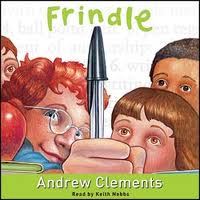
I went to the Princeton Public Library looking for audio books for the kids (we’ve exhausted most of our town library’s books). There was a nice new selection of audio books at PPL, and this was one of them. I wasn’t familiar with the story but Sarah knew it already.
So in Frindle, (which was Clements’ first chapter book after several picture books), Nick Allen is upset to find out that he has Mrs Granger as his English teacher this year. You see, Nick is beloved by his classmates for his ability to ask the perfect and perfectly timed question that will distract the teacher so he or she forgets to give homework. He has even sidetracked teachers so that they barely taught any lessons at all. But Mrs Granger has been around and has a reputation as being a really really tough teacher.
One the first day, Nick comes up with the perfect question. He learns that Mrs Granger loves dictionaries–she has one propped up on a lectern in the front of the class–so he waits until there’s about six minutes left and he asks her how all those words got in the dictionary. It was genius, it was brilliant. It didn’t work. She turned it around on him and asked him to give do research and give a report about the question. Tomorrow. Ack!
Nick is distraught. But then he decides to get really into it. And the next day he gives a presentation that lasts over thirty minutes. Mrs Granger knows what he’s up to but she is impressed by his tenacity. They have a kind of friendly stand off. But she makes a small comment that sets the rest of the book in motion. She tells Nick that it is him, and really everyone, who decides what words mean. If everyone agrees that a word means something, then it does.
[LISTENED: April 15, 2013] Shop Class as Soulcraft
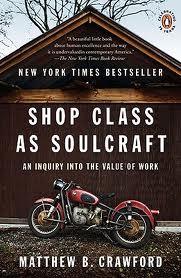
My sister-in-law Karen got me this audio book for Christmas. Now that I have a daily commute I had a chance to listen to it. And it has really stayed with me. I think about things from it nearly every day.
Think of the book as “Western Philosophy and the art of Motorcycle Maintenance.” Crawford studied philosophy in college. He later went to work for a think tank. But underneath all of that learning was a kid who worked as an electrician and a man who was always a gearhead. So after working in a knowledge job, he quit the life and opened a motorcycle repair shop in Virginia (Shockoe Moto). This is very likely the only book that quotes Heidegger and Hannah Arendt and also liberally uses the words shit and motherfucker (until I write my novel, of course).
My initial reaction to this book was not great. I didn’t especially like the reader, Max Bloomquist (although I see he is a frequent audiobook voice). His voice reminded me a lot of old filmstrips from grade school–a little stilted (which made the cursing even more surprising). But I got used to it after an hour or so. I also didn’t like the introduction/first chapter. There was something about the tone of the Introduction that was either snooty or pedantic which I found off-putting. The first chapter was a lengthy summary/example of what the book was supposed to be about–so much so that it felt like he wouldn’t need the rest of the book. By the end of the chapter I didn’t understand why there was so much left. So I’m actually pleased with myself for sticking with it, as I really didn’t enjoy the first two hours or so. It was an uncomfortable mix of fifty cent words and a comparable dismissal of people who use them, or at least that’s how it felt.
But then he seemed to loosen up and that’s when it got really interesting. His story is a fascinating one. I think he grew up on a commune (although I feel like he only started talking about that about midway through the book). His scholarship, his abandonment of it, his love of motorcycles and his work as an electrician and an apprentice mechanic all led to where he is now–a well-rounded individual. (more…)
We were looking for a good audio book for the kids and I stumbled upon this, an autobiography from Jon Scieszka. We love Scieszka’s books (Stinky Cheese Man and the Time Warp Trio among others) and figured that this autobiography had to be good for a few laughs too. And we were very much correct.
This is a funny book about what it was like to grow up as the second oldest of six brothers in Flint, Michigan. It’s not really about being an author (although he does talk about where he gets ideas), it’s really about his childhood. Most of the anecdotes in the book are things that he and his brothers got up to and how his father used to affectionately call all six of them knuckleheads.
The book has almost 40 chapters, all of them very short (as befitting the author of books for reluctant readers). And each one has a pretty good set up and punchline. Like how the older brothers used to tease the youngest ones or how Jon and his brother burnt a dry cleaning bag because it dropped little plastic bombs onto a battlefield–in the basement. Or how he and his brother peed on the space heater because they thought that would put it out (that seems suspect, but it could have happened. (more…)
 I loved Book I and Book II of The Grimnoir Chronicles immensely. The first was an amazing introduction to this new world and the second upped the scale and intensity to an amazing level (nearly destroying Washington D.C.).










 I Just Read About That...