Feeds:
Posts
Comments

Archive for the ‘Artists’ Category

2016-05SOUNDTRACK: GODSPEED YOU! BLACK EMPEROR-‘Asunder, Sweet and Other Distress’ [CST111] (2015).

Godspeed_You!_Black_Emperor_-_Asunder,_Sweet_and_Other_DistressIn 2015, GY!BE released their so far last record.  And it lasts a mere 40 minutes.

As with the previous record, there are two longer songs and two somewhat shorter ones.  The album’s four tracks are based on “Behemoth,” played live numerous times since 2012 and previously recorded onstage for the concert series We Have Signal. (Absolutely worth a viewing if you like the band–this is a good recording).

“Peasantry or ‘Light! Inside of Light!'” has perhaps my favorite opening from any GY!BE album.  After a series of drum beats, the big monolithic riff kicks in.  It begins as two notes but slowly grows and morphs into something bigger.  The bands rocks the riff for about 3 minutes, when there’s a brief guitar solo and a change in direction (with lots of chaos and noise).  And then the song turns pretty and strangely uplifting–the violin riffs that punctuate the middle of the song are quite beautiful.  For the last two or so minutes, the song really slows down, keeping that same basic melody but adding a slow guitar playing the riff.  It’s capped off with more of those soaring violin riffs.  At ten minutes total, it’s one of their shorter “epic” pieces, but I think it’s a great one.

“Lambs’ Breath” (almost ten minutes) begins as a seamless continuation of the previous part, opening with noisy static guitar sounds and droney chords.  This track is almost ten minutes long and it goes through many different waves of noise.  There’s some echoed sound effects and static that more or less drop out into a quieter drone about 3 minutes in.  The quiet (very quiet) drone is accompanied by electronic sounds.  The last nearly 3 minutes are all one note, oscillating somewhat, but feeling like it never stops.  On the vinyl, this track ends in a locked groove, so it actually does go forever.

“Asunder, Sweet” (6 minutes) continues with that same note until it is punctuated by echoed guitar notes and buzzing sounds.  Around three minutes in, more sounds start rising out of the murky noise.  It feels like a beast slowly waking.  There’s some pretty feedback as the drone grows louder….

“Piss Crowns Are Trebled” is nearly 14 minutes long. It continues of the growing drones of the previous song but immediately adds a violin.

For this album there is one minor change:

  • Thierry Amar – bass guitar, double bass
  • David Bryant – electric guitar, Portasound, organ, drones
  • Aidan Girt – drums
  • Karl Lemieux – 16mm frames artwork, photography
  • Efrim Menuck – electric guitar
  • Mike Moya – electric guitar,
  • Mauro Pezzente – bass guitar
  • Sophie Trudeau – violin, drones
  • Timothy Herzog drums, drone [replacing Bruce Cawdron]

[READ: April 11, 2016] “Witness”

I really enjoyed this story and the wonderful direction it went at the end (I’ve been worried about The Walrus’ dark stories as of late).

The story is about an older woman (she is over 70), Harriet.  Harriet is a painter.  She lives alone by the lake, despite her son’s protestations.   And as the story opens, we see her attacked by someone in her home.

What was so interesting about the way the story was constructed was that Harriet remained wonderfully calm through the whole ordeal.  She remembered to turn her head while the man (who smelled of Juicy Fruit) put his arms around her throat (this prevents you from losing oxygen).  She could tell that the boy was one of the local kids who hung out down by the 7-Eleven.

But instead of freaking out, she remains calm through it all.  She talks to him in a friendly manner.  When he asks for the money, she says it’s in the bedroom.  But he forces her down the hall to the room.  As they are about to head in, she tells him that there’s a mirror in there.  She doesn’t want to see is face or know who he is (such good thinking).

He pauses, thinks this over, then throws her to the floor and proceeds to take her money.  (So I didn’t love that part of the story). (more…)

Read Full Post »

lio1 SOUNDTRACK: JOE HENRY-Tiny Desk Concert #176 (November 21, 2011).

joe henryI had never heard of Joe Henry, so imagine my surprise to find out that he was releasing his 12th album in 2011.  For this Tiny Desk, it’s just him at a stool playing his guitar.  He has a very easy vibe, telling stories between songs and playing them with very little fuss.

He opens the show by saying this is, “not exactly like Woody Guthrie playing for the union members but you are working people.”

He plays four songs, “Sticks and Stones,” After the War,” “Odetta” and “Piano Furnace.”

Between the first two songs, he says he first became aware of Tiny Desk Concerts when his friend Vic Chesnutt was on the show (amusingly, he was the second person on the show).  He says he has a song on his new record about Chesnutt (Chesnutt had recently died).  He doesn’t play it though.  At first it seems like he might not be allowed to play it, but then it seems like maybe he just doesn’t get to it.

Rather he plays “After the War” where his guitar sounds like it has an incredible echo on it.  That echo is also present on the third song.  After which Bob asks him about his guitar.

Joe says he’s had the guitar for 6 years.  But the guitar dates back to 1932.  He says that he heard things differently with this guitar.  It’s got a smaller body and was actually sold as a budget guitar by Gibson (for $19 in 1932).  He also jokes that it’s black and looks a bit like a World Wrestling Federation belt.

Then someone asks him about Sam Phillips.  Joe says he sold her husband a guitar about 20 years ago.  She and her husband have split and Sam got the guitar and has been playing only that guitar for the last 20 years.  He says that he loves that she doesn’t plug in her guitar.  She plays into a microphone where you can hear the whole guitar and which makes the other players lean in to hear her.

I love the chords he plays in the final song, “Piano Furnace,” even if I don’t know what the song is about.  Henry’s voice is familiar.  I think he sounds a bit like a number of different singers.  And overall, nothing really stands out in his performance, except that everything sounds great and hiss songwriting is really solid.  That’s not a bad thing.

[READ: December 20, 2015] Happiness is a Squishy Cephalopod

Mark Tatulli is the author of the Desmond books.  I liked the stories, but I didn’t love the drawing style so much.  Imagine my surprise to find out that Tatulli has been drawing comics featuring this little boy Liō since 2006 (going forward, I’m leaving off that line over the o, because it’s a real pain).

And even more surprising is that I like the drawing style in the comic quite a bit–it is slightly refined over the Desmond books and is all the better for it.

I am also really surprised to find out that this strip appeared in newspapers across the country.  I’ve certainly never heard of it (but then I don’t read newspapers anymore, either).

So Lio is strip about a boy named Lio.  Lio is a dark, dark kid.  He has a pet squid, he loves monsters and he’s delighted by chaos. (more…)

Read Full Post »

sleazeSOUNDTRACK: MARKETA IRGLOVA-Tiny Desk Concert #174 (November 10, 2011).

marketaMarketa Irglova came to the world’s attention in the film Once, where she duetted with Glen Hansard.  They formed The Swell Season and made some beautiful music together.  But he has another band and she has done some solo work, like in this Tiny Desk.  Incidentally, watch the video, but listen to the audio.  For some reason the sound in the video is all wonky and weird, but the audio is fine.

This concert is a little surprising because Irglova plays a synth, rather than a piano, and she is accompanied by Iranian singer-percussionist Aida Shahghasemi whom she met in New York.  And Shahghasemi and her drum (called a daf) are actually a bit more interesting than Irglova.

Irglova has a nice voice, and I have really enjoyed a lot of her music, but I found these songs to be a little long and a little undramatic.  However, once you accept that she’s not going for drama, these songs are mellow and lovely.

The opening song, “We Are Good,” has an interesting main riff on the keyboard and her voice blends nicely with the music.  The end section has a very nice melody as it builds and builds.  But as I mentioned, it the daf that is so fascinating.  The drum itself looks like an Irish bodhran (or any other hand-held drum, I suppose), except it has a much bigger diameter and is very thin.  It also has a series of dangling items on the inside, which bring about a lot more percussive qualities.

“Dokhtar Goochani” is a traditional Iranian song sung in Farsi.  Shahghasemi sings the song while Irglova plays.  With the keyboard, the song doesn’t really sound very Middle Eastern until Irglova joins in on harmony vocals in the chorus, when it takes on a very cool quality.  And the drum and percussive sounds in the middle are really enticing.

After this song, Shahghasemi talks a bit about her drum and says that it can be much louder than she’s playing it here.  It’s a traditional Kurdish drum with “jangles” which she explains is usually made of goatskin, but this one is synthetic because the humidity doesn’t affect it as much.

The final song, “Let Me Fall In Love” is about the idea of being in love, with lyrics that are a bit didactic, but whatever.  I really like the middle section where the two women harmonize quite beautifully.  But again the song is a little long.

[READ: October 25, 2015] Sleaze Castle

The cover of this book is crazy.  The full title appears to be:

Markosia/Gratuitous Bunny Comix
Sleaze Castle : The Director’s Cut
Part Zero: “Tales from Sleaze Castle”
Reprinting “Takes from Sleaze Castle” #1-#4
Screenplay by Terry Wiley & Dave McKinnon  Art Direction by Terry Wiley

And then a drawing of a woman with what looks like a magic wand and another woman standing by watching her.

And then there’s a whole list of “Starring” (these names are actually characters in the stories)
and then Film Sound Track Album by MWOWM available on Gratuitous Bunny Audio #GBA3

That’s a lot to take in and it made me wonder if the comic would be that busy.  And it is.  This book is a wonder to behold.  Self published in 1992, this book is just chock full of story, with an astonishing amount of detail included in the drawings–nods to other comics, musical appreciation and all kinds of fun things to look at.  It took me a pretty long time to read this because there was just so much to see and read.  It was a lot of fun.  Even if the plot was a little confusing.

This book collects the original books and adds material (which is not at the end of the story necessarily (so art quality varies).

The book opens on a planet far away.  A blonde woman is talking about the trip she will take which will last for ten minutes their time.

Then we jump to the Prologue set in Jo’s house.  Her sister Petra is giving her a hard time.  Jo wants to take her watchman to school (she is a film studies graduate student) but it was Petra’s new present.  So they are fighting of course.  The amazing detail starts here with books on Jo’s shelves and all manner of other things to look at. (more…)

Read Full Post »

witoy SOUNDTRACK: JUANES-Tiny Desk Concert #172 (November 3, 2011).

Juanes is a Colombian superstar (he’s really juanesquite hunky).  This performance consists of Juanes singing and playing electric guitar (mostly solos) and his accompanist playing acoustic guitar.

The blurb says that he usually plays arenas and large venues, so it’s a treat to see him up close like this.  He was in town to receive an award from the Hispanic Heritage Foundation.

His voice is great and powerful and while he is singing in Spanish, his phrasings don’t sound Spanish at all.  Perhaps its the blend of Colombian roots-folk and rock ‘n’ roll.

“Hoy Me Voy” begins with some acoustic guitar playing and Juanes singing.  It’s a bouncy and upbeat folk song.  And while I don’t understand the words, I feel like I can make sense of the song.

For “Yerbatero” he opens the song with a guitar riff while the other guy plays percussive chords.  The “yeaaaaaaaaaaaah” section is catchy in any language.  And the solo he plays is pretty fun.  There’s also a fairly wild guitar solo near the end of the song.

“La Camisa Negra” was requested by someone in the audience–it was one of his bigger hits.  Juanes plays a cool intro riff (and some complex chords) before launching into the song proper.  I love the middle section with the warm guitars and catchy vocals that counter the staccato verses.

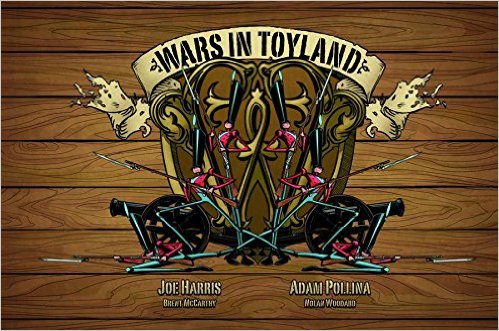
[READ: September 24, 2015] Wars in Toyland

There have been many books about toys coming to life, but I don’t think I’ve read anything quite like this before.

And the artwork is so good that it made the whole story even more compelling.

This book is geared towards YA readers and I can see why… although there’s no bad words (one “bastard”), the subject is very dark.  As it opens we see that young Matthew’s brother Adam is missing.  There’s even Missing posters on the fridge (it’s pretty dark).  Matthew and Adam used to play war with their toys all the time (I love the way the toy soldiers are drawn).

But now that Adam is missing Matthew doesn’t feel like playing war anymore.  And that’s when the toys drag Adam into the toy box and into Toyland, where things are very bad indeed. (more…)

Read Full Post »

fableSOUNDTRACK: CALLmeKAT-Tiny Desk Concert #152 (August 29, 2011).

callmekatKatrine Ottosen is CALLmeKAT and she is from Copenhagen.  I’m unclear what her sound normally is–if it’s fuller than it is here–but for this show, it’s her on a couple of synths and a drummer.

I like the interesting synth sound she gets in the beginning of “Tigerhead,” but, despite the two synths, the whole song feels a little thin to me. Nevertheless, she hits some admirable high notes.

She wrote the second song, “Going Home” at Newark airport—she says always miserable there, it’s “so depressing” (no argument there).  She samples herself on a tiny keyboard (Bob asks her what she’s doing singing into the tiny Casio–this has to have been before everyone was looping everything).  The song is very pretty but feels very slight again–even more so because there is no percussion.

The third song, “Glass Walls” also has a sample of her voice–the sample is just an “ooooooh” note.  She says she wrote this one in the Copenhagen airport (which must be nicer than Newark)  This song is a bit more robust.

I liked her voice but the whole show I wanted a bit more oomph, which is not a typical reaction from a Tiny Desk where I know things are usually stripped down somewhat.

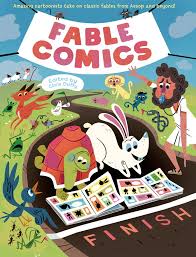
[READ: February 15, 2016] Fable Comics

Following up on First Second’s 2011 collection of Nursery Rhyme Comics, comes this new collection of Fable Comics, also edited by Chris Duffy.

Duffy says that for this collection they wanted to use mostly Aesop’s fables (because they are the most widely knows).  But the book also includes a sampling from other traditions.  He says that cartoonist were allowed to embellish the stories but we asked that the lesson remained.

And so there are 28 fables and the artists are pretty much a who’s who of contemporary comics.  I’ve broken down the Fables by their creators:

Aesop

The Fox and the Grapes-James Kochalka modernizes this a bit with a jet pack, which is hilarious.

The Town Mouse and the Country Mouse-Tom Gauld is back, and it’s great to see his work as he keeps the story fairly traditional

Hermes and the Man Who Was Bitten by an Ant ; Hermes and the Woodsman ; The Frogs Who Desired a King ; Hermes and the Sculptor. George O’Connor is responsible for the First Second Olympians series, so it’s no surprise that he tackles these stories about Hermes.  He remains faithful to the original and keeps up his very cool drawing style.

The Belly and the Body Members–Charise Harper has a wonderfully stylized look for this story about how the body parts need to work together or it can’t do anything.

Lion +Mouse–R. Sikoryak’s Mad Magazine style works very well for this familiar story about a mouse helping a lion (he has modified it somewhat of course).

Fox and Crow-Jennifer L. Meyer’s style is gorgeous.  This fable has a fantastic look to it with pale colors and circles of details.  I could look at it for hours.

The Old Man and Death–Eleanor Davis’s art is boxey and stark.  It works very well with this dark and Communist-looking story.

The Boy Who Cried Wolf–Jaime Hernandez.  I love when Hernandez does kids’ stoires because his characters are so perfectly cartoon and his colors are bright and fun.  His telling of this story is very good.

The Crow and the Pitcher–Simone Lia  I didn’t know this fable.  And I don’t really know how the beginning sets up the end. It shows crow as being very smart for others but the end has the crow being extremely smart for himself.   It’s a weird fable although it rings rather true.

The Dog and His Reflection–Graham Chafee does an awesome job of showing greed in others and leaving the dog’s story to be un-narrated.  He witnesses greed and acts accordingly.

The Dolphins, The Whales and the Sprat–Maris Wicks.  I was completely unfamiliar with this fable.  I’m also curious about how much Wicks has added.  I love that she adds some very funny factual details like that dolphins are actually a type of whale and that there are detailed asides about all of the animals throughout this story.  The moral is that they’d rather die than take advice from a sprat.  Still true today.

The Milkmaid and Her Pail–Israel Sanchez  This fable was also unfamiliar.  Sanchez’ drawings are stark and work well to tell this story of greed.

The Great Weasel War–Ulises Farinas.  This comes from a longer fable called The Mice and the Weasels.  I love Farinas’ art in this story.  The colors are spectacular and the creatures are great   And I love the moral is that they build these giant machines that cannot fight against nature.

The Sun and the Wind–R.O. Blechman. This fable was in Ava and Pip, so its funny to read it there and then see it here. Blechman’s simple drawings complement the story well.

The Hare and the Tortoise–Graham Annable’s art is great for this.  The tortoise is so crabby looking.  I’m unfamiliar with the deus ex machina that happens though.  It’s funny how many of these fables we may know without knowing them in total.

The Grasshopper and the Ants–John Kerschbaum’s art is so busy and full of detail, it’s really wonderful.  I’m unfamiliar with the ants asking the grasshopper to play for them at the end of the story tough.

The Thief and the Watchdog–Braden Lamb & Shelli Paroline. I really enjoyed the way these two created this fable.  The art is great–angular and simple but really powerful.  Having the dog explain why giving him meat won’t work is a great idea.

Demandes and His Fable–Roger Langridge.   I love Langridge’s clear lines and distinctive colors. He tries to get people’s attention and only succeeds by telling them a fable about Demandes.  I’m intrigued that his fable gets interrupted by himself.

The rest of the fables’ origins are mentions in parentheses after the title:

Leopard Drums Up Dinner (Angolan Fable)–Sophie Goldstein makes a fun visual of this story about animals trying to capture others with music.  I wonder how closely this aligns to the original, as its pretty crazy.

The Hare and the Pig (Indian Fable)–Vera Brosgol.  I didn’t know this fable at all.  Rabbit and Pig are arguing about who is best.  Leave it to fox to make the declaration.

The Demon, The Thief and the Hermit (Bidpai)–Keny Widjaja illustrates this amusing tale of a thief trying to join with a demon to rob a hermit

The Elephant in Favor (by Ivan Krilov)–Corinne Mucha.  I love that Corine modernizes the fable (the lion says Dude).  This is all about how everyone talks about the elephant.  He works slow but gets a raise. What makes him so great?  All the other animals speculate.  But it turns out that his ears are the real reason–for reasons other than the obvious.  This may be my favorite fable of all.

The Mouse Council (medieval European fable)–Liniers. This is the story of putting a bell on a cat and how no one wants to risk their life for the good of all.  Liniers’ art is spectacular.  I love the subtle shading of his drawings and then the rough drawings by the mice.

Man and Wart (Ambrose Bierce)–Mark Newgarden.  I love Ambrose Bierce but had no idea he wrote fables.  This one about people’s need for privacy and not belonging to a club is pretty strange.

The Hen and the Mountain Turtle (Chinese Fable)–Gregory Benton. I was unfamiliar with this story about a wise turtle saving a farm.

These collections of short pieces are quite wonderful. I wonder what genre First Second will tackle next.  #10yearsof01

Read Full Post »

fairytaleSOUNDTRACK: JOE BOYD AND ROBYN HITCHCOCK-“Tiny Desk Concert #142 (July 18, 2011).

robynThis is one of the more unusual Tiny Desk Concerts because it is not just music.  It is music and a recitation.  Joe Boyd (who I didn’t know) is a producer of many classic 1970s albums, including albums by Pink Floyd, Syd Barret and Nick Drake.  Robyn Hitchcock is an unusual and often funny singer songwriter.

Hitchcock opens the concert by stating (in his wonderfully British broadcaster’s voice) “All my life I’ve been Robyn Hitchock [and I’m here with] Joe Boyd who has been Joe Boyd even longer than I’ve been me.”

Joe and Robyn were doing a tour together in which Joe would talk about his experiences with these artists and then Robyn would play a representative song.

Robyn plays two songs.  The first is Syd Barrett’s “Terrapin,” a song I’ve always like.  His cover sounds a lot like Barrett’s version while still retaining Hitchcock’s distinctive singing quality.

The second song is one that Hitchcock wrote for the tour called “I Saw Nick Drake.”  It was planned as the first encore. It’s very much a Hitchcock song, a little trippy and strangely  catchy about him seeing Nick Drake and Nick being fine.

Between these songs, Boyd talks for about fifteen minutes, telling about working with Syd and how amazing he was…until he wasn’t.  And then about working with Nick and how every recording he did was perfect and how big his hands were.

If you care about either of these musicians or about British rock from that era, this is a great performance to check out.  It’s informative and a little funny too.

[READ: January 19, 2016] Fairy Tale Comics

This book follows on First Second’s Nursery Rhyme Comics book. Perhaps because this was a thinner volume or perhaps because Fairy Tales are a bit more substantive than Nursery Rhymes, I found this book even more enjoyable than the other.

And even though I (and possibly you) think that you know every a fairy tale, there were quite a few in here that I didn’t know.  In his editors note, Chris Duffy notes that he encouraged the artists to pick stories other than Grimms (although Grim is well represented).

Brothers Grimm stories include:

“Sweet Porridge,” which I’d never heard of.  This is done in a classic cartoon style by Bobby London.

“The 12 Dancing Princesses” seemed vaguely familiar.  This was done in a very pretty style by Emily Carroll.

“Hansel and Gretel” I did know, of course.  It’s fun to see Gilbert Hernandez doing a children’s story since I think of his stories as very adult.  But his simple drawing style works perfectly for this story.

“Little Red Riding Hood” has a very simple almost anime style from Gigi D.G.  It ends with a happy ending.

“Snow White” was done by the other Hernandez brother, Jaime.  His style is so peculiar and yet so perfect for this tale (the fact that the baby is actually white is a wonderful touch.

“Rumpelstiltskin” is done by Brett Helquist whom I know from the Lemon Snicket stories.  I can see his style a bit in these drawings but the colors really bring his interesting style to life.  It’s a great version.

“Rapunzel”  I have recently become a huge fan of Raina Telgemeier, and I love what she does with this story.  Although as I finished it I had to wonder if this is how the story is usually finished.  This seemed much more positive than what I imagine the Grimms intended.

“Bremen Town” I had never heard of this story.  And I can’t believe that this was how it was originally written. In this story a group of animals forms a band.  They frighten away bad guys so that they can jam.  How weird.  Karl Kerschl’s style suits it well.

“Give Me the Shudders” is another Grimm story that I had never heard of.  It’s about a boy who can’t shudder or shiver and so every one assumes he is fearless. He keeps asking people to teach him to shiver, but when they see he can’t they keep promoting him to better stations in life. David Mazzucchelli’s style works nicely with this because of the simplicity of his design amid the craziness of the story.

In addition to stories from Grimm, there are these fairy tales

From Charles Perrault:

“Puss in Boots” makes me wonder if I don’t know the story all that well.  I was quite intrigued by the way this one turned out.  Vanessa Davis has a kind of sloppy style.

From 1001 Nights Tales:

“The Prince and the Tortoise.” I had never heard of this story.  It’s pretty wild and weird.  The drawing style by Ramona Fradon reminds me of adventure comics from the Sunday papers.

From a Japanese Tale:

“The Boy Who Drew Cats” is a wonderfully cool and interesting story about the powers of fantasy and doing what you are meant to do.  Luke Pearson’s drawing is perfectly old school and nearly monochromatic for the Japanese landscape.

From Bre’r Rabbit”

“Rabbit Will Not Help”  I don’t know this tale but I do know some Bre’r Rabbit.  He’s such a bastard, and the drawing style by Joseph Lambert works nicely with that.  It’s a little weird and dark–perfect for this tale.

From an English Tale”

“The Small Tooth Dog”  I had never heard of this tale.  It’s pretty weird from start to finish, and that includes the art by Charise Mericle Harper whose style is very dramatically cartoony and also a little weird.

“Goldilocks and the Three Bears” I didn’t realize that this wasn’t a Grimm story.  This was my favorite in the book because of the way Graham Annable chose to do it.  There are no words just wonderful illustrations and great looks by both Goldilocks and the bears.  I suppose it helps if you know the story already–it may not be ideal for those who are seeing for the first time (whoever that may be) but as an interpretation, I loved it,

From the Russian Tale:

“Baba Yaga”  Russian Tales are always so dark.  And Jillian Tamaki represents this very well. This story has a house with chicken legs, wolves, talking cats and much more.  I really like Tamaki’s work a lot and I enjoyed her interpretation.

From The King and His Storyteller:

“Azzolino’s Story Without End” is another story I’d never heard of.  In it, a boy king wants to be told a story without an end.  And the king’s story-teller think of a great way to do it The story is short but Craig Thompson’s style is right on.

I really enjoyed this collection a lot.  And I love getting introduced and reintroduced to these stories that I’ve known for quite some time.

Thanks First Second. #10yearsof01

Read Full Post »

bewareSOUNDTRACK: YACHT-Tiny Desk Concert #136 (June 22, 2011).

yachtYacht is a synthy band with a dramatic and charismatic lead singer–Claire Evans.

There are tons of synth and funky synth sounds on “Dystopia (The Earth is On Fire)”.  But what really sound great are the excellent harmony vocals.  There is some guitar but it’s pretty overshadowed by the synth (and synth drums).  I don’t love the line “The earth is on fire.  We don’t have no daughter.  Let the mother father burn.”  But I’m willing to accept it because the synth solo is pretty cool.

The keyboardist and programmer switch places for “Psychic City (Voodoo City).”  The guitar is more prominent in this song primarily because the song is practically a capella–the chorus is principally Aye Yi Yah Yah HOOH, Aye Yi Yah Yah HO HO, which would probably be a lot of fun to sing along to live, but feels a little tedious here.

After this song it is revealed–horrors–that there was gum under Bob’s desk and Jona Bechtolt gets some on his nice pants.  There is talking of sending them the dry cleaning bill, but Claire grimaces and says “too soon.”

“Shangri-La” opens with an interesting synth riff (and the guys in back switch places).  The chorus “If I can’t get to heaven let me go to L.A.” is pretty funny.

I’m not sure what the band sounds like when it is not stripped down (the blurb talks about how long it took them to get settled), but I feel like their lyrics don’t support the stripped down sound.

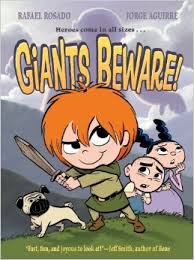
[READ: February 17, 2015] Giants Beware

This is a First Second children’s graphic novel.  It is quite long for a children’s book (200 pages) but it’s a lot of fun and the design is fantastic.

The story opens with an old storyteller telling a story to a bunch of kids.  It’s the story of the Baby Feet Eating Giant.  The giant liked to eat the feet of all the babies in the village.  No one was safe until the brave leadership of the great Marquis Pierre the XXXII. He chased the giant into the mountains and built a wall around the village to keep it secure.

The end.

Except, as the young girl on the cover of the book says…  Well?  How did he kill the giant?  Did they “tell the evil giant a pointless story and he died of boredom?”  This is Claudette; she wants to hear action.  She wants to hear about giant slaying.  She thinks that leaving the giant outside and simply building a wall around the city is irresponsible.

As the story teller walks away he mumbles that she is just like her father and look where that got him. (more…)

Read Full Post »

jan2016 SOUNDTRACK: STEVE EARLE-Tiny Desk Concert #123 (April 25, 2011).

earleSteve Earle is pretty cool.  He’s a country outlaw who is a socialist and an outspoken Bernie Sanders supporter.  He is a vocal opponent of capital punishment.  He’s also written a song “directed towards the state of Mississippi and their refusal to abandon the Confederate Flag and remove it from their state flag.”

For this Tiny Desk it’s just him and his guitar as he sings songs from his then new album.

He opens with “Waitin’ On The Sky” and says it’s the first time he’s played it in front of people.  He has to restart the song because “debris from a Cobb salad shifted in his throat.”  He also forgets some of the words, but it still sounds great.

He is very chatty with lots of stories about the recording of the record and how a song that he mentions isn’t on the record, but it is on a download or vinyl.  “We used to make records for girls and now we make them for nerds.”

“Every Part Of Me” is a slow ballad, it’s quite pretty.  His voice sounds good and hard-worn as he sings.  He says it is “the song you’re most likely to hear on the handful of radio stations that actually play me.”

While tuning before his third song he says that he is  involved with a show called Treme “that’s ‘treme,’ just like it sounds… if you’re French.”  In the show he’s a street performer in New Orleans.  He says that there are non-traditional buskers–professional musicians who sing on the streets for tips (hundreds of dollars a day).  And he tells about the turf wars that began in the 80s.  Eventually an agreement was reached between the players.   That’s all a lead in to a song that is on the Treme soundtrack called “This City.”  It’s a touching song about New Orleans.

I’d always thought that he was much more “country” sounding, and maybe he is on record, but at least here, he is simply singing well writing and well-though out songs.

[READ: February 23, 2016] “To Laugh That We May Not Weep”

This is a brief essay about cartoonist Art Young.  Young would be 150 years old this year and Spiegelman says that Bernie Sanders would have been the best birthday present we could have given him.  Because Art Young was a radical! Political !! Cartoonist!!!  (the oblivion trifecta).  The only concept less inviting is a political radical.

Spiegelman says that once upon a time political cartoonists were very powerful (although in some respect they still are, as you can see by the the murdered Charlie Hebdo artists).

Young was a talented cartoonist who drew for all kinds of publications.  He was never convicted for his drawings, but he was put on trial for libel.  He was found not guilty; he drew a picture of himself sleeping with a caption “Art Young on trial for his life.”

Spiegelman contends that political cartoons are usually short-lived and timely but that Young’ are more timeless–and perhaps sadly still relevant.  And that he was never shrill or humorless. (more…)

Read Full Post »

photoSOUNDTRACK: WILCO-Tiny Desk Concert #509 (February 23, 2016).

wilcoAs far as I can tell, Wilco is the first band to be invited back for a Tiny Desk Concert (there was a stated rule that no one would come back twice, with some people skirting that by coming with another band).  Laura Gibson was invited back since she was the very first attendee, but since Wilco’s newest album has been so successful, it seems somehow fitting that they get invited back.

And perhaps in honor of that, while their last performance was noisy and raucous, this one is decidedly more mellow—with all acoustic instruments.  But that doesn’t mean it’s quiet and calm either.

For the first song “The Joke Explained” from Star Wars, they used banjo, acoustic bass, hollow bodies electric guitar (w/ slide), the ever-present melodica and muted drums (w/shakers).  And it sounded great.

For the second song, the older “Misunderstood” everybody seemed to switch instruments.  Tweedy switched guitars, the acoustic bass became an acoustic guitar, the hollow body became a slide guitar.  Nels Cline’s slide guitar brings so much to the song by doing seemingly so little.  I love how this simple, sweet song has a wild middle section–a crazy breakdown with noisy cymbals and drums–drummer Glenn Kotche is fantastic–and everyone else playing some crazy high-pitched notes until it all settles back down again.

Tweedy has another guitar for the third song “I’m Always In Love” and the melodica is back.  There’s xylophone keeping the melody.  And as with all of these songs, Tweedy sounds great and the backing vocals add wonderful harmonies.  Cline plays a wonderful slide solo, too.

Before the final song and there’s another guitar change for Tweedy, and he says that after this song, “you guys need to get back to work solving this Trump problem. Figure it out! Its weird!”  They play “Shot in the Arm,” another great old song.

The band sounds excellent—a wonderfully full sound even without amplification. I am really excited to see them his summer.

There’s also a nifty video showing “Misunderstood” with two 360 degree cameras so you can see what goes on in the audience during a Tiny Desk Concert.  Check it out.

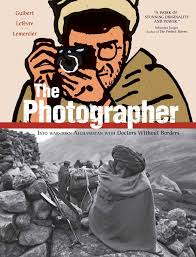
[READ: February 7, 2016] The Photographer

I loved Guibert’s book Alan’s War, in which he took the words of Alan Cope and put them to an amazing graphic novel.  Well, he is back again doing the same thing with the words of famed photograph Didier Lefèvre.

Didier Lefèvre died in 2008, but before he died he left a legacy of amazing photojournalism.  That includes this trip to Afghanistan which he took with the team from Doctors without Borders.

Alexis Siegel translated this book again, and he offers an excellent introduction which not only explains Lefèvre’s life, it also gives context for everything tat these men and women were up against in that war-torn region.

As mentioned Guibert draws out the story that Lefèvre told him.  But this book is different from Alan’s War in that it also uses the photos that Lefèvre took.  Guibert fills in the gaps where Lefèvre, didn’t or couldn’t, shoot.  And there was a lot he couldn’t shoot. (more…)

Read Full Post »

americusSOUNDTRACK: FLY PAN AM-Sédatif en fréquences et sillons EP [CST011] (2000).

330px-SedatifsEnFrequencesCover This is an EP that works as a kind of remixes and deconstructs further the debut. There are three songs, the first is fourteen minutes, the second is 11 and the final is 4.  As the Constellation site describes the disc:

This 3-song EP of fractured, tape-infested experiments is an intransigent slab of self-referential auto-criticism. The band was sticking to its agenda of acutely self-conscious musical manipulations, re-working its own materials and assumptions to yield new compositions of uncompromising formalism. Side A is a medley of sorts, consisting of phrases and fragments reconfigured and replayed from their self-titled debut (Fly Pan Am). Various melodies are reassembled and played off of one another, creating an extended live remix with blissful passages of layered guitars, drones, sampled backing vocal lines, and the requisite incidental noise break in the middle of the piece. The result is something like a ‘Stars On 45’-style musical encapsulation of the entire debut record.

“De cercle en cercle, ressasser et se perdre dans l’illusion née de la production de distractions et multiplier la statique environnante!” (“From Circle to Circle, Rehash and Get Lost in the Illusion Born of Production and Increase the Static Distractions Surrounding!”) opens with the sounds of machinery rumbling and then slowing to a stop. The song proper opens with a rapid bass line and squalls of feedback.   Some beautiful guitars play over the noise. More guitars come in along with all kinds of crazy noises—scrapes and scratches, radios and distortion.

The propulsive music stops around 3 and half minutes in and the noise takes over. There’s loud noises and static and all kinds of things. Then the noise shifts to what sounds like someone emptying a bag of ball bearings onto a metal table.  And then maybe making microwave popcorn.  About five minutes later (seriously) a drum starts playing in the background and then a guitar line that references the debut album starts up.  It sounds a bit like the two note guitar from “Dans ses cheveux soixante circuits” with the voices from “Nice est en feu!” thrown on top.  And then at 11:20 that two note half-tone thing from “Dans ses cheveux soixante circuits” resumes, but it’s only for 20 or so seconds before different sounds come to take away the repetitiveness (although the guitars do continue that until the end of the song).  It seems like the band wanted to revisit their debut but also wanted to make sure that it was properly buried under chaos as well.

The second song “Éfférant/Afférant” (“Unrelated / Related”) (11 minutes long) is described as “somnambulist clockwork repetition.” The bass and drums are kinda funky with some simple guitar chords playing in the background. While things do change somewhat throughout song (including notes that seem inappropriate at times), the main source of change is the weird electronic sounds that play over the top. The noise starts to grow louder and louder around 9 minutes and just when it gets unbearable it fades out to the end of the song.

“Micro Sillons” (“LPs”) is only 4 minutes long and it opens with static and noises—different ones in each ear.  After about three minutes of that, the noise mutates into a kind of machine-like hum.

This is definitely a challenging listen.  There are rewards to be had, and it s amazing what good songwriters these guys are, if they’d ever let their songs stay unmolested.

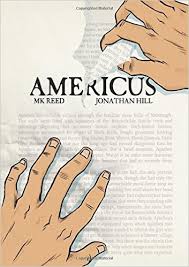
[READ: December 17, 2015] Americus

I didn’t really have any idea what this book was about–the title Americus evokes many different things.

So imagine my surprise to find out that this First Second graphic novel [go First Second!, #10yearof01] tackles the idea of banning books in schools.  It looks at religion, freedom of speech and middle school.

The story is about Neil Barton, an unpopular kid who loves fantasy and books, especially the Apathea Ravenchilde series (such a great name). Neil and his friend Danny race to library after school because the latest volume is out.  Neil is bummed that his library could only afford one copy of the book (budget cuts!) and Danny gets it first.  And as he starts reading, the artistic style switches to the Ravenchilde world (I loved that).

Then we meet Neil’s and Danny’s families.  Neil’s parents are divorced.  He lives with his mom who is harried and exhausted.  Danny’s family is an intact nuclear family, with two younger siblings.  And we learn soon enough that his mother (and father to a degree) are very Christian. (more…)

Read Full Post »

« Newer Posts - Older Posts »