Feeds:
Posts
Comments

Archive for the ‘Artists’ Category

 socks kronosSOUNDTRACK: KRONOS QUARTET-Tiny Desk Concert #322 (November 25, 2013).

2013 was the 40th anniversary of Kronos Quartet.  I first heard of them about eight years after they started with their cool arrangement of “Purple Haze.”  And then I learned that they were like a sponge, soaking up and playing music from all over the world: In just one year they released albums with tango, songs by South African composers, Polish composers, jazz musicians and so much more.

I have many of their releases, although I realized I more or less stopped listening to new stuff from them around the turn of the century (since when they have released some 16 albums!).

Well, amazingly, the Quartet is still the same original players (except for the cellist–the cello is like Kronos’ drummer as they seem to replace her every couple of years).

They play three pieces here and the three range the gamut from dark and broody to rather sweet to quirky.  In other words, typical Kronos.

For more info:

The musicians —  David Harrington (violin) and longtime members John Sherba (violin) and Hank Dutt (viola) and new (as of 2013) cellist Sunny Yang — could reminisce over more than 800 new works and arrangements they’ve commissioned in 40 years. But instead, the new-music train pushes ever onward to new territories. They remain a living, breathing world-heritage site for music.

Now in the midst of its 40th-anniversary tour, Kronos brings to this Tiny Desk Concert a new arrangement, a work from a new album and, for Kronos, something of a chestnut, a piece the group recorded a whopping five years ago.

“”Aheym” (Yiddish for “homeward”) was written for Kronos by Bryce Dessner; a member of the Brooklyn rock band The National, he studied composition at Yale. The music thrives on nervous energy, pulsating with strumming and spiccato (bouncing the bow on strings) while building to a tremendous fever.”

I love this piece. It is intense and dramatic with its 4-3-3 bowing from all four members.  There’s an interesting cello melody with pizzicato strings from the rest.  The overall melody seems somewhat circular with different instruments taking on different leads.  But this song also plays with some interesting bowing techniques.  In addition to the spiccato (about 4 minutes in), the players drag the bow for momentary scraping and scratching sounds.

Another wonderfully dramatic moment comes at 7 minutes where each musician takes a turn bowing his or her note while the violin plays a super fast series of notes.  The song builds and build in dramatic until it gets to about nine and  half minutes and it reaches its powerful ending.

“Lullaby,” opens with plucked cello notes and strummed viola.  “It is a traditional song with Afro-Persian roots (from the group’s Eastern-flavored 2009 album Floodplain), [and] is woven from different cloth altogether. Colorful tones that lay between our Western pitches are threaded through the music, anchored by a gorgeous solo from violist Dutt; his contribution takes on the warm and weathered sound of a grandmother singing to a child.”  It is slow and moody and beautiful.

Harrington introduces the final piece by saying it’s by a performer that no one had heard of–including, until recently, even himself.

“Kronos caps off the concert with another hairpin turn, this time to a fresh arrangement of “Last Kind Words,” a little-known blues song from around 1930, recorded by singer and guitarist Geeshie Wiley. In Jacob Garchik’s exuberant arrangement (which Kronos premiered this fall), interlocking strums and plucks provide a kind of rhythm section, while Harrington’s violin stands in for the now-forgotten blues singer.”

There’s lots of plucked notes from everyone–including plucked bent note on the viola which gives it a real “early” guitar sound.  While I don’t know what Geeshie sounded like, so I can’t compare the violin to her vocal, the whole thing sounds great together.  In fact the whole thing is unlike any string quartet I’ve heard–so different and wonderful.

I’m going to have to bust out so Kronos CDs.

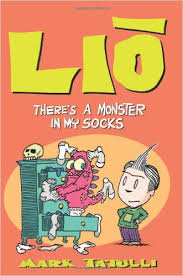
[READ: September 10, 2016] There’s a Monster in My Socks

I’ve been quite puzzled about the publication history of the Liō books.  And this just adds another layer of confusion.  This book covers the exact same time period as Happiness is a Squishy Cephalopod which was published in 2007.  The difference is that Cephalopod placed all of the strips in order, while this one seems to move things around quite a bit (the thinner format also means that it can’t quite handle the single panel strips very well.   But more egregious is that this volume (remember, the one printed after the previous one) prints the Sunday color strips in black and white.

The book also leaves some of the strips out.  It covers the date range from May 15, 2006 – Feb 16, 2007 (Cephaolopod went to May 23), but while it has the Feb 14 strip, it does not have the Feb 15 strip.  Weird.

So, basically this is an inferior version of the same book, but the publishers presumably wanted the books in this more friendly size (or some other nefarious reason).

I’ll include the review of Cephalopod below.

And, here’s the current list of existing Liō books. It’s a shame that there are years and years of strips thus far uncollected. (more…)

Read Full Post »

dressSOUNDTRACK: IMANI WINDS-Tiny Desk Concert #277 (May 29, 2013).

windsFor some reason this video and audio has been removed from the NPR site (no explanation is given).  But I found it elsewhere and was able to really enjoy it.

But they have left up the blurb:

When Igor Stravinsky began composing The Rite of Spring, his ballet for vast symphonic forces, he could hear the music in his head but couldn’t quite figure out how to write it down. It was just too complicated.

Today, 100 years after The Rite‘s premiere, the fearless musicians of Imani Winds make it all sound remarkably easy, given that they’ve condensed Stravinsky’s massive walls of sound down to just five instruments: bassoon, clarinet, flute (doubling on piccolo), oboe and French horn.

Make no mistake: Many of the jagged rhythms and crunching chords remain viscerally intact, albeit on a more intimate scale. As the group huddled behind Bob Boilen’s desk, bassoonist Monica Ellis noted the opposing ratios, saying, “It’s apropos in some strange way that we are playing one of the most massive pieces in some of the smallest instrumentation in one of the smallest settings that it could possibly be played in.”

The setting might be small, but in this clever arrangement by Jonathan Russell, we learn that a wind quintet, when called upon, can make a mighty and sonorous wail. Just listen to how the Imanis cap off “Dances of the Young Girls” with the entire quintet in full cry (at about 4:30 into the video). The bassoon repeats a fat bass line while the clarinet runs its snaky scales. The piccolo, in piercing chirps, serves as a foil to a frenzied oboe and snarling “whoops” from the French horn.

But not everything in The Rite is all pound and grind. Stravinsky’s transparent introduction, almost impressionistic, is a fluttering aviary of winds — even in the original — with individual colorings for each instrument. It’s all rendered beautifully here by Imani Winds, musicians brave enough to play David to Igor Stravinsky’s imposing Goliath.

This concert is fascinating to watch (and listen to) because even though this piece is familiar (to me) in theory, it’s apparent that I don’t really know it.  And I can see why this piece was so controversial when it came out–it is weird and chaotic and almost random at times.  I imagine that seeing it as a ballet might make it more cohesive, but it’s still pretty out there.

I love that the bassoon seems to be the primary instrument–one that doesn’t typically take center stage.

The group breaks up their selections into three primary chunks.

Selections from The Rite of Spring:

For “Introduction” the bassoon is the primary instrument playing the initial melody.  Then the clarinet and oboe give the whole thing an unsuaul sound–to say the least.  The French horn actually works as the the bass for this part.  It’s also neat watching the flautist switching between flute and piccolo.  I’m not sure when the second part “Augurs of Spring” begins, but I assume it’s when the bassoon repeats that initial melody and then the French horn plays a staccato bass note. The music sounds kind of threatening but whimsical at the same time.

Somewhere in here “Dances of the Young Girls”  begins.  I assume once the piccolo starts chirping and swooping.   And then the band grows very loud before abruptly stopping.

The second segment she describes as incredibly picturesque. “Ritual of Abduction” begins nosily with almost total chaos from all the instruments–the piccolo stands out as sharp and piercing.  As with the other segments, I’m not sure when “Spring Rounds” begins, but I have to wonder if this is when the music seems to go circular and then slow down. There are low notes from the French horn while someone is playing accent notes that sound, not off, but dissonant–providing stark contrast with the rest of the slow movement.  There are some blares of music from the French horn as well.

I’m guessing that “Dancing Out of the Earth”  begins with the fast bassoon melody: up down up down up down up down with trills and swirls from the flutes and clarinet.  It rises and rises very dramatically and then stops.

They tell us that it’s not possible to play the entire ballet so they have taken the “greatest hits” and for this show it’s the greatest hits of the greatest hits.  Consider it a deconstruction with five instruments. But it still evokes the spirit of this sacrificial dance.

She talks about how controversial this was in 1913, “when ballet was meant to be about… I was going to say flamingos…. fairies swans, the other water animals.”   This is the final moment the virgin who sacrifices herself dances herself to death.  And they are going to exemplify trombones and timpani and all that loud stuff (the French horn player laughs and says “Grr I am trombone”).

“Sacrificial Dance: The Chosen One” begins with a three note melody–again it is somewhat threatening.  There’s lots of little fast runs by the French horn with accents from everyone else.  It stops dramatically at one point and then resumes with so many different melodies.  And then comes the surprise ending with a rising flute line and then a low end from the horn.

Without taking away anything from Imani Winds, I ‘m sure this performance doesn’t do the whole thing any justice.  But it is amazing to imagine how much more there is to it.  And it is amazing that these five instruments can evoke so much.  It’s an uncomfortable and somewhat shocking first listen.  It’s amazing that is over 100 years old, although it sounds so contemporary.

I don’t know why it’s not on NPR any more. I found it on YouKu (whatever that is).  I have been able to watch it twice but on two other times I was unable to watch it.  So keep trying, it’s worth the effort.

[READ: May 5, 2016] The Boy in the Dress

David Walliams is best known (if he is known at all) as the tall one on the sitcom Little Britain.

I had no idea he wrote books (he has done over half a dozen children’s books), and I was happy to start with this, his first one.

This book is illustrated by Quentin Blake, who is best known (if he is known at all) as the illustrator for the Roald Dahl books.  So his simple, somewhat sloppy, style might look familiar.

The story is, as the title suggests, about a boy who wears a dress.  And the story is very funny–not because it makes fun of him for wearing a dress, oh no.  In fact, I love the story for going out of its way to show that it is normal that a boy might want to wear a dress. (more…)

Read Full Post »

20SOUNDTRACK: ARTURO O’FARRILL-Tiny Desk Concert #303 (September 14, 2013).

arturo Arturo O’Farrill is not, as I expected, an Irish traditional musician.  He is, in fact, a Latin jazz pianist.  And the blurb states:

Latin jazz works best when the musicians involved are as fluent in Afro-Cuban rhythms as they are in the deep grooves and advanced harmonics of bebop. Arturo O’Farrill has that pedigree in his DNA: His father, Chico O’Farrill, was part of a groundbreaking group of musicians who created the mash-up of Afro-Cuban music and jazz back in late-’40s New York.

The octet you see in this video is a stripped-down version of the Afro Latin Jazz Orchestra, which is at least twice as large — don’t think I didn’t try to get the whole band behind Bob Boilen’s desk — and dedicated to both preserving the legacy of the elder O’Farrill and documenting the younger musician’s efforts to move the music forward.

The octet includes trombone, trumpet, sax, bongo, conga, drums, bass and of course, piano.  And they play three pieces (for quite a long set).

“In Whom…” has a good swinging feel with O’Farrill’s piano running wild.  At one point they cut to the conga player and the lady behind him is checking her phone (rudeness even in 2013!).  But it’s not all about the piano, there s sax solo and then a fairly lengthy bass solo.  Indeed there are many bass solo moments in this concert–Arturo certainly shares the spotlight.

The second song is “Compay Doug.”  He explains that “compay” means some who is not family but who is as close as family or maybe even closer.  The main melody has a cool fast/slow riff and then there’s another long bass solo.  There’s some great conga work in the middle of the song ( you can hear the percussionist use a rain stick, too).  Late in the song there a trumpet solo.  So even though this is ostensibly a pianist’s performance, there is much more–but don’t be fooled, his piano playing is intense!

The final song is called “Mass Incarceration Blues.” He says many years ago it was called “Blue State Blues,” then it became “Stop and Frisk Blues” and now it’s called “Mass Incarceration Blues.”  NPR’s Felix Contreras joins them (he ha so many cameos!).  There’s a super fast series of opening piano runs.  Then there’s a surprisingly fun (given the name) staccato melody and lots percussion.  And, as if to get everybody a moment to shine, this song includes a trombone solo, a sax solo and Felix even gets a conga solo.

[READ: July 5, 2016] Goes for the Gold

This book came out in time for the 2016 Summer Olympics, and Babymouse joins the swim team!

The book begins with her doing a fantastic dive (called the Reverse Messy Whisker Dive) only to wake up in her backyard kiddie pool.

Despite her fantasy of doing dramatic dives, she actually spends all of her time after school reading and eating cupcakes.  Her parents insist that she do something–join a team or whatever.  She chooses to join the school swim team, “The shrimps.”  She figures how hard can it be, “I mean, swimming’s not even a real sport.”

Well not when you wear the suit that Babymouse has on.  She is encouraged to wear a proper swimming suit and goggles and a cap (to much amusement of everyone).

But swimming proves to be hard–between trying to go straight, the way the chlorine dries out your fur and the whale living in her locker (Moby-Dick, anyone?), it’s more than just splashing in a pool.

Especially when we see the other team–actual sharks!  And is that a giant squid at  the bottom of the pool?

But The Shrimps are very good and when Felicia Furrypaws dismisses swimming as not even a real sport, Babymouse has second thoughts–or at least would rather stay up late eating cupcakes.  Will she feel guilty about letting her team down?  Of course, she will.

But what will she do about it?

Read Full Post »

19SOUNDTRACK: MARTIN HAYES & DENNIS CAHILL-Tiny Desk Concert #269 (March 11, 2013).

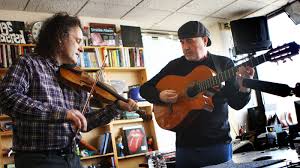
hayescahillEven though I have enjoyed much Irish music over the years, I was unfamiliar with Martin Hayes and Dennis Cahill.

The blurb says:

You’re about to watch one of the best fiddlers on the planet and a subtle guitar master work their magic. For too many of us, Irish music is something that merely gets trotted out around … St. Patrick’s Day and the coming of spring — and made a cliche by commercialism.

But for a moment, stop, put aside your notion of jigs and reels, and just listen. Martin Hayes plays his fiddle with an exquisite touch and tone, as well as a magnificent sense of melody and rhythm that never ceases to astonish.

Hayes has worked with many accompanying musicians, and some are equal partners, but with Dennis Cahill you get delicate support. It’s a rhythm that keeps the tune in; that accents and colors it but never overtakes it. It’s brilliant restraint that serves the music and perfectly suits his partner. So with fresh ears, come join us in a rare treat with a familiar sound.

And indeed, this is just beautiful fiddle playing and understated guitar work.  It’s a fantastic pair.

They play three pieces (some of which are actually made up of smaller independent pieces).

“The Mountain Lark/Tom Doherty’s Reel” I’m not sure when the first part ends, but I love as they get near the end of the piece—the fast bowing is just great.   Hayes gets some really amazing sounds.

As with many great Irish players, modesty is the key.  He talks about how he learned while watching his father and how he enjoys other players.  He talks about how traditional Irish music is not slavishly about the past, but it incorporates new elements into an old tradition.  As you can tell by the name of the second half of this next pair: “P. Joe’s Reel/The Barack Obama Reel.”

He also says that it’s good to see you get music breaks.  Music breaks should be part of all work—lunch break and music break.  The final piece is in fact a traditional piece called “O’Carolan’s Farewell To Music.”  It was originally written for harp by Turlough O’Carolan and is rumored to be the final piece that O’Carolan played before he died.  The transposition to fiddle and guitar is perfect.

[READ: February 8, 2016] Bad Babysitter

Babymouse continues to delight with the funny stories and amusing spoofs.

This story opens with Babymouse dreaming about “The Old Woman Who Live in a Shoe” (which is instantly transformed into a bunny slipper).  She wakes from her daydream about comics to see an ad for a Super Scooter, only $79.  There’s no way Babymouse’s mom will pay for this, so Babymouse better save up!

The next day at school one of her friends say that there’s a babysitting job available if Babymouse would like it.  Babymouse imagines herself as Mary Poppins until the dream kitten (who looks suspiciously like Felicia Furrypaws) complains about her whiskers.

Babymouse is set to babysit for Mrs Ladybug whose child (she swears) is a sweteahrt and only cries when he is hungry.  And, he should sleep the night. Ha!  He is up all night and, just like with her goldfish, Babymouse overfeeds the baby until it throws up all over her.  This job ends with her watching a zombie movie (called Babysitting Movie) and causing serious damage to the hosts’ house. (more…)

Read Full Post »

two-worse  SOUNDTRACK: CHEICK HAMALA DIABATEN-Tiny Desk Concert #285 (July 6, 2013).

hamalaNPR Music has been the sole source of my exposure to music from Mali.  I have really grown to like its slightly unusual patterns which are all based on a fairly standard rock structure.  But unlike some of the other Mali musicians I’ve been exposed to, Diabaten does not play guitar.  He plays banjo and the ngoni (but there is plenty of guitar in the song too).

The blurb tells us

Malian tradition lies at the heart and foot-stomping soul of Cheick Hamala Diabate and his band, but their melodies and undeniable rhythms cut across age and ethnicity. Diabate primarily plays the ngoni and the banjo; think of the ngoni as a great-grandfather to the banjo and it all makes sense, because both instruments share the ability to convey melody and plucked percussive rhythm.

Diabate is from Kita in Mali and born into a family of griots, or storytellers; his first cousin is the legendary kora player Toumani Diabate. Cheick Hamala Diabate makes his home these days in a Maryland suburb a few miles over the D.C. line, and his musicians are American-born and inspired by this lively lyrical music, which often tells a tale about Mali and its people as part of the sway and shake.

“Mali De Nou” sounds fairly traditional–with all of the percussion.  And then about a minute and half in a noisy scratchy guitar solo plays over all of the music–a very Mali sound.  But it’s interesting that, for the beginning anyhow, Diabate isn’t doing all that much.  In fact, the song feels almost overwhelmed by percussion (but in a good way). There’s a shaker or two, big floor drums (congas?) and a drum held between the knees and there’s even that big round gourd drum.

There’s also a sax and a bass, the lead guitar and of course, Cheick’s banjo.  By the middle of the song,  Chieck does some lead banjo playing.  And then it sounds like he’s put some effects on the banjo making it sound almost like a kettle drum—he even plays the strings below the bridge.  He really gets a lot of cool sounds out of the instrument

After this song he chats briefly and wants to “Invite you guys to visit Mali, it’s a beautiful country, you’ll be more happy.”

For “Talcamba” he switches to the ngoni.  He explains that the original ngoni had 4 strings, but his has 7 so he can play…more.  This instrument can play reggae, salsa, everything.  This is when he says the American banjo is like the grandson of ngoni.

Tacamba is a dance from north Mali—you can move your body (he waves his arms).  There are vocals but they are mostly a chanted refrain   The solo on the ngoni isn’t a conventional solo, it’s him flicking the strings making a very interesting sound.  I could have used more close-ups of this instrument as you could barely see the strings, and I’d love to see how he fit 7 on that small neck.  Half way through the song it shifts gears and the tempo really picks up—there’s a fast guitar solo with all that percussion keeping up.  And then the percussionist puts down her shaker and starts dancing in the center of the room.  It feels inspired and impromptu and it’s a lot of fun to watch.  While she’s doing that, Cheick picks up a hand drum and starts creating a new rhythm.  It is joyful and celebratory.

For the final song, “Djire Madje,” he switches to acoustic guitar which he plays lefty upside down (so the high notes are at the top).  He plays the lead riff.  At one point the electric guitar is also playing a lead but in a very different styles and they work very well together.

[READ: October 10, 2016] The Terrible Two Get Worse

I really enjoyed The Terrible Two, and this sequel is just as enjoyable.  The pranks are bigger, but the victim has changed.  Why?

Because Niles Sparks’ and Miles Murphy’s pranks got their principal fired!

Principal Barkin was the perfect guy to play a prank on–he had no sense of humor, he was pretty jerky and his face got really purple when he was upset.  But Principal Barkin is nothing compared to his father.  We met his father in the previous book–he yelled a lot, especially at Principal Barkin.  You see, the principal’s father was the previous principal, and he was a tough guy–he took no guff from anyone.

So after a delicious opening prank, Niles and Miles set about to making a great prank on Photo Day.  One of the great things about these books is the illustrations (by Kevin Cornell).  Sometimes the text incorporates the illustrations into the story. Like with Picture Day–the hilariously bad “pictures” absolutely make the sequence.  But it’s what they do to Principal Barkin’s son (who has paid the extra $10 for a gray background) is frankly genius.

But even better is what they have done to the whole school photo– a prank many months in the making.

(more…)

Read Full Post »

two SOUNDTRACK: MOHAMMAD REZA SHAJARIAN-Tiny Desk Concert #276 (May 20, 2013).

rejaI had never heard of Mohammad Reza Shajarian, but I see that he was voted one of NPR’s 50 Great Voices.

With the visit of the incredible, honey-voiced Mohammad Reza Shajarian from Iran, we lucked out by having him sing on not just any day, but on the biggest holiday of the Persian calendar: Nowruz, the New Year.

Shajarian is accompanied by brothers Sohrab and Tahmoures Pournazeri (celebrated musicians in their own right) and French percussionist Robin Vassy.

They play one song, an improvised piece called “Az Eshgh (Love Song).”  There is an upright, bowed instrument, the Kamancheh which plays the lead melody for much of the song.  The rest of the music comes from the Tar, one of the most important musical instruments in Iran and the Caucasus.  It has a rather tinny sound.

Meanwhile, the drummer has several different gourd drums.  He hits one with his fist and scratches the notches on the side.  Around three and a half minutes in, he starts blowing into this whistle-like object that makes a wind sound.  He also has two gourds that are floating in water.  He takes one out and we can hear the dripping.  He gets almost two minutes of a solo to play all of these sounds.  Its very cool.

Interestingly, even though this Tiny Desk is all about Shajarian, he doesn’t sing all that much.  But when he does, it’s quite powerful.  As the blurb says:

In the course of this love song, titled “Az Eshgh,” Shajarian unleashed torrents of swooping, soaring, goosebump-inducing sound — still perfectly controlled at age 73.

[READ: September 20, 2016] The Terrible Two

I love Mac Barnett.  He’s one of my favorite children’s authors.  I only know Jory John a little but I’ve enjoyed what I’ve read by him.  There are also fantastic illustrations by Kevin Cornell to make this book a delightful story about pranksters.

The book opens in Yawnee Valley, a quiet place where cows are the main thing.  Literally.  They are everywhere–and you hear them mooing all day and night (and throughout the book).  Miles Murphy (the dark haired boy on the cover) is moving to Yawnee Valley.  And he is not happy.  He has already sighed 100 times that day.  He hates the thought of leaving his friends and starting a new school.

Page twelve lays out an excellent summary of what it’s like to be a new kid in a school.  What kid are you going to be?  chess kid? basketball kid?  front-row kid? kid who’s allowed to see R-rated movies?  Kid whose family doesn’t own a TV and just wants to watch your TV?  And so many more options.  But Miles knows who he is.  He’s the prankster.

But when he gets to school (this is the first day of school), someone has moved the principal’s car to the front of the stairs–blocking the front door. Looks like Yawnee Valley Science and Letters Academy already has a prankster.

The principle is Principal Barkin.  He loves being principal of the school, as his father and his father and his father and his father had been.  There was one embarrassment in the family chain of command–the principal who actually closed the school during a blizzard, but otherwise, their record was sound–no closures.  And Barkin’s own son was poised to become the principal as well. After all, he had been elected president the past two years–just as had all of his ancestors–president and then principal–that’s the plan.

But this first day of school was not a good day for Principal Barkin.  And Chapter 6 lists the 40 things that happened as soon as he found out that his car was blocking the main entrance (none of them were good for him).

Principal Barkin suspects and questions everyone for being responsible for doing this prank.  And when he sees Miles–the only child he doesn’t recognize–he automatically assumes he is guilty.  Miles assures him that he didn’t do it.  Principal Barkin says okay but he will have his eyes on him.

Barkin then gives him a book called 1,346 Interesting Things You May or May Not Know About Cows.  He also gives Miles a buddy.  The buddy is named Niles.  He is dressed in a blazer with a sash that reads “school helper.”  The introduction goes like this: “Niles is the student who first told me abut my car.  Miles is the student who I suspect moved it.”

Niles is the most cheerful, obnoxious child Miles has every seen.  And he will not let up.  Niles introduces Miles to people (like Holly the girl who sits next to him).  He states the obvious.  And he tells Miles about Josh Barkin, the Principal’ son.  And boy is Josh a jerk.  Josh intentionally hits Miles in the face with his backpack as he walks by.

Niles says “while i don’t want to call anyone the worst, Josh is pretty mean sometimes…also he really likes the word nimbus for some reason.” (Josh calls everyone a nimbus as an insult).

Another kid who makes a lot of noise and is used mostly for comic effect is Stuart, Stuart talks in all caps and really really states the obvious.  Everyone hates him.

Miles is still pretty bummed about someone else being the school prankster.  But when Josh comes over in the cafeteria to give him a hard time, Miles deliberately dumps his food all over himself and then manages to blame Josh.  Josh says he didn’t do it, but Niles supports Miles.  When Miles asks why he would lie for him, Niles says that Josh made him swallow a rock over the summer–twice.

Miles gets home an has a kind of rough night.  So doe Principal Barkin whose father calls to yell at him for the embarrassment of his school day.  But while Bakin is beaten down, Miles is inspired.  And he comes out with his greatest prank ever.

The awesome birthday party of a boy he just made up, Cody Burr-Tyler.  The plan?  Make the party secret, tell only a few people and then watch everyone show up with presents.

It’s a great plan and it works.  And just as he is about to reap his rewards, Cody Burr-Tyler shows up and steals the show.  What just happened?

I don’t want to spoil who the prankster is.  He is impressed by Miles but sees some serious flaws.

Like the birthday party–did Miles really think he could fool the entire class and walk away with a bunch of presents and have people still like him?  He had to learn to be subtle.

And so the prankster offers to let him join forces to become a great pranking team.  But there is no way Miles is going to join forces with HIM.  So instead, Miles challenges him to a prank battle.

And the rest of the book is a series of escalating pranks.  The whipped cream one is outdistancing as is the diorama double cross (everything about the plan is genius–on both sides).

Can these two join forces to torment the person who most needs some comeuppance?  (Yes).  But what can they do that will really be a spectacular prank that people will talk about for years?

I was surprised and delighted by the final prank and I love the way they pulled it off.

I’m really looking forward to book two.


Read Full Post »

squish-7SOUNDTRACK: CANTUS-Tiny Desk Concert #264 (February 4, 2013).

Cantus is an a capella cantusgroup of nine men with beautiful voices.

The blurb tells that there are many choral groups all over Minnesota (I had no idea):

Is there some kind of weird vocal vortex in Minnesota? The state turns out so many excellent choral groups — at the school, church and professional levels — that it can arguably be dubbed the choral center of the U.S.

Cantus went professional in 2000 and has cut 15 albums on its own label. Unlike some choral groups who specialize in one style of music, Cantus prides itself on diversity. Just take a look at the three songs its members chose for this concert.

“Wanting Memories” is a song steeped in African-American culture, written by Ysaye Barnwell from Sweet Honey in the Rock. “Zikr,” composed by A.R. Rahman — the same guy who scored the hit movie Slumdog Millionaire — has roots in the Sufi tradition, where deep chords and repeated phrases signal a slow burn toward religious ecstasy. And the group closes with German composer Franz Biebl’s gorgeous “Ave Maria,” a signature piece for the group that blends traditional plainsong (or chant) with delicate melody and voluptuous harmonies that ascend heavenward.

I was really impressed with this set.  “Wanting Memories”was very pretty all the way through.  From what I can tell there are two “bass’ singers who hum the melody while the others sing different parts with various harmonies.  (There’s also a shaker keeping rhythm, but that doesn’t count against the acapella in my opinion).  In the middle of the song, the basses stop the humming and sing along (in a fugue style).  The absence of those droning sounds is a dramatic change in the song. They resume the hums and end the song like it began–beautifully.

“Zikr” has incredibly low bass notes–they are genuinely impressive.   There is an occasional drum that adds some Sufi authenticity–but the sound like they have been singing in this style their whole lives.  It’s really impressive that they are doing something that seems so unlike the Minnesotans that they are.  The end of the song speeds things up a bit which is a very cool sound added to a very cool song.

In introducing “Ave Maria” they explain that they started in 1995 with four guys.  They expanded to 7 so they could perform this piece.  This turns out not to be the traditional Ave Maria.  It is very different indeed–with a traditional Latin (not Latin America, but Roman Latin) feel.  And here again there is the amazing deep voice of the bass and some amazing tenors.

It’s amazing how different they sound in each of these three songs–their range is tremendous.  There’s a comment in the blurb about the beauty of the human voice and that is really the case here–their voices are pristine and beautiful.  It’s a marvelous Tiny Desk.

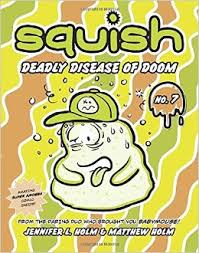
[READ: July 20, 2013] Squish #7

I love the Squish books.  They’re funny and quick and often teach you a thing or two.  I also love that most of the characters are named after real microbes.  And each issue also has a Super Amoeba comic book scattered throughout.

As this book opens, we see Small Pond, where Super Amoeba lives.  Something flies out of the sky and crashes into the pond.

As with every time Squish reads this book though, he is interrupted,  This time it’s to go to school.  His friend Pod is drowsy walking down the street.  He was up late working on his top-secret project.  Squish asks is he can help, and Pod says yes–give him Squish’s Twinkie.

At school the teacher is showing them about acids and bases. The kids are bored until he pours vinegar into baking soda and they all wake up.

The next day on the way to school, sneaky Squish takes a bite out of his Twinkie.  So that when he offers it to Pod, Pod refuses.

But when Squish gets to school, his stomach starts to gurgle and he turns green (literally). (more…)

Read Full Post »

squish-6SOUNDTRACK: ALLISON MILLER’S BOOM TIC BOOM-Tiny Desk Concert #223 (June 7, 2012).

boom I hadn’t heard of Miller–who is a drummer primarily in jazz circles.  Although the blurb says that she has also played live with Ani DiFranco so it’s very possible that I saw her play a decade or so ago.

But this band is all about the jazz.   The quartet has an upright bass, piano, sax and of course Miller’s drums and percussion.

And yet for a band which has her name in it, the drums and percussion are not very prominent.  This was a little disappointing as I wanted to hear some wild percussion, it also makes sense since she’s writing these tunes with melodies in mind.

They play three songs. “Big And Lovely” is primarily a sax song with a few moments of piano playing by itself.  The drums are certainly present but they don’t seem like the centerpiece of this song (and I gather they are not meant to).  It is fun to watch Miller play, though—jazz drummers really do seem to smile a lot more than rock drummers.  This was written for Miller’s friend, musician and activist Toshi Reagon.  During the end of the song—when it’s just bass and piano, Miller breaks out all kinds of bells and percussion which is neat.

“Spotswood Drive” is where a man named Walter Salb once lived; “he was a beloved and respected drummer, and by most accounts a larger-than-life character.  His 2006 Washington Post obituary ran with the headline ‘Drum Teacher Was Scurrilous, Rude — and Greatly Admired.'”  Salb was her drum teacher.  She says he was a “mentor and great guy… sometimes great guy.”  The blurb tells us that “Salb’s mentorship remains so important that Miller started a scholarship fund in his name, and recently dedicated a new tune to him — a searching, slow-burning meditation with lots of percussive coloring between the lines.”  It’s a slow song with lots of interesting percussion which sadly doesn’t really make it to the forefront in the song.  There are gongs and bells and other interesting things—its fun to see Miller scrambling around back there to grab different items.   A few minutes in, there’s a cool bass line (which I’d also like to be louder) that rides under the sax.

She introduces “The Itch” by saying “There’s a story behind this too, (laughter) it’s a little personal…”  Bob says you can stop there.  This was my favorite of the songs.  It opens with a Miller playing the floor tom—but the floor tom has all kinds of things on it—a cymbal, bells, a gong of some sort and she hits them all while keeping rhythm on the tom.  Then she gets to do some really snappy drumming—nice paradiddles and whatnot.  It was a little funny to watch the sax player just standing there watching her for the first minute and a half before joining in. After she gets a rhythm going the bass joins in.  The sax and keyboard lines are interesting and a little wonky sounding.  There’s some piano soloing and then a dissonant section with the sax and the keys playing off of each other.

Overall, this was an enjoyable set.

[READ: March 18, 2016] Squish #6

This book is about admitting to your fears.   Everybody in town wants to go see The Water Bear, a scary horror movie–with a great scary poster.  It’s all anyone can talk about.

When they finally get to the movie, I love that the first scare is a cat jumping out at you (classic horror movie trope).  But then everyone is terrified by the genuinely frightening Water Bear.  A footnote informs us that the Water Bear is entirely real.  Fortunately, it is also only 1 mm long (click if you dare)

The movie is super scary and Squish is terrified for days afterward. However, his friend Pod thought it was cool and Peggy thought the kitty was cute (Squish notes that it was cute until it got eaten). (more…)

Read Full Post »

bythewaySOUNDTRACK: KAYHAN KALHOR-Tiny Desk Concert #203 (March 24, 2012).

kayhanWhy not continue February’s Resistance with an Iranian performer?

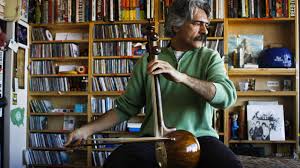
Kayhan Kalhor plays the kamencheh, a four-stringed fiddle-like instrument.  The piece he plays is a 12 minute improvisation.  It is otherworldly and unlike anything I’ve heard–although the blurb makes it sound like a fairly common instrument in his native country.  I don’t have much to say about the piece, so I’ll let the blurb do most of the talking:

For Persians, the New Year comes not in the dead of winter, but right at the vernal equinox. As spring renews the earth, people celebrate this fresh beginning as Nowruz, a joyous 12-day festival to celebrate beauty and abundance. We were lucky enough to have a master musician and composer from Iran, Kayhan Kalhor, visit us in time to celebrate with his gorgeous and deeply moving music.

As one of our interns observed during Kalhor’s mic check, Kalhor’s instrument does the dancing as he kneels with his legs folded beneath him. (This performance actually marks a Tiny Desk Concert first: having a musician perform on top of Bob Boilen’s desk, covered for the occasion by a rug, as Persian tradition dictates.) As Kalhor plays, his bowed, four-stringed kamencheh, a spiked fiddle, spins this way and that, swaying gracefully from side to side.

Before Kalhor played for us, I asked him what he was going to perform. He told me that it was to be an improvisation: “I don’t know yet where I’ll start, or where I’ll end up,” Kalhor said simply. That humble comment aside, Kalhor is a great master who embodies the core principles of this style of music: the ability to perform, entirely by heart, a huge amount of music composed over centuries — but then to take that tradition to new places through the art of improvisation. For us, he then proceeded to spin out a soulful, contemplative and beautifully moving improvisation in the mode of Nava.

The piece has been given the title: “Improvisation In Dastgah Nava.”

As the screen goes black, Kalhor asks: “Was this enough for you? I wanted to go on but I wasn’t sure how much time you had.”

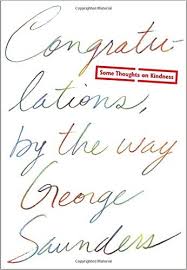
[READ: February 1, 2017] Congratulations, By the Way

Children’s books will commence shortly. But as hatred continues to spread in Washington, one more post on kindness.

Have you ever read George Saunders’ convocation speech at Syracuse University for the class of 2013?  It is stunning and moving and profound.  And yet at heart it is so simple–be kind.

This book, much like David Foster Wallace’s This is Water, is a padded-out book version of Saunders’ speech.  (With illustrations of stars by Chelsea Cardinal).  I am generally opposed to this sort of cash grab book ($14 list price for content that is freely available), but as with Wallace’s book, the speech is so great that any way it can get into people’s hands is a good thing.

There’s not much I can say about the speech, because it is all true and beautiful and doesn’t bear me summarizing.  But I wanted to compare the wisdom of this speech with our horrifying new President and his band of hate-spreaders.  As you read this and know it to be true, wonder what in the hell happened to the people currently running our country that they have fallen so far from the common decency of this speech.

I was thinking how we are taught as children not to lie (Trump lies daily, egregiously) to study hard (Trump is unqualified and none of his cabinet picks are qualified–half of them are downright simpletons), to be kind and obey the golden rule (Trump is literally harming / hurting / damaging / ostracizing / potentially killing people every day with his executive orders).  How did a wicked liar actually win?  Why aren’t the good guys coming to take him out?  I am prepared to RESIST, but it get harder every day with every evil thing he and his minions do.  And watching our spineless elected officials (on both sides, but especially Democrats who were pushed around for eight years) cave to this dictator’s dreams is the most disheartening thing I have ever experienced.

And so, it takes someone liked George Saunders to lift you up.  To believe that somehow this will all be made right.  And to espouse try to kindness where you can.  Because it sure isn’t coming from anyone elected.

The full content of the speech is below.  Read it all, it’s worth it.  Share it with everyone.

(more…)

Read Full Post »

slowreadSOUNDTRACK: DIRTY THREE-Tiny Desk Concert #245 (October 15, 2012).

dirty-3For a Murakami collection I should really have picked a jazz Tiny Desk Concert.  But none jumped out at my on my list.  So I decided to do something that might be jazzy in spirit, even if it is nothing like jazz at all.

Dirty Three are a three-piece band which consists of violinist Warren Ellis (who works closely with Nick Cave), drummer Jim White (who I had the pleasure of seeing live with Xylouris White), and guitarist Mick Turner (who has released a string of gorgeous instrumental solo albums and worked a lot with Will Oldham).

I’ve liked Dirty Three for years, although I kind of lost touch with them back around 2000.  So it was fun to see that they are still working.  (They’ve released all of 3 albums since 2000).

Jim White plays an eccentric but very cool style of drum–it always feels improvised and random, and maybe it is, but it’s never “wrong.”  Turner is the only one who is keeping the song, shall we say, “stable.”  He’s got the rhythm and melody both with his strumming.  And Ellis is all over the place with melody lines and bowing.

For this Tiny Desk, they play three songs.  Their music is ostensibly instrumental although Warren Ellis is not above shouting and yelling and keening when appropriate.

The first two songs are from their 2012 album and the last one is from Ocean Songs.

“Rain Song” opens with Ellis strumming the violin while Turner plays slightly different chords.  Then Ellis takes off on a series of spiralling violin rolls.  As always, White is back there waving his arms around with the loosest grip on drumsticks I’ve ever seen.  He plays brushes on this song but the drums are far from quiet.  Meanwhile Ellis is soloing away, yelling where appropriate and doing high kicks when White hits the cymbals.   As the song comes to an end, White is going nuts on the drums and Ellis takes off his jacket (revealing a wonderful purple shirt) .  He starts screaming wildly as he physically gets into his violin playing.

“The Pier” is about realizing that it’s the rest of the world that is driving you crazy.  It’s about “trying to undermine Facebook and realize a new way of communicating with people beyond the internet.”  It’ about… are you ready Mick?  Okay.  “The Pier” is a slower song with some plucked violin.  Ellis climbs up on the desk and dances around as he plays.  This one feels a but more controlled but in no way staid.

For “Last Horse in the Sand,” white switches to mallets and adds a tambourine to his cymbal.  It’s really interesting to watch White play around with things–moving his gear around as he plays.  He switches sticks and seems to be not even paying attention, but without ever really losing momentum or timing.  For this song, Ellis and Turner are the mellow ones while White is just all over the place with his amazing drumming.

I haven’t said anything about Turner because he is really the grounding of the band, while the other two are taking flights of fancy.

This is a wild and untamed set and it’s a lot of fun.  It’s also amusing to watch the audience witnessing this seeming chaos.

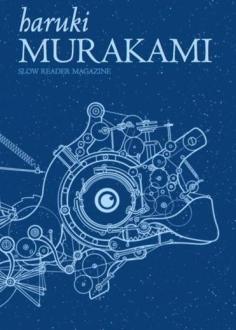
[READ: December 16, 2016] Slow Reader Vol. 1

Madras Press had released 16 small books, which I enjoyed reading quite a lot.  I have posted about some and will post about more in the new year.  But word is that they have given up on the small books and have switched their attention to a new magazine/journal called Slow Reader.  The first issue came out this month and it collects stories, essays, poems, illustrations, and other things that center around novelist Haruki Murakami.

Support this small press!  You can order this issue directly (and name your price, although I think the asking price is $6).

From an article elsewhere I’ve learned that future issues will cluster around M.F.K. Fisher, Kazuo Ishiguro, and Patricia Highsmith.

This issue contains essays, fiction and illustrations, some dating back as far as 2000.

CHIP KIDD-cover illustration (wind-up bird)
Chip Kidd is awesome

GRANT SNIDER-Murakami Bingo Board
This bingo is hilariously apt–covering most of the bases of Murakami’s writing: cats, jazz, running, and even a Chip Kidd cover.

JESSE BALL-Sheep Man
A line drawing of a sheep standing upright with the caption “The sheep man’s peculiar tail was never visible to me.”

HARRIET LEE-MERRION-Diner illustration
A nice line drawing of a corner diner

KAREN MURPHY-Sputnik and two moon illustrations
Two simple drawings of Sputnik and two moons.

BEIDI GUO-Hard Boiled Wonderland and the End of the World map
A cool map of the locations of the novel.

DINA AVILA–Murakami Tasting Menu at Nodoguro in Portland, OR
I don’t really get if the menu items are related to the stories but it’s a neat idea that there are foods named after his works. But why are so many called IQ84?

EUGENIA BURCHI–IQ84 menus
A drawing of foods with what I think are character names (I haven’t read the novel yet).

FABIO VALESINI-train illustrations taken from the book trailer for Colorless Tsukuru Tazaki and His Years of Pilgrimage
No idea what the original context is, but it’s a neat, clean drawing of a train station.

JEFFREY BROWN-“In Conversation” What Jeffrey Brown Thinks About
The first piece is an amusing cartoon in which Brown scores a job at an indie bookstore by mentioning Murakami.  The little blurb says that it is an only slightly exaggerated account. There’s also a later picture by Brown of Murakami’s face posted on a bulletin board (with a lost cat flier), that’s really great.

DANIEL HANDLER-“I Love Murakami”
Handler begins his piece by apologizing to dozens of authors before saying that Murakami is our greatest living practitioner of fiction.  He mentions a few books but heaps a ton of praise on Wind Up Bird Chronicles and mentions his excitement at  finally getting Norwegian Wood in English (it had been untranslated for many years).  He wrote this essay in 2000.

YOKO OGAWA-“On Murakami’s “The Last Lawn of the Afternoon” [Translated from the Japanese by Stephen Snyder]
Ogawa writes about a house in her neighborhood which has a lawn that she finds unsettling–it’s perfectly manicured and a pale, cool shade of green.  She is reminded of the Murakami story in which a boy mows a woman’s lawn and she asks him an unexpected question.  Ogawa imagines a woman in that home asking the same kinds of questions.

ETGAR KERET-“What Do We Have in Our Pockets?”
This was inspired by Murakami’s story “On Seeing the 100% Perfect Girl One Beautiful April Morning.”  This story is about a man whose pockets are always bulging with unusual items.  People often say to him, “What the fuck do you have in your pockets?”  And his answer is that he carries things that he imagines the perfect woman needing–a stamp or a toothpick.  It is a wonderfully charming story.

RIVKA GALCHEN-“The Monkey Did It”
Of all of the items in this collection, this is  the only piece I’d read before.  I remembered parts of it (particularly the excerpts from “A Shinagawa Monkey,” and her talking about Colorless Tsukuru Tazaki.  I also recalled her saying that she liked his short stories better than his novels, but that she was perhaps wrong in thinking that.  The one thing I didn’t pick up on last time was that in the beginning of the essay she writes about Toricelli’s Trumpet or Gabriel’s Horn–an item with finite volume but infinite surface area.  She says this perfect describes Murakami’s work.  And I love that she ties it to translator Philip Gabriel who is a gentle and modest translator–perfect for the watery novel.

TESS GALLAGHER-“Murakami and Carver Meet at Sky House”
Before he had written any substantial works, Murakami translated Raymond Carver’s works into Japanese.  Ray was excited and bemused that Haruki and his wife Yoko would travel from Japan to meet with him.  This essay tells us that the following poem came about as Ray tried to imagine how his poems could possibly be appreciated in Japan.  Murakami told him how both the Japanese and American people of the 1980s were experiencing humiliation at being unable to make a decent living.  Gallagher says that if they were to meet today Ray would be awkward about Haruki’s stature.  But he would have loved knowing that Murakami had translated everything he had written.

RAYMOND CARVER-“The Projectile”
This poem is wonderful. It begins with Carver speaking about his meeting with Murakami and then flashing back to when he was 16 and was hit with an ice ball.  It was thrown from someone in the street through a small crack in the window of the car he was riding in–a chance in a million.

RICHARD POWERS-“The Global Distributed Self-Mirroring Subterranean Neurological Soul-Sharing Picture Show”
This is the most abstract and “intellectual” of the essays here.  It speaks of a team of neuroscientists discovering a lucky accident–that neurons in the brain fire when someone else makes a motion that we recognize.  Similarly, in Murakami–representation is the beginning of reality.  He speaks of the parallel narratives in Hard Boiled Wonderland.  He wonders at the universality of dreams and ideas in Murakami.  “But if his own stories are steeped in the endless weirdness hiding just inside everyday life, how then to account for Murakami’s astonishing popularity throughout the world?”

MARY MORRIS-“The Interpreter”
I loved this story.  An American business woman is giving a series of lectures in Japan.  She is assigned a translator who goes with her nearly everywhere.  She is a little annoyed that he is always there, but he is very respectful of her and only speaks when spoken to.  She assumes he is translating her speeches correctly, but during one, the audience laughs where there was nothing funny.  She doesn’t want to disrespect him, but she can’t imagine what he said to them.  In the next one, they are practically doubled over with laughter at what he says.  Finally she has to confront him about it.  He reveals astonishing insights into her personal life.  And the next day he is called away–just as she has begun to feel close to him.

In the author’s note, she says that the she was at an writer’s meeting in Princeton (where she teaches) and Murakami was there eating with them. He was by himself, and she talked to him because she was a fan of his work.  She relates a story of holding up a sign for him when he ran the New York City Marathon.  She says that the part about the translator and his family (which I didn’t mention) is from an actual translator she met in Japan.

AIMEE BENDER-“Spelunking with Murakami”
Bender speaks of trusting Murakami.  She says when the cat started speaking in one of his books, she began to mistrust him.  Nevertheless, she says, she loves a lot of writers but only trusts a few of them.  She’s not trusting Murakami’s honesty or his ability to make her smarter.  Rather, she trusts him like a man with a torch in a cave–someone who is willing to explore–and to be in front leading the way.

SUMANTH PRABHAKER-Editor’s Note
Prabhaker would like to ask the world’s philosophers why some things seem to happen to us in a random fashion.

Read Full Post »
« Newer Posts - Older Posts »