Feeds:
Posts
Comments

Archive for the ‘Aliens’ Category

SOUNDTRACK: SSINGSSING-Tiny Desk Concert #651(September 21, 2017).

I have never seen or heard anything quite like SsingSsing.

It’s easy to dismiss them as a novelty by looking at them, but their music is really compelling.  Their songs may be (as stated below), a regional folk style, but the music is really groovy and interesting–the bass is nicely prominent but never obtrusive, and the guitar plats a lot of different strumming techniques, bringing very different intonations to the music.

And then there’s the front trio who are totally infectious.

One look at (and listen to) the cross-dressing, Asian rock band SsingSsing and you would hardly think they’re singing music inspired by traditional Korean folk. But SsingSsing isn’t like any other band I’ve ever seen or heard.

The group sings a regional folk style called minyo and the gender bending look has to do with shamans not glamour. As singer Hee-moon Lee describes it, “In Korean traditional art, male shamans, called baksu, have the body of a male. But as mediums, they need more than a single sexual identity, because they’re channeling both male and female spirits. When I act a female character and sing, I have to overcome the fact of my being a male sorikkun (singer), and try my utmost to bring a more neutral, unisex feeling to the performance. It sounds silly, but I feel like going back to the sensibilities of my youth, when I liked Madonna, helps.”

They play three songs:

“Minyo Medley” opens with reggae guitars and the strangely infectious vocal of the female singer doing a nearly cartoon-high pitched” Oh” sound and the taller male singer (with the cute white bob and white lipstick) laughing and then stating “Oh,” as if surprised out of his laugh.  It’s weird and catchy and cool all at the same time.  The lead singer with the magenta curls sings traditional vocals and eventually the other two join him.  The middle of the song slows down to a quiet guitar motif and mellow singing from the lead singer.  The end of the song picks up speed with an almost ska feel as it rocks to an end.  Then there’s a little coda of that opening (and even more crazy laughter) as the song ends properly.

On “Nanbongga (Song of Beloveds)” the woman sings lead which opens with a slinky groove and all three gently dancing.  The two men alternate spoken words before the woman singing in a traditional female Asian style takes over.  By the middle of the song everyone is dancing with the men singing back up and the tall guy (I love that he is holding a clutch the whole time) saying what sounds like “caw.”

The final song, “Saseol Nanbongga (Narrative Song of Beloveds)” appears to be a variant on the middle song (although perhaps not, it is musically quite different).  However, the taller guy does a lot of very fast recitations in the verses with impressive delivery.  The backing vocals are really catchy and the lead singer is really into it. The song totally rocks by the end.

How bummed am I to have found out that they were at MusikFest this summer and I could have seen them?  Because this is a band that begs to be seen live.

I don’t know which singer is which, but here’s the band members: Hee-moon Lee (vocal), Da-hye Choo (vocal), Seung-tae Shin (vocal), Young-gyu Jang (bass guitar), Tae-won Lee (electric guitar), and Chul-hee Lee (drums).

[READ: June 25, 2016] Amulet: The Stonekeeper’s Curse

I read the Amulet series last year but for some reason never got around to posting about the books.  So, let’s get this series finished.

The Stonekeeper’s Curse opens pretty dark.  We head to a tower where guards have captured the creepy looking guy from book one (Emily could have killed him when he attacked them, but she spared his life).  Turns out this guy is the son of a faceless creature (in a scary mask).  The father says that his son has failed him again.  The son argues but the father’s mind is made up.

He will have one more chance to get the amulet and the girl and he will have help from an older looking creature named Luger.

Cut back to a colorful scene with a walking house (that happened in book one, too). Navin is “driving ” the house and is doing a pretty good job.  They are on their way to Kanalis to get medicine for their mother who was injured in the first book.

Kanalis has suffered a curse and most of the people in town are slowly turning into animals.  It may or may not be contagious.  As our heroes walks around, a fox-person is following them. But as soon as the creepy elf guy charges, the fox steps in.  Emily sees him and asks who is he.  He says he’s a bounty hunter.  Miskit says they don’t want to deal with his kind.  He ultimately relents and admits he’s not really a bounty hunter.  His name is Leon Redbeard and he offers to help them if they will help him too. (more…)

Read Full Post »

SOUNDTRACK: PENGUIN CAFE-Tiny Desk Concert #628 (June 16, 2017).

I recently found out about Penguin Cafe from a piece on All Songs Considered.  I learned that Penguin Cafe Orchestra was responsible for some cool/unusual classical/pop recordings back in he 1970s and 1980s.  And it’s likely that if you listened to NPR back then, you heard some of their music.:

The music of Penguin Cafe is like no other. Its origins date back to the early ’70s, within fever dreams Simon Jeffes had that were brought on by food poisoning. In those dreams he imagined a dispassionate world “where everyone lived in big concrete blocks and spent their lives looking into screens. In one room, there was a couple making love lovelessly. In another there was a musician sat at a vast array of equipment, but with headphones on, so there was no actual music in the room.” Eerily accurate.

But he also imagined a place, the Penguin Cafe, where folks could gather, for pleasure, cheer and music. He wanted to hear what that music would sound like, and so created the Penguin Cafe Orchestra. I was always a huge fan of that original music; listeners of NPR may have heard it often in-between news stories during the many years I directed All Things Considered.

But Penguin Cafe Orchestra is no more.

While Simon Jeffes died in 1997, his son Arthur has been creating new music infused with his father’s original inspiration. He calls his group, simply, Penguin Cafe. You can hear Brazilian sounds in the rhythms, classical and minimalism in the strings, Asia in its harmonium, African sounds in the kalimbas. But honestly, it’s none of these; it’s a universal dream state.

If you’re looking to explore further be sure the listen to Penguin Cafe’s recent album The Imperfect Sea, which nods to Kraftwerk, Simian Mobile Disco and Franz Schubert. It’s none of these.

The band has a lot of strings: Oli Langford (violin) Clementine Brown (violin) Vincent Greene (viola) Andy Waterworth (double bass).  There’s also a ukulele (Des Murphy) which you can’t hear too often, but it is notable on the final song.

“Wheels Within Wheels” is cover of a song by Simian Mobile Disco.  It is nearly five minutes long with slow, building strings and a simple melody that seems to be never ending as it remains the same while the backing chords change.  In addition to the strings, there’s a guy (Neil Codling) playing a dulcitone on top of the real piano (he’s holding his hand up by the end).  And the percussionist (Darren Berry) seems to have a wooden plank to play on.  He uses mallets on the wood to get quite a deep sound.  It’s a really fun piece.

“Protection” has a catchy piano motif (played by Arthur with outstretched arm on the dulcitone) in 7/8 time.  But everyone else plays in 4/4, so the motif changes every time.  After a few bars, it switches to the real piano and the strings are really lovely while that’s going on.  The ducitone player has switched to a large ukulele and the percussion consists of drums sticks on the piece of wood–fast clicking sounds.

“Ricercar” is an old renaissance Italian term.  At the beginning of a fugue you embed a theme that is expounded on later.  This song opens the album and few themes come back later in the album.  Jeffes plays a quiet melody on the dulcitone.  About half way through the song he opens the piano and seems to be dampening the strings with his hand while playing the notes.  The percussion includes a shaker and the mallets on the wood once again.  It’s upbeat and catchy and a lot of fun.

This is a really enjoyable show–classical music for people who like to have fun as well.  As far as the original band goes, if you’ve heard anything by Penguin Cafe Orchestra, it’s probably this piece: “Music for a Found Harmonium.”

[READ: June 24, 2016] Amulet: The Stonekeeper

I have really enjoyed Kibuishi’s Explorer collections, so it seemed sensible to try out his Amulet as well.  And what a great, interesting and unusual story it is.

Although I must admit I was pretty shocked by the fact that the main characters Emily and Navin are in a car accident in the prologue and their father is killed.  What a way to start!

After the death of their father, the family (Emily, Navin and their mom) move out to an old country estate to get some perspective on things.  As they begin to clean up the old house, they go into a room of inventions by their ancestor Silas Charnon.  The story is that Charnon went missing one day and was never heard from again. While Emily is looking over some books, a creepy ghost creatures hovers behind her.

Navin and Emily look around (they don’t see the ghost) and soon, Emily puts her hand on a hand-shaped plate and a necklace–an amulet–is revealed.  Emily puts it on and when Navin complains, she says he can wear it tomorrow.  But that night the amulet speaks to her.  It tells her to stay with her family and keep the safe–they are in danger. (more…)

Read Full Post »

SOUNDTRACK: THE ATTACCA QUARTET-Tiny Desk Concert #580 (November 18, 2016).

The Attacca Quartet are a fascinating group. The group consists of Amy Schroeder and Keiko Tokunaga (violins), Nathan Schram (viola) and Andrew Yee (cello).  And they play a huge variety of music (and really get into what they are playing).

The first two pieces are modern and a little wild, so I assumed that that was the kind of music they played.  But then they told us about a Haydn quartet that they loved as well.   The blurb says:

They revere the old school, having recently completed a performance cycle of all 68 string quartets by Joseph Haydn, the man who invented the genre. They also hunger for the new, exploring the music of three living composers each year in a project called Recently Added.

The composer of the first two pieces is John Adams, who I know a little because of the Kronos Quartet.  But I like the blurb’s comment:

One contemporary composer the group continues to champion is John Adams. The head-banging pulsations of “Toot Nipple” (titled after a character in an Annie Proulx story) contrast with the slippery and funky episodes in “Alligator Escalator.” Adams has said he imagined such a creature waddling up and down the floors of Macy’s department store. The two movements belong to John’s Book of Alleged Dances from 1994.

I love the beginning of “Toot Nipple” as the cello is sawing away furiously and then passing off that fast sawing to the viola.  The piece is only a minute and 13 seconds long.  The second piece plays with quiet squeaky sounds as the strings progress up and down the fretboard almost randomly.  When things settle down I enjoy watching how aggressively the cellist plays the heavy notes before returning to some smooth notes high up the fretboard.  The violins also show some really fast fingerwork near the end.  This piece is all of 4 and a half minutes long.

Haydn seems really traditional when compared to Adams, there’s still some intensity on his piece:

Next to Adams, Haydn sounds positively genteel, but you needn’t look far to find the composer’s own feisty side. Sunny skies suddenly turn threatening at the turn of a phrase — a trend in Haydn’s time known as Sturm und Drang, or “Storm and Stress” — when moods can swing wildly with impunity.

Of all of the 68 string quartets, this is their favorite part to play.  It is pretty with a lot of really fast fingerwork as well.  I’m most surprised by the note it ends on–it doesn’t go down a note as you might expect.

The concert ends with “Smoke Rings.”

Measured by the cello’s tick-tock pizzicato, the mood of Michael Ippolito’s Smoke Rings is languid, even a little trippy. Inspired by a 14th-century French song about a smoking society, the composer employs long, slow strokes and light bow pressure for a hazy texture. The music heats up dramatically midway through, only to drift back into the smoke.

While the blurb talks about the cello, I was more taken with the pizzicato violin that ends the piece.  But after listening as second time I see that the pizzicato passes around to different musicians, beginning with the cello and the moving from one violin to the next.  But it’s not all pizzicato, there is a an aggressive middle section with notes the gradually ascend and grow more rapid.  It’s when this section ends that the pizzicato violin comes in to bring us home.

[READ: May 6, 2016] Hilo: Book 1

Judd Winick is a cartoonist whom I have liked for a really long time.  He has done a bunch of really funny cartoons and a very serious graphic novel called Pedro and Me.

Winick (and Pedro) and Winick’s wife Pam were all on The Real World San Francsico.  I don’t believe that that has anything to do with Winick’s success as a cartoonist (how could it, really?), but it is fun to remember him from the show.

Anyhow, this story is outstanding.  Winick has an amazing sense of comic timing and pacing.  He uses repetitive jokes to excellent result here.  On top of that, the story is compelling, funny and bittersweet.  It’s a great start to what I hope is a long series. (more…)

Read Full Post »

SOUNDTRACK: THE WESTERLIES-Tiny Desk Concert #576 (November 2, 2016).

The Westerlies call themselves “an accidental brass quartet,” (two trumpets and two trombones).  I don’t know if a brass quartet has a “standard make up,” but having only two instruments seems to make for an unexpected sound–one that feels more like a marching band than a swing or big band, but which is clearly not playing marching band music.  “Trumpeters Riley Mulherkar and Zubin Hensler and trombonists Andy Clausen and Willem de Koch can blow hard — after all, this is a brass band — but the surprise comes in their soft tones and subtle phrasing.”

The band doesn’t only play standards either.  For this Tiny Desk, they play three originals:

Clausen provides two tunes, beginning with “New Berlin, New York,” which sports a snappy theme, standing out like a bright tie on a smart suit. A scurrying pattern of interlocking notes furnishes the underlying fabric.  [I really like the staccato trombone notes which are really fast and bouncy.  Mulherkar  gets a pretty cool solo in the middle of the piece, but it sounds best when the two trumpets play together.  And yet there is another moment later on where it’s just one trumpet and one trombone and it sounds very cool.  I love watching the trombone play all of those fast notes].

Hensler’s “Run On Down” evokes the calm beauty of Washington’s San Juan Islands, north of the band’s former home base. [I love that he can get a different sound out of his trumpet without seeming to do anything different in his playing style. The song opens with two lonely sounding trumpets.  Midway through Clausen plays a sound like a person talking or humming.  I didn’t know you could change the tone and sound of a trombone like that].

Clausen ‘s closing number, “Rue Des Rosiers,” conjures up the circus-like vibe of a Parisian street scene. A whimsical theme gradually coalesces from fragments and grows into a rollicking amusement. [He introduces the piece by saying it was “inspired by a crazy old man riding a tricycle down the street of Paris. It was a giant tricycle and was wearing a beautiful bejeweled vest and there were windmills and horns and was something straight out of the circus.”  And boy, does this ever evoke circus music with the opening bass notes and the screaming trumpet.  The song slows down before building up into a rollicking circus piece.  And when one trumpet and one trombone put a mute on the sound gets all the more wild.  The piece ends with a variation on the traditional circus music before concluding].

[READ: June 2, 2016] Copper

After enjoying Kabuishi’s Explorer series I saw this book by him.

Copper was his first “comic strip” creation.  The story follows a boy named Copper who is quiet adventuresome and his dog Fred who is practical–and tries to keep him out of trouble.

In the introduction, Kabuishi says that the first comic (called Rocket Pack Fantasy) reflected his inner life at the time.  This proved to be his first published comic.  It was pretty dark (and black and white).  In that first one, he imagines wearing a rocket pack and then dropping bombs on a city.

But after a few more strips, Copper became more optimistic and Fred was there to question that optimism.  Kabuishi also added color. (more…)

Read Full Post »

SOUNDTRACK: DAKHABRAKHA-“Kolyskova” NPR’S SOUTH X LULLABY (March 21, 2017).

I loved DakhaBrakha’s Tiny Desk Concert.  It was mesmerizing and beautiful.  And so the performers came to SXSW and did a lullaby.  And as the blurb says, they brought their “cello, keyboard, accordion – and tall, wool hats! — to the balcony of the Hilton Austin hotel.”

This lullaby of “Kolyskova” quiets things down a bit.  The song opens with simple keyboard notes.  One of the women sings, and when they reach the end of the verse, the male accordionist sings a falsetto that matches the women’s tone.  The woman on drums makes a strange sound–like a baby crying or animal yelping.

Then he winds up singing lead on the second verse in that falsetto with the women singing backing vocals.  Then the cello and drums kick in to build the sound.   The third verse is sung by the cellist as the keys play a pretty melody.

The song is upbeat with lots of bouncy vocals, even though the lyrics seem rather dark.  ‘The band only ever calls it “Lullaby.” It’s a quiet, contemplative song that the band says is a “connecting of several lullabies” with “philosophical lyrics that [say] we have time for everything — time to laugh and cry, time to live and die.’

I love at the very end as the song slows down to just the keyboardist singing because the drummer adds a very cool breathing as a kind of percussion accompaniment.  And then as the camera pulls back the two attack the keyboard making a cacophony of fun notes.  I bet they’re a lot of fun live.

[READ: June 2 2016] Explorer: The Hidden Doors

This is the third (and I assume final) in a series of graphic novel short stories edited by Kazu Kibuishi, the creator of Amulet.

I really enjoyed the first one a lot and was pretty excited to read the rest. As with the other two I was delighted by the authors involved and the quality of these stories.

The three books are not related to each other (aside from thematic) so it doesn’t matter what order you read them in.

This book revolves around the theme of “hidden doors.”  I like the way each author takes a concept that seems like it would be pretty standard and turns their stories into things that are very different indeed. (more…)

Read Full Post »

SOUNDTRACK:  NINA DIAZ & Y LA BAMBA’s LUZ ELENA MENDOZA-“January 9th” & “Living Room” NPR’S SOUTH X LULLABY (March 20, 2017).

I was intrigued by this pairing because Luz Elena Mendoza has a shirt buttoned up to her neck and, from the angle of the first song, it appears that she has her long sleeves down, while Nina Diaz (originally from Girlfriend in a Coma) is wearing a sleeveless T-shirt with tattoos showing up and down her arms.  They seem somewhat mismatched.  Until they sing.  (And also during the second song when it becomes obvious that Luz Elena’s arms are covered in tattoos as well).

The two have never played together, but after NPR Music paired them in the courtyard of St. David’s Episcopal Church for a late evening performance, we’re beginning to wonder why not. They’ve both played the Tiny Desk (Diaz twice, once with Girl In A Coma) and both navigate complex emotions and notions of identity in their music. Also, they just sing beautifully together, Mendoza’s yodel swirling in Diaz’s gritty croon.

Luz Elena’s song “Living Room” is first.  She plays guitar and sings. It’s a short song with Nina’s nice high harmonies over Luz Elena’s deeper voice.  The blurb also notes: Mendoza shares a brand-new song here, “Living Room.” When the two harmonize its confession — “I feel like I’ve been undressing all my thoughts in front of you” — it is, in tandem, starkly intimate and separate.

Nina Diaz’ song “January 9th” is a bit more fun (partially because I know it from her Tiny Desk Concert, but also because it’s a bit more upbeat).  I like Diaz’ singing quite a bit.  Mendoza’s backing vocals add nicely to the “bad one/sad one” part of the chorus.  The blurb adds: “It’s a bluesy ballad with a through line of ’60s pop, a tribute to her late grandmother, cooed and howled into a warm Austin evening.”

Future collaborations should be called for.

[READ: June 27, 2016] Explorer: The Lost Islands

This is the second in series of graphic novel short stories edited by Kazu Kibuishi, the creator of Amulet.

The three books are not related to each other (aside from thematic) so it doesn’t matter what order you read them in.

This first one is all about “lost islands.”  What was neat about this book was that since the premise of an island is so broad, the stories were all very different. (more…)

Read Full Post »

SOUNDTRACK: L.A. SALAMI-“Day To Day (For 6 Days A Week)” NPR’S SOUTH X LULLABY (March 17, 2017).

L.A. Salami’s full name is Lookman Adekunle Salami.  I really enjoyed Salami’s song “Going Mad As The Street Bins.”  His delivery is great and there were some rather unexpected chords.

For this performance of “Day to Day,” he is standing on the balcony of the Hilton Austin hotel overlooking the downtown skyline.

I usually try to pair kid-friendly songs with books, but there’s some curses in this song).

The music is basically the same for 7 minutes (although it does build by the end), which means you must focus on the lyrics. And they are pretty dark.  It talks about boredom on public transportation as well as gruesome deaths on the news.  There’s talk of mental health, like this section:

Went to work for the NHS –
Mental health, people depressed.
Met Joanne – Scared of living,
Afraid of dying, terrified of being.
Then met Paul, a schizophrenic,
Shaking limbs, paranoid fanatic –
Unwashed 10 days in a row –
So afraid almost paralytic.
I tell them that I do the same –
In certain moods, on certain days…
But despite the sane ways I can think
I could not do much to convince them…

But mostly I enjoy his delivery which has his slightly accented voice and charming mannerisms.  The first time I heard this I wasn’t as drawn to it as I was his other song, but each listen unveils something more to like about it.

[READ: June 1, 2016] Explorer: The Mystery Boxes

This is the first in a series of short graphic novel short stories edited by Kazu Kibuishi the creator of Amulet.

Sarah brought these home for the kids to read and they were sitting around our house for a while so I picked one up.  When I flipped through it and saw all the great authors in it I knew I had to read them.

The three books are not related to each other (aside from thematic) so it doesn’t matter what order you read them in.

This first one is all about “mystery boxes.” (more…)

Read Full Post »

 socks kronosSOUNDTRACK: KRONOS QUARTET-Tiny Desk Concert #322 (November 25, 2013).

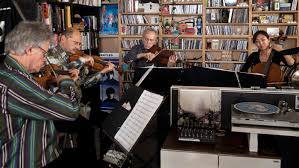
2013 was the 40th anniversary of Kronos Quartet.  I first heard of them about eight years after they started with their cool arrangement of “Purple Haze.”  And then I learned that they were like a sponge, soaking up and playing music from all over the world: In just one year they released albums with tango, songs by South African composers, Polish composers, jazz musicians and so much more.

I have many of their releases, although I realized I more or less stopped listening to new stuff from them around the turn of the century (since when they have released some 16 albums!).

Well, amazingly, the Quartet is still the same original players (except for the cellist–the cello is like Kronos’ drummer as they seem to replace her every couple of years).

They play three pieces here and the three range the gamut from dark and broody to rather sweet to quirky.  In other words, typical Kronos.

For more info:

The musicians —  David Harrington (violin) and longtime members John Sherba (violin) and Hank Dutt (viola) and new (as of 2013) cellist Sunny Yang — could reminisce over more than 800 new works and arrangements they’ve commissioned in 40 years. But instead, the new-music train pushes ever onward to new territories. They remain a living, breathing world-heritage site for music.

Now in the midst of its 40th-anniversary tour, Kronos brings to this Tiny Desk Concert a new arrangement, a work from a new album and, for Kronos, something of a chestnut, a piece the group recorded a whopping five years ago.

“”Aheym” (Yiddish for “homeward”) was written for Kronos by Bryce Dessner; a member of the Brooklyn rock band The National, he studied composition at Yale. The music thrives on nervous energy, pulsating with strumming and spiccato (bouncing the bow on strings) while building to a tremendous fever.”

I love this piece. It is intense and dramatic with its 4-3-3 bowing from all four members.  There’s an interesting cello melody with pizzicato strings from the rest.  The overall melody seems somewhat circular with different instruments taking on different leads.  But this song also plays with some interesting bowing techniques.  In addition to the spiccato (about 4 minutes in), the players drag the bow for momentary scraping and scratching sounds.

Another wonderfully dramatic moment comes at 7 minutes where each musician takes a turn bowing his or her note while the violin plays a super fast series of notes.  The song builds and build in dramatic until it gets to about nine and  half minutes and it reaches its powerful ending.

“Lullaby,” opens with plucked cello notes and strummed viola.  “It is a traditional song with Afro-Persian roots (from the group’s Eastern-flavored 2009 album Floodplain), [and] is woven from different cloth altogether. Colorful tones that lay between our Western pitches are threaded through the music, anchored by a gorgeous solo from violist Dutt; his contribution takes on the warm and weathered sound of a grandmother singing to a child.”  It is slow and moody and beautiful.

Harrington introduces the final piece by saying it’s by a performer that no one had heard of–including, until recently, even himself.

“Kronos caps off the concert with another hairpin turn, this time to a fresh arrangement of “Last Kind Words,” a little-known blues song from around 1930, recorded by singer and guitarist Geeshie Wiley. In Jacob Garchik’s exuberant arrangement (which Kronos premiered this fall), interlocking strums and plucks provide a kind of rhythm section, while Harrington’s violin stands in for the now-forgotten blues singer.”

There’s lots of plucked notes from everyone–including plucked bent note on the viola which gives it a real “early” guitar sound.  While I don’t know what Geeshie sounded like, so I can’t compare the violin to her vocal, the whole thing sounds great together.  In fact the whole thing is unlike any string quartet I’ve heard–so different and wonderful.

I’m going to have to bust out so Kronos CDs.

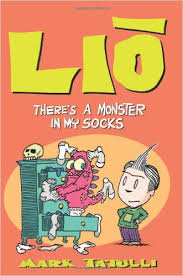
[READ: September 10, 2016] There’s a Monster in My Socks

I’ve been quite puzzled about the publication history of the Liō books.  And this just adds another layer of confusion.  This book covers the exact same time period as Happiness is a Squishy Cephalopod which was published in 2007.  The difference is that Cephalopod placed all of the strips in order, while this one seems to move things around quite a bit (the thinner format also means that it can’t quite handle the single panel strips very well.   But more egregious is that this volume (remember, the one printed after the previous one) prints the Sunday color strips in black and white.

The book also leaves some of the strips out.  It covers the date range from May 15, 2006 – Feb 16, 2007 (Cephaolopod went to May 23), but while it has the Feb 14 strip, it does not have the Feb 15 strip.  Weird.

So, basically this is an inferior version of the same book, but the publishers presumably wanted the books in this more friendly size (or some other nefarious reason).

I’ll include the review of Cephalopod below.

And, here’s the current list of existing Liō books. It’s a shame that there are years and years of strips thus far uncollected. (more…)

Read Full Post »

sardine6SOUNDTRACK0 Tonne Seize [CST bonus] (2016).

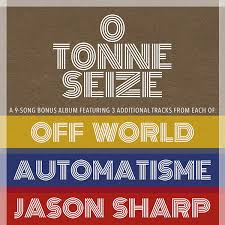
tonne0 Tonne Seize is a bonus compilation of three tracks each from Off World, Automatiste and Jason Sharp.  The collection is 41 minutes of music (not too shabby) and came with a pre-order of the three records (and is available on Soundcloud as well).

The first three songs are by Off World and the first two of those are remixes.  The original “Wonder Farm” is dominated by popping drum sounds.  There are some other sounds that go through the track but the base is mostly a kind of slow Asian melody.  The “Wonder Farm (Summer Crop)” mix removes those snaps and percussion entirely.  It focuses just on the music, which I have to say is far more enjoyable without the bangs.  “Primitive Streak” is a slow droning piece, while this compilation’s “Primitive Streak (Silver Mix)” doesn’t sound all that different.  It also removes the drums, and highlights the squeaky synth sounds and the overall drone tone.  It seems to emphasize and de-emphasize different instruments but otherwise sounds pretty similar. The final track  “Lost Meadow” is a pretty, delicate piano based piece with some twinkling of spacey synth notes.  It’s easily the prettiest piece.

The three Automatiste tracks do not quite follow the same naming convention as the actual disc, although the first track is called “Simultanéité 5.” It has slow beats and is basically two-note washes building on top of each other.  “Fragments continus” is a noisy piece with layered thudding drums (like heartbeats especially around the 1 minute mark) and drone noises that wash in and out.   About half way through what sounds like a melody appears amid the din, but it feels like it formed organically around the synths and drums which is pretty cool.   “Le Silence 3” opens with some jackhammer sounding drums and then almost easy listening synths.  The juxtaposition is interesting and by the end the song feels nicely dancey.

The final three songs are from Jason Sharp.  These three are quite different from his album because they really feature the saxophone to a larger degree.  “Plummeting Veins” opens with a heartbeat and some rumbling sax (that sounds like the opening of the Speed Racer TV show).   This track is under 2 minutes, the shortest he’s done by far, and the way the heartbeat speeds up as the sax plays some low rumbling notes is pretty cool. “Hear a Fading Cry” is a much longer number.  The heartbeat is quieter but the sax is much louder.  It sounds a lot like Colin Stetson in the low rumbling and noisy barking that the bass sax can produce.  It ends with some rather high-pitched squeaky sounds that I assume come from the sax, but which I can’t imagine coming from such a bass instrument.  It’s 7 minutes long although it takes almost 2 minutes to really get going.  And it swerves between loud and rumbling and then sort of menacing by the end,  “Ride On Into the Sweetening Dark” is perhaps the most conventional of Sharp’s songs.  It is a series of sax solo lines over a gentle tinkling backing drone.  Some of the solos lead to noisy wailing, but for the most part the line are pretty and jazzy.

It’s interesting how different these bonus tracks tend to be from the actual releases.  I enjoyed listening to these variants to see what else these artists are capable of.

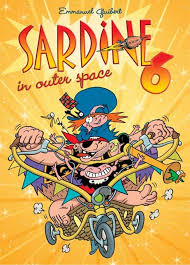
[READ: April 9, 2016] Sardine in Outer Space 6

Sardine is a children’s book published by First Second.  It was originally published in France (and in French) and was translated by Sasha Watson.  There are six Sardine books out.

The inner flap says “No Grownups Allowed (Unless they’re pirates or space adventurers).”  This is the final Sardine book.  And while I didn’t enjoy the first book much, by now I’m sorry to see the series end.

This book also has the fewest stories in it (only 9). (more…)

Read Full Post »

sardine5SOUNDTRACK: JASON SHARP-A Boat Upon Its Blood [CST119] (2016).

Layout 1Constellation records had been rather quiet this year in terms of new releases.  And then back in August they announced three new discs with this intriguing blurb:

Constellation’s three new fall releases by Off World, Automatisme and Jason Sharp are dropping on September 30th…  These new releases are wildly different yet satisfyingly leftfield albums that share an electric thread of sorts.  Electronic music strategies, technologies, histories and sensibilities come into play, in very diverse ways, with each of these debut records – making them stand out a little differently in the context of the Constellation catalogue perhaps, but also informing one another and making a lot of sense to our ears as an album trio (somewhat in the spirit of our Musique Fragile series).

This is the third of those three.

Jason Sharp has written this disc as “music written for amplified heart & breath,” and Sharp is credited with “playing” amplified heart, feedback, synthesizers and bass saxophone.  Other instruments listed are Pedal Steel Guitar, Violin and various percussive instruments.

From the Constellation site: “Using custom-built equipment to translate breath and heart rate into variegated sonic triggers, along with other modes of signal processing and in tandem with traditional instrumentation…[the album] deploys the human metronome of amplified pulse as a recurring undercurrent, with compositions that incorporate electro-acoustic and musique concrète strategies, drone, noise, electronics, methodical dissonance, tone poem, layered rhythmic and melodic figures, and improvisation.”

The disc opens with a trio of songs: “A Boat Upon Its Blood Pt.s 1, 2 & 3”  Part 1 begins with some quiet drones and pulses and what sounds (if you think about it) like water running through pipes or blood through veins.  It also like plectrum hitting strings or a musical rain stick.  The songs build in intensity until a pulse that sounds a lot like a heart beat (which it should) ends the track. This heart beat segues into Part 2 which is dominated by violins.  The violins seem to alternate between drones and dissonance with the pulses seeming to beat a bit faster in parts.  As this track ends, a martial beat takes over the drums, and that segues into Part 3 which has more drone sounds.   About midway through, new percussive sounds come in, changing the tone of the piece entirely.

Track 4 is “In the construction of the chest, there is a heart” is the most interesting of the bunch.  It has what I assume are several different heart beat sounds modified to create different percussion under various droning sounds. It really exemplifies the “heartbeat” aspect of the piece, which I thought would be more prominent in the disc overall.  The second half of the song is full of swishes and scratchy sounds which I certainly hope are the sounds of his blood pulsing through his veins.

“A blast at best” is a noise piece which sounds almost like the heart beats have been put through an autotune.  Midway through the song comes the bass sax playing some farting and pulsing sounds that add an interesting  melody to the sloshy noises.

Tracks 6 and 7 are another multi-part song “Still I sit
with you inside me Parts 1 and 2.”  Part 1 opens with a much more pleasant, albeit somber violin.  Slowly the heartbeats grow louder and more prominent.  The pulses increase and decrease although not necessarily with the intensity of the music.  The violins swirl and ebb, growing louder and more intense and then fading and seguing into the last track which opens with pretty guitars and accompanying violin.  About halfway through the song, the heartbeat resumes.  It come pulsing into the song louder and louder, dominating the whole thing.  And then with a few seconds left it builds a wall of feedback and noise that gives way to a cathartic echo.

This would be another string candidate for NPR’s Echoes.  Have you heard this, John Diliberto?

The disc notes that the piece was inspired by the Robert Creeley poem, “The Heart,” which I have included at the end of the post.

[READ: April 9, 2016] Sardine in Outer Space 5

Sardine is a children’s book published by First Second.  It was originally published in France (and in French) and was translated by Sasha Watson.  There are six Sardine books out.

The inner flap says “No Grownups Allowed (Unless they’re pirates or space adventurers).”  For the first time, Sardine was created without the help of Joann Sfar.  And I found this one to be my favorite one yet!

It seems like Sardine has really hits its stride with Book 5.  The author is having a ton of fun playing around with pop culture and with the idea that the characters know that there are books about them. It’s still a little weird that Supermuscleman is really the only bad guy and that he is always coincidentally where they show up, but that’s clearly not the point of the comic, right? (more…)

Read Full Post »

« Newer Posts - Older Posts »