Feeds:
Posts
Comments

Archive for the ‘Adventure’ Category

  SOUNDTRACK: DANA FALCONBERRY-Tiny Desk Concert #292 (July 29, 2013).

This Tiny Desk Concert introduced me to Dana Falconberry:

Dana Falconberry’s songs are gentle, almost invariably delicate, sometimes mysterious and frequently feather-light. But her music’s sweet, intricate softness never stands in for strength: This is a confident songwriter, whether she’s ambling through six- and seven-minute epics (“Leelanau,” “Dolomite”) or chirping sweetly in the bouncy “Crooked River.”

The compositions on Falconberry’s most recent album, last year’s Leelanau, are sturdy enough to be stripped down for a space like Bob Boilen’s desk at the NPR Music offices. But each benefits immeasurably from the broad assortment of lovely flourishes she re-creates here with the help of five instrument-swapping backing players. What makes Falconberry stand out in a crowded field of singer-songwriters is her music’s unfailing impeccability, and this Tiny Desk Concert finds her and her crack band hitting every immaculately crafted mark.

I tend to agree with the blurbs, but this one really is spot on: delicate, impeccable, sturdy.  These are words I would absolutely use to describe these songs.  I would also use fantastical–not suggesting that there might be fairies floating around during these songs, but it wouldn’t surprise me if one made an appearance.

“Dolomite” is a beautiful 7 minute song with many different sections.  Falconberry’s delicate (but not wimpy, it must be said) voice works perfectly with the capoed guitar she’s playing.  After the first verse, she’s joined by a cello, banjo and backing vocals, and the song builds.  Then after almost 2 minutes the bass and drums jump in and the song, while staying basically the same, gets a whole new feel (the bassline is staccato and unexpected while everything else is so smooth).  At around 3 and a half minutes the keyboards start adding these pretty little runs that make the song seem even more magical.  The middle of the song has the three female singers rotating through a  series of oohs and ahs as they make a cool-sounding fugue.

For “Crooked River,” the bassist switches to melodica.  Once again there’s a great sequence where each of the female singers sings one note in a very complex melody–it’s quite enchanting.  The cello is plucked giving the whole song a very different feel from the first.

Before the final song Bob asks if she has had any desk jobs.  She says she has had her fair share.  “I currently have a desk job…I hope. We’ll see when I get home.”

For Leelanau, the keyboardist switches to accordion, and there is prominent banjo and delicate melodica.  The verse is really quite catchy, and after the verse there is a gently rocking section where everyone joins together–it bursts forth in contrast to the rest.  It is repeated a few times throughout the song, and each one is more fun than the previous.  The middle has a kind of slow break down with the cello scratching and the melodica and accordion sounding like they are running out of breath.  Dana even hit’s Bob’s gong.  The accordion is even “breathing” without making a musical note.  The song returns to that super catchy verse and jam section and just as you think its going to fade to an end, there’s very cool chime that echoes and then a huge buildup to the conclusion.

I was so entranced by Falconberry’s music that I need to hear more of it.

[READ: September 19, 2016] Bandette 2

Two years ago I wrote about Bandette Volume 1: “The book was very exciting and sweetly charming as well.  I’m looking forward to Volume 2.”  And I waited and waited for it to come out.  I even saw Vol 1 the other day and wondered when we’d get volume 2.  Well, apparently this has been out since 2015, but the library just acquired it.  So I’m happy to say it’s not my fault it took two years for me to get around to reading it.

Even though I didn’t exactly remember how book 1 had ended, Tobin & Coover added a helpful “Previously” section to get us caught up.

The wit and charm of the first book is back in spades. Bandette continues to be seemingly immune to the world around her–she says what she wants and does what she wants and no resistance will get in her way–whether it is verbal sparring or her uncanny gravity-defying stunts.  Her love of chocolate remains as well, of course.  And the tone retains that agelessness.  It feels like this book could have been written in the 1950s but for the cell phones and scooters.

Chapter One reminds us that Bandette is a civilizan as well  She has dark hair and a love of pastries–she even gives the bakery owner priceless urn (from where) as payment for the delicious sweets. (more…)

Read Full Post »

agathaSOUNDTRACK: VALERIE JUNE-Tiny Desk Concert #310 (October 12, 2013).

I enjoyed Valerie June’s —I found her voice to be unusual but enjoyable.   But I find her sound here to be kind of flat and disappointing.  Her guitar choice feels too quiet or something and her voice sounds too tinny—almost childlike.  I have a love hate relationship with singers with this kind of voice, and I’m afraid she comes down on the bad side.

But maybe it was something with the location, because the blurb says I’m wrong.

Valerie June is a singular performer with an array of singing styles. Sometimes she’s channeling an old male voice; at other times, she channels a younger woman or even a child. Her music is steeped in tradition. The striking Tennessee singer — on its own, her hair could pass for sculpture — can sing the blues or gospel or country or a blend that sounds like nothing else. She learned how to sing during 18 years of church, but the “old man’s voice” comes from deep inside in unexpected ways. Prepare to be surprised, and to become Valerie June’s newest fan.

During “Workin’ Woman Blues” I couldn’t get the melody of Steely Dan’s Do It Again out my head.  It’s something about her vocal delivery–although clearly the music is very different.  It’s unusual that the first line of “Rain Dance” is the same as Bad Company’s “Feel Like Making Love”—intentional I’m sure.  And the way she sings the lyrics very differently than the original also unexpected.  But the whole presentation of her voice and guitar sounds like an old timey black and white cartoon–Popeye or the like.

She’s very chatty before the final song.  She talks about love and then says there’s a lot of cute babies here today.  This is my cute baby: a tiny banjo made in Memphis.  It is a very tiny banjo.

Of the three, “Somebody To Love” is my favorite song, although she does get a little crazy on the chorus.  I’m most intrigued by the electric foot pedal that appears to simply be an electronic drum stomping thing.

[READ: August 15, 2016] Agatha

In high school I had to read And Then There Were None.  I really liked it, but I never read anything else by Agatha Christie.  I’m a snob who doesn’t read mysteries, true.

But I’ve always been intrigued by Christie.  So I was thrilled that I found this graphic novel biography at work.

As many of these graphic novels tend to be, this one was French and recently translated to English (by Edward Gauvin).  I was fairly certain that I had seen the work of the artist in a previous comic, but Alexandre Franc is new to me.  As are the writers Anne Martinetti and Guillaume Lebeau.

This is a great biography–it is told with flair and excitement and throws in a lot of details about the creation of her most famous novels (without spoiling any of them). And, in a very clever conceit she “talks” to Hercule Poirot throughout the book–allowing her to narrate things without it seeming strange or flat.  And, even better, Poirot is a jerk to her–perpetually jealous and unhappy with her.  It’s a great technique. (more…)

Read Full Post »


SOUNDTRACK
: BATHS-Tiny Desk Concert 300 (September 4, 2013).

I was unfamiliar with Baths and I am impressed by their busy-ness in this set.  There are only two guys playing, both play with various computer gadgets and then switch to keyboards and guitars.  They layer more and more music on this fairly dancey and very electronic sound.

Baths, a.k.a. Will Wiesenfeld, plays mysterious and textured electronic music. When Wiesenfeld came to the Tiny Desk, I expected contemplative tones and a laid-back performance; he does, after all, call his project Baths. But what sets him apart from the vast majority of like-minded performers is that his music doesn’t get buried behind the buttons or lost in a hypnotic glaze.

Wiesenfeld is an extrovert live, and at the Tiny Desk, he sounds vibrant and compelling as he performs songs from this year’s Obsidian. His partner Morgan Greenwood, an accomplished music-maker in his own right, keeps the music dense but frees up Wiesenfeld to sing with few distractions; there’s a mind-meld between the two that’s undeniable. They’re not accustomed to playing in the light of day, but they enchant in this perfect introduction to their work.

Wisenfeld’s vocals are a lot of wordless sounds (ba ba ba, na na na) that get looped and mixed around.  He sings in a rather high register, especially when making the looped sounds.

“Miasma Sky” builds with layers upon layers of sounds and vocals.  The sounds are manipulated in great ways with those little knobs and sliders. And just as you think it’s going to end with a series of delicate synth and guitar notes, he begins looping them which create the building blocks for the rest of the song.   It’s primarily keyboards and glitchy drums until the end.

“Phaedra” begins with some heavy drums and them playing around with all their gadgets.  This is a fast, pumping, dancing song.  Greenwood sings backing vocals in an equally high register.

“Ocean Death” has deep thumping drums and an opening with lots of na na nas and la la las in a textually rich soundscape.  It all fades down o just drums before building back up again.

[READ: July 9, 2016] Ruins

Seven years ago I read a book called Diario de Oaxaca, a sketchbook by Peter Kuper that I really enjoyed.  When I grabbed this book of the shelf the other day I didn’t realize it was the same guy.  But I can see that that sketchbook informed this excellent graphic novel.

The Diario covered his two-year stay in Oaxaca where he drew a lot, studied insects (and saw the monarch butterflies) and experienced both chaos and contentment.

This fictionalized account of the story places two characters into a situation that sounds similar to what he experienced, but with enough difference to keep it purely fictional. (more…)

Read Full Post »

SOUNDTRACK: THE ATTACCA QUARTET-Tiny Desk Concert #580 (November 18, 2016).

The Attacca Quartet are a fascinating group. The group consists of Amy Schroeder and Keiko Tokunaga (violins), Nathan Schram (viola) and Andrew Yee (cello).  And they play a huge variety of music (and really get into what they are playing).

The first two pieces are modern and a little wild, so I assumed that that was the kind of music they played.  But then they told us about a Haydn quartet that they loved as well.   The blurb says:

They revere the old school, having recently completed a performance cycle of all 68 string quartets by Joseph Haydn, the man who invented the genre. They also hunger for the new, exploring the music of three living composers each year in a project called Recently Added.

The composer of the first two pieces is John Adams, who I know a little because of the Kronos Quartet.  But I like the blurb’s comment:

One contemporary composer the group continues to champion is John Adams. The head-banging pulsations of “Toot Nipple” (titled after a character in an Annie Proulx story) contrast with the slippery and funky episodes in “Alligator Escalator.” Adams has said he imagined such a creature waddling up and down the floors of Macy’s department store. The two movements belong to John’s Book of Alleged Dances from 1994.

I love the beginning of “Toot Nipple” as the cello is sawing away furiously and then passing off that fast sawing to the viola.  The piece is only a minute and 13 seconds long.  The second piece plays with quiet squeaky sounds as the strings progress up and down the fretboard almost randomly.  When things settle down I enjoy watching how aggressively the cellist plays the heavy notes before returning to some smooth notes high up the fretboard.  The violins also show some really fast fingerwork near the end.  This piece is all of 4 and a half minutes long.

Haydn seems really traditional when compared to Adams, there’s still some intensity on his piece:

Next to Adams, Haydn sounds positively genteel, but you needn’t look far to find the composer’s own feisty side. Sunny skies suddenly turn threatening at the turn of a phrase — a trend in Haydn’s time known as Sturm und Drang, or “Storm and Stress” — when moods can swing wildly with impunity.

Of all of the 68 string quartets, this is their favorite part to play.  It is pretty with a lot of really fast fingerwork as well.  I’m most surprised by the note it ends on–it doesn’t go down a note as you might expect.

The concert ends with “Smoke Rings.”

Measured by the cello’s tick-tock pizzicato, the mood of Michael Ippolito’s Smoke Rings is languid, even a little trippy. Inspired by a 14th-century French song about a smoking society, the composer employs long, slow strokes and light bow pressure for a hazy texture. The music heats up dramatically midway through, only to drift back into the smoke.

While the blurb talks about the cello, I was more taken with the pizzicato violin that ends the piece.  But after listening as second time I see that the pizzicato passes around to different musicians, beginning with the cello and the moving from one violin to the next.  But it’s not all pizzicato, there is a an aggressive middle section with notes the gradually ascend and grow more rapid.  It’s when this section ends that the pizzicato violin comes in to bring us home.

[READ: May 6, 2016] Hilo: Book 1

Judd Winick is a cartoonist whom I have liked for a really long time.  He has done a bunch of really funny cartoons and a very serious graphic novel called Pedro and Me.

Winick (and Pedro) and Winick’s wife Pam were all on The Real World San Francsico.  I don’t believe that that has anything to do with Winick’s success as a cartoonist (how could it, really?), but it is fun to remember him from the show.

Anyhow, this story is outstanding.  Winick has an amazing sense of comic timing and pacing.  He uses repetitive jokes to excellent result here.  On top of that, the story is compelling, funny and bittersweet.  It’s a great start to what I hope is a long series. (more…)

Read Full Post »

SOUNDTRACK: THE WESTERLIES-Tiny Desk Concert #576 (November 2, 2016).

The Westerlies call themselves “an accidental brass quartet,” (two trumpets and two trombones).  I don’t know if a brass quartet has a “standard make up,” but having only two instruments seems to make for an unexpected sound–one that feels more like a marching band than a swing or big band, but which is clearly not playing marching band music.  “Trumpeters Riley Mulherkar and Zubin Hensler and trombonists Andy Clausen and Willem de Koch can blow hard — after all, this is a brass band — but the surprise comes in their soft tones and subtle phrasing.”

The band doesn’t only play standards either.  For this Tiny Desk, they play three originals:

Clausen provides two tunes, beginning with “New Berlin, New York,” which sports a snappy theme, standing out like a bright tie on a smart suit. A scurrying pattern of interlocking notes furnishes the underlying fabric.  [I really like the staccato trombone notes which are really fast and bouncy.  Mulherkar  gets a pretty cool solo in the middle of the piece, but it sounds best when the two trumpets play together.  And yet there is another moment later on where it’s just one trumpet and one trombone and it sounds very cool.  I love watching the trombone play all of those fast notes].

Hensler’s “Run On Down” evokes the calm beauty of Washington’s San Juan Islands, north of the band’s former home base. [I love that he can get a different sound out of his trumpet without seeming to do anything different in his playing style. The song opens with two lonely sounding trumpets.  Midway through Clausen plays a sound like a person talking or humming.  I didn’t know you could change the tone and sound of a trombone like that].

Clausen ‘s closing number, “Rue Des Rosiers,” conjures up the circus-like vibe of a Parisian street scene. A whimsical theme gradually coalesces from fragments and grows into a rollicking amusement. [He introduces the piece by saying it was “inspired by a crazy old man riding a tricycle down the street of Paris. It was a giant tricycle and was wearing a beautiful bejeweled vest and there were windmills and horns and was something straight out of the circus.”  And boy, does this ever evoke circus music with the opening bass notes and the screaming trumpet.  The song slows down before building up into a rollicking circus piece.  And when one trumpet and one trombone put a mute on the sound gets all the more wild.  The piece ends with a variation on the traditional circus music before concluding].

[READ: June 2, 2016] Copper

After enjoying Kabuishi’s Explorer series I saw this book by him.

Copper was his first “comic strip” creation.  The story follows a boy named Copper who is quiet adventuresome and his dog Fred who is practical–and tries to keep him out of trouble.

In the introduction, Kabuishi says that the first comic (called Rocket Pack Fantasy) reflected his inner life at the time.  This proved to be his first published comic.  It was pretty dark (and black and white).  In that first one, he imagines wearing a rocket pack and then dropping bombs on a city.

But after a few more strips, Copper became more optimistic and Fred was there to question that optimism.  Kabuishi also added color. (more…)

Read Full Post »

SOUNDTRACK: GUARDS-Tiny Desk Concert #290 (July 29, 2013).

Guards play a simple, almost naïve, kind of pop music.  I’d almost call it bubblegum.  Particularly in the lyrics: “I wanna build a happy home a home for you and me…I wanna live for ever I don’t care.”

The blurb explains:

Guards’ music captures the pop sound of the late ’50s and early ’60s, but with more power and polish. It’s hard not to hear a bit of Buddy Holly’s melody and spirit — think 1958’s “Rave On” — when you hear Guards play “Silver Lining,” the first song in this Tiny Desk Concert.

I also found this factoid interesting:

I also hear a contemporary band like Cults, a band inspired by ’60s dreaminess and power pop, when I hear Guards. When I first saw this group in concert, I was struck by its physical similarity to Cults: a whole lot of long black hair, for starters, with a man and woman at the front of each band. It all made sense when I learned that Richie Follin of Guards and Madeline Follin of Cults are brother and sister, and that Richie played guitar in Cults for a bit. In fact, the first set of songs he wrote and demoed were meant for Cults.

I found all three songs to be fairly similar. I really like the guitar line of the first song, “Silver Lining” which yes, is quite Buddy Holly-esque.  I also like that the woman (no names given, sadly) is playing some kind of electronic contraption that’s generating twinkles and other effects [I see that it’s called a Qchord].

“Not Supposed To” has a similarly simple poppy melody, although it’s a little slower (switching the lead instrument from guitar to keyboards also softens the sound).  I really like the backing vocals on this song–it really flashes it out.

Richie Follin also seems really nice and cheerful and his voice is quite clean.  Before the final song he says that John needs his coffee first, and then John starts playing the opening keyboard notes of  “Coming True.”  It’s a straightforward love song, simple and pretty.

Guards are pretty much a poppier, sweeter version of Cults.  It would be a fun double bill.

[READ: June 16, 2016] Lucky Penny

Sarah brought this book home and I was instantly drawn to the art style on the cover (and the fact that it was by Oni Press).

This is the funny story of a young adult named Penny who has the worst luck imaginable.

As the book opens she gets fired. This means that she has to move out of her apartment.  Even the soda machine won’t give her a soda.

She decides to move into her roommate’s storage unit (her roommate is moving and was going to sell the unit, but it’s much cheaper too live there than to pay rent).  Even if it is against the rules.  The only things she still has to her name are a grandfather clock (what a pain to move) and her grandmother’s steamy romance novel collection (I love that she arranged it according to hotness).

Her roommate’s parents own a laundromat and Penny asks if she can get a job there.  She shows up but the only person there is her roommate’s younger brother David. And he is a cold unwelcoming figure (and he’s only 11 1/2).   He says she can’t have a job because he doesn’t like her. With some cajoling, he changes his mind and gives her the job. (more…)

Read Full Post »

SOUNDTRACK: THE NATIONAL-Tiny Desk Concert #279 (June 10, 2013).

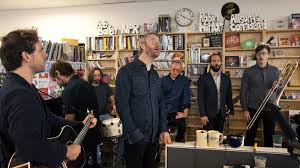
I rather like The National and yet I haven’t spent much time really listening to them.  This Tiny Desk Concert really shows them off well.  It is extremely winning and enjoyable.

I enjoyed this part of the introduction:

we’d gotten word that the group would strip its sound way down for the occasion, sticking to two acoustic guitars and a bit of hand percussion. What we got instead was a fully fleshed-out septet, complete with horns and piano; the band showed up at 9:30 to rehearse and sound-check.

Though singer Matt Berninger had barely rested his voice from a show in the area the night before, The National dutifully performed gorgeous acoustic renditions of four tracks from its fine new album, Trouble Will Find Me.

I like the way the first song “This is the Last Time” starts quietly with just some acoustic guitars (playing quite interesting chords too) but builds, adding more and more instruments.  It grows and grows until it hits a new section where there’s a trumpet solo that fits perfectly in the song.  This new section introduces the second half of the song which never returns to the first part.  The backing vocals–between the guys singing the lines and the other guys singing the high “ahhh” that almost sounds like a horn–also work great together.  It’s a wonderfully full song.

“I Need My Girl” has a cool part with the two guitars.  They play a simple picked melody, but after the second verse, the second guitars plays it one step after the first, making it sound like an echo. And again that lone trumpet sounds terrific here.  This song is a bit more mellow.  In fact, this whole acoustic vibe sounds different from what I expect from the band.

The third song “Pink Rabbits” begins as primarily piano with lots of backing vocals.  But again the song builds slowly (with trumpet and trombone).  And again, after the horns go down there’s a backing voice that sounds a bit like muted trumpet.

Through the whole concert, I love Berninger’s casual demeanor while singing–hands in pockets, gently swaying.

Bob tells them that they are performing Tiny Desk’s first encore.  The blurb notes that the band:

even treated the hundreds of worshipful gawkers to Building 2.0’s first-ever Tiny Desk encore, in response to a roar of applause that could be heard in the far reaches of the newsroom downstairs.

Berninger says this is usually when they run back stage to piss but we’ll just go behind your desk.  Bob jokes that it’s no different from the trombone spit that he sees back there.

Berninger introduces “Sea of Love” by saying this is the only song we’ve ever written with a harmonica in it…and its the last one.

The full band sings and it sounds terrific.  I especially like the pause in the line “they say love is a virtue don’t….they” is pretty dramatic.  And I am tickled by the final lines of the song (while the backing singers do some great work: “I see you rushing down / tell me how to reach you / I see you rushing down / what did Harvard teach you.”

The National are usually more dramatic, I believe–almost theatrical, but this quieter version is really quite enjoyable.

[READ: April 2, 2016] Feathers

Jorge Corona introduces this book by explaining that he had an idea for a Beauty and the Beast kind of story that features a boy with feathers.  And it slowly expanded into the story we have here.

The story opens with a bright white city in the distance.  In the foreground, there’s some dark Victorian-looking houses.  And as we zoom in, we learn that the dark city is known as the Maze.  And in this Maze live the poor.  Little kids, called “mice” are street urchins who run all over the Maze.  And then there’s a man with a beard.  The man finds a baby in an alley.  The baby is born with feathers and he decides to take the boy in and raise him.

The scene jumps to eleven years later.  The boy, known as Poe has grown up and has stayed hidden.  He still has feathers and he goes out at night, but no one knows about him.  People just speak of the ghost–Poe–who swoops down unseen and does things (mostly to help the poorest) and then flees. (more…)

Read Full Post »

SOUNDTRACK: LYDIA AINSWORTH-“Afterglow” NPR’S SOUTH X LULLABY (March 23, 2017).

I was unfamiliar with Lydia Ainsworth, but I was instantly struck by the setting of her lullaby.

We asked Lydia Ainsworth to perform in Raum Industries’ Optic Obscura installation. Surrounded by dim, long-hanging optical fibers that look like an infinity room of cat’s whiskers, she sings a stripped-down version of the slow-burning “Afterglow,” accompanied only by an upright bass and light percussion.

I’m not sure what the original song sounds like, but this version is moody and intense.  The upright bass opens the song as Lydia’s whispered, sensual vocals come forth.  She has a beautiful voice and it is especially haunting in this setting.  It reminds me a bit of someone else although I can’t decide who.

The starkness of the silence when she stops singing is intense.  And I really like the way the song ends, not abruptly exactly, but rather unexpectedly.

[READ: March 21, 2016] T-Minus

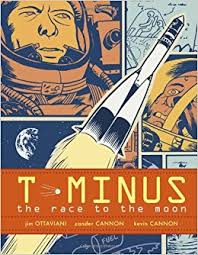
Jim Ottaviani did the amazing graphic novel Feynman, and in the blurb about him in that book, it said that he also wrote T-Minus.  Coincidentally I had just brought T-Minus home for Clark and I to read.  He read it quickly and said it was very good.  It took me a little longer to read (I’m sure he didn’t read all the details) because Ottaviani jam packs this book with interesting facts.

As the title says, this is about the race to get a man to the moon.  It begins 12 years before the actual date occurred.  And it toggles back and forth between the United States and the Soviet Union.

On the margins of many pages there are drawings of all of the various attempts each country had to get a rocket into the air.  The drawings show the design and then at the bottom it states the duration of the flight, the date and some other details.  The USSR’s first rocket (1957) lasted all of 20 seconds before exploding.  The U.S’s first rocket lasted about 7 seconds.

We meet a handful of people who were instrumental in the design and origination of these rockets.  (Ottaviani explains that many of these people are composites of real people involved–if he wanted to include everyone, there would be 400 people in every panel). (more…)

Read Full Post »

SOUNDTRACK: DAKHABRAKHA-“Kolyskova” NPR’S SOUTH X LULLABY (March 21, 2017).

I loved DakhaBrakha’s Tiny Desk Concert.  It was mesmerizing and beautiful.  And so the performers came to SXSW and did a lullaby.  And as the blurb says, they brought their “cello, keyboard, accordion – and tall, wool hats! — to the balcony of the Hilton Austin hotel.”

This lullaby of “Kolyskova” quiets things down a bit.  The song opens with simple keyboard notes.  One of the women sings, and when they reach the end of the verse, the male accordionist sings a falsetto that matches the women’s tone.  The woman on drums makes a strange sound–like a baby crying or animal yelping.

Then he winds up singing lead on the second verse in that falsetto with the women singing backing vocals.  Then the cello and drums kick in to build the sound.   The third verse is sung by the cellist as the keys play a pretty melody.

The song is upbeat with lots of bouncy vocals, even though the lyrics seem rather dark.  ‘The band only ever calls it “Lullaby.” It’s a quiet, contemplative song that the band says is a “connecting of several lullabies” with “philosophical lyrics that [say] we have time for everything — time to laugh and cry, time to live and die.’

I love at the very end as the song slows down to just the keyboardist singing because the drummer adds a very cool breathing as a kind of percussion accompaniment.  And then as the camera pulls back the two attack the keyboard making a cacophony of fun notes.  I bet they’re a lot of fun live.

[READ: June 2 2016] Explorer: The Hidden Doors

This is the third (and I assume final) in a series of graphic novel short stories edited by Kazu Kibuishi, the creator of Amulet.

I really enjoyed the first one a lot and was pretty excited to read the rest. As with the other two I was delighted by the authors involved and the quality of these stories.

The three books are not related to each other (aside from thematic) so it doesn’t matter what order you read them in.

This book revolves around the theme of “hidden doors.”  I like the way each author takes a concept that seems like it would be pretty standard and turns their stories into things that are very different indeed. (more…)

Read Full Post »

SOUNDTRACK:  NINA DIAZ & Y LA BAMBA’s LUZ ELENA MENDOZA-“January 9th” & “Living Room” NPR’S SOUTH X LULLABY (March 20, 2017).

I was intrigued by this pairing because Luz Elena Mendoza has a shirt buttoned up to her neck and, from the angle of the first song, it appears that she has her long sleeves down, while Nina Diaz (originally from Girlfriend in a Coma) is wearing a sleeveless T-shirt with tattoos showing up and down her arms.  They seem somewhat mismatched.  Until they sing.  (And also during the second song when it becomes obvious that Luz Elena’s arms are covered in tattoos as well).

The two have never played together, but after NPR Music paired them in the courtyard of St. David’s Episcopal Church for a late evening performance, we’re beginning to wonder why not. They’ve both played the Tiny Desk (Diaz twice, once with Girl In A Coma) and both navigate complex emotions and notions of identity in their music. Also, they just sing beautifully together, Mendoza’s yodel swirling in Diaz’s gritty croon.

Luz Elena’s song “Living Room” is first.  She plays guitar and sings. It’s a short song with Nina’s nice high harmonies over Luz Elena’s deeper voice.  The blurb also notes: Mendoza shares a brand-new song here, “Living Room.” When the two harmonize its confession — “I feel like I’ve been undressing all my thoughts in front of you” — it is, in tandem, starkly intimate and separate.

Nina Diaz’ song “January 9th” is a bit more fun (partially because I know it from her Tiny Desk Concert, but also because it’s a bit more upbeat).  I like Diaz’ singing quite a bit.  Mendoza’s backing vocals add nicely to the “bad one/sad one” part of the chorus.  The blurb adds: “It’s a bluesy ballad with a through line of ’60s pop, a tribute to her late grandmother, cooed and howled into a warm Austin evening.”

Future collaborations should be called for.

[READ: June 27, 2016] Explorer: The Lost Islands

This is the second in series of graphic novel short stories edited by Kazu Kibuishi, the creator of Amulet.

The three books are not related to each other (aside from thematic) so it doesn’t matter what order you read them in.

This first one is all about “lost islands.”  What was neat about this book was that since the premise of an island is so broad, the stories were all very different. (more…)

Read Full Post »

« Newer Posts - Older Posts »