 SOUNDTRACK: THE DISTRICTS-Live at Philly Music Fest @Ardmore Music Hall, Philadelphia PA, September 25, 2020).
 I was supposed to see The Districts play at Union Transfer on March 12. COVID-19 had just found its way into New Jersey and Pennsylvania and I was being very cautious so I decided to skip the show. It was a safe decision, but one that I now regret as it would have been a pretty great final show of the year.
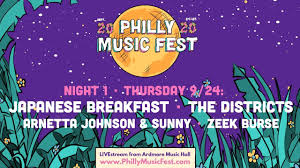
Last year I went to one night of the Philly Music Fest and it was terrific. This year, the Philly Music Fest was all virtual. The live shows were played at Ardmore Music Hall and there were some prerecorded shows as well.
If this were a show I could have attended (apparently, some “golden tickets” were given out to a few people, but I have no idea how), the two live bands are exactly who I would have wanted to see. The Districts opened for Japanese Breakfast. And in the live stream, Arnetta Johnson & Sunny played before The Districts and Zeek Burse played in between them.
So here was my chance to see The Districts playing live. I’m actually not sure if I would have gone had I gotten a golden ticket (I have read that 25 people were in the place including the band). When they played Union Transfer, they played 26 songs in what must have been quite a long show. For this show, they only had about 45 minutes. So they played 10 songs from their last two albums and a new song.
They opened with “My Only Ghost,” which opens the new album. It’s a quiet song with a nifty bassline and a lot of atmospheric keys. It’s an unusual song for them, with a lot of gentle falsetto singer. But it works as a good opener.
Up next was “Nighttime Girls,” a 2018 single that I didn’t know. It rocks with echoing whammy bar guitar chords. The band really started having fun with this song. When the song ended a slow drum beat thumped as they prepped for the next song. They thanked everyone for coming out and talked about how excited they were to play live again. a
Then they launched into “Fat Kiddo” from Popular Manipulations.
The camera came up behind them to show that there was a video monitor in front of them where they could see the people watching online. After shouting out to a few people, they started the ripping “Sidecar” with the really fun “hoo hoo hoo” singalong part.
After some more chatting with more of the “zoomers” and acknowledging the few people in the audience whom they cannot see, they play the wonderful new “Hey Jo.” It was great to hear this live.
As the band tuned up there were samples of tweeting birds and a slow rumble of bass and drums. Singer Rob Grote says, “someone’s putting on quite the show on zoom,” before jumping into a great sounding “If Before I Wake.” The band sounds really tight as they jump between the quiet verses and the loud ones.
Then one of them looks at the screen and says “hey that’s my apartment! that’s my girlfriend.” She says “you guys are great. Love you!” It’s nice they unmuted her for that. They play the moody “And the Horses All Go Swimming” (which they did not play at UT) and there’s some wild soloing at the end. I think the band would have been bouncing around if there was an audience, but they are pretty animated.
Up next was the slow whistling opening of “4th of July.” It was followed by the faster “Salt” complete with gang vocals during the chorus.
The set was nearing the end and they played their fantastic new song “Cheap Regrets.” This is one of my favorite songs of the year. I love that it’s totally retro sounding but not retro at all. It’s got a great bassline and keys. They rocked this out to a roaring ending.
They ended the show with a new song that is quiet and pretty with a flute-like keyboard and mellow guitar. There’s some great changes in the song and some really cool guitar parts. It might be called “Do It Over.”
And that was it. Was it as good as being at a live show? Not really. But it was still petty great seeing them play live and have a good time.
My Only Ghost [¥]
Nighttime Girls [single]
Fat Kiddo [¶]
Sidecar [¥]
Hey Jo [¥]
If Before I Wake [¶]
And the Horses All Go Swimming [¥]
4th of July [¥]
Salt [¶]
Cheap Regrets [¥]
Do It Over [new]¥ = You Know I’m Not Going Anywhere (2020)
¶ Popular Manipulations (2017)
[READ: September 24, 2020] Light Ahead for the Negro (an excerpt)
During the COVID Quarantine, venerable publisher Hingston & Olsen created, under the editorship of Rebecca Romney, a gorgeous box of 12 stories. It has a die-cut opening to allow the top book’s central image to show through (each book’s center is different). You can get a copy here.
This is a collection of science fiction stories written from 1836 to 1998. Each story imagines the future–some further into the future than others.
As it says on the back of the box
Their future. Our present. From social reforms to climate change, video chat to the new face of fascism, Projections is a collection of 12 sci-fi stories that anticipated life in the present day.
About this story, Romney writes that this is an early example of Afrofuturism and of utopianism. It follows in the tradition of Edward Bellamy’s 1888 Looking Backward in imagining a future society that has changed for the better due to a vastly different political climate. As with most such vision, Johnson’s world manages to be both too optimistic and too pessimistic.
In his 2006, news outlets no longer produce racist content, yet there are only 11,000 Bloack doctors…. The main characters’ conversations about “now and then” are in reality, a survey of cutting edge political thought on issues of major concern to Black citizens of 1904: voting disenfranchisement, lynchings, reconstruction, employment, poverty, education and more.
Johnson was a practicing attorney when he wrote this and he later became the first African American to be elected to the New York State legislature in 1917.
The book opens in 1906 with the narrator flying in a dirigible to the South. He is planing to help the Negroes in the South adjust to their new citizenship. But the dirigible hits bad weather and he is lifted up into the atmosphere only to come back to earth in the year 2006.
He was taken in by a family in Georgia, but he was hesitant to tell his story. They revealed that they had read the papers in his pockets and saw that a Mr Gilbert Twitchell was being sent going to teach in Georgia in 1906. They wondered how he got these papers. He professed to be confused about everything so they put him in “the room used to cure nervousness.” He went in the room and immediately felt soothed. The only color visible was violet and an artificial light filled the room. When they saw that he was better, he confessed that he was Twitchell.
The nurse reveals that she is interested in the “negro question” as well. She has been teaching at a negro school and hopes to be of service to them since “their chances have not been as favorable as ours.”
He is delighted to hear this and commends her because in 1906, “the work you are engaged in would have disgraced you and have branded you for social ostracism.” Back in 1906, men like Oglethorpe justified slavery and burned Negroes a the stake. The “cracker class” were a long ways removed from the Oglethorpe’s type of citsienship.
As he is given tour, he learns that Congress had been abolished and that the country was run on what known as the corporation plan. The business of Government was entrusted to bureaus or departments and officers were chosen for their fitness by an improved state of civil service
There is no President either–he was replaced by an Executive Department.
Twitchell says,
I always felt a misgivings to our old system which left the Government and management of the people’s affairs in the hands of politicians who had more personal interest than statesmanship.
[He sure got that right!]
The one exception was President Roosevelt had been abused by a certain class of newspaper for appointing worthy men to office regardless of color. He refused to bow to the people who fought him and stood true to the end.
Twitchell goes to the library where he sees a chart comparing 1900 to 2004
- Aggregate negro wealth $890,000.00 — $2,670,000,000
- Ratio of home owners 1 in 1000 — 1 in 30
- Death rate 2 per million — 5 per million
- Number of lawyers 250 — 5,282
- Number of doctors 800 — 11,823
Twitchell was pleased to see that Negros stood on the same footing legally as other people.
It was a pet phrase in my time for certain communities to say to the Negro that they would protect him in his rights. But what the Negro wanted was that he should not have to be protected at all! It made the Negro’s rights depend upon what his white neighbors said of him–if these neighbors did not like him, his rights were nil.
This book is simultaneously uplifting and depressing. I’d be so interested in what he would have thought about the real 2006.

 I Just Read About That...
Leave a comment