 SOUNDTRACK: THE SULTANS OF PING FC-“Wheres Me Jumper?” (1992).
 The Sultans of Ping were, of course, named after the Dire Straits song. They were named when “it was sacrilege to say anything whatsoever funny or nasty about Dire Straits.”
This song (or 30 seconds of it) was used as the opening to the TV show Moone Boy.
The song was an unexpected, presumably novelty, hit in 1992. It’s stupidly catchy and amusingly nonsensical and your appreciation for it is pretty much entirely dependent on your appreciation for Niall O’Flaherty’s voice which is comical and rather shrill in this song. The other songs on the record are somewhat less so, but are still delivered in his speak-singing style.
I get a sense of them being like Ireland’s answer to The Dead Milkmen with a sprinkle of John Lydon on vocals–a fun punk band that flaunted a silly side. Of course, I wasn’t in Ireland at the time, so perhaps they’re more akin to the Ramones in punk legacy.
The Sultans of Ping (later named The Sultans) were (a subconscious at least) predecessor to bands like Fontaines D.C.
But whereas Fontaines D.C. tackles existential life in Dublin, this song tackles a more urgent and pressing concern:
Wait a minute:
“Where’s me jumper?
It’s all right to say things can only get better
If you haven’t just lost your brand new sweater
And I’m sure I had it on in the lavatory
Dancing in the disco, go go go
Dancing in the disco, oh no, oh no
Dancing in the disco, bumper to bumper
Wait a minute:
Where’s me jumper?…
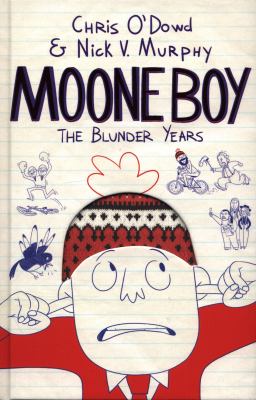
[READ: Summer 2019] Moone Boy
Chris O’Dowd is an Irish actor (we love him from the IT Crowd, and he has since been all over the place). In 2012, he created Moone Boy as a sitcom based on his own childhood growing up in Boyle, County Roscommon, Ireland.
The show was a hit and they made three six-episode seasons. This book came out around the time of the second season.
The story focuses on Martin Moone, a 12 year-old boy growing up in Boyle. His friend Pádraic has an imaginary friend and Pádraic encourages him to get an imaginary friend (IF) of his own. The rest of the book follows the exploits of Martin and his first (and second) imaginary friend.
But the book begins with some absurdist comedy. Turns out he book is written from the point of view of the imaginary friend (we don’t really learn that until later) and he starts off with this:
Before we begin, I need to carry out a quick survey,
Are you reading this book because:
A. You have a scientific interest in the moon.
B. You have a scientific interest in the misspelling of the word “moon.”
C. You want to find out how quick and easy it is to obtain an imaginary friend that you’ll cherish for life.
D. You’ll read anything You’re just like that.If your answer is A or B, then I’m afraid you’re going to be disappointed. There’s very little moon action in this story, apart from the brief appearance of a wrestler’s wrinkly bum.
If your answer is C, then you’ll be equally disappointed. I suggest you pick up a copy of Imaginary Friends – The Quick and Easy Guide to Forever Friendship by a former colleague of mine, Customer Service Representative 263748.
If your answer is D, the good for you! You’re my kind of reader. I’m glad we got rid of that other bunch of idiots who picked A, B and C.
It is summer and Martin Moone is off from school. Martin has three sisters, Trisha, Fidelma, and Sinéad. And they are just horrible to him. He even has the indignity of sharing a room with one of them. They are all older and they thump him mercilessly.
His best friend, Pádraic is his only salvation. But Pádraic is made to work on his family’s farm (the extent of his work is pretty shocking–sometimes literally). Pádraic is kind of miserable, understandably. His only salvation is his imaginary friend Crunchie Haystacks–a professional wrestler. Pádraic encourages Martin to try to get his own IF and he tells him how to do it. It involves going through the Boyle Forest past stingy, scratchy, spooky things where he will find the magic spruce tree.
Martin rides his terrible bike–a rusty ladies’ bike. This is as good a point as any to mention the delirious illustrations by Walter Giampaglia/Cartoon Saloon. There’s a very funny picture of Martin on his terrible bike riding past a brick wall. Behind the wall is an adorably drawn cow who says “Ha Ha! Idiot.”
Martin gets to the forest. The tree says “I’m a spruce.” His name is Bruce. But Bruce is tetchy and when Martin asks if he is like a Dutch Elm, Bruce calls him a tree racist.
The book is full of footnotes. Like *PLONK – another word for idiot. Named after the Irish order of PLaid mONKs, a checkered-shirt-wearing bunch of holy men who were locally regarded as idiots.
Another is *GENIE MAC – Cork talk meaning “flippin’ heck!” A Genie Mac is also a type of burger, like a Big Mac, but served in a lamp.
Martin is given insane instructions for how to get an Imaginary Friend and all of the crazy things he must do. The final thing is to wait for the Postman. And there’s some wonderful Postman Pat humor.
The postman brings a catalog called WHIF? and Martin gets to pick his Imaginary Friend from it. But he chooses poorly. His first choice is based primarily on the special offer: “Order Loopy Lou now and get a FREE CHOCOLATE FISH!”
Loopy Lou proves to be terrible and Martin desperately wants to get rid of him. Pádraic tells him that he can do it, but he has to follow protocol. That’s how he meets Customer Service Representative 263748. Customer Service Representative 263748 is a boring, unimaginative pencil pusher. He’s perfect for Martin.
Much of the middle of the book involves Customer Service Representative 263748 (the name that Martin chooses for him is even less exciting: Seán Murphy) and Martin working together to try to get rid of Loopy Lou.
And then Martin has to go back to school.
Some of the plot also includes some of season one’s first episode
Martin celebrates his 12th birthday. While his sisters don’t exactly go all-out with their gifts, Martin is thrilled with his Readybix bike from Mam and Dad, although it doesn’t last long when the local bullies, Jonner and Conner Bonnor decide to intervene. Dad tries to even the score with the Bonner brothers with unexpected consequences.
The book ends with the existential crisis. Customer Service Representative 263748 is not trained as an imaginary friend. And since Martin already has an IF (Loopy Lou), Customer Service Representative 263748 must be sent back to his workstation. Loopy Lou is happy to see him go.
How can Martin and his new best IF possibly continue to hang out? There is a surprisingly tender ending.
The book isn’t laugh-out-loud funny (well, some of the footnotes sure are), but the general tone is darkly funny. My favorite footnote:
*CUMULUS CLOUDS – soft, bouncy clouds that often look like other things. This means they are filled with wonder and possibility. These are a rare sight in Ireland, which specializes in stratus clouds, which are filled with drizzle and disappointment.

 I Just Read About That...
Leave a comment