 SOUNDTRACK: THE FOUR LADS-“The Bus Stop Song (A Paper of Pins)” (1956).
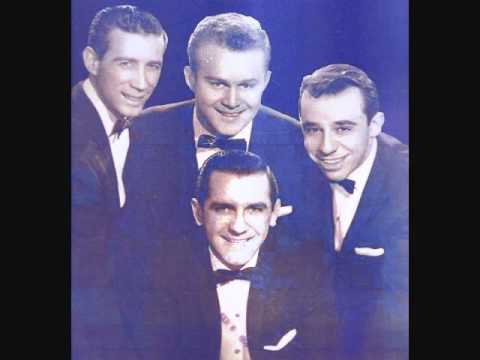 Given the content of this book, I thought it might be fun to pick a song that was popular in Canada in, say 1956.
I was pretty fascinated to learn from the Canadian Music Blog:
National charts did not begin in Canada until the launch of RPM Magazine in 1964. Below, from Oh Canada What a Feeling A Musical Odyssey by Martin Melhuish are lists of popular songs in Canada through the 1950s. We have also included big hits by Canadian artists that made the year-end charts of U.S. Billboard Magazine with their year-end positions on the chart.
Some popular artists back then were
Guy Lombardo & His Royal Canadians: Enjoy Yourself, The Third Man Theme, Dearie, Our Little Ranch House, All My Love, Harbour Lights, Tennessee Waltz. (all 1950) If, Because of You (1951) Crazy Heart, Blue Tango, Auf Wiederseh’n Sweetheart, Half as Much (1952) Hernando’s Hideaway (1954)
The Four Lads: Moments to Remember (#17) (1955) My Little Angel, A House with Love In It, The Bus Stop Song (A Paper of Pins) (1956) Who Needs You, I Just Don’t Know, Put a Light in the Window (1957) There’s Only One of You, Enchanted Island, The Mocking Bird (1958)
The Crew-Cuts: Earth Angel, Ko Ko Mo, Don’t Be Angry, Chop Chop Boom, A Story Untold, Gum Drop, Angels in the Sky (1955) Mostly Martha, Seven Days (1956)
Paul Anka Diana (#24) (1957) You Are My Destiny, Crazy Love, Let the Bells Keep Ringing, The Teen Commandments (1958) Lonely Boy (#5) Put Your Head On My Shoulder (#12) My Heart Sings, I Miss You So, It’s Time to Cry (1959)
My dad was really into big band music of this ilk and he had records from Guy Lombardo and The Four Lads. To me the switch from that kind of sound to the style of Paul Anka in 1957/1958 seems like a pretty big shift. I feel like my dad didn’t like the kind of crooner-y music that Paul Anka sang. It’s interesting that The Four Lads never rose above a chart position of 52 after 1958.
I chose this particular song because I know The Four Tops a little. But mostly because this song is very perplexing. I had no idea what a “paper of pins” could be. Turns out the lyrics are a traditional English children’s song. A “paper of pins” is a sheet of paper with different size pins for sewing. Why on earth would you give them as a sign of your love?
In the original, the song is a call and response, with the second verse being the rejection of the first verse.
I’ll give to you a paper of pins
And that’s the way our love begins
If you will marry me, me, me
If you will marry me[The original verse two is :
I don’t want your paper of pins,
If that’s the way that love begins,
For I won’t marry,
Marry, marry, marry
I won’t marry you.][The original next verse is not a feathery bed but:
I’ll give to you a silver spoon,
Feed the baby in the afternoon]I’ll give to you a feathery bed
With downy pillows for your head
If you will marry me, me, me
If you will marry me
After a few more verses, the Four Lads end:
But you don’t want my paper of pins
And you don’t want my feathery bed
You want my house and money instead
That is plain to seeWell, here they are take everything
My house, my money, my wedding ring
And in the bargain I’ll throw in me
If you will marry me
But in the original ends like this
If you give me the keys of the chest,
And all the money that you possess,
Then I will marry,
Marry, marry, marry,
I will marry you.Ah ha ha, now I see,
You love my money but you don’t love me,
So I won’t marry,
Marry, marry, marry,
I won’t marry you.
So The Four Lads made this song kind of sweet, but also kind of pathetic. Weird choices.
And why in the world is it called The Bus Stop Song?
[READ: November 17, 2019] The Canadians
This is a book of 79 photos taken from The Globe and Mail archives. The are not art, they are not beautiful. They are documentation. Documentation of a specific time and place–Canada in the late 1950s and early 60s.
These are pictures of regular folks working, doing chores, meeting politicians. There’s no posing, there’s no “beauty.” It’s just grim reality. I grabbed this book because Douglas Coupland wrote the introduction (I’m not sure who wrote the copy for the pictures–each picture has one line of information about it). The collection was edited by Roger Hargreaves, Jill Offenbeck and Stefanie Petrilli.
I love Coupland’s take on these picture because he looks at things from such a different vantage point than I’m used to. Like the way he opens the book. He says that the Canada depicted here pretty much didn’t exist anymore by the time he was born. He describes Canada then as “a country in which, it would seem, people were born, became teenagers, and then magically at the age of 21, turned into chain-smoking fifty year-olds with undiagnosed cancers.”
He observes that few people smiled and those that did had teeth riddled with nicotine stains. This is by and large true. The photos with politicians seem to have the biggest smiles although the young members of Chelecos and Lancers Motorcycle Club certainly mug for the camera.
Some of his other observations: everyone looks so old and everyone is trying to look the same. There’s a disregard for what we would now deem beautiful. Strippers have cellulite and the only “hot” people in the photos are the prisoners making license plates. Even the contestants for Mr. Canada seem well-nourished and buff, and kind of supergay.
There is virtually no overlap with modernity in these pictures. The movie posters for sale feel reminiscent of eBay ads. Their luggage has one handle and no wheels! Did snowflakes come down gray back then, too?
While looking at these pictures he called his mother to ask what it was like living then. She said, that living in the 1950s was spooky because “nothing ever happened. Nothing. Days, weeks, months and years would go by and it was as if the world was trapped under amber.” Although she concedes that by the 1960s, the country was going to hell in a handbasket.
Everything seems more difficult back then. Like finding a job in a coal mine (based on the picture). Doing so was only seemingly possible if you were passing by, and saw a job vacancy sign made of of wood and paint. There’s photo of a nuclear fallout suit “Ah nuclear wall, the bogeyman from 1945 to 1990.” The photo encourages everyone to build a family fallout shelter “before disaster strikes.”
There are so many pictures of politicians who Coupland says, “appear to be about one and half porterhouse steaks away from a catastrophic heart attack.” I ‘m surprised he doesn’t acknowledge that there were some women in office (which I find surprising, honestly). Like Margaret Campbell running as a Liberal in St. George. I especially liked the photo where “Former mayor Charlotte Winston refuses to recognize “O Canada” as the national anthem [and stays seated] while the others stand to sing.”
But, Coupland says, mostly the people in these pictures are “getting the job done.” Whether it is visiting a laundromat, selling boats, having a coffee and a filter-tipped cigarette at 1:25 in the afternoon on December 20, 1963 in a diner (The Electric Diner, believe to be one of a kind in Toronto). A dine that even to the eyes of 1963 had doom stamped all over it.
There’s people reacting to sports (by no actual sports photos). There are young people in a marching band (so many accordions)
There seems to be a lot of people standing in snow. As well as angry people waiting around during a rail strike,
Most of the women in these pictures are defined by the men however. Whether they are women smiling at a male politician or being on the arm of a more famous man. Or even the stripper who is viewed by a male gaze. The strip club even used television screens to lure people in.
The only women with their own agency are the workers–a solitary nurse or a shop owner putting up a fore rent sign.
For the men seem to do everything back then–maybe the hats gave them authority. There’s even photos of men at the laundromat. Even when the camera goes to Chinatown, the two photos are of men.
Coupland asks, “So what is absent here: advanced human rights, minorities as people not minorities, ecology, feminism.” Even if one picture shows a civil rights sit in from 1965.
The cars are behemoths and run on leaded gas, There’s a photo of a car almost fully submerged in a flood because they weighed so much back then.
There are a lot of cars in the pictures–people going places, ostensibly having fun. Like camping in Six Mile Provincial Park in Port Severn Ontario, 1960.
Then there’s the no outdoors fun. Like a sad dance hall (with people dancing very stiffly and slowly), there after hours in the Chelsea Club and men hanging out in a jazz club. There’s also bingo: one double card 25 cents ; three double cards: 50 cents. Coupland notes: In the days before the hyperabundance of lotto tickets, bingo was about the only legal way to dance with the gods of chance.
Of course there are buildings: a town hall, a city hall, a grain elevator, the Royal Canadian Legion, a tar paper shack in rural New Brunswick, even The Uranium Cafe in the Northwest Territories circa 1958.
He ponders what a young person of today would make of a phone booth melted in a fire: “is it a condom dispenser dressed in chaps? [It really looks like that]. Ten cents seem very cheap for condoms, but wait condoms should be free.”
There are some young people–riding a minibike (with no helmets of course) and sitting in a classroom with a giant forbidding box that proves to be a TV with a tiny screen.
But on the bright side, imagine being able to buy mid-century furniture in mid-century, when it was practically fee.
There is also death on film. There is a kidnapping victim being carried away and a shooting victim under the tarp. About this picture Coupland observes:
Or ferchrisake the fabric sheet on the corpse is going to blow off in the wind, put something on top of it to keep it down. I don;t know–use the corpse’s shoe if you have to.
Although he does end with a slightly upbeat attitude: “all in all looking at the pictures is like a dream of time travel to a place that was actually kind of nice.” We also have the benefit of hindsight: “You and I get to see how things worked out in the end for so many situations depicted in these photos.”
These pictures are not exactly like the ones shown in the paper–most of these are the full thing–with red lines showing where to crop the pictures. That is also an interesting take on things because you also get to see what was cut out. All of this is a nice snapshot of a time and place.

 I Just Read About That...
Leave a comment