 SOUNDTRACK. COME FROM AWAY: Tiny Desk Concert #890 (September 11, 2019).
 When I first heard about story of Come From Away, I was intrigued. Could you make a musical–a musical–about the events of September 11, 2001?
At the end of this performance, the narrator says that this is really a story about September 12, 2001. And that is true. And the story is powerful and fascinating and really really interesting. And yes, the music is fantastic.
So is this story about the attacks? No. The story is set
In the aftermath of the Sep. 11 attacks, 38 planes carrying thousands of passengers were grounded in remote Gander, Newfoundland in Canada for five days. The creators of Come From Away traveled to Gander 10 years later and collected the tales that make up the musical.
In Gander there’s an expression that, if you’re visiting, you’ve “come from away.” The people of Gander took in the come-from-aways, and their stories have resonated with audiences worldwide. The Broadway cast recently celebrated 1,000 performances and there are simultaneous productions running in London, Toronto, Melbourne and a national tour.
I listened to the soundtrack when it was streaming on NPR. I was able to get through about half of it–the songs were great and the kindness shown was incredible. I have yet to hear the end and I sort of imagine I might try to see the performance someday. So for now, I’ll just enjoy these excerpts.
Sixteen performers from the Broadway production of Come From Away recently climbed out of a chartered bus in front of NPR and crammed behind Bob Boilen’s desk. They condensed their nearly two-hour show about the days following 9/11 into a relatively tiny 17 minutes. By the end of the diminutive set, there were more than a few tears shed.
In the show, the songs have full orchestration. But here, the songs are played with great Irish instrumentation: keys, accordion (Chris Ranney); fiddle, fiddle in Gb; (Caitlin Warbelow); high whistles, low whistles, flute (Ben Power); bodhran, cajon (Romano DiNillo) and acoustic guitar (Alec Berlin:)
I don’t know who the lead vocalists are. But two women take the majority of the songs. And one of the men narrates the truncated version of the story. The vocalists here include:
Petrina Bromley; Holly Ann Butler; Geno Carr; De’Lon Grant; Joel Hatch; Chad Kimball; Kevin McAllister; Happy McPartlin; Julie Reiber; Astrid Van Wieren and Jim Walton.
They sing five tracks:
“28 Hours/Wherever We Are” sets the stage–people were on the planes for 28 hours–just imagine that.
“I Am Here” is wonderful. The way the singer has to interrupt herself as if she were on a phone call–it’s a great performance.
“Me and the Sky” is based on an interview with Beverly Bass the first female pilot for American Airlines. She was flying from Dallas to Paris when she was grounded. It’s an amazingly personal story–I’ll bet she loves it.
“Something’s Missing” is a song I hadn’t heard before. It’s amazingly powerful–the reactions of people who returned to New York and New Jersey to see what they didn’t know anything about–and to see what’s left. The most incredible line:
I go down to Ground Zero which… its like the end of the world. It’s literally still burning. My dad asks were you okay when you were stranded? How do I tell him I wasn’t just okay. I was so much better.
They end with the uplifting “Finale.”
As one of the actors explains, “The story we tell is not a 9/11 story, it’s a 9/12 story. It’s a story about the power of kindness in response to a terrible event, and how we can each live, leading with kindness.”
This is a great tribute to not only Gander, but also to the victims of the attacks.
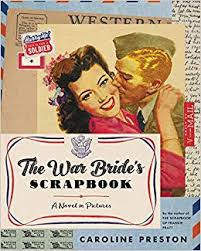
[READ: June 20, 2019] The War Bride’s Scrapbook
Seven years ago, Caroline Preston created The Scrapbook of Frankie Pratt.
I summarized it:
it’s a biography of a lady named Frankie Pratt from the ten or so years after she gets out of high school. She went to high school in Cornish, New Hampshire in the early 1920s; that’s when this scrapbook starts. Over the decade, Frankie goes to college, gets a job in New York City, travels to Paris and then returns home. That is the basic plot, but that simple summary does a grave, grave injustice to this book.
For Preston has created a wondrous scrapbook. Each page has several images of vintage cutouts which not only accentuate the scene, they often move the action along. It feels like a genuine scrapbook of a young romantic girl in the 1920s.
For this book, take that premise and move it forward twenty years.
This is the scrapbook of a woman, Lila Jerome, who was a bit of a wallflower, who then married a soldier just before he went off to World War II. The book is structured in four parts:
Life Before Perry: 1921-1943
Our Romance: 1943
Life Without Perry: 1943-1945
Homecoming: 1945
Like the previous book, this one is full of old photographs or ticket stubs, candy wrappers or advertisements. There are also letters that Lila and Perry write to each other to move the story along. It is another wondrous trip down vintage lane.
I loved Preston’s first scrapbook novel, but I found this one to be a little bit less enjoyable. I think it’s because I didn’t find Lila quite as compelling (in the beginning). Eventually she becomes a wonderful character.
This book begins with her saying that she bought a scrapbook pitched to young war brides:
Has your husband recently shipped out and you wonder how to keep his memory alive for the duration? This scrapbook is especially designed for our wartime brides.
Suggested items for your scrapbook:
- Family records: both his and yours
- Souvenirs of your courtship & wedding
- Scraps from your home-front activities
- His military records and letters
- Plans for your future after the war.
And that’s what she does.
Part 1 introduces her.
I had a problem with the fact that she was chubby and worried about keeping her figure. It does make narrative sense, with the way her family treats her, and is probably realistic for the time. However, it was kind of tedious to read about, She went to college but her parents only imagined her getting an MRS degree. She graduated in 1941 and returned to work for her father in an insurance office. While she was inspecting a claim at the University (someone had crashed into an old wall) she ran into an architecture student. She said that the wall could be repaired but he said it could never be replaced–it’s 120 years old.
This man, Perry Weld, would be her husband many years later.
America entered the war in 1941 and that’s when the book starts filling with WWII scraps–stamps, war bonds, everything else.
Know what your wife really wants for Christmas? A toaster? Pearl Earring? No–a war bond.
Lila had a roommate who eventually moved out. She sought a new roommate, expecting a woman. But it was Perry who knocked on he door. In the time that they encountered each other, Lila had trimmed down and become much prettier in her mind. She was taken aback that the man she had a crush on was back. He had no idea who she was, but he said he was shipping out in a couple of weeks and needed a place to crash until then.
She was worried about the scandal but decided to accept him anyhow. He pledged that he would be a perfect gentleman (which disappointed her a little).
Part 2 covers their whirlwind romance. They both had an interest in architecture. They went to the movies together. But everything was chaste. Then with just a few days to go before he shipped out, he proposed. It’s possible that she just wanted to have sex (she later confesses) but she was sure he was the one. So they rushed out, got married and had a passionate honeymoon.
The bulk of the book is taken up with Perry being at war.
Preston is an archivist and has done a ton of research (according to the acknowledgments) about the war.
Perry went to war as an architect and an engineer. This if frankly an interesting perspective. He talks about the pontoon bridges that he created. He even sends her a Pepsi-Cola sponsored vinyl recording of his voice before he ships out.
Her letters to him are typed on air mail paper. His are “handwritten” on presumably military stationary. She talks about life at home while he talks about life in the war.
Her story has more of a narrative flow, since his is mostly that he is at war, getting shot at and being very cold–although the details he includes are very interesting.
Meanwhile her life is chaotic She is evicted from their apartment and winds up living in with his family. His family is old school pretentious New England. They live at “The Manse.” Mrs Weld (call me Mimi) is cold and standoffish. Perry has stated many times that she was not a good mother, and she seems to agree with that assessment of herself. His father Wink is an older man and while he is friendly to Lila he and Mimi seem to be living very different lives.
There’s a moment when both Lila and Perry read The Fountainhead and make fun of his architectural skills and the stilted prose.
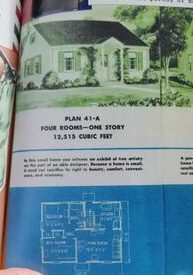 Meanwhile while Lila was home she took a wartime training course and discovered that she had an aptitude for architectural drawing. She was admitted in to Harvard’s program. Eventually she gets a job writing “helpful articles for GI wives” about buying cheap housing when “he comes home.” The examples in the book include the house that I grew up in. I’m so curious if this is actually where the design for my house came form
As the story moves on and things get more intense for Perry, new opportunities arise for Lila. So when a contest opens for new architectural designs for GIs, Lila submits a modified version of a design that Perry showed her ages ago. The prize is $2,500.
One thing that I really liked about the story was the way the news clippings kept us up to date of the important events in the war and the world. So when Roosevelt died on April 13, 1945, it comes as a huge shock in the narrative. But I love the way she makes the personal political by having the next page be the detail that her husband was seriously wounded in action, which is more important that the President.
There’s no word from him for weeks.
Perry survives (as the contents page tells us). But when he returns he is a very different man. He feels useless (he can’t hold a pencil) and he actually misses the war.
Can a marriage that was only a few days old (sort of) survive this?
I love the way the “scrapbook” ends–a total cliffhanger.
And now I will wrap this scrapbook in brown paper and tie it up tightly with string, because this chapter of our story is over. … [maybe] I will toss it in the trash and never look at it again.
But the book offers an epilogue–a wonderful way to summarize what has happens (and the amazing success that Lila became). It also has an amusing and entertaining final document–a school report from Lila’s daughter from 1973 in which she interviews her mother. The interview is wonderfully dismissive as a teenager can only be.
So even though I found Lila to be unpleasant at first, by the end, I found her really compelling and interesting.

 I Just Read About That...
Leave a comment