 SOUNDTRACK: KIAN SOLTANI-Tiny Desk Concert #880 (August 16, 2019).
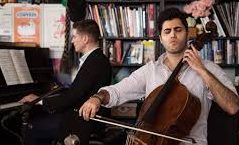 I feel like listeners are more familiar with a violin than a cello. Violins are everywhere (they’re so portable), but cellos only seem to come out when you need a bigger string section. I have come to realize that I much prefer the sound of a cello to a violin The cello can reach some impressive high notes (check out about three minutes into the Hungarian Rhapsody) but its the richness of the low notes that really impresses me, Or maybe it’s just the historical value of Kian Soltani’s cello
It’s not every day someone walks into our NPR Music offices and unpacks an instrument made in 1680. And yet Kian Soltani, the 27-year-old cellist who plays with the authority and poetry of someone twice his age, isn’t exactly fazed by his rare Giovanni Grancino cello, which produces large, luminous tones. (He also plays a Stradivarius.)
I love Liszt’s Hungarian Rhapsody, and I love this one as well. What is it about Hungary that inspires such wild songs?
The Hungarian Rhapsody, by the late 19th century cellist and composer David Popper, traces its inspiration to similarly titled pieces by Franz Liszt and Johannes Brahms, but showcases a number of hot-dogging tricks for the cello, including stratospheric high notes, flamboyant slides and a specific high-velocity bouncing of the bow called sautillé. Soltani nails all of them with nonchalant elegance, backed with companionable accompaniment by pianist Christopher Schmitt.
He says that that piece was a very extrovert, out-there piece and so from this mode we take it more inward.
To prove he can make his instrument truly sing, Soltani worked up his own arrangement of “Nacht und Träume” (Night and Dreams) by Franz Schubert, replacing the human voice with his cello’s warm, intimate vocalizing.
It’s fascinating to think that this song was musically written for the piano and voice. But he has taken the vocal track and turned it into a moving (possibly better?) version on the cello.
His parents emigrated to Austria from Iran in the mid-1970s. He grew up in Austria and loved it as a locus of great classical music. But he also hold on to his Persian roots.
And in the Persian Fire Dance, Soltani’s own composition, flavors from his Iranian roots – drones and spiky dance rhythms – commingle with percussive ornaments.
This is a wonderful Concert and Soltani’s playing is really breathtaking.
[READ: September 1, 2019] Middlewest
I had heard of Skottie Young as the author of I Hate Fairyland (which sounds like a children’s book but is definitely not).
This book is also definitely not for children (although I see some people think it could be for YA readers).
Abel is a young boy who lives with his abusive father. His father, Dale, is a real piece of work. Abel’s mother left, so Dale blames Abel and is on him all the time.
As the first chapter opens, Abel has overslept his paper route (the second time in five years). His father is very angry even if Abel has been getting up at 4:30 every day for five years. As Abel is running late delivering the papers, his friends tell him to blow it off–it’s too late anyway, just go with them to play video games.
Despite his father’s stern warning to come straight home, he goes with his friends. But they don’t have enough money to buy snacks at Randall’s liquor store, so one of the “friends” talks Abel into shoplifting something. He is instantly caught and they are all in trouble. Randall knows them (never shoplift from the store you go to all the time, duh). He calls their parents rather than the cops which is better for most of them. But not Abel.
By the time Dale comes to get him, he is so outraged that he makes Abel spend the night outside. When Abel resists, Dale literally turns into a monster tornado creature. He stabs Abel through the chest and now Abel is branded with a glowing mark.
Abel flees on a train that was passing by.
The only thing that Abel has for comfort is a fox. A talking fox. A talking fox who is awesome. So far in the rest of the book we haven’t come across any other animals, so I don’t know how common talking animals are, but no one seems surprised when the fox talks.
They meet a man name Jeb who suggests they find The Marvelous Mystic Mind of Magdalena at the Hurst Family Circus. The fox knows where the travelling circus would be this time of year and so they set out for Sparland.
Meanwhile Dale wakes up naked and confused. His entire village was decimated by a tornado (him) which everyone says seemed … angry. He sees that Abel is missing and despite the protests of the neighbors, he sets out to find him.
On their journey, Abel and the fox encounter some bad guys and when Abel gets angry the marks on his chest glow and send out a powerful beam of light which does … some kind of damage. Abel can’t control it–he just needs to calm down.
When they get to the circus, the owner (who used to be the Marvelous Magdalena) is able to help him by saying some archaic words.
Abel winds up staying with the circus as a worker (he is going to pay back the circus after trying to steal some food). He finds that he is useful and appreciated and he decides to stay after he has paid off his debt. He also befriends a girl his own age named Bobby who made a talking robot called Wrench.
As the book ends, Dale has come across Jeb and done some damage there. Jeb sends a warning to the circus that Dale is coming, so they take off for a new city. En route, Magdalena tries to look inside Able’s memories to help him get rid of this power. But she goes too deep and Abel seems unable to calm down at all.
Uh oh.
I loved the artwork by Jorge Corona (although Dale’s long rectangular face bugged me for some reason). But I loved everybody else. The fox design was great and I loved Bobby’ hair.
The story itself was kind of interesting but I’m not sure if I’m compelled enough to read any more. If there was only one more book I would read it to finish the series, but I don’t know if I’m interested enough to read a long-term saga.

 I Just Read About That...
Leave a comment