 SOUNDTRACK: KING GIZZARD AND THE LIZARD WIZARD-Flying Microtonal Banana (2017).
 2017 was a massive year for KGATLW as they pledged (and kept that pledge) to release five albums in the year. This was the first.
Flying Microtonal Banana starts with the same sort of relentless frenzy that Nonagon Infinity had. Just witness the stomping, grooving repetition of “Rattlesnake,” a catchy, 7 minute song whose lyrics are primarily “rattlesnake.”
The difference comes in the title of the record. It’s not banana, it’s microtonal. The banana in question is the yellow microtonal guitar that Stu Mackenzie uses on the album (and live). It’s a custom-made guitar modified for microtonal tuning, which allows for intervals smaller than the semitones of Western music. Since the new guitar could only be played with similarly tuned instruments, the rest of the band got their gear tricked out with microtonal capabilities.
This gives many of the songs a distinctly Middle-Eastern sound. As does the inclusion of the zurna, a wind instrument which is almost constantly loud, high-pitched, sharp, and piercing. Not an inviting description, but the instrument adds some interesting sounds and textures to the disc. “Rattlesnake” is so catchy, though, that the zurna just feels like one more component.
“Melting” lets up the intensity with a wonderful guitar/vocal melody and some great synth accents. As the song grooves along there’s some cool sounds and textures throughout the vocals and background sounds. The solo comes from a slightly distorted synth–the ever-rising melody is catchy but leaves you wanting more. The microtones really come out in the middle of the song, where the guitar/vocal melody experiments with all the various microtones that their instruments could achieve.
“Open Water” has a ringing guitar melody and a sinister chorus about open water.
Open water
Where’s the shore gone?
How’d I falter?
Open water
Height of the sea
Will bury me
And all I see is
Open water
 There’s a very cool microtonal guitar solo throughout the middle of the song. When the zurna comes in it brings a whole new kind of tension.
The rest of the album is made up of shorter songs. They don’t exactly segue into each other, but they do feel like a suite of sorts. Except that each one focuses on a different style (not at all unusual for KGATLW).
“Sleep Drifter” is sung in a near whisper, almost comforting, as it follows the nifty rising chorus melody. The interstitial guitar riff is really cool, too. “Billabong Valley” returns to their Western style from earlier albums. It is sung by Ambrose in his very different vocal style. There’s a staccato piano and an interesting western-inspired microtonal riff. “Anoxia” slows things down with a twisty guitar. The zurna contributes to a trippy ending.
“Doom City” sounds like early Black Sabbath with deep notes and a strangely hippie tone with lots of echo. Then it picks up speed and adds some wild zurna tones. There’s even some high-pitched laughs giving an even weirder feel. I love that the speed jumps between slow and ponderous and speedy and hurried. “Nuclear Fusion” has a staccato rhythm. For this one, not only does the lead vocal follow the interesting guitar melody, but there’s a deep harmony voice following along as well. I always love when they add organ sounds to the song, like this one. And the deep voices as the beginning and end are pretty awesome.
The final track is the instrumental title song. It explores all manner of microtonal solos both on guitar and zurna. It opens with bongos and congos and just takes off from there with the screeching zurna melody. It’s catchy and weird like t he rest of the album and it ends with the winds blowing things away.
That’s the banana itself on the right.
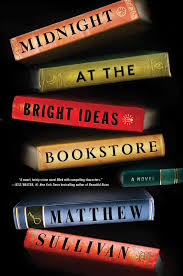
[READ: January 2019] Midnight at the Bright Ideas Bookstore
I was attracted to this book because of the title. I knew literally nothing about it, but the blurb called it a smart, twisty crime novel. I typically don’t read crime novels, but I’ve had pretty good luck with books set in bookstores, so it seemed worth taking a chance.
And, wow, what a delightfully convoluted story. It was absolutely full of surprises and puzzles. In the past I would have tried to figure out he puzzles myself, but since the answers to the puzzles were given right after the puzzles were shown, I got lazy and let the book do the work for me. And what a fascinating bunch of characters Sullivan has created.
Lydia Smith works at the Bright Ideas Bookshop in Denver. She has been there for a while, but she’s keeping a low profile. She grew up in Denver and had a reasonably good childhood. Then, suddenly something horrific happened and she and her father moved into a remote cabin outside of Denver where neighbors were nowhere near. Her father, who was once a loving librarian too a job at a county prison and became a hardened policeman.
The event is hinted at in the beginning. In the middle we get a vivid description of her perception of the event. The rest of the story unpacks it.
After living in the woods, Lydia left her father, without saying a word. She returned to Denver and hadn’t spoken to him for years.
She loves the security of the Bright Ideas Bookstore. The store is populated by the Book Frogs, old men mostly, who spend hours and hours here browsing books. They are all eccentric in some respect, but they are harmless–and most are thoughtful.
But as the book opens, one of the younger Book Frogs, Joey Molina, her favorite one, hangs himself–right upstairs in Western History. She tried to take him down, to save him, to do something. But she was too late. As she was trying be helpful, she saw that he had a picture in his hand. It was a picture of her when she was a little girl. A picture she had never seen before.
What a great opening chapter!
Lydia had been keeping a low profile while back in Denver, but this suicide brought some attention to the shop and her photo wound up in the paper. A detective from her past wrote to her to see if she needed anything. She hadn’t talked to him in decades and she didn’t intend to start now.
We flash back to Lydia’s childhood. Her librarian father was well liked in town. But he was always busy. Lydia was lucky to have made a friend in Raj, a quiet boy in her class. Raj’s parents owned the doughnut shop in town (which sounds awesome); Lydia and Raj would spend most afternoons either in the library or the doughnut shop. Things were pretty great. Until Lydia started hanging around with Carol O’Toole. She was a troublemaker. Not a terrible one, but just enough of one to snare Lydia and push Raj away from them.
It was at Carol O Toole’s house that the bad thing happened. The thing that changed her life forever.
Lydia was at work a few days after the suicide when she was approached by Joey’s landlady. According to her notes, Lydia was Joey’s person of contact. Lydia assumed it was a mistake. But the landlady told her that every resident had to give her a contact in case they left–someone to clear away the last their stuff. Joey had no family and Lydia was the only person on the landlady’s list.
Lydia went to Joeys place and found that most of his stuff had been burned–by Joey. The only things that hadn’t been were a pile of books. In the books random pages had random holes cut in them. She also noticed that the books had the wrong label on them. After thinking about it for a while, she understood the puzzle. She wants nothing to do with puzzles, but this one is hard to resist–since it seems to involve her in different ways.
The puzzle leads to some fascinating messages and each one is more confounding than the previous one.
Then she runs into a familiar face. It is Raj. She didn’t really want to get back in touch with him–she certainly could have since she moved back since his parents still owned the doughnut shop (she can’t set foot in thee). She really wanted her past to stay past, but it was nice to see him. He also saw her picture and realized she was local again. He eventually got up the nerve to come in and see her.
It’s unclear what Raj’s motives are. We’re suspicious of him at first, but he quickly proves to be a decent friend. And maybe more? Lydia is currently dating someone. She’s happy with him, but it seems like she’s keeping him distant. She feels close enough to Raj to tell him about Joey and the puzzles.
Since Joey has no one and there’s no way to find out some of the clues that he is leaving, Lydia decided to go to the Colorado Department of Records. She asks Raj to come along. What she finds is as unexpected as the clerk’s reaction to her and Raj.
And from there Lydia’s entire past comes flooding back. However, nothing that comes flooding back is anything that she knew before.
This book was exciting and full of cliffhangers. The details of her life and Denver were interesting and the way the characters developed was really interesting.
The harrowing thing that happens to her is really awful. When Sullivan finally reveals it, it’s pretty gruesome. I won’t say the story didn’t earn the details, but it will certainly turn away many more sensitive readers from an otherwise compelling and intriguing mystery.
I don’t know if this will get me to read more mysteries, but I’m glad I read this one.

 I Just Read About That...
Leave a comment