 SOUNDTRACK: CAROLINA EYCK AND CLARICE JENSEN-Tiny Desk Concert #816 (January 11, 2019).
 There have been a lot of bands I have first heard of on Tiny Desk and whom I hope to see live one day. Carolina Eyck and Clarice Jensen are two women I would love to see live–together or separately.
The concert opens with a looping voice (Carolina’s) and what appears to be her using a theremin to play looped samples. And then soon enough, she starts showing off how awesome she is at the futuristic 100-year-old instrument.
Carolina Eyck is the first to bring a theremin to the Tiny Desk. The early electronic instrument with the slithery sound was invented almost 100 years ago by Leon Theremin, a Soviet scientist with a penchant for espionage. It looks like a simple black metal box with a couple of protruding antennae, but to play the theremin like Eyck does, with her lyrical phrasing and precisely “fingered” articulation, takes a special kind of virtuosity.
After playing a remarkably sophisticated melody on the theremin (with suitable trippy effects here and there), for about three minutes, she explains how the instrument works. She even shows a very precise scale.
The position of the hands influences electromagnetic fields to produce pitch and volume. Recognized as one of today’s preeminent theremin specialists, Eyck writes her own compositions, such as the pulsating “Delphic” which opens the set, and she’s got big shot composers writing theremin concertos for her.
Up next is Clarice Jensen with “her wonderful cello.”
Joining Eyck for this two-musician-in-one Tiny Desk is cellist Clarice Jensen. When she’s not making gorgeous, drone-infused albums like last year’s For This From That Will be Filled, Jensen directs one of today’s leading new music outfits, ACME, the American Contemporary Music Ensemble.
Jensen doesn’t explain what’s going on, but she makes some amazing sounds out of that instrument–she’s clearly got pedals and she modifies and loops the sounds she’s making.
“Three Leos,” composed by Jensen, offers her masterful art of looping the cello into symphonic layers of swirling, submerged choirs with a wistful tune soaring above.
Vak Eyck comes back for the final song, a wonderfully odd duet of cello and theremin.
The two musicians close with “Frequencies,” a piece jointly composed specifically for this Tiny Desk performance. Amid roiling figures in cello and melodies hovering in the theremin, listen closely for a wink at the NPR Morning Edition theme music.
Van Eyck make soaring sounds, while Jensen scratches and squeals the cello. Within a minute Jensen is playing beautiful cello and Van Eyck is flicking melodies out of thin air.
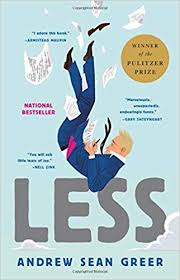
[READ: June 24, 2017] Less
It wasn’t until several chapters into this book that I realized I had read an excerpt from it (and that’s probably why I grabbed it in the first place). I also had no idea it won the Pulitzer (PULL-It-ser, not PEW-lit-ser) until when I looked for some details about it just now.
It opens with a narrator talking about Arthur Less. He describes him somewhat unflatteringly but more in a realistic-he’s-turning-fifty way, than a displeased way.
And soon the humor kicks in.
The driver who arrives to take Less to an interview assumes he is a woman because she found his previous novel’s female protagonist so compelling and persuasive that she was sure the book was written by a woman (and there was no author photo). So she has been calling out for “Miss Arthur,” which he has ignored because he is not a woman. This makes him late and, strangely, apologetic.
He is in New York to interview a famous author H. H. H. Mandern who has, at the last moment, come down with food poisoning.
It takes only ten pages to get the main plot out of the way:
Less is a failed novelist about to turn fifty. A wedding invitation arrived in the mail: his boyfriend of the past nine years is about to be married to someone else. He can’t say yes–it would be too awkward–and he can’t say no–it would look like defeat. The solution might just be on his desk –a series of invitations to half-baked literary events around the world. Can he simply get out of town, and go around the world, as a way to avoid looking foolish?
It just might work–although knowing Less, he is going to look foolish wherever he goes.
Arthur had lived with the poet Robert Brownburn (Yes, that Robert Brownburn, the famous poet) for about a decade from twenty-one into his thirties. He had been a bachelor most of his life since then. But he wasn’t celibate.
He found a young man who liked and respected him–Freddy–a boy toy of his own. Freddy was the son of Arthur’s oldest friend Carlos. Freddy “`wasn’t interested in romance and neither was Arthur. And Carlos certainly didn’t want a romance between them. Carlos proves to be Arthur’s oldest friend and bitter rival. The non-romance with Freddy lasted nine years.
And then Freddy got engaged.
So Arthur set up his conference itinerary around free flights and free meals. A strange itinerary to be sure:
- New York City to interview H.H.H. Mandern.
- Mexico City for a symposium on Robert (on principle, he never went to these).
- Turin for a book award which he has never heard of.
- Berlin to teach a five-week course “on a subject of Mr. Less’s choosing.”
- Morocco for a birthday celebration for a woman he has never met named Zohra-his friend Lewis insisted Arthur come on this whirlwind tour of the desert (when Arthur himself would turn fifty).
- India, where he could relax and finish his novel.
- Finally, Japan. This was the strangest one. At a poker game someone said his wife was sick of all his business travel, and asked if someone could go to Kyoto for him–he just had to write an article on traditional kaiseki cuisine.
- Then to San Francisco and home.
The book is full of smart snark like
New York is a city of eight million people, approximately seven million of whom will be furious when they hear you were in town and didn’t meet them for an expensive dinner, five million furious you didn’t visit their new baby, three million furious you didn’t see their new show, one million furious you didn’t call for sex, but only five actually able to meet you.
As soon as he gets to the auditorium for that interview, the comedy of errors begins. They want Arthur to wear a costume because Mandern writes sci-fi. The vomiting Mandern, it turns out, has also never heard of Arthur.
On his way to Mexico he remembers a thing Freddy said about him one night while out with friends: “Arthur Less is the bravest person I know.” Arthur thinks of this on every flight. It always ruins everything.
Mexico is the location for the symposium about his dead lover. He meets a Dutch German man named Harold Van dervander. Less doe snot speak Spanish and neither does Van dervander and Arthur finds himself afoul of local colloquialism fairly quickly
Each city is an episode n which Less has a crisis (sometimes of his own design, sometimes not). Like the unattended “An evening with Arthur Less” back when he was a young writer (which has a great payoff in Mexico). And Robert’s wife, whom he has always felt guilty about, also turns up at the symposium.
On to Italy where the excerpt that I read came from. He is on the way to the award reception. The prize is minor and no one–not he nor his agent–thinks he has a chance.
Freddy had once given him advice about international flights: “They serve you dinner, you take your sleeping pill, they serve you breakfast, you’re there.”
He did as instructed with the pills, but woke up in the middle of the night–only two hours having passed! He takes out another pill and then it’s time for breakfast. He is in a fog and the first few pages of the chapter are an amusing comedy of him possibly going the wrong way. He barely makes his local flight (and is shocked to see ashtrays in the airplane seats–charming or frightening?) And then… was it a mistake to get in the car marked for Sr. Ess? The driver speaks no English and it sure looks like he is heading in the wrong direction.
The finalists were chosen by an elderly committee but the final jury is made up of 12 high school students –presumably the same students who saw him swimming last night. How mortifying.
Then he meets the other finalists. Ricardo is a young unshaven Italian man; Luisa is glamorously white-haired and dressed in white linen; Vittorio is a cartoon villain with streaks of white at his temples; and a short rose-gold gnome from Finland who asks to be called Harry. He can’t match any of the to their book subjects. And then there is Fosters Lancett a past winner full of false modesty.
Luisa tells Arthur she read his book and it made her think “of Joyce in space.”
The next couple of days are whirlwind full of interviews and lunches. Speeches and more lunches. Less is unused to the attention since he is below the radar in America. He is baffled by the interviewer who says “I am sorry I need the interpreter, I cannot understand your American accent.” He fears that the journalists are disappointed by him.
The ceremony begins and he imagines that he has been not mistranslated but super-translated that the award should go to his translator: she worked his mediocre English into breathtaking Italian. Many more thoughts creep into his head as the ceremony goes on.
Like when he thinks back to when Robert received a phone call back in 1992 and the first thing he says to Arthur is “I’ve been pronouncing it wrong all these years… It’s not Pew-lit-sir. Its Pull-it-sir. Holy fuck Arthur, I won.”
The German trip is hilarious if you like word play. Or rather, word failure. Less thinks he knows German better than he does. Which makes the class he is teaching rather unusual
“I am your Mr Professor and mow. I am sorry I must kill most of you.”
Less is also invited to give a reading at 11PM in a nightclub. What could possibly go wrong?
Up next is Morocco with a detour in Paris. He meets his friend Lewis and his husband Clark, yes Lewis and Clark. The were together for twenty years and have decided to part on mutually happy terms. Arthur is horrified at this, believing something failed, but Lewis says no–they agreed upon this. Twenty ears of joy and support and friendship that’s a success. If they were a band it would be a miracle.
Then we are all introduced to the coterie for the birthday party which Arthur summarizes: “This isn’t a birthday party, it’s an Agatha Christie novel. Zohra is a spectacular individual which makes her party awful and sensational–just what Arthur likes least,.
And then he’s off to India and Japan for some introspection and a revelation from the narrator which ties the whole book together wonderfully.
I enjoyed this book immensely–there’s some great writing and very delightful characters.

 I Just Read About That...
Hi Paul,
I like your website and your opinions. i enjoyed a review of an adam johnson short story, nirvaana, you wrote a few years ago.
I did put Less down about half way through though because I disliked his sense of humor, too sitcom like. Might give his writing another chance but with his pulitzer prize he’s already got enough fans.
Hi Peter. Thanks for the kind words. I never would have guessed that this would win any prize, much less a Pulitzer. I enjoyed the humor and the spiraling situations. Having said that I don’t really even know what wins a Pulitzer, so maybe it was right on for it?