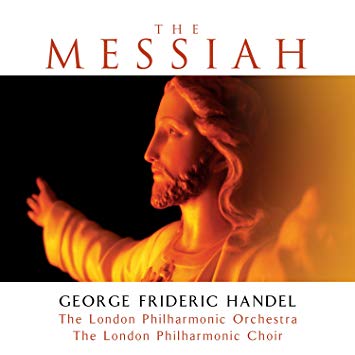
 SOUNDTRACK: GEORGE FRIDERIC HANDEL-Messiah (HWV 56) (1741).
 Back in college, I took a class in classical musical called (I thought cleverly) From Bach to Rock. It was a survey course of all things classical and beyond. It was surprisingly hard if you took it seriously. I got a great appreciation for classical music from it, without question.
My friend and I joked about how the rock section was little more than the teacher (a nun) talking about rock in the last half of the last class and saying something like rock music is all about people vomiting on stage. The most memorable moment was when this friend, who I barely knew at the time, quoted George Michael’s “I want Your Sex” to her and she asked if those lyrics should apply to her as well. The details are fuzzy but that moment and the amused awkwardness that followed is imprinted on my mind.
As was my other Friend Eric’s choice for a project. We were tasked with using one or two pieces of music to create a commercial of sorts. The only one I remember was Eric’s. I don’t even remember my own. I know I tried to be pretentious by using some obscure music to convey whatever. But Eric went straight for the obvious and it was awesome. He used some kind of drudging music in the beginning as he walked into his “room” stumbling over everything. Dropping books and muttering “I need my milk. I need my milk.” (His family were dairy farmers). When he finally found his red carton and put it to his lips, the Hallelujah Chorus burst forth and he drank greedily from his carton. It was bizarre and awesome.
Much like only remembering one or two things from class, really the only thing that people remember from Handel’s Messiah is the Hallelujah Chorus and, amazingly, it doesn’t even come at the end. There’s at least nine more pieces to go before the end of it (two of which are over 7 minutes long!) And there’s a whole lot before it, too.
I also didn’t realize that Handel wrote the opera in English.
Handel’s reputation in England, where he had lived since 1712, had been established through his compositions of Italian opera. He turned to English oratorio in the 1730s in response to changes in public taste; Messiah was his sixth work in this genre. Although its structure resembles that of opera, it is not in dramatic form; there are no impersonations of characters and no direct speech.
Instead, Jennens’s text is an extended reflection on Jesus as the Messiah called Christ. The text begins in Part I with prophecies by Isaiah and others, and moves to the annunciation to the shepherds, the only “scene” taken from the Gospels. In Part II, Handel concentrates on the Passion and ends with the “Hallelujah” chorus. In Part III he covers the resurrection of the dead and Christ’s glorification in heaven.
Our recording features conductor John Alldis with the London Philharmonic Orchestra and the London Philharmonic Choir and was produced by Bully Ray Hearn. It features an interesting note.:
The intention of this version made in 1979 was to be “more friendly to the “man in the pew” by using a choral conductor and modern orchestration. There was no attempt to be authentic or ‘purist.’
As you can see by the summary above, the whole album is technically not a Christmas album. It’s more like Parts 1 and 2 should be played now (culminating in the Hallelujah chorus) and Part III should be saved for Easter.
[READ: December 25, 2018] “The Age of Doubt”
Once again, I have ordered The Short Story Advent Calendar. This is my third time reading the Calendar (thanks S.). I never knew about the first one until it was long out of print (sigh). Here’s what they say this year
Fourth time’s the charm.
After a restful spring, rowdy summer, and pretty reasonable fall, we are officially back at it again with another deluxe box set of 24 individually bound short stories to get you into the yuletide spirit.
The fourth annual Short Story Advent Calendar might be our most ambitious yet, with a range of stories hailing from eight different countries and three different originating languages (don’t worry, we got the English versions). This year’s edition features a special diecut lid and textured case. We also set a new personal best for material that has never before appeared in print.
Want a copy? Order one here.
Like last year I’m pairing each story with a holiday disc from our personal collection.
I love Maile Meloy’s writing, so I was super excited to read this. It was great and a wonderful end to the calendar.
This is a sweet Christmas-themed story about parents, Santa Claus and belief.
As Laurie was tucking her boys in on Christmas Eve, she noticed that both of their stockings were taped to their beds, instead of hanging where they were earlier.
Her nine-year-old Christopher had asked her is she believed in Santa Claus and she said she did–in the spirit of Santa. But he was concerned–he’d heard the rumors about parents. His brother Max, two years younger, had no such concern.
She decided to remove the stockings and put them back, but as she peeled off the tape Christopher woke up. He was horrified and started to cry. Laurie told him it would be easier for Santa to find them by the fireplace.
How can doing a kindness for someone cause so much trouble?
I loved the profundity of such a simple story.
Here’s the Q&A with Maile Meloy.

 I Just Read About That...
Leave a comment