 SOUNDTRACK: THE HARRY SIMEONE CHORALE-The Little Drummer Boy: A Christmas Festival (1973 or 1959).
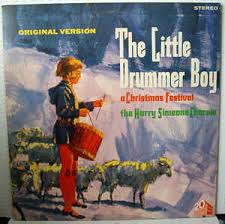 This is a simply beautiful chorale. The vocalists are top-notch and the instrumentation is subtle and apt. S. grew up listening to it and was delighted that we could find it online. I had never heard of Harry Simeone, and had no idea he was from New Jersey (in fact the 1973 recording of the album was done in Linden, NJ). But here’s a Wikipedia summary of the guy who co-wrote The Little Drummer Boy!
Simeone was born in Newark, New Jersey. He grew up listening to stars performing at the Metropolitan Opera in New York City, not far from his native Newark. Initiated and inspired by this childhood passion, he sought a career as a concert pianist. To this end, he enrolled in the Juilliard School of Music, which he attended for three years, but when he was offered work at CBS as an arranger for bandleader Fred Waring, he dropped out of Juilliard to accept it.
When the Twentieth-Century Fox Records label contracted Simeone to make a Christmas album in 1958, he assembled a group he called “The Harry Simeone Chorale” and searched for recording material. After being introduced to an obscure song by friend and credited song co-author Henry Onorati, titled “Carol of the Drum,” Simeone changed the title to “The Little Drummer Boy” and recorded it under that title for his album Sing We Now of Christmas. He received joint authorship-and-composition credit for the album, although he did not actually write or compose the song. The single “The Little Drummer Boy” quickly became extremely popular and scored on the U.S. music charts from 1958 to 1962.
Turns out this recording The Little Drummer Boy: A Christmas Festival is a repackaging of Sing We Now of Christmas but renamed to tie in The Little Drummer Boy’s success.
The music is great with a broad range of voices and often minimal orchestration (lots of French horns and sousaphone)
“Sing we now of Christmas/Angels we have heard on high/Away in a manger/What Child is This?/Joy to the World” Lots of bells, with the women singing alternately in rounds. It’s a great opening. Almost threatening music comes in with the intro of “And this shall be a sign to you” spoken/sung to introduce “Away in a Manger.” “What Child” is done with a harp–lovely. I tend to forget that “Joy to the World” is a Christmas song. It’s so upbeat and happy and could be much longer.
“Go Tell It On the Mountain” a very deep voice sings this one, and it swings a bit.
“It Came Upon A Midnight Clear/Good King Wenceslas/We Three Kings/Villancico/Hark, The Hearld Angels Sing” is quieter again. A gentle vocal turn is followed by a spoken word introduction to “We Three Kings.” Before “Villancico” there’s some “do de doo doo” bass singing from the men while the women sing. “Hark” is wonderful with bells and horns.
The segues between sections aren’t really clean or anything and its unclear why some things are a medley and others not. Maybe it was easier than making a ton of short tracks? It matters not.
“Bring A Torch, Isabella / Lo, How A Rose E’er Blooming” I’ve never heard of either of these and they are delightful. A kind of folk song, I guess with Isabelle bringing a torch to see the baby. Rose is a lot bigger and more olde-movie-chorus-sounding
“Deck The Halls/ Christian Men Rejoice /Master’s In The Hall /O’ Tannenbaum”
“Deck” is quite fast, but the voices are great and then after the first verse it turns really jazzy with a hi-hat jazz and a swinging style. The rest of the tracks feel more formal, concluding with a lovely “Tannenbaum.”
“O Holy Night” starts out in a way I’ve never heard with a kind of introductory verse. The deep-voiced man singing “blessed are you among women and blessed if the fruit of your womb” makes me uncomfortable. But the lead soloist is fabulous.
“The Little Drummer Boy” is really great with the deep “rumm”-ing from the men and the high female voices.
“Coventry Carol / Rise Up Shepherds / God Rest Ye Merry, Gentlemen O’ Little Town Of Bethlehem / O’ Come Little Children
Carol” sounds a bit like a European spy movie with the xylophones and the accordion. It’s very cool. The deep voiced guy comes back for “Rise Up.” But its the impressive big horns and the repeated rounds that come in for “God Rest” which sound great. “Town” is beautiful and quiet and it’s possible that children sing “Children.”
“Ding Dong / While Shepherds Watched Their Flock By Night / The First Noel / The Friendly Beasts”
This begins with the spoken word about the angels said unto them… which leads to a spritely “Ding dong.” I don’t know Shepeherds” but the vocal is lovely and operatic. “Noel” is similarly lovely with a very high note and some nice horn accompaniment at the end. “Beasts” brings in a nice change with harpsichord and chorus.
The final medley is “Silent Night / Adeste Fideles / A Christmas Greeting”
“Silent Bight is beautiful, with a lovely solo. “Adeste” is quiet, sung gently by men. And the “Greeting” is like a card from the chorale wishing everyone a Merry Christmas.
It’s a wonderful record and I see that many other people grew up with it. I wish I had too.
[READ: December 14, 2018] “Will Evans Save the World”
Once again, I have ordered The Short Story Advent Calendar. This is my third time reading the Calendar (thanks S.). I never knew about the first one until it was long out of print (sigh). Here’s what they say this year
Fourth time’s the charm.
After a restful spring, rowdy summer, and pretty reasonable fall, we are officially back at it again with another deluxe box set of 24 individually bound short stories to get you into the yuletide spirit.
The fourth annual Short Story Advent Calendar might be our most ambitious yet, with a range of stories hailing from eight different countries and three different originating languages (don’t worry, we got the English versions). This year’s edition features a special diecut lid and textured case. We also set a new personal best for material that has never before appeared in print.
Want a copy? Order one here.
Like last year I’m pairing each story with a holiday disc from our personal collection.
I haven’t read much Ben Greenman lately, so it was nice to see his name again. Greenman writes such a variety of things that you never know what kind of story you’re going to get. And you don’t know exactly what kind of story this is until the end, either.
It begins with the narrator saying that there are two dogs in the room and they’ve got to go. There’s a reddish-brown one and brownish-red one.
The next paragraph mentions that there was an incident with the reddish-brown one mauling a neighbor.
But that was because the neighbor had fallen under really hard times and had taken to standing on his porch in his bathroom. His pockets were sometimes filled with sandwiches. And that’s what the dog went after–it’s just that the neighbor’s hand was in the way.
But there was no trouble from the incident. Rather, the neighbor just up and moved one day.
The narrator wants to disparage the man but he acknowledges that the man had a wife and kids (now lost to him for various reasons) while the narrator had nothing but his dogs. Which is not to say he is lonely and bereft “I have entertained company with some regularity, by which I mean women, and sometimes even invited these women to stay over…there was an extended session of what can only be referred to as funny business.” During the funny business the brownish-red dog decided to watch (the reddish-brown one was bored having “tasted blood and sandwich.” So the brownish-red dog tilted her head “and observed with a studious air. At that moment we were in fact engaged in the manner that dogs prefer.” That was many Fridays ago.
But he must focus now because important work has come in.
“If I get it right, it can save our nation…If I get it wrong, someone else will get the chance to get it right Most likely it will be Evans.”
Evans is charming, fit and lives two doors down.
Evans has been seeing Stephanie. The narrator and Stephanie had a history but she hated dogs and now she likes Evans,
And then the story becomes somewhat cyclical and he becomes even more unreliable.
The phrase “The dogs bark. I need them out of the room” ends a section and then begins the next section.
He wants them off the bed but he can only lift one at a time. When he returns for the other, the first one jumps back on the bed. The two paragraphs are then repeated exactly. I thought it was a misprint but it clearly isn’t because it gets repeated again later.
There’s a feeling of futility and derangement in this story. And yet its all very funny too.
Greenman doesn;t even mention the narrator in describing the story: “It’s broadly concerned with love, loss, death, and the repetition of life that leads inexorably to death—though specifically its concerns run to less intimidating matters like neighborhood politics and the difficulty of carrying multiple dogs at the same time.
Read more in the Q&A with Ben Greenman.

 I Just Read About That...
Leave a comment