 SOUNDTRACK: THE RADIO DEPT.-Clinging to a Scheme (2010).
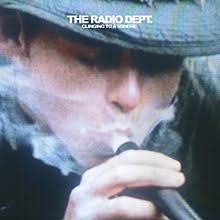 In this final book, Karl Ove mentions buying a record on a whim by The Radio Dept. Given the timing of the book, I assume it’s this record. So I’m going to give it a listen too.
I really enjoyed this record which has a feeling of a delicate My Bloody Valentine fronted by The Stone Roses. The key word in all of this is delicate. It’s a very soft and gentle record (except for one song). It hits all the buttons of 90s Britpop and to me is just infectious.
“Domestic Scene” opens the disc with pretty guitars intertwining with an electronic thumping. After the first listen I was sure the whole record was synthy, but this track has no synths at all, just like five or six guitar lines overdubbing–each opener just as pretty as the others. The voice sound a lot the guys from The Stone Roses on the more delicate tracks.
“Heaven’s on Fire” opens with bouncy synths and a sampled (from where?) exchange:
People see rock n roll as youth culture. When youth culture becomes monopolized by big business what are the youth to do. Do you have any idea?
I think we should destroy the bogus capitalist process that is destroying youth culture.
Then come the jangling guitars and the introduction of synths.
“This Time Around” has a cool high bass line (and what sounds like a second bass line). I love the overlapping instruments on this record. I couldn’t decide if it was a solo album or a huge group, so I was surprised to find it’s a trio.
“Never Follow Suit” continues this style but in the middle it adds a recorded voice of someone speaking about writing.
“A Token of Gratitude” has some lovely guitars swirling around and a percussion that sounds like a ping-pong ball or a tap dancer. The last half of the song is a soothing gentle My Bloody Valentine-sque series of washes and melody.
“The Video Dept.” is full of jangly guitars and gentle blurry vocals while “Memory Loss” has some muted guitar notes pizzicatoing along and then what sounds like a muted melodica.
David is the one song that sounds different from the rest. It has strings and synth stabs and drums that are way too loud. Most of the songs don’t have drums at all, but these are deliberately recorded too loud and are almost painful.
The final two songs include “Four Months in the Shade” which is an instrumental. It is just under 2 minutes of pulsing electronics that segues into the delicate album closer “You Stopped Making Sense.” This song continues with the melody and gentleness of the previous songs and concludes the album perfectly.
I really enjoyed this record a lot. It’s not groundbreaking at all, but it melds some genres and styles into a remarkably enjoyable collection.
[READ: September and October 2018] My Struggle Book Six
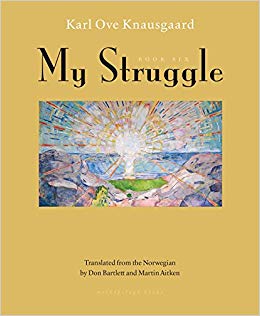
 Here is the final book in this massive series. It was funny to think that it was anticlimactic because it’s not like anything else was climactic in the series either. But just like the other books, I absolutely could not put this down (possibly because I knew it was due back at the library soon).
I found this book to be very much like the others in that I really loved when he was talking conversationally, but I found his philosophical musings to be a bit slower going–and sometimes quite dull.
But the inexplicable center of this book is a 400 plus page musing on Hitler. I’ll mention that more later, but I found the whole section absolutely fascinating because he dared to actually read Mein Kampf and to talk about it at length. I’m sure this is because he named his series the same name in Norwegian. He tangentially compares Hitler to himself as well–but only in the way that a failed person could do unspeakable things.
But in this essay, he humanizes Hitler without making him any less of an evil man. His whole point is that in order to fully appreciate/understand Hitler’s evil, you have to realize that he was once an ordinary person. A teenager who had dreams about becoming an artist, a boy who was afraid of sex and germs. If you try to make him the inherent embodiment of evil, it’s easy to lose sight of the fact that he was a child, a teen, a young man who was not always evil.
Why Karl Ove does this is a bit of a mystery especially contextually, but it was still a fascinating read especially when you see how many things gibe with trump and how he acts and behaves–especially his use of propaganda. It’s easy to see how people could be swayed by evil ideas (and this was written before trump was even a candidate).
So my general outline for the other volumes:
Book Five: 1988-2002 (19-33)
Book Four: 1987 (18)
Book Three: 1968-1981 (1-13)
Book Two: 2008 (40) (with flashbacks to meeting his second wife in 2003 or so)
Book One: 2008 (40) (with flashbacks to his father’s death in 1998 or so)
Book Six: 2009-2010 (42) (with a huge chunk about Hitler)
Book Six opens with Karl Ove preparing to publish Book One. Yes it has gone full circle. Book one is just about to come out (2009) [Book two a few months after that] in Norway and so he has sent a copy of it to most of the main people mentioned in it to afford them a last minute veto.
He is visiting his friends Thomas and Marie in Höganäs and Mölle, Sweden. I get a kick out of how even a simple pleasure is denied him. They go to a pond where there is a species of toad which only lives in the pond in their town (the European fire-bellied toad) whose call sound alike little bells. They stand around but they do not get to hear the toad.
It also opens with a casual mention of his wife Linda’s manuscript and how he has brought it to a friend for a review. I’m not sure that we ever heard about Linda as a writer before. Linda plays a significant role in this book both as his wife and partner but also as a woman with manic-depressive tendencies. He lashes out at her and seems impatient with her quite a lot. Its unclear what their actual relationship was like, of course, although (spoiler alert for his life, but not this book, they are currently divorced).
He ends the book by saying he is happy to no longer be a writer and yet he is already thinking beyond this book. He imagines the opening of his next novel that will begin with the death of many species of animals–bees, nightingales, bats, but he doubts anything will come of it.
But much of the book is full of his daily minutiae: he smokes a lot, drinks a ton of black coffee, bemoans how bad a driver he is and gets on with writing the book that we are currently reading.
He also spends a lot of his time (and this book) with his children. He and Linda have a kind of system in which he spends most of his time during the day writing and the children are in day care. Then, Linda goes out and about on her projects and he watches them at other times. He seems to have a system down, but man do those kids get up early! (5:45 regularly). The eldest, Vanja is going to start proper school soon (their ages obviously vary through the two plus years that this book covers), Heidi is the middle child and John is the newborn(ish) one who reaches about 3 by the books end.
He talks about the daily routine–putting on diapers, feeding children, cleaning, cleaning, cleaning. And then he tends to digress about a topic. Some digressions of Karl Ove’s I do like, especially when he talks about literature. He speaks of a book by Eyvind Johnson, Molnene Over Metapontion (The Clouds over Metapontion) (1957) “one of the purest works of modernism I had read, certainly from that part of modernism that had been interested in the classical age, such as Ezra Pound’s The Cantos, Hermann Broch’s The Death of Virgil and James Joyce’s Ulysses.”
But really, a lot of this book is his concern about what he wrote–mostly from a fear of persecution or prosecution) but also for fear that he is simply mistaken about his memory.
Around page 50 we get to the crux of his concerns with his Uncle Gunnar. Gunnar was in the first book but he is raging about the way he and his brother (Karl Ove’s father) are portrayed in the book. He feels that Karl Ove’s father is portrayed very badly, as is their mother (Karl Ove’s grandmother). He blames all of this portrayal on Karl Ove’s mother who he claims always hated Gunnar’s side of the family and is seeking to harm them. Yikes. He threatens to sue everybody.
Interestingly, we find out much later in the book that Gunnar’s name was changed in all volumes of the book–a concession that upsets Karl Ove–because Gunnar was threatening to take him to court. This change of name bothers Karl Ove on a certain level because it is not real (he goes on a lengthy tangent about the importance of a name) To me, if anyone wanted to find out who Gunnar actually was, the details seem like they would lead to him pretty easily.
Most everyone else, include his brother Yngve and some other family and friends are much more comfortable with things. Yngve suggests a minor change but most people want nothing. Despite how much Karl Ove is freaking out ,everyone seems okay with it–even the publisher there is talk of publishing it as 12 small books, once a month). He says he is most nervousness about his old friend Jan Vidar (who will always be 15 to him). Jan Vidar gives his blessing and even invites him for coffee. He also hears from Tonje, who says she was afraid of being held up to scrutiny, but it allowed the stories she’d forgotten about to came back to life, “it touched my heart to read it.”
It’ s good the way he intersperses these legal issues that could derail the book (even though we know it was already published) with the frustrations and irritations of the children “Why does Heidi get carried and not me?” “Sleeping is boring!” And they watch Bolibompa quite a lot.
During the day, especially when he is stressed out, he spends a ton of his time on the phone with his friend Geir Angell. When Geir Angell comes to visit they talk just as much. Geir Angell is a very enjoyable person–funny and dark, vaguely insulting but loving underneath. They are a good pair. When Geir Angell asks how Gunnar is reacting we get his exchange
GA: How bad can it be? Get in the game. Stop being an ostrich.
KO: The subject line says “verbal rape.”
GA: “Like I said.”
There is some confusion (for me) in that his publisher’s name is Geir Berdahl, but both Geirs are incredibly supportive of this man who is always feeling guilty about his life’s work.
What a fucking mess. How the hell could I ever have put myself in such a spot? What was I trying to do? Why couldn’t I keep all the badness to myself like other people did? But no, I had to go and shove it in everyone’s face and drag others down with me in the fall.
Gunnar had done nothing apart from living his life as best he could and now this?
He spends a lot of time on the phone with other people bemoaning things. “I was aware of the risk of trying people’s patience; if I called Espen or Tore again, for instance, I’d be approaching the limits of what I could reasonably expect from them.”
Karl Ove spends a lot of time trying to get into the head of Gunnar and then imagines being on trial and defending Gunnar’s accusations of lies.
But when Geir Angell comes to visit it’s a relief–a free and fun time. Its fun to hear them reminisce about Cuba Cola (see a brief oral history of Cuba Cola here). Although later on they buy Hemköp soda. Indeed, I love when Karl Ove goes shopping because it really gives an insight into daily life in Sweden at least through his own lens.
Like when he forgets to get a bag and he asks:
Can I have a bag as well, please” I said.
Would he say it was OK and dismiss the extra cost with a wave of his hand, or would he enter the amount and make me get my card out again?
“That’ll be two kronor,” he said. [That’s about 22 cents].
You little shit. Fuck you.
I did my shopping here every single day.
“OK,” I said, reinserting my card again, entering my PIN again, accepting the amount again. By the time it was done, Geir and Heidi had filled the bag with our items and we could go back out into the warm, late summer afternoon (351).
They take a drive (I love Karl Ove’s mocking of Geir’s car) to the village of Lund–a town that shaped the people, unlike Malmö which was built up around production.
Geir Angell teases Karl Ove about a cabin he and Linda bought in a gated community that was supposed to by idyllic like Lund. The average age must be 70. “Ugh how the hell you could ever be so stupid as to buy that little dolls’ house there I’ll never know. It’s exactly what I’ve spent my whole life trying to get away from.”
This cabin proves to be a major obstacle for Karl Ove and Linda (it was her idea to buy it and he refused to do anything to keep it nice). They try to sell it with little interest from anyone. When Karl Ove has to clean up the place he has another close call with a huge amount of human waste.
Nazism is brought up a few times before the big Hitler essay. First as a Utopian plan that failed (and was horrible, of course). He also mentions that “the only alternative to capitalism in our time has been Nazism. The Nazis attempted to change society from the bottom up and start something radically different. And we know how that turned out.”
An example of one of Karl Ove’s philosophical musings would start like this
The I of literature resembles the I of reality in the way the uniqueness of the individual may be expressed only through what is common to all, which in the case of literature is the language.
He muses on why one would write (stating here that it’s the twelfth of June, 2011). To write is to lose oneself or one’s self.
But he also talks about literature in more prosaic terms like when comparing fancy clothes and name brands to generic clothes, or in terms of books.
It was what sort of signals a novel by Anne Karin Elstad sent out compared to a novel bu Kerstin Ekman and how both of these related to a collection of poetry by Lars Mikael Raattamaa, for instance. The reason why reading Peter Englund was a bit more exclusive than reading Bill Bryson (albeit not by much). The reasons why one could no longer express fascination and enthusiasm about Salman Rushdie without seeming culturally adrift, left behind in the late eighties, while V.S. Naipaul was still accepted. … a novel by Danielle Steel in a different place than a novel by Daniel Sjölin.
Karl Ove has other philosophical musings as well, like about Death. Death is what the human sphere borders. But he always brings it back to literature.
Darwin wrote a book and whereas biological nature before Darwin existed Spiritually, after Darwin it existed temporally. Like the way Harold Bloom claims that Shakespeare invented humanity–when Shakespeare’s characters step forward on the stage and reason with themselves, as if aside from the action yet still a part of it, haunted by doubt or stricken by love, at odds with themselves or astonished at themselves, man is then no longer merely a creature of action, a seat of emotions, but also a locus on which these emotions are confronted by a reflective self. It is the appearance of this self that arises from Shakespeare in Bloom’s opinion, prompting him with some justification to claim that Shakespeare invented humanity. since only when something becomes visible to others besides the single individual does it become real (368).
Or these thoughts on laughter
Laughter is in this respect a powerful social force, one of the strongest corrective mechanisms of all; few things are more humiliating than being laughed at in public, and in order to avoid it a person must keep his head down and stay with everyone else. In this way, laughter on the one hand exposes the social game, and on the other keeps it going. Laughter is counterrevolutionary and antiutopian: he who laughs at everything laughs also at the dictatorship of the proletariat, and if everyone laughs at the revolutionary there will be no revolution. If everyone had laughed at Semmelweis, mothers and newborn infants would still be dying of childbed fever. If the Germans had laughed at Hitler, he and his ideas would have been rendered harmless. But they did not laugh, they were earnest, they wanted something, the supreme, and in the supreme tragedy prevails, and tragedy is no laughing matter (370).
At one point he even sort of forgives his father:
he was not a good man. But he was his own person, and if he’d wanted to fasten his gaze and be good, I think he could have done so. Something inside him was broken right from the start (383).
The first section ends with the family on vacation beset by ladybugs. Thousands of them swarming around. Who ever heard of such a thing?
The second section is called The Name and the Number. It starts on page 407 and begins with him thinking about names. “Before I wrote about him I had never given a thought to what a name was and what it meant” (429).
He didn’t want to give in to the pressure of his uncle and use a false name for his father because it would have taken away some of the veracity of the story. So instead, he didn’t name his father at all! “Neither his first name nor his surname appears in the novel. In the novel he is a man without a name (409). [How could his surname not appear?].
Later on he tells us that much of his Dad was collected in his name.
He spelled it differently when he was young, and changed it sometime in his forties, and as he lay there dead and nameless, the name the mason chiseled into his headstone was spelled incorrectly. The stone is still there, in the cemetery in Kristiansand, with its misspelled name on top of the interred urn containing the ashes of his body (409). [How is any of that possible? I’m really curious about that]
He even talks about God and Moses and how the God of Abraham never gives himself a name (only “I am who am”).
This leads to personhood. “Apart from material necessities, the most important need of any human is to be seen. Anyone who is not seen is no one.” (411).
In a novel, the name works like a face: on the first encounter it’s new and unfamiliar, but spending even a short time in its presence you start associating certain characteristics with it, then gradually, if it remains near to you over time, a history, eventually an entire life, in that the faces with which you’re familiar absorb all that you know about them without you necessarily being aware of the fact.
He writes of Knut Hamsun who in his first novel wrote a person without history or home. He is nameless but not an anti-person (as in Kafka) he has an urge toward individuality. Then Karl Ove talks about Don DeLillo, Joyce, Shakespeare and much more about names and personhood.
I enjoyed this take on The Sound and the Fury.
Reading The Sound and the Fury is like gong into the home of a family you don’t know, where everyone’s talking about their relations and paying you not even the slightest attention. All you get is a number of names connected to various events and occurrences everyone knows about except you, which is why they are never related in their entirely but merely alluded to (424).
He has a lengthy section on poetry. Beginning on 429 he starts to dissect a poem by Paul Celan, of whom I had never heard. The poem is “Engführung” of “The Straitening.” It swirls around to different authors and theories, but ultimate returns to the poem until page 482. It was 53 rough going pages for me.
Then things get really dark as he begins to talk about Shoah. This of course leads to thoughts about the Holocaust but as viewed via language.
The reality of language is thereby a social reality, it is the reality of the I, the you, and the we. But language is no neutral phenomenon giving expression to the existent; the I, the you, and the we both color and are colored by the by the language they create and are created within. Identity is culture, culture is language, language is morality. What made the atrocities of the Third Reich possible was an extreme reinforcement of the we, and the attendant weakening of the I, which lessened the force of resistance against the gradual dehumanization and expulsion of the non-we which is to say the Jews (485).
Karl Ove says that when he and his brother found his dead father they found a Nazi pin and a German eagle among his belongings. Where did he get them? He wasn’t the kind of guy to buy that sort of thing so where did it come from? They found a Norwegian copy of Mein Kampf in his grandma’s room. A year later he began reading up on Nazism.
Seven years later he bought a Norwegian copy of Mein Kampf for himself and then he did what so many people never do–he actually read it. He thought about reading it on airplanes but knew he could never do that. Because he knows that
Hitler’s Mein Kampf is literature’s only unmentionable work. Hitler’s book was no longer literature. What later happened, what he later did, the axioms of which are meticulously laid out in that book, is such that it transforms literature int something evil (492).
I have to say that I found this whole section fascinating. I really knew nothing about young Hitler. It’s fascinating to learn that he was a loser and a loner who had one friend and a father he was terrified of. He wanted more than anything to be an artist–a painter–but his father wouldn’t allow it. As such his artistic skills never blossomed. To think that if he had been successful so many things would be different.
The book takes form of a bildungsroman, in which we follow the author from birth, through the first character-shaping years of childhood and becoming a young adult. Hitler builds a persona in Mein Kampf and that person is his political platform. It’s also easy to forget that he wrote the book long before he came to power.
Amazing also is that for many years he was so poor, he lives in hostels, with one pair of clothes, eating scraps and handouts. Again, if he hadn’t been saved by kindness he provably would have died.
What was it about him that attracted people to him? He was standoffish and arrogant. But he was also determined. In interviews with those who knew him or went to his speeches, they talk about the way Hitler spoke–his cadence and delivery were mesmerizing–not the shrill nonsense we see in later footage, but a kind of quiet thinking aloud style that sucked you in before he hammered you with harsh ideas.
I thought this description of Hitler also presages the rise of trump.
Hitler himself knew he could never win over the people through argument alone. The written word was of no use to him, it led to nothing. What he wanted was palpable action he strive for transformation and transformation took place in the moment, among the people. An opinion in the newspaper, hitting out against this or that, prompting a response in kind, an endless debate washing this way and that was meaningless, nothing but words. … This is the goal: to work other thoughts in behind the protective wall formed by prejudice which is to say general unreflected opinions. That protective wall cannot be penetrated by argument, for it is not made of arguments. It is made of a sense of what is right and wrong, what is decent what is appropriate.
Hitler had one friend, whom he lived with–Kubizek–and yet he never even told him that he failed to get into the Academy. Such was his pride and feeling of superiority over his only friend that he pretended to go to school all that time.
Karl Ove says that Hitler was very much like the previously mentioned character is Hamsun’s Hunger–they have very similar character traits. What distinguishes them is that Hamsun would later write the book he imagined he would and breakthrough as a writer, whereas in Hitler’s case nothing happens Why not? For want of talent? For want of drive?
Interestingly it is WWI that saves Hitler and much of Germany. Germany is in a terrible state–overcrowded cities, no money or jobs for most people. It’s dreadful. The thought of going to war was actually exciting for many people:
something to die for means something to live for. The people, the earth, the war, the hero, death. The local, the town, the great, the eternal. These were the predominant concepts of German culture prior to the outbreak of World War I and many of those who saw it coming looked on it as a catharsis, long-awaited and good. It was not politically, but existentially motivated. Thomas Mann expressed pleasure at the collapse of a peaceful world, so full of loathing. Freud regained his belief in Austria as a nation. Rilke wrote of war being a good. Kafka envied the soldiers who were fighting. But none of them participated in it. Ernst Junger, on the other hand, only nineteen years old when war broke out joined up as a volunteer like Hitler. He kept a diary throughout 1920 and then wrote the best book about World War I: Storm of Steel.
The book starts off enthusiastic and almost romantic, but mid war talks about blood and guts: “The road was reddened with pools of gore…. the curbstone was splattered with blood.”
Mein Kampf was written in 1923 in the Great War’s shadow. The war became a home to him–he did not apply for leave until he had lived in the trenches for two years, because he didn’t want to. He was shattered by Germany’s capitulation. He returned to Munich and became a prison guard. When he was hired to do more powerful work his supervisor described him as a “tired stray dog looking for a master.” At the time he joined German worker’s party where he solidified his nascent Antisemitism (he did have Jewish acquaintances while growing up and didn’t exhibit inherent racism then). Hitler was finally succeeding in this political party and that catapulted his rise.
Karl Ove says that Mein Kampf is not a well-written book. It received terrible reviews. It was totally destroyed wherever it was given attention. The Frankfurter Zeitung under the headline End of the Road for Hitler called it political suicide. One newspaper expressed doubts as to the author’s mental stability. And the Bayerische Vaterland dubbed the book Sein Krampf (his cramp). Hitler’s book was ridiculed in any circles. In his memoir Stefan Zweig writes that hardly anyone read it and the few who did refused to take it seriously because it was so poorly written (755).
Like the section about the poem, this one also travels all over the place while he is focusing on Hitler. He mentions Sept 11, 2001 and a man on a bike getting hit by a car right in front of him.
And then there’s this section which also seems to describe a trump rally:
What made Hitler so different, however, was the flame he ignited in all who listened to him speak, his enormous ability to establish community, in which the entire register of his inner being, his reservoir of pent-up emotions and suppressed desire, could offer an outlet and pervade his words with such intensity and conviction that people wanted to be there, in the hatred on the one side, the hope and utopia on the other, the gleaming, almost divine future that was theirs for the taking if only they would follow him and obey his words.
Hitler was the great amplifier, a mirror to his own yearning, but rather than merely paying lip service to that yearning in his political convictions he exploited it cynically as a rhetorical trope, even hitting out against sophistication and complexity in his speeches.
Hitler himself said, when describing what he did:
Political agitation must be primitive. This is the trouble with all the other parties. They have becomes too professional, too academic. The ordinary man in the street cannot follow and, sooner or later, falls a victim to the slap-bang methods of propaganda.
It sounds too familiar (and I can’t believe I quoted Hitler).
People were caught up in the hysteria and they agreed with everything–no matter how reprehensible.
Later Karl Ove attempts the very challenging task of explaining how something as horrible as the holocaust could have happened:
The death camps, the transporting of prisoners all of it became a part of life. It became tangible, local, and eventually became normal. “So wholly incorporated that it could take place and scarcely be noticed. All horror converged in this.”
He reminds us that the first people killed in gas chambers were those with mental and physical disabilities–they called it euthanasia. And this was presented as a way of correcting nature’s deformities–of making things better for these poor people. In fact, a Catholic priest gave his blessing to the program–conceding that it was justifiable. Once death was justified, it continued from there.
This section is tough reading and powerful stuff. I have never read anything that went into the Holocaust so carefully before (okay, well , I have read Elie Wiesel’s Night but that’s a whole other level of horror). When page 846 arrives and the study is wrapped up, one feels a real sense of relief, 350 exhaustive and exhausting pages later.
And yet I’m still not entirely sure why it’s included. He does mention his own concerns that he has feelings like Hitler, and of course he named his own series Min kamp. But there is no explicit reason that I saw why this couldn’t be a separate essay. But I still found it thoroughly engaging.
Part 2 resumes as if nothing happened: The alarm clock rings and off he goes. His book comes out tomorrow and he is preparing for the outrage.
He does some interviews and some photo shoots as well as other promotion.. I always love when he insults people–one of the critics he insulted in the first book actually interviewed him after the fact (but either didn’t recognize himself or chose not to say anything).
I also like when he says that he read Carl-Johan Vallgren’s Kunzelmann & Kunzelmann–a contemporary thriller he bought the day before on the basis of a review it had received on Swedish TV. “Ingrid Elam had said, ‘I don’t think much of this’ which was a mark of quality for me.”
Somehow he gets on the topic of Felice Vinci’s theory that Homer’s Odyssey actually took place in the seas between Norway and Sweden and Denmark (The Baltic Origins of Homer’s Epic Tales). He was puzzled that the geography of the Odyssey was at so much variance with the real geography of the Mediterranean sea. I find this idea fascinating, although the theory has been largely debunked.
Later, he and Linda go on a hilarious vacation with the kids and almost get talked into buying a time share.
The last hundred or so pages feel more like a diary than the others.
Page 958 states Today is August 26, 2011 I am writing this in an unfurnished loft in Glemmingebro, [Sweden] in what we have begun to call the summer loft.
August 27 2011 8:06 I am sitting in an annex on the island of Møn in Denmark
August 28, 2011 4:56 Pitch black outside
August 29, 2010 12:12 I am in the flat in Mälmo which shows signs of having been empty for three months. He says that is he stays in Mälmo and by Friday he will finish the book.
He gave Linda the manuscript for book 2 and she learns the truth about what happened with another woman. Linda’s mother comes to visit–he had some less than kind things to say about her in the first book, so that’s an amusingly awkwardly tense scene, especially since he is not around so he can write more.
Starting around page 1000 he confesses to some inauthenticity in the books. He describes the books a failed experiment but not a valueless one–if it had been more painful it would have been more true. He admits that in book four he changed a lot of details because of the scene where a teacher sleeps with a student. He didn’t want anyone to get into trouble.
He says he was writing books four and five at that time and had an opportunity to meet with Jan Vidar to catch up. It was interesting learning how Jan Vidar had seen Karl Ove’s father back then–new insights into an old issue. He also gets some proof about what he remembered and what he had written–it proves Gunnar was lying.
On page 1011 he talks about going to a Wilco gig in an old theater in Copenhagen. So that was a nice surprise
Starting on page 1039, the books begins to focus quite a bit on Linda.
She also had a book accepted He says he had read one of her short stories called “Universe” and thought it was amazing. “It had a language and suggestive power that went straight to your heart, something that was both naked and robust, helpless and supreme, beneath a bitterly cold winter sky. It was about the best thing he had read for many years.
We also learn a lot more about Linda’s manic depression. She has serious mood swings–huge highs and really deep lows. She was very excited to get a job making a documentary based on the Hindenburg’s last flight. It was going very well until she started to crash and then she lost control of it.
She has a major downturn in her mood. It is quite devastating and she winds up admitting herself in to the hospital. For thousands of pages there has been what seemed like drama but this is actual drama. I had no idea what happened to his wife so I was reading this not like it ‘s seven ears ago, but like its happening right now. Will she come home? What about the kids? What happened when she said she would go back to the hospital on her own and doesn’t? Holy cow, the drama. Not saying that he didn’t know how to write drama before but–and this is done in his same slow, building style–this is really dramatic stuff.
There is always the feeling that what he wrote–what Linda recently read–is what prompted this downturn. Certainly her mother implies that.
Meanwhile, he had travel plans to promote the next book. They had travel plans for when he finished the book. He couldn’t finish the book because he had to be with the kids.
He ends this book that he will truly revel in the “thought that I am no longer a writer.”
He doesn’t mention a ton of music in this book. Near the very end he goes to a record store with the kids and buys a compilation by Thåström, the first Järvinen and on a whim a Swedish band called Radio Dept. He also likes a Swede called Christian Kjellvander and says of the album The Courage of Others by Midlake: I’ve listened to it every day for months.
This was a surprisingly enjoyable series of books. It was fun carrying this giant tomes around and seeing the looks people gave me and the few conversations they struck up. Overall you kind of take away a sort of, huh, about the whole thing. Which in some ways is terribly anticlimactic after 3,600 pages. And yet it never presents itself as anything more than that. I’m glad I read them and I am curious now to read his earlier works to see how it compares.
I also almost forgot to mention that this book is translated by Don Bartlett and Martin Aitken. I have no idea why it was split between the two of them (size?). It says that Martin did the first part. I can;t say that either section was more enjoyable, although the second Part was much faster.
For ease of searching, I include: Hoganas, Molle, Hemkop, Malmo, Daniel Sjolin, Engfuhrung, Mon in Denmark, Thastrom, Jarvinen

 I Just Read About That...
Leave a comment